
Free OH&S Downloads and Safety Templates for Employers
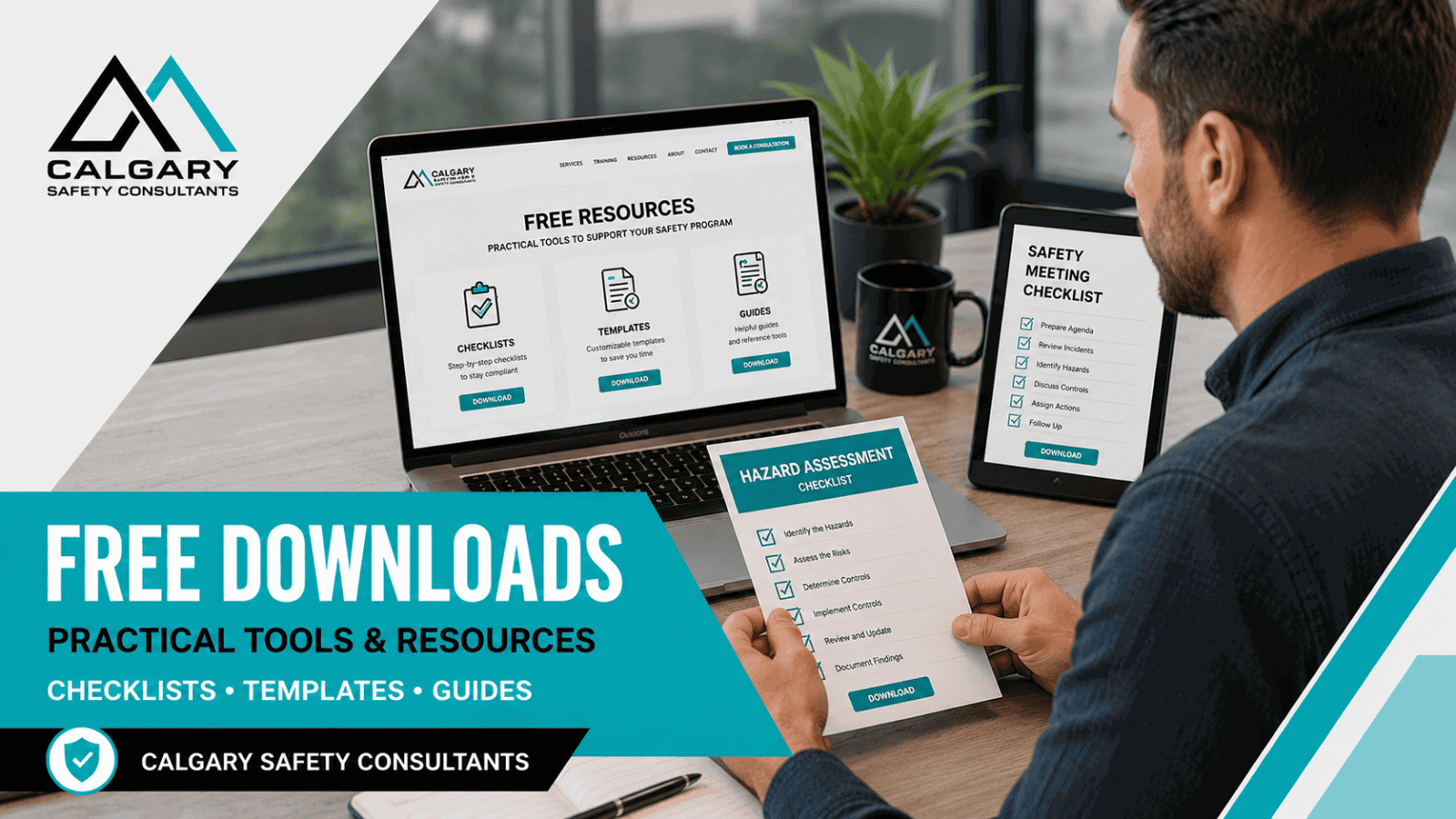
Free OH&S downloads can help employers organize basic workplace safety activities, improve documentation, and start identifying gaps in their safety program. Calgary Safety Consultants provides practical safety templates, checklists, forms, and resource materials for employers, supervisors, contractors, and safety coordinators across Alberta, British Columbia, Saskatchewan, and Canada.
These resources are designed to support real workplace needs, including hazard assessments, workplace inspections, incident reporting, emergency response planning, corrective action tracking, safety meetings, supervisor follow-up, and safety program maintenance. They are especially useful for small and mid-sized employers that need practical tools but may not have a full-time safety department.
Free safety templates are a starting point. They still need to be reviewed, customized, communicated, and used properly in the workplace. The goal is to help employers move from scattered safety paperwork to more organized, practical, and defensible safety documentation.
Practical Free Safety Resources for Employers
Many employers know they need safety forms, checklists, and templates, but they are not always sure where to start. A company may need a hazard assessment form, inspection checklist, incident report form, emergency response planning template, toolbox meeting record, training matrix, or corrective action tracker. The challenge is that a form only helps when it matches the work being performed and is actually used by workers, supervisors, and management.
The purpose of this Free Downloads page is to provide practical OH&S resources that help employers take action. These downloads can help organize records, support supervisor follow-up, improve hazard identification, document inspections, track corrective actions, and prepare for safety reviews, audits, client requirements, or regulatory inspections.
Free safety templates can also help employers see where their current program may be weak. For example, if a company downloads a workplace inspection checklist and realizes inspections are not being completed consistently, that points to a system gap. If a hazard assessment template does not match the actual job tasks, equipment, or environment, the employer may need a more specific process. If corrective actions are being assigned but not closed, the issue is not only paperwork. It is follow-through.
Calgary Safety Consultants provides these resources as practical starting points for employers across construction, transportation, warehousing, manufacturing, agriculture, healthcare, utilities, municipal operations, resource support, and contractor-based work. The downloads can support compliance, documentation, productivity, audit readiness, claims management, and due diligence when they are adapted and implemented properly.
Available Free OH&S Downloads and Safety Templates
Hazard Assessment Checklist
Who it is for: Employers, supervisors, safety coordinators, contractors, field crews, and operations managers.
What it helps with: This checklist supports hazard identification, task review, risk awareness, and basic control planning. It can be used as a starting point for job hazard assessments, field-level hazard assessments, or safety program reviews.
Why it matters: Hazard assessments are one of the most important parts of a safety program. When hazards are not identified clearly, training, inspections, PPE, procedures, and supervision may not address the real risks. A practical checklist helps employers review tasks, equipment, work environments, and changing conditions before work begins.
Recommended CTA: Download Hazard Assessment Checklist
Workplace Inspection Checklist
Who it is for: Supervisors, managers, safety representatives, health and safety committee members, and employers responsible for workplace inspections.
What it helps with: This checklist supports routine workplace inspections, observations, deficiency tracking, housekeeping reviews, equipment checks, and corrective action follow-up.
Why it matters: Inspections help employers identify unsafe conditions before they contribute to incidents, downtime, claims, or regulatory concerns. A checklist can help make inspections more consistent, especially across multiple sites, departments, supervisors, or field locations.
Recommended CTA: Download Inspection Checklist
Incident Report Form
Who it is for: Employers, supervisors, workers, safety coordinators, and managers involved in incident reporting.
What it helps with: This form supports initial reporting of injuries, near misses, property damage, equipment damage, environmental events, and other workplace incidents.
Why it matters: Incident reporting must happen early enough for the employer to gather useful information. A clear form helps capture what happened, where it happened, who was involved, what immediate actions were taken, and whether further investigation is required.
Recommended CTA: Download Incident Report Form
Corrective Action Tracker
Who it is for: Managers, supervisors, safety coordinators, administrators, and employers responsible for closing safety gaps.
What it helps with: This tracker helps organize corrective actions from inspections, incidents, audits, hazard assessments, client reviews, and regulatory findings.
Why it matters: Corrective actions are only useful if they are assigned, completed, verified, and documented. A tracker helps employers avoid repeat gaps and provides evidence that issues were followed up. This can support due diligence, audit performance, and operational control.
Recommended CTA: Download Corrective Action Tracker
Emergency Response Planning Template
Who it is for: Employers, supervisors, managers, field crews, rural operations, mobile crews, and multi-site employers.
What it helps with: This template supports basic emergency planning, including contacts, site information, communication methods, first aid arrangements, evacuation steps, severe weather response, and emergency roles.
Why it matters: Emergency response plans need to reflect actual workplace conditions. A generic plan may not be enough for remote worksites, field crews, temporary sites, mobile operations, or locations where emergency response may be delayed.
Recommended CTA: Download Emergency Planning Template
Training Record Template
Who it is for: Employers, HR personnel, safety coordinators, supervisors, and administrators responsible for training records.
What it helps with: This template helps track worker training, completion dates, certificates, refresher needs, and role-specific training requirements.
Why it matters: Training records are often requested during audits, client reviews, inspections, and incident investigations. A clear training record system helps employers show what training has been completed and where gaps still exist.
Recommended CTA: Download Training Record Template
Safety Meeting or Toolbox Talk Record
Who it is for: Supervisors, lead hands, forepersons, committee members, and field crews.
What it helps with: This form supports documentation of toolbox talks, safety meetings, attendance, topics discussed, worker questions, and follow-up actions.
Why it matters: Safety meetings help communicate expectations and address changing conditions. Keeping records helps employers show that information was shared and that concerns were identified and followed up.
Recommended CTA: Download Safety Meeting Record
Who These Resources Are For
These free OH&S downloads are intended for employers and workplace leaders who need practical safety tools they can begin using right away. They are useful for business owners, managers, supervisors, safety coordinators, HR personnel, operations leaders, contractors, subcontractors, health and safety committee members, and health and safety representatives.
Small and mid-sized employers may find these resources especially useful because safety duties are often shared between several people. A supervisor may complete inspections. An administrator may track training. A manager may follow up on corrective actions. The owner may be responsible for making sure the overall safety program is working. Free templates can help bring structure to those shared responsibilities.
These resources may also help employers in construction, transportation, warehousing, manufacturing, agriculture, municipal operations, utilities, healthcare, resource support, contractors, and field-based work. Rural employers, remote worksites, mobile crews, seasonal operations, and multi-site businesses may also benefit from forms that create a consistent starting point.
Workers can also benefit when forms are clear and easy to use. If a hazard assessment form is confusing, it will not be used well. If an incident report form is too vague, important details may be missed. If a corrective action tracker is not maintained, the same issue may return. Practical templates help make safety expectations easier to understand and easier to document.
How These Resources Support Compliance, Operations, and Due Diligence
How Free Safety Templates Support Compliance and Operations
Free safety templates can support compliance by helping employers organize the records that are often needed to demonstrate that safety activities are happening. Documents such as hazard assessments, inspection records, training records, incident reports, emergency response plans, and corrective action trackers may become important during regulatory inspections, COR or SECOR audits, client prequalification, incident investigations, claims reviews, or internal safety program assessments.
These templates also support operations. When supervisors have a consistent inspection checklist, they are more likely to identify issues and follow up. When training records are organized, managers can see who is ready for certain work and who may need additional instruction. When corrective actions are tracked properly, repeat issues are easier to identify and close.
Safety documentation also helps reduce confusion. Workers and supervisors need to know what must be completed, when it must be completed, who is responsible, and what happens next. A simple form can create structure, especially when the company is growing, expanding into new locations, hiring new supervisors, or preparing for client requirements.
From a business perspective, organized safety records can support productivity, claims management, audit performance, and client confidence. Poor documentation can create problems even when good work is happening. If an employer cannot show what was done, who completed it, and how it was followed up, it becomes harder to demonstrate due diligence.
Free downloads are not a complete safety program, but they can help employers build better habits. When the forms are customized, communicated, and used consistently, they can become part of a stronger OH&S management system.
Related OH&S Services and Next Steps
Free downloads can help employers organize safety tasks, but many organizations need support applying those templates to their actual workplace. Calgary Safety Consultants provides practical OH&S consulting services for employers that need help reviewing, developing, implementing, or maintaining their safety systems.
If your organization is preparing for certification, client requirements, or audit maintenance, COR and SECOR support can help review documentation, identify gaps, improve records, and support audit readiness. Employers that need complete program documentation can also review customized safety manuals developed to reflect the work, hazards, workers, equipment, and operating structure of the business.
For employers that need stronger field documentation, hazard assessments and workplace inspections support can help improve hazard identification, inspections, corrective action tracking, and supervisor verification. If your organization is responding to an order, complaint, inspection finding, incident follow-up, or corrective action request, OHS regulatory support can help create a more structured response.
Some employers need regular help after the first round of documents is complete. Ongoing safety program support can help maintain records, update forms, review inspections, organize training, and support supervisors over time.
These free downloads also connect naturally with online safety training and practical OH&S books. Templates help organize the work. Training helps build awareness. Books help build understanding. Consulting support helps apply the system to the workplace.
If you download a resource and are unsure how to adapt it, book a consultation before relying on it as part of your safety program.
What Free Safety Templates Can and Cannot Do
Free safety templates can help employers get organized, but they cannot replace a complete OH&S program. They are tools. Their value depends on how they are customized, communicated, used, reviewed, and maintained.
A template can help create a starting structure. It can remind supervisors what to look for during inspections. It can help workers report incidents more consistently. It can help managers track corrective actions. It can help employers organize training records. These are practical benefits, especially for small and mid-sized employers that need simple tools to support daily safety activities.
However, a template cannot determine all hazards for a specific workplace. It cannot confirm legal compliance by itself. It cannot prove that workers were trained properly. It cannot verify that supervisors followed up. It cannot close corrective actions. It cannot replace site-specific procedures, task-specific hazard assessments, practical instruction, or competent supervision.
This distinction matters. Employers can create risk when they download a form, place a company logo on it, and assume the safety program is complete. A form must be connected to responsibilities, procedures, training, communication, and records. It must also be reviewed when work changes, equipment changes, incidents occur, or inspections identify repeat issues.
The best use of a free template is to start a practical conversation. Does this form match our work? Who will use it? What records do we need? What happens when a problem is found? What evidence will we keep? If those questions are answered clearly, the template becomes much more useful.
Frequently Asked Questions About OH&S Resources
Are the free OH&S downloads ready to use right away?
The free OH&S downloads can be used as starting points, but they should be reviewed and customized before being relied on as workplace safety documents. Employers should adapt each template to their actual work, hazards, equipment, workers, supervision structure, and jurisdictional requirements. A generic form may help organize information, but it should still match the workplace where it will be used.
Do free safety templates replace a safety manual?
No. Free safety templates do not replace a complete safety manual or OH&S program. They may support specific parts of a safety system, such as hazard assessments, inspections, incident reporting, training records, emergency planning, or corrective action tracking. A safety manual should explain the employer’s policies, responsibilities, procedures, and processes in a way that reflects the actual business.
Can these downloads help with COR or SECOR preparation?
Yes, free OH&S downloads can help employers organize records that may support COR or SECOR preparation, including inspections, training records, hazard assessments, incident reports, and corrective actions. However, audit readiness requires more than completed forms. Employers also need evidence that the safety program is implemented, communicated, reviewed, and supported by leadership, supervisors, and workers.
What types of free safety downloads are available?
Free downloads may include hazard assessment checklists, workplace inspection checklists, incident report forms, corrective action trackers, training record templates, emergency response planning templates, toolbox meeting records, and other practical safety resources. The available resources may change over time as Calgary Safety Consultants adds new templates, guides, and safety program support materials.
Can small employers use these free safety resources?
Yes. Small and mid-sized employers can use free safety resources to organize basic safety activities and identify documentation gaps. These tools may be especially useful when safety duties are shared between owners, managers, supervisors, HR, and administration. The key is to keep the forms practical, assign responsibility, and make sure the completed records are reviewed and followed up.
How often should safety templates be reviewed?
Safety templates should be reviewed when work changes, equipment changes, legislation changes, incidents occur, inspections identify repeat issues, or supervisors and workers find that a form is not working well. Employers should also review templates during annual safety program reviews, COR or SECOR preparation, client prequalification, and after significant operational changes.
Can Calgary Safety Consultants customize these templates for our workplace?
Yes. Calgary Safety Consultants can help customize safety templates so they reflect your work, hazards, equipment, workers, locations, supervision structure, and jurisdictional requirements. This may include hazard assessment forms, inspection systems, incident reporting forms, emergency response documents, corrective action tracking, training records, or a broader safety manual update.
Do these free downloads apply in Alberta, British Columbia, and Saskatchewan?
The free downloads are written from a practical Canadian OH&S perspective and may be useful for employers in Alberta, British Columbia, Saskatchewan, and other Canadian jurisdictions. However, legal requirements can vary by province, industry, employer size, and type of work. Employers should confirm jurisdiction-specific requirements before relying on any template as part of their safety program.