MSI Training – Musculoskeletal Injury Prevention Training
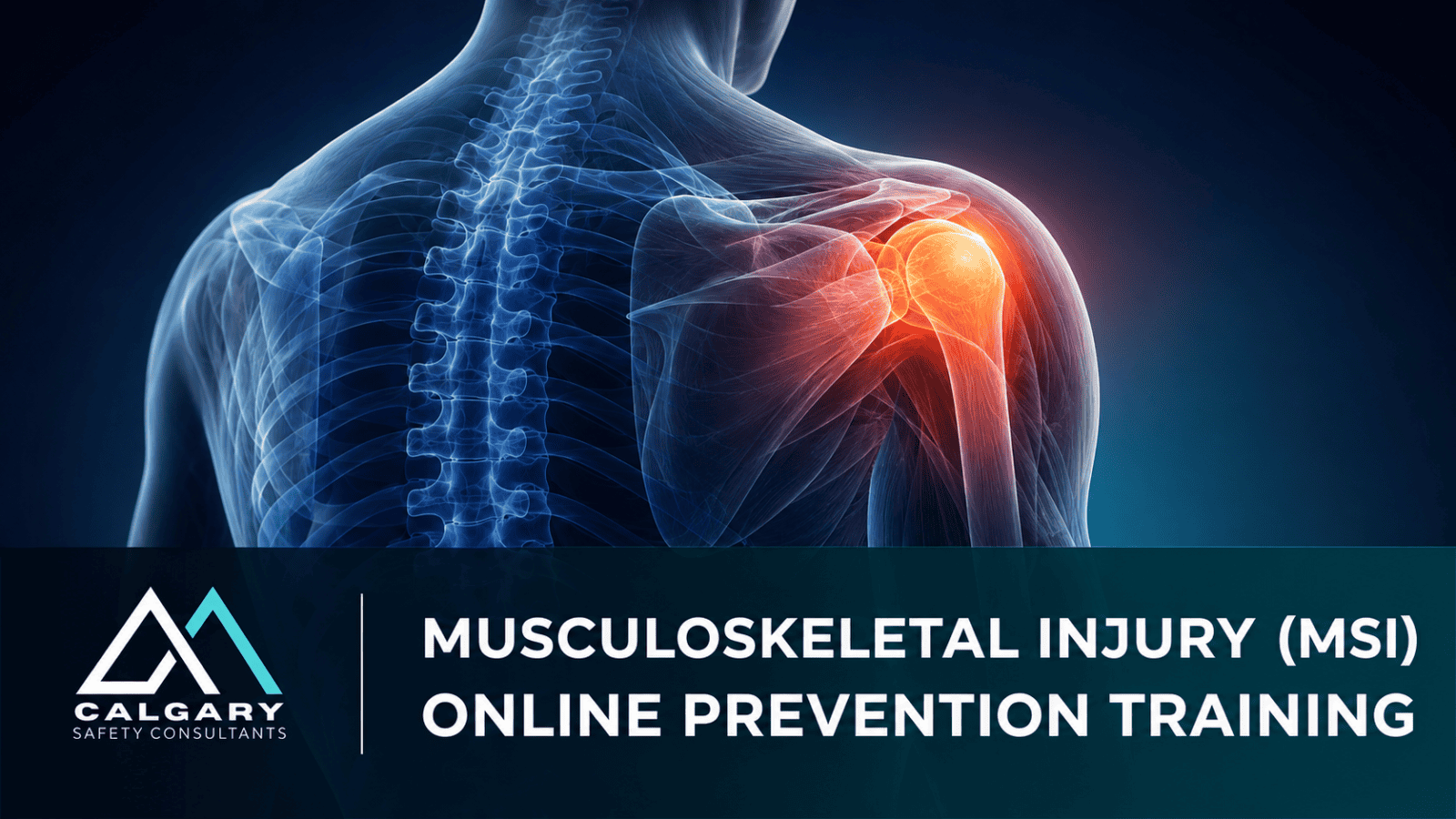
If your employees lift, carry, push, pull, perform repetitive work, maintain awkward positions, or complete other physically demanding tasks, they need to understand how those activities can contribute to musculoskeletal injuries.
Calgary Safety Consultants provides practical Musculoskeletal Injury Prevention Training for Canadian workers and employers, with flexible delivery options including Online MSI Training, Virtual Instructor-Led MSI Training, and Classroom MSI Training.
Whether you need to train one employee or an entire workforce, we can help you choose a training format that works for your operations, your employees, and your schedule.
Calgary Safety Consultants provides MSI Prevention Training for individuals and organizations across Canada. Our MSI training is available through self-paced online learning, live virtual instructor-led sessions, and in-person classroom training. Whether you need MSI training for one new employee or an entire workforce, training can be selected based on your employees’ responsibilities, work activities, locations, schedules, and operational requirements.
Choose Your Musculoskeletal Injury Prevention Training Option
Online Musculoskeletal Injury Prevention Training
Complete your Musculoskeletal Injury Prevention Training online at your own pace from virtually anywhere in Canada.
Our online MSI course is ideal for individual workers, new employees, remote workers, smaller organizations, or employers who need training available on demand.
Participants work through structured training modules covering musculoskeletal injury hazards, common risk factors, early signs and symptoms, manual material handling, ergonomics, and practical measures that can reduce exposure.
Online training gives employers a convenient way to provide consistent MSI prevention training without coordinating classroom schedules or employee travel.
Virtual Instructor-Led MSI Training
Get the interaction of a classroom without requiring everyone to be in the same location.
Our Virtual MSI Training is delivered live by an instructor using Microsoft Teams or another agreed virtual platform.
Participants can ask questions, discuss workplace situations, and examine the types of lifting, repetitive work, awkward postures, material handling, and ergonomic concerns that affect their own operations.
Virtual MSI training is particularly effective for organizations with employees working from multiple offices, job sites, branches, or communities.
It combines the convenience of remote training with the opportunity to interact directly with an experienced occupational health and safety professional.
Classroom Musculoskeletal Injury Prevention Training
Bring Musculoskeletal Injury Prevention Training directly to your workplace.
Our Classroom MSI Training provides instructor-led training for groups of employees who benefit from face-to-face discussion, practical examples, and workplace-specific questions.
Classroom training can be particularly valuable when employees regularly perform manual material handling, repetitive tasks, physically demanding work, or activities involving awkward or sustained body positions.
Training can be arranged for workplaces in Calgary, Okotoks, Edmonton, and other Alberta locations, with additional locations available by arrangement.
What Is Musculoskeletal Injury Prevention Training?
MSI stands for musculoskeletal injury.
Musculoskeletal injuries affect muscles, tendons, ligaments, joints, nerves, and other tissues that support movement and physical activity.
You may also encounter terms such as musculoskeletal disorder (MSD), work-related musculoskeletal disorder (WMSD), repetitive strain injury (RSI), or ergonomic injury.
MSIs can result from a single physically demanding event, but many develop gradually as workers are repeatedly exposed to physical demands such as force, repetition, awkward posture, sustained positions, manual material handling, or vibration.
Musculoskeletal Injury Prevention Training helps workers recognize these risk factors and understand practical measures that can be used to reduce their exposure.
The objective isn’t simply to teach employees how to lift.
Workers need to understand what makes a task physically demanding, how to recognize changing conditions, and what can be done to reduce the risk before an injury develops.
Who Needs MSI Training in Canada?
MSI hazards can occur in almost every industry.
Workers may benefit from Musculoskeletal Injury Prevention Training when their jobs involve:
- Lifting or lowering materials.
- Carrying loads.
- Pushing or pulling.
- Repetitive movements.
- Forceful exertion.
- Awkward working positions.
- Reaching or working overhead.
- Prolonged sitting or standing.
- Manual material handling.
- Hand tools or powered equipment.
- Vibration.
- Physically demanding work.
- Computer or workstation-based activities.
MSI training may therefore be appropriate for construction workers, tradespeople, warehouse employees, manufacturing workers, healthcare workers, drivers, maintenance employees, retail workers, equipment operators, office employees, supervisors, and many other occupations.
Occupational health and safety requirements differ between Canada’s federal, provincial, and territorial jurisdictions.
Employers should ensure that their training, hazard assessment, ergonomic, and manual material handling practices address the requirements that apply where their employees are working.
MSI Training for Workers, Supervisors and Employers
Musculoskeletal injury prevention involves more than the worker performing the physical task.
Consider a typical material-handling activity.
Someone selects how materials will be stored.
Someone determines where the materials will be placed.
Someone may select the equipment or tools used to move them.
A supervisor assigns the work.
A worker performs the task.
Someone may determine production rates, schedules, or staffing.
Management decides whether mechanical equipment or other improvements will be purchased.
Each of those decisions can affect the physical demands placed on the worker.
That is why effective MSI prevention requires workers, supervisors, and employers to understand their role in recognizing hazards and improving how work is performed.
A worker shouldn’t simply be expected to compensate for poorly designed work through better lifting technique.
What Does Our Musculoskeletal Injury Prevention Training Cover?
Depending on the training format and workplace activities, our Musculoskeletal Injury Prevention Training addresses important concepts including:
- What musculoskeletal injuries are.
- How musculoskeletal injuries can develop.
- Common workplace MSI hazards.
- The relationship between ergonomics and MSI prevention.
- Force and physical exertion.
- Repetitive movements.
- Awkward working positions.
- Static and sustained postures.
- Manual material handling.
- Lifting and lowering.
- Carrying materials.
- Pushing and pulling.
- Workplace and workstation design.
- Tool and equipment considerations.
- Vibration and other contributing factors.
- Recognizing early signs and symptoms.
- The importance of early reporting.
- Hazard identification and assessment.
- Eliminating or reducing unnecessary manual handling.
- Mechanical lifting and material-handling aids.
- Workplace design and engineering controls.
- Administrative controls and work practices.
- Safe manual handling principles.
- Worker responsibilities.
- Supervisor responsibilities.
- Workplace-specific MSI prevention.
The training emphasizes understanding the conditions creating the exposure, rather than relying exclusively on worker behaviour.
Common Musculoskeletal Injury Risk Factors
Musculoskeletal injuries usually aren’t caused by a single risk factor.
Several physical demands may occur together and increase the overall stress placed on the body.
Force
Force refers to the physical effort required to complete a task.
Workers may exert force while lifting, lowering, carrying, pushing, pulling, gripping, holding, or operating tools and equipment.
As the amount of force increases, so does the physical demand placed on muscles, joints, and other tissues.
Repetition
Repeatedly performing the same or similar movement can increase musculoskeletal stress.
The concern becomes greater when repetitive work is also forceful, performed from an awkward position, or completed with limited opportunity for recovery.
Awkward Postures
Bending, twisting, reaching, kneeling, squatting, working overhead, or performing tasks away from a comfortable body position can increase physical demands.
The amount of time spent in the position and how frequently the worker must assume it are also important.
Static or Sustained Postures
A worker doesn’t need to be moving continuously to experience musculoskeletal stress.
Remaining in the same position for an extended period can fatigue muscles and tissues.
This can affect workers performing physical jobs as well as employees who spend long periods sitting or using computers.
Manual Material Handling
Manual material handling can include lifting, lowering, carrying, pushing, pulling, holding, or moving materials.
The weight of a load is only one consideration.
Its size, shape, stability, location, grip, carrying distance, frequency of handling, and surrounding work environment can all affect the demands placed on the worker.
Vibration
Workers may be exposed to vibration through powered hand tools, machinery, vehicles, and other equipment.
Vibration can contribute to musculoskeletal concerns and may interact with other physical demands.
Multiple Risk Factors
The greatest concern often occurs when several risk factors exist at the same time.
For example, repeatedly lifting an object may involve force.
If the material is stored near floor level, the task may also involve bending.
If the worker needs to turn while lifting, twisting is added.
If the activity continues throughout the shift, repetition and duration also become factors.
Effective MSI prevention looks at the complete task rather than considering each movement in isolation.
Frequently Asked Questions About MSI Training
What does MSI stand for?
MSI stands for musculoskeletal injury. Musculoskeletal injuries affect muscles, tendons, ligaments, joints, nerves and related tissues.
What is the difference between MSI and MSD?
MSI means musculoskeletal injury, while MSD means musculoskeletal disorder. You may also see the term WMSD, meaning work-related musculoskeletal disorder. Different Canadian jurisdictions and safety organizations may use different terminology when discussing similar workplace ergonomic and musculoskeletal hazards.
Who should take MSI training?
Workers who perform lifting, carrying, pushing, pulling, repetitive work, physically demanding activities, awkward postures or other tasks that may expose them to musculoskeletal injury hazards can benefit from MSI training.
Is MSI training just lifting training?
No. Lifting is only one source of musculoskeletal injury risk. MSI prevention also considers repetition, force, awkward positions, sustained postures, pushing, pulling, workstation design, equipment design, vibration and how work is organized.
Can office workers experience musculoskeletal injuries?
Yes. Prolonged sitting, repetitive keyboard and mouse use, poor workstation positioning, awkward reaching and sustained postures can contribute to musculoskeletal problems.
Can MSI training be completed online?
Yes. Online MSI Training provides workers with a convenient way to complete foundational musculoskeletal injury prevention training from an internet-connected computer or compatible device.
Will I receive a certificate after completing MSI training?
Yes. Participants who successfully complete the online course requirements receive a certificate of completion.
Is MSI training required everywhere in Canada?
Occupational health and safety requirements aren’t identical across Canada. Requirements related to ergonomics, manual material handling, hazard assessment and worker training vary between federal, provincial and territorial jurisdictions. Employers should confirm the requirements that apply to their workplace.
Does MSI training replace a workplace hazard assessment?
No. Training helps workers understand MSI hazards and prevention principles, but employers still need to identify and assess the hazards associated with their actual workplace and implement appropriate controls.
What are the most common MSI risk factors?
Common factors include forceful exertion, repetitive movement, awkward or sustained postures, manual material handling, limited recovery time, vibration and workplace or equipment design.
Why is early reporting important?
Early reporting gives workers and employers an opportunity to identify whether a task may be contributing to discomfort and determine whether changes are needed before the problem potentially becomes more serious.
Do supervisors need MSI training?
Supervisors can benefit significantly from MSI training because they assign work, observe working conditions, respond to worker concerns and help ensure workplace controls are followed.
Can MSI training be provided to groups?
Yes. MSI Training can be provided for groups through online, virtual instructor-led or classroom delivery. Contact Calgary Safety Consultants to discuss training for your organization.