On this page
- What Corrective Actions Are and Why They Matter
- Where Corrective Actions Come From
- Who Is Responsible for Corrective Actions
- What Canadian OHS Law Requires
- How to Manage Corrective Actions, Step by Step
- Step 1: Log Every Finding in One Place
- Step 2: Control the Hazard Now
- Step 3: Find the Cause, Not Just the Symptom
- Step 4: Choose a Strong Corrective Action
- Step 5: Assign an Owner, a Priority and a Due Date
- Step 6: Track, Follow Up and Escalate
- Step 7: Verify the Fix and Close the Action
- Communicate Corrective Actions to Workers and the Committee
- Measure Corrective Action Performance and Improve
- A Practical Workplace Example
- Common Corrective Action Mistakes to Avoid
- What an Auditor Expects to See
- Download the Tracker and Quick Guide
- Frequently Asked Questions
- Related Guides and Articles
- How Calgary Safety Consultants Can Help
- Sources
What Corrective Actions Are and Why They Matter
A corrective action is a change made to eliminate or control a hazard, or to fix a gap in a safety program, after it's been identified. Replacing a missing machine guard is a corrective action. So is redesigning a lift so workers don't carry loads by hand, rewriting a lockout procedure that didn't match the equipment, or retraining a crew after an incident showed they'd never been taught the task properly.
Managing corrective actions is the part of a safety program that turns findings into results. Inspections, investigations, hazard reports and audits all do the same thing: they find problems. On their own, none of them makes anyone safer. Corrective actions are where the hazard actually gets fixed, and a program that finds hazards but doesn't fix them can be worse than one that never looked, because it leaves a written record of hazards the employer knew about and didn't address.
It helps to separate three kinds of action. An immediate action is what you do on the spot to protect people, such as stopping the work, taping off the area or taking equipment out of service. An interim control is a temporary measure that keeps the risk down while the permanent fix is arranged. The corrective action itself is the permanent change that deals with the cause. Some programs also use the term preventive action for changes made before anything goes wrong, such as fixing the same guard on every similar machine after a finding on one. Good programs track all of them.
The stakes are real. Workers' compensation boards across Canada accepted 274,022 lost-time claims in 2023, according to the Association of Workers' Compensation Boards of Canada. Many serious incidents follow a warning that was noticed and written down but never fixed: a near miss on the same equipment, a repeat inspection finding, a worker concern that sat on a list. Well-managed corrective actions are how you close that gap, and how you show due diligence when someone asks what you did about a hazard you knew about.
Where Corrective Actions Come From
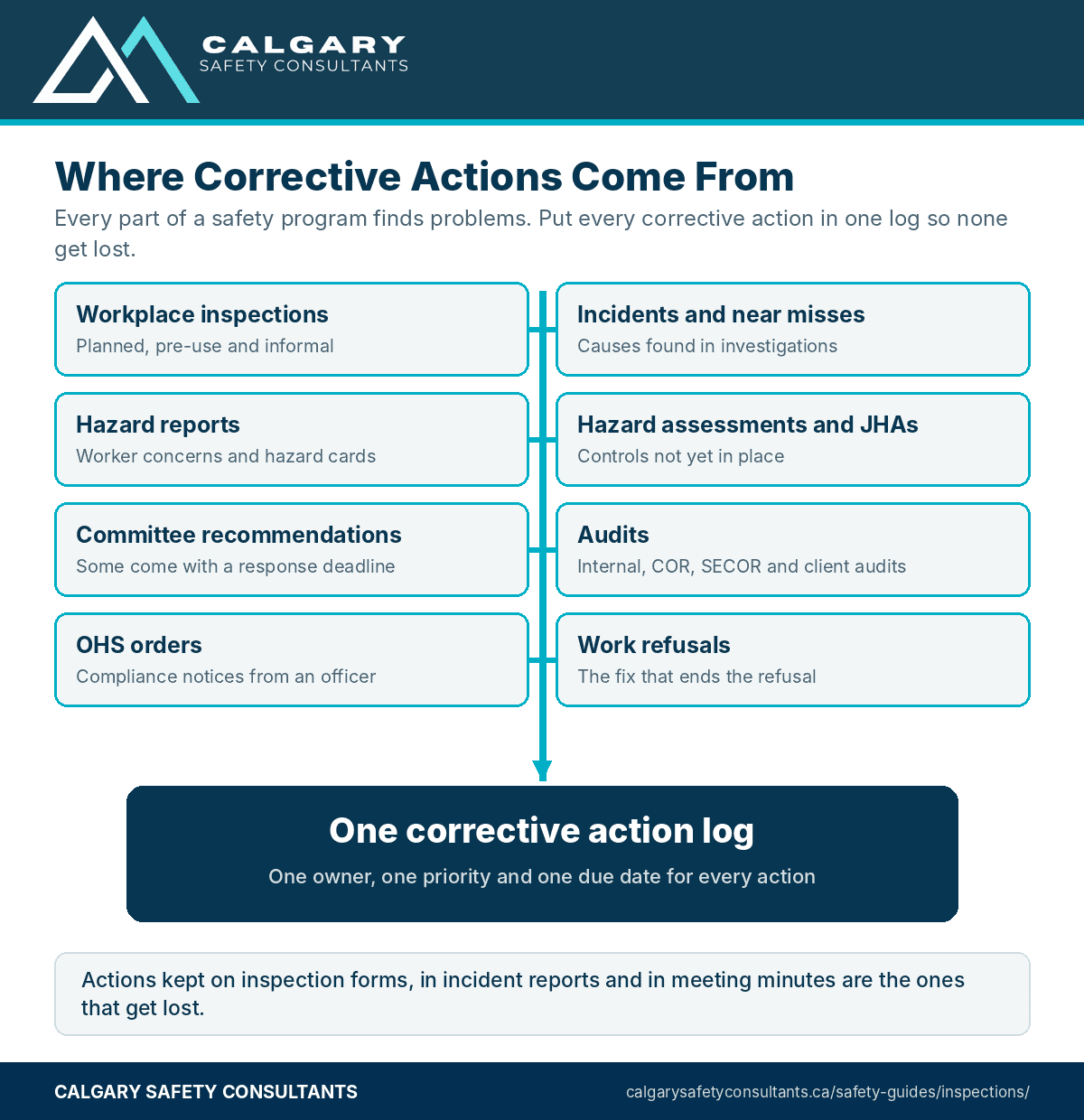
Corrective actions come from every part of a safety program. The most common sources are:
- Workplace inspections. Planned inspections, pre-use equipment checks and informal walk-throughs. Our workplace safety inspection guide explains how to record findings so they can be acted on.
- Incidents and near misses. Every investigation should end with corrective actions aimed at the causes, not just the injury. Our incident investigation guide shows how to find those causes.
- Hazard reports and worker concerns. Hazards raised by workers, in person, on a card or through an app, and concerns raised at toolbox talks or safety meetings.
- Hazard assessments and JHAs. Controls identified in a job hazard analysis or hazard assessment that aren't yet in place.
- Health and safety committee or representative recommendations. In several jurisdictions, these come with a legal deadline for the employer's written response.
- Audits. Internal audits, COR and SECOR audits, client and prequalification audits, and insurance surveys.
- OHS officer orders and compliance notices. These have their own deadlines and usually require you to report compliance to the regulator.
- Work refusals. A refusal ends when the danger is corrected, and the fix should be recorded like any other corrective action.
Most organizations track these in different places: inspection findings on the inspection form, incident actions in the investigation report, committee items in the minutes and audit findings in the audit report. That's where actions get lost. One of the most useful changes you can make is to pull every corrective action, whatever its source, into one log.
Who Is Responsible for Corrective Actions
Corrective actions involve almost everyone in the organization, but each person has a different job.
- The employer and senior management. The legal duty to eliminate or control hazards sits with the employer. Management provides the money, people and authority to fix things, sets the expectation that actions close on time and reviews performance.
- Supervisors and managers. They own most corrective actions in their areas, put interim controls in place and make sure the permanent fix happens. They're also the first point of escalation when an action stalls.
- The action owner. One named person who's responsible for getting the action done by its due date, even when other people do the work. The owner needs the authority and budget to do it, or a clear route to someone who has them.
- The health and safety committee or representative. They raise concerns, make recommendations, review the employer's response and help check that fixes are working.
- Workers. They report hazards, suggest practical fixes and tell you whether a change actually works on the job. Our post on worker participation in workplace safety explains why this matters for compliance as well as results.
- The safety coordinator or advisor. Where you have one, they maintain the log, send reminders and report on progress. They shouldn't own every action. When the safety person owns everything, the line organization stops feeling responsible for fixing its own hazards.
What Canadian OHS Law Requires
No Canadian jurisdiction has a single section called "corrective actions," but the duty runs through every OHS law. Employers must eliminate or control hazards they know about, act on hazards found in inspections and investigations, and in several provinces respond to committee recommendations within a set time. The table below summarizes the main requirements in selected jurisdictions.
| Jurisdiction | What the law requires |
|---|---|
| Alberta | Hazards must be eliminated or, where that isn't reasonably practicable, controlled using engineering controls first, then administrative controls, then personal protective equipment (OHS Code, Part 2, section 9). After a serious injury, illness or incident, the employer must investigate and prepare a report outlining the circumstances and the corrective action, give it to the committee, representative or workers, and keep it for at least two years (OHS Act, section 33). The Act sets no deadline for responding to committee recommendations. |
| British Columbia | Unsafe conditions found during an inspection must be remedied without delay, and reported unsafe conditions must be investigated and corrected without delay (OHS Regulation, sections 3.9 and 3.10). Employers must respond in writing to joint committee recommendations within 21 days. After an incident, a preliminary investigation report is due within 48 hours and a full report within 30 days, with corrective action taken without undue delay (Workers Compensation Act, sections 39, 71 and 72). |
| Manitoba | Employers must respond in writing to committee recommendations within 30 days, including any interim control measures and the reasons for disagreeing with any recommendation (Manitoba's committee guidance). |
| Ontario | Employers must respond in writing within 21 days to written recommendations from the joint health and safety committee or representative, with a timetable for the recommendations they accept and reasons for any they don't (Ontario's committee guide). |
| Federal | Employers must respond in writing to committee or representative recommendations within 30 days, and must investigate, record and report hazardous occurrences (Canada Labour Code, section 125). |
Other provinces and territories set their own rules, and our OHS Legislation in Canada page links to the legislation for each one. Two points apply everywhere. First, a deadline for a written response isn't a deadline for the fix; a serious hazard needs to be controlled right away, whatever the paperwork says. Second, an officer who finds a known hazard that was never corrected is likely to see it as a failure of due diligence, which is why closed, verified corrective actions are some of the most valuable records you keep.
How to Manage Corrective Actions, Step by Step
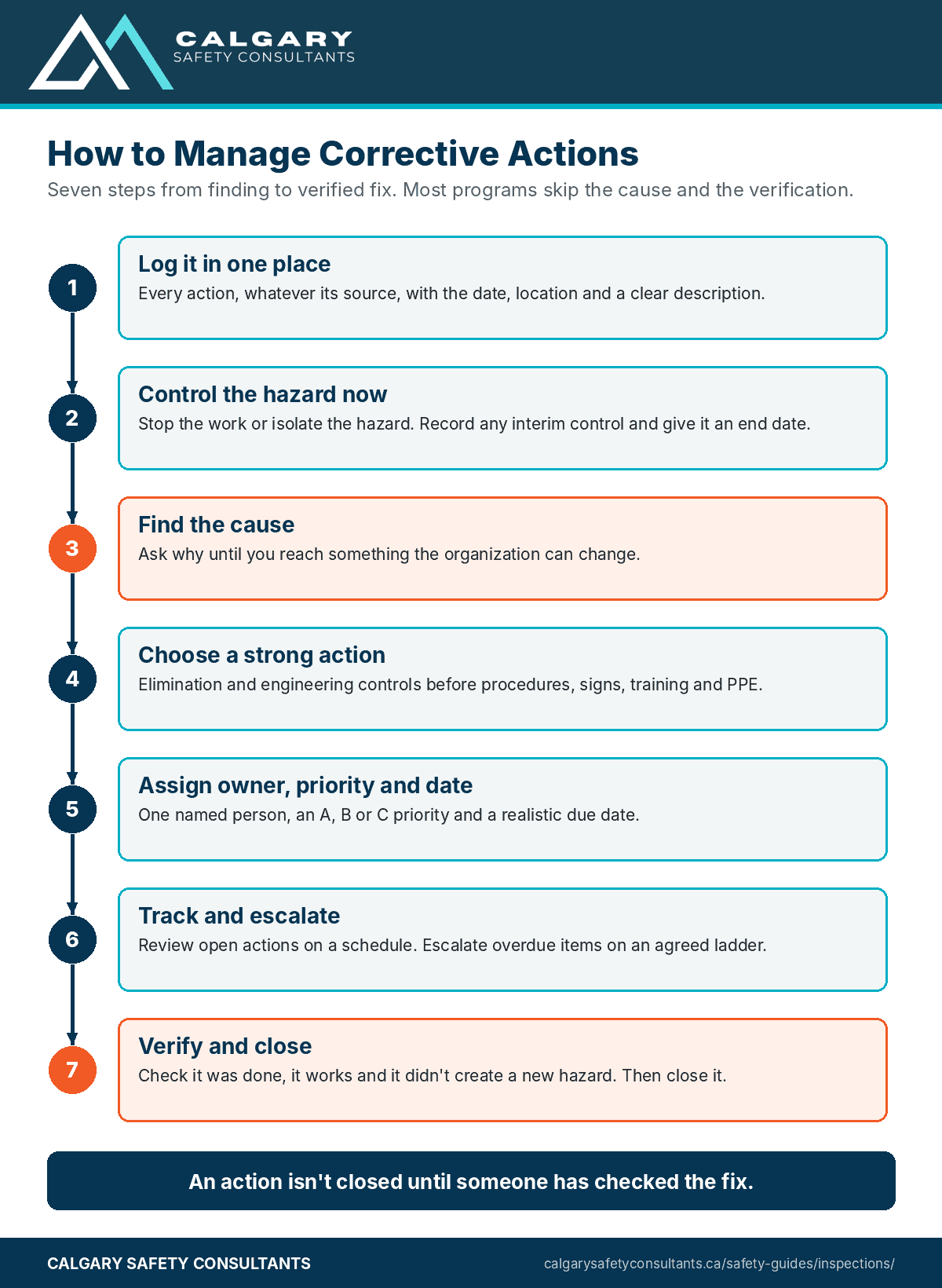
Managing corrective actions follows the same seven steps whatever the source: log the finding, control the hazard now, find the cause, choose a strong action, assign an owner, priority and due date, track and escalate, and verify before you close. The steps below explain each one, and our free corrective action tracker follows the same structure.
Step 1: Log Every Finding in One Place
Start by getting every corrective action into a single log, whatever its source. A spreadsheet works for most small and mid-sized employers, and inspection or safety management software works well for larger ones. What matters is that there's one list, everyone knows where it is and nothing gets fixed or forgotten outside it.
Each entry needs enough information for someone who wasn't there to understand and act on it:
- a reference number, the date it was raised and the source (inspection, incident, hazard report, committee, audit or order);
- the exact location and a clear description of the hazard or gap, with a photo reference where you have one;
- any immediate action or interim control already in place;
- the cause, once it's been identified;
- the corrective action, its priority, its owner and its due date;
- the status, the date it was completed, who verified it and how.
Log the finding the same day. Actions that wait for the inspection report to be typed up, or for the next committee meeting, start out late. If your inspection forms or incident reports already have a corrective action section, that's fine; just make sure every action on them is copied into the master log, or better, use the log as the place where actions are written in the first place.
Step 2: Control the Hazard Now
The permanent fix may take days or weeks. The hazard is there today. Before you plan the corrective action, decide what has to happen right now to protect people, and do it.
For a serious hazard, that means stopping the work, isolating the equipment or keeping people away until it's controlled. For lesser hazards, it might mean a temporary barrier, a change to the work sequence, an extra check or a supervisor briefing the crew. Record what you did and who did it. An interim control is part of the corrective action, not a replacement for it.
The US Occupational Safety and Health Administration's guidance on hazard prevention and control makes the same point: interim controls may be necessary, but the overall goal is effective long-term control. The risk with interim controls is that they become permanent by default. A row of pylons around a damaged floor plate is fine for a week. Six months later, it's a sign the corrective action was never done. Give every interim control an end date tied to the permanent fix, and check it's still in place and working at every review.
Step 3: Find the Cause, Not Just the Symptom
The quality of a corrective action depends on how well you understand why the problem happened. A blocked exit can be cleared in a minute. If it keeps getting blocked because receiving has nowhere else to stage freight, clearing it again is a symptom fix, and the same finding will be back next month.
For most inspection findings and hazard reports, a short "why" conversation with the people who do the work is enough. Ask why the condition exists, then ask why again, until you reach something the organization can change: the design of the work area, the equipment, the procedure, the schedule, staffing, training, supervision or purchasing. Stop when the answer points to a fix, and be wary of any cause that ends with a worker's name. "The worker didn't follow the procedure" is rarely the root cause; the useful question is why the procedure wasn't followed.
Incidents and serious near misses deserve a more structured approach. The UK Health and Safety Executive's guide Investigating accidents and incidents sets out four steps: gather the information, analyse it, identify the risk control measures, then build an action plan and implement it. The action plan is part of the investigation, not something that happens afterwards if there's time. Our guide on how to investigate a workplace incident walks through each stage, and our post on incidents that keep recurring looks at what happens when investigations stop at the symptom.
Step 4: Choose a Strong Corrective Action
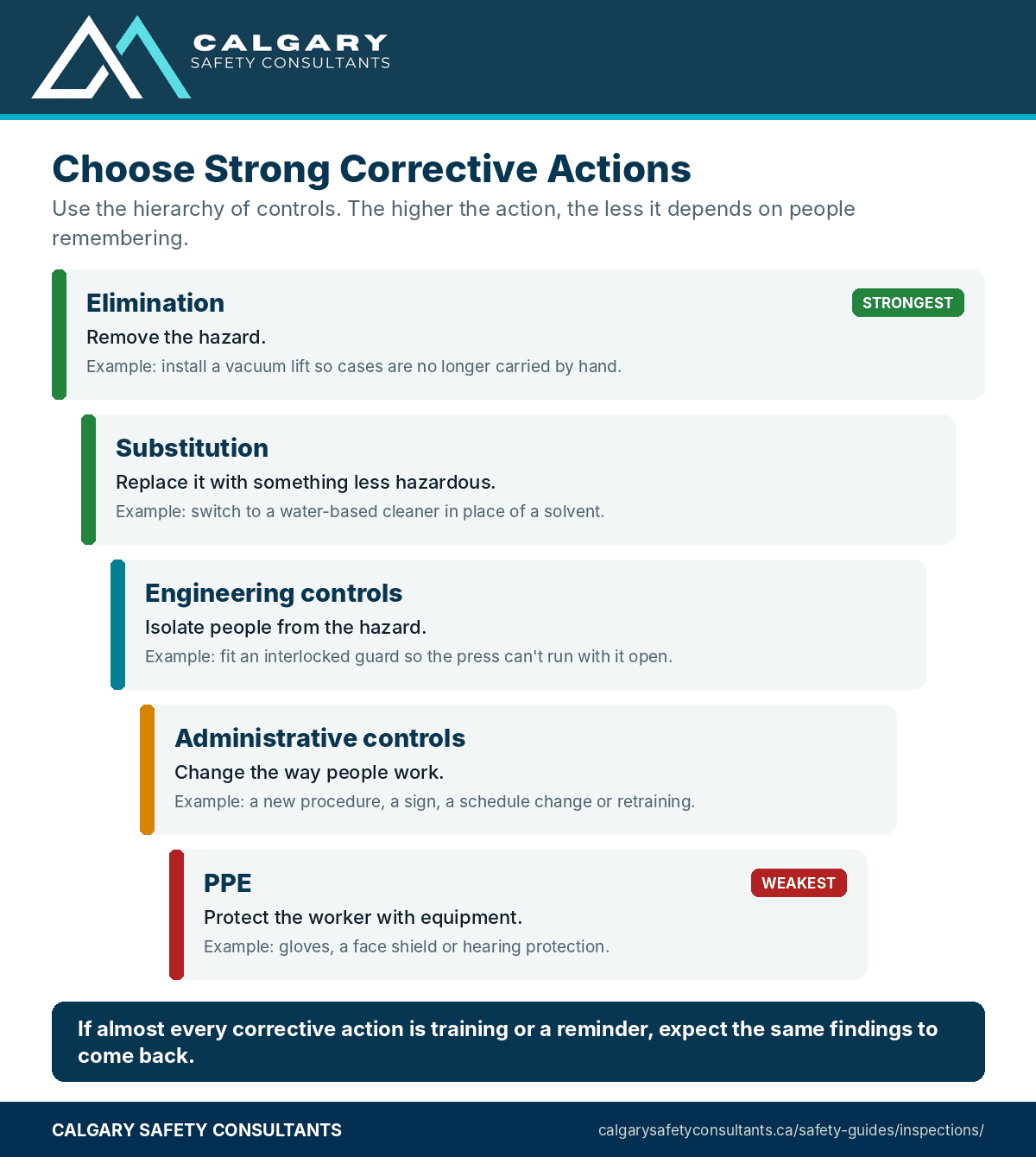
Once you know the cause, choose the fix. This is where many programs settle for less than they should. The easiest actions to write are reminders, signs and retraining, and they're also the weakest.
Use the hierarchy of controls to test every proposed action. Alberta's OHS Code builds the hierarchy into law: hazards must be eliminated where reasonably practicable, and otherwise controlled with engineering controls first, administrative controls next and personal protective equipment last. The US National Institute for Occupational Safety and Health explains why in its hierarchy of controls guidance: administrative controls and PPE require significant and ongoing effort by workers and supervisors, while higher-level controls work without depending on people remembering to do the right thing.
A strong corrective action is also specific. It says exactly what will change, where and to what standard, so the owner knows what "done" looks like and the verifier can check it. Compare these:
| Weak corrective action | Strong corrective action |
|---|---|
| Remind workers to use the guard. | Install an interlocked guard on press 3 so the press can't cycle with the guard open. Update the press SWP and train the three operators on the change. |
| Be more careful with housekeeping near the exit. | Mark a freight staging lane on the east side of the dock, move overflow there and add the exit route to the daily supervisor check. |
| Retrain staff on lifting. | Install a vacuum lift at the packing station for cases over 20 kg, then train the packing crew on its use. |
| Look into the ladder issue. | Remove the two damaged stepladders from service today, replace them with platform ladders and add ladders to the monthly inspection checklist. |
Before you commit to an action, check that it won't create a new hazard. A new guard that makes cleaning harder may get removed. A procedure that adds ten minutes to a rushed job may get skipped. Asking the workers who'll live with the change is the quickest way to find out, and it's often where the best fixes come from. Our post on why PPE should be the last line of defence covers this trade-off in more detail.
Step 5: Assign an Owner, a Priority and a Due Date
Every corrective action needs three things before it leaves the meeting: one owner, a priority and a due date. OSHA's guidance calls for the same thing in a hazard control plan: list hazards in order of priority, assign responsibility for each control to a specific person and establish a target completion date.
One owner. Name a person, not a department. "Maintenance" can't be held to a date; the maintenance lead can. The owner should have the authority and budget to get the action done, or a clear route to someone who does. If an action needs several people, name one owner and list the others as support.
A priority. Rate each action by how serious the possible harm is and how likely it is to happen. Our tracker uses the same three levels as our inspection checklist:
- Priority A, critical. Could cause death, serious injury, serious illness or major damage. Control the hazard immediately, before work continues, and complete the permanent fix as quickly as possible.
- Priority B, serious. Could cause injury, illness or damage, but the risk isn't immediate. Complete it as soon as possible, typically within seven days.
- Priority C, minor. Low risk, such as housekeeping or routine maintenance. Complete it within 30 days or at the next scheduled maintenance.
A realistic due date. Set the date from the priority, then check that it's achievable. Ordering a part with a six-week lead time means a seven-day due date will be missed before it starts. In that case, set the real date, strengthen the interim control and record why. A due date that everyone knows is fiction teaches people that dates don't matter.
If your organization already uses a risk matrix for hazard assessments, use the same scale for corrective actions so a finding, a hazard assessment and an action plan all speak the same language.
Step 6: Track, Follow Up and Escalate
This is the step where most corrective action programs fail. Actions are assigned with good intentions, then life gets busy, the list grows and the oldest items quietly fade. Our post on what happens when corrective actions are never properly closed explains how that slide happens and what it costs.
Three habits keep a log moving:
- A regular review. Go through open actions at a set meeting: a weekly supervisors' meeting, a monthly management meeting or the health and safety committee. Sort by priority and due date, ask each owner for a status, and record the update in the log. Fifteen minutes a week is enough for most small and mid-sized employers.
- Clear escalation. Agree in advance what happens when an action is overdue. A simple ladder works: the owner's supervisor at the due date, the manager at two weeks overdue, and senior management at 30 days or for any overdue priority A action. Escalation isn't punishment; it's how actions that need money, people or a decision get to the person who can provide them.
- Honest extensions. Sometimes a date has to move. Allow it, but require a reason, a new date, approval from the next level up and confirmation that the interim control is still working. Never extend an action just to make the overdue count look better.
Software can help with reminders, photos and dashboards, and tools such as Site App Pro link corrective actions directly to the inspection or report that raised them. But the discipline matters more than the tool. A spreadsheet that's reviewed every week will outperform an expensive system that nobody opens.
Step 7: Verify the Fix and Close the Action
A corrective action isn't finished when someone says it's done. It's finished when someone has checked three things: the action was completed as written, it fixed the problem, and it didn't create a new hazard.

Where possible, the person who verifies the action shouldn't be the person who did the work. A supervisor, a committee member or the person who raised the finding can do it during their next walk-through. Record who verified it, when and how: a photo of the installed guard, a copy of the revised procedure with training records, or a note that the area was checked during the next inspection.
For priority A and B actions, and for anything that came from an incident, schedule a second check a few weeks or months later. Is the guard still in place? Is the new procedure being followed on night shift? Has the hazard come back? This effectiveness check is what separates a closed action from a solved problem. If the fix isn't working, reopen the action and go back to step 3.
Only then close it. Closing an action without verification gives you a clean report and a false sense of security, and auditors and officers are very good at finding the difference.
Communicate Corrective Actions to Workers and the Committee
People who raise hazards need to hear what happened. Tell the worker who reported the problem what's being done and when, and tell them again when it's fixed. Post the corrective action summary, cover it at toolbox talks and share the log with the health and safety committee or representative at every meeting. Workers who see their concerns acted on keep raising them. Workers who never hear back stop, and those unreported hazards are the ones that hurt people.
Committee recommendations need particular care. Where the law sets a deadline, as it does in British Columbia, Manitoba, Ontario and federally, put the response due date in the log as soon as the recommendation arrives. The response should say which recommendations you accept and when they'll be done, explain any you don't accept and describe the interim measures in place. Even where there's no legal deadline, a written answer within a few weeks shows the committee that its work matters. Our post on when your workplace needs a committee or representative explains who these rules apply to.
Measure Corrective Action Performance and Improve
A corrective action log is also one of the best measures of how well your safety program works. Review it at least every quarter and report a few simple numbers to management:
- the number of open actions, and how many are overdue, by priority;
- the percentage of actions closed on or before their due date;
- the average number of days to close, by priority;
- repeat findings: the same hazard raised again after an action was closed;
- the share of actions at each level of the hierarchy of controls.
Look for patterns as well as totals. Ten findings about the same forklift route point to a traffic design problem, not ten separate issues. A department with no overdue actions and no new ones may not be reporting. A program where almost every action is training or a reminder is relying on the weakest controls.
Senior management should see these numbers regularly. The UK Health and Safety Executive's guidance on the Act stage of plan, do, check, act expects leaders to decide actions to address weaknesses and have a system to monitor their implementation. In practice, that means overdue critical actions appear on the management agenda until they're closed, and the resources to fix them are provided. Our post on underused safety data has more ideas for turning these records into decisions.
Workplace example
A Practical Workplace Example
Situation: Consider a 60-person steel fabrication shop with a busy safety program on paper. Supervisors did monthly inspections, incidents were investigated and the joint health and safety committee met every month. But corrective actions lived in four places: inspection forms in a binder, incident reports on a shared drive, committee minutes in email and audit findings in last year's audit report. Nobody could say how many were open. When the safety coordinator finally pulled them together, there were 112, the oldest was 14 months old and 31 had no owner.
One of the oldest was a missing guard on a pedestal grinder. It had appeared on three inspections, each time marked "maintenance notified." In the same month the list was compiled, a fitter's glove caught on that grinder and he needed stitches.
Action: The plant manager made corrective actions a standing item at the Monday supervisors' meeting. Every open item went into one spreadsheet tracker, was given a priority, a named owner and a realistic due date, and anything without an owner was assigned on the spot. Priority A items were reviewed the same week, and any action more than 30 days overdue went to the plant manager.
The team also looked at why items stalled. Many were waiting on parts nobody had ordered, so the purchasing lead joined the Monday review for 10 minutes. Others were written so vaguely that nobody knew when they were done, so supervisors rewrote them as specific actions. Every closed item now needed a photo or a note showing who had verified it.
Result: Within a few months, the open list was down to a manageable number, overdue priority A actions had disappeared and the same findings stopped reappearing on inspection reports. The committee started reviewing the tracker at each meeting instead of re-raising old concerns. At the company's next COR maintenance audit, the auditor could follow findings from inspections, incidents and committee meetings through to verified fixes, and workers interviewed on the floor could point to changes made because of things they'd reported.
Common Corrective Action Mistakes to Avoid
- Keeping actions in several places. Inspection forms, incident reports and meeting minutes each hold a few actions, and nobody sees the whole list.
- Assigning actions to a department. "Maintenance" or "the office" can't be held to a date. Name one person.
- Defaulting to retraining and reminders. These are the weakest controls. Use them, but not as the only answer.
- Fixing the symptom. If the same finding keeps coming back, the cause hasn't been addressed.
- Unrealistic due dates. Dates that everyone knows will be missed teach people that dates don't matter.
- Letting interim controls become permanent. Pylons, tape and extra checks should come with an end date.
- Closing without verification. "Done" should mean someone checked that the fix is in place, working and hasn't created a new hazard.
- Never telling the person who raised it. Workers who don't hear back stop reporting.
Audit perspective
What an Auditor Expects to See
If your organization holds or is working toward a Certificate of Recognition (COR) or a Small Employer Certificate of Recognition (SECOR), corrective actions show up across the audit, not in one element. Alberta's COR audit standard, for example, looks for:
- controls that are implemented, used and enforced, in the hazard control element;
- timely resolution of health and safety concerns, in the committee and representative element;
- a system to correct the deficiencies that inspections identify, in the inspections element;
- corrective actions that are implemented after incident investigations, in the investigations element;
- follow-up on identified deficiencies and a yearly analysis of statistics and records to find trends and improvements, in the system administration element.
In practice, auditors pick findings from inspection reports, investigations and committee minutes and trace them forward to see whether each was assigned, completed and verified. They also ask workers whether hazards they reported were fixed. A single log with owners, dates, verification and trend reviews makes that trail easy to follow; scattered actions with no close-out make it hard.
Each certifying partner uses its own approved audit standard, so check the current version for your program. Our tracker can help you produce the records auditors look for, but no form guarantees an audit result. Calgary Safety Consultants helps employers build corrective action systems and prepare for audits; we don't issue certificates. CORs and SECORs are issued through the applicable certifying partner.
Download the Corrective Action Tracker and Quick Guide
Three free downloads go with this guide.
- Corrective Action Tracker (Excel). A ready-to-use log with drop-down lists for source, priority, control type and status. It calculates days open, flags overdue actions automatically and includes a summary tab with open and overdue actions by priority, so the numbers for your management review are ready when you need them.
- Corrective Action Tracker (PDF). A printable, fillable version with clickable checkboxes: a corrective action record for individual findings and a log page for teams that prefer paper or need a form to bring on site.
- Corrective Actions Quick Guide (PDF). A two-page summary of the seven steps, the priority system and the review questions, with clickable checklists.
Click any button to download the file. Adapt the tracker to your workplace by adding your own areas, owners and priority timeframes.

About the author
John Duplessis, B.Sc., CRSP
John Duplessis is a Canadian Registered Safety Professional with more than 30 years of occupational health and safety experience in oil and gas, construction, green energy, midstream operations and industrial project work.