On this page
- What a Working Alone Program Is
- What Counts as Working Alone
- Working Alone Requirements by Jurisdiction
- Who's Responsible for What
- Step 1: Find Out Who Works Alone, and When
- Step 2: Assess the Hazards of Working Alone
- Step 3: Eliminate or Reduce the Need to Work Alone
- Step 4: Choose Effective Communication and Check-In Intervals
- Technology Options: Apps, Lone Worker Devices and Satellite
- Late-Night Retail and Cash-Handling Rules
- Step 5: Plan the Response to a Missed Check-In
- Step 6: Train Lone Workers and Check-In Contacts
- Step 7: Write the Working Alone Policy and Procedure
- Step 8: Review and Improve the Program
- A Practical Workplace Example
- Common Working Alone Mistakes to Avoid
- What an Auditor Expects to See
- The Bottom Line
- Download the Working Alone Forms
- Frequently Asked Questions
- Related Guides and Articles
- How Calgary Safety Consultants Can Help
- Sources
What a Working Alone Program Is
Picture an operator checking a remote pump station at two in the morning, a home care nurse visiting a client on the edge of town, or a clerk alone behind a gas station counter. Each could be hurt, fall ill or face a threat with no one close enough to notice. A working alone program exists to close that gap between something going wrong and someone knowing about it.
It isn't a single form or a phone. It's a small system: a working alone policy, a hazard assessment for each lone work situation, controls, a communication and check-in plan, a clear response to a missed check-in, training and regular review. When those parts fit together, a lone worker in trouble is found quickly, and most trouble is prevented in the first place.
This guide explains what counts as working alone, compares the working alone requirements across Canada and walks through setting up a program that works in practice. It comes with two free downloads: a hazard assessment and check-in plan, and a program setup checklist.
What Counts as Working Alone
Working alone doesn't only mean being the only person in the building. In most jurisdictions, a worker is working alone, or in isolation, when help wouldn't be readily available if they were injured, became ill or faced an emergency. Someone surrounded by the public can still be working alone.
Alberta's working alone bulletin gives a practical test. Three factors decide whether assistance is readily available: awareness (would people able to help know the worker needs it?), willingness (is it reasonable to expect them to help?) and timeliness (would help arrive within a reasonable time?). The bulletin adds that for high-risk hazards, "readily available" may need to be treated as "immediately available."
Common examples include field workers at remote sites, workers who drive alone, home care and inspection staff visiting clients, retail and gas station staff on their own, cleaners and security guards on night shifts, office staff working after hours and employees working from a home office. The simplest check for any job or shift is this: if this person collapsed right now, who would know, and how long would help take to reach them?
Working Alone Requirements by Jurisdiction
Every jurisdiction's general duty covers lone workers, and most add specific working alone requirements. Here's how they compare.
| Jurisdiction | Main provisions | Key requirements |
|---|---|---|
| Alberta | OHS Code Part 28 (ss. 393 and 394), with Part 2; Part 27 for retail fuelling outlets and convenience stores | Hazard assessment with affected workers; effective communication; contact at intervals appropriate to the hazards; visits or call-ins where electronic communication isn't practicable; Part 27 violence prevention plan rules for retail fuelling outlets and convenience stores, including a monitored personal emergency transmitter for anyone working alone |
| British Columbia | OHS Regulation ss. 4.20.1 to 4.23 | Identify and control hazards first; written check procedure with intervals, a designated contact who records results, end of shift check and emergency rescue; training; late night retail rules; annual review |
| Saskatchewan | OHS Regulations, 2020, s. 3-24; late night retail provisions | Identify and reduce risks; effective communication system; measures such as regular contact, activity limits, training and emergency supplies; late night retail rules |
| Manitoba | Workplace Safety and Health Regulation, Part 9 | Identify and reduce risks; written procedures; communication system; regular contact, activity limits or training; procedures posted; review at least every three years |
| Ontario | No specific working alone regulation; general duties apply | OHSA duty to take every reasonable precaution; workplace violence provisions |
| Quebec | No stand-alone regulation confirmed; Act, s. 51 | General duty to protect, inform, train and supervise workers and protect them from violence |
| New Brunswick | N.B. Reg. 92-133 | Written code of practice with risks, procedures and how to get emergency help; training for workers and supervisors |
| Nova Scotia | No stand-alone general regulation confirmed | General duties; violence risk assessment |
| Prince Edward Island | General Regulations, Part 53 | Written procedures; check intervals; designated contact; emergency rescue; end of shift check; training |
| Newfoundland and Labrador | OHS Regulations, 2012, s. 15 | Risk assessment; written check procedure with intervals and designated contact; emergency response; annual review |
| Northwest Territories and Nunavut | OHS Regulations, s. 33; WSCC code of practice | Identify hazards; effective communication system (s. 33); WSCC code recommends intervals set by risk, shift end check, training and review at least every three years |
| Yukon | No stand-alone section confirmed | General duties; confirm with the Workers' Safety and Compensation Board |
| Federal | Canada Labour Code Part II; COHSR | No general prohibition; hazard prevention program; restrictions for specific tasks; violence risk assessment |
Summary only, current to October 2026. Read the current legislation for your jurisdiction and follow the stricter rule where more than one applies.
British Columbia's OHS Regulation, Part 4 is the most detailed. It requires a written procedure for checking a lone worker's well-being, with set intervals, a designated contact who records each check, an end of shift check and a plan for when the worker can't be reached, including emergency rescue. Intervals are developed with the joint committee or representative and the worker, and the procedures are reviewed at least annually.
Newfoundland and Labrador's OHS Regulations, 2012 follow a similar model in section 15, and Prince Edward Island's Part 53 also requires set intervals, a designated contact, emergency rescue and an end of shift check. Manitoba's Workplace Safety and Health Regulation defines working alone and working in isolation separately, with requirements in Part 9.
Saskatchewan's section 3-24, quoted in the Saskatchewan Construction Safety Association's working alone toolbox talk, requires employers to identify the risks, take all reasonably practicable steps to reduce them and establish an effective communication system. In the Northwest Territories and Nunavut, section 33 sets similar duties, and the WSCC's working alone code of practice adds detail on intervals, training and review.
Elsewhere, general duties do the work. Ontario has no specific working alone regulation, so general duties apply. Its sector guidance for firefighters on working alone points to the duty to take every precaution reasonable and to the workplace violence provisions, and recommends check-in and check-out by phone or radio. Section 51 of Quebec's Act respecting occupational health and safety requires employers to protect, inform, train and supervise workers and protect them from violence.
Nova Scotia's Violence in the Workplace Regulations require a violence risk assessment that considers the circumstances of the work. We couldn't confirm a stand-alone working alone section in Yukon's Workplace Health and Safety Regulations.
Federally, the Labour Program's interpretation on working alone says the Canada Labour Code doesn't prohibit working alone, but the general duty and hazard prevention program apply and some tasks are restricted. It adds that low-risk jobs may need no extra provisions, while high-risk jobs may need a personal alarm or set check-in times. For more on how the laws fit together, see our guide to OHS legislation in Canada.
Who's Responsible for What
- Employers identify lone work, assess hazards, provide controls and equipment, write the working alone policy, train people and review the program.
- Supervisors confirm each lone worker has a current assessment, check-in plan and working equipment, respond to missed check-ins and stop unsafe lone work.
- Check-in contacts make or receive contact on schedule, record each check and start escalation the moment a check is missed.
- Lone workers follow the plan, check in on time, keep devices charged and report changes in location or task.
- Committees and representatives take part in assessing hazards and, in some jurisdictions, setting the check procedure.
When lone workers share a site with other employers, share the plan. SAFE Work Manitoba's working alone page says employers must let prime contractors, contractors, tenants and landlords know a worker will be working alone. Our guide on managing contractor safety covers that coordination.
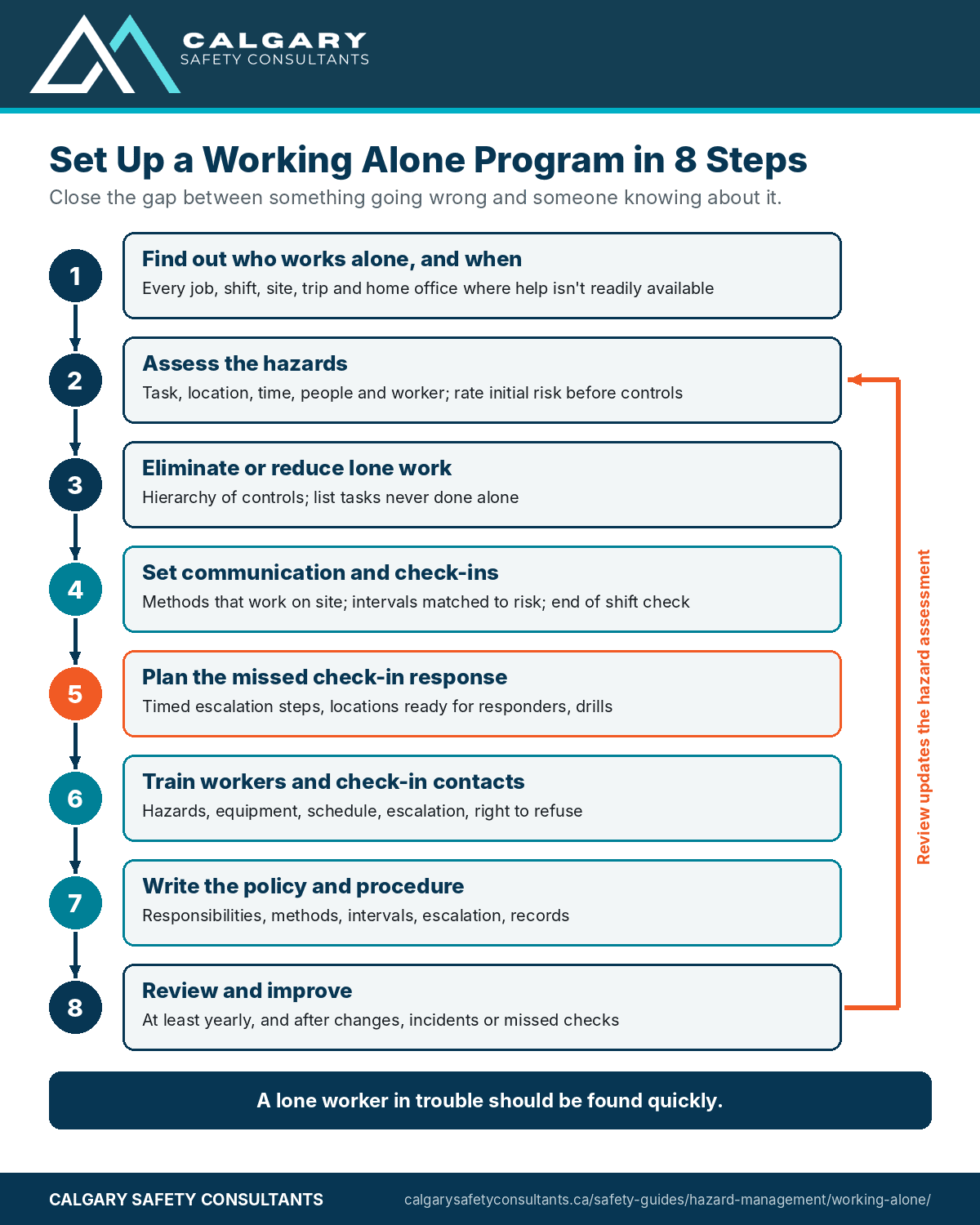
Step 1: Find Out Who Works Alone, and When
List every situation where someone might work alone. The field operator who drives to remote sites is obvious; the bookkeeper who stays late on Fridays or the shop hand who opens alone at six often isn't. Walk through a full week, including early starts, nights, weekends, on-call work and travel, and ask workers when they actually end up alone.
Note each location and how long the worker is alone, because fifteen minutes in a busy building isn't the same as a twelve-hour night shift at a remote facility. Don't skip home offices.
The BC government's internal guidance for its own employees on working alone risk assessment and check-in treats working alone in a home office, outside normal hours, visiting clients and driving remote routes as situations that call for a check-in procedure. It's employer guidance, not law, but it's a useful prompt for any workplace. Record every situation in a simple register, because each one needs a hazard assessment and check-in plan.
Step 2: Assess the Hazards of Working Alone
Every jurisdiction with specific rules starts here: identify the hazards of working alone, and British Columbia requires this before the worker is assigned to work alone. Look at the hazards of the task, and at how being alone makes them worse, because no one is there to help, stop the work or call for help. Consider the task (heights, energy, machinery, confined spaces, chemicals), the location and coverage, time of day and weather, contact with the public or cash, the worker's training, experience and health, and travel.
Rate the risk before controls. Our working alone form uses the same five-by-five matrix as the forms in our guides on field-level hazard assessments and job hazard analysis: likelihood times severity, with 1 to 4 low, 5 to 9 moderate, 10 to 16 high and 17 to 25 extreme. An honest initial rating shows which lone work needs the strongest controls, the shortest check intervals or a second worker. Then rate the residual risk after controls.
Involve the people doing the work. Alberta says affected workers must be involved in the hazard assessment and in controlling the hazards found, and several other jurisdictions require consultation with the committee, representative or workers. Lone workers know where the coverage dead zones are.
Don't let a phone stand in for the assessment. WorkSafeBC's OHS Guidelines say giving a worker a phone, radio or personal alarm doesn't by itself guarantee help is readily available, and a person check system alone is unlikely to meet that test.
Step 3: Eliminate or Reduce the Need to Work Alone
Often the best control is not to work alone at all. British Columbia requires hazards to be eliminated before the work starts where practicable, and otherwise reduced to the lowest practicable level. The hierarchy of controls gives the order of preference:
- Eliminate lone work. Schedule high-risk tasks when others are present or pair workers for site visits.
- Change the work. Rearrange layouts so workers can see each other, or automate remote readings.
- Engineering controls. Barriers, lighting, video surveillance, time lock safes and locked access.
- Administrative controls. Check-in procedures, trip plans, task restrictions, experience requirements and cash limits.
- Equipment. Personal alarms, first aid kits, cold weather survival gear and task PPE.
Some work shouldn't be done alone. Manitoba's code of practice lists limits or prohibitions on specified activities as one measure, and federal regulations restrict lone work for some confined space and electrical tasks. Put confined space entry, work near energized conductors and similar tasks on a written list of work never done alone.
Step 4: Choose Effective Communication and Check-In Intervals
Every program needs a reliable way for the worker to reach help and for someone to check on them. Effective means it works at the actual location, at the actual time. A cell phone with no coverage at the site isn't effective communication.
Alberta requires an effective means of communication and contact at regular intervals appropriate to the hazards; where electronic communication isn't practicable, the employer must visit or the worker must call in. New Brunswick's Code of Practice for Working Alone Regulation requires a written code that sets out the risks, the procedures and how a lone worker gets emergency help.
No regulation sets a single check-in interval; the higher the risk, the shorter it should be. Prince Edward Island's guide to the working alone regulations uses two-hour calls in its sample procedure, and Manitoba's code of practice gives the example of a night security worker calling dispatch every hour before rounds. Tying the interval to the initial risk rating is a practical start:
| Initial risk | Practical starting point | Typical methods |
|---|---|---|
| Low (1 to 4) | Start and end of shift, plus every two to four hours | Phone, text, app check-in |
| Moderate (5 to 9) | Every one to two hours, plus before and after riskier tasks | Two-way voice, app with missed check-in alerts |
| High (10 to 16) | Short intervals or continuous monitoring; second worker for the riskiest tasks | Lone worker device with no-motion alarm, radio, satellite device |
| Extreme (17 to 25) | Don't work alone until the risk is reduced | Second worker or change the work |
Planning starting points, not legal requirements. Set intervals with your committee or representative and the lone worker.
Write down who the contact is and who backs them up, what the worker reports, how checks are recorded and how late counts as missed. The plan has to work at three in the morning on a long weekend. And always include an end of shift check that positively confirms the worker is finished and safe. It's the check that catches the worker who never made it home.
Technology Options: Apps, Lone Worker Devices and Satellite
- Calls and texts. Fine for low-risk work with good coverage, but they rely on people remembering.
- Check-in apps. Prompt the worker, log each check and alert a contact when one is missed.
- Lone worker devices. Panic buttons and, on many models, fall or no-motion alerts for a worker who can't call.
- Two-way radios. Reliable within range of a repeater or base station.
- Satellite devices. Messengers, personal locator beacons and satellite phones for sites with no cell coverage.
- GPS tracking. Useful for drivers, combined with a trip plan and arrival check-in.
The UK Health and Safety Executive's guidance on managing the risks of working alone reminds employers to consider violence, mental health and medical suitability as well. A device can raise an alarm, but it can't prevent a violent encounter. The HSE's advice on monitoring lone workers sums up what any system must deliver: knowing where workers are, pre-agreed contact intervals, a way to raise the alarm and confirmation that the worker has returned to base.
Test any system where the work happens: coverage, battery life over a full shift and how alerts reach the contact. British Columbia notes that a one-way system that raises an alarm if not reset can be acceptable where two-way contact isn't practicable. Always have a backup method. Our Site App Pro digital safety management service lets workers check in and out and keeps time logs across sites.
Late-Night Retail and Cash-Handling Rules
Retail workers alone at night face robbery and violence, and three provinces have specific rules.
- British Columbia. For retail premises open between 11:00 p.m. and 6:00 a.m. where a lone worker faces any risk of violence, the employer needs a written safe money handling procedure plus a barrier separating the worker from the public, a second worker, or a violence prevention program. The program includes a time lock safe, good visibility, limited access, video surveillance, signs, a monitored personal emergency transmitter for a worker at least 19 years old and a regular independent security audit.
- Saskatchewan. The province's page on late night retail premises covers retail open between 11:00 p.m. and 6:00 a.m.: a written safe cash handling procedure, video cameras covering the cash desk and outdoor gas pumps, good visibility and signs. A worker alone needs a check-in system with a written procedure and a personal emergency transmitter at no cost to them.
- Alberta. According to the province's page on fuel and convenience store worker safety, under Part 27 of the OHS Code, retail fuelling outlets and convenience stores need a violence prevention plan that includes safe cash handling, good visibility, limited public access, video monitoring and signs, and any worker working alone must wear a personal emergency transmitter monitored by the employer or its designate, at any hour. Stores open between 11:00 p.m. and 5:00 a.m. also need a time lock safe that workers can't open during those hours, limited high-value items with secure storage for the rest, and signs saying so. Fuel must be prepaid at retail fuelling outlets.
Elsewhere, the same controls make sense for anyone handling cash alone: limit cash on hand, keep the cash area visible, use drop safes, post signs and train staff on robbery response.
Step 5: Plan the Response to a Missed Check-In
A check-in system is only as good as what happens when a check-in doesn't come. This is where many programs fail: the contact assumes the worker is busy, and an hour passes. British Columbia, Newfoundland and Labrador and Prince Edward Island require the procedure to say what happens if the worker can't be contacted, including emergency rescue or response. Give the contact a clear sequence with times attached:
| Time after missed check-in | Action |
|---|---|
| Immediately | Try the worker by every method: device, backup phone, radio, text |
| Short set window, such as 10 to 15 minutes | Notify the supervisor; try people near the last known location |
| Set window, such as 30 minutes, sooner for high risk | Send a designated person to the last known location, or call emergency services if remote or high risk |
| Worker not found or hurt | Call 911 with the location details from the plan; follow the emergency response plan |
| Afterwards | Record and report as required; review whether the plan worked |
Example timings only. Set windows that suit the risk and how long it takes to reach the worker.
Have the information ready before it's needed: a location responders can use (civic address, legal land description, GPS coordinates or site name and access route), the worker's vehicle and phone numbers, and how long emergency services take to arrive. Newfoundland and Labrador's working alone guidelines also recommend a sign-out procedure and an overdue-worker procedure for travel and remote work.
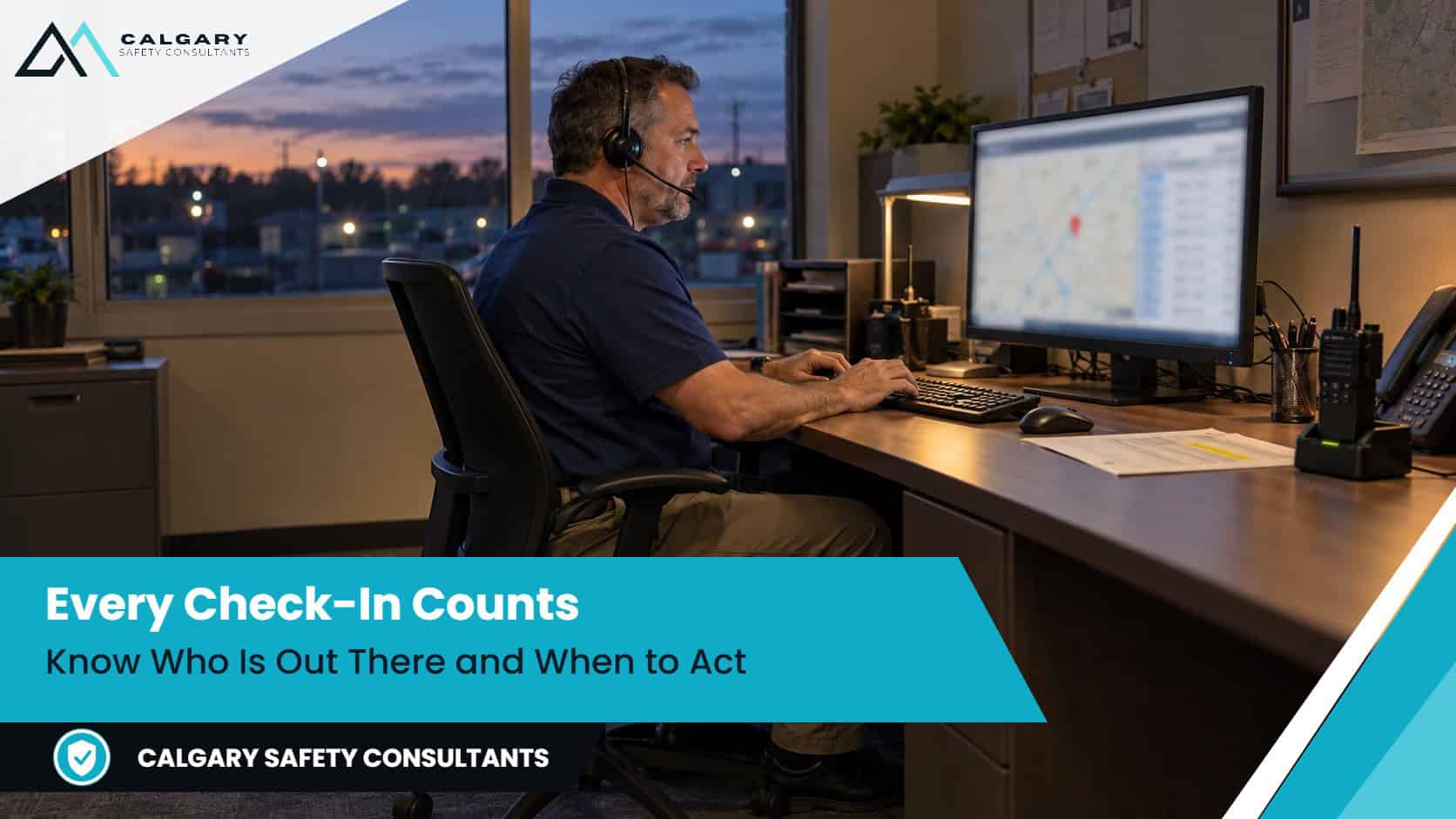
Practise it. Run an unannounced missed check-in drill a couple of times a year and time the escalation. If a missed check-in turns into an emergency, investigate it; our incident investigation guide explains how.
Step 6: Train Lone Workers and Check-In Contacts
British Columbia requires training for lone workers and the people who check on them, Prince Edward Island and New Brunswick require training for lone workers and supervisors, and the WSCC code expects all lone workers to be trained in the communication system and call-in procedures. Cover the hazards and controls, tasks never done alone, how to use and test the equipment, the check-in schedule, the escalation steps, emergency and robbery response, and the right to refuse unsafe work.
Train the check-in contacts too. As the HSE's lone working guidance says, there will always be greater risks for lone workers without direct supervision or anyone to help if things go wrong. Keep records and refresh training when the procedure or equipment changes. Our online working alone and lone worker safety course is built for lone workers, supervisors and check-in contacts across Canada.
Step 7: Write the Working Alone Policy and Procedure
Most jurisdictions require at least part of the program in writing. A practical working alone policy and procedure covers:
- Purpose, scope and what working alone means at your workplace.
- Responsibilities of the employer, supervisors, contacts and workers.
- How lone work is assessed, by whom and how often.
- Tasks that must not be done alone.
- Approved communication methods, intervals by risk, end of shift checks, backups and records.
- Missed check-in steps and the link to your emergency response plan.
- Training and review.
Manitoba requires procedures to be posted in a conspicuous place, and New Brunswick and Prince Edward Island require a copy for officers on request. WorkSafeNB's advice on working alone codes of practice is to involve the committee and affected employees, include the code in orientation and review it regularly. Fit the policy into your wider health and safety system rather than leaving it on its own.
Step 8: Review and Improve the Program
Lone work changes with new sites, staff, equipment and shifts. British Columbia and Newfoundland and Labrador require a review at least annually and after changes or a report that the procedure isn't working.
Manitoba requires a review at least every three years (s. 9.3(4)), and the WSCC code for the Northwest Territories and Nunavut recommends the same. Saskatchewan's late night retail hazard assessments are reviewed every three years and when circumstances change. Alberta requires hazard assessments to be repeated at reasonably practicable intervals and when a work process changes.
Review at least yearly anyway. Look at check-in logs for missed or late checks, device tests, drill results, incidents and worker feedback, and ask whether any lone work can now be eliminated. Track the fixes like any other corrective action, and use workplace safety inspections to confirm lighting, signs, equipment and emergency supplies are in place. Journey management and driver fatigue, which often overlap with lone work, are covered in separate guides.
Workplace example
A Practical Workplace Example
Situation: Consider a water and wastewater services company in Saskatchewan with about 30 employees. Its operators check lift stations, lagoons and rural treatment plants across a wide area, usually alone, and an on-call operator covers nights and weekends. The company's working alone policy was a single paragraph telling operators to carry a cell phone. Several stations had no reliable coverage, and nobody checked on the on-call operator overnight.
One winter night, an operator slipped on ice at a remote station, injured an ankle and couldn't get a signal. It was more than two hours before a family member raised the alarm.
Action: The company listed every lone work situation and assessed each one with the operators, rating initial risk on the same five-by-five matrix it used for job hazard analyses. Coverage was tested at every station.
Operators were given satellite-capable lone worker devices with no-motion alerts for sites without coverage, and confined space entry and chemical deliveries were added to a list of tasks never done alone. Check-in intervals were set with the occupational health committee: hourly for night and winter work, every two hours in daytime, and always at the start and end of the shift. A written escalation plan, with station locations and access routes, went to every check-in contact.
Result: Within six months, missed check-ins were being followed up within minutes rather than hours, and the logs showed which stations generated the most late checks. A surprise missed check-in drill showed the night contact reaching the second escalation step in under fifteen minutes. The company now reviews the program every year with the committee and has moved two high-risk tasks to daytime two-person crews.
Common Working Alone Mistakes to Avoid
- Treating a phone as the program. A phone with no coverage, a dead battery or no one checking on it doesn't keep anyone safe.
- Missing the less obvious lone workers. After-hours office staff, cleaners, early openers and home office workers often get left out.
- Intervals that don't match the risk. A single interval for every job is usually too long for the riskiest work.
- No plan for a missed check-in. Without written steps and times, contacts wait and hope.
- Untrained check-in contacts. The person receiving check-ins needs training as much as the worker does.
- No end of shift check. The worker who never gets home is the one this check catches.
- Allowing high-risk tasks alone. Some work needs a second person, whatever the communication plan.
- Never testing the system. Coverage, devices and escalation steps should be tested at the actual sites and drilled.
- Forgetting late-night retail rules. Retail employers in British Columbia, Saskatchewan and Alberta have extra specific obligations.
Audit perspective
What an Auditor Expects to See
In a COR audit, working alone usually comes up under hazard assessment, hazard control, training and emergency response rather than as a separate element. Alberta's page on how to get a Certificate of Recognition explains that audit instruments include interviews at all levels, a review of documents and observation of workplace conditions, and auditors use all three to test a working alone program.
On paper, an auditor will look for a working alone policy and procedure, hazard assessments that cover lone work, check-in records, training records for lone workers and contacts, and evidence of review.
In interviews, they'll ask lone workers how they check in, what happens if they don't and what they would do in an emergency, and they'll ask supervisors and contacts how they respond to a missed check. Energy Safety Canada's 2023 COR audit protocol also recognizes dispatched or remote workers, who are often lone workers, and auditors will want to see how the program reaches them. Answers should match the written plan.
Calgary Safety Consultants helps employers build and test working alone programs and prepare for COR and SECOR audits; we don't issue certificates. CORs and SECORs are issued through the applicable certifying partner.
The Bottom Line
A working alone program closes the gap between something going wrong and someone knowing about it. Find out who works alone and when, assess the hazards with the people doing the work, eliminate lone work where you can, and set up effective communication with check-in intervals that match the risk. Then plan exactly what happens when a check-in is missed, train workers and contacts, and review the program regularly.
The working alone requirements differ in detail across Canada, but the core is the same everywhere: a lone worker in trouble should be found quickly, and most of the time the trouble should never happen. Start with your highest-risk lone work, use the free downloads below, and build from there.
Download the Working Alone Hazard Assessment and Program Setup Checklist
Two free, fillable downloads go with this guide. Both are thorough, multi-page resources with clickable checkboxes and fillable fields, so you can complete them on screen or print them, and use the parts that fit your workplace.
- Working Alone Hazard Assessment and Check-In Plan (PDF, 7 pages). A how-to-use section and key definitions; the readily available test; a hazard checklist; a hazard table with initial risk rated before controls on the same five-by-five matrix as our FLHA and JHA forms, then controls and residual risk; tasks not to be done alone; the communication and check-in plan with backup methods; the missed check-in escalation plan; emergency location details; a late-night retail add-on for British Columbia, Saskatchewan and Alberta; a table of the jurisdictions that spell out check-in rules; worked prompts; common mistakes; sign-off; and a check-in log.
- Working Alone Program Setup Checklist (PDF, 6 pages). A step-by-step checklist with clickable checkboxes that follows the eight steps in this guide, plus a jurisdiction quick reference table, a lone work register, a policy contents checklist, technology selection and testing checks, training and drill records, a program review record, an action plan and sign-off.
Click either button to download the file. Adapt both to your own work and to the current requirements in your jurisdiction.

About the author
John Duplessis, B.Sc., CRSP
John Duplessis is a Canadian Registered Safety Professional with more than 30 years of occupational health and safety experience in oil and gas, construction, green energy, midstream operations and industrial project work. He is an external auditor with Energy Safety Canada.