On this page
- What Driver Fatigue Is and Why It Matters
- Who Is Most at Risk
- Two Sets of Rules: Hours of Service and OHS Law
- Commercial Vehicle Hours of Service Rules
- Fatigue Under OHS Law: The Employer's General Duty
- Build Fatigue Into Your Hazard Assessment
- Shift Scheduling and Hours of Work
- Long Commutes, Camp Work and Rotations
- Recognizing the Signs of Fatigue
- Fitness for Duty and Fatigue Reporting
- A Fatigue Risk Management Approach
- Trip Planning for Fatigue
- What Supervisors Do When a Worker Is Too Tired to Drive
- A Practical Workplace Example
- Common Driver Fatigue Mistakes to Avoid
- What an Auditor Expects to See
- The Bottom Line
- Download the Checklist and Supervisor Guide
- Frequently Asked Questions
- Related Guides and Articles
- How Calgary Safety Consultants Can Help
- Sources
What Driver Fatigue Is and Why It Matters
Fatigue is more than feeling a bit tired at the end of the day. Alberta's guidance on impairment in the workplace describes it as feeling very tired, weary or sleepy from mental or physical factors, and treats it as a form of impairment that employers and workers have to address. Behind the wheel, that impairment shows up as slower reactions, poorer judgement and, at worst, falling asleep.
The comparison with alcohol helps. In a study of transport and army workers, Williamson and Feyer found that after 17 to 19 hours without sleep, performance on some tests was as bad as, or worse than, at a blood alcohol concentration of 0.05 per cent. With longer sleep loss, it matched 0.1 per cent. A worker who starts at 6 a.m. and drives home after a long overtime shift can easily reach that range.
Road numbers are hard to pin down, because fatigue leaves no breath test. In the United States, NHTSA estimated that drowsy drivers were involved in 91,000 police-reported crashes in 2017, causing about 50,000 injuries and nearly 800 deaths, and says that's an underestimate. Transport Canada's briefing on fatigue management in transportation notes that fatigue is cited internationally as a factor in 15 to 20 per cent of road crashes.
In the Traffic Injury Research Foundation's Road Safety Monitor survey for 2011, almost one-fifth of drivers said they had fallen asleep or nodded off at the wheel in the past year. And driving is one of the deadliest things many workers do on the job. According to Road Safety at Work, motor vehicle incidents are the leading cause of traumatic work-related death in British Columbia, with about a third of those deaths from 2021 to 2025 involving vehicles.
Who Is Most at Risk
Anyone can drive tired, but some work patterns stack the odds. The common thread is sleep: too little, at the wrong time, or squeezed by long hours and travel.
- Night and rotating shift workers. In a closed-track study by Lee and colleagues, 16 night-shift workers drove for two hours after a night's sleep and again after a night shift. After the night shift, 6 of the 16 drives had near-crashes and 7 were stopped early for safety. After sleep, there were none of either.
- People working long hours or overtime. A NIOSH bulletin on work-related fatigue makes the point plainly: fatigue at work doesn't stay at work, because tired workers drive on public roads. It also reports that more than 60 per cent of night shift workers get less than the recommended 7 to 9 hours of sleep.
- Workers with long commutes or camp rotations. Drives before dawn or at the end of a rotation often fall at the day's lowest point.
- Workers who drive alone. NHTSA notes that drowsy-driving crashes often involve a single driver with no passengers who leaves the road at speed without braking, often on rural roads and highways.
- People with untreated sleep problems. Sleep apnea and other disorders can leave someone tired after a full night in bed.
Time of day matters too. NHTSA says sleepiness peaks between midnight and 6 a.m. and again in the late afternoon. Alberta's bulletin on fatigue and extended work hours reports that most major workplace incidents happen between 12 a.m. and 6 a.m. and between 1 p.m. and 3 p.m., when the body is naturally tired.
How much sleep is enough? The American Academy of Sleep Medicine and the Sleep Research Society recommend seven or more hours a night for adults, and say six or fewer isn't enough to sustain health and safety. Several five-hour nights add up to a real sleep debt, even if the worker feels fine.
Two Sets of Rules: Hours of Service and OHS Law
When people think about driver fatigue rules, they think of truck drivers and logbooks. Those rules are only part of the picture. Two bodies of law apply, and most employers need to understand both.
- Hours of service rules set maximum driving and on-duty time and minimum rest for drivers of commercial vehicles. They're transportation law, enforced by roadside officers and carrier audits.
- Occupational health and safety law covers every worker who drives for work, in any vehicle. It doesn't set driving hour limits, but it requires employers to identify hazards, including fatigue, and control them.
Responsibility is split. Transport Canada's overview of commercial vehicle safety in Canada explains that the federal government is responsible for extra-provincial truck and bus transport, while provinces and territories enforce the federal rules on its behalf and have sole responsibility for carriers that operate only within their borders.
Here's what many employers miss. The federal rules apply to trucks registered over 4,500 kg and to buses, run by carriers that cross borders. A worker in a half-ton pickup, a technician in a van or a manager in a car is usually outside hours of service rules altogether. For them, OHS law is the main legal control on fatigue.
Commercial Vehicle Hours of Service Rules
For carriers that cross provincial, territorial or national borders, the federal Commercial Vehicle Drivers Hours of Service Regulations apply. They set daily driving and on-duty limits, a daily rest requirement, a 7-day or 14-day cycle and a required 24-hour break in every 14 days.
They also contain a general rule worth quoting to any dispatcher: no carrier or other person may request, require or allow a driver to drive, and no driver may drive, if driving would be likely to jeopardize the safety or health of the public, the driver or the carrier's employees.
Federally regulated carriers must also use certified electronic logging devices, or ELDs, in place of paper logs. Transport Canada's page on fatigue management in trucking says the hours of service rules exist to mitigate fatigue-related risks, and that the ELD requirement came into force on June 12, 2021, with full enforcement since January 1, 2023.
Provincial rules for carriers that stay inside one province mostly follow the federal model. Transport Canada reported that 11 of 13 jurisdictions had adopted rules mirroring the federal ones by the end of 2018, with Alberta and Saskatchewan the exceptions. Those two provinces still use their own, older rules, and neither requires ELDs for carriers that operate only within the province.
| Jurisdiction | Who it covers | Driving and on-duty limits | Rest | Electronic logging |
|---|---|---|---|---|
| Federal, south of 60°N (carriers that cross borders) | Trucks registered over 4,500 kg and buses designed for more than 10 people, including the driver | 13 hours driving and 14 hours on duty in a day; no driving once 16 hours have passed since the last 8 hours off; 70 hours in 7 days or 120 hours in 14 days | 10 hours off duty in a day; 8 consecutive hours off before driving again after the daily limits; 24 consecutive hours off in every 14 days | Certified ELD required, enforced since January 2023, with exceptions such as the 160 km radius and pre-2000 vehicles |
| Federal, north of 60°N | Same vehicles | 8 consecutive hours off required after 15 hours driving or 18 hours on duty; no driving after 20 hours elapsed | 8 consecutive hours off; cycle limits of 80 hours in 7 days or 120 hours in 14 days | Same as above |
| Alberta (within Alberta only) | Trucks registered at 11,794 kg or more and buses designed for 11 or more people, including the driver | No driving after 13 hours driving in a work shift or after 15 consecutive hours on duty; no 7-day or 14-day cycle | 8 consecutive hours off before the next shift, reducible to 4 hours once every 7 days | Not required; an automatic onboard recording device may replace the paper log |
| Saskatchewan (within Saskatchewan only) | Truck and trailer combinations with a towing unit registered over 5,000 kg, and vehicles seating more than 10 | No driving more than 13 hours after 8 consecutive hours off, or after 15 hours on duty; no 7-day or 14-day cycle | 8 consecutive hours off before going on duty, reducible to 4 hours once in 7 days in limited cases | Not required; paper logs or another approved method |
| British Columbia (within B.C. only) | Commercial vehicles under Division 37 of the Motor Vehicle Act Regulations | 8 consecutive hours off required after 13 hours driving or 14 hours on duty; no driving after 16 hours elapsed between off-duty periods (s. 37.25) | Broadly mirrors the federal rules; see Division 37 for daily off-duty and cycle rules | Required since August 1, 2023 for drivers who keep a daily log, unless exempt |
| Ontario (within Ontario only) | Commercial motor vehicles over 4,500 kg and buses | 13 hours driving in a day; no driving after 14 hours on duty or once 16 hours have passed since 8 hours off; 70 hours in 7 days or 120 hours in 14 days | 10 hours off duty in a day | Required for drivers who keep a daily log, including trucks operating only in Ontario |
Summary only. Each set of rules has exemptions, permits, deferral options and record-keeping details not shown here. Check the full regulation and your provincial or territorial transportation regulator before relying on a number.
The sources behind the provincial rows are Alberta's provincial hours of service module, Saskatchewan's hours of service regulations and its ELD page, B.C.'s NSC bulletin on ELDs, and Ontario's truck handbook and ELD requirements.
Alberta's module says plainly that fatigued drivers must not operate a commercial vehicle, and its hours of service and fatigue management page recommends that all carriers create a fatigue management program. Hours of service limits are a ceiling, not a target: a driver can be legal on paper and still too tired to drive safely.
Fatigue Under OHS Law: The Employer's General Duty
No Canadian OHS statute sets a maximum number of hours a worker may drive a pickup in a day. What every jurisdiction does have is a general duty to protect workers from hazards, and fatigue fits squarely inside it.
Federally, section 124 of the Canada Labour Code says every employer shall ensure that the health and safety at work of every person employed by the employer is protected. In Alberta, Part 1 of the OHS Act requires employers to protect workers' health, safety and welfare as far as reasonably practicable, requires supervisors to take all precautions necessary and warn workers of known or reasonably foreseeable hazards, and requires workers to take reasonable care.
Alberta's 2009 explanation guide to the OHS Code hazard assessment rules gives work-related fatigue as an example of a site-specific hazard employers should assess even though the Code doesn't address it explicitly. It also lists limiting hours of work and work and rest schedules as administrative controls. The government's impairment guidance adds that workers must not perform work when there's a risk of impairment that may affect their own or others' safety.
In British Columbia, section 4.19 of the OHS Regulation requires a worker with an impairment that may affect safe work to tell their supervisor or employer, and bars assigning a worker to activities where a reported or observed impairment may create an undue risk. A note to sections 4.19 and 4.20 names fatigue as a potential source of impairment.
Saskatchewan's summary of employer duties requires a safe and healthy workplace, with the information, training and supervision workers need. Ontario's guidance on impairment at work repeats the duty to take every precaution reasonable in the circumstances.
| Jurisdiction | General duty | What it means for fatigue |
|---|---|---|
| Federal (Canada Labour Code) | Employers must ensure the health and safety at work of every employee is protected | Covers federally regulated employers, including interprovincial trucking, whatever the vehicle |
| Alberta | Employers protect workers as far as reasonably practicable; supervisors take all precautions necessary; workers take reasonable care | Government guidance names work-related fatigue as a hazard to assess and treats fatigue as impairment that must be controlled |
| British Columbia | Workers must report an impairment that may affect safe work and must not be assigned work where it creates undue risk | The regulation's note names fatigue as a potential source of impairment |
| Saskatchewan | Employers provide a safe and healthy workplace, with the information, training and supervision workers need | Fatigue falls under the general duty and the employer's safety program |
| Ontario | Employers take every precaution reasonable in the circumstances for the protection of a worker | Ontario's impairment guidance (written for drugs and alcohol) says supervisors who know a worker is impaired should consider stopping them from hazardous work |
| Other provinces and territories | Each OHS statute contains a general duty on employers, and most also set out supervisor duties | Fatigue is managed through hazard assessment and controls under that general duty |
For other jurisdictions, use our guide to OHS legislation in Canada. The message is the same everywhere: if your workers drive, fatigue is a hazard to assess and control.
Build Fatigue Into Your Hazard Assessment
Driver fatigue management starts with your existing hazard assessment, not a separate binder. For every job that involves driving, ask how far, how often, at what time of day and after how many hours of work. A 40-minute daylight drive is a different risk from a four-hour drive home after a 12-hour night shift.
- List driving as a task. Include site travel, deliveries, commuting in company vehicles and end-of-rotation travel in your job hazard analysis for each role.
- Rate fatigue honestly. Consider shift length, night work, consecutive days, overtime, commute time and how much sleep the schedule realistically allows.
- Add it to field checks. A fatigue question on the field-level hazard assessment gives workers a daily prompt to say they're not fit to drive.
- Choose controls from the top down. Using the hierarchy of controls, the strongest options remove or shorten the drive: local accommodation, a crew bus, a different schedule. Breaks, check-ins and training come after.
Auditors look for this. Energy Safety Canada's 2023 COR audit protocol asks whether all positions have tasks identified in formal hazard assessments and whether the health and safety hazards for each task have been identified. Its list of examples includes fatigue among psychological hazards.
Shift Scheduling and Hours of Work
Schedules are the strongest fatigue control most employers have, because they decide how much sleep is possible. Alberta's fatigue bulletin suggests keeping schedules consistent so workers can keep regular sleep patterns, and recognizes that night shifts and shifts starting before 6 a.m. are linked to less sleep. Where you can, schedule safety-sensitive tasks, including long drives, outside the high-risk hours.
- Count the whole day. Alberta's fatigue quick facts note that workers on extended shifts may have only 4 to 5 hours left for sleep after travel, eating and social time, while most people need 7.5 to 8.5 hours.
- Limit overtime that ends with a drive. Set a rule for when extra hours mean the worker gets a ride, a room or a later start instead of driving.
- Protect rest between shifts. Mandatory off-duty time makes rest more likely. Avoid a late finish followed by an early start.
- Watch consecutive days. Sleep debt builds, so the last days of a stretch carry the most risk.
- Plan for call-outs. A worker called out at 2 a.m. after a full day has been awake a long time already.
Long Commutes, Camp Work and Rotations
Many Western Canadian workers spend hours on the road getting to and from work: to a distant lease site, to camp, or home after the last shift of a rotation. The BC Forest Safety Council's paper on commuting and fatigue calls the drive to and from the worksite a critical time for fatigue-related vehicle incidents, and lists commute length, early-morning or late-night travel, night shifts and hours awake as risk factors.
Whether a commute counts as work under your province's rules is a separate question. If your schedule creates the fatigue, it's your hazard to manage.
- Provide transport where you can. Crew buses and group transport take the drive out of tired workers' hands. The BC Forest Safety Council lists group transportation, better shift scheduling and pairing workers among employer measures.
- Use accommodation well. Alberta's quick facts point to on-site accommodation, prepared meals and quiet rooms. A camp only helps if workers can sleep there.
- Manage the last day of a rotation. Don't schedule a full shift and then a long drive home. Finish early, start the drive in the morning or provide an overnight stay.
- Manage the first day too. A worker who leaves home at 3 a.m. for a 7 a.m. camp start has barely slept.
Workers who drive long distances alone also need a check-in system. Our guide to working alone explains how to set one up.
Recognizing the Signs of Fatigue
Fatigue is hard to judge from the inside, because tired people are often the last to notice. Drivers and supervisors both need to know the warning signs. The Road Safety at Work driver fatigue tool kit lists signs on the road, including:
- drifting in the lane or onto the shoulder, or trouble holding a steady lane position
- speed creeping up and down without meaning to
- head nodding or micro-sleeps
- not being able to remember the last few minutes or kilometres
- frequent yawning, sore or blurry eyes and slower reactions
Before the drive, supervisors can watch for what Alberta's bulletin describes: a worker who seems sleepy, irritable, sad or giddy. Other clues include mistakes on simple tasks, trouble concentrating, a long run of shifts, or a mention of a sleepless night.
The most dangerous sign is the micro-sleep. NHTSA warns that seriously sleep-deprived drivers can have micro-sleeps lasting 4 to 5 seconds, long enough to cover a lot of road. Turning up the radio or opening a window doesn't fix it. Only sleep does.
Fitness for Duty and Fatigue Reporting
Fitness for duty means a worker is able to do their job safely at the start of the shift and throughout it. For drivers, that includes being rested enough to drive. A simple self-check before a long drive or at shift start helps workers think it through: how much they slept in the last 24 hours, how long they've been awake, and how they feel right now.
Self-checks only work if honesty is safe. If saying "I'm too tired to drive" leads to lost pay, teasing or a black mark, people stop saying it. Your fatigue policy should make clear that reporting fatigue is expected and never disciplined.
- Make reporting simple. A call, a line on the hazard assessment or a box on the trip plan all work.
- Treat it as information. One report is today's problem. Several from one crew point to a schedule problem.
- Support sleep health. Persistent tiredness can signal a sleep disorder. The North American Fatigue Management Program, managed by the Commercial Vehicle Safety Alliance, includes free education on identifying sleep disorders and treatment options for drivers, families and carriers.
- Respect privacy. Ask whether a worker is fit to drive, not for medical history.
Workers have duties too. Alberta's impairment guidance and B.C.'s regulation both say workers must not do work where impairment creates a risk to themselves or others. Our article on the right to refuse unsafe work explains how refusals work when a worker believes a task is dangerous.
A Fatigue Risk Management Approach
A fatigue risk management program pulls all of this into one system. Transport Canada describes a fatigue risk management system as a tailored, performance-based approach to managing fatigue. Under its flight and duty time rules, air operators can either follow the prescriptive limits or submit an alternate plan showing how a fatigue risk management system will give equivalent control of fatigue risks.
Railways have had to submit fatigue management plans. Road employers aren't required to have one, but the approach works for any company with drivers.
Energy Safety Canada's fatigue risk management guideline is written for supervisors, managers, senior leaders and fatigue risk management committees, and aims to reduce incidents, injuries and damage caused by fatigue. For trucking, Transport Canada's page describes the North American Fatigue Management Program as a voluntary, no-fee program covering fatigue management, work and rest practices, and sleep disorder screening and treatment.
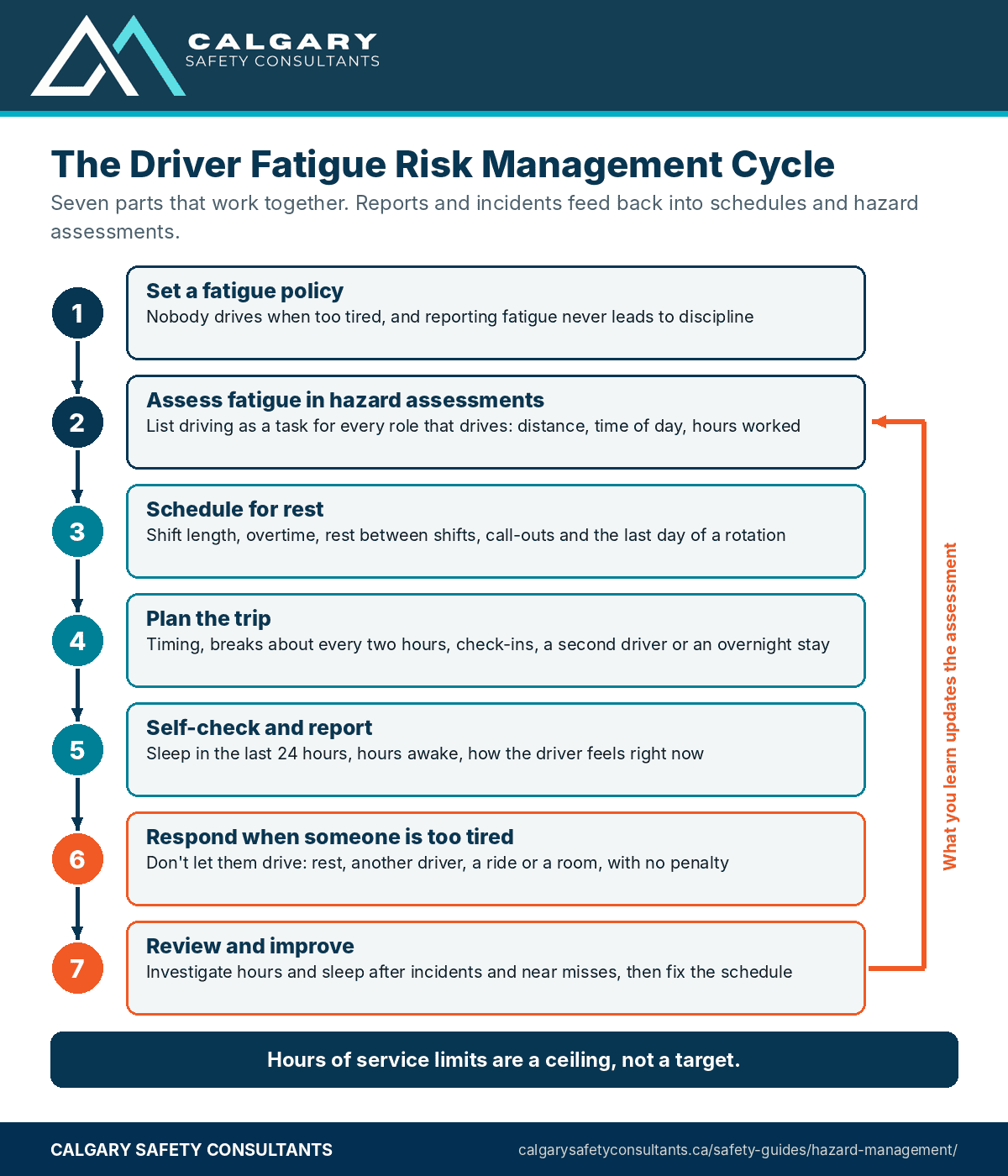
A practical program for a small or mid-size employer usually has these parts:
- A written fatigue policy saying nobody drives when too tired.
- Hazard assessment of fatigue for every role that drives.
- Scheduling rules on shift length, overtime, rest and when a drive becomes a ride or a room.
- Trip planning for long or high-risk drives.
- Self-checks and reporting with no penalty for honesty.
- Training on causes, signs and what to do.
- Investigation and review that asks about hours worked and sleep whenever a vehicle incident or near miss happens. Our incident investigation guide explains how to dig into causes like these.
Build the program into your wider health and safety system so it gets reviewed with everything else.
Trip Planning for Fatigue
For long or unusual drives, a short trip plan does more than any poster. The UK Health and Safety Executive's guidance on planning and managing journeys is a good model: calculate journey times that allow safe driving within the speed limit, tell drivers clearly they shouldn't drive if they feel sleepy, even if that affects schedules, and consider overnight stays to manage risk.
- Is the trip necessary? A video call or crew bus may remove the drive.
- Is the timing right? Avoid the midnight to 6 a.m. window and the afternoon low where you can, and don't start a long drive at the end of a long shift.
- Are breaks planned? Road Safety at Work suggests allowing time for a break every two hours. Pick the stops before leaving.
- Is there a second driver or a place to stop? Book an overnight stay for trips too long for one day.
- Who knows the plan? Set check-in times and agree what happens if one is missed.
If a driver gets drowsy on the road, the answer is to stop. NHTSA's advice is one to two cups of coffee, then a 20-minute nap in a safe, lit spot, and it warns the benefit is short-lived. Energy Safety Canada's journey management guideline sets out how to turn trip planning into a full program, and our guide to journey management walks through it step by step. Pre-use vehicle inspections, which we cover in a separate guide, belong in the same routine.
What Supervisors Do When a Worker Is Too Tired to Drive
Sooner or later a worker will say they're too tired to drive, or a supervisor will see it. How that moment goes says a lot about your culture. Road Safety at Work recommends that employers spell out in advance what supervisors and co-workers will do when an employee looks too tired to drive, so nobody has to improvise.
- Take it seriously. Thank the worker for speaking up, or raise what you've noticed privately and calmly.
- Don't let them drive. Take the keys if you have to. Ontario's guidance says supervisors who know a worker is impaired should consider stopping them from doing hazardous work, and Alberta's Act requires supervisors to take all precautions necessary.
- Offer a safe alternative. A rest or nap in a safe place, another rested driver, a crew vehicle, a ride service or a hotel room. Decide in advance who pays, so cost never decides.
- Adjust the work. Move the drive to morning, reassign it or reschedule the job.
- Don't penalize honesty. No discipline, lost pay or pressure for reporting fatigue in good faith.
- Record it and look for the cause. Note what happened and why. Was it the schedule, a call-out, overtime or a personal issue? Track the follow-up like any other corrective action.
Supervisors need support from above. If sending a tired worker to a hotel earns criticism, the program won't survive the next busy week.
Workplace example
A Practical Workplace Example
Situation: Consider an illustrative well-servicing contractor in central Alberta with about 60 workers. Crews worked 12-hour shifts on a 14 days on, 7 days off rotation, staying in motels near the job and driving company pickups between sites. After a worker drifted off the road on the drive home at the end of a rotation, the investigation found he had worked a night shift, then driven three hours on about four hours of sleep. Nobody had broken a rule, because there wasn't one.
Action: The safety coordinator added fatigue to the hazard assessment for every role that drives and put a fatigue question on the daily field-level hazard assessment. The company set two rules: no drive longer than two hours after a night shift, and no drive home at the end of a rotation without a full sleep first. It paid for extra motel nights, added a one-page trip plan for longer drives and trained supervisors on the signs of fatigue.
Result: Within a few months, supervisors were fielding fatigue reports a couple of times a month, mostly after call-outs. Two of those patterns led to schedule changes. The extra motel nights cost far less than one damaged truck, and the company's next COR audit found fatigue identified in its hazard assessments with controls that workers could describe.
Common Driver Fatigue Mistakes to Avoid
- Thinking hours of service is the whole answer. Most work drivers aren't covered, and legal hours can be unsafe.
- Leaving fatigue out of hazard assessments. If driving isn't listed as a task, fatigue won't be assessed or controlled.
- Ignoring the commute. The drive home after a night shift or a rotation is often the week's riskiest.
- Scheduling to the limit. Rosters that use every hour leave no slack for traffic, weather or poor sleep.
- Relying on coffee and willpower. Only sleep fixes fatigue.
- Punishing honesty. Discipline, lost pay or teasing for reporting fatigue guarantees people will stop reporting it.
- No plan for the moment. Supervisors who can't approve a hotel room default to "be careful out there."
- Not asking about sleep in investigations. Skipping hours worked and sleep misses a common cause.
Audit perspective
What an Auditor Expects to See
In a COR or SECOR audit, fatigue usually comes up under hazard assessment and hazard control. An auditor will typically look for driving listed as a task in the formal hazard assessments for the roles that drive, fatigue identified as a hazard, and controls that make sense for the work: scheduling rules, trip plans, check-ins and a fatigue policy.
Interviews tell the rest. Workers should be able to say what they'd do if too tired to drive, and supervisors how they've handled it. Vehicle incident investigations should show that hours worked and sleep were considered.
Calgary Safety Consultants helps employers build and review their programs and prepare for COR and SECOR audits; we don't issue certificates. CORs and SECORs are issued through the applicable certifying partner.
The Bottom Line
Driver fatigue is one of the most underestimated hazards in Canadian workplaces. Hours of service rules cover commercial drivers, but the general duty in every OHS law covers everyone who drives for work, and fatigue belongs in your hazard assessment alongside every other driving risk.
Manage it the way you'd manage any serious hazard. Build schedules that allow real sleep, plan long trips around rest, teach people the signs, and make it normal and safe to say "I'm too tired to drive." When that happens, have a plan ready, and use what you learn to fix the schedule that caused it.
Download the Driver Fatigue Checklist and Supervisor Quick Guide
Two free, fillable PDF downloads go with this guide. Both have clickable checkboxes and fill-in fields, so you can complete them on screen or print them for the truck.
- Driver Fatigue Self-Assessment and Trip Planning Checklist (PDF, 6 pages). A pre-drive self-check on sleep, hours awake and risk factors with clear stop triggers, a trip plan with breaks, rest stops and check-ins, the on-road warning signs, an hours of service quick reference for commercial drivers, a post-trip record, key terms, common mistakes and sign-off.
- Fatigue Management Quick Guide for Supervisors (PDF, 6 pages). Fatigue duties by jurisdiction, a scheduling and rotation checklist, signs to watch for, a step-by-step response when a worker is too tired to drive, a fatigue report and response record, hazard assessment prompts, a fatigue risk management program checklist, common mistakes, definitions and sign-off.
Click either button to download the file. Adapt both to your own policies, schedules and the rules that apply in your province or territory.

About the author
John Duplessis, B.Sc., CRSP
John Duplessis is a Canadian Registered Safety Professional with more than 30 years of occupational health and safety experience in oil and gas, construction, green energy, midstream operations and industrial project work. He is an external auditor with Energy Safety Canada.