On this page
- What a Pre-Use Inspection Is
- Why Pre-Use Inspections Matter
- Who Does Pre-Use Inspections
- When a Pre-Use Inspection Is Needed
- What the Law Requires Across Canada
- Commercial Vehicle Trip Inspections Under NSC Standard 13
- Forklifts and Lift Trucks
- Elevating Work Platforms and Aerial Lifts
- What a Good Pre-Use Checklist Covers
- Defects: Report, Tag and Do Not Use
- Record Keeping
- Paper or Digital Inspections
- Training Operators to Inspect
- Rentals, Contractors and Shared Equipment
- Auditing Pre-Use Inspections
- A Practical Workplace Example
- Common Pre-Use Inspection Mistakes
- What an Auditor Expects to See
- The Bottom Line
- Download the Pre-Use Inspection Checklists
- Frequently Asked Questions
- Related Guides and Articles
- How Calgary Safety Consultants Can Help
- Sources
What a Pre-Use Inspection Is
A pre-use inspection is the check an operator does before putting a vehicle or machine to work. It's usually a walkaround followed by an in-cab or at-the-controls check: tires, fluids, leaks, lights, brakes, steering, horn, alarms, seat belt, guards and attachments. The operator records the result and reports anything wrong. In a truck, the same idea is called a pre-trip inspection or a daily trip inspection.
WorkSafeBC's guidance on workplace inspections puts it plainly: workers who operate equipment are responsible for pre-use inspections of that equipment, and employers must train workers to do these checks and confirm they happen.
A pre-use inspection isn't a mechanical inspection or a service. It's a quick check by the person about to use the equipment, aimed at defects that can be seen, heard or felt. The UK Health and Safety Executive's guidance on inspection of work equipment makes the same split: a quick visual check before use is enough for many items, while equipment that wears also needs more detailed inspections at suitable intervals.
This guide covers the law across Canada for mobile equipment, forklifts and work platforms, commercial vehicle trip inspections, checklists, defects, records and auditing. For planned inspections of the whole work site, see our guide on how to conduct a workplace safety inspection.
Why Pre-Use Inspections Matter
Equipment fails in predictable ways. Brakes wear, hoses chafe, tires lose pressure and backup alarms stop working, and most of those failures give warning signs long before they cause harm. A worker who finds a cracked hydraulic hose at 7 a.m. has prevented a spill or a dropped load at 10 a.m.
Regulators know this. When Alberta's OHS officers ran a focused inspection project on powered mobile equipment, Part 19 of the OHS Code accounted for 85 of the 214 orders written. The most frequent were under section 260, on inspection and maintenance of equipment, followed by section 257, on visual inspection before operating, and section 256, on operator training and responsibilities.
There's a business case too. Defects found at the start of a shift are cheaper to fix than breakdowns mid-job, and honest records of inspections and repairs are strong evidence of due diligence if something does go wrong.
Who Does Pre-Use Inspections
The operator usually does the inspection, because they're about to rely on the machine and know how it should feel and sound. But several people have a part to play.
- Operators and drivers do the inspection, record it honestly, report defects and refuse to use equipment that isn't safe.
- Supervisors make sure inspections happen before work starts, review the forms, act on reported defects the same day and never pressure anyone to run equipment that's been flagged.
- Mechanics and maintenance staff repair defects, confirm the repair and clear the equipment for use.
- The employer sets up the system: equipment-specific checklists, training, defect reporting and tagging, records and follow-up, along with manufacturer's maintenance schedules and any required periodic inspections.
When a Pre-Use Inspection Is Needed
The short answer is before the equipment is used on each shift, and whenever something has happened that could have changed its condition. The exact trigger depends on the equipment and the jurisdiction, but these are the common ones:
- Before first use on each shift or day. This is the standard trigger for mobile equipment, lift trucks and elevating work platforms in most provinces, and for commercial vehicles under the trip inspection rules.
- When a new operator takes over. Many employers require a quick check by the new operator when a machine changes hands mid-shift.
- After an incident or possible damage. WorkSafeNB's guide to workplace inspections notes that New Brunswick requires a competent person to inspect an industrial lift truck before it's first put in use and after any incident that may have damaged some part of it, on top of the daily inspection.
- When equipment arrives on site. Rented, borrowed or contractor-supplied equipment should be inspected before your workers use it, whatever the supplier says.
- After repairs or modifications. Equipment returned from the shop should be checked before it goes back to work, and the repair confirmed on the defect record.
Pre-use inspections don't replace the periodic inspections and preventive maintenance that manufacturers and regulations require. They're the daily layer on top of a maintenance program, not a substitute for one.
What the Law Requires Across Canada
Every Canadian jurisdiction requires employers to keep equipment in safe condition, and most add specific rules for mobile equipment, forklifts and work platforms. Here's how the main rules line up.
British Columbia is the clearest. Under Part 16 of the OHS Regulation on mobile equipment, before mobile equipment is first operated on a shift, the operator must inspect it and report unsafe or potentially unsafe defects to the supervisor or employer. During operation, the operator must keep monitoring the equipment's performance. The employer must keep a record of reported defects for at least two years, which can be part of the maintenance record.
Alberta covers this ground in Part 19 of the OHS Code. Section 257 requires the operator to visually inspect the equipment and the surrounding area before operating it. Section 260 requires the employer to have powered mobile equipment inspected by a competent worker, kept out of use until defects are repaired, and a record of inspections and maintenance kept at the work site, and s.256 sets out operator responsibilities. Read the current text of Part 19 for the full wording.
Saskatchewan's OHS Regulations, 2020 define powered mobile equipment as a self-propelled machine designed to move or manipulate materials or to provide a work platform, and Part 11 includes sections on visual inspection (11-3) and inspection and maintenance (11-4). The general equipment rule in s.3-14 requires maintenance at sufficient intervals, immediate steps to protect workers when equipment has a defect, and workers to report unsafe equipment to the employer immediately.
Manitoba's regulator, SAFE Work Manitoba, explains that under Part 22 of the Workplace Safety and Health Regulation, employers must make sure powered mobile equipment is inspected by a competent person for defects and unsafe conditions as often as necessary, and that defects are reported and addressed before trained workers operate it.
Ontario relies on the general duty in the OHSA to keep equipment in good condition and on section 51 of Regulation 851 for lifting devices. Ontario's lift truck guideline explains that the legal requirements for lifting devices should be read broadly to cover the whole powered lift truck, not only the mast. New Brunswick requires industrial lift trucks to be inspected daily, as noted above.
Federally regulated workplaces follow Part XIV of the Canada Occupational Health and Safety Regulations. Before materials handling equipment is first used, the employer must set out written instructions for inspection, testing and maintenance, including how often they're done. A qualified person does the work and signs a report, which is kept for one year. Defective equipment that poses a hazard must be taken out of service until a qualified person repairs it.
| Jurisdiction | Main requirement | When | Records |
|---|---|---|---|
| British Columbia | OHS Regulation Part 16: the operator inspects mobile equipment and reports unsafe defects to the supervisor or employer (s.16.3). Elevating work platforms: Part 13 (s.13.3) | Before mobile equipment is first operated on a shift; platforms before use on each shift and after any modification | Record of reported defects kept at least 2 years (s.16.3) |
| Alberta | OHS Code Part 19: operator responsibilities (s.256), visual inspection (s.257), inspection and maintenance (s.260) | Operator visual inspection of the equipment and surrounding area before operating (s.257); competent worker inspections (s.260) | Record of inspections and maintenance kept at the work site (s.260) |
| Saskatchewan | OHS Regulations, 2020, Part 11: visual inspection (11-3) and inspection and maintenance (11-4) of powered mobile equipment; defects (3-14) | Check the current text of Part 11 and Part 12 for your equipment | Follow the regulations and your program |
| Manitoba | Workplace Safety and Health Regulation Part 22: inspection by a competent person for defects and unsafe conditions | Operator visual check before operating; competent person inspections as often as necessary; defects addressed before use | Written records of inspections, repairs and maintenance kept at the workplace and available to workers |
| Ontario | OHSA s.25: equipment maintained in good condition. Reg. 851 s.51: lifting devices, read to include the whole lift truck | Lifting device examined by a competent person before it's first used and then at least once a year (more often if the manufacturer recommends) | Signed record of each examination; keep at least the two most recent |
| New Brunswick | General Regulation 91-191 s.216: industrial lift trucks | Inspected daily; competent person inspection before first use and after possible damage | Follow the regulation and your program |
| Federal | Canada Occupational Health and Safety Regulations Part XIV: written inspection, testing and maintenance instructions (s.14.20) | Frequency set in the employer's written instructions | Signed reports kept 1 year; training records kept while the operator is employed |
| Other provinces and territories | Mobile equipment, lift truck and platform rules in each OHS regulation, plus the general duty to maintain equipment | Usually before use or on a set schedule | Check the regulation that applies |
A summary only, checked against the official sources linked in this guide in October 2026. Where the official text couldn't be read, the table reports what the regulator's own pages say, so confirm the current wording.
Whatever province you're in, start with your own regulation. Our guide to OHS legislation in Canada links to every jurisdiction's laws.
Commercial Vehicle Trip Inspections Under NSC Standard 13
Trucks and buses have their own pre-use rules under transportation law. The National Safety Code is, as the Canadian Council of Motor Transport Administrators describes it in its NSC fact sheet, a set of 16 standards developed by its member jurisdictions. Standard 13 covers trip inspections. Each province and territory adopts the standards through its own legislation, so the rules look similar across the country but aren't identical.
Which vehicles are covered depends on where you operate. In Alberta, which applies the National Safety Code standards, Alberta Transportation's summary of safety and maintenance program requirements shows that commercial vehicles registered over 4,500 kg need a daily trip inspection and must not be driven with a major defect, while the written trip inspection report and a copy of Schedule 1 in the vehicle are required for vehicles registered for 11,794 kg or more. Check the registered weights of heavier pickups and service trucks.
The core of Standard 13 is consistent. SGI's handbook on trip inspection standards says the inspection must be done once in every 24-hour period while the vehicle is in use, using the schedule for the vehicle type. Minor defects must be repaired before the next trip inspection, and a vehicle with a major defect can't be driven until it's repaired. In Saskatchewan, drivers carry the reports for the current and previous day, with the schedule.
Ontario's summary of commercial vehicle safety requirements applies the daily inspection to trucks over 4,500 kg, tow trucks of any weight and buses designed for 10 or more passengers. The MTO truck handbook adds that drivers must monitor the vehicle throughout the trip and report defects found on the road to the operator as soon as possible.
Nova Scotia's trip inspection regulations show what a report needs: the plate, VIN or unit number, odometer reading, defects found or a statement that none were, the carrier's name, date, time, location and the inspector's signature and printed name. Paper and electronic reports both work.
| Term | What it means in practice |
|---|---|
| Trip inspection | The daily inspection of a commercial vehicle against the applicable schedule, recorded on a trip inspection report. Often called a pre-trip inspection. |
| 24-hour rule | The inspection must be done at least once in every 24-hour period while the vehicle is in use. A vehicle can't be driven on an inspection that's more than 24 hours old. |
| Schedule 1 | Trucks, tractors and trailers. |
| Schedule 2 | Buses, and trailers towed by a bus. |
| Schedule 3 | Motor coaches with air ride suspension, air brakes and automatic brake adjusters (as SGI describes it). |
| Minor defect | Recorded and reported to the carrier. In Saskatchewan and Nova Scotia, for example, it must be repaired before the next trip inspection. |
| Major defect | The vehicle must not be driven until it's repaired. |
Based on SGI's trip inspection standards, Ontario's commercial vehicle pages and Nova Scotia's trip inspection regulations. Weight thresholds and record rules differ by province, so check your own.
Trip inspections are one part of keeping drivers safe on the road. Our guides on setting up journey management for field crews and managing driver fatigue cover the rest of the trip.
Forklifts and Lift Trucks
Forklifts get their own attention in most regulations because a defect in the mast, chains, forks or brakes can drop a load or crush a pedestrian. The visual check is done with the truck parked, forks lowered and power off, then the controls are tested with it running.
In British Columbia, Part 16 requires lift trucks to be designed, used, inspected, maintained and repaired to CSA B335-15, the safety standard for lift trucks, or, as applicable, the listed ANSI/ITSDF or ISO standard (or the version in force when the truck was made), and operator training must meet Clause 6 of CSA B335.
Ontario's lift truck guideline on maintenance explains that under Regulation 851 a lifting device must be examined by a competent person before it's first used and then at least once a year (more often if the manufacturer recommends), and that the truck must be plainly marked with its maximum rated load. It also makes the point that an employer's responsibilities can't be passed on to a maintenance contractor.
US rules are a useful comparison. OSHA's standard for powered industrial trucks requires trucks to be examined at least daily before being placed in service, and a defective truck taken out of service until it's restored to safe condition.
A forklift checklist should cover at least:
- Forks, carriage and backrest for cracks, bends and wear, and fork locking pins in place.
- Mast, chains and rollers for damage, lubrication and even tension.
- Hydraulic hoses and cylinders for leaks; fluid levels; tires for damage and inflation where applicable.
- Overhead guard, seat belt and capacity plate; brakes, steering, horn, lights and backup alarm.
- Lift, lower and tilt controls working smoothly and returning to neutral.
Elevating Work Platforms and Aerial Lifts
Scissor lifts, boom lifts and vehicle-mounted aerial devices put workers at height on a machine, so a missed defect can mean a fall or a tip-over. The check covers the machine on the ground and a function test of the ground and platform controls, including emergency lowering, before anyone goes up.
British Columbia's rules on ladders, scaffolds and temporary work platforms define an elevating work platform as a movable work platform that self-elevates to overhead work locations. Equipment must meet the applicable CSA or ANSI standard in effect when it was manufactured, must be inspected before use on each shift and after any modification, and the manufacturer's operation manual must be available at the workplace.
In Ontario, IHSA's guide to elevating work platforms explains that under the construction regulation (O. Reg. 213/91, s.144) a platform must be inspected each day before use by a trained worker, and must meet CSA standards including the B354 series.
Ontario also filed a new regulation on elevating work platforms, O. Reg. 117/26, in April 2026, as listed in the Ontario Gazette. It's scheduled to come into force on January 1, 2027 and moves the construction rules for elevating work platforms into a standalone regulation with new operator training requirements, so check e-Laws for the requirements that apply on your dates.
A platform checklist should cover guardrails and gate, the platform floor, controls and emergency stops at both stations, emergency lowering, tires and outriggers, the tilt alarm, hydraulic leaks, decals and the capacity plate, and the work area: ground conditions, slopes, holes and overhead power lines.
What a Good Pre-Use Checklist Covers
A checklist keeps the inspection consistent, especially early in the morning when people are tempted to rush. The best ones are built for the specific equipment from the manufacturer's operator's manual, and short enough that operators actually use them. A generic form for every machine tends to miss the items that matter on each one.
Most good pre-use checklists share the same structure:
- Identification. Unit number or serial number, hour meter or odometer, date, time, location and operator name.
- Walkaround. Visible damage, leaks under the machine, tires or tracks, wheels and lug nuts, lights and mirrors, guards, steps and handholds, and attachments.
- Fluids. Engine oil, coolant, hydraulic oil, fuel and, for trucks, washer fluid and DEF where used.
- Safety devices. Seat belt, rollover or falling object protection, horn, backup alarm and camera, fire extinguisher, first aid kit and any emergency stop.
- Operational checks. Gauges and warning lights after start-up, brakes, steering, controls and hydraulic functions, and any interlocks.
- Work area. Ground conditions, overhead hazards, pedestrians and traffic, which ties in with your hazard assessment.
- Result. A clear pass, fail or defect line, a description of any defect, the action taken and signatures from the operator and, for defects, the supervisor or mechanic.
Keep the checklist tied to the rest of your program. The pre-use inspection checks the machine, the field-level hazard assessment checks the task and site, and your job hazard analysis sets the controls for the job. Many employers combine the equipment and site checks on one form.

Defects: Report, Tag and Do Not Use
An inspection only protects people if defects lead to action. Every pre-use program needs a clear rule about what happens when the operator finds something wrong, and the rule needs to be the same on a busy day as on a quiet one.
Start by deciding which defects stop the equipment. Borrow from the trip inspection rules: some defects, such as brakes, steering, a failed seat belt, a cracked fork or a missing guardrail, mean the equipment must not be used until it's repaired. Others, like a torn seat cover, can be recorded and scheduled. Write that list down for each type of equipment so operators aren't deciding under pressure.
When equipment is unsafe, take it out of service so no one can use it by accident. British Columbia's general conditions require unsafe equipment to be identified in a way that prevents it from being returned to service until it's made safe. In practice that means a do not use tag on the controls, the key held by the supervisor or mechanic, and your lockout procedure for repairs.
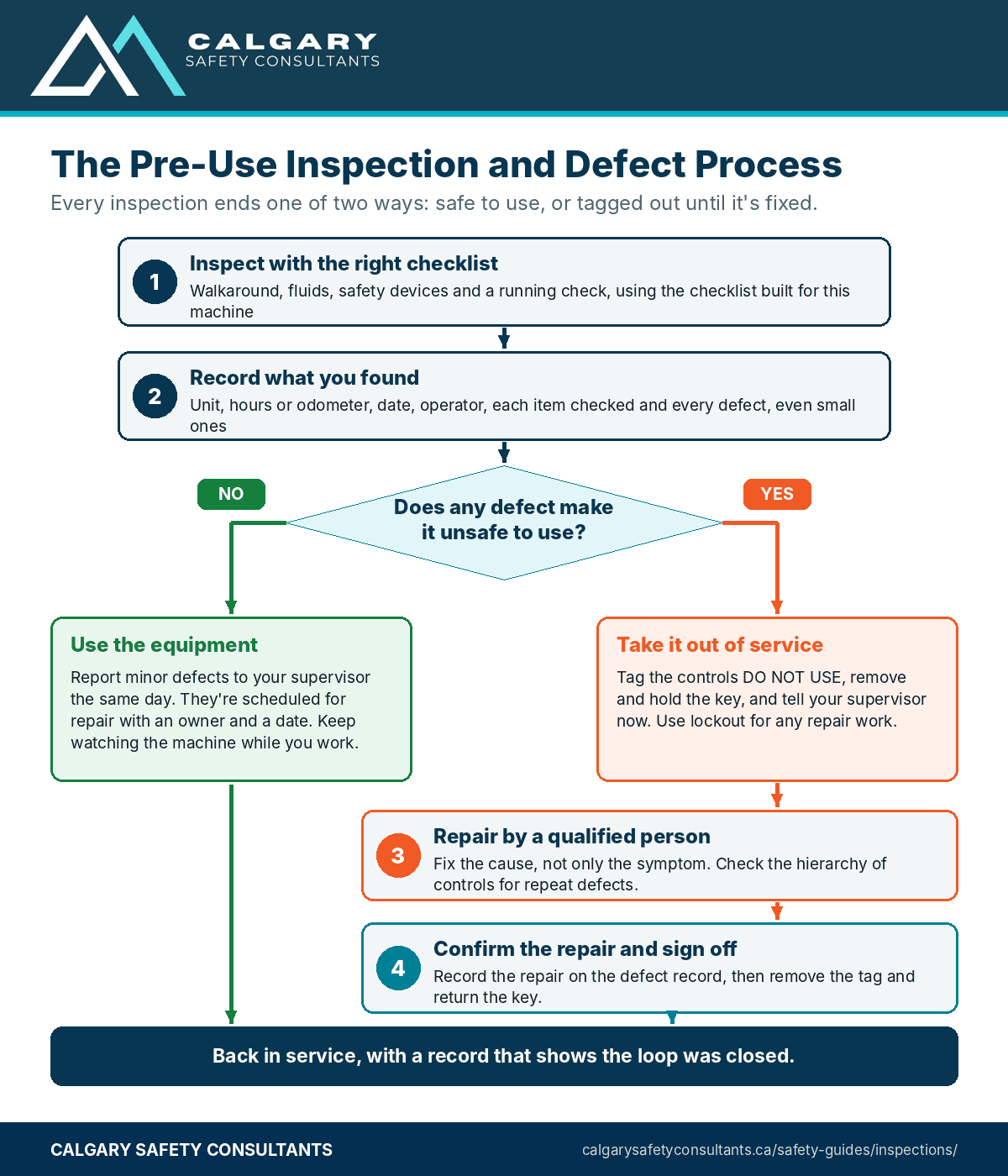
Then close the loop. A qualified person repairs the defect, and someone confirms the repair on the record before the tag comes off. Track open defects like any other corrective action, with an owner and a date, and use the hierarchy of controls when a defect keeps coming back.
Finally, protect the people who report defects. If they're blamed for downtime or pushed to run the machine anyway, the next defect won't be reported.
Record Keeping
Records prove inspections happened and defects were fixed, and they show which machines are wearing out. Capture the equipment, date and time, operator, what was checked, what was found and what was done.
Retention rules vary. British Columbia requires mobile equipment defect records to be kept for at least two years, and federal Part XIV reports are kept for one year. Ontario's lift truck guideline says to keep signed examination records long enough that at least the two most recent are on file. Trip inspection reports have their own rules in each province's transportation law. Where no period is set, keep records for a full three-year COR audit cycle.
Alberta's guide to health and safety programs says an inspection procedure should include training for the people leading inspections, scheduled and unscheduled inspections and a system to correct identified hazards. Your pre-use records are the evidence that this system works.
Keep defect records with each unit's maintenance file, have supervisors review the forms at least weekly, and look each month for repeat defects, forms that are always perfect and gaps on particular shifts.
Paper or Digital Inspections
Paper checklists work, but forms get lost, defects sit in a truck door pocket for days, and nobody sees trends. Digital inspections fix most of that: operators complete the checklist on a phone, add photos and submit on the spot, supervisors are notified at once and open defects show on a list. A QR code on each machine can open the right checklist for that unit.
Calgary Safety Consultants helps employers move inspections to Site App Pro, which handles equipment pre-use inspections, defects, service schedules and QR-code access, and works offline when reception drops. Software doesn't replace the program, though. It still takes trained operators, sensible checklists and supervisors who act on what's reported.
Training Operators to Inspect
Operators can only find what they've been taught to look for. Training on pre-use inspection should be part of every operator's training on the equipment, not an afterthought. Federal Part XIV, for example, requires motorized equipment operators to be instructed and trained in inspection, fuelling and the safe and proper use of the equipment, with a training record kept for each operator.
Good inspection training is hands-on. Walk the operator around the actual machine with the checklist and manual, show what a worn part or leak looks like, and have them do several inspections under supervision before sign-off. Make sure they know which defects stop the machine, who to report to and how to tag it out.
Refresh the training when equipment changes, when inspections are being skipped or pencil-whipped, and after any incident involving a defect.
Rentals, Contractors and Shared Equipment
Shared and rented equipment is where pre-use inspections most often fall through the cracks.
- Rentals. Inspect rented equipment on delivery, before your workers use it, and keep the rental company's inspection paperwork. Report defects to the supplier in writing and don't use the machine until they're fixed.
- Contractors. Contractors who bring their own equipment should inspect it to their own program, and you should be able to see that they do. Our guide on managing contractor safety explains how to check.
- Pool vehicles and shared machines. Use one logbook or digital record per unit, so the next operator can see recent defects and repairs before they start.
Auditing Pre-Use Inspections
Pre-use inspections are easy to do badly. Warning signs include forms filled in ahead of time, every box ticked for months, the same handwriting on every sheet, and defects recorded but never repaired. Auditing your own program catches these before an incident, a regulator or a COR auditor does.
COR audit tools look at pre-use inspections directly. Energy Safety Canada's 2023 COR audit protocol asks whether the inspection program sets a frequency for each type of inspection, including legislated requirements, with pre-use and shift change among the examples, whether inspectors have checklists, whether inspections were completed as required, whether deficiencies are corrected in a timely manner and whether people who inspect have been trained. Its hazard control element asks about a preventive maintenance program with an equipment inventory and schedule.
In Ontario, IHSA's COR 2020 audit tool requires the inspection procedure to cover pre-use inspections of vehicles, machines, tools and equipment and asks whether they're being performed as per the procedure. Its preventive maintenance element asks whether defective vehicles, tools and equipment have been removed from service as the procedure requires.
To run your own check, pull a sample of forms for several units and months and compare them with the maintenance file and hour records. Walk the yard, look at the equipment and ask a few operators what they check and what happens when they find a defect. Our guide on how to prepare for a COR audit shows how this fits the wider audit.
Workplace example
A Practical Workplace Example
This example is invented to show how the ideas in this guide work together.
Situation: Consider a civil and landscaping contractor in central Alberta with about 30 workers, a dozen pickups, two tandem dump trucks, three skid steers, a wheel loader and a rented scissor lift. Every machine had the same one-page pre-use form, often completed at the end of the week. A skid steer was found with a seat belt buckle that hadn't latched for weeks, although every form for that unit was marked as a pass.
Action: The owner and shop lead built a checklist for each type of equipment from the operator's manuals, with a short list of defects that stop the machine. The dump trucks moved to trip inspection reports against Schedule 1. Operators were trained on their own machines, a do not use tag and key-hold rule was added, and inspections moved to a phone app with a QR code on each unit. Supervisors reviewed open defects every morning.
Result: In the first two months operators reported more defects than in the previous year, mostly small ones that were fixed before they became breakdowns. The rented scissor lift was tagged out on delivery for a faulty tilt alarm and swapped by the supplier. When the company's next COR maintenance audit sampled inspection records, the auditor could follow each reported defect through to its repair.
Common Pre-Use Inspection Mistakes to Avoid
- One generic form for every machine. It misses the items that matter on each piece of equipment. Build checklists from the operator's manual.
- Pencil-whipping. Forms filled in from the cab, at the end of the week or in advance are worse than no form, because they hide defects behind a record.
- No rule for which defects stop the machine. Operators shouldn't have to decide under production pressure.
- Defects recorded but never fixed. An open defect with no owner or date is a finding waiting to happen.
- Treating the pre-use check as maintenance. It doesn't replace the periodic inspections and servicing the manufacturer and regulations require.
- Blaming the person who reports a defect. It's the fastest way to stop defects being reported.
Audit perspective
What an Auditor Expects to See
From the auditor's chair, a strong program has a written procedure saying which equipment is inspected, when and by whom, with checklists built for each type of equipment. Records for the units and dates sampled are complete and look real: the occasional defect, notes that match the hour meter and maintenance file, and every defect traceable to a repair and sign-off.
In interviews, operators describe what they check and what they do when something's wrong. On the site walk, tagged units are out of service and units in service don't have obvious defects. The warning signs are perfect forms for months and equipment working with defects listed on yesterday's sheet.
Calgary Safety Consultants helps employers build and test their inspection programs and prepare for COR and SECOR audits. CORs and SECORs are issued through the applicable certifying partner.
The Bottom Line
A pre-use inspection is a few minutes of looking, listening and testing before a vehicle or machine goes to work. Most Canadian jurisdictions require it, in different words, for mobile equipment, lift trucks, work platforms or commercial vehicles, and certifying partners look for it in COR audits.
The programs that work keep it simple: checklists built for each machine, trained operators, a clear rule for defects that stop the equipment, tags and key control, and supervisors who make sure every defect is fixed and recorded.
Download the Vehicle and Equipment Pre-Use Inspection Checklists
Two free, fillable PDF checklists go with this guide. Both have clickable checkboxes and fill-in fields, so you can complete them on screen or print them, and both are built so you can take the parts you need and add your own items.
- Vehicle Pre-Use Inspection Checklist (PDF, 6 pages). A how-to-use page with key terms and a table of when the NSC trip inspection rules apply in Alberta, Saskatchewan, Ontario and Nova Scotia; vehicle and trip details; exterior walkaround, under-the-hood, in-cab and running checks; emergency equipment and company-specific items; a defect report with minor and major defects, out-of-service steps and a driver declaration; repair and return-to-service sign-off, en route defects and supervisor review; and guidance notes on good practice, common mistakes, records, roles and what auditors look for.
- Equipment Pre-Use Inspection Checklist (PDF, 7 pages). For skid steers, loaders, excavators, telehandlers, forklifts and elevating work platforms: how to use it, key terms, roles and a before-you-start check; equipment details, work area and walkaround checks; fluids and operational checks with space for equipment-specific items; forklift, elevating work platform and other equipment modules; a defect report with out-of-service steps and an operator declaration; repair sign-off, a weekly log and supervisor review; and a jurisdiction table, common mistakes and tips for building equipment-specific checklists.
Click either button to download the file. For NSC trucks and buses, use the inspection schedule for the vehicle type as your legal checklist and the vehicle form to support it. Adapt both forms to your equipment, the manufacturer's manuals and the rules in your jurisdiction.

About the author
John Duplessis, B.Sc., CRSP
John Duplessis is a Canadian Registered Safety Professional with more than 30 years of occupational health and safety experience in oil and gas, construction, green energy, midstream operations and industrial project work. He is an external auditor with Energy Safety Canada.