How to Run a JHSC Meeting
How to plan, run and follow up on joint health and safety committee meetings that lead to real fixes, not just minutes.
Coming soon
Practical guides to health and safety committees, representatives and worker participation: when you need them, how to run them well and how to handle work refusals. Written for employers, co-chairs, members and supervisors anywhere in Canada.
Prepared by Calgary Safety Consultants, led by John Duplessis, B.Sc., CRSP.
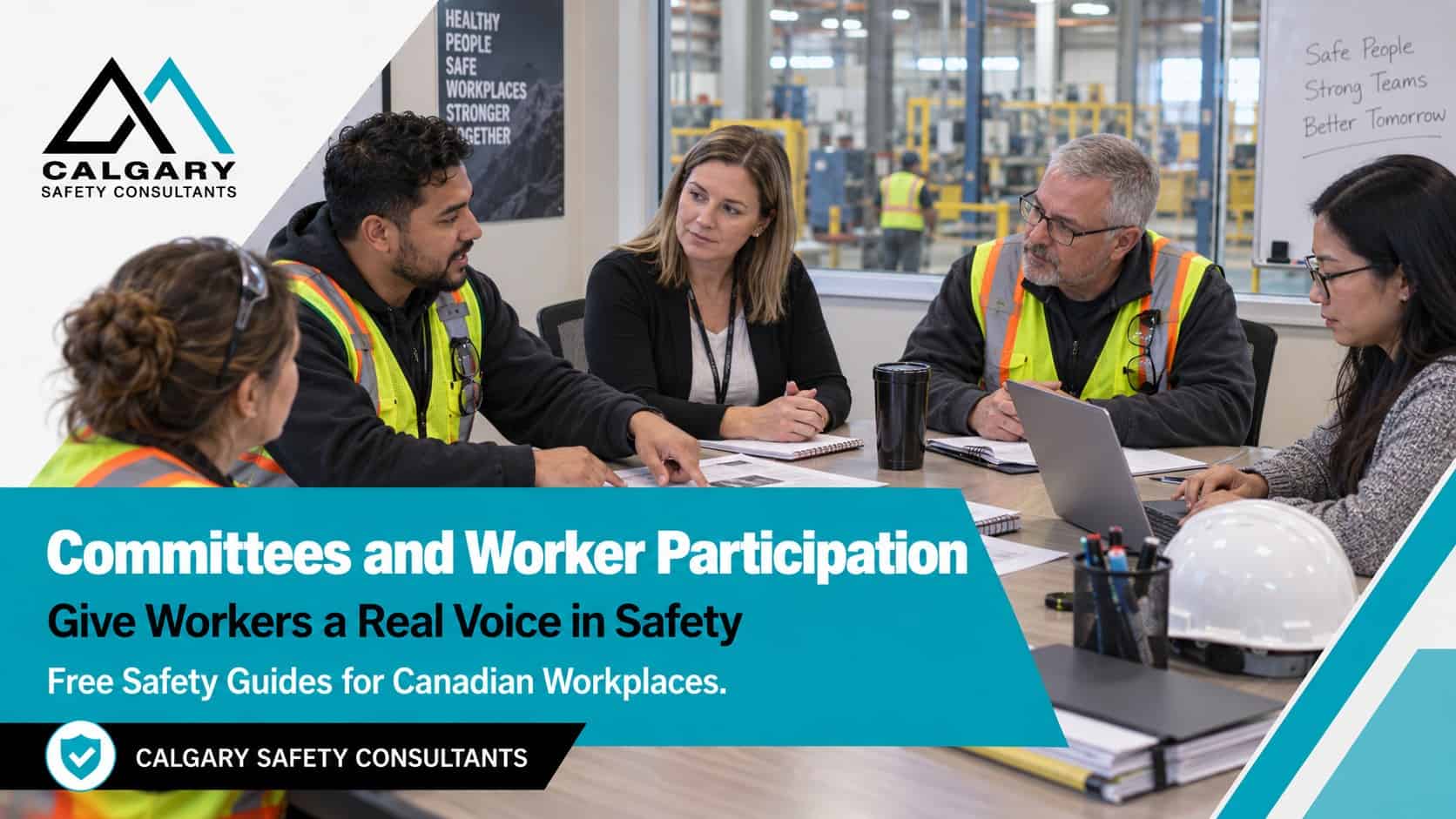
Committee and worker participation guides
Every guide in this category explains how a part of worker participation is done well, from health and safety committees to toolbox talks, with the legal requirements linked at the point they matter. Guides marked coming soon open here as they're published.
How to plan, run and follow up on joint health and safety committee meetings that lead to real fixes, not just minutes.
Coming soonWhen your workplace needs a committee or representative, how members are chosen and how to get a new committee working well.
Coming soonHow to record meetings clearly and write recommendations management can act on, with the response deadlines that apply.
Coming soonHow to run short, practical safety meetings that crews actually take part in, and how to record them.
Coming soonHow smaller workplaces choose a representative, what the role involves and how to give them the time and training they need.
Coming soonWhat supervisors and employers must do when a worker refuses unsafe work, step by step and without reprisals.
Coming soonAbout worker participation
Health and safety committees and representatives give workers a formal voice in health and safety, alongside management, so problems get raised, examined and fixed.
Joint health and safety committees bring worker and management members together to identify hazards, hear concerns, take part in inspections and investigations, and recommend improvements. Smaller workplaces usually have a single health and safety representative instead. The names vary across Canada, from joint health and safety committees to Saskatchewan's occupational health committees and the workplace and policy committees of federally regulated employers, but the purpose is the same.
Worker participation goes well beyond the committee. It includes the right to know about hazards, the right to take part in health and safety and the right to refuse unsafe work, along with everyday practices such as toolbox talks, safety meetings and workers helping with hazard assessments. The committee is the formal piece of a much wider habit of involving the people who do the work.
When health and safety committees work well, they find problems earlier, help solutions stick because workers had a hand in them, and give management a reliable read on what's really happening on the floor. They're also one of the first things inspectors and COR auditors look at.
The research backs this up. A survey of committees by Morse and colleagues, published in the American Journal of Industrial Medicine, found that workplaces whose committees closed more than 90% of items within 30 days had lower injury rates than those closing 51 to 75%: 2.83 compared with 3.96 injuries per 100 employees. Committees with more hourly workers as members, and a focus on training and ergonomics, also tended to have lower rates.
Process matters, too. A 2025 federal research summary on workplace committees found that very effective committees were more likely to have clear and consistent processes, and an Institute for Work & Health study of a committee self-assessment tool found that most committees met legal requirements but lacked training and visibility.
How it works
Effective health and safety committees and representatives follow the same five habits, whatever the size of the workplace.
Confirm whether you need a committee or a representative, have workers choose their own members, appoint management members with the authority to act, and agree on written terms of reference.
Give members, co-chairs and representatives the training your jurisdiction requires, plus practical skills in inspections, investigations and writing recommendations that management can act on.
Meet on the schedule the law requires, with an agenda that covers worker concerns, inspection and incident reports, and open recommendations. Keep minutes and post them where workers will see them.
Turn concerns into clear, written recommendations, and make sure management replies in writing within the required time, either accepting them with a timeline or explaining why not.
Track recommendations until they're closed, tell workers what changed, and review how the committee is working at least once a year.
The same thinking appears internationally. The UK Health and Safety Executive describes consulting and involving workers as the best way to reduce work-related injury and ill health. Under Australia's model laws, as Safe Work Australia explains, a business must set up a committee when a health and safety representative or five or more workers ask for one.
WorkSafeBC's guidance for joint committees is a practical place to start for anyone in British Columbia, with clear explanations of who counts toward the thresholds and what committees are expected to do.
What the law expects
Every Canadian jurisdiction requires worker participation, and most require health and safety committees in larger workplaces, but the size thresholds, meeting schedules, training and response deadlines differ.
Alberta's OHS Act, Part 2 requires a joint health and safety committee where an employer regularly employs 20 or more workers, and a representative for 5 to 19. Employer members can't outnumber worker members, and the committee takes part in hazard assessments and reviews the employer's inspection records. British Columbia's Workers Compensation Act requires a committee at 20 or more workers and a representative for 10 to 19, with monthly meetings and a written employer response to recommendations within 21 days.
Saskatchewan requires an occupational health committee at 10 or more workers, with co-chairs from both sides, trained co-chairs and paid education leave for members. Ontario's guide for committees and representatives sets out its rules, including certified members and a 21-day response deadline. SAFE Work Manitoba explains Manitoba's thresholds of 20 workers for a committee and 5 to 19 for a representative. Under the Canada Labour Code, federal workplace committees meet at least nine times a year, and employers must respond to recommendations within 30 days and train members, as the federal guide to employer duties explains.
| Jurisdiction | Committee or representative | Meetings, training and responses |
|---|---|---|
| Alberta | A committee at 20 or more regularly employed workers, a representative at 5 to 19. | Employer members can't outnumber worker members. Check the OHS Code, Part 13, for meeting, training and response rules. |
| British Columbia | A committee at 20 or more workers, a representative at 10 to 19. | Monthly meetings and a written employer response within 21 days. Members get 8 hours of training (representatives 4) within six months, plus 8 hours of education leave a year. |
| Saskatchewan | An occupational health committee at 10 or more workers, a representative at 5 to 9 in prescribed hazardous work. | Meetings at least every three months once established, a written employer reply, and five days of paid education leave a year. |
| Ontario | A committee at 20 or more workers, a representative at 6 to 19. Committees need two certified members. | Meetings at least every three months and a written employer response within 21 days. |
| Federal | A workplace committee at 20 or more employees, a policy committee at 300 or more, and a representative under 20. | Workplace committees meet at least nine times a year. Written employer responses within 30 days. |
Every jurisdiction also protects the right to refuse dangerous work, and committees play a part. In Alberta, a worker may refuse work they reasonably believe involves an undue hazard. The employer must inspect immediately, notify the committee or representative and can't give the work to someone else until the hazard is resolved, as the province's guide to refusing dangerous work explains. British Columbia's OHS Regulation, Part 3 adds a second investigation with a worker representative present, and federal law sends an unresolved refusal to the committee or representative before a federal official investigates and decides. Workers can't be disciplined for using these rights.
Because the details differ, start by confirming which law applies to your workplace. Our OHS Legislation category links the Act, regulations and regulator for all 14 jurisdictions in Canada, and explains how to read them.
From our audits
Most health and safety committees we see meet the legal minimum. Far fewer make a visible difference, and the reasons are usually easy to spot.
Each of these is fixable once you see it. The guides on this page show what effective health and safety committees and worker participation look like in practice.
Free downloads
Use these free tools to support health and safety committees, representatives and safety meetings, then adapt them to your workplace and the law that applies to you.
From the blog
August 31, 2026

August 27, 2026

August 17, 2026

October 24, 2025
When to bring in help
The guides are written so you can act on them yourself. Sometimes it helps to have an experienced safety professional involved, especially when you're setting up a new committee, members need training or a committee has stalled.
Calgary Safety Consultants helps employers build health and safety committees that get results. We train members, co-chairs and representatives, help set up new committees and terms of reference, coach committees on running meetings and writing recommendations, and train supervisors to handle work refusals properly. Alberta readers can take our online Joint Health and Safety Committee course, and readers elsewhere can start with our committee and representative training. Our consulting focuses on Alberta, British Columbia and Saskatchewan.
We help employers prepare for COR and SECOR audits, but we don't issue certificates. CORs and SECORs are issued through the applicable certifying partner.
Common questions
Answers to the questions employers, co-chairs and members ask most often about health and safety committees, representatives and work refusals.
In most provinces, once you regularly employ 20 or more workers. That's the threshold in Alberta, British Columbia, Manitoba and Ontario, and for federally regulated workplace committees. Saskatchewan requires an occupational health committee at 10 or more workers, and federal employers with 300 or more employees also need a policy committee. Check how your jurisdiction counts workers.
In smaller workplaces. Alberta and Manitoba require a representative at 5 to 19 workers, British Columbia at 10 to 19 and Ontario at 6 to 19. Saskatchewan requires one at 5 to 9 workers in work its regulations class as hazardous, and federally regulated workplaces with fewer than 20 employees need a representative. A representative takes on many of the same duties as a committee.
It varies. British Columbia committees meet at least once a month, Ontario committees at least every three months, and federal workplace committees at least nine times a year. Saskatchewan committees meet more often when they start, then at intervals of no more than three months. Whatever the minimum, meet often enough to keep concerns and recommendations moving.
At least half the members must be workers who don't do management work, chosen by the workers or their union, with the rest appointed by the employer. In Alberta, employer members can't outnumber worker members. Most committees have two co-chairs, one from each side. Choose management members who have the authority to act on what the committee raises.
It depends on where you are. In British Columbia, new members need at least eight hours of training and representatives at least four, within six months, plus eight hours of education leave a year. Ontario requires certified members, Saskatchewan requires trained co-chairs and gives members paid education leave, and federal employers must train their members. Alberta's OHS Code also includes training requirements.
Health and safety committees identify hazards, hear and deal with worker concerns, take part in inspections, hazard assessments and incident investigations, and make written recommendations to the employer. They don't replace the employer's responsibility for health and safety. Their value is in bringing workers' knowledge to the table and making sure problems are raised, examined and followed up.
Yes, in most jurisdictions. British Columbia requires a report after each meeting, kept for two years, with the three most recent posted. Saskatchewan requires minutes in the ministry's format, posted until the concerns are resolved, and Ontario expects minutes to be recorded and posted. Even where the rules are lighter, posted minutes show workers their concerns are being heard.
In British Columbia and Ontario, the employer must reply in writing within 21 days, and federally regulated employers within 30 days. Saskatchewan requires a written reply explaining the action taken or the reasons for not acting. A good response either accepts the recommendation with a timeline or explains clearly why it won't be implemented, so the committee can follow up.
There's no general legal requirement across Canada to hold toolbox talks, but they're one of the simplest ways to involve workers and share hazard information. British Columbia does require employers that don't need a formal health and safety program to hold regular monthly meetings with workers, with records kept. Keep toolbox talks short, specific to the day's work and two-way.
The process is similar across Canada. The worker reports the refusal to their supervisor or employer, who investigates and fixes the problem if they can. If the worker still believes the work is unsafe, the committee or a worker representative becomes involved, and if it's still unresolved, an OHS officer investigates and decides. In Alberta and Saskatchewan, the work can't be given to another worker in the meantime.
No. OHS laws protect workers who refuse unsafe work under the law from discipline, dismissal, suspension, demotion and similar action. Employers can usually assign other work temporarily with no loss of pay. In Alberta, a worker can file a complaint with an officer within 180 days, and in British Columbia within one year. Remedies can include reinstatement and lost wages.
Usually not a committee, but small businesses still need worker participation. In Alberta, workplaces with fewer than five workers don't need a committee or representative, and in Ontario, workplaces with five or fewer don't either. British Columbia employers with fewer than 10 workers need no representative, but may need to hold monthly safety meetings. Federally regulated workplaces need a representative under 20 employees.
Look at outcomes, not attendance. Are recommendations answered on time and closed? Do workers know who the members are and raise concerns with them? Do inspections and investigations lead to real changes? British Columbia requires a written evaluation of the committee every year, and the Institute for Work & Health has developed a self-assessment that helps committees pinpoint strengths and weaknesses.
Yes. We train committee members, co-chairs and representatives, help set up new committees and terms of reference, coach committees on running meetings and writing recommendations, and train supervisors to handle work refusals properly. Our consulting focuses on Alberta, British Columbia and Saskatchewan, while our guides, free downloads and online training are available anywhere in Canada. Book a free consultation to talk it through.
Talk to a safety consultant
Whether you're setting up a new committee, training members or getting a stalled committee moving again, we'll help you work out the next practical step. Complete the form below or book a 30-minute consultation.