
On this page
- What a Job Hazard Analysis Is and When You Need One
- Who's Involved in a Job Hazard Analysis
- How a Formal JHA Is Done Well
- Start With an Inventory of Jobs and Positions
- Plan and Describe the Job Before You Analyze It
- List Every Task, Then Break Each One Into Steps
- Identify Hazards and What They Could Do
- Rate the Risk Consistently
- Choose Controls Using the Hierarchy
- Confirm the Residual Risk and Assign the Work
- Approve, Communicate and Train
- Keep the JHA Current
- How the JHA Works With FLHAs, Procedures and Training
- A Practical Workplace Example
- Common JHA Mistakes to Avoid
- What an Auditor Expects to See
- Download the JHA Quick Guide and Template
- Frequently Asked Questions
- Related Guides and Articles
- How Calgary Safety Consultants Can Help
- Sources
What a Job Hazard Analysis Is and When You Need One
A job hazard analysis (JHA) is a formal, written assessment of a job or position. It lists every task the job involves, breaks each task into the steps a worker actually follows, identifies what could hurt someone at each step, rates the risk and sets the controls that bring that risk down to an acceptable level.
When it's done well, the JHA becomes the reference point for how that job is done safely. It tells you what training the worker needs, what equipment and PPE the job requires, which procedures and permits apply and what has to be in place before anyone starts.
At Calgary Safety Consultants, we treat the JHA as a fully formal document for a job or position, such as a shop welder, forklift operator, service technician or care aide. We don't recommend writing a JHA for a single task. All of the tasks that make up the job go into its one JHA, including set-up and clean-up, the routine production work and the non-routine work that only comes up now and then, such as clearing a jam or doing minor maintenance. Looking at the whole job means nothing falls between separate task forms, and every worker in the position has one document that describes their job from start to finish.
It also keeps the paperwork manageable. One well-built job hazard analysis per position is far easier to approve, communicate and keep current than a drawer of task forms nobody reviews.
The daily, task-level check still matters. That's the role of a field-level hazard assessment (FLHA), completed at the start of a shift or task to confirm the day's conditions. The JHA sets the standard for the job, and the FLHA checks today against it.
When You Need a JHA
Most Canadian occupational health and safety laws don't use the words "job hazard analysis." What they share is an expectation that employers find the hazards in their work and control them, whether through a specific hazard assessment rule, a required health and safety program or the employer's general duties. A formal JHA for each job or position is one of the clearest ways to meet that expectation and to show you've met it. The explanation below links the specific requirements where they apply to the work.
Every job or position should have a JHA, so the practical question is which ones to complete first. Start with:
- jobs where a mistake could cause a serious or disabling injury or illness, even if nothing has happened yet;
- jobs with a history of incidents, near misses or first aid cases;
- new jobs and positions;
- jobs that involve complex, high-risk or infrequent work.
A JHA isn't a one-time exercise. When equipment, materials, methods or the work environment change, or after an incident or near miss, the existing JHA for that position is reviewed and revised rather than replaced with a new task form. US OSHA's Job Hazard Analysis guide sets out very similar priorities, and SAFE Work Manitoba lists performing a job hazard analysis among the ways employers can identify hazards, alongside listening to workers' concerns and regular inspections.
Who's Involved in a Job Hazard Analysis
Even careful, written hazard identification misses things. In a UK study of construction method statements, no more than 6.7 percent identified every hazard they should have, and even the best identification level missed about one hazard in ten. That's why a JHA is built by a team that includes the people who do the job, not by one person working alone.
A strong JHA team usually includes:
- Workers who do the job. Include both experienced workers and newer ones. They know the shortcuts, the awkward reaches and the steps the manual leaves out.
- The supervisor. The supervisor plans and directs the work and usually leads the review with the crew.
- The manager who approves it. Approval means committing the resources the controls need, not just signing the form.
- The joint health and safety committee or health and safety representative. They bring a wider view of the workplace and help make sure worker concerns are heard.
- A safety advisor or consultant, where you have one. They keep the method consistent from one job to the next and check the legal requirements.
How a Formal JHA Is Done Well
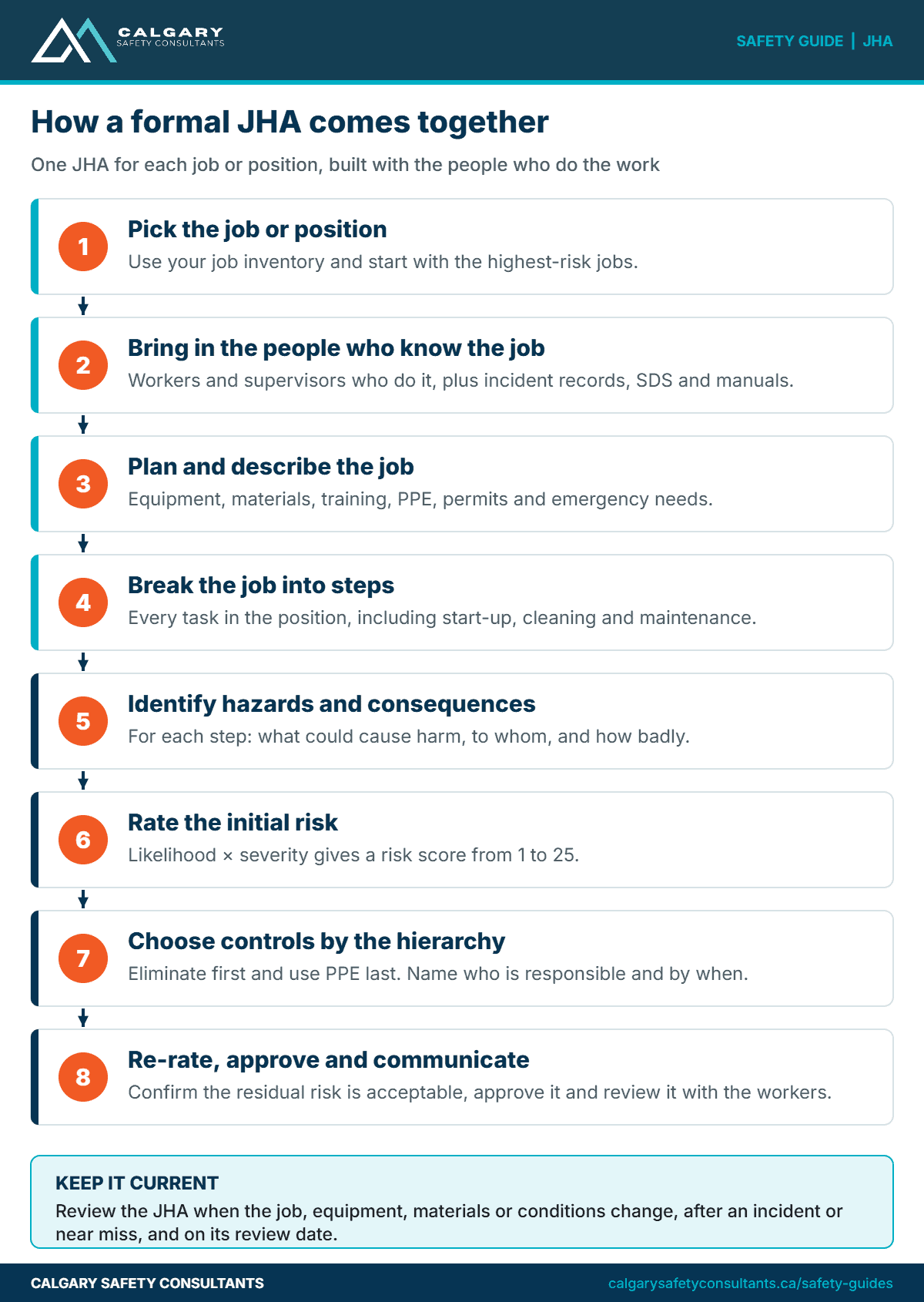
A formal JHA follows the order a good analysis naturally takes. Our template starts with information about the job, then pre-job planning and a short job description. The worksheet then takes every step of every task from hazard to initial risk, controls, residual risk and the person responsible. Ontario's supervisor health and safety workbook sums up the whole process in four words: recognize, assess, control and evaluate.
The sections that follow explain what good looks like at each stage, where the law connects to the work and where job hazard analyses usually go wrong.
Start With an Inventory of Jobs and Positions
Before writing a single JHA, list every job and position in your organization. A job inventory tells you what jobs and positions you have, so each one gets a JHA, and which ones come first.
Alberta's hazard assessment and control handbook starts the same way, with a list of all the jobs or types of work in the operation, followed by the tasks within each one. The WSCC Hazard Assessment Code of Practice for the Northwest Territories and Nunavut takes the same approach, looking at the individual tasks within each position.
The law gives the inventory its purpose. In Alberta, the OHS Code requires a hazard assessment before work begins at a work site, with the results and the controls recorded in a dated written report. Yukon's Workplace Health and Safety Regulations require every employer to assess the hazards at each workplace and the likelihood of injury. Several jurisdictions build hazard identification into a health and safety program that many workplaces must have, including Saskatchewan, Manitoba, Nova Scotia, New Brunswick, the Northwest Territories and Nunavut. However your jurisdiction frames it, an inventory is how you show that every job has been looked at, not just the obvious ones.
Use the priorities above to set the order. A warehouse might start with forklift operator and shipper-receiver. A clinic might start with the positions that involve lifting and repositioning patients.
Keep the inventory as a living list, with a JHA number, an owner and a review date for each position. The JHA No. field on the template ties each analysis back to that list, so you can see at a glance which positions are covered, which are overdue for review and which still need work.
Plan and Describe the Job Before You Analyze It
Sections 1 to 3 of the template capture the context that makes the rest of the analysis accurate.
Job information. Section 1 records the job, the JHA number, the location or area, the date the JHA was completed, who prepared it, who reviewed and approved it, which workers and subject-matter experts were consulted, and the review date. Enter the job or position title in the Job / Task field, such as "Forklift Operator," rather than a single task. Fill in the date completed each time the JHA is prepared or revised; Alberta's Code, for one, requires that date to be recorded on the assessment. Put real names in the workers consulted field, too. It's the simplest proof that the people who do the job helped build it.
Pre-job planning. Section 2 lists the tools and equipment, materials and chemicals, required training and competency, required PPE, permits, procedures and SDS, and emergency or rescue considerations. Completing this first forces the team to look at everything the job touches, and it creates a ready-made list of requirements for orientation and training.
If a chemical shows up here, its safety data sheet belongs in the review. The SDS describes the hazards and the protective measures the manufacturer expects, and it often points to controls the team hadn't considered.
Job description. Section 3 is a short paragraph describing what the job is for, where and when it's done, how often and by whom. Say what's included and what isn't, so the scope matches the tasks on the worksheet. For example: "Includes daily pre-use inspection, loading and unloading trailers, and propane cylinder changes. Excludes forklift repairs, which are covered by the maintenance technician JHA."
List Every Task, Then Break Each One Into Steps
This is where most job hazard analyses succeed or fail. Start by listing all of the tasks the position involves. Then break each task into the steps a worker actually follows, in the order they happen. Watch the job being done if you can, and talk it through with the workers while you watch.

Every task belongs in the position's JHA, not just the main production work. For most jobs, that means start-up and shutdown, cleaning, clearing jams, minor maintenance, working in poor weather and what happens when equipment breaks down. ISO 45001, the international standard for occupational health and safety management systems, expects hazard identification to cover both routine and non-routine activities, and the ISO committee responsible for the standard describes non-routine work as occasional, infrequent or unplanned. These steps deserve particular attention, because workers do them less often and get less practice at them.
Worker involvement at this stage isn't a courtesy. Alberta's OHS Code requires employers to involve affected workers in the hazard assessment and in controlling the hazards, and Saskatchewan requires a worker participation strategy as part of the program. The research points the same way: workplaces that score higher on the Institute for Work & Health's organizational performance metric, which counts employee involvement in health and safety decisions among its items, tend to have lower injury claim rates.
Getting the level of detail right matters. OSHA's guide warns against breakdowns so detailed they become unnecessarily long, or so broad they leave out basic steps. A practical test: each step should start with an action, such as "position the trailer," "inspect the forks" or "change the propane cylinder," and describe one meaningful action. If a step needs a paragraph to explain, split it. If three steps could be described in one short sentence, combine them.
Group the steps by task on the worksheet so the JHA reads in the order the job is done. The worksheet has eight numbered rows per page, and a full position will usually need several pages. Keep the job title and JHA number at the top of every page so the pages stay together, and number the steps continuously across pages.
Identify Hazards and What They Could Do
For each step, ask what could cause harm, to whom and how. Record both the hazard and the potential consequence in the hazards and potential consequences column. "Forklift" isn't a hazard description. "Forklift reversing near pedestrians, causing a struck-by or crushing injury" is.
This is also where you find the hazards workers need to be told about. BC's Workers Compensation Act, for example, requires employers to inform workers of all known or reasonably foreseeable health or safety hazards they're likely to be exposed to, and you can only do that once those hazards have been identified.
Thinking in terms of energy helps. Look at each step for gravity, motion, mechanical, electrical, pressure, temperature, chemical, biological, radiation and sound. In a US study of construction crews, workers identified on average only 38 percent of the hazards present before an energy-based recognition method was introduced, and their hazard recognition improved once they used it.
Remember health hazards and human factors, not just the things that cause immediate injuries. That includes noise, dust, fumes, vibration, repetitive motion and awkward postures, heat and cold, fatigue, working alone, and the risk of workplace violence and harassment, particularly where workers deal with the public. Quebec's Act respecting occupational health and safety now requires prevention programs to identify and analyze psychosocial risks as well.
Use evidence beyond the walk-through. WorkSafeNB's OHS guide lists injury reports, inspection reports, incident investigations, near-miss reports, employee reports, monitoring data and experience with the task as sources for identifying hazards. Add the SDS and the manufacturers' manuals for the equipment, and you'll catch hazards a single observation can miss.
Rate the Risk Consistently
A list of hazards isn't an assessment until you decide how serious each one is. The template uses a five-by-five matrix. Likelihood runs from 1 (rare) to 5 (almost certain), severity runs from 1 (insignificant) to 5 (catastrophic), and the risk score is likelihood multiplied by severity. Each score falls into a band that tells you what to do next.
| Risk score | Rating | What it means |
|---|---|---|
| 1 to 4 | Low | Maintain controls and monitor. |
| 5 to 9 | Moderate | Improve controls where practicable; supervisor review. |
| 10 to 16 | High | Additional controls required before work begins. |
| 17 to 25 | Extreme | Do not proceed until the risk is reduced. |
Rate the initial risk with the controls that are actually in place today, not the ones you intend to add. That keeps the analysis honest and shows how much the new controls will achieve. The federal Canada Occupational Health and Safety Regulations build this in for federally regulated workplaces: the hazard assessment has to take into account the nature of the hazard, the level, frequency and duration of employees' exposure, and the preventive measures already in place.
Consistency matters more than precision. Agree as a team on what each likelihood and severity level means in your operation, and use the same scale on every JHA, so a "high" in the shop means the same as a "high" in the warehouse. The template's matrix is a generic example. If your organization already has an approved risk method, use that instead.
Severity should reflect the realistic worst outcome of the hazard, not the most common one. Likelihood should consider how often the step is done, how many people are exposed and for how long.
Choose Controls Using the Hierarchy
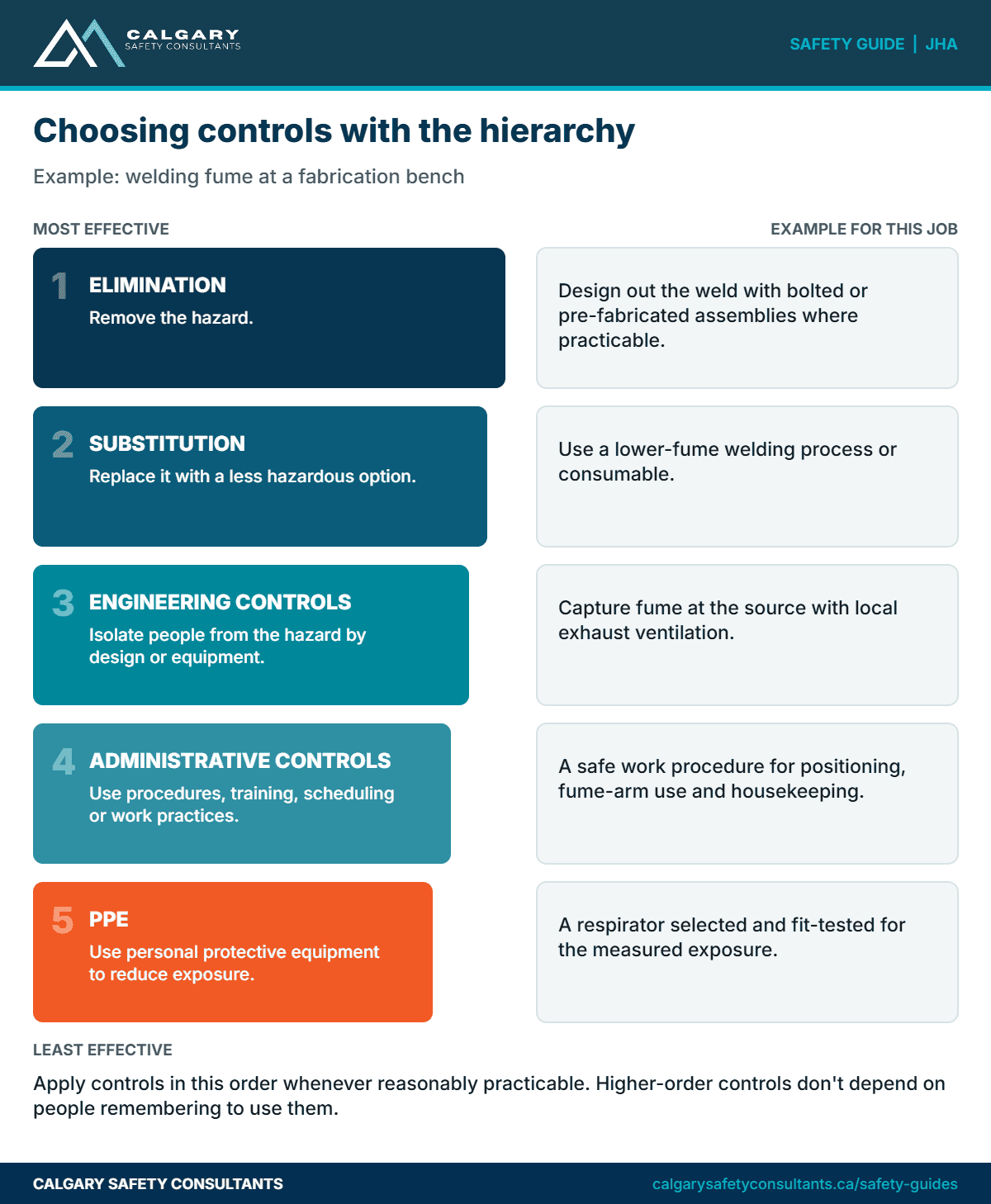
Controls are the point of the whole exercise. For each hazard, work down the hierarchy of controls: eliminate the hazard, substitute something less hazardous, isolate people with engineering controls, use administrative controls such as procedures, training and scheduling, and then use PPE. The template prints the hierarchy along the bottom of the worksheet as a reminder.
The US National Institute for Occupational Safety and Health (NIOSH) explains why the order matters. The controls at the top are more effective and protective, while administrative controls and PPE need significant, ongoing effort from the workers and supervisors who rely on them.
Several Canadian jurisdictions write the hierarchy into law. Alberta's OHS Code requires hazards to be eliminated where reasonably practicable, and otherwise controlled through engineering controls, administrative controls and PPE, in that order, or a combination that gives workers a greater level of safety. Manitoba's Workplace Safety and Health Regulation and Yukon's regulations also require hazards to be eliminated where possible and otherwise controlled.
The federal regulations also set an order of priority, but they place PPE ahead of administrative procedures. That difference is worth knowing if any of your work is federally regulated. For BC employers, WorkSafeBC's guidance on managing risk walks through the same thinking.
Where the law doesn't list the hierarchy, it still expects the thinking behind it. Ontario's Occupational Health and Safety Act requires employers to take every precaution reasonable in the circumstances for the protection of a worker, and showing that you considered higher-level controls before settling for lower ones is one practical way to demonstrate it.
Write controls someone could check. "Be careful" isn't a control. "Install a convex mirror at the aisle intersection and mark a pedestrian walkway" is. Name the specific procedure, the specific training and the specific PPE. The best answer often combines levels: an engineering control as the main defence, a procedure and training to support it, and PPE for what's left.
Confirm the Residual Risk and Assign the Work
Once the controls are chosen, rate the risk again as if they're in place. That's the residual risk, recorded in its own column on the worksheet. It should drop to a level your organization accepts. If a step still rates high or extreme, the work doesn't go ahead until more controls are added, which is exactly what the template's action levels say.
Controls that don't exist yet need an owner and a date, which is what the person responsible and target date column is for. A JHA that lists "install local exhaust ventilation" with nobody responsible quickly becomes a wish list. Track these items through your corrective action process, mark the template's revision or follow-up box while actions are still open, and record when each one is complete.
Be candid about controls that depend on people. If the residual rating relies on training and PPE alone, check whether a higher-level control is truly not reasonably practicable before you accept it. Auditors and inspectors tend to ask that question too.
Approve, Communicate and Train
A formal JHA is reviewed and approved by someone with the authority to commit resources, usually the supervisor's manager or the operations lead. The reviewed and approved by field in Section 1 and the supervisor review line on the worksheet show who signed off and when.
Then it has to reach the people doing the job. Review it with every worker in the position, explain the higher-risk steps and their controls, and record who it was communicated to and on what date. Ontario's OHSA requires employers to acquaint workers with any hazard in the work, and Manitoba, Nova Scotia and New Brunswick have similar duties. The federal regulations require each employee to be trained on the hazard prevention program and the hazards of their workplace.

Use the JHA to drive training and orientation. The required training and competency field becomes the checklist for every new worker in the position, and the highest-risk steps are the ones that deserve written safe work procedures and hands-on demonstration.
Keep the approved JHA where workers can get to it, at the work area or in the digital system your crews already use. Alberta's OHS Act requires employers to keep information about work site hazards and controls readily available and to provide it to workers.
Keep the JHA Current
A JHA is only accurate as long as the job stays the same. The template's review note sets out the triggers: changes to the job's tasks, equipment, materials, work environment or applicable requirements; any incident or near miss; and evidence that controls aren't working. Set a scheduled review date as well, and keep it.
The law points the same way. Alberta requires hazard assessments to be repeated at reasonably practicable intervals, when a new work process is introduced, when a work process or operation changes and before significant additions or alterations to a work site.
Program-based jurisdictions set outer limits for the program as a whole. Saskatchewan, Manitoba, the Northwest Territories, Nunavut and the federal regulations call for a review at least every three years or when circumstances change, and New Brunswick requires the program to be reviewed at least once a year. The federal hazard prevention program guide explains how that evaluation works for federally regulated employers.
International guidance agrees. The UK's Health and Safety Executive says you must review your controls to make sure they're working, and review them again when workplace changes could bring new risks. Safe Work Australia's code of practice adds reviews before a change at the workplace, when a new hazard is found and when consultation with workers shows a review is needed.
When a JHA is revised, walk the affected workers through what changed, update the date completed and the next review date, and keep the superseded version on file so you can show how the job has improved over time.
How the JHA Works With FLHAs, Procedures and Training
A JHA doesn't replace permits, procedures, competency requirements or site-specific pre-job hazard assessments, and the template says so in its review note. Each of these does a different job, and they work best when they're connected.
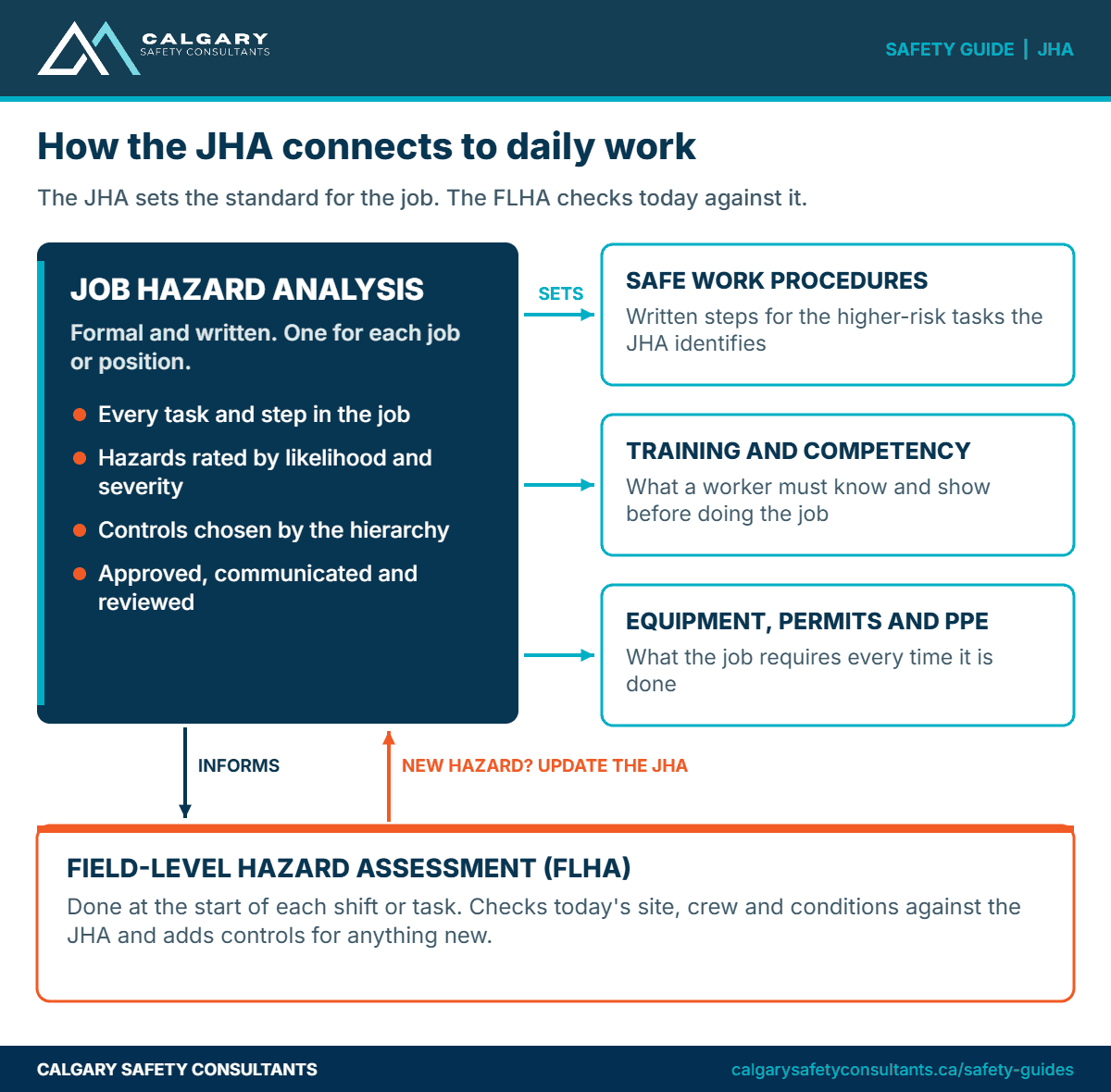
The JHA sets the standard for a job or position. Safe work procedures give step-by-step instructions for the higher-risk tasks the JHA identifies. Training shows that a worker can do the job the way the JHA describes. The FLHA, completed at the start of a shift or task, checks today's conditions against what the JHA assumed: the weather, other crews nearby, a different site or a missing tool.
When an FLHA turns up a hazard the JHA didn't foresee, treat it as a signal. Deal with it on the day, then bring it back to the supervisor so the position's JHA can be updated. Over time, that loop is what keeps your formal analysis true to the work. Yukon's Workers' Safety and Compensation Board publishes both a formal hazard assessment template and a site-specific hazard assessment template for the same reason: each level supports the other.
Workplace example
A Practical Workplace Example
Situation: Consider a 30-person metal fabrication shop with about 40 task-based JHAs: one for grinding, one for the overhead crane, one for welding and so on. Most had been copied from other sources, few had been reviewed in years and none named the workers who helped write them. When a fitter was hurt turning a heavy assembly between the crane and the welding table, no JHA covered that step. It fell between the crane form and the welding form.
Action: The shop built an inventory of its five positions: fitter-welder, machine operator, shipper-receiver, maintenance technician and painter. For each one, the supervisor and two experienced workers walked through a full shift and listed every task, including set-up, clean-up and the monthly crane inspection, and all of those tasks went into that position's JHA. Each position got one formal JHA on the same template, with initial and residual risk rated on the same matrix. Higher-risk steps, such as turning assemblies, got an engineering control and a written procedure.
Result: Forty fragmented forms became five job hazard analyses that workers recognized as their own jobs. Each one had an approval, a communication record and a review date. The turning step now has a fixture and a procedure, and new hires in each position start with their JHA as part of orientation.
Common JHA Mistakes to Avoid
- Writing a JHA for each task instead of each job. The forms multiply, the steps between tasks go unexamined and the paperwork soon stops being reviewed. All of a position's tasks belong in its one JHA.
- Writing it without the workers. A JHA built in the office describes how the job should work, not how it does.
- Leaving out the non-routine work. Cleaning, clearing jams, breakdowns and minor maintenance are part of the job and belong on the worksheet.
- Copying generic content. A borrowed JHA lists someone else's equipment, layout and habits, and misses yours.
- Stopping at "be careful" and PPE. If every control is a reminder or a piece of PPE, the hierarchy hasn't really been used.
- Filing it and forgetting it. A JHA that was never communicated, never revised after changes or incidents, or has actions with no owner won't protect anyone.
Audit perspective
What an Auditor Expects to See
If your organization holds or is working toward a Certificate of Recognition (COR) or a Small Employer Certificate of Recognition (SECOR), hazard assessment is a core element of the audit. Energy Safety Canada's SECOR external audit protocol, for example, looks for:
- a written process for formal hazard assessments;
- every position or discipline inventoried, with the tasks for each one identified;
- hazards identified for each task and assessed using a consistent measure of risk, such as severity, probability and frequency;
- a system to review and revise assessments at a set frequency and when processes change, with proof that the reviews happen;
- employee participation in hazard assessment, which auditors confirm through interviews;
- site-specific hazard assessments completed before work starts.
Each certifying partner uses its own approved audit standard, so check the current version for your program. A JHA program built on our template can help you produce many of the records auditors look for, but no document guarantees an audit result. Calgary Safety Consultants helps employers develop hazard assessment programs and prepare for audits; we don't issue certificates. CORs and SECORs are issued through the applicable certifying partner.
Download the JHA Quick Guide and Template
Two free downloads go with this guide.
- JHA Quick Guide (PDF). A two-page summary of how a formal JHA is done well, with a checklist to tick off as you complete each JHA and another for keeping it current.
- JHA Template (PDF). Our two-page, landscape form for a formal JHA of one job or position. Page 1 covers job information, including the JHA number and date completed, then pre-job planning, the job description and the five-by-five risk matrix with action levels. Page 2 is the worksheet, with eight numbered rows for job steps, hazards and consequences, initial risk, controls by the hierarchy, residual risk, and the person responsible and target date. It finishes with communication and supervisor review, a revision or follow-up box, the next review date, the review note and a hierarchy of controls reference. Use as many worksheet pages as the job needs.
Click either button to download the PDF. Adapt the template to your operation and, if your organization already has an approved risk method, use it in place of the generic matrix.

About the author
John Duplessis, B.Sc., CRSP
John Duplessis is a Canadian Registered Safety Professional with about 30 years of occupational health and safety experience in oil and gas, construction, green energy, midstream operations and industrial project work.