How to Complete a Job Hazard Analysis (JHA)
How to build one formal, written JHA for each job or position, covering every task, so you can show how you meet your duty to identify and control hazards.
Read the guide →
Canada has 14 sets of occupational health and safety (OHS) legislation. Most workplaces follow the law of the province or territory where the work is done, while federally regulated businesses, such as banks, airlines, railways and trucking companies that cross provincial borders, follow Part II of the Canada Labour Code. Find your jurisdiction below, then read its Act, regulations and any code together.
Prepared by Calgary Safety Consultants, led by John Duplessis, B.Sc., CRSP. Last reviewed October 2026.
About OHS legislation
Occupational health and safety legislation is the set of laws that sets the minimum standard for keeping people safe at work. It spells out what employers, supervisors, workers, prime contractors, suppliers and owners must do, gives inspectors the power to enforce it and sets the penalties when it isn't followed.
Canada doesn't have one national OHS law. It has 14: one for each of the 10 provinces and 3 territories, and one for federally regulated work. Each jurisdiction writes its own Act, regulations and, in some places, a code. They share the same basic ideas, such as finding and controlling hazards, training and supervising workers and involving them in safety, but the details, the thresholds and even the terms they use differ.
That matters because the law is the baseline everything else is measured against. Your safety program, your hazard assessments, your orientation and your audit results all rest on it. When an inspector visits, when an incident is investigated or when a client asks how you meet your legal obligations, the question is always which law applies and whether you met it. Enforcement makes a difference, too: a systematic review by the Institute for Work & Health found that inspections resulting in penalties reduce work injuries, while inspections without penalties have little effect.
You'll need to look up your OHS legislation when you:
The good news is that you don't need to read all 14. Most workplaces need one, and the rest of this page shows you how to find it, read it and keep up with it.
Who it's for
Everyone at work has duties under OHS legislation, but the level of knowledge each person needs is different.
Some laws make this expectation explicit. Alberta's OHS Act, for example, requires employers to make sure workers are aware of their rights and duties, that supervisors are competent and familiar with the legislation that applies to the work they direct, and that current copies of the Act, regulations and OHS Code are readily available to workers. Other jurisdictions have similar duties, and auditors check for them.
Start here
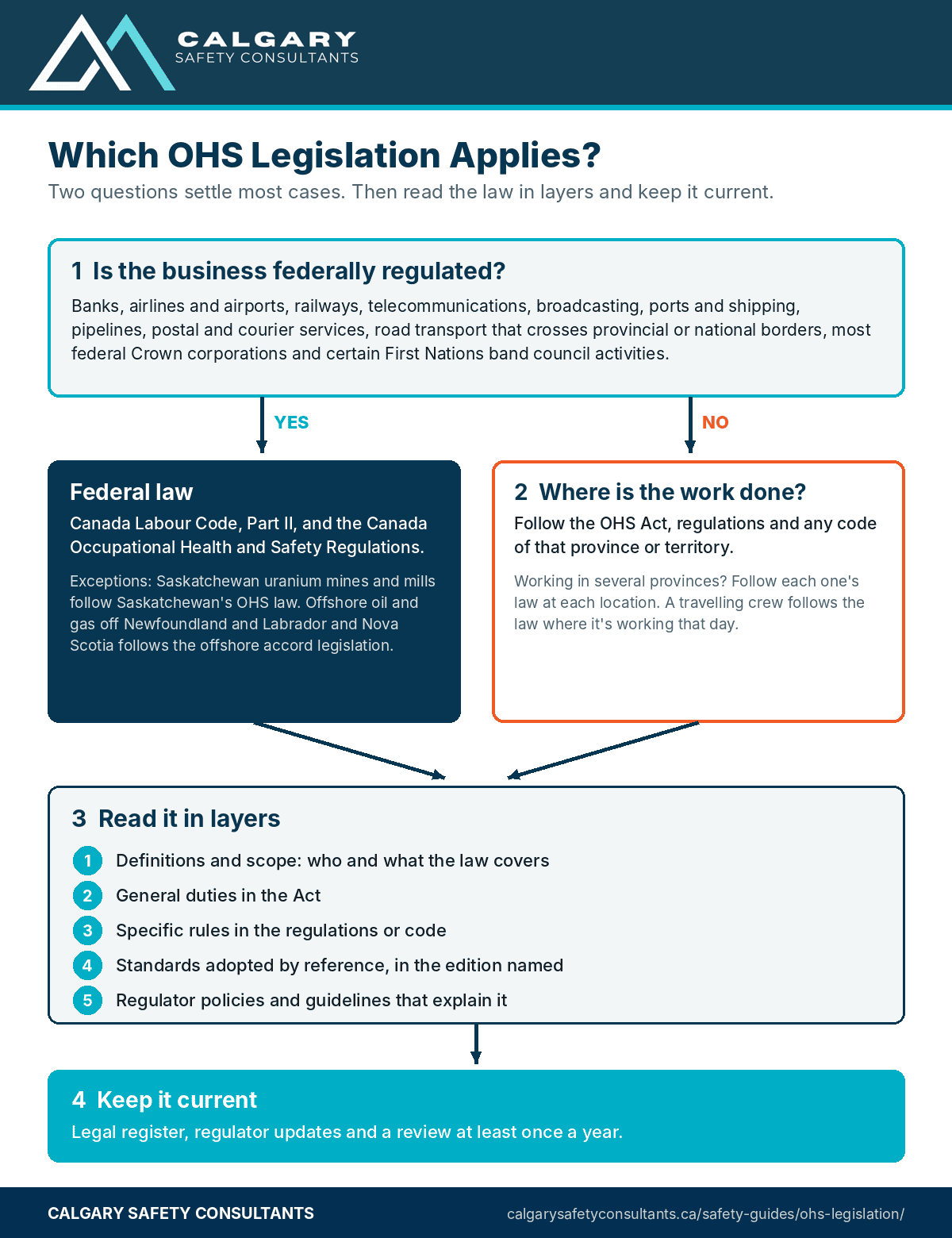
Finding the right OHS legislation starts with one question: is your business federally regulated? If it isn't, the law of the province or territory where the work is done applies. That's true for the large majority of Canadian employers.
The federal government's list of federally regulated industries and workplaces includes air transportation and airports, banks, grain elevators, marine shipping, ports and ferries, pipelines, postal and courier services, broadcasting, telecommunications, railways and road transport that cross provincial or national borders, uranium mining, most federal Crown corporations, the federal public service and certain First Nations band council activities. It also covers businesses that are vital, essential or integral to one of those sectors.
What decides it is the nature of the business, not the job a particular worker does. A trucking company that regularly hauls across provincial borders is generally federally regulated, while a company whose trucks only run within one province generally isn't. A clerk at a bank works under federal law, and a clerk at a credit union usually doesn't. If your business sits near the line, ask the federal Labour Program or your provincial regulator to confirm it, and keep their answer on file.
For everyone else, the work location decides. A company based in Calgary that sends a crew to a site near Regina follows Saskatchewan's law on that site, not Alberta's. A business with locations in three provinces follows three sets of legislation, one for each location, and a worker who travels follows the law where the work is done that day.
A few situations have their own arrangements. Offshore oil and gas work off Newfoundland and Labrador and Nova Scotia falls under the federal and provincial offshore accord legislation, administered by the offshore energy regulators, as Natural Resources Canada explains. Uranium mines and mills in Saskatchewan are federally regulated, but the Saskatchewan Uranium Mines and Mills Exclusion Regulations apply Saskatchewan's OHS law to them instead of Part II of the Canada Labour Code. In the North, Yukon has its own legislation, and one commission administers the separate laws of the Northwest Territories and Nunavut.
All 14 jurisdictions
The table links each jurisdiction's main OHS Act, its main general regulations or code, and the regulator that enforces them. Every link goes to the official government or regulator source. Many jurisdictions also have regulations for specific hazards or industries, such as mining, so check the regulator's site for anything that applies to your work.
How the law fits together
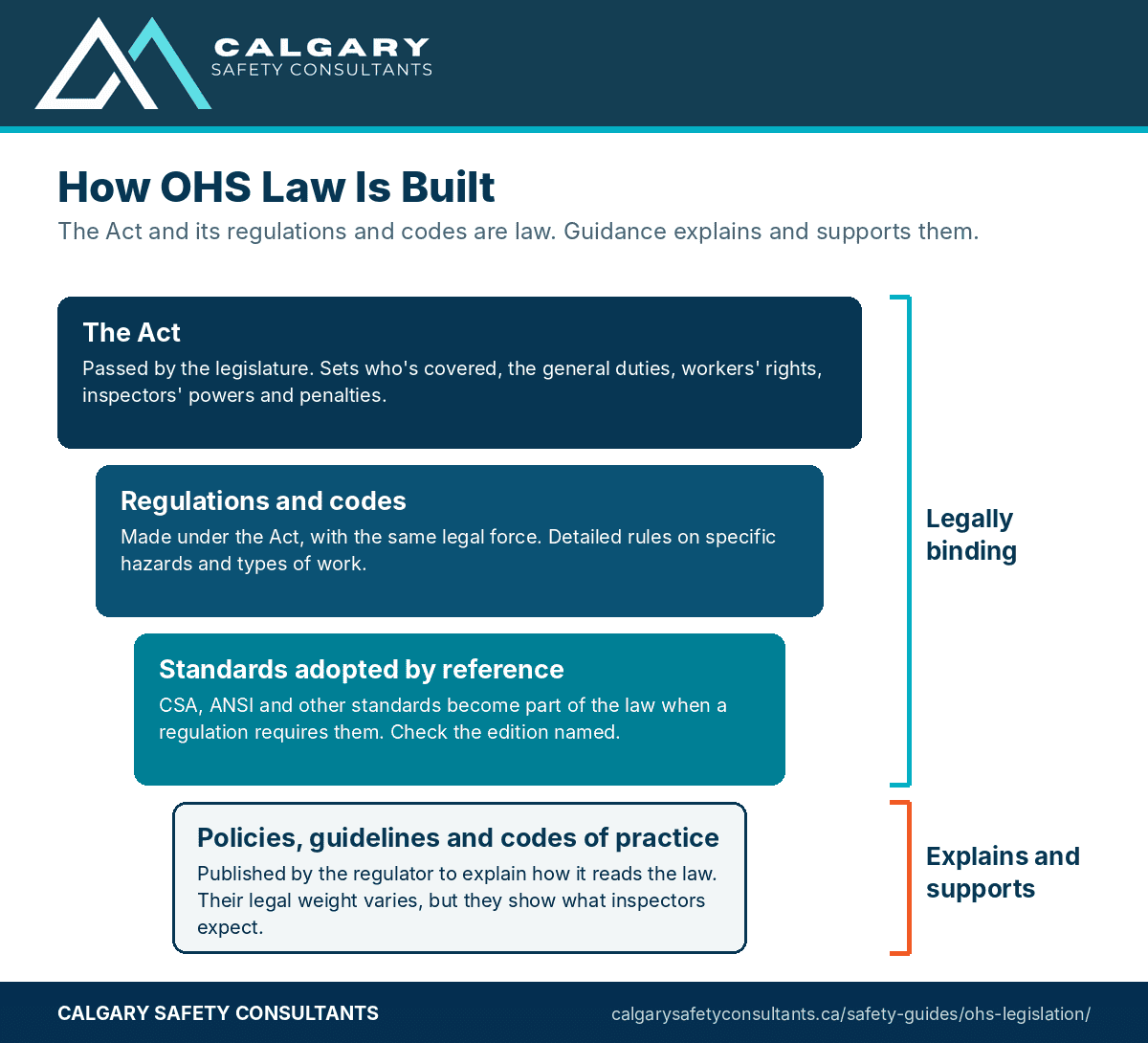
OHS legislation comes in layers, and you need to know which layer you're reading. As Saskatchewan's own guide to understanding OHS in Saskatchewan puts it, the Act sets out general requirements, while the regulations give the detailed provisions.
The Act. The Act is passed by the legislature. It sets out who's covered, the general duties of employers, supervisors, workers and others, workers' rights, the powers of inspectors and the penalties. General duty clauses, such as an employer's duty to ensure the health and safety of workers as far as it's reasonably practicable, apply even where no specific rule exists.
Regulations and codes. Regulations are made under the Act and carry the same legal force. They hold the detailed rules on topics such as first aid, fall protection, confined spaces and WHMIS. Alberta splits its detailed rules between the OHS Regulation and the OHS Code, which sets the technical requirements. Ontario uses separate regulations for different sectors, such as industrial establishments and construction projects.
Standards adopted by reference. Many regulations require compliance with a CSA, ANSI or other standard. When they do, that standard becomes part of the legal requirement, so check which edition the law refers to.
Policies, guidelines and codes of practice. Regulators publish material that explains how they read the law. Their legal weight varies. In British Columbia, WorkSafeBC's OHS policies must be applied by WorkSafeBC and the appeal tribunal, while its OHS guidelines help interpret the law but aren't the only acceptable interpretation. In the Northwest Territories and Nunavut, the WSCC notes in its joint OHS committee code of practice that codes of practice don't have the same legal force as the Acts and regulations. Guidance isn't law, but it shows how inspectors are likely to read the law, so it's worth following.
Reading the law
Legislation reads differently from most documents, but a few habits make it much easier to use.
Start with the definitions. Words such as "worker," "work site," "supervisor," "competent" and "prime contractor" have specific legal meanings, and they're not always the same from one jurisdiction to the next. Alberta talks about a work site, for example, where most other jurisdictions talk about a workplace. Read the definitions section first, and come back to it whenever a word seems to carry weight.
Check the scope and application. Early sections tell you who and what the law covers, and what's excluded. A section may apply only to construction, only to a certain number of workers or only to particular equipment.
Read the duty words carefully. "Shall" and "must" create obligations. "May" gives permission or a choice. The federal Interpretation Act says that "shall" is imperative and "may" is permissive, and each province and territory has its own interpretation statute with similar rules. These statutes also tell courts to read laws as remedial, giving them the fair, large and liberal interpretation that best achieves their purpose. British Columbia's Interpretation Act is a good example. In practice, that means an OHS law is read to protect workers, not narrowly to excuse a gap.
Understand "reasonably practicable." Many duties apply as far as it's reasonably practicable. Alberta's plain-language explainer, Legal terms 101: reasonably practicable, describes it as what's feasible in the circumstances and what a reasonable person would consider appropriate. Cost and convenience alone don't make a precaution impracticable. Our article on what reasonably practicable means goes into more detail.
Read the layers together. A general duty in the Act, a specific rule in a regulation and an adopted standard often all apply to the same work. Where a specific rule exists, follow it; where it doesn't, the general duty still applies.
Use the current, official version. Many online consolidations are kept up to date but are labelled unofficial. Manitoba, Saskatchewan, Prince Edward Island and the Northwest Territories all say so on their consolidations, while the federal Justice Laws Website, LegisQuébec and Newfoundland and Labrador's House of Assembly publish official versions. Check the currency date, and don't rely on old printouts or third-party summaries.
Ask when it matters. Regulators answer questions about their legislation, and their guidance often covers the most common ones. For a decision with real consequences, such as whether a contract makes you the prime contractor, get advice before you act.
The legal standard
Due diligence is the legal standard at the heart of Canadian OHS law. It means taking every reasonable precaution in the circumstances to prevent injury and illness, and being able to show you did.
Its legal footing comes from the Supreme Court of Canada's decision in R. v. Sault Ste. Marie (1978). The Court recognized a category of public welfare offences, called strict liability offences, that includes most OHS offences. The prosecution doesn't have to prove the accused meant to break the law. Instead, once the offence itself is proven, the accused can avoid conviction by showing, on a balance of probabilities, that it took all reasonable care. That's the due diligence defence.
Regulators describe it the same way. WorkSafeBC sums it up as "taking all reasonable steps to protect workers from harm," and Alberta's explainer ties it to being able to prove that all reasonably practicable steps were taken. Due diligence is judged on what you did before the incident, not on what you meant to do or did afterward.
In practice, due diligence is built from the ordinary parts of a good safety program:
There's also a criminal law side. Section 217.1 of the Criminal Code, added after the 1992 Westray mine disaster, says anyone who directs how others work has a legal duty to take reasonable steps to prevent bodily harm. A serious failure can lead to criminal negligence charges against organizations and individuals, separate from any OHS prosecution. Our article on OH&S due diligence in Canada looks at what it means for employers and supervisors.
Across Canada
The core ideas are shared, but the details aren't, and the differences catch out employers who work in more than one jurisdiction. The table shows two of the most common: when you need a joint health and safety committee or representative, and when you need a written health and safety program.
| Jurisdiction | Joint committee or representative | Written health and safety program |
|---|---|---|
| Alberta | 20 or more workers; representative for 5 to 19 | 20 or more workers |
| British Columbia | 20 or more workers; representative for 10 to 19 | Formal program at 20 or more workers with a moderate or high hazard rating, or 50 or more; less formal program for others |
| Saskatchewan | 10 or more workers; representative at prescribed workplaces with 5 to 9 | Prescribed workplaces with 10 or more workers |
| Manitoba | 20 or more workers; representative for 5 to 19 | 20 or more workers |
| Ontario | 20 or more regularly employed; representative for 6 to 19 | Written policy, reviewed yearly, and a program where more than 5 workers are regularly employed |
| New Brunswick | 20 or more workers; for 5 to 19, the safety policy may provide for a representative | 20 or more workers |
| Nova Scotia | 20 or more workers; representative for 5 to 19 | Program at 20 or more; written policy at 5 or more |
| Yukon | 20 or more workers; representative for 5 to 19 | Health and safety management system at 20 or more, with separate requirements for smaller workplaces |
| Northwest Territories and Nunavut | 20 or more workers; representative under 20 | 20 or more workers |
| Federal | Work place committee at 20 or more; representative under 20; policy committee at 300 or more | Hazard prevention program for every employer, whatever its size |
Thresholds are counted differently, too. Some jurisdictions count workers at each workplace and some count them across the employer, some count regular workers only, and some average the count over a year, so check the exact wording before relying on a number. Our article on when a committee or representative is legally required goes into the detail for Alberta, British Columbia and Saskatchewan.
Other differences show up in how the law is organized and enforced:
Staying current
OHS legislation changes more often than most employers expect. Newfoundland and Labrador, for example, raised its committee threshold from 10 to 20 workers in March 2024, and New Brunswick amended its Act in 2024 so employers with 20 or more employees must establish and implement their written health and safety program, not just establish it. A program written to last year's law can fall out of step without anyone noticing.
A few simple habits keep you current:
Inspectors enforce the law as it stands today, not as it stood when your manual was written, so a register reviewed on schedule is one of the simplest ways to show due diligence.

Guides
Guides that go deeper into specific parts of OHS law will be listed in this category as they're published. In the meantime, this guide shows how the law turns into everyday safety work.
How to build one formal, written JHA for each job or position, covering every task, so you can show how you meet your duty to identify and control hazards.
Read the guide →From our audits
Free downloads
Two free downloads go with this page. Click a button to download the PDF.
From the blog
July 18, 2025
September 7, 2026
August 31, 2026
May 11, 2026
When to bring in help
Calgary Safety Consultants helps employers understand the OHS legislation that applies to them and turn it into a practical program. Our consulting covers legal registers, program and manual development, multi-province operations, responses to orders and inspections, and audit preparation, with a focus on Alberta, British Columbia and Saskatchewan. Our online training and free downloads are available anywhere in Canada.
We help employers prepare for COR and SECOR audits, but we don't issue certificates. CORs and SECORs are issued through the applicable certifying partner, and no document guarantees an audit result.
Common questions
Answers to the questions employers ask most often about OHS legislation in Canada.
If your business is federally regulated, Part II of the Canada Labour Code and its regulations apply. Otherwise, the OHS legislation of the province or territory where the work is done applies. A business working in more than one province follows each province's law at its own locations, and the table on this page links the Act, regulations and regulator for all 14 jurisdictions.
Check the federal government's list of federally regulated industries, which includes banks, airlines and airports, railways, telecommunications, broadcasting, ports and shipping, pipelines, postal services and road transport that crosses provincial or national borders. What counts is the nature of your business, not an individual's job. If you're unsure, ask the federal Labour Program and keep the answer on file.
No. Canada has 14 OHS jurisdictions: the 10 provinces, the 3 territories and the federal government. Each has its own Act and regulations. The Canada Labour Code applies only to federally regulated workplaces, which are a small share of employers. Most businesses follow the law of the province or territory where the work is done.
The Act is passed by the legislature and sets out the general framework: who's covered, the main duties and rights, inspectors' powers and penalties. Regulations are made under the Act and hold the detailed rules on specific topics, such as first aid or fall protection. Both are law, and you need to read them together to know what's required.
It depends on what it is. Alberta's OHS Code is a regulation and fully binding. Codes of practice published by regulators, such as those from the WSCC in the Northwest Territories and Nunavut, generally don't have the same legal force as the Act and regulations, although following them helps show you've met the law. Check how your jurisdiction treats each document.
Not in the same way as the Act and regulations. Guidelines explain how a regulator reads the law and what it expects, and some policies, such as WorkSafeBC's OHS policies, are binding on the regulator itself. Following guidance is a strong way to show compliance, but it doesn't replace the legal text, and it can't lower a requirement in the law.
Due diligence means taking every reasonable precaution in the circumstances to prevent injury and illness, and being able to show it. Under the Supreme Court of Canada's decision in R. v. Sault Ste. Marie, most OHS offences are strict liability offences, so an accused can avoid conviction by proving it took all reasonable care. Records of hazard assessments, training, supervision and corrective action are how you show it.
It means what's feasible in the circumstances and what a reasonable person would consider appropriate, weighing the risk against the time, effort and cost of controlling it. A precaution isn't impracticable just because it's inconvenient or costs money. Many OHS duties apply as far as it's reasonably practicable, so the term comes up often when interpreting the law.
The law where the work is done. A crew from Alberta working on a site in Saskatchewan follows Saskatchewan's OHS legislation while it's there. Orientation, committees, first aid and other requirements should match that province's rules. The exception is a federally regulated business, which follows the Canada Labour Code wherever it operates in Canada.
Yes. OHS legislation applies to employers of every size, apart from a few specific exclusions set out in each law. Some requirements, such as a joint health and safety committee or a written program, only start at a set number of workers, and those thresholds vary by jurisdiction. The general duties, such as protecting workers' health and safety and training them, apply from the first worker.
Use the government's own legislation site or King's Printer, linked in the table on this page. Many online consolidations are labelled unofficial but are kept current and are what most people use day to day. Some jurisdictions, such as Quebec and Newfoundland and Labrador, publish official versions online. Always check the date the consolidation is current to.
Changes happen every year somewhere in Canada, from new regulations to changed thresholds. Newfoundland and Labrador raised its committee threshold in 2024, for example, and New Brunswick amended its Act the same year. Subscribe to your regulator's updates, keep a legal register and review it at least once a year and whenever your work changes.
It's the common name for the Criminal Code amendments that came into force in 2004 after the 1992 Westray mine disaster in Nova Scotia. They added section 217.1, which says anyone who directs how others do their work has a legal duty to take reasonable steps to prevent bodily harm to them and others, and set rules for holding organizations criminally responsible. Serious breaches can lead to criminal negligence charges against organizations and individuals.
Most jurisdictions require a joint committee at 20 or more workers and a health and safety representative for smaller workplaces, but the numbers vary. Saskatchewan requires a committee at 10 or more workers, for example, and British Columbia requires a representative from 10 to 19. Check the exact threshold and how workers are counted in your own legislation.
Each jurisdiction has its own regulator. In some, it's the workers' compensation board, such as WorkSafeBC or WorkSafeNB. In others, it's a government department, such as Alberta OHS or Ontario's Ministry of Labour, Immigration, Training and Skills Development. Federally regulated workplaces are overseen by the federal Labour Program. The table on this page links each regulator.
Sources
This page is general information, not legal advice. OHS requirements differ between provinces, territories and federally regulated workplaces, and they change over time, so always check the current legislation that applies to your workplace and get advice for decisions with legal consequences.
Talk to a safety consultant
Working in more than one province, unsure whether you're federally regulated, or facing an inspector's order? Complete the form below or book a 30-minute consultation, and we'll help you work out the next practical step.