Joint Health and Safety Committee and Representative Training
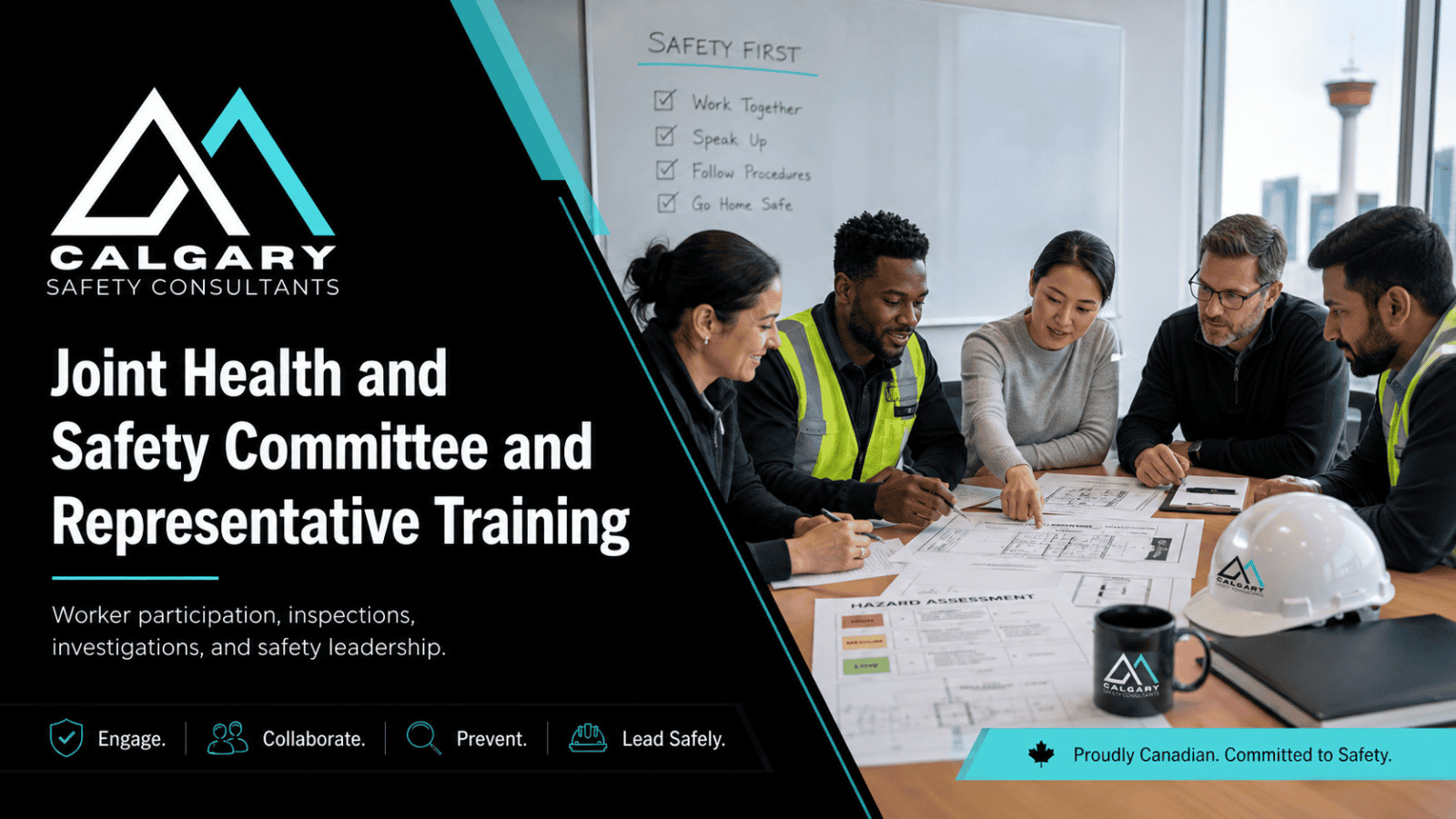
Joint Health and Safety Committee and Representative Training gives committee members, Health and Safety Representatives, supervisors, managers, and employers the practical knowledge needed to support worker participation and contribute to a functioning workplace health and safety system.
Calgary Safety Consultants offers Alberta-focused JHSC training through three delivery options: self-paced online training, live virtual instructor-led training, and classroom training for workplace groups. Individuals can begin the online course when it suits their schedule, while employers can arrange group training for new committees, existing committee members, Health and Safety Representatives, supervisors, or multi-location teams.
Participants learn how to understand their roles, receive and examine workplace safety concerns, participate in hazard assessments, review inspection information, develop practical recommendations, document committee activities, communicate with workers and management, and follow corrective actions through to completion.
The objective is to move beyond simply establishing a committee or appointing a representative. Effective training helps participants understand how their responsibilities connect with everyday operations, workplace risk, worker concerns, employer decision-making, and ongoing safety improvement.
Alberta, British Columbia, and Saskatchewan training options
Alberta Joint Health and Safety Committee and Representative Training
Alberta uses the terms health and safety committee and Health and Safety Representative. Employers generally require a committee when they regularly employ 20 or more workers and a representative when they regularly employ between five and 19 workers. Alberta requires committee members and representatives to receive training in their roles and responsibilities, the obligations of work-site parties, and worker rights.
British Columbia Joint Health and Safety Committee Training
British Columbia uses the terms joint health and safety committee and worker health and safety representative. New joint committee members generally require at least eight hours of prescribed instruction and training, while worker health and safety representatives generally require at least four hours. The required subject matter includes committee duties, committee procedures, workplace inspections, incident investigations, unsafe-work refusals, and, for committee members, annual committee evaluations.
Saskatchewan Occupational Health Committee Training
Coming soon.
Online, virtual, and classroom delivery options
Employers don’t all need the same training format. Some workers need flexible individual training, while newly established or developing committees may benefit from live instruction and workplace-specific discussion.
Calgary Safety Consultants provides several delivery options so organizations can choose the approach that best fits their workforce, locations, operational requirements, and applicable provincial legislation.
Online Joint Health and Safety Committee and Representative Training
Online training provides a flexible option for individuals who need to complete committee or representative training without waiting for a scheduled classroom session.
Participants work through structured lessons, workplace examples, knowledge checks, and assessments at their own pace. Online delivery is particularly useful for individual committee appointments, replacement members, geographically dispersed workers, and employers managing training across several locations.
Where an online course is available for the applicable jurisdiction, participants receive a Certificate of Completion after successfully completing the course requirements.
Online training may include:
- Self-paced lessons.
- Workplace examples and scenarios.
- Knowledge checks and quizzes.
- Final assessment.
- Progress tracking.
- Certificate of Completion.
- Access from a computer, tablet, or compatible mobile device.
- Training records that can support employer documentation.
You can see our links to online training here:
Start Online Committee Training
Virtual Instructor-Led Joint Health and Safety Committee and Representative Training
Virtual training brings committee members and representatives together for live instructor-led training without requiring participants to travel to a classroom.
This format provides opportunities to ask questions, discuss workplace situations, examine committee challenges, and better understand how legislative requirements apply to the organization.
Virtual training is particularly useful for:
- Newly established committees.
- Organizations with workers at several locations.
- Regional or remote operations.
- Committees requiring refresher training.
- Employer and worker representatives who need to train together.
- Organizations that want more discussion than a self-paced course provides.
Sessions can also incorporate workplace-specific examples involving committee terms of reference, meeting processes, hazard assessments, inspections, incident investigations, recommendations, and corrective-action tracking where appropriate. Fill out the contact form below.
Request Virtual Committee Training
Classroom Joint Health and Safety Committee and Representative Training
Classroom training provides direct instructor interaction and allows the material to be connected more closely to the organization’s workplace, hazards, safety systems, and committee processes.
This option is particularly effective when an employer is establishing a new committee, improving an existing committee, preparing members for their roles, or addressing concerns involving participation, meeting effectiveness, recommendations, documentation, or corrective-action follow-up.
Classroom sessions can include group discussion, practical exercises, workplace scenarios, document reviews, and examples relevant to the employer’s industry.
Training may be delivered at the employer’s workplace or another agreed training location. Fill out the contact form below.
What Does Joint Health and Safety Committee Training Cover?
Committee and representative training should help participants understand both their legislative responsibilities and how those responsibilities are applied in an actual workplace.
Course content varies by province, but training may include:
- Purpose and function of workplace health and safety committees.
- Roles of worker and employer representatives.
- Responsibilities of committee co-chairs.
- Role of a Health and Safety Representative.
- Employer, supervisor, worker, and other workplace-party responsibilities.
- Worker health and safety rights.
- Committee structure and terms of reference.
- Effective committee meetings.
- Agendas, meeting minutes, and action items.
- Receiving and addressing worker concerns.
- Hazard identification and assessment.
- Risk assessment and prioritization.
- Hierarchy of controls.
- Workplace inspections.
- Incident and near-miss investigations.
- Unsafe-work refusal processes.
- Developing practical safety recommendations.
- Communication between employees and management.
- Conflict resolution and problem-solving.
- Corrective-action tracking.
- Documentation and record keeping.
- Monitoring whether implemented controls are effective.
The objective is to help participants move beyond simply identifying problems. Effective committee members should be able to gather relevant information, understand the concern, contribute to a practical recommendation, document the decision, and follow the issue until appropriate action has been taken.
Frequently Asked Questions for for Joint Health and Safety Committee and Representative Training
What is Joint Health and Safety Committee and Representative Training?
Joint Health and Safety Committee and Representative Training prepares worker and employer representatives to understand their responsibilities and participate effectively in workplace health and safety. Training commonly addresses committee responsibilities, worker rights, workplace inspections, hazard assessment, incident investigation, recommendations, communication, and corrective-action follow-up.
Is Joint Health and Safety Committee Training required?
Training requirements depend on the province and the participant’s role. Alberta, British Columbia, and Saskatchewan each have requirements relating to the training of committee members or workplace health and safety representatives, but the required content and training structure aren’t identical.
How long does it take to complete WHMIS training?
Most online WHMIS courses can be completed in approximately 1–2 hours, depending on the learner. The course is self-paced, allowing workers to complete it quickly and efficiently.
Can Joint Health and Safety Committee and Representative Training be completed online?
Can Joint Health and Safety Committee and Representative Training be completed online?
What is the difference between online and virtual committee training?
Online training is self-paced and allows participants to complete lessons independently. Virtual training is delivered live by an instructor and allows participants to ask questions, participate in discussion, and work through workplace situations as a group.
Is JHSC training the same in Alberta, BC, and Saskatchewan?
No. Although the underlying goal of worker participation is similar, each province establishes its own committee structure, terminology, training requirements, and representative requirements. Employers should select training developed for the jurisdiction where the participant works.
What is a Health and Safety Representative?
A Health and Safety Representative performs worker-participation functions in workplaces where a full committee may not be required. The terminology, worker thresholds, duties, and training requirements vary by province.
Do participants receive a certificate?
Participants completing Calgary Safety Consultants courses that include certification receive a Certificate of Completion after meeting the applicable course and assessment requirements. A course certificate documents completed training but shouldn’t be confused with a professional designation or government licence.
Does committee training help with COR or SECOR?
Effective committee training can support a broader COR or SECOR safety management system by improving worker participation, committee documentation, inspections, hazard assessment involvement, recommendations, and corrective-action follow-up. Completing training alone doesn’t guarantee certification or a particular audit result.
Should supervisors and managers take committee training?
It can be beneficial. Supervisors and managers frequently interact with committee members, receive concerns and recommendations, assign corrective actions, and provide operational information. Understanding the committee process can improve communication and reduce delays when safety concerns require management action.
Does Joint Health and Safety Committee Training expire?
Refresher requirements should be assessed based on the applicable jurisdiction, changes to legislation, committee roles, workplace processes, and the participant’s ongoing competency. Employers should also review training when committee performance or workplace changes indicate that additional instruction is appropriate.
Need Joint Health and Safety Committee Training for Your Team?
Calgary Safety Consultants provides committee and representative training for individual participants, complete committees, supervisors, managers, and multi-location organizations across Alberta, British Columbia, and Saskatchewan.