On this page
- What First Aid Requirements Cover
- Why First Aid Planning Matters
- Who Is Responsible for Workplace First Aid
- The Three Factors Behind Every First Aid Requirement
- CSA Z1210 and CSA Z1220: The Common Language
- First Aid Requirements by Jurisdiction
- Start With a Written First Aid Assessment
- First Aiders: Numbers, Levels and Shift Coverage
- Kits, Stations, First Aid Rooms and Eyewash
- Communication and Emergency Transportation
- Remote Sites, Mobile Crews and Multiple Shifts
- Contractors and Shared Sites
- Keep First Aid Records That Hold Up
- How First Aid Ties Into Your Emergency Response Plan
- A Practical Workplace Example
- Common First Aid Mistakes to Avoid
- What an Auditor Expects to See
- The Bottom Line
- Download the Worksheet and Checklist
- Frequently Asked Questions
- Related Guides and Articles
- How Calgary Safety Consultants Can Help
- Sources
What First Aid Requirements Cover
Every province, territory and the federal government sets minimum first aid requirements for workplaces. The names differ, but the rules answer the same questions. Who helps an injured or ill worker in the first few minutes, with what, and how does that worker get to a hospital or clinic?
In most jurisdictions, the employer has to provide, and keep ready:
- First aiders (called attendants in some places) in the right number and with the right level of certificate for each shift.
- First aid kits and supplies of the right type and size, in places workers can reach quickly.
- First aid rooms or stations at larger or more remote workplaces.
- A way to summon help, from the first aider and from emergency services.
- Emergency transportation that suits the distance, the weather and the likely injuries.
- Records of first aid given, kept confidential for a set period.
These are minimums. Several regulations also require you to assess your own risks and add what's needed.
Why First Aid Planning Matters
Minutes matter most when the injury or illness is serious. According to the Heart and Stroke Foundation's Restart a Heart campaign, about 60,000 cardiac arrests happen outside hospitals in Canada every year, and only one in 10 people survives. Every minute without CPR or defibrillation lowers the chance of survival by about 10 per cent, and doing CPR and using an AED can double it.
That's why the rules tie first aid to travel time: the further you are from care, the more your own people have to be able to do.
Having certificates on file isn't the same as having a response that works. Our article on why a trained first aider's response can still fail walks through the usual gaps: expired kits and AED pads, locked doors, dead radio zones and nobody assigned to meet the ambulance.
Who Is Responsible for Workplace First Aid
The employer carries the main duty everywhere in Canada. On shared sites, the prime contractor or principal contractor usually takes it on for everyone, which we cover in the section on contractors below. Other people play a part too:
- Supervisors make sure first aid is available on their shift and that injuries get reported and recorded.
- Workers report injuries and illnesses as soon as they can, even minor ones.
- First aiders give care within their training, record it and refer serious cases on.
- The joint committee or representative is consulted on the first aid assessment in B.C., Saskatchewan, the Northwest Territories and Nunavut.
First aid sits inside your wider health and safety system. It works best when someone owns it and it's reviewed with everything else.
The Three Factors Behind Every First Aid Requirement
Nearly every jurisdiction sets first aid requirements from the same three factors. Get these right and the tables become easy to read.
1. Hazard level
Most rules split work into two or three hazard levels. Alberta uses low, medium and high hazard work, as its first aid in the workplace bulletin explains. Alberta's explanation guide to the first aid rules describes low hazard work as typically clerical or administrative, treats work that's neither low nor high hazard as medium, and says a site is rated at its highest level if the higher-hazard areas can't be separated.
In B.C., you don't pick the rating yourself. WorkSafeBC's page on conducting a first aid assessment explains that it assigns a low, moderate or high hazard rating to each classification unit, and you'll find yours on the description that comes with your annual assessment rate letter. Other jurisdictions, including Saskatchewan, Prince Edward Island, the Northwest Territories and Nunavut, now have the employer set the risk level through a documented first aid risk assessment.
2. Number of workers per shift
Tables are usually built on the number of workers present at one time or on one shift, not your total headcount. Count everyone who'll be there, including part-time and casual workers, supervisors and managers.
3. Time to medical care
This is where the rules vary most. Some measure travel time to a hospital or medical facility under normal conditions, others how long an ambulance takes to reach you. Alberta's OHS Code defines a close work site as 20 minutes or less from a health care facility, distant as more than 20 but less than 40 minutes, and isolated as 40 minutes or more, under normal travel conditions. Federally and in B.C., the test is about ambulance response, as the next sections show.
CSA Z1210 and CSA Z1220: The Common Language
Two CSA Group standards now sit behind first aid rules in much of the country. As more jurisdictions adopt them, a kit or a certificate means roughly the same thing from one province to the next.
- CSA Z1210, First aid training for the workplace, sets curriculum and quality rules for training agencies, with basic, intermediate and advanced levels.
- CSA Z1220, First aid kits for the workplace, sets kit types and contents. The current edition, CSA Z1220:24, covers a classification system, selecting kits by the number of workers per shift and ongoing maintenance, and includes annexes on doing a workplace first aid risk assessment.
Under CSA Z1220, Type 1 is a personal kit, Type 2 is for basic first aid in low and medium risk work, and Type 3 is for intermediate first aid in higher risk work. Types 2 and 3 come in small, medium and large. Alberta's summary of its 2023 first aid changes links those sizes to workers per shift: small for 2 to 25, medium for 26 to 50 and large for 51 to 100.
Jurisdictions don't all reference the same edition. Nova Scotia's guide addendum, for example, says the April 2024 editions had to be followed after August 1, 2024. Check which edition your regulation names before you buy kits or book training.
First Aid Requirements by Jurisdiction
Here's how first aid requirements line up across Canada.
| Jurisdiction | Main first aid rules | How needs are set | Distance or time trigger | Records kept |
|---|---|---|---|---|
| Federal | Canada Occupational Health and Safety Regulations, Part XVI | Employees at any time; ambulance response time; kit types A to D | Remote: ambulance response time over two hours | 2 years |
| Alberta | OHS Code Part 11 and Schedule 2 | Hazard level; workers per shift; CSA Z1210 and Z1220 | Close, distant or isolated by travel time | 3 years |
| British Columbia | OHS Regulation Part 3 and Schedule 3-A | Written assessment; WorkSafeBC hazard rating; class 1 to 4 | Remote: road ambulance over 30 minutes from its base | 3 years |
| Saskatchewan | OHS Regulations, 2020, Part 5 | Risk assessment; Class A and B attendants; CSA Z1220 | Close: within 30 minutes' road travel | Register, 5 years |
| Manitoba | Workplace Safety and Health Regulation, Part 5 | Workers, type of work and distance | Close 30 minutes; distant two hours; isolated beyond | See Part 5 |
| Ontario | Reg. 1101 under the Workplace Safety and Insurance Act | Workers per shift; Basic or Intermediate | Not a factor in the WSIB summary | Record all treatment |
| Quebec | Regulation respecting minimum standards of first aid and first aid supplies | Workers present at once; CSA Z1210 intermediate; CSA Z1220 | Check the regulation | See the regulation |
| New Brunswick | First Aid Regulation 2004-130 | Employees per shift; high hazard work; CSA standards | Isolated sites need suitable transport | 3 years |
| Nova Scotia | Workplace Health and Safety Regulations, Part 4 | Employees per shift; office or other; CSA standards | Close 20 minutes; distant to 40; isolated 40 or more | 5 years |
| Prince Edward Island | OHS Act General Regulations, Part 9 | Documented risk assessment; CSA standards | Part of the risk assessment | See Part 9 |
| Newfoundland and Labrador | OHS First Aid Regulations | Workers per shift; CSA Z1220 kits | Suitable transport readily available | Register, 5 years |
| Yukon | Workplace Health and Safety Regulations, Part 18 | Hazard class A, B or C; workers per shift | Close 20 minutes; isolated over 40 or no all-weather road | 3 years |
| Northwest Territories and Nunavut | OHS Regulations, Part 5 | Risk assessment; low, moderate or high risk; CSA Z1220 | Isolated: over one hour or aircraft only | Register, 3 years |
Summary only. Each regulation has definitions, exemptions and table details not shown here. Read the full text, or call your regulator, before relying on a number.
Federally regulated workplaces
Federally regulated employers follow Part XVI of the Canada Occupational Health and Safety Regulations. You need a first aid attendant wherever six or more employees work at any time, or two or more at a remote workplace, where ambulance response time is over two hours. Outside offices, a basic certificate covers response times under 20 minutes and a standard certificate 20 minutes to two hours.
The remaining sections of Part XVI require a first aid room at 200 or more employees, transport arranged before employees are assigned, certificates valid for no more than three years and a first aid record kept for two years. Kit types A to D are set by Schedule I.
Alberta
Under Part 11 of the OHS Code, the prime contractor, or the employer if there's none, uses Schedule 2 Tables 4 to 7 to set first aiders, kits and rooms. Training must meet CSA Z1210 and kits CSA Z1220. In Alberta's own example, medium hazard work with 20 workers per shift under 20 minutes from a medical facility needs a CSA Type 2 small kit plus one basic and one intermediate first aider on every shift.
British Columbia
Under Part 3 of the OHS Regulation, you must prepare a written first aid assessment covering workers, hazards, likely injuries, barriers to first aid and transport, and review it within 12 months with your joint committee or worker representative. Schedule 3-A sets the minimum by workplace class, hazard rating and workers present.
A workplace is remote if a road ambulance can't reach it from its base in 30 minutes or less, and less accessible if ambulance personnel can't safely reach part of it. WorkSafeBC's note on the November 2024 changes explains that the old remote test was 20 minutes from a hospital. In Table 3-1, a class 1 moderate hazard workplace with 20 to 49 workers needs an intermediate kit, a dressing station and an intermediate attendant.
Saskatchewan
Part 5 of The Occupational Health and Safety Regulations, 2020 requires a first aid risk assessment by a competent person, with the committee or representative consulted. It doesn't apply to a close workplace, within 30 minutes' road travel of a medical facility, where all work is low hazard.
WorkSafe Saskatchewan's first aid guide sets out Table 9, starting at one Class A attendant for 2 to 25 workers at any risk level, and lists high-hazard activities such as construction, drilling, well servicing, logging and trucking. A first aid room is needed where 100 or more workers may be at a distant or isolated site.
Manitoba
The Workplace Safety and Health Regulation defines close, distant and isolated workplaces by travel time to a medical facility: 30 minutes, two hours, or more than two hours or air only. Part 5 sets basic, intermediate or advanced first aiders. SAFE Work Manitoba's first aid page points to CSA Z1220 kits and says a workplace with more than 100 workers needs a first aid room.
Ontario
Ontario's rules sit under workers' compensation law. The WSIB's first aid program page says every business covered by the Workplace Safety and Insurance Act must follow Regulation 1101. Each station needs a kit, the Form 82 poster, an inspection card and a list of first aiders, and kits must be checked at least four times a year. With six or more people on a shift, at least one needs Intermediate First Aid; Basic covers five or fewer.
Training must come from a WSIB-approved provider aligned with CSA Z1210:24, and CSA Z1220 kits are accepted. Workplace Safety and Prevention Services adds in its first aid guidance that a stretcher and two blankets are needed where more than 15 workers are on a shift.
Quebec
The Regulation respecting minimum standards of first aid and first aid supplies was amended in early 2026. Since February 12, 2026, new first aid certificates must be for CSA Z1210 intermediate training from a CNESST-recognized organization, and kits refer to CSA Z1220. Older certificates stay valid until they expire.
You need one first aider when up to 50 workers are present at once, plus one for each additional hundred or part of a hundred. Workers present for less than 30 minutes aren't counted. The CNESST subsidizes first aid training.
Atlantic Canada
New Brunswick's First Aid Regulation sets first aid providers per shift by whether the work is high hazard, starting at one for 2 to 19 employees, with intermediate training for high hazard work. A first aid room is required at 100 or more employees per shift.
Nova Scotia's workplace first aid guide uses close, distant and isolated bands of 20 and 40 minutes and requires a plan for isolated workplaces. A close workplace with 2 to 25 employees needs one basic first aider and one small Type 2 kit.
Prince Edward Island moved to a risk-based model on January 1, 2025. WCB PEI's prevention update says employers must document a first aid risk assessment and choose Basic, Intermediate or Advanced training for low, moderate or high risk work, with CSA Z1220 kits.
In Newfoundland and Labrador, the First Aid Regulations require an emergency first aid certificate holder where 2 to 14 workers are on a shift, a standard certificate holder from 15 workers (plus emergency certificate holders as numbers grow), and a first aid attendant and first aid room at 200 or more. Vehicles carrying workers need a Type 3 kit.
The territories
Yukon's Part 18 minimum first aid requirements sort work into hazard classes A, B and C and sites into close (up to 20 minutes), distant and isolated (over 40 minutes, or no all-weather road). The Yukon board's first aid resources recognize CSA Z1210 certificates and accept CSA Z1220 kits.
The Northwest Territories rewrote Part 5 of its OHS Regulations around a first aid risk assessment, CSA Z1220 kits and intermediate or advanced attendants. The changes took effect January 1, 2021. Nunavut made matching changes in R-003-2021, which also names CSA Z1210 as the training standard.
For the main OHS statute in each jurisdiction, see our guide to OHS legislation in Canada.
Start With a Written First Aid Assessment
A first aid assessment is a short written record of how you worked out what you need. B.C., Saskatchewan, Prince Edward Island, the Northwest Territories and Nunavut require one. Elsewhere it's still the easiest way to show you've met the minimums.
The UK Health and Safety Executive's list of things to consider in a first aid needs assessment is a good checklist for Canadian employers too. It includes the work and its hazards, the size and work patterns of your workforce, absences of first aiders, your incident history, travelling, remote and lone workers, and shared sites.
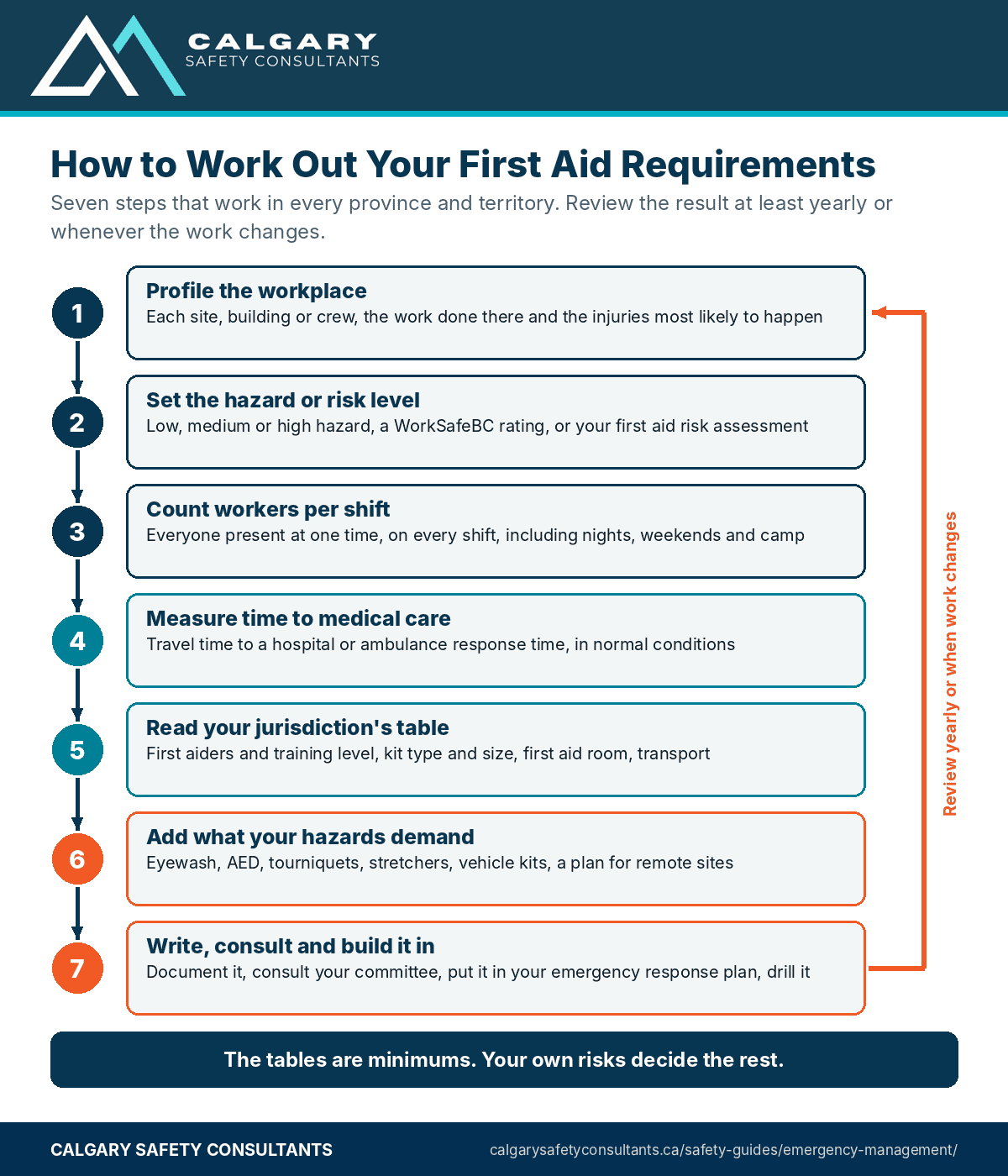
- Profile the workplace. List each site, building or crew, what work happens there and its hazards. Use your job hazard analyses to spot the injuries most likely to happen.
- Set the hazard or risk level your jurisdiction uses.
- Count workers by shift, including nights, weekends, overtime and peak periods.
- Measure time to care as your rules define it.
- Read your jurisdiction's table.
- Add what your hazards demand. Eyewash for chemicals, a tourniquet for saw work, burn supplies for hot work, an AED where you choose to provide one.
- Write it down, consult and review. Involve your committee or representative and review it at least yearly, or when the work changes.
First Aiders: Numbers, Levels and Shift Coverage
The tables set a minimum per shift. If your only intermediate first aider works days, your night shift has no coverage, so build the roster around the actual schedule.
- Cover every shift. Name the first aiders for each shift, crew and site, and post the names.
- Plan for absences. Train more first aiders than the minimum so one holiday or sick day doesn't leave a gap.
- Keep first aiders available. Federal and B.C. rules both bar assigning attendants duties that would stop them responding.
- Match the certificate to the requirement. A basic certificate doesn't count where the table calls for intermediate.
- Track expiry dates. Certificates are generally valid for up to three years. The federal rules even require a record of attendants' expiry dates.
- Pay for it. Saskatchewan requires that attendants have time to give first aid without losing pay.
Older certificate names don't map the same way everywhere. Alberta and Ontario renamed Emergency First Aid to Basic and Standard First Aid to Intermediate. B.C. treats unexpired Level 1, 2 and 3 certificates issued before November 1, 2024 as basic, intermediate and advanced (a transition rule that ends November 1, 2027), while the Northwest Territories treats Level 1 as intermediate. When in doubt, check with your regulator before relying on an older card.
Kits, Stations, First Aid Rooms and Eyewash
Choose kits by type and size for the workers they serve, and put them where people can reach them fast. A kit in a locked office is no help. Keep supplies clean, dry and ready (B.C. and Saskatchewan say so in their regulations), and remember that the federal rules bar storing prescription drugs and unlisted medications in kits.
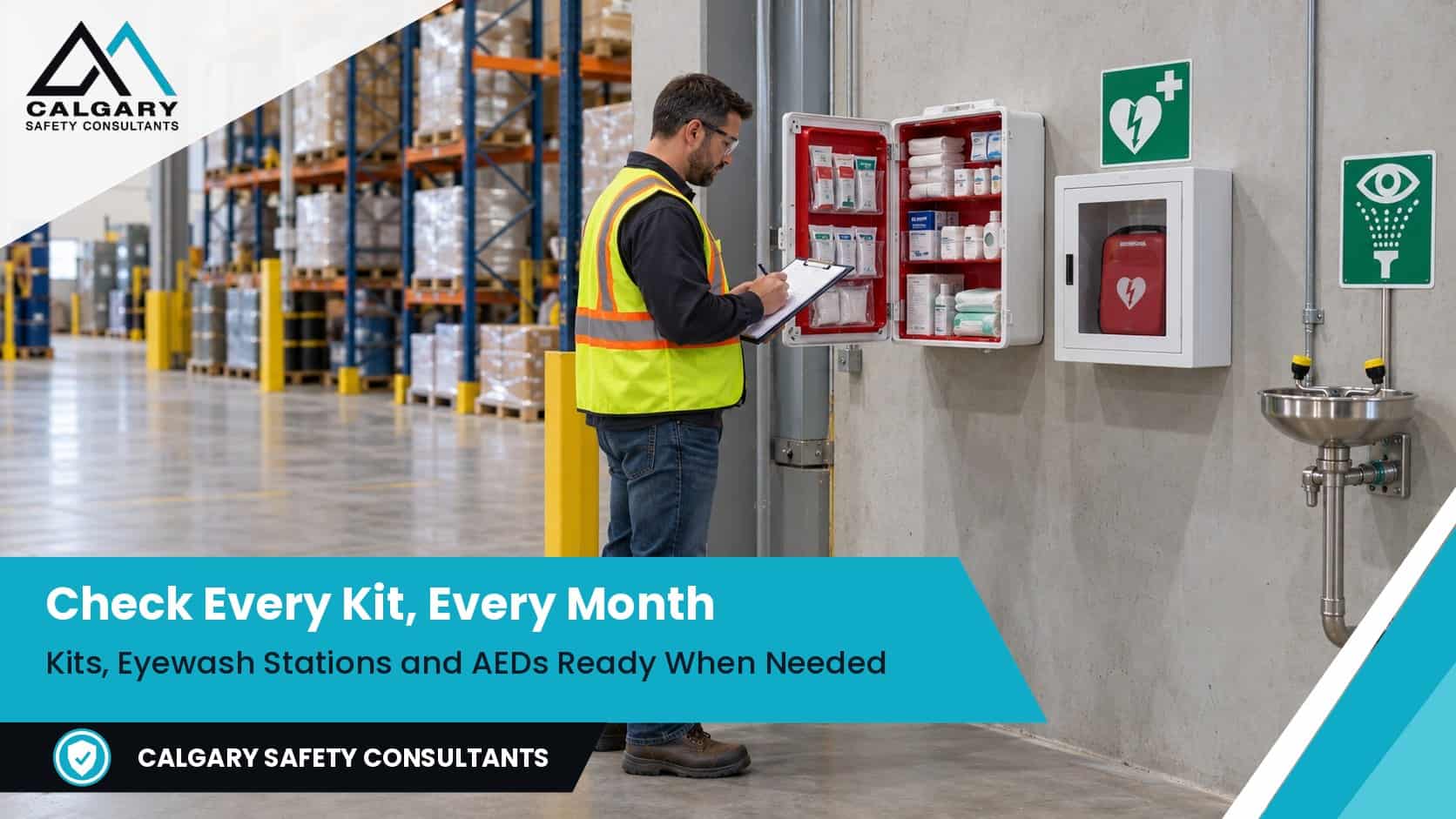
- Inspect on a schedule. Federal stations must be inspected at least monthly, Ontario kits at least four times a year, and Northwest Territories and Nunavut kits at intervals of no more than 90 days and after every use. A monthly check is a sensible default anywhere.
- Know your first aid room trigger. Thresholds range from 100 workers per shift in New Brunswick to 200 federally and in Newfoundland and Labrador, with remote sites often triggering one sooner.
- Provide eyewash where chemicals can splash. The federal rules require shower and eyewash facilities where a hazardous substance could injure skin or eyes, and Saskatchewan covers eye flushing equipment in its chemical rules.
- Decide on AEDs deliberately. Most first aid rules don't require an AED, and the WSIB says they aren't required under Ontario's Regulation 1101. Many employers provide one anyway. If you do, inspect it and track pad and battery dates.
Add kit checks to your routine workplace inspections.
Communication and Emergency Transportation
First aid only works if someone can call for it and the injured worker can be moved to care quickly. Most rules make the employer plan both before work starts.
- A reliable way to call for help. Phones, satellite phones or radios, tested where your people actually work.
- Posted information. Emergency numbers, the site address and directions, the names of first aiders and where the kits are, near phones and at each station.
- A transport plan. Alberta requires an emergency transportation plan before workers are sent to a site, with transport that suits the distance and likely injuries, protects from the weather, can carry a stretcher and lets the crew talk to the receiving facility. A first aider must go with the injured worker, and the driver can't be that first aider. The accompanying first aider isn't required at sites with three or fewer workers.
- Someone to guide the ambulance in from the gate or highway turn-off.
B.C. requires written first aid procedures, posted or otherwise communicated, and drills at least once a year and whenever procedures change. Where air transport is the main or only option, B.C. and Yukon add extra planning requirements. Our article on Canadian legal obligations for emergency drills explains how to test the plan.
Remote Sites, Mobile Crews and Multiple Shifts
Remote and mobile work is where first aid planning most often falls short, because calling 911 and waiting may take an hour or more.
- Expect more capability on site. As travel time grows, the tables require more first aiders, higher training levels, bigger kits, stretchers and sometimes a first aid room. B.C. requires an attendant available for overnight care where a first aid room is required and travel to a qualifying hospital would take longer than two hours.
- Equip vehicles. Several jurisdictions set kits for vehicles carrying workers: a Type 3 kit in Newfoundland and Labrador, a Level 1 kit in Yukon and a Type 2 kit in the Northwest Territories and Nunavut. Federally, one to three workers travelling by snowmobile or another small vehicle need a type D kit.
- Count camp populations. Saskatchewan, Yukon, the Northwest Territories and Nunavut base requirements on everyone housed at or near a camp (in Saskatchewan and Yukon, at distant or isolated sites), not only those on shift.
- Plan for lone workers. A worker alone needs a personal kit, a way to call for help and a check-in system. Our guide to working alone covers the check-in side.
For mobile crews, add a first aid check to the field-level hazard assessment at each new location: nearest hospital, drive time, cell service and today's first aider.
Contractors and Shared Sites
When several employers share a site, each can assume another has first aid covered. Most jurisdictions settle who's responsible.
- Alberta: the prime contractor provides first aid services, supplies and equipment, or the employer if there's no prime contractor.
- British Columbia: the prime contractor at a multi-employer workplace does the first aid assessment for all workers and does what's reasonably practicable to provide what's required.
- New Brunswick: at project sites, the contractor provides first aid for everyone with access to the site.
- Yukon: the principal contractor takes on the duties, and all workers on the project count toward the tables.
- Saskatchewan, Nova Scotia, the Northwest Territories and Nunavut: employers can agree in writing to share first aid arrangements, based on the combined number of workers.
Put the arrangement in writing: who supplies first aiders on each shift, where the kits are, how contractors call for help and who records treatment. Our guide to contractor safety shows how to build this into prequalification and site orientation.
Keep First Aid Records That Hold Up
Every jurisdiction expects a record of first aid given. It helps the worker if the injury turns out worse, supports a compensation claim and shows patterns worth investigating.
- Record the essentials: the worker's name, date and time of the injury and of the report, where and how it happened, the injury or illness, the first aid given, and the first aider's name and qualification.
- Record minor injuries too. Alberta now requires every illness or injury that receives first aid to be recorded.
- Keep records for the required period: two years federally, three years in Alberta, B.C., New Brunswick and Yukon, and five years for Saskatchewan's first aid register and in Nova Scotia and Newfoundland and Labrador.
- Keep them confidential. Store records securely and let workers see their own.
- Report to the WCB when required. A first aid record doesn't replace a claim report. In Ontario, for example, WSPS notes that a Form 7 isn't needed for a first-aid-only injury but is needed once the injury goes further.
Review the log every few months, since repeat injuries point to a hazard to fix. Treat those trends like any other incident investigation lead, and track fixes as corrective actions.
How First Aid Ties Into Your Emergency Response Plan
First aid is one part of your emergency response, not a separate program. Alberta makes the link explicit: its emergency response planning tool kit quotes the OHS Code requirement that the plan include the first aid services required, and its template asks for the type and location of kits and supplies, first aiders per shift, the first aid room if there is one, and transportation.
Wherever you are, your plan should name first aiders by shift, show where kits, AEDs and eyewash are, say who calls 911 and who meets the ambulance, and describe transport for remote work. Then test it.
- Run short drills. A 10-minute unannounced scenario shows whether people can find the kit and AED, get through on the phone and clear the access route.
- Rotate the roles so the response doesn't depend on one person.
- Fix gaps fast. Give each finding an owner and a date.
Auditors check the same links. Energy Safety Canada's 2023 COR audit protocol asks about first aid under its emergency response element, as the audit section below explains.
Our separate guides on emergency response plans and drills are on the Emergency Management topic page as they're published.
Workplace example
A Practical Workplace Example
Situation: Consider an illustrative Alberta mechanical contractor with about 45 workers. Most work in a shop near a city hospital, but a crew of eight spends months each year on a gas plant turnaround 50 minutes by road from the nearest hospital, working 12-hour days and nights. The company assumed the plant owner covered first aid there.
Action: The safety coordinator wrote a first aid assessment for each location. At the turnaround, she confirmed in writing what first aid the prime contractor supplied, and found it didn't cover nights. The company trained two more crew members to the intermediate level, put a CSA Type 3 kit and a stretcher in the crew truck, added a satellite phone for the dead zone and wrote a transport plan naming a driver and an accompanying first aider for each shift.
Result: When a worker took a deep forearm cut on a night shift, the first aider controlled the bleeding, the crew called ahead on the satellite phone and a second worker drove while the first aider rode along. At the next COR audit, interviews showed workers knew who their first aider was on each shift.
Common First Aid Mistakes to Avoid
- Counting total staff, not workers per shift. The tables work per shift, and nights and weekends need their own coverage.
- Guessing the travel time. Time the actual drive to care, or check ambulance response, under normal conditions.
- Letting certificates lapse. Track every expiry date.
- Kits that are empty, expired or locked away. Inspect monthly and restock after every use.
- No transport plan for remote work. Calling 911 isn't a plan when the ambulance is an hour away.
- Assuming the prime contractor covers you. Confirm it in writing, shift by shift.
- Never testing the response. Short drills find dead radio zones, locked gates and missing supplies before an emergency does.
Audit perspective
What an Auditor Expects to See
First aid is checked under the emergency response element of a COR or SECOR audit. Energy Safety Canada's 2023 COR audit protocol asks, in Element F, whether the company has plans or procedures for medical emergencies, rendering first aid and reporting first aid incidents, whether the correct number of employees are trained in first aid as required by legislation, and whether appropriate first aid equipment and supplies are available.
An auditor will typically look for a first aid assessment for each site, a first aider roster that matches the shifts, current certificates, kit inspection records, a transport plan and first aid records. In interviews, workers should know who today's first aider is and where the kit is.
Calgary Safety Consultants helps employers build and review their programs and prepare for COR and SECOR audits; we don't issue certificates. CORs and SECORs are issued through the applicable certifying partner.
The Bottom Line
First aid requirements look complicated because every jurisdiction words them differently, but they rest on the same three factors: hazard level, workers per shift and time to medical care. Work those out honestly for each site and shift, read them against your local table, and you'll know what first aiders, kits, rooms and transport you need.
Then make it work in real life. Write the assessment down, put first aid into your emergency response plan, keep certificates and kits current, and test the response with short drills. The aim isn't a binder that satisfies an auditor. It's a worker who gets the right help in the first few minutes.
Download the First Aid Needs Assessment Worksheet and Inspection Checklist
Two free, fillable PDF downloads go with this guide. Both have clickable checkboxes and fill-in fields, so you can complete them on screen or print them for the site.
- First Aid Needs Assessment Worksheet (PDF, 7 pages). A step-by-step worksheet for each site or crew: workplace profile, hazard level, worker counts by shift, travel time to care, a jurisdiction lookup table, the first aiders, kits, room and transport you need, a communication and emergency transport plan, key terms, common mistakes and sign-off.
- First Aid Kit and Station Inspection Checklist (PDF, 6 pages). A monthly inspection for kits, stations, first aid rooms, eyewash, AEDs and transport, with a restock log, guidance on first aid records and a sample record log, and a first aider roster with certificate expiry tracking.
Click either button to download the file. Adapt both to your own sites and the rules that apply in your province or territory.

About the author
John Duplessis, B.Sc., CRSP
John Duplessis is a Canadian Registered Safety Professional with more than 30 years of occupational health and safety experience in oil and gas, construction, green energy, midstream operations and industrial project work. He is an external auditor with Energy Safety Canada.