On this page
- What Contractor Safety Management Is and Why It Matters
- Who's Responsible When You Hire a Contractor
- Check Workers' Compensation Coverage: Clearance Letters
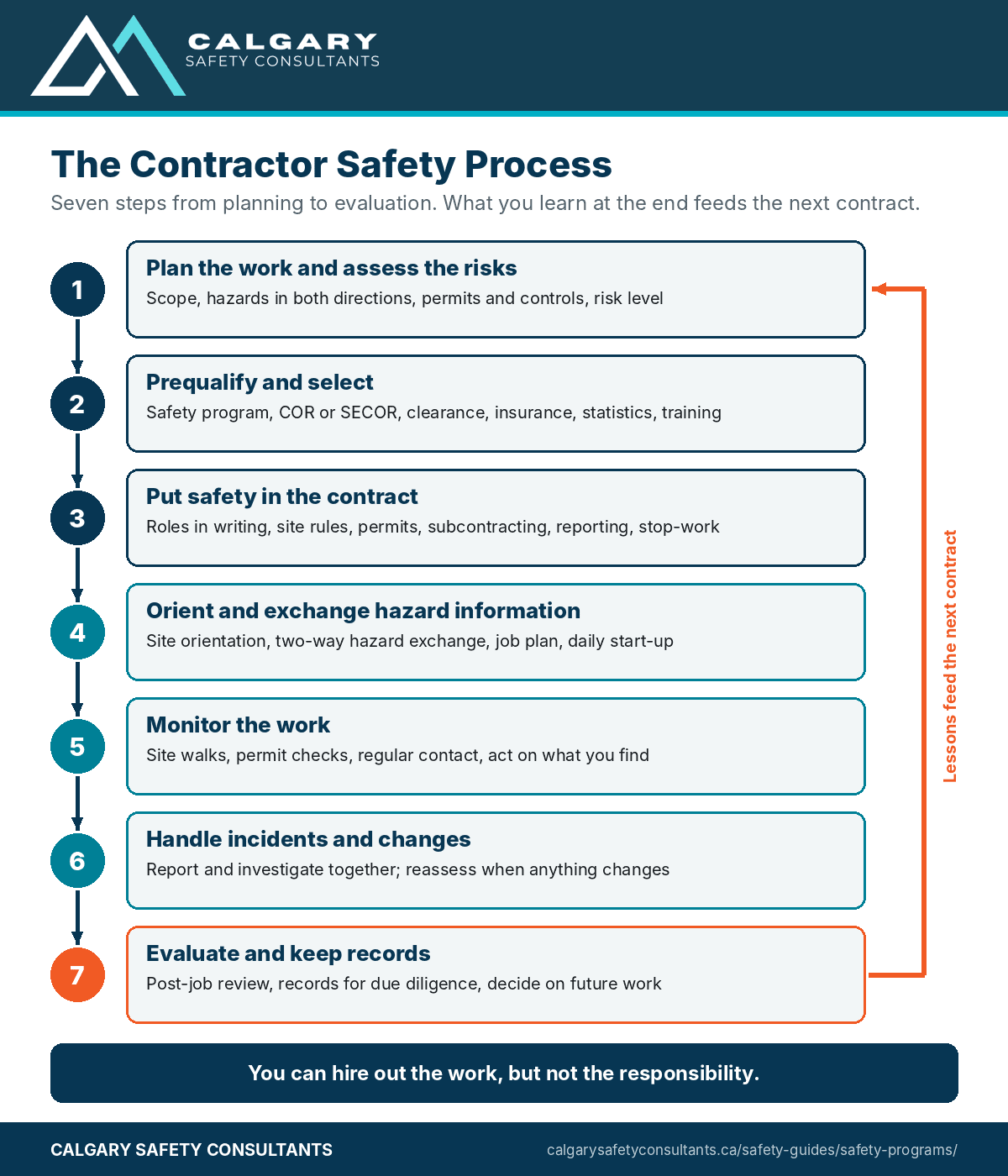
- Step 1: Plan the Work and Assess the Risks
- Step 2: Prequalify and Select Contractors on Safety, Not Just Price
- Step 3: Put Safety in the Contract
- Step 4: Orient Contractors and Exchange Hazard Information
- Step 5: Monitor the Work
- Step 6: Handle Incidents, Near Misses and Changes
- Step 7: Evaluate the Contractor and Keep Records
- Setting Up a Contractor Safety Program
- Coordinating Multi-Employer Sites
- When You're the Contractor Hiring Subcontractors
- How Contractor Safety Shows Up in a COR Audit
- A Practical Workplace Example
- Common Contractor Safety Mistakes to Avoid
- What an Auditor Expects to See
- The Bottom Line
- Download the Checklist and Contractor Register
- Frequently Asked Questions
- Related Guides and Articles
- How Calgary Safety Consultants Can Help
- Sources
What Contractor Safety Management Is and Why It Matters
Almost every workplace uses contractors: an electrician for a panel upgrade, a crew to repair a roof, a maintenance contractor during a shutdown, a cleaning company that works after hours. Contractor safety management is the system you use to make sure that work is done safely, from the moment you decide to hire someone until the job is finished and reviewed.
Contractor safety matters because contract work carries extra risk. Contractors often work on sites they don't know, alongside people they haven't met, under time pressure and with someone else's equipment and procedures. The U.S. Bureau of Labor Statistics counted 829 fatal work injuries to contracted workers in 2015, up from 542 in 2011. A study of U.S. mine accidents from 1998 to 2007 found that accidents involving contractors had 2.8 times the odds of being fatal compared with those involving mine operators' own workers, and a widely cited 2001 international review found that well over 90 per cent of the more than 25 studies on outsourcing it examined linked it to worse health and safety outcomes.
The UK Health and Safety Executive's brief guide on using contractors puts the basic point simply: both the client and the contractor have duties, and both need to cooperate. WorkSafe New Zealand goes further in its overlapping duties position, saying a business can't contract out of its duties and shouldn't push risk down the contracting chain. Canadian law takes the same view, as the next section explains.
Good contractor safety management also pays off in ways that go beyond compliance. Competent contractors finish the job with fewer delays, incidents and surprises, and your own workers stay safer when the people working beside them follow the same rules.
Who's Responsible When You Hire a Contractor
Hiring a contractor doesn't hand over your health and safety duties. Health and safety laws across Canada set duties for employers toward people at or near their workplaces, and most add specific duties for owners, for the person who directs other employers and for whoever coordinates a site with more than one employer. The names change across Canada, but the idea is consistent: someone has to be in charge of coordination, and everyone keeps their own obligations.
| Jurisdiction | Key role on multi-employer sites | Where to look |
|---|---|---|
| Alberta | Prime contractor, required on construction and oil and gas work sites, and sites a Director designates, with two or more employers; contracting employers and owners have their own duties | OHS Act, ss. 8 to 10 |
| British Columbia | Prime contractor on multiple-employer workplaces; owners and employers have their own duties | Workers Compensation Act, ss. 13, 24 and 25; OHS Regulation s. 20.3 |
| Saskatchewan | Prime contractor on certain multi-employer sites with 10 or more workers; contractors and owners have their own duties | The Saskatchewan Employment Act, Part III, and the OHS Regulations, 2020 |
| Manitoba | Prime contractor on construction project sites with more than one employer or self-employed person; contractors and owners have their own duties | Workplace Safety and Health Act, ss. 7 to 7.2 |
| Ontario | Constructor on construction projects; owners and employers have their own duties | OHS Act, ss. 23, 25, 29 and 30 |
| Quebec | Principal contractor (maître d'oeuvre) on construction sites | Act respecting occupational health and safety |
| Nova Scotia | Constructor on projects; contractors and owners have their own duties | OHS Act, ss. 14, 15 and 19 |
| New Brunswick | Contractor and contracting employer | OHS Act, ss. 10 and 10.1 |
| Prince Edward Island | Constructor and contractor, including duties to coordinate and share information | OHS Act, ss. 13 and 14 |
| Newfoundland and Labrador | Principal contractor for a project | OHS Act, s. 10 |
| Northwest Territories and Nunavut | Principal contractor, or the owner, coordinates employers at the same establishment | Safety Act, s. 4(2) |
| Federally regulated | Employer duties toward every person granted access to the work place | Canada Labour Code, s. 125(1) |
Yukon's workplace safety duties are set out in its Workers' Safety and Compensation Act. Check the current Act and regulations for your jurisdiction, and our OHS legislation guide links them all.
A few examples show how this works in practice.
- Alberta. Under the OHS Act, an employer must protect workers who aren't its own but are present at the work site. A contracting employer that directs another employer must ensure, as far as reasonably practicable, that the other employer complies, and must make sure the parties at the site know about existing or potential hazards. Every construction and oil and gas work site with two or more employers needs a prime contractor, and if none is designated in writing, the person in control of the site is the prime contractor. Alberta's prime contractor guidance explains that the prime contractor must have a system or process to ensure compliance and cooperation among everyone on the site.
- British Columbia. The Workers Compensation Act makes the prime contractor responsible for coordinating health and safety activities at a multiple-employer workplace and for keeping a system that ensures compliance. If there's no written agreement naming a prime contractor, the owner is the prime contractor. On construction sites, the OHS Regulation adds coordination requirements such as advance notice of work that could create a hazard for another employer's workers and, where more than five workers are on site and overlapping work creates a hazard, a qualified coordinator.
- Saskatchewan. A prime contractor is required at certain construction, forestry and oil and gas sites with 10 or more workers under two or more employers, and must coordinate activities and prepare a written plan before work begins. Any contractor that hires and directs others must set up a system of shared responsibility, give subcontractors health and safety information and monitor their compliance.
- Manitoba. Under the Workplace Safety and Health Act, the prime contractor on a construction project must coordinate, organize and oversee the work, and contractors must, so far as reasonably practicable, make sure work under their contract doesn't create a risk to anyone.
- Ontario. The constructor must make sure every employer and worker on a project complies with the Act and that workers are protected, and on construction projects owners must give constructors a list of designated substances before a contract is signed, as Ontario's guide to the OHS Act explains. In R. v. Greater Sudbury (City), 2023 SCC 28, the Supreme Court of Canada split four to four, which left in place the Ontario Court of Appeal's ruling that a city that owned a road project, and sent its own inspectors to the site, was an employer under the Act even though it had hired a constructor. The four judges who would have dismissed the appeal said control over the work is relevant to the due diligence defence rather than to whether the employer duty applies, and the due diligence question was sent back to a lower court.
- Quebec. On construction sites, the principal contractor has the same obligations as an employer under the Act respecting occupational health and safety, and must notify the CNESST before work starts and, on larger sites, prepare a prevention program.
- Atlantic Canada. Nova Scotia's OHS Act requires contractors and constructors to take every reasonable precaution to protect people at or near the workplace or project. New Brunswick's OHS Act makes a contracting employer ensure, so far as reasonably practicable, that the employers it directs comply. Prince Edward Island's OHS Act requires constructors and contractors to coordinate the activities of employers and to share safety information. In Newfoundland and Labrador, the OHS Act requires the principal contractor to ensure, where reasonably practicable, that everyone working on its project complies with the Act.
- The North and federal workplaces. In the Northwest Territories and Nunavut, where two or more employers share an establishment, the principal contractor or owner must coordinate them, and the WSCC's code of practice on OHS programs advises putting health and safety into contracts and bids. Federally regulated employers must make sure people granted access to the work place don't endanger employees and are told about known hazards, under the Canada Labour Code.
The practical contractor safety lesson is the same everywhere. Know which role you hold on each job, write it down, and make sure the system behind that role actually works.
Check Workers' Compensation Coverage: Clearance Letters
One of the simplest contractor safety checks is also one of the most often missed. In many provinces, including Alberta, British Columbia, Saskatchewan, Manitoba and Ontario, if a contractor you hire doesn't pay its workers' compensation premiums, you can be held responsible for them. A clearance letter, called a clearance certificate in Ontario, confirms the contractor is registered and in good standing.
- Alberta. WCB-Alberta advises getting a clearance letter before you hire and before you pay a contractor. Without one, you may be liable for the contractor's unpaid premiums.
- British Columbia. WorkSafeBC recommends requesting a clearance letter before and after the work, addressed to you and showing the contractor active and in good standing for the whole contract period.
- Saskatchewan. WCB Saskatchewan's letters of good standing are valid only on the day they're issued, so request a clearance after the work and before you pay.
- Manitoba. WCB Manitoba's guidance on coverage for contract workers advises getting a clearance before hiring and before final payment, because if the contractor owes the WCB, the principal can be liable for the premiums on the labour portion of the contract.
- Ontario. In construction, the WSIB's clearance certificate policy requires a valid clearance before work begins and throughout the contract. A certificate lasts up to 90 days.
Build the clearance check into your contractor safety process and your purchasing and payment process, so no contractor starts work or gets paid without a current clearance on file. Our contractor register, below, tracks clearance dates and flags any that are about to expire.
Step 1: Plan the Work and Assess the Risks
Contractor safety starts before you call anyone, with planning. The UK Health and Safety Executive's guide Managing contractors begins with planning: define the job, identify the hazards, assess the risks and decide the health and safety conditions the work will need. Most of the problems that show up on site, such as surprise confined spaces, missing permits or two crews in the same space, can be traced back to a job that was never properly planned.
- Define the scope. What exactly is being done, where, when and with what equipment? Vague scopes lead to surprises on site. "Fix the boiler" is a scope; "replace the boiler feed pump in the mechanical room during the weekend shutdown, with the boiler isolated and drained" is a plan.
- Identify the hazards of the work and of your site. Think about both directions: the hazards the contractor's work creates for your people, and the hazards your site and operations create for the contractor. A formal hazard assessment or job hazard analysis is the right tool for higher-risk work.
- Decide the controls and permits. Will the job need lockout, a hot work permit, confined space entry, working at heights or ground disturbance? Use the hierarchy of controls to decide what needs to be in place, and decide who provides each control. If your maintenance team will isolate the equipment and the contractor will verify it, write that down now.
- Think about timing and the people around the work. Will the work happen during production, after hours or during a shutdown? Will your workers, visitors or the public be nearby? Scheduling noisy, dusty or overhead work when fewer people are around is one of the cheapest controls available.
- Set the risk level. A low-risk job, such as a delivery or a small office repair, needs a lighter process than a shutdown or a construction project. Matching the effort to the risk keeps the system workable.
Many employers sort contract work into three risk levels and set out what each one requires. A simple version looks like this:
| Risk level | Typical examples | What the contractor safety process looks like |
|---|---|---|
| Low | Deliveries, office equipment repair, a consultant visiting site, landscaping away from operations | Clearance letter where it applies, sign-in, a short site briefing covering emergencies and restricted areas, and an escort or check-in as needed |
| Medium | Building maintenance, HVAC service, painting, small renovations, cleaning crews working after hours | A short prequalification questionnaire, clearance and insurance, a site orientation, a review of the contractor's hazard assessment and periodic check-ins during the work |
| High | Shutdowns and turnarounds, confined space entry, work on energized or pressurized systems, hot work, cranes and critical lifts, excavation, roofing, demolition | Full prequalification, safety terms in the contract, a job-specific or site-specific safety plan, permits, a detailed orientation, daily coordination and frequent monitoring, and a formal evaluation at the end |
Write your risk levels into your contractor safety procedure so the decision isn't left to whoever happens to hire the contractor. The person who books the job should be able to look at the scope and know straight away which level applies and what they need to collect.
Step 2: Prequalify and Select Contractors on Safety, Not Just Price
Prequalification is the first contractor safety check, and it's how you confirm a contractor can do the work safely before you invite them to bid. WorkSafe New Zealand's advice on working together when contracting warns against choosing a contractor on cost alone, and recommends checking health and safety capability before the contract is awarded.
A practical contractor safety prequalification usually asks for:
- A health and safety program that fits the work, with the hazard assessments and safe work procedures for the job
- Certification such as a COR or SECOR, where your industry expects it
- A current workers' compensation clearance and proof of insurance
- Injury and incident statistics for the past few years, and any regulatory orders or penalties
- Training and certification records for the workers and supervisors who will do the job
- How the contractor manages its own subcontractors
Don't just collect the documents; read them. A thick safety manual tells you less than a few well-chosen questions. Ask for the hazard assessment the contractor would use for a job like yours, the name and experience of the supervisor who'd be on site, and an example of an incident they investigated and what they changed afterwards. A contractor that answers those clearly and specifically usually runs its work the same way.
Look at the statistics with care too. A contractor with a handful of workers can show a high injury rate from a single incident, and a contractor with no recorded incidents may simply not be reporting them. Use the numbers as a starting point for a conversation, alongside regulatory orders, references from other clients and how the contractor talks about safety.
Scale the requirements to the risk. A high-risk contractor should face a full review, while a low-risk supplier might only need a clearance letter and a short questionnaire. Many employers score prequalification as acceptable, acceptable with conditions, such as closer supervision or an action plan, or not acceptable for this work. Keep an approved contractor list and review it at least once a year, so expired clearances, lapsed insurance and poor evaluations don't go unnoticed.
Many larger owners have formal prequalification requirements, and contractors working for them need to keep their submissions current. Our upcoming guide on completing contractor prequalification will cover the contractor's side of that process, including third-party systems such as ISNetworld, Avetta and ComplyWorks.
Step 3: Put Safety in the Contract
The contract is where contractor safety expectations become obligations. U.S. OSHA's guidance on communication and coordination between host employers and contractors recommends agreeing on who is responsible for each part of the safety program, writing it into the contract, and including safety specifications and qualifications in bids.
Good contractor safety terms cover:
- Who holds the prime contractor, constructor or principal contractor role, in writing
- The contractor's duty to follow your site rules and its own safety program, and which applies when they differ
- Required permits, training, certifications and personal protective equipment
- Rules for subcontracting, including approval before any subcontractor starts
- Incident and hazard reporting, and access for inspections and audits
- Workers' compensation clearance before work starts and before payment
- What happens if the contractor doesn't comply, up to stopping the work
Put the safety requirements in the bid documents, not just the final contract. When contractors know the requirements before they price the job, they can include the time and cost of doing it safely, such as a fire watch, a rescue plan, extra guardrails or a full-time supervisor. Adding requirements after the price is agreed tends to produce arguments, shortcuts or both.
The prime contractor role deserves special care. On a multi-employer site, decide deliberately who will hold it, make sure that party has the authority and the people to do the job, and name it in writing. Handing the role to a contractor on paper while your own people keep directing the work can leave everyone unsure who's really in charge, and in several provinces an owner that doesn't name a prime contractor can end up holding the role by default.
For repeat contractors, standard safety terms or a master service agreement save time, but check that each new job still fits them. A cleaning contract written for an office won't cover a crew cleaning inside running production equipment.
ISO 45001, the international standard for occupational health and safety management systems, includes requirements for coordinating procurement with contractors, defining health and safety criteria for selecting them and making sure they meet your system's requirements. Contractor safety terms in the contract are a practical way to meet that expectation.
Step 4: Orient Contractors and Exchange Hazard Information
Before a contractor starts work, they need to know your site and you need to know their work. Orientation is where contractor safety becomes real on the ground. The Health and Safety Executive's Managing contractors guide warns against letting contractors turn up and "just get on with the job" without a check and a briefing.
- Site orientation. Cover the site's hazards, rules, restricted areas, emergency procedures, muster points, first aid, incident reporting and who to contact. Record who attended.
- Two-way hazard exchange. Share the hazards of your operations that could affect the contractor, and have the contractor explain the hazards their work creates for others, such as noise, dust, overhead work or energized equipment.
- Job-specific planning. Review the contractor's hazard assessment, procedures and permits for the job. On larger or higher-risk jobs, ask for a site-specific safety plan, which our upcoming guide on site-specific safety plans will explain.
- Daily start-up. Field-level hazard assessments and start-of-shift meetings keep the plan current as conditions change. Our guide to field-level hazard assessments covers how to make them useful.
A good contractor orientation is done in person, at the site, by someone who knows it. Walk the contract workers through the areas they'll work in, point out the hazards and the emergency equipment, and show them the muster point rather than describing it. Keep it short enough that people pay attention; 30 to 60 minutes is enough for most jobs, with longer sessions for complex sites.
Check tickets and competency at the same time. If the job needs a qualified electrician, a certified crane operator, confined space training or a ground disturbance certificate, see the proof before the person starts. It's much easier to sort out a missing ticket at the gate than after an incident.
Orient every worker, not just the supervisor. The contractor's supervisor may attend the planning meeting, but the workers who arrive on day three still need the site orientation before they start. A simple rule helps: no orientation record, no access. Visitors and short-term contractors can get a shorter briefing, but they still need to know the alarm, the muster point and where they can and can't go.
Safe Work Australia's guidance on consulting, cooperating and coordinating with other duty holders makes a useful point here: start the conversation during planning, agree who manages each risk, and make sure there are no gaps between the controls each party puts in place.
Step 5: Monitor the Work
Prequalification and orientation set the work up well, but they don't guarantee it stays safe. Monitoring is how you find out whether the contractor safety plan is being followed. The level of monitoring should match the risk of the work and how well you know the contractor.
- Site walks and inspections. Check the contractor's work area, equipment and practices against the agreed plan. Our guide on workplace safety inspections explains how to make them count.
- Permit checks. Confirm that permits are in place, followed and closed out properly.
- Regular contact. Short check-ins with the contractor's supervisor catch changes in scope, crew or conditions early.
- Act on what you find. Raise concerns right away, stop work when there's a serious risk, and track corrective actions to completion. Our corrective actions guide shows how to close the loop.
| Situation | Suggested level of monitoring |
|---|---|
| Low-risk job by a contractor you know well | A check-in at the start and end of the job, and spot checks if the work runs long |
| Medium-risk job, or a new contractor | A walk-through on the first day, then regular documented checks, such as daily or every few days, depending on the work |
| High-risk work, such as confined space, hot work, lockout on complex systems or critical lifts | Permit checks before and during the work, frequent site walks, daily coordination meetings and someone with authority to stop work nearby |
| A contractor with past performance problems | Closer monitoring, with agreed improvement actions checked and recorded |
Focus your checks on the critical controls, the few things that prevent serious injury or death on that job: isolation and lockout, fall protection, atmospheric testing and the attendant for confined spaces, the fire watch for hot work, trench protection, and exclusion zones around lifts. A tidy work area is nice to see, but a missing lock or an untested atmosphere is what hurts people.
Write down what you see, good and bad. A short note of each check, with the date, what was looked at and any follow-up, is your evidence that monitoring happened, and it feeds directly into the contractor's evaluation at the end of the job.
Be clear about stopping work. Everyone on site, including your workers, should know they can stop work they believe is dangerous, and the contract should say you can stop a contractor's work for serious safety concerns. When you do, explain the concern, agree on the fix with the contractor's supervisor, and restart only when the fix is in place. Handled respectfully, a stop is a normal part of managing risk, not a breakdown in the relationship.

Step 6: Handle Incidents, Near Misses and Changes
Contractor safety doesn't stop when something goes wrong. Contractors need to report incidents, near misses and hazards to you as well as to their own employer, and your incident process needs to include them. Agree in advance who investigates, who notifies the regulator when a report is required and how findings will be shared. Our guide on how to investigate a workplace incident covers the investigation itself.
When an incident involves a contractor, a joint investigation usually works best. The contractor knows its own work, procedures and people; you know your site, your equipment and how your systems interact with the work. Investigating separately often produces two reports that each blame the other party and miss the gap in between. Agree who leads, share the findings and follow both sets of corrective actions through to completion.
Near misses deserve real attention. A contractor crew that reports a near miss is giving you free information about a hazard before anyone is hurt. Thank them, act on it quickly and tell them what changed. Contractors who are criticized or sent home for reporting will simply stop reporting.
Changes need the same attention. A new crew, a change in scope, a different piece of equipment or a change in your own operations can make the original plan out of date. The Health and Safety Executive's approach is simple: if conditions change, go back to the planning step and reassess. Ask contractors to tell you before they change methods, bring in new equipment or add a subcontractor, and make sure your own people tell contractors before they restart equipment, change production or start work nearby.
Step 7: Evaluate the Contractor and Keep Records
When the job is done, take a few minutes to evaluate the contractor's safety performance. Did they follow the plan, report hazards and incidents, cooperate with your people and fix problems quickly? WorkSafe New Zealand recommends a post-contract review that also considers whether the contractor is suitable for future work.
A simple evaluation form works well. Rate a handful of areas, such as planning and paperwork, supervision on site, following permits and site rules, reporting hazards and incidents, response to concerns and housekeeping, and add a short comment. Base the ratings on what was recorded during the job, not just memory, and share the results with the contractor. Good contractors want the feedback, and poor performers need to hear it before they bid again.
Close the job out properly too. Confirm permits are closed, temporary hazards are removed, your equipment has been returned to service safely and any open corrective actions are finished or handed over. Get a final clearance letter before the last payment where your workers' compensation board recommends one.
Keep the contractor safety records together: the prequalification, contract terms, clearance letters, orientation records, permits, inspection notes, incident reports and the evaluation. These records show due diligence if something goes wrong, and they're exactly what a COR auditor asks to see. Use the evaluation the next time you need a contractor, so good performers are rewarded and poor ones are not invited back without changes.
Setting Up a Contractor Safety Program
The seven steps work best when they're part of a written program rather than something one supervisor remembers to do. You don't need a large system. A short contractor safety procedure in your safety manual, a register and a few forms are enough for most small and mid-size employers. Our guide on how to build a health and safety system shows where contractor safety fits in the wider program.
- A written procedure. Two or three pages that describe your risk levels, what each level requires, who approves contractors and who's responsible for orientation, monitoring and evaluation.
- Clear roles. Decide who owns contractor safety overall and who does the day-to-day work. In many workplaces, the person who books the contractor is the contractor's host on site and is responsible for orientation and check-ins.
- A link to purchasing and payment. The most reliable control is a simple one: no purchase order without an approved contractor, and no final payment without a current clearance and a completed evaluation.
- A contractor register. One list of every contractor you use, with its risk level, approval status, clearance and insurance expiry dates, orientation dates and evaluation results. Our free register, below, does this for you.
- Standard forms. A prequalification questionnaire, an orientation checklist, a monitoring record and an evaluation form keep the process consistent, whoever is running it.
- Training for the people who hire. Supervisors, maintenance leads and purchasing staff need to know the procedure, because they're the ones who decide whether it's followed.
Start with your highest-risk contractors and the people who hire them most often. Once the process is working there, extend it to the rest. Review the program once a year using your evaluations, incidents and audit findings, and adjust the risk levels or forms where they're not working.
Coordinating Multi-Employer Sites
When several employers work on one site at the same time, coordination becomes the main contractor safety task. The prime contractor, constructor or principal contractor, or the owner if no one else has the role, is responsible for making it work.
- Name the coordinator. Put the role in writing and make sure every employer knows who it is.
- Collect each employer's contact. Know who supervises each employer's workers on site.
- Schedule the work to avoid conflicts. Overhead work above other crews, hot work near flammables and traffic around pedestrians are common conflicts that planning can prevent.
- Run coordination meetings. A short daily or weekly meeting with each employer's supervisor keeps everyone current.
- Share information both ways. Site hazards, changes and incidents should reach every employer on site.
- Keep one set of site rules and emergency procedures. Everyone on site should follow the same rules and know the same muster point.
Lockout and isolation need particular care on multi-employer sites. When several crews work on the same equipment, every crew should apply its own lock, and no one should rely on another employer's isolation without verifying it. A group lockout box or isolation register, run by one person, keeps track of who's still working on the equipment before anything is re-energized.
Agree on shared responsibilities by name: who maintains the shared guardrails and access, who provides first aid for the whole site, who controls traffic, and who keeps the site drawing and contact list current. Gaps between employers are where serious incidents on shared sites often start. On larger or higher-risk projects, these arrangements belong in a written site-specific safety plan, which our upcoming guide will cover in detail.
When You're the Contractor Hiring Subcontractors
Contractors often hire subcontractors of their own, and the same contractor safety duties flow down the chain. If you're a contractor, you're the client for your subcontractors. Prequalify them, put safety in their contracts, include them in your orientation and hazard assessments, check their workers' compensation clearance and monitor their work.
Make sure your client knows who your subcontractors are before they start. Many owners and prime contractors require approval of subcontractors in advance. Some laws also require it: in Manitoba, a contractor on a construction project must tell the prime contractor about every employer it brings onto the site, and in British Columbia each employer must give the prime contractor the name of its site supervisor.
Your client's requirements usually apply to your subcontractors too. If the owner requires a COR, specific training or a site orientation for everyone on site, check your contract and pass those requirements down in writing before your subcontractor prices the work. A subcontractor that turns up without the client's orientation or tickets can hold up your crew and damage your standing with the client.
The same applies to self-employed workers and labour supplied through an agency. They may not be your employees, but they're working on your job, and you need to orient them, make sure they're competent and include them in your hazard assessments and emergency plan.
How Contractor Safety Shows Up in a COR Audit
Contractor safety management is part of the major COR audit standards, so the system described in this guide can also support your audit, provided you can show it's followed. Energy Safety Canada's 2023 COR audit protocol includes an element on other affected parties, asking about written responsibilities for other employers and visitors, criteria for selecting, monitoring and evaluating other employers, site-specific orientations and how hazards and changes are communicated. In Ontario, IHSA's COR 2020 audit tool has a full element on procurement and contractor management, including health and safety criteria for selecting, monitoring and evaluating contractors and leading coordination on multi-employer sites.
Auditors will look for evidence that the process is followed, not just written. Prequalification files, orientation records, inspection notes and contractor evaluations are the records that prove it. Our guide on how to prepare for a COR audit explains the wider audit.
Workplace example
A Practical Workplace Example
Situation: Consider a food processing plant in Saskatchewan that brought in contractors for its annual maintenance shutdown: a mechanical contractor, an electrical contractor and a cleaning crew, all on site at once. In past years, the plant had sent each contractor a purchase order and a copy of its safety rules. During the previous shutdown, a mechanical fitter was nearly struck when an electrician re-energized a conveyor that had been locked out by a different crew.
Action: The plant manager worked through the seven steps. The plant scoped each job and its hazards, prequalified all three contractors with a short questionnaire, clearance letters and their safety programs, and wrote the coordination role and the lockout procedure into the contracts. Every contract worker attended a one-hour site orientation, and each contractor's supervisor joined a daily coordination meeting where lockout points and overlapping work were planned. The plant's maintenance supervisor walked the shutdown twice a day and checked permits and locks.
Result: The shutdown finished on time with no lost-time injuries. Two near misses were reported and investigated within a day, and both led to changes the next morning. The plant now evaluates every contractor at the end of the job and uses the results to decide who it invites back.
Common Contractor Safety Mistakes to Avoid
- Choosing on price alone. The cheapest bid can be the most expensive job if it ends in an incident.
- Assuming the contractor's safety program covers everything. It won't cover the hazards of your site unless you tell them.
- No one in charge of coordination. On multi-employer sites, an unclear prime contractor role leaves gaps where no one controls overlapping hazards.
- Skipping the clearance letter. It's quick to get, and skipping it can leave you paying someone else's premiums.
- Orientation by email. Sending a rule book isn't the same as walking someone through the site and its emergency plan.
- Never checking the work. Prequalification and paperwork don't show what's happening on the floor today.
- Forgetting subcontractors. The worker you've never met may belong to a subcontractor you didn't know was there.
- Adding safety requirements after the price is set. Put them in the bid documents so contractors can price the job to do it safely.
- Relying on another crew's lockout. Every crew working on the equipment needs its own lock and its own verification.
- Investigating contractor incidents separately. Two reports that blame each other miss the gap between the two organizations.
- No evaluation at the end. Without it, the same problems come back on the next job.
Audit perspective
What an Auditor Expects to See
An auditor looking at contractor safety wants to see a written process that matches what happens in practice. That means documented criteria for selecting contractors, prequalification files for the contractors actually used, contracts that include safety requirements, orientation records for contract workers, evidence of monitoring during the work and evaluations at the end.
Interviews tell the rest of the story. Supervisors should be able to explain how contractors are oriented and monitored, and contract workers on site should know the site's hazards, emergency procedures and who to report to. Gaps between the written process and those answers are where audit marks are lost.
Calgary Safety Consultants helps employers build contractor safety programs and prepare for COR and SECOR audits; we don't issue certificates. CORs and SECORs are issued through the applicable certifying partner.
The Bottom Line
Managing contractor safety comes down to a simple principle: you can hire out the work, but not the responsibility. Plan the work, choose competent contractors, put safety in the contract, orient and coordinate everyone before work starts, check the work while it's happening and learn from every job.
Done well, contractor safety management protects your own workers and the contractors' workers, keeps projects on schedule and gives you the records to show due diligence. Start your contractor safety program with your highest-risk contractors and build from there.
Download the Contractor Safety Checklist and Contractor Register
Two free downloads go with this guide.
- Contractor Safety Checklist (PDF). A checklist with clickable checkboxes that follows the seven steps, from planning and prequalification to orientation, monitoring and the post-job evaluation.
- Contractor Safety Register (Excel). A register of the contractors you use, with prequalification status, clearance and insurance expiry dates, orientation and evaluation results, and automatic flags for anything expired or about to expire.
Click either button to download the file. Adapt both to your own work, sites and contracts.

About the author
John Duplessis, B.Sc., CRSP
John Duplessis is a Canadian Registered Safety Professional with more than 30 years of occupational health and safety experience in oil and gas, construction, green energy, midstream operations and industrial project work. He is an external auditor with Energy Safety Canada.