
OH&S Leadership Training in Canada
Strong workplace health and safety performance depends on more than policies, procedures, and completed forms. It depends on the decisions leaders make every day.
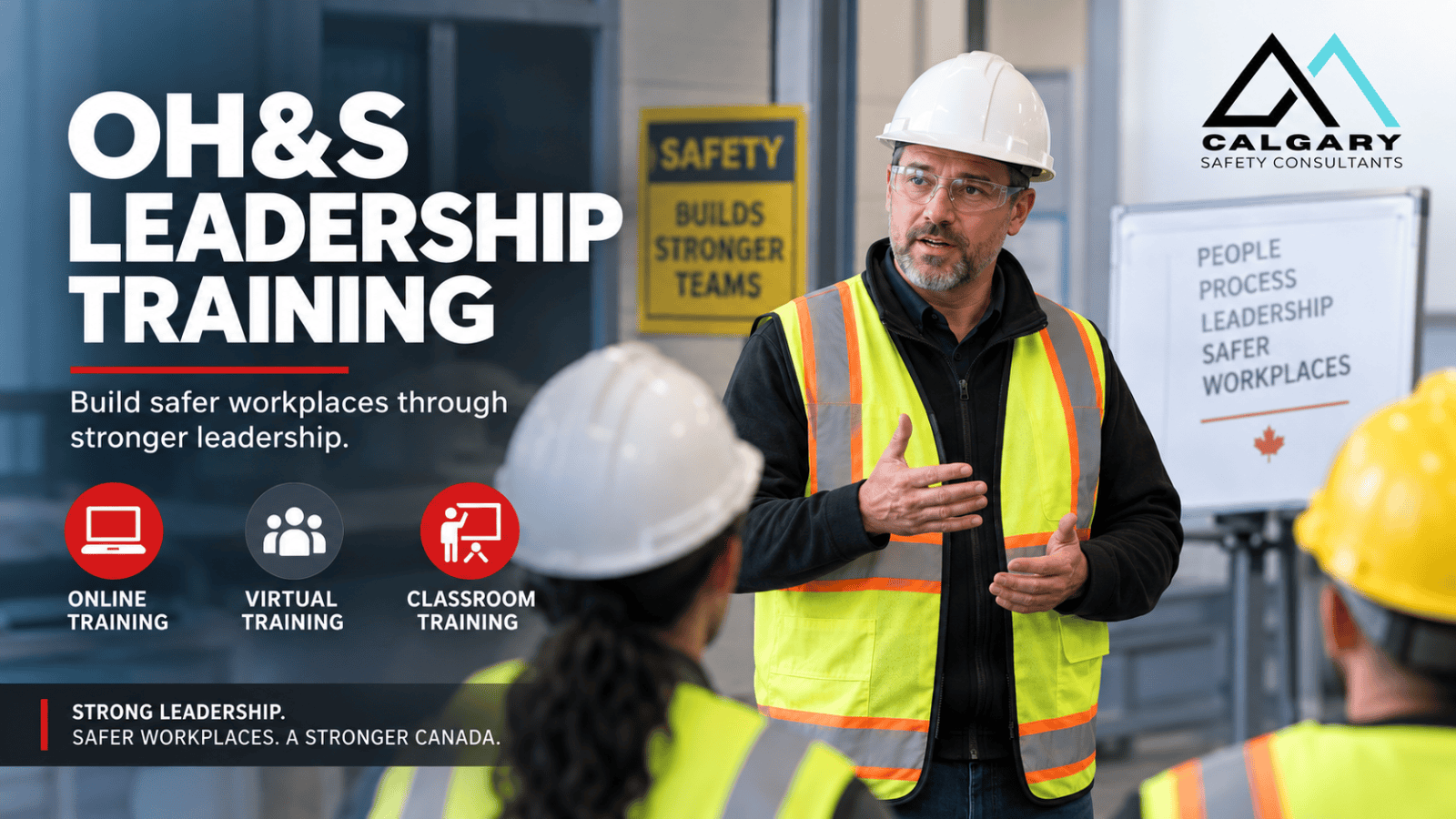
Calgary Safety Consultants provides practical OH&S Leadership Training for supervisors, managers, business owners, project managers, and others responsible for directing work. Training is available through OH&S Online Leadership Training, Virtual Instructor-Led Leadership Training, and Classroom Leadership Training.
Our training helps leaders understand how their decisions affect hazard control, worker behaviour, due diligence, incident prevention, safety culture, accountability, and operational performance.
Whether you’re developing a new supervisor, strengthening an experienced management team, responding to audit findings, or improving an existing health and safety program, we can help you choose a training format that works for your organization.
Choose Your OH&S Leadership Training Option
OH&S Online Leadership Training
Complete your OH&S Online Leadership Training at your own pace from virtually anywhere in Canada.
Our online leadership course is designed for supervisors, managers, business owners, project managers, and employees preparing for leadership responsibilities. Participants work through structured modules covering leadership responsibilities, due diligence, hazard management, safety culture, communication, incident leadership, corrective actions, data-driven safety, and root cause analysis.
The course is approximately eight hours in length and can be completed around the participant’s work schedule.
Online training is particularly useful for individual supervisors, newly promoted leaders, remote employees, multi-location organizations, and employers who need consistent leadership training available on demand.
Participants receive an OH&S Leadership Certificate of Completion after successfully completing the course requirements.
Virtual Instructor-Led OH&S Leadership Training
Bring your management and supervisory team together without requiring everyone to travel to the same location.
Our Virtual OH&S Leadership Training is delivered live by an experienced occupational health and safety professional using Microsoft Teams or another agreed virtual platform.
Participants can ask questions, discuss workplace situations, work through leadership scenarios, and examine how health and safety responsibilities apply within their actual operations.
Virtual training is particularly effective for organizations with supervisors and managers working from multiple offices, branches, projects, or worksites.
The format combines structured OH&S leadership development with the opportunity for direct discussion and practical application.
Classroom OH&S Leadership Training
Bring practical health and safety leadership training directly to your workplace.
Our Classroom OH&S Leadership Training provides face-to-face instruction for supervisors, managers, leadership teams, and other employees responsible for directing work.
Classroom training creates additional opportunities to discuss real workplace situations, existing company systems, leadership challenges, recurring hazards, incident trends, and operational pressures.
This option is particularly valuable when an employer wants the training discussion connected directly to its own health and safety program, supervisory structure, workplace hazards, and management expectations.
Training can be arranged for workplaces in Calgary, Okotoks, Edmonton, and other locations, with additional Canadian locations available by arrangement.
What Is Transportation of Dangerous Goods Training?
Occupational health and safety leadership training helps people who direct work understand how their decisions influence workplace risk.
Leadership goes beyond knowing the rules.
Supervisors and managers influence how work is planned, which hazards receive attention, whether workers have adequate resources, how standards are communicated, whether unsafe conditions are corrected, how incidents are handled, and whether the organization learns from problems.
Canadian OH&S legislation generally assigns important responsibilities to employers, managers, supervisors, and workers, although the exact requirements vary by jurisdiction. Managers and supervisors commonly have responsibilities related to worker protection, hazard communication, safe work, appropriate supervision, and taking reasonable precautions.
Effective OH&S leadership turns those responsibilities into everyday actions.
The objective isn’t simply to teach supervisors what legislation says.
They need to understand what good leadership looks like when production pressure increases, conditions change, a worker raises a concern, a critical control fails, or an incident occurs.
Who Should Take OH&S Leadership Training?
OH&S leadership training is intended for people who have authority over workers, workplace activities, projects, resources, or operational decisions.
This may include:
- Business owners
- Executives
- Senior managers
- Operations managers
- Project managers
- Department managers
- Superintendents
- Supervisors
- Forepersons
- Crew leaders
- Team leaders
- Lead hands
- Health and safety coordinators
- Employees preparing for supervisory responsibilities
- Managers responsible for contractors or subcontractors
Leadership training can be particularly valuable when a technically experienced employee is promoted into a supervisory role.
Knowing how to perform a job well isn’t the same as knowing how to supervise the work safely.
A supervisor must also understand hazards, competency, worker communication, changing conditions, control verification, accountability, documentation, and when intervention is required.
OH&S Leadership Training for Supervisors and Managers
Supervisors and managers are often the link between an organization’s written health and safety system and what actually happens at the point of work.
Consider a typical workday – a supervisor may need to determine whether workers are competent for an assigned task. A manager may need to decide whether staffing or scheduling creates unacceptable risk. A project manager may need to respond when conditions change from the original plan. A supervisor may notice a shortcut developing under production pressure. A worker may raise a hazard or report a near miss. A corrective action may be listed as complete even though the same problem continues appearing in the field.
Each situation requires a leadership decision.
Effective OH&S Leadership Training helps leaders recognize these decision points and understand how to respond in a way that protects workers, supports operations, and strengthens due diligence.
What Does Our OH&S Leadership Training Cover?
Depending on the delivery format and workplace requirements, our OH&S Leadership Training addresses important leadership concepts including:
- Leadership as an operational control
- Managing safety versus leading safety
- Preventing workplace drift
- Canadian OH&S roles and responsibilities
- Due diligence
- Responsibility, authority, and accountability
- Delegation and control ownership
- Hazard identification
- Risk assessment
- Critical controls
- The hierarchy of controls
- Field verification and workplace inspections
- Corrective-action management
- Worker participation and reporting
- Safety culture and safety climate
- Mental health and psychological safety
- Complacency and normalization of deviance
- Leading and lagging safety indicators
- Safety metrics and operational reviews
- Safety conversations
- Coaching and worker engagement
- Toolbox and safety meetings
- Incident leadership
- Incident reporting and immediate response
- Investigation support
- Continual improvement
- Leadership action planning
- Root cause analysis
- Evidence-based cause statements
- Corrective-action effectiveness and verification
The course is built around nine major learning areas: leadership mindset; legal duties and responsibilities; hazard and risk leadership; safety culture; data-driven safety; communication and engagement; incident leadership; action planning; and root cause analysis.
Leadership as an Operational Control
One of the central principles of our training is that leadership itself acts as a workplace control.
Policies establish expectations, but workers experience leadership through what gets prioritized, what gets tolerated, what gets corrected, and what receives resources.
When leaders establish clear standards, verify critical controls, correct small deviations early, and follow through on identified issues, they help prevent workplace drift.
This becomes particularly important when schedules tighten, workloads increase, workers become familiar with a task, or conditions change.
The real standard in a workplace is often demonstrated by what leaders consistently allow and verify.
Practical OH&S Leadership Training
Effective leadership training shouldn’t consist of reading legislation to supervisors and expecting them to remember it.
Leaders need to understand how health and safety principles affect actual workplace decisions.
For example:
- What should a supervisor do when an experienced worker begins taking a shortcut?
- How should a manager respond when a critical control isn’t available but the job is already behind schedule?
- How do you determine whether a worker is actually competent rather than simply trained?
- What should happen when the same corrective action keeps appearing on inspections?
- How should a supervisor respond when a worker reports a near miss?
- What does due diligence look like when conditions change unexpectedly?
- How should leaders distinguish human error from reckless behaviour?
- When should a completed corrective action be considered truly effective?
These are practical leadership questions.
Our training focuses on helping participants understand what appropriate leadership looks like when they encounter these situations at work.
Due Diligence and Leadership Responsibilities
Due diligence is a recurring theme throughout the training.
A policy or training record can demonstrate that a system exists, but effective leadership also requires evidence that the system is being implemented.
Leaders should be able to demonstrate that hazards were considered, controls were established, workers were competent, appropriate supervision was provided, deficiencies were addressed, and follow-up occurred.
The course therefore emphasizes a shift from simply assuming that controls are working to verifying that they are working.
This distinction matters during normal operations, internal audits, COR audits, regulatory inspections, and incident investigations.
Hazard Management and Critical-Control Leadership
Supervisors and managers don’t need to perform every hazard assessment themselves, but they need to understand whether the hazard-management process is working.
Leaders need to recognize important hazards, understand risk, identify high-consequence exposures, and determine whether appropriate controls are in place.
The training reinforces the hierarchy of controls:
- Elimination
- Substitution
- Engineering controls
- Administrative controls
- Personal protective equipment
Participants also learn why administrative controls and PPE shouldn’t automatically become the first or only response to significant hazards.
Strong safety leadership asks whether the hazard can be eliminated, reduced, isolated, engineered, or otherwise controlled more reliably before depending heavily on worker behaviour.
Safety Culture and Leadership Behaviour
Organizations frequently talk about improving safety culture.
Culture, however, isn’t created by slogans.
Workers learn what the organization actually values by watching what leaders do. For example:
- What happens when a deadline conflicts with a safety requirement?
- What happens when a worker raises bad news?
- What happens when a high performer takes shortcuts?
- Are supervisors expected to verify critical controls, or only complete forms?
- Are workers recognized for identifying problems, or quietly discouraged from reporting them?
The answers to these questions shape the workplace’s safety culture.
Our OH&S Leadership Training helps participants understand how their own behaviour can either strengthen or undermine the standards their organization is trying to establish.
Communication, Coaching, and Worker Engagement
Effective safety leadership requires more than giving instructions.
Supervisors need to know how to ask useful questions, listen to workers, correct unsafe behaviour, reinforce good decisions, and communicate expectations without creating unnecessary confrontation.
The course introduces control-focused safety conversations designed around observable behaviour and actual risk.
Instead of saying, “Be careful,” a leader learns to identify what they observed, explain the exposure, confirm the required control, agree on the correction, and verify that the control has been restored.
The same practical approach is applied to toolbox meetings, coaching, recognition, hazard reporting, and worker participation.
Incident Leadership and Continuous Improvement
Leadership becomes especially important when something goes wrong.
The course examines what supervisors and managers should do immediately following incidents and near misses, including protecting people, controlling the scene, containing hazards, initiating reporting, preserving information, and supporting the investigation process.
Participants also learn that leadership shouldn’t stop when the investigation report is completed.
Corrective actions need ownership, resources, deadlines, implementation, verification, and effectiveness checks.
The objective is to make sure the organization actually learns from the event.
Root Cause Analysis for Leaders
Weak investigations often stop at statements such as “worker error,” “failure to follow procedure,” or “employee wasn’t paying attention.”
Those statements may describe part of what happened, but they often don’t explain why the situation developed.
Our leadership training introduces practical root cause concepts that help participants look deeper.
Leaders learn to consider factors such as unclear standards, inadequate supervision, equipment design, workload pressure, competency, maintenance, planning, weak verification, and management-system deficiencies.
Participants are also introduced to tools such as the 5 Whys, Fishbone analysis, and causation analysis to help move investigations from symptoms toward preventable system weaknesses.
OH&S Leadership Training and COR
Leadership is an important component of an effective health and safety management system.
Organizations preparing for a Certificate of Recognition audit need more than written policies. They need supervisors and managers who understand the system and can demonstrate how it is implemented.
OH&S Leadership Training can help strengthen understanding in areas such as management commitment, hazard assessment, competency, inspections, worker participation, incident management, corrective actions, accountability, and continual improvement.
Training alone doesn’t guarantee COR certification.
It can, however, help leaders better understand what implementation looks like and why auditors look for evidence that the health and safety system operates in practice.
OH&S Leadership Training for Canadian Workplaces
Calgary Safety Consultants provides OH&S leadership training for employers across Canada.
The fundamental principles of leadership, hazard management, due diligence, communication, supervision, and accountability are relevant across Canadian workplaces, although specific legislative requirements vary between federal, provincial, and territorial jurisdictions. CCOHS notes that many basic OH&S responsibilities are similar across Canada while specific legislative details and enforcement requirements vary by jurisdiction.
Our training is suitable for organizations operating in:
- Canadian provinces and territories
- Federally regulated workplaces
For organizations operating across multiple jurisdictions, leadership training can help establish consistent management expectations while workplace-specific procedures address applicable jurisdictional requirements.
Group and Corporate OH&S Leadership Training
Need to train several supervisors or managers?
Calgary Safety Consultants can provide OH&S Leadership Training for supervisory teams, management groups, project leaders, business owners, or larger organizations.
Virtual and classroom delivery provides additional opportunities to discuss workplace-specific situations and leadership challenges.
Topics can be connected to issues such as:
- COR preparation
- Audit findings
- Recurring incidents
- Hazard-management weaknesses
- Supervisor competency
- Corrective-action performance
- Contractor management
- Worker engagement
- Safety culture
- Operational growth
- New supervisor development
For organizations with employees at multiple locations, virtual training provides a practical way to bring leaders together without requiring unnecessary travel.
Why Choose Calgary Safety Consultants?
Calgary Safety Consultants provides occupational health and safety training with an emphasis on practical workplace application.
We believe supervisors and managers need more than regulatory information.
They need to understand how to recognize risk, make defensible decisions, communicate expectations, verify controls, respond to problems, and demonstrate effective leadership when conditions are less than ideal.
Our OH&S Leadership Training is designed around that principle.
Whether training is completed online, virtually, or in the classroom, the objective is the same: give leaders information and practical tools they can apply when they return to work.
Frequently Asked Questions about About OH&S Leadership Training
Who should take OH&S Leadership Training?
OH&S Leadership Training is designed for supervisors, managers, business owners, project managers, forepersons, team leaders, lead hands, and others who direct work or influence workplace health and safety decisions.
It can also be valuable for employees preparing to move into supervisory positions.
Is OH&S Leadership Training only for supervisors?
No. Supervisors are an important audience, but managers, executives, business owners, project managers, health and safety personnel, and others responsible for operational decisions can also benefit from the training.
Different leadership levels influence safety in different ways.
Is TDG training only for truck drivers?
No. TDG requirements can apply to drivers, shipping and receiving employees, warehouse workers, supervisors, people preparing documentation, employees loading and unloading dangerous goods, and other workers involved in handling or offering dangerous goods for transport.
Can I take TDG training online?
Yes. Calgary Safety Consultants offers online TDG training that allows participants to complete the course remotely and at their own pace.
Employers should still ensure that employees receive any additional workplace-specific instruction required for their duties.
Can I take OH&S Leadership Training online?
Yes. Our OH&S Online Leadership Training is self-paced and can be completed remotely. The course is designed for Canadian supervisors and managers and includes approximately eight hours of structured learning.
Do you offer virtual OH&S Leadership Training?
Yes. Virtual instructor-led training can be provided for employer groups using Microsoft Teams or another agreed platform. This format works particularly well for organizations with participants located at different offices, branches, or worksites.
Do you provide classroom OH&S Leadership Training?
Yes. Instructor-led classroom leadership training can be arranged for employer groups and can be delivered at client workplaces depending on location and training requirements.
Does OH&S Leadership Training cover due diligence?
Yes. Due diligence is an important part of the course. Participants learn why leaders must do more than establish policies and procedures and how verification, supervision, corrective actions, documentation, and follow-through help demonstrate that reasonable precautions have actually been implemented.
Does the training cover supervisor responsibilities?
Yes. Supervisor responsibilities are a major component of the training, including hazard identification, competency, supervision, worker communication, control verification, corrective actions, incident response, documentation, and accountability.
Does the training cover safety culture?
Yes. The course examines how leadership behaviour influences safety culture and safety climate, including what leaders allow, reward, correct, and verify. Mental health, psychological safety, worker engagement, complacency, and normalization of deviance are also addressed.
Does OH&S Leadership Training include incident investigation?
The training introduces incident leadership, immediate response, investigation support, root cause analysis, corrective actions, and continual improvement. Organizations requiring more detailed investigator training may also benefit from our dedicated Incident Investigation Training.
Does OH&S Leadership Training help with COR preparation?
It can support COR preparation by strengthening management and supervisor understanding of the health and safety system. The training covers many areas commonly relevant to COR implementation, including leadership, responsibilities, hazard assessment, inspections, worker participation, competency, incident management, corrective actions, documentation, and continual improvement. The course itself doesn’t guarantee COR certification.
Can employers purchase training for multiple supervisors or managers?
Yes. Employers can arrange online training for multiple participants or request instructor-led virtual or classroom training for leadership teams. Contact Calgary Safety Consultants to discuss your workforce, locations, training objectives, and preferred delivery format.
Should I Choose Online, Virtual, or Classroom OH&S Leadership Training?
OH&S Online Leadership Training is a strong option for individual supervisors and managers who need flexible, self-paced training.
Virtual Instructor-Led OH&S Leadership Training works well for management teams that want live instruction and group discussion without bringing everyone to one physical location.
Classroom OH&S Leadership Training is well suited to organizations that want face-to-face discussion and greater opportunity to connect leadership concepts with their own workplace systems, hazards, and operational challenges.
The best option depends on the number of participants, their locations, your training objectives, and the amount of workplace-specific discussion you want included.