On this page
- What COR Audit Interviews Are and Why They Matter
- Who Gets Interviewed and How Many
- How Interview Answers Are Scored
- What Auditors Ask Managers, Supervisors and Workers
- Prepare the Program, Not the Answers
- A Three-Month Interview Readiness Plan
- Preparing Workers
- Preparing Supervisors
- Preparing Managers and the Owner
- Remote, New and Contract Workers
- On Audit Day: Scheduling and Logistics
- After the Interviews: Using What You Learn
- Interviews in Certification, Maintenance and SECOR Audits
- A Practical Workplace Example
- Common COR Interview Mistakes to Avoid
- What an Auditor Expects to Hear
- The Bottom Line
- Download the Checklist and Practice Guide
- Frequently Asked Questions
- Related Guides and Articles
- How Calgary Safety Consultants Can Help
- Sources
What COR Audit Interviews Are and Why They Matter
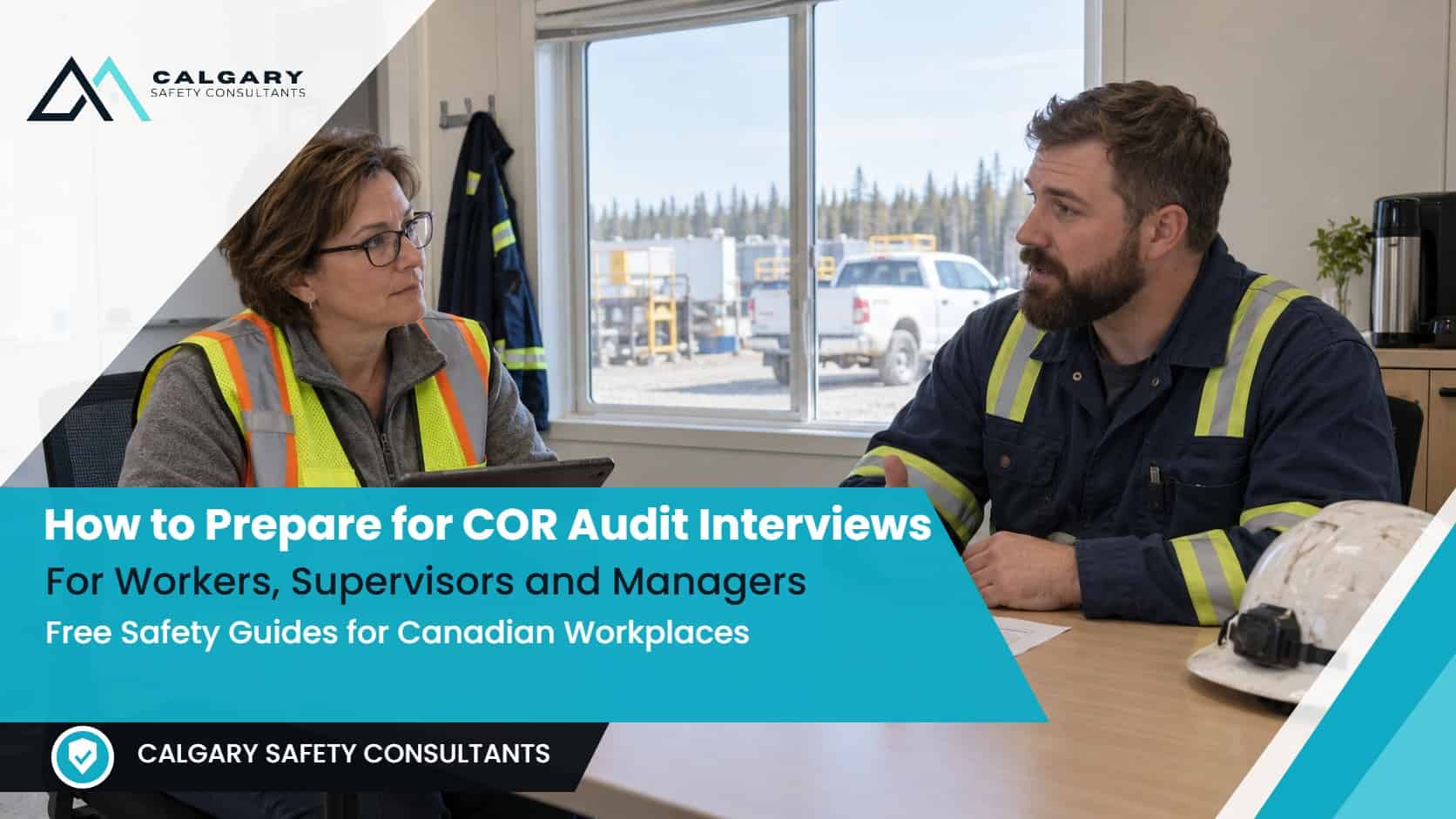
A Certificate of Recognition, or COR, shows that an employer's health and safety management system has been audited against an established standard and met it. Every COR audit gathers evidence in three ways. Alberta's page on how to get a Certificate of Recognition says each certifying partner's audit instrument must include employee interviews at all levels, a review of documentation and observations of workplace conditions and practices. Auditors and certifying partners often call this documentation, interviews and observation, or DIO.
COR audit interviews are where many employers lose the most marks, and it's rarely because people say the wrong thing on purpose. It's because the binder says one thing and the person in front of the auditor describes something different. A hazard assessment process that exists on paper but that workers have never seen, an emergency plan no one can describe or a supervisor who isn't sure what an inspection is for all show up quickly in a one-on-one conversation.
That's also why interviews are worth taking seriously long before audit day. They're the auditor's way of answering the question that matters most: is this program real for the people doing the work? An employer whose people can describe the system in their own words, with examples, is usually an employer whose system is working.
This guide explains who gets interviewed and how many, how answers are scored, what auditors tend to ask managers, supervisors and workers, and how to prepare your people properly and ethically. If you're earlier in the process, start with our guide on how to prepare for a COR audit.
Who Gets Interviewed and How Many
The auditor, not the employer, chooses who's interviewed. That's a firm rule, and it's the single most important thing to understand when you prepare. Anyone on the payroll could be in the sample, from the owner to a worker hired last month.
In Alberta, the audit sampling criteria (SAC-GDL-004) used by Energy Safety Canada and the other certifying partners set out how the sample is built. The key rules are straightforward:
- The sample is based on total company headcount. The minimum number of interviews comes from the number of employees in the whole company, not just the people at the sites being visited.
- The auditor selects the interviewees. The employer provides an accurate employee list, and the auditor decides who to speak with.
- Every level is included. The sample must cover a cross-section of all staffing levels, from senior management to workers, including part-time and casual staff. The criteria don't set separate quotas for managers, supervisors and workers, so the auditor balances the sample to suit your organization.
- The sample must be representative. It should reflect years with the company, departments, shifts, sites, business units and, where there's more than one, WCB industry codes. After a merger or restructuring, people from both the old and new parts of the company should be included.
- The minimum is a floor, not a target. Larger or more complex operations may need more interviews than the table shows, and the audit report must show that the sample meets the criteria.
- Everyone is asked every required question. Auditors must ask each interviewee all the questions the audit instrument requires for their role, even if a trend appears early.
Here's the minimum number of interviews from Table 1 of the Alberta criteria, covering the company sizes most employers fall into:
| Total staff | Minimum interviews | Total staff | Minimum interviews |
|---|---|---|---|
| Fewer than 5 | All staff | 31 to 36 | 16 |
| 5 | 4 | 37 to 44 | 17 |
| 6 to 7 | 5 | 45 to 49 | 18 |
| 8 | 6 | 50 to 64 | 19 |
| 9 | 7 | 65 to 74 | 20 |
| 10 to 11 | 8 | 75 to 88 | 21 |
| 12 to 14 | 9 | 89 to 99 | 22 |
| 15 to 16 | 10 | 100 to 120 | 23 |
| 17 | 11 | 121 to 149 | 24 |
| 18 to 20 | 12 | 150 to 199 | 25 |
| 21 to 24 | 13 | 250 to 299 | 37 |
| 25 to 27 | 14 | 400 to 475 | 58 |
| 28 to 30 | 15 | 500 to 510 | 60 |
From Table 1 of the Alberta Partnerships audit sampling criteria (SAC-GDL-004, Rev. 1.1). The table continues in small steps past 25,000 staff; the last three rows are examples for larger employers. Other provinces and certifying partners use their own sampling rules, so confirm the numbers with your auditor and certifying partner before the audit.
The same document sets the minimum number of work sites the auditor visits:
| Number of work sites | Minimum sites visited |
|---|---|
| 1 to 2 | All sites |
| 3 to 4 | At least 2 |
| 5 to 8 | At least 3 |
| 9 to 30 | One-third, rounded up |
| More than 30 | Set in consultation with the certifying partner |
A few site rules matter for planning. The main office or shop must be in scope in certification and recertification years. An employer with 3 to 30 fixed sites should have every site audited at some point in the three-year cycle, and an employer with three or more sites can't use the same combination of sites for recertification that it used in its last certification audit. Where sites differ a lot in work type, conditions, location or size, more sites may need to be sampled. Every site in scope is also sampled for interviews, so crews at those sites should expect to be part of the conversation.
Other provinces work the same way in principle. In British Columbia, go2HR's guidance on audit scope and sampling for the tourism and hospitality sector describes documentation, interviews and observation as the three data-collection methods and notes that interviews may not be needed at every site visited, depending on the company. go2HR also publishes an interview matrix that sets the minimum number of worker interviews by full-time equivalent staff size.
Some interview questions are aimed at particular groups. Energy Safety Canada's 2023 COR audit protocol, for example, asks certain questions only of workers hired or transferred in the past 12 months, others only of people who conducted inspections or took part in investigations, and others only of senior and middle managers. If your company hired new workers or promoted new supervisors this year, expect them to be in the sample.
How Interview Answers Are Scored
Interview results aren't a pass or fail on each person. They're scored as part of each audit question, alongside documents and observation, and they add up with everything else to your element and overall scores.
- Points come from the share of positive responses. In Energy Safety Canada's protocol, an interview item has its own point range, and the score depends on the percentage of positive answers across the people asked. Many questions split their points between documentation and interviews, so weak interviews can pull down a question even when the paperwork is perfect.
- Some questions set a higher bar. The same protocol requires at least 80 per cent positive responses on some items, requires each interviewee to verify all the criteria on others, and on some requires answers to match the written program. For instance, workers asked about emergency duties must describe responsibilities that match the written emergency response plan, and new workers must know all three of their health and safety rights.
- Interviewees who weren't involved aren't counted. A worker with no emergency duties isn't scored on emergency duties. Auditors mark those questions as not asked rather than negative.
- Auditors note details and examples. Notes must support each interview score with specifics, which is why vague or rehearsed answers rarely score well. "We do hazard assessments" is weaker than "I filled one out this morning before we started on the pump, and my supervisor signed it."
- Names stay confidential. The protocol says auditors keep interviewees' names confidential and don't include the names of sources in their audit notes.
In Ontario, IHSA's COR 2020 audit tool labels each requirement with its verification technique, such as documentation, interview, observation or a combination, and records interview results separately for management and workers. The details differ by certifying partner, but the principle is the same everywhere: interviews confirm whether the system on paper is the system in use.
All of this feeds the final result. In Alberta, an employer must score at least 80 per cent overall, with at least 50 per cent in each audit element, to pass. A handful of weak interview items in one element can be the difference.
What Auditors Ask Managers, Supervisors and Workers
Every certifying partner has its own audit instrument, and the exact questions are part of that instrument. What doesn't change much from one province to the next is the ground interviews cover. Across Energy Safety Canada's protocol, interview questions appear under most elements, from management leadership and hazard assessment to hazard control, inspections, training, emergency response and incident investigation. Questions are pitched at the level of the person being asked.
| Who | Topics auditors commonly explore | What a strong answer sounds like |
|---|---|---|
| Senior and middle managers | The health and safety policy and how it's communicated, responsibilities and accountability, resources for safety, how hazards and incidents reach them, how the program is reviewed and improved | Specific examples: a decision they made after an incident, a budget item for a control, the last program review and what changed |
| Supervisors | Their own responsibilities, hazard assessments and controls for their crew, inspections, orientations for new workers, investigating incidents, enforcing rules, emergency roles | A clear description of what they do and when: the last inspection they did, a hazard they fixed, how they orient a new worker on their crew |
| Workers | The hazards of their job and how they're controlled, field-level hazard assessments, training for their tasks, how to report a hazard or incident, emergency procedures, their health and safety rights | Plain-language answers about their own work: what they check before starting, where the muster point is, who they'd tell about a near miss |
| New and transferred workers | Their orientation, what they learned about hazards and rules, their rights, who they report to | An honest account of their orientation and first weeks, including who showed them the job |
A few topics come up so often that they deserve special attention:
- Health and safety rights. Workers should be able to explain their rights in their own words. Alberta's Guide to OHS: Workers describes three fundamental rights: the right to know about hazards, the right to participate in health and safety, and the right to refuse dangerous work.
- Hazard assessments. Workers should know what hazard assessments cover their work and how they took part in them. Supervisors should know how they're reviewed. Our guides on job hazard analysis and field-level hazard assessments explain both.
- Reporting. Everyone should know how to report a hazard, an injury or a near miss, and what happens next. Our incident investigation guide covers the process behind it.
- Emergencies. People should know the alarm, the muster point, first aid and their own role, and their answers should match the written plan.
- Inspections and follow-up. Supervisors and workers who do inspections should be able to describe how findings are tracked and fixed. See our guides on workplace safety inspections and corrective actions.
Auditors usually ask open questions and follow up with "Can you give me an example?" or "When was the last time?" That's not a trick. It's how they tell the difference between a memorized phrase and real experience.
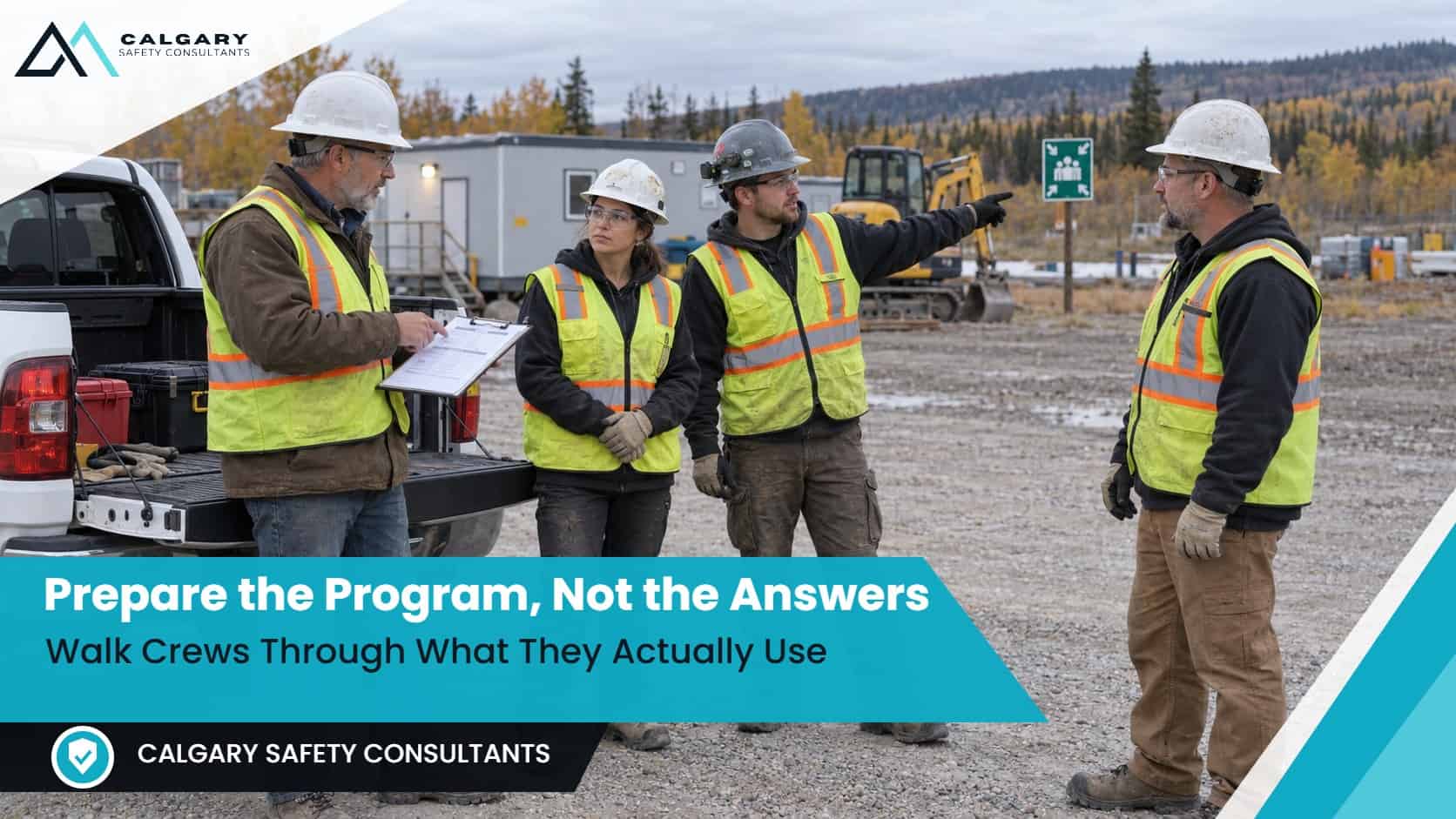
Prepare the Program, Not the Answers
It's tempting to hand out a list of likely questions with model answers and have people memorize them. Don't. It rarely works, it can damage the audit, and it misses the point.
- Rehearsed answers fall apart under follow-up questions. A worker who has memorized "we complete a hazard assessment before every task" but can't say when they last did one, or what was on it, scores worse than a worker who simply describes what they did this morning.
- Coaching can call the whole audit into question. When every interviewee gives the same word-for-word answer, auditors notice. It undermines confidence in the rest of the evidence, and it isn't consistent with an honest audit.
- The goal is a working program. If people can't describe part of the program, that's a finding worth having. It tells you which part of the program hasn't reached the field, and fixing that protects workers and lifts your score at the same time.
So the right preparation has two parts. First, make sure the program is actually being used: hazard assessments done with the crew, orientations delivered, inspections carried out and followed up, drills held and incidents investigated. Second, help people understand their part in it and feel comfortable talking about it. U.S. OSHA's recommended practices on worker participation make the same point from a different angle: when workers are involved in finding and fixing hazards, they understand the program because they helped build it.
It's perfectly fine to tell people what to expect: who the auditor is, why interviews happen, roughly what topics come up, that there are no trick questions and that "I'm not sure, but I'd ask my supervisor" is an honest answer. That's preparation. Handing them the words is coaching.
A Three-Month Interview Readiness Plan
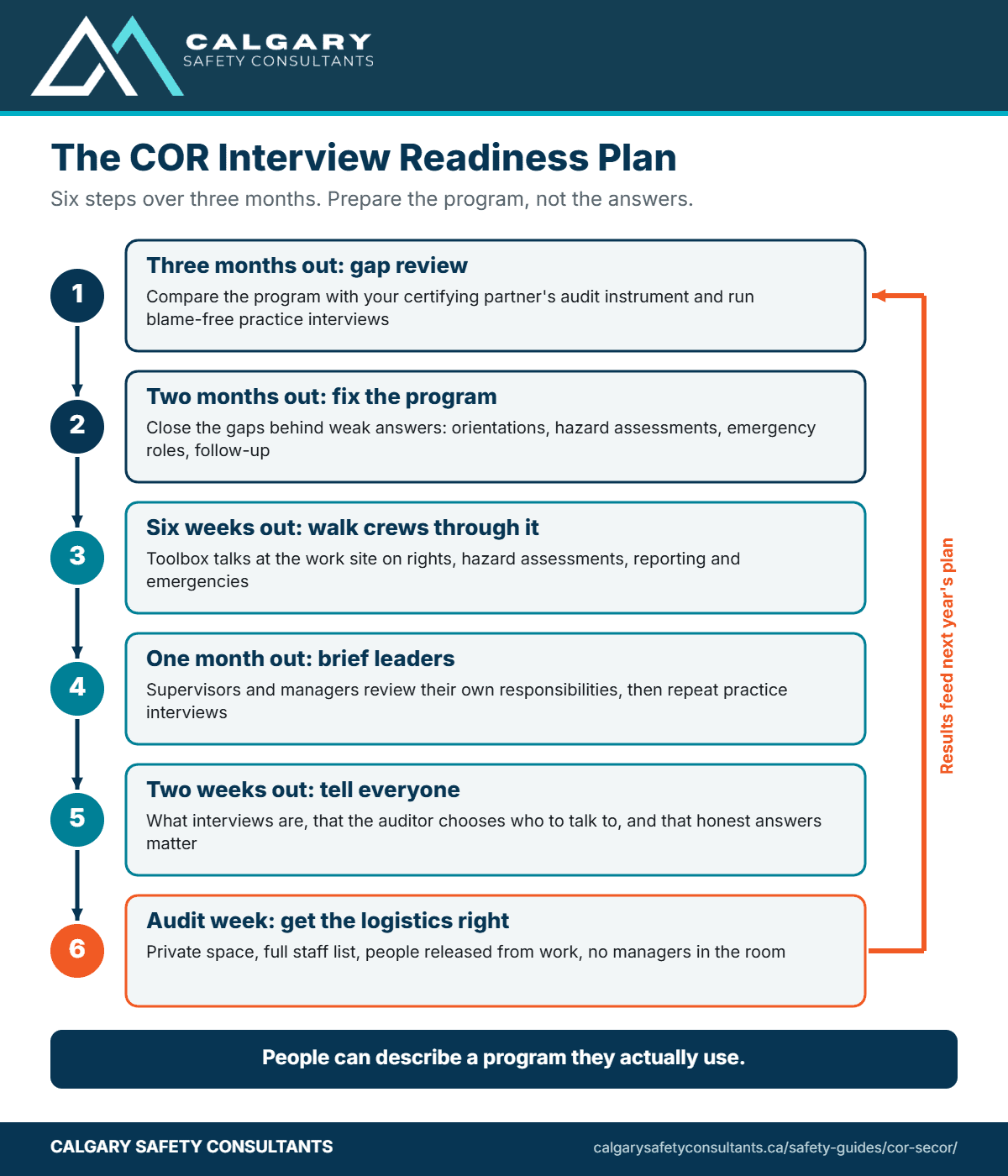
Interview readiness can't be built in the week before the audit. Here's a practical timeline for an employer heading into a certification, maintenance or recertification audit.
| When | What to do |
|---|---|
| Three months out | Run a gap review against your certifying partner's current audit instrument, including practice interviews with a cross-section of people. List the topics where answers were weak or inconsistent. |
| Two months out | Fix the program gaps behind the weak answers: missing orientations, hazard assessments workers haven't seen, unclear emergency roles, inspections without follow-up. Update documents to match how the work is really done. |
| Six weeks out | Use toolbox talks and crew meetings to walk through the program in practice: rights, hazard assessments, reporting, emergency procedures. Focus on the topics from the gap review. |
| One month out | Brief supervisors and managers on their own responsibilities and on what interviews involve. Repeat practice interviews with different people to see whether the fixes have reached the field. |
| Two weeks out | Tell everyone the audit is coming, what interviews are and that the auditor chooses who to speak with. Confirm the employee list, shifts and sites with your auditor so the sample can be representative. |
| Audit week | Arrange a private space, release people from work when they're called, keep production pressure off and let the auditor run the schedule. |
The practice interviews are the most useful part of this plan. Have someone who wasn't involved in writing your program, such as an internal auditor from another department or an outside consultant, interview a few people from each level using open questions. Keep it private and blame-free, and treat what you hear as information about the program, not about the person.
Preparing Workers
Workers make up most of any COR audit interview sample, and they're often the most nervous about it. A few simple steps help them do well by describing their real work.
- Explain what interviews are. A short, private conversation about how safety works in their job. It isn't a test of them, and the auditor keeps their name confidential.
- Walk through the program at the work site. Show workers the hazard assessments that cover their tasks, the procedures they use, where the emergency equipment is and where the muster point is. Ask them what's missing or out of date.
- Cover their rights. Use a toolbox talk to go over the right to know, the right to participate and the right to refuse unsafe work, and what each looks like on your site.
- Practise reporting. Make sure every worker knows how to report a hazard, an injury and a near miss, and has seen what happens to a report.
- Encourage honesty. Tell workers it's fine to say they don't know and that the auditor wants their real experience. An honest gap is far better than a guess.
Pay particular attention to new and transferred workers, workers on night shifts or remote sites and part-time or casual staff. They're part of the sample too, and they're the people most likely to have missed a toolbox talk or a revised procedure.
Preparing Supervisors
Supervisors are the link between the written program and the field, and auditors usually spend extra time with them. A supervisor who can't describe their own responsibilities, or who describes a different process from the one in the manual, raises questions about every crew they lead.
- Go over their written responsibilities. Make sure every supervisor has read the responsibilities in your program and can explain them in their own words. Many supervisors carry out duties every day without realizing they're part of the safety program.
- Connect duties to records. Ask each supervisor to pull the last inspection, orientation, field-level hazard assessment review and incident report they were involved in. If they can't find them, that's the gap to fix.
- Clarify their role in emergencies and investigations. Supervisors should know exactly what they do when the alarm sounds and when one of their workers is hurt.
- Train them, not just brief them. If supervisors haven't had training in their health and safety duties, the audit is a good reason to provide it. Our guide on how to build a health and safety system explains where supervisor training fits.
Remind supervisors not to sit in on worker interviews, not to ask workers afterwards what they were asked and not to steer who gets selected. The auditor needs workers' independent views, and anything that looks like pressure can affect the audit.
Preparing Managers and the Owner
Senior managers and owners are interviewed too, and their answers set the tone for the management leadership element. Auditors want to hear how leadership shows up in practice, not a recitation of the policy statement.
- Know the policy and how it reaches people. Be ready to explain what the policy commits the company to and how it's communicated, for example at orientation, on postings and at meetings.
- Have examples ready from memory. A hazard that was fixed because of a worker report, money spent on a control, a change made after an incident, a site visit where you checked the program yourself.
- Know how the program is reviewed. Be able to describe the last management review or program review, what it found and what changed as a result.
- Know the numbers and trends. Incident trends, open corrective actions and inspection results show the auditor that safety information actually reaches management.
Small employers sometimes worry that the owner is also the manager, the supervisor and the safety coordinator. That's normal. Auditors understand multi-role positions, and the owner simply needs to be able to describe each part of the role.
Remote, New and Contract Workers
Some groups need a little extra planning, because they're easy to miss in preparation and they often end up in the sample.
- New and transferred workers. Several questions in Energy Safety Canada's protocol are asked only of people hired or transferred in the past 12 months, covering their orientation, rights and training. Make sure every new hire's orientation actually happened and was recorded.
- Remote and field workers. Workers who rarely see the office still need to know the program. The protocol recognizes that dispatched or remote workers may be covered through regular contact with a dispatch or field supervisor, so make sure that contact happens and includes safety.
- Night and weekend shifts. Sampling should cover shifts, so tell your auditor about every shift and make sure off-shift crews get the same toolbox talks and updates.
- Workers with language or literacy needs. If some workers would be more comfortable in another language, talk to your auditor and certifying partner well before the audit about how interviews will be handled.
- Contractors and other employers. Interview samples are based on your own employees, but auditors also look at how you manage contractors and visitors. Our guide on managing contractor safety explains what that involves.
On Audit Day: Scheduling and Logistics
Good logistics make COR audit interviews easier for everyone and keep the focus on what people say.
- Provide a private space. A quiet office, meeting room or site trailer where people can't be overheard. Some interviews happen in the field during the site walk, which is fine, as long as the person can speak freely.
- Let the auditor choose. Give the auditor your full employee list with roles, shifts and sites, and let them select. Never hand-pick interviewees or send only your best people.
- Release people from work. Make sure supervisors know that when the auditor asks for someone, that person is released without pressure to hurry back.
- Keep managers out of the room. Interviews are one-on-one. Supervisors and managers shouldn't be present for anyone else's interview.
- Plan for every shift and site. Agree with the auditor in advance on how night shifts, remote crews and other sites will be reached.
- Don't debrief people afterwards. Asking workers what they were asked, or how they answered, can feel like pressure and isn't needed.
The auditor will also be observing the work and checking records while interviews happen. If an interview reveals that something in the documents isn't happening in practice, don't argue the point or rush to produce paperwork. Note it, and deal with it in your action plan.
After the Interviews: Using What You Learn
The audit report will show where interview scores were weak. Those results are some of the most useful information you'll get all year, because they show exactly where the program hasn't reached the people it's meant to protect.
- Look for patterns, not people. If several workers couldn't describe the emergency plan, the problem is how the plan was communicated, not the workers.
- Build the fixes into your action plan. Assign owners and dates, and track them like any other corrective action.
- Check again in your maintenance years. Maintenance audits are a chance to show that weak interview areas have improved. Practice interviews midway through the year tell you whether they have.
- Use interviews in your own program evaluation. A few informal interviews each quarter, done kindly and privately, are one of the best health checks any employer can run.
Interviews in Certification, Maintenance and SECOR Audits
COR audit interviews are part of certification, recertification and, in most programs, maintenance audits as well, although the scope of a maintenance audit can differ. Check with your certifying partner about which audit type you're facing and what it requires. Our guide on how to prepare for a COR audit explains the three-year cycle.
Small employers working toward a SECOR follow a different format designed for smaller businesses, and the way evidence is gathered differs from a full COR audit. Check your certifying partner's current SECOR requirements, and see our guide on how to prepare for a SECOR evaluation for the process. Whatever the format, the same principle applies: the people in your business should be able to describe the system you've written down.
Workplace example
A Practical Workplace Example
Situation: Consider an oilfield service company in Alberta with about 45 employees across a shop and three field crews, heading into its COR recertification audit. Its documents were in good shape, but in the last maintenance audit, interview scores had been low on hazard assessment and emergency response. Field workers described hazard assessments as "the supervisor's paperwork," and several couldn't say where their crew's muster point was on a lease.
Action: Three months before the audit, the safety coordinator arranged practice interviews with a dozen people, chosen at random from every crew and the shop. The answers confirmed the problem. Supervisors began completing field-level hazard assessments with their crews instead of for them, and each crew walked through the emergency plan, including muster points, at its next three job starts. The owner and operations manager each spent a day in the field reviewing the program with crews. Two weeks before the audit, everyone was told what interviews were, that the auditor would choose who to speak with, and that honest answers were what mattered.
Result: The auditor interviewed 18 people, the minimum for a company of that size, including two workers hired that spring. Workers described the hazard assessment they had done that morning and pointed to their muster points without hesitation. Interview scores on both weak elements improved, and the company kept its COR. The coordinator now runs a handful of informal interviews every quarter.
Common COR Interview Mistakes to Avoid
- Handing out scripted answers. Identical, memorized responses collapse under follow-up questions and can undermine the auditor's confidence in all your evidence.
- Hand-picking interviewees. The auditor chooses. Trying to steer the sample toward your best people isn't allowed and usually backfires.
- Preparing only the office. Field crews, night shifts, remote workers and casual staff are part of the sample.
- Forgetting new workers. Workers hired or transferred in the past year face their own questions on orientation and rights.
- Supervisors in the room. Interviews are one-on-one. A manager sitting in, even with good intentions, changes the answers.
- A program on paper only. If the documents describe a process no one follows, interviews will show it.
- Answers that don't match the written plan. On some questions, such as emergency duties, answers must match the written program. Update the documents when the work changes.
- Treating weak interview results as a people problem. They're almost always a communication or program problem.
Audit perspective
What an Auditor Expects to Hear
From the auditor's chair, a good interview sounds like a conversation about work. The person describes what they do, in their own words, with an example or two, and their account lines up with the documents and with what the auditor sees on site. Different people describe the same system in different words, which is exactly what a working program sounds like.
The warning signs are just as easy to hear: identical phrases from several people, a supervisor who reads from a card, workers who describe a process the documents don't mention, or nobody below management who knows what a hazard assessment is for. None of those are about the individual. They're about whether the program has reached the field.
Calgary Safety Consultants helps employers build and test their programs and prepare for COR and SECOR audits, including practice interviews; we don't issue certificates. CORs and SECORs are issued through the applicable certifying partner.
The Bottom Line
COR audit interviews test one thing: whether the people in your company can describe the health and safety system you've written down. The auditor chooses who to speak with, scores the answers alongside your documents and observations, and listens for real examples rather than rehearsed phrases.
The best preparation is a program that's really in use, people who understand their part in it, and a few months of honest practice conversations. Do that, and audit-day interviews become what they should be: a chance for your people to show the auditor how they work safely.
Download the COR Interview Readiness Checklist and Practice Guide
Two free downloads go with this guide.
- COR Interview Readiness Checklist (PDF). A two-page fillable checklist with clickable checkboxes that follows the three-month plan in this guide, from the gap review and practice interviews to audit-week logistics.
- COR Practice Interview Guide (PDF). Open conversation starters for managers, supervisors and workers, with space to record themes and program gaps, for running your own blame-free practice interviews. It's built to find gaps in the program, not to script answers.
Click either button to download the file. Adapt both to your own program and your certifying partner's current audit instrument.

About the author
John Duplessis, B.Sc., CRSP
John Duplessis is a Canadian Registered Safety Professional with more than 30 years of occupational health and safety experience in oil and gas, construction, green energy, midstream operations and industrial project work. He is an external auditor with Energy Safety Canada.