On this page
- What a Workplace Safety Inspection Is and Why It Matters
- Types of Workplace Inspections
- Who Should Do Workplace Inspections
- How to Conduct a Workplace Safety Inspection, Step by Step
- Plan the Inspection: Scope, Frequency and Team
- Build a Checklist That Fits the Area
- Prepare Before You Walk the Area
- Walk the Area: Look at Conditions and Work Practices
- Record Findings So Someone Else Can Act on Them
- Rate and Prioritize Each Finding
- Assign Corrective Actions That Fix the Cause
- Verify, Close and Communicate the Results
- Use Inspection Results to Improve the Program
- Pre-Use and Equipment Inspections
- Be Ready When an OHS Officer Inspects
- A Practical Workplace Example
- Common Workplace Inspection Mistakes to Avoid
- What an Auditor Expects to See
- Download the Checklist and Quick Guide
- Frequently Asked Questions
- Related Guides and Articles
- How Calgary Safety Consultants Can Help
- Sources
What a Workplace Safety Inspection Is and Why It Matters
A workplace safety inspection is a structured look at a work area, its equipment and the way people are working, carried out to find hazards and confirm that controls are in place and working. It's one of the oldest tools in occupational health and safety, and still one of the most useful, because it puts trained eyes on the actual workplace instead of on paperwork about it.
A good inspection looks at two things. The first is conditions: blocked exits, damaged racking, missing guards, leaking containers, worn cords, poor lighting. The second is work practices: how people lift, whether they use the guard or bypass it, whether lockout happens every time, whether the procedure on paper matches the job in front of you. Many inspections only cover the first. The second is usually where the serious hazards are.
The payoff is practical. Every hazard you find and fix during an inspection is one that won't turn up in an incident report, a claim or an officer's order. Across Canada, workers' compensation boards accepted 274,022 lost-time claims in 2023, according to the Association of Workers' Compensation Boards of Canada. Each of those claims is lost time, lost production and a person who got hurt.
Regular workplace safety inspections are one of the simplest ways to keep your workplace out of those numbers, and they give you a steady record of due diligence along the way.
Inspections are also expected by law. British Columbia's Occupational Health and Safety Regulation is the clearest example. It requires employers to make regular inspections of "all workplaces, including buildings, structures, grounds, excavations, tools, equipment, machinery and work methods and practices, at intervals that will prevent the development of unsafe working conditions."
The same part of the Regulation requires special inspections after a malfunction or accident, involves the joint committee or worker representative where feasible, and requires unsafe conditions to be remedied without delay. Other jurisdictions set the duty in different ways, covered below, and our OHS Legislation in Canada page links to the rules for every province and territory.
An inspection isn't the same as an audit. The UK Health and Safety Executive's Plan, Do, Check, Act guidance separates routine monitoring of conditions and practices from periodic audits that test whether the whole management system works. Inspections are the routine monitoring. They tell you whether hazards are being controlled today, area by area, and that evidence is what an audit later relies on.
Types of Workplace Inspections
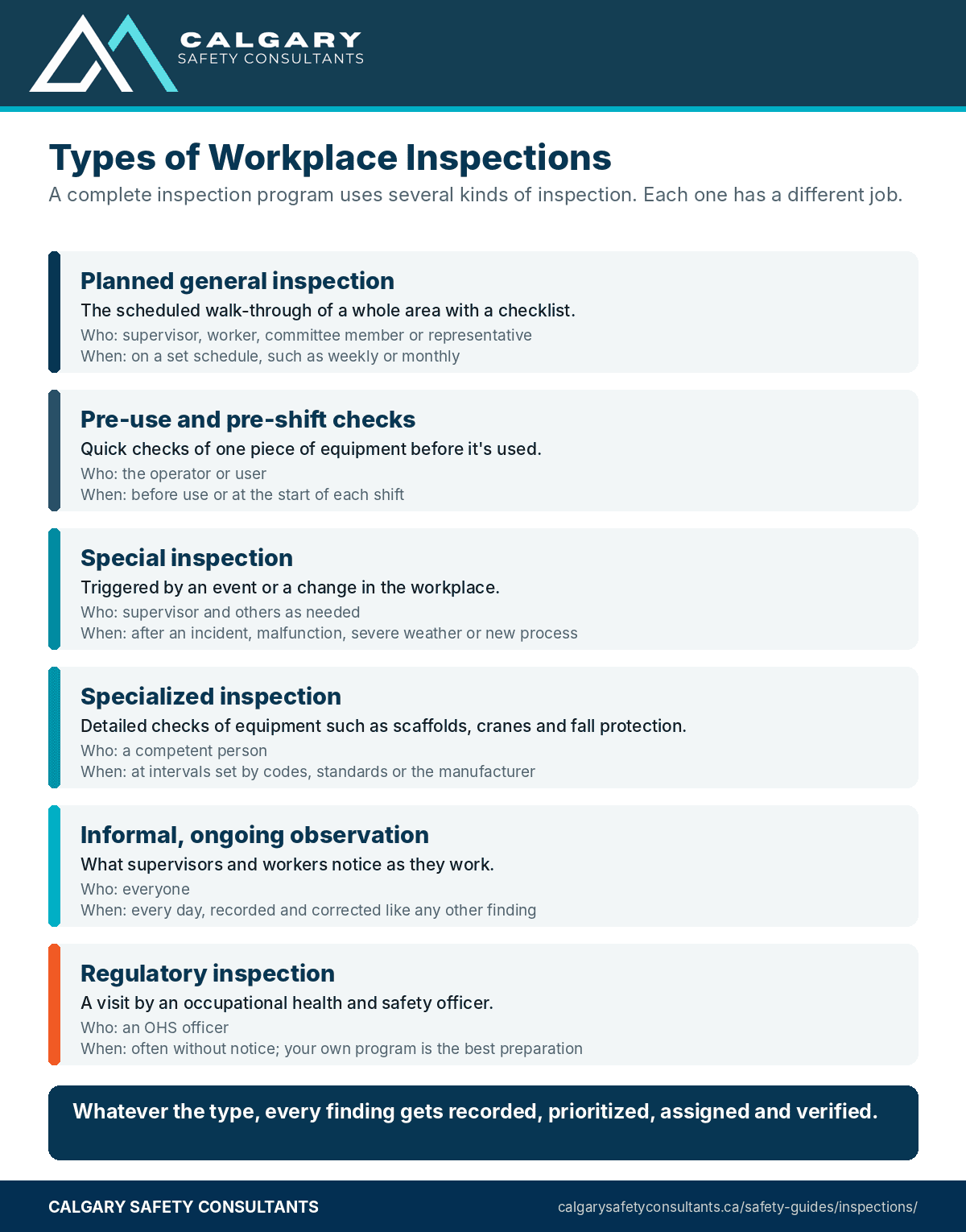
"Inspection" covers several different activities, and a complete program uses most of them. WorkSafeBC's guidance on workplace inspections describes planned, pre-work and special inspections, and other regulators add informal and regulatory inspections to the list. Each one has a different job.
- Planned general inspections. Scheduled, documented walk-throughs of a whole area with a checklist, done by a supervisor, a worker and, where you have one, a committee member or representative. This is what most people mean by a workplace safety inspection, and it's the focus of this guide.
- Pre-use and pre-shift inspections. Quick checks by the operator before equipment is used: a forklift circle check, a ladder or harness check, a look over a power tool. They're short, frequent and specific to one piece of equipment.
- Special inspections. Done when something happens or changes: after an incident or near miss, a malfunction, severe weather, a new process or piece of equipment, or before a shutdown or startup.
- Specialized inspections. Detailed inspections of particular equipment by a competent person, often at intervals set by a code, standard or manufacturer: scaffolds, cranes and hoists, fall protection equipment, pressure vessels, fire protection systems.
- Informal, ongoing inspections. What supervisors and workers notice every day as they work. They don't replace planned inspections, but anything significant they find should be recorded and corrected in the same way.
- Regulatory inspections. Visits by an occupational health and safety officer. You don't schedule these, but a strong internal program is the best preparation for them. Our Inspections and Regulators guides cover what to expect when an officer arrives.
Who Should Do Workplace Inspections
The best inspection teams combine someone who knows the area with someone who doesn't. Familiarity tells you what's normal. Fresh eyes catch the hazards everyone has learned to step around.
- Supervisors. They're responsible for the area, they can fix many problems on the spot, and they're the ones who'll follow up. A supervisor should lead or take part in planned inspections of their own area.
- Workers who do the job. They know where the shortcuts are taken, which equipment acts up and what's been reported before. Including them also makes it more likely that problems get reported between inspections.
- The joint health and safety committee or representative. In many jurisdictions, committee members or representatives are required to inspect or to take part in inspections, as the table below shows. Even where it isn't required, their involvement adds credibility and a worker's perspective.
- Managers. A manager walking an inspection a few times a year sees conditions first-hand, hears from workers directly and shows that inspections matter. It's also the quickest way to get a long-standing problem funded.
- Competent persons for specialized equipment. Scaffolds, rigging, cranes, fall protection and similar equipment need inspections by someone with the training and experience the regulations and manufacturers call for.
Whoever leads a workplace safety inspection needs training. Good inspectors know the hazards of the area, the legal requirements that apply, how to observe work without disrupting it, how to talk to workers and how to write a finding someone else can act on. Our online workplace inspection training covers these skills, and the Workplace Inspection and Compliance Training page explains the options for teams.
How to Conduct a Workplace Safety Inspection, Step by Step
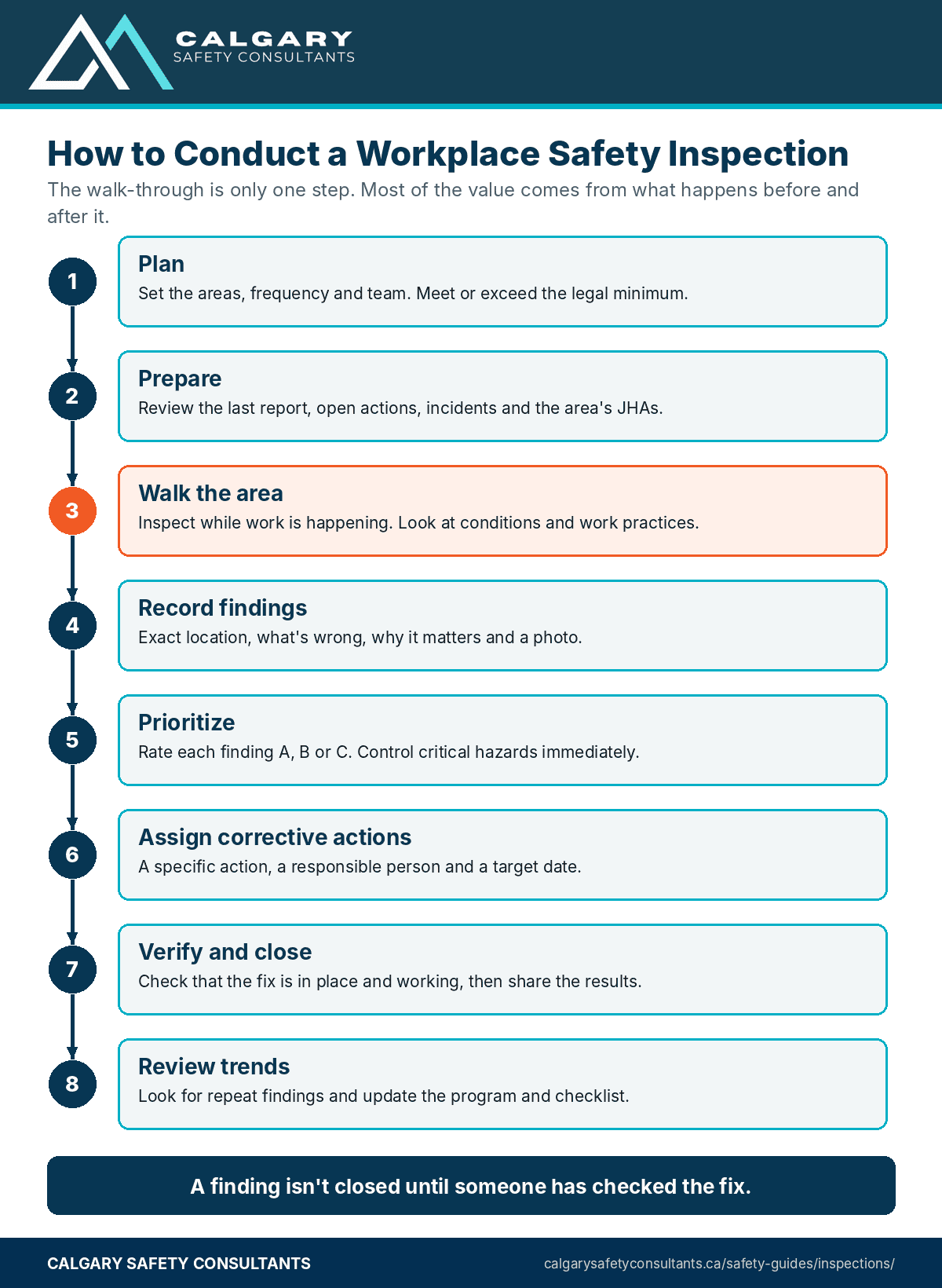
A workplace safety inspection follows the same cycle every time: plan it, prepare, walk the area, record what you find, rate and prioritize each finding, assign corrective actions, verify they're complete and use the results to improve. The steps below explain the judgement calls at each stage, and our free inspection checklist follows the same structure.
Plan the Inspection: Scope, Frequency and Team
Every good workplace safety inspection starts with a plan. Divide the workplace into inspection areas that a team can cover properly in one visit: the shop floor, the warehouse, the yard, the office, each job site or vehicle. A list of areas, with the equipment, hazardous products and high-risk tasks in each, tells you what every inspection has to cover and makes it easy to see when an area has been missed.
Then set the frequency. The right interval depends on how serious the hazards are, how quickly conditions change, the condition of the equipment, what your incidents and near misses are telling you, and what the law requires. WorkSafeBC notes that monthly inspections are common but may not be enough where the risk is higher.
A busy construction site or a warehouse with heavy forklift traffic may need weekly planned inspections on top of daily supervisor checks, while a small office may be well served by monthly or quarterly inspections. Our post on how often employers should conduct workplace inspections looks at the factors in more detail.
Legal minimums vary across Canada. This table summarizes the main inspection requirements in selected jurisdictions. Your own frequency must meet or exceed the minimum that applies to you.
| Jurisdiction | Who inspects | How often |
|---|---|---|
| Alberta | The employer, as part of the health and safety program. The committee or representative reviews the employer's inspection records (OHS Act, section 13). | Not set in the Act. Alberta's health and safety program guide says schedules should reflect the site's size, workforce, work and hazards. |
| British Columbia | The employer, with the committee or worker representative taking part where feasible. | Often enough to prevent unsafe conditions from developing, plus special inspections after a malfunction or accident. |
| Saskatchewan | The occupational health committee or representative, with the employer's cooperation (OHS Regulations, 2020, section 3-17). | At reasonable intervals agreed by the committee or representative and the employer. |
| Manitoba | The employer, and separately the workplace safety and health committee (Manitoba's committee guidance). | Employer inspections regularly. Committee inspections at least once before each regularly scheduled committee meeting. |
| Ontario | A designated worker member of the joint health and safety committee, or the health and safety representative (Ontario's committee guide). | At least once a month, or part of the workplace each month so the whole workplace is covered at least once a year. |
| New Brunswick | The employer, with the inspection program set up with the committee (OHS Act, section 9). | At least once a month. |
| Federal | The workplace committee or health and safety representative (Canada Labour Code, section 135). | Each month, covering every part of the workplace at least once a year. |
Finally, put the schedule in writing: which areas, how often, who leads each inspection and who takes part. Rotate team members from time to time so the same people aren't always looking at the same area, and plan some inspections on different shifts and days. A night shift or a weekend crew often works differently from the day shift.
Build a Checklist That Fits the Area
A checklist keeps each workplace safety inspection consistent and makes sure the important items aren't forgotten. The US Occupational Safety and Health Administration's guidance on hazard identification recommends regular inspections with workers on the team and checklists organized by hazard category, such as housekeeping, slips and trips, electrical, equipment, fire, ergonomics and emergency procedures.
A generic checklist is a starting point, not the finished tool. Tailor it to each area by removing items that don't apply and adding the equipment, processes and legal requirements specific to your operation. WorkSafeNB's OHS guide on workplace inspections makes the point that checklist items shouldn't be treated as permanent: update them when equipment, processes or hazards change, and after incidents show that something was missed.
A good checklist item is specific enough that two inspectors would reach the same answer. "Fire extinguishers OK" invites a glance. "Extinguishers are the right type for the hazards, visible, unobstructed, mounted at the correct height and have a current monthly inspection record" tells the inspector exactly what to check. Include work practices as well as conditions, flag the items that are legal requirements, and leave room for comments, locations and photo references.
Our free General Workplace Safety Inspection Checklist, which you can download below, covers 20 areas found in most workplaces, from exterior grounds and exits to electrical safety, hazardous products, mobile equipment and safe work practices. It uses a Yes, No and N/A rating for each item, flags compliance items to check against your own legislation, and includes a corrective action log and sign-off. Mark the sections that apply, skip those that don't and add your own items.
Don't let any checklist limit what you see, though. The most serious hazard in an area is sometimes the one nobody thought to put on the list. Leave space for "other hazards observed" and use it.
Prepare Before You Walk the Area
Ten minutes of preparation makes a workplace safety inspection far more useful. Before you start:
- Review the last inspection report for the area and check which corrective actions are still open. An inspection that rediscovers last month's findings without noticing they're still open is a wasted inspection.
- Look at recent incidents, near misses, first aid records and hazard reports from the area. They point you to where the risk is.
- Check the hazard assessments and JHAs for the main tasks, so you know which controls are supposed to be in place. Our job hazard analysis guide explains what a good JHA contains.
- Let the area supervisor know you're coming, agree how you'll handle anything urgent, and arrange to see the main tasks while they're being done.
- Bring what you need: the checklist or app, a camera or phone, a flashlight, a tape measure and the PPE required for every area you'll enter.
Walk the Area: Look at Conditions and Work Practices
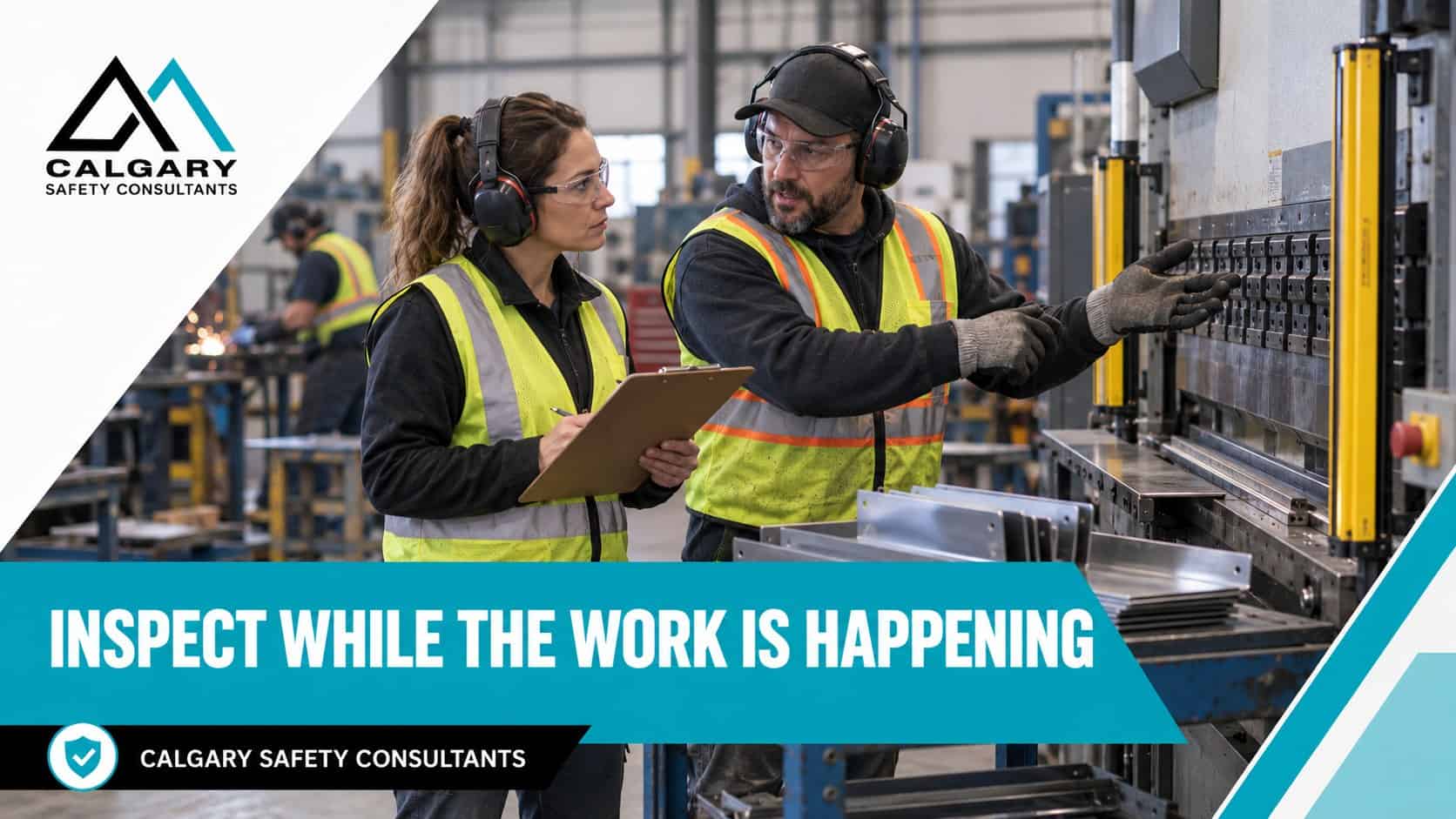
Carry out the workplace safety inspection while work is happening. An inspection done before the shift starts, or while the area is shut down, shows you the equipment but not how it's used, and work practices are where many of the serious hazards are.
Work methodically so nothing is skipped. Follow a planned route, cover one section at a time and use a consistent pattern: look up at overhead hazards, out at the area, down at floors and openings, and behind and under equipment. Check storage areas, mechanical rooms, exits and the corners people rarely visit. Look at equipment both at rest and while it's running, and listen for unusual noises, smell for leaks or fumes and notice heat, vibration and lighting.
Watch how tasks are actually done. Is the guard in place while the machine runs? Are workers lifting loads the JHA says need a lift aid? Is the lockout procedure followed, or skipped for "quick" jobs? Compare what you see with the controls on paper, because the gap between the two is often the most important finding of the day.
Talk to workers as you go. Ask what slows them down, what they've reported, what worries them and what they'd change. Keep it a conversation, not an interrogation. The purpose is to find hazards, not to catch people out, and workers who feel blamed stop telling you things.
If you find a hazard that could cause serious injury or illness right away, don't wait for the report. Stop the work, make the area safe or keep people away from it, and tell the supervisor immediately. Then record what you found and what you did, so the temporary fix is followed by a permanent one.
Record Findings So Someone Else Can Act on Them
A workplace safety inspection is only as good as its record. The person who fixes a problem often wasn't on the inspection, so each finding has to stand on its own. A useful finding says exactly where the hazard is, what's wrong, why it matters and what was done about it on the spot, with a photo where possible.
| Vague finding | Finding someone can act on |
|---|---|
| Housekeeping poor in warehouse. | Broken pallets and shrink wrap piled in front of the north emergency exit beside dock door 4, blocking the exit route. Photo 12. Cleared during the inspection. Priority A. |
| Racking damaged. | Upright on rack B-14, second bay, bent about 5 cm at forklift height with a full load on the beam above. Bay unloaded and taped off; rack inspection requested. Priority A. |
| Extinguisher issue. | Extinguisher FE-07 beside the paint booth has no monthly inspection recorded for October. Gauge in the operable range. Priority C. |
Record what's working well, too. Noting good housekeeping, a well-run lockout or a crew that stopped work to fix a hazard tells people what you want more of, and it makes the inspection feel less like fault-finding. If you spot a hazard during an informal walk-through, treat it the same way: write it up and put it into the corrective action process rather than mentioning it and moving on.
Rate and Prioritize Each Finding
Not every workplace safety inspection finding is equally urgent, and treating them as if they were means the serious ones get lost in a long list. Give each finding a priority based on how severe the possible harm is and how likely it is to happen. Our checklist uses three levels:
- Priority A, critical. Could cause death, serious injury, serious illness or major damage. Act immediately: stop the work or isolate the hazard until it's controlled.
- Priority B, serious. Could cause injury, illness or damage, but the risk isn't immediate. Correct it as soon as possible, typically within seven days.
- Priority C, minor. Low risk, such as a housekeeping or maintenance issue. Correct it within 30 days or at the next scheduled maintenance.
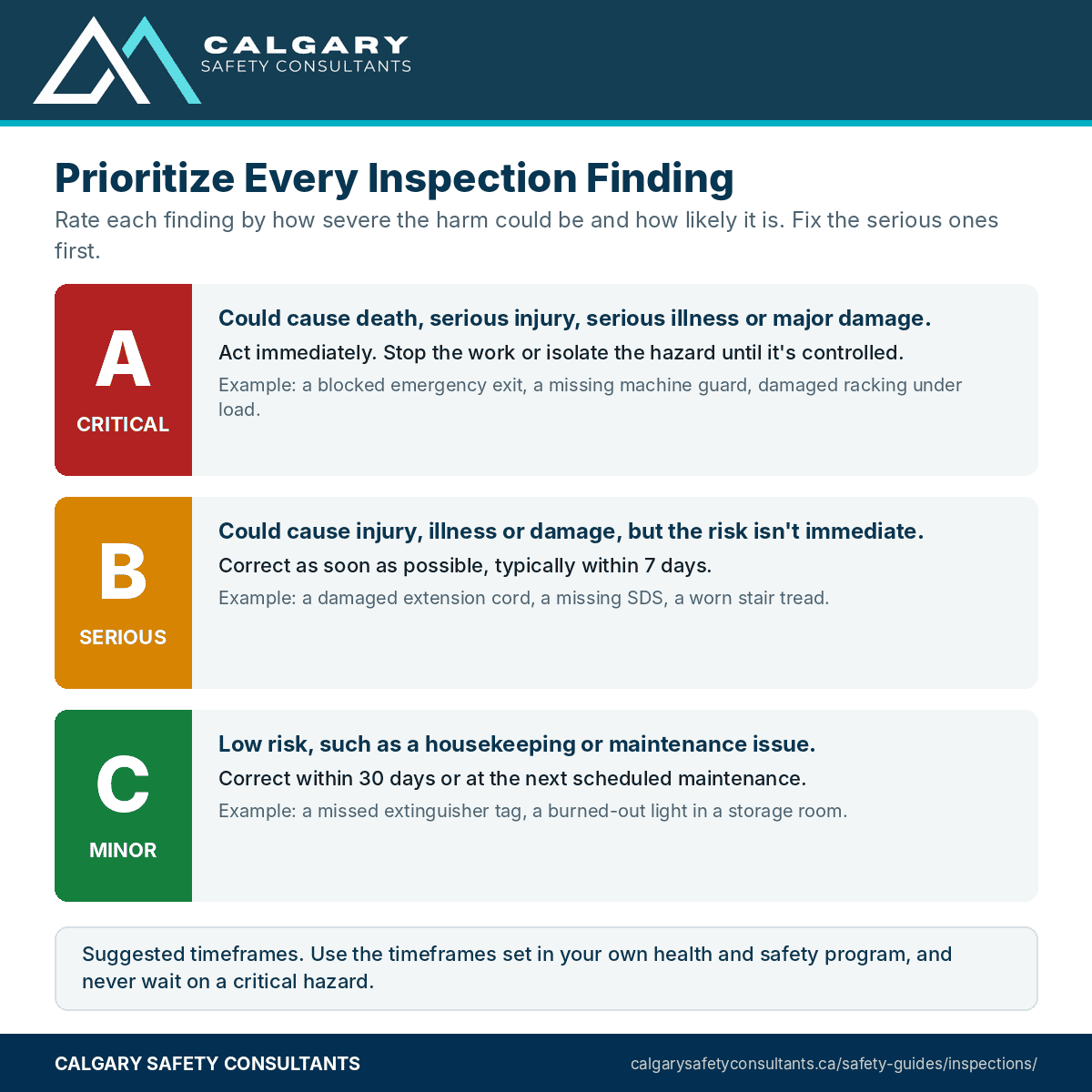
If your organization already uses a risk matrix for hazard assessments and JHAs, you can use the same method for inspection findings, so a finding and a hazard assessment use the same language. Whatever method you use, apply it consistently, and remember that the law doesn't wait for a priority code. British Columbia's requirement to remedy unsafe conditions without delay is a reminder that a critical hazard needs immediate action, with the paperwork to follow.
Assign Corrective Actions That Fix the Cause
Every finding marked No, or rated A, B or C, needs a corrective action with three things: a specific action, a person responsible who has the authority and resources to do it, and a target date that matches the priority. "Maintenance to look at it" isn't a corrective action. "Replace the damaged upright on rack B-14 and have the rack inspected before reloading the bay. Assigned to the warehouse manager. Due Friday" is.
Aim the action at the cause, not just the symptom. If exits keep getting blocked, clearing them again isn't enough. Ask why: maybe the receiving area has nowhere to stage incoming freight. Strong corrective actions sit high in the hierarchy of controls: removing the hazard, redesigning the work or adding an engineering control. Reminders, signs and retraining have a place, but if every corrective action is administrative, the same findings will keep coming back.
Track every action in one place, whether that's the corrective action log on the checklist, a spreadsheet or an inspection app, and review open items at a regular supervisors' or safety meeting. Digital tools can send reminders and flag overdue items, but the discipline matters more than the software. Our post on what happens when corrective actions are never properly closed explains why so many programs stall at this step. Our guide to managing corrective actions covers the whole process, from logging and prioritizing each action to verifying and closing it, with a free tracker.
Verify, Close and Communicate the Results
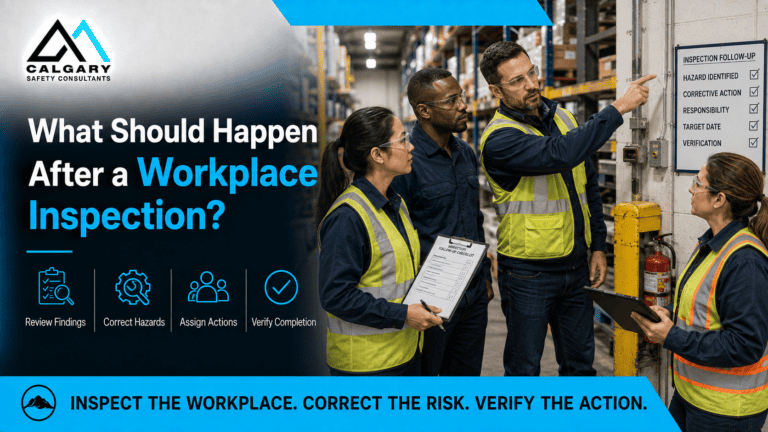
A workplace safety inspection isn't finished until its corrective actions are verified. Don't close a corrective action because someone said it was done. Check that it was done, that it fixed the problem and that it didn't create a new hazard. A quick look on the next walk-through, a photo or a signature from the person who verified it is enough, but it needs to happen. Our post on what should happen after a workplace inspection walks through the follow-up in more detail.
Share the results. Give the report to the area supervisor and management, share it with the health and safety committee or representative, and tell workers what was found and what's being done about it, either by posting the report or covering it at a toolbox talk. Workers who see their concerns acted on keep raising them. Workers who never hear back stop.
Some jurisdictions set formal response rules. In Saskatchewan, when the committee or representative gives written notice of an unsafe condition, the employer must take immediate steps to protect workers, correct it as soon as possible and reply in writing. In Ontario, an employer who receives written recommendations from the joint health and safety committee must respond in writing within 21 days.
Use Inspection Results to Improve the Program
Over time, workplace safety inspection records become one of the best sources of information in your safety program. Once or twice a year, and whenever a pattern seems to be forming, look across the inspection reports and ask:
- Which findings keep coming back, and in which areas? A repeat finding is a sign the corrective action fixed the symptom, not the cause.
- How long do corrective actions take to close, and how many are overdue?
- Do inspection findings match what incidents, near misses and first aid records are telling you? If people keep getting hurt in an area that always inspects clean, the inspection isn't looking at the right things.
- Are inspections happening on schedule, in every area and on every shift?
- Does the checklist still match the work, the equipment and the hazards?
Use the answers to adjust training, procedures, supervision, purchasing and the checklist itself. Recurring findings may also mean a hazard assessment needs updating. Inspection data won't predict every incident, but a program that acts on it is far more likely to catch problems while they're still small.
Pre-Use and Equipment Inspections
Planned inspections cover areas. Pre-use inspections cover individual pieces of equipment, and they matter because equipment condition can change from one shift to the next. Many regulations require them. In British Columbia, the mobile equipment rules require the operator to inspect mobile equipment before it's first operated on a shift and report defects, and the employer to keep a record of reported defects for at least two years. Similar requirements apply to ladders, scaffolds, rigging, fall protection and other equipment across Canada.
Follow the manufacturer's instructions for what to check and how often, and make the check quick and specific: a short checklist for the forklift, the aerial work platform or the harness, not the full area checklist. The UK Health and Safety Executive's guidance on the inspection of work equipment makes a useful distinction: simple equipment may only need a quick visual check before use, while equipment that deteriorates in ways that could cause danger needs a more detailed inspection by a competent person at suitable intervals, with records kept.
Make sure defects lead somewhere. A pre-use check that finds a problem should take the equipment out of service with a tag until it's repaired, and planned inspections should confirm that pre-use checks are actually being done. Our field-level hazard assessment guide covers the matching check for the task itself.
Be Ready When an OHS Officer Inspects
Occupational health and safety officers can inspect workplaces, often without notice. In Alberta, for example, the OHS Act allows officers to enter and inspect a work site at any reasonable hour without a warrant, examine records, take samples and photographs, and interview people, and to issue compliance, stop-work and stop-use orders.
A strong internal workplace safety inspection program is the best preparation. When an officer asks how you identify and control hazards, completed checklists, a corrective action log with closed items, and supervisors and workers who can explain the process are far more convincing than a binder of blank forms. Our posts on preparing for an OH&S inspection and the red flags that make inspectors dig deeper explain what officers tend to look for.
Workplace example
A Practical Workplace Example
Situation: Consider a 40-person distribution warehouse with a monthly inspection program that looked good on paper. Every month, the same supervisor walked the building at 6:30 a.m., before the first shift started, and completed a generic one-page checklist. The same findings appeared month after month: the north emergency exit blocked by inbound freight, forklift damage to racking and pallet debris in the aisles. The corrective action column said "addressed," but nobody could say what had been done.
Then a picker tripped over shrink wrap near the blocked exit and broke her wrist.
Action: The operations manager rebuilt the program with the joint health and safety committee. They divided the building into four inspection areas and tailored the general inspection checklist to each one, adding racking, dock and forklift traffic items. Inspections moved to mid-shift so the team could see work as it happened, and each team now included the area supervisor, a worker from another area and a committee member, rotating every quarter.
Findings were written with exact locations and photos, rated A, B or C, and entered in a single corrective action log that the supervisors reviewed every Monday. When the team asked why the north exit kept getting blocked, the answer was simple: receiving had nowhere to stage freight on busy days. The fix was a marked staging lane on the other side of the dock and a rule that the lane, not the exit, took the overflow.
The team also asked the racking supplier to inspect every bay, replaced the damaged uprights and added column guards at the end of each aisle.
Result: The blocked exit disappeared from the inspection reports. Over the following months, racking damage reports dropped, repeat findings became rare, and open corrective actions were closed or escalated within their target dates. When the company's next COR maintenance audit came around, the auditor could follow a clear trail from finding to verified correction, and workers interviewed on the floor could describe how inspections worked and what had changed because of them.
Common Workplace Inspection Mistakes to Avoid
- Treating the checklist as the goal. A fully ticked form proves an inspection happened, not that hazards were found and fixed. The aim is fewer hazards, not more paperwork.
- Inspecting when nobody's working. Early-morning or shutdown inspections miss work practices, which is where many serious hazards are.
- Same inspector, same route, every time. People stop seeing hazards they walk past every day. Rotate team members and vary the timing.
- Vague findings. "Housekeeping poor" can't be prioritized, assigned or verified. Record the exact location, what's wrong and a photo.
- Corrective actions without an owner or a date. If nobody is named and no date is set, the action usually doesn't happen.
- Closing items without verifying them. "Done" should mean someone checked that the fix is in place and working.
- Fixing symptoms, not causes. Repeat findings are a sign the real cause hasn't been addressed.
- Leaving workers out. Inspections done to workers instead of with them miss what workers know and discourage reporting.
Audit perspective
What an Auditor Expects to See
If your organization holds or is working toward a Certificate of Recognition (COR) or a Small Employer Certificate of Recognition (SECOR), inspections are a core audit element. Alberta's COR audit standard, for example, includes inspections as one of its elements and looks for:
- a formal inspection process, with inspection frequency that meets or exceeds the legislated requirements;
- participation from employees at all levels of the organization, including workers;
- training for the people who lead inspections;
- inspection checklists or forms suited to the work;
- a system to correct the deficiencies that inspections identify.
In practice, auditors compare completed inspections against your schedule, follow findings through to verified corrections, and ask workers on the floor whether they've taken part in inspections and seen hazards fixed as a result. Findings that never change from month to month, or corrective actions with no dates or sign-off, are common reasons for lost marks.
Each certifying partner uses its own approved audit standard, so check the current version for your program. Our checklist can help you produce the records auditors look for, but no form guarantees an audit result. Calgary Safety Consultants helps employers build inspection programs and prepare for audits; we don't issue certificates. CORs and SECORs are issued through the applicable certifying partner.
Download the Inspection Checklist and Quick Guide
Two free downloads go with this guide.
- General Workplace Safety Inspection Checklist (PDF). A 22-page checklist with clickable checkboxes covering 20 areas found in most workplaces, from exterior grounds, exits and housekeeping to electrical safety, hazardous products, fire protection, mobile equipment and safe work practices. It includes inspection details, a rating key, a priority key, a summary of findings, a corrective action log and sign-off.
- Workplace Safety Inspection Quick Guide (PDF). A two-page summary of how to plan, conduct and follow up an inspection, with clickable checklists for each stage.
Click either button to download the PDF. Adapt the checklist to your workplace by marking the sections that apply and adding items for your own equipment, processes and legal requirements.

About the author
John Duplessis, B.Sc., CRSP
John Duplessis is a Canadian Registered Safety Professional with more than 30 years of occupational health and safety experience in oil and gas, construction, green energy, midstream operations and industrial project work.