On this page
- What Supervisor Due Diligence Means
- Why Supervisor Due Diligence Matters
- Who Counts as a Supervisor
- Supervisor Duties Across Canada
- When Due Diligence Gets Tested
- What Reasonable Care Looks Like: The Judgement Calls
- Hazard Assessments and Pre-Job Planning
- Inspections and Field Observations
- Training, Orientation and Competency Checks
- Enforcing Rules and Correcting Unsafe Acts
- Listening to Workers and Acting on Concerns
- The Records That Prove Due Diligence
- What Employers Must Give Supervisors
- A Practical Workplace Example
- Common Due Diligence Mistakes to Avoid
- What an Auditor Expects to See
- The Bottom Line
- Download the Checklist and Daily Log
- Frequently Asked Questions
- Related Guides and Articles
- How Calgary Safety Consultants Can Help
- Sources
What Supervisor Due Diligence Means
Due diligence is the legal standard of reasonable care. WorkSafeBC puts it simply: due diligence requires taking all reasonable steps to protect workers from harm. For a supervisor, that means knowing the hazards in the work you direct, putting the right controls in place, making sure people actually follow them, and stepping in when they don't.
The idea comes from a 1978 Supreme Court of Canada decision, R. v. Sault Ste. Marie. As a LawNow article on the case explains, the Court created a middle category of strict liability offences between crimes that require intent and absolute liability offences that allow no defence. Once the prosecution proves the offence happened, the burden shifts to the accused to show that reasonable care was taken to prevent it.
Most OHS charges in Canada work this way. The Department of Justice's Charter guidance on strict liability says the accused is presumed negligent once the Crown proves the prohibited act, but can avoid liability by proving, on a balance of probabilities, that they exercised all due diligence to prevent it. In plain terms, the prosecutor doesn't have to prove you were careless. You have to prove you were careful.
Due diligence is about evidence as much as effort. Alberta's guidance on the term reasonably practicable describes due diligence as a legal defence raised after an incident, and links it to doing what is feasible and what a reasonable person would consider appropriate in similar circumstances. Our article on what reasonably practicable means covers that test in more detail.
Why Supervisor Due Diligence Matters
Supervisors sit where the safety program meets the work. Policies, procedures and hazard assessments only protect people if someone on the floor or at the site makes them happen, and that person is usually a supervisor. The WorkSafe Saskatchewan supervisor handbook says supervisors must be able to demonstrate they were duly diligent in meeting their legal obligations, and frames the test around four questions: was the harm foreseeable, was it preventable, how severe was the hazard, and who had control.
The consequences are personal. OHS duties fall on supervisors by name in most Canadian jurisdictions, so supervisors can be charged as individuals, not only their employers. In Alberta, a first conviction under the OHS Act's penalty section can carry a fine of up to $500,000, plus up to $30,000 for each day an offence continues, up to six months in jail, or both.
Criminal law adds another layer. Section 217.1 of the Criminal Code, added by Bill C-45, says everyone who undertakes, or has the authority, to direct how another person does work is under a legal duty to take reasonable steps to prevent bodily harm arising from that work. That wording reaches supervisors, foremen and lead hands directly, whatever their title.
Bill C-45 also changed how organizations are held responsible. The Department of Justice's plain language guide to Bill C-45 explains that an organization's representatives include employees and contractors, that senior officers include anyone with an important role in managing an important part of its activities, and that there's no limit on the fine for an indictable offence. Our article on Bill C-45 and the Westray law walks through the criminal cases.
Who Counts as a Supervisor
Being a supervisor under OHS law depends on what you do, not what your business card says. Ontario's guidance on supervisors under the OHSA says supervisor status is based on job functions, not on whether the word supervisor is in the job title. Having either charge of a workplace or authority over a worker is enough.
The definitions across Canada point the same way. Alberta's Act defines a supervisor as a person who has charge of a work site or authority over a worker. B.C.'s OHS Regulation uses a person who instructs, directs and controls workers in the performance of their duties. WorkSafeBC's page on supervising for health and safety lists owners, managers, superintendents, charge hands and lead hands as examples.
The Ontario cases on that government page show how courts apply it:
- A working foreman was convicted after two workers climbed a scaffold without proper fall protection. The court found he was a supervisor because he had the authority to direct workers to take corrective action (R. v. Lockyer, 2009).
- A lead hand on a four-person landscaping crew modified a lawn mower, and a worker was injured using it. He was convicted of failing, as a supervisor, to take every precaution reasonable in the circumstances. The court found he was a supervisor because he led the crew, assigned work and was expected to address safety issues (R. v. Walters, 2004).
- A project manager who decided crew make-up and equipment was found to be a supervisor after a scaffold contacted power lines, killing one worker and injuring three (R. v. Jetters Roofing, 2000).
- A general superintendent was found to be a supervisor but was acquitted because he proved due diligence, including reasonable reliance on his safety department's advice, a system for known hazards and monthly joint inspections (R. v. Bartram, 2009).
The lesson for employers is to treat every lead hand, foreman and crew lead as a supervisor for training and records, because the law probably already does. Supervisor due diligence starts with people knowing they're supervisors.
Supervisor Duties Across Canada
Every Canadian jurisdiction expects supervisors to protect the workers they direct, but the wording differs, and a few provinces don't list supervisor duties separately at all. Here's the short version for the four Western provinces, where most of our clients work.
- Alberta. Section 4 of the OHS Act requires every supervisor, as far as reasonably practicable, to take all precautions necessary to protect every worker under their supervision, ensure they work according to the Act, regulations and OHS Code, keep them from harassment and violence, advise them of all known or reasonably foreseeable hazards, and report unsafe acts and conditions to the employer.
- British Columbia. Section 23 of the Workers Compensation Act requires supervisors to ensure the health and safety of all workers under their direct supervision, be knowledgeable about the OHS provisions for the work, make workers aware of known or reasonably foreseeable hazards, and consult and cooperate with the joint committee or worker representative.
- Saskatchewan. Section 3-9 of The Saskatchewan Employment Act sets out the general duties of supervisors. The province's page on duties of supervisors adds that supervisors inspect work areas and correct unsafe acts and conditions, instruct and coach workers, and ensure only authorized, competent workers operate equipment. The OHS Regulations, 2020 require employers to make sure work is sufficiently and competently supervised.
- Manitoba. Section 4.1 of the Workplace Safety and Health Act requires supervisors, so far as reasonably practicable, to take all precautions necessary to protect workers, make sure they follow required procedures and wear required PPE, and advise them of known or reasonably foreseeable risks.
In Ontario, section 27 of the OHSA requires supervisors to take every precaution reasonable in the circumstances, and the government's guide to Part III explains that employers must appoint competent persons as supervisors: people qualified through knowledge, training and experience to organize the work. Ontario's supervisor page adds that, since July 1, 2014, employers must ensure supervisors complete basic awareness training under O. Reg. 297/13.
Elsewhere the approach varies. Quebec's Act respecting occupational health and safety doesn't define supervisors and places the duties on the employer, including providing appropriate training, assistance or supervision, though supervisors have a role in work refusals (ss. 15 and 16).
New Brunswick's OHS Act requires supervisors to take every reasonable precaution and acquaint workers with hazards. Nova Scotia's OHS Act and Prince Edward Island's OHS Act rely on employer duties to supervise and to make supervisors familiar with hazards. Newfoundland and Labrador's OHS Act sets supervisor duties in sections 5.1 and 5.2.
In the North, Yukon's Workers' Safety and Compensation Act sets out supervisor duties in section 28. The Northwest Territories OHS Regulations require employers to ensure supervisors have completed an approved regulatory familiarization program, and the WSCC says supervisors in both the Northwest Territories and Nunavut must attend an approved course.
Federally regulated workplaces follow Part II of the Canada Labour Code. It doesn't list supervisor duties separately, but it defines the employer to include any person who acts on behalf of an employer and requires employers to ensure that employees with supervisory or managerial responsibilities are adequately trained in health and safety.
| Jurisdiction | Who is a supervisor | Core supervisor duties | Employer duty and training |
|---|---|---|---|
| Federal (Canada Labour Code, Part II) | No separate definition; "employer" includes any person who acts on behalf of an employer (s. 122) | Supervisors acting for the employer carry the employer's duties, including s. 124 | Employees with supervisory or managerial responsibilities must be adequately trained in health and safety (s. 125(1)(z)) |
| Alberta (OHS Act) | Has charge of a work site or authority over a worker (s. 1(nn)) | As far as reasonably practicable, take all precautions necessary; ensure work follows the Act and Code; prevent harassment and violence; advise of known or reasonably foreseeable hazards; report concerns (s. 4) | Workers supervised by a person who is competent and familiar with the Act, regulations and Code (s. 3(1)(d)) |
| British Columbia (Workers Compensation Act) | Instructs, directs and controls workers (OHS Regulation s. 1.1) | Ensure the health and safety of workers under direct supervision; know the rules that apply; make workers aware of hazards and ensure they comply; work with the joint committee or representative (s. 23) | Employer provides the information, instruction, training and supervision necessary (s. 21(2)(e)) |
| Saskatchewan (Saskatchewan Employment Act) | Authorized by an employer to oversee or direct workers (s. 3-1(1)(dd)) | General duties of supervisors (s. 3-9); ensure workers comply (Regulations s. 3-6(2)) | Work sufficiently and competently supervised; supervisors know the Act, program, PPE and emergency procedures (Regulations s. 3-6(1)) |
| Manitoba (Workplace Safety and Health Act) | Has charge of a workplace or authority over a worker (s. 1) | So far as reasonably practicable, take all precautions necessary; ensure procedures and PPE are followed; advise of known or reasonably foreseeable risks (s. 4.1) | Workers supervised by a person competent through knowledge, training or experience (s. 4(2)(h)) |
| Ontario (OHSA) | Has charge of a workplace or authority over a worker (s. 1) | Ensure workers follow the Act and use protective devices; advise of potential or actual dangers; take every precaution reasonable in the circumstances (s. 27) | Appoint competent persons as supervisors (s. 25(2)(c)); basic awareness training under O. Reg. 297/13 |
| Quebec (Act respecting OHS) | Not defined | No separate list of supervisor duties; supervisor has a role in work refusals (ss. 15 and 16) | Employer provides appropriate training, assistance or supervision (s. 51, para. 9) |
| New Brunswick (OHS Act) | Authorized to supervise or direct the employer's employees (s. 1) | Take every reasonable precaution; comply and ensure compliance; acquaint workers with hazards; provide information (s. 9.1) | Work competently and sufficiently supervised, by supervisors with sufficient knowledge (s. 9(2)) |
| Nova Scotia (OHS Act) | Not defined | No separate list of supervisor duties | Employer provides supervision and ensures employees, particularly supervisors and foremen, know the hazards (s. 13(1)) |
| Prince Edward Island (OHS Act) | Not defined | No separate list; supervisors investigate work refusals (s. 28) | Workers and supervisors familiar with workplace hazards (s. 12(1)(d)) |
| Newfoundland and Labrador (OHS Act) | Authorized or designated to exercise direction and control over workers (s. 2(k.1)) | Ensure, where reasonably practicable, health, safety and welfare (s. 5.1); advise of hazards, give instructions, ensure PPE use (s. 5.2) | Employer provides information, instruction, training and supervision (s. 5(b)) |
| Yukon (Workers' Safety and Compensation Act) | Has charge of a workplace or authority over a worker (s. 25) | Duties of supervisors set out in s. 28 | Employer duties in s. 27 |
| Northwest Territories and Nunavut (Safety Act and OHS Regulations) | Authorized by an employer to oversee or direct workers (NWT Regulations s. 1) | Ensure workers comply with the Act and regulations (s. 16(2)) | Work sufficiently and competently supervised; supervisors complete an approved familiarization program (s. 16(1)) |
Summary only. Section numbers are from the current consolidations checked in October 2026. For the Northwest Territories and Nunavut row, section numbers are from the NWT regulations; Nunavut's Occupational Health and Safety Regulations have matching provisions. Some acts also place duties on directors, officers, prime contractors and owners. Check the full legislation for your jurisdiction before relying on a summary.
For links to the legislation in each jurisdiction, see our guide to OHS legislation in Canada.
When Due Diligence Gets Tested
Supervisor due diligence is usually tested at the worst possible time: after someone is hurt, after an officer writes an order, or during a COR audit when an auditor asks a crew what their supervisor does. In each case, the question is the same. What did you know, what did you do about it, and can you show it?
You can't build due diligence after the fact. A record written the day after an incident, a training sign-off backdated to fill a gap, or a hazard assessment created for the investigation won't carry much weight, and can do real damage to your credibility. The evidence that counts is the ordinary record of ordinary days, made at the time by the people doing the work.
That's good news for supervisors who already do the job well. The gap is usually in the paper trail, not the practice.
What Reasonable Care Looks Like: The Judgement Calls
Reasonable care isn't perfection, and it isn't a fixed checklist. It's what a competent, careful supervisor would do in the same situation. Four questions help you judge it, and they're the same ones a prosecutor or investigator will ask.
- Was it foreseeable? If the hazard was known in your industry, written in your hazard assessment, raised by a worker or seen before, you were expected to deal with it.
- Was it preventable? Were there controls you could have used, such as a guard, a different method, a second person, a permit or a stop-work call?
- How serious was it? The higher the potential for serious injury or death, the more care is expected. A fall from height calls for more than a reminder at the morning meeting.
- Who had control? Supervisors are judged on what was within their authority. If you didn't have the authority or resources to fix something, the reasonable step was to stop the work and escalate it, and to record that you did.
The judgement call supervisors face most often is the busy day: the crew is behind, the client is waiting and the safe way is slower. Reasonable care means the safe way still wins. Supervisors who can show they stopped work, slowed it down or escalated a problem on those days have strong evidence of due diligence.
Hazard Assessments and Pre-Job Planning
Due diligence starts before the work does. A supervisor should know the hazards of every task they direct, and the clearest way to show that is a hazard assessment that's current, specific and actually used.
- Know the formal assessment. Read the job hazard analysis for each task your crew does, and flag anything that doesn't match how the work is really done.
- Review field assessments. Check and sign the crew's field-level hazard assessments, and talk through them rather than just collecting them. A stack of unread forms is weak evidence.
- Pick strong controls. Use the hierarchy of controls to push for elimination, substitution and engineering fixes before relying on rules and PPE.
- Re-assess when things change. New equipment, a new location, weather, a short crew or a new worker are all reasons to stop and look again.
Most jurisdictions expect supervisors to tell workers about the hazards they'll face, and where the law puts that duty on the employer, the supervisor is usually the person who carries it out. Alberta, B.C. and Manitoba all use the phrase known or reasonably foreseeable, which means you're judged on what you should have known, not only what you did know.
Inspections and Field Observations
Supervisors are expected to see the work, not just hear about it. WorkSafeBC says supervisors should perform regular safety activities, such as inspections, observations, investigations or crew talks, and should verify that workers' performance meets safety expectations. Energy Safety Canada's COR audit protocol asks the same thing in its own words: do frontline supervisors tour work sites to observe work practices?
- Do the scheduled inspections. Complete the formal workplace safety inspections assigned to you, on time, and record what you found even when the answer is nothing.
- Walk the work every day. Short, informal checks catch most problems.
- Watch a task from start to finish. A planned observation shows whether the procedure works in practice and gives you something specific to coach.
- Close the loop. Every deficiency needs an owner, a due date and proof it was fixed. Our guide to corrective actions explains how to track them.
Unresolved items are one of the most damaging things an investigator can find. An inspection report that lists the same broken guardrail three months running shows the hazard was foreseeable and known, and that nobody fixed it.
Training, Orientation and Competency Checks
A supervisor can't assume a worker knows how to do a job safely. Many jurisdictions require that hazardous work be done by competent workers. Alberta, for example, requires such work to be done by a competent worker or under the direct supervision of one, and defines competent as adequately qualified, suitably trained and with enough experience to work safely with little or no supervision.
- Check orientation before the first shift. Confirm new and transferred workers have had their site and job orientation, and that it's recorded. A separate guide on new worker safety orientation is coming soon.
- Verify, don't assume. Ask for tickets and certificates, then watch the worker do the task before letting them work alone.
- Match the worker to the job. Keep a simple record of who is trained and authorized for which equipment and tasks. A training matrix makes this easy, and we'll cover it in an upcoming guide.
- Retrain when needed. After an incident, a near miss, a procedure change or poor performance, retrain and record it.
Supervisors need training too. In Ontario, employers must ensure supervisors complete basic OHS awareness training, and in the Northwest Territories and Nunavut, an approved familiarization course. Federally, employers must make sure supervisors are adequately trained in health and safety. In Saskatchewan, employers must ensure supervisors know the Act, the safety program, PPE and emergency procedures.
Enforcing Rules and Correcting Unsafe Acts
Knowing the rules isn't enough. Supervisors are expected to make sure workers follow them, and to act when they don't. WorkSafeBC lists correcting improper and unsafe work activities and conditions, and reinforcing safe and proper work performance, among routine safety-related actions supervisors take.
A fair, consistent approach works best. Most employers use a progressive system that starts with coaching and only escalates if the problem continues:
- Stop the unsafe act. If someone is at risk, stop the work first and talk second.
- Coach on the spot. Explain the hazard and the rule, ask why it happened and show the right way. Many unsafe acts come from unclear procedures, missing tools or time pressure, not attitude.
- Fix the cause. If the procedure, equipment or schedule set the worker up to fail, fix that too.
- Escalate if it repeats. A documented verbal warning, then written warnings and further steps under your company's discipline policy.
- Record every step. A two-line note in your log, made the same day, is far better than a memory.
Two cautions. First, discipline must never punish workers for acting safely. Section 18 of Alberta's OHS Act says no one may take disciplinary action against a worker for complying with the Act, regulations or OHS Code, and other jurisdictions have similar protections. Second, praise counts too. Recognizing good work is part of reinforcing safe behaviour, and it's worth recording.
Listening to Workers and Acting on Concerns
Workers often see hazards before supervisors do. A supervisor who listens, acts and reports back builds trust, and creates some of the strongest due diligence evidence there is: a record that a concern was raised and dealt with.
- Make concerns easy to raise. Ask at every toolbox talk, and thank people who speak up.
- Act and report back. Fix it, control it or escalate it, then tell the worker what happened. Alberta's Act requires supervisors to report unsafe acts and conditions to the employer.
- Handle refusals properly. If a worker refuses work they believe is dangerous, follow the process in your jurisdiction. Our guide to work refusals explains the steps.
- Work with the committee. B.C. requires supervisors to consult and cooperate with the joint committee or worker representative. Bring recurring concerns to JHSC meetings.
- Report and investigate incidents. Near misses are free lessons. Our incident investigation guide explains how to find the real causes.
The Records That Prove Due Diligence
WorkSafeBC's due diligence page tells employers to be on record: gather evidence of the health and safety program and all its components, and be able to provide proof of enforcement when necessary. For supervisor due diligence, that evidence comes from a handful of routine records.
- A daily supervisor log. WorkSafeBC lists recording a daily entry in a supervisor journal or log book among the routine safety actions supervisors can take. A WorkSafeNB presentation for supervisors, published by the Workers Compensation Board of PEI, gives the same advice: keep a shift log of safety checks, hazards corrected, worker concerns and refusals to work.
- Toolbox talks and crew meetings. Date, topic, key points, attendees and any concerns raised.
- Hazard assessments. Reviewed and signed field-level assessments, and notes on changes.
- Inspection and corrective action records. What was found, who owns the fix, the due date and the date it was closed.
- Training and competency records. Orientations, tickets, observed competency checks and retraining.
- Coaching and discipline notes. What you saw, what you said, what the worker said and what happens next.
- Incident and near-miss reports. With your part of the investigation and follow-up.
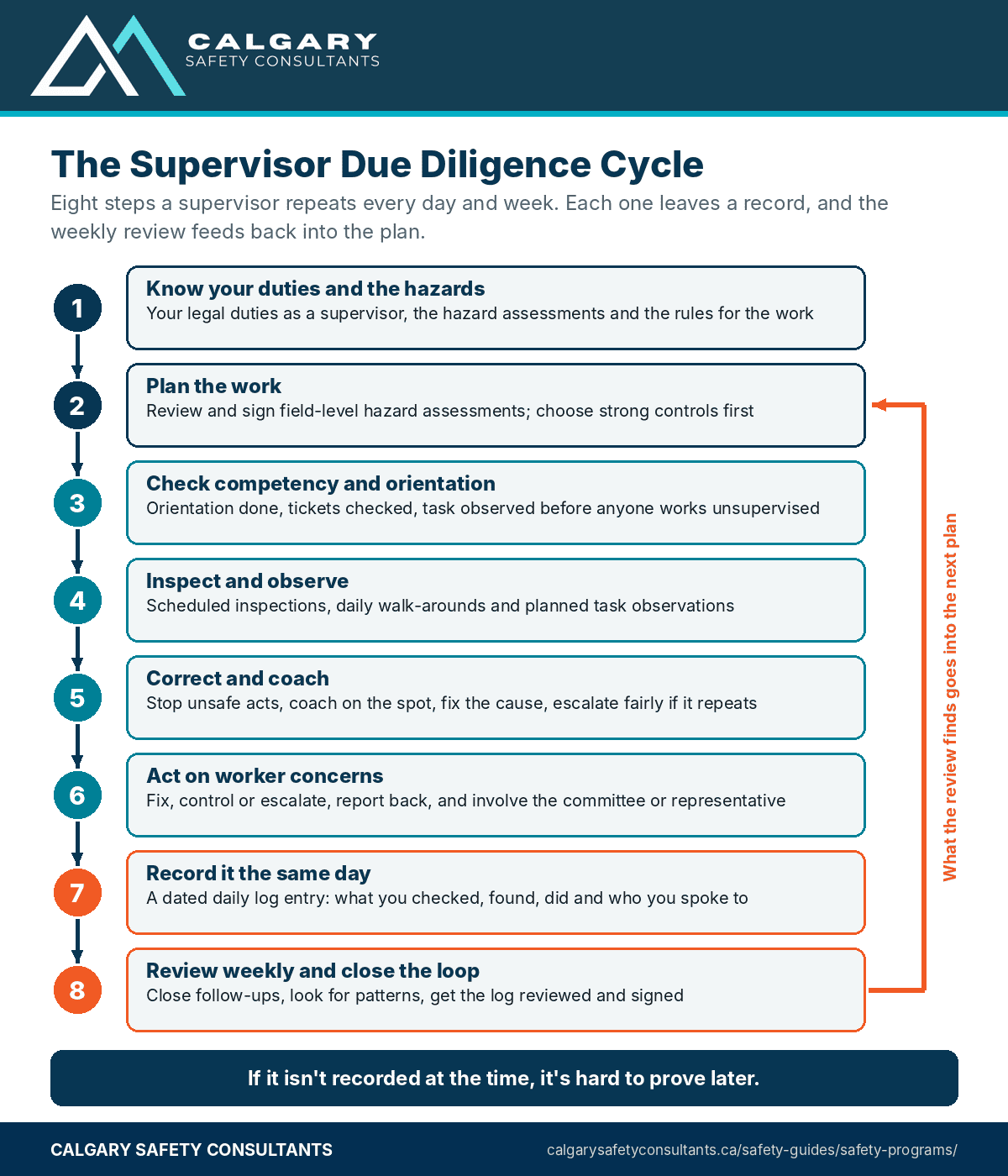
Good records share a few traits. They're made at the time, by the person who did the work. They're specific, not just a tick. They show follow-up, not only findings. And they're kept where someone can find them. WorkSafeBC says documentation should be clear, appropriate and frequent, showing a systematic approach to safety.
Supervisor due diligence records don't have to be long. A dated, two-line note that says what you saw and what you did is worth more than a perfect form filled in a week later.
What Employers Must Give Supervisors
Supervisor due diligence depends on the employer, and on clear supervisor responsibilities. A supervisor can't be diligent without clear duties, real authority, training and time. The UK Health and Safety Executive's guidance on why supervision is important calls supervision a key factor in safety performance, and warns that problems emerge from poorly defined responsibilities, heavy workloads and inadequate resources.
- Written responsibilities. Spell out supervisor responsibilities in your health and safety policy and job descriptions. A separate guide on writing a health and safety policy is coming soon.
- Authority to act. Supervisors need the authority to stop work, remove a worker from a task, buy a part or call in help without a fight.
- Training. Legal duties, hazard assessment, inspections, investigation, coaching and difficult conversations.
- Time. If a supervisor runs three crews and does paperwork all day, they can't observe the work.
- Accountability and support. Review supervisors' safety activities, as you would production, and back them when they make the safe call.
Build all of this into your health and safety system, so supervisor duties are reviewed with everything else rather than left to habit.
Workplace example
A Practical Workplace Example
Situation: Consider an illustrative steel fabrication and installation company in southern Saskatchewan with about 45 workers and five field foremen. The company had a good safety manual, but its foremen kept few records. When a worker cut his hand after a grinder guard was removed, the officer asked the foreman what he had done about guarding. The foreman had spoken to the crew about it twice, but nothing was written down, and the hazard assessment didn't mention guard removal.
Action: The safety coordinator met with the foremen and listed their duties under The Saskatchewan Employment Act and the company's policy. Each foreman started a one-page daily log covering pre-shift checks, hazards found and fixed, coaching and corrections, worker concerns and follow-ups. The company added guard checks to the field-level hazard assessment, set a coaching then warning approach for guard removal, and booked all five foremen into leadership training. The operations manager reviewed and signed each log weekly.
Result: Within three months, the logs showed a clear pattern: most guard removals happened on one type of job, where the standard guard got in the way. The company bought a different guard for that work, and removals dropped. At the next COR audit, foremen could explain their duties, and the auditor could match what they said to dated records, inspections and closed corrective actions.
Common Supervisor Due Diligence Mistakes to Avoid
- Thinking a title decides it. Lead hands and foremen are often supervisors in law, with or without the word in their title.
- Talking without recording. Verbal warnings and coaching that never get written down are hard to prove later.
- Collecting forms without reading them. A pile of unsigned, unreviewed hazard assessments shows paperwork, not diligence.
- Leaving findings open. Inspection items that repeat month after month prove the hazard was known.
- Inconsistent enforcement. Letting a good producer skip the rules undermines the rules for everyone, and the record.
- Backfilling records. Writing or editing records after an incident can destroy credibility.
- Assuming competence. Accepting a ticket without watching the worker do the task.
- Not escalating. If a fix is beyond your authority, stopping the work and escalating in writing is part of reasonable care.
Audit perspective
What an Auditor Expects to See
Supervisors appear throughout a COR audit. Energy Safety Canada's audit protocol, for example, asks for written supervisor responsibilities, interviews in which supervisors express their responsibility for the safety of workers, and evidence that frontline supervisors tour work sites to observe work practices. It also asks whether supervisors enforce the use of hazard controls, whether formal inspections are assigned to supervisors, and whether supervisory personnel make sure orientations happen before new employees start their regular duties. Other certifying partners' protocols cover similar ground in their own words.
Training is checked directly. The protocol looks for a documented supervisor training program covering job responsibilities, legislation, policies and procedures, supervisory skills such as coaching and conflict management, and emergency procedures, and then checks that every supervisory role has received it. It also asks for an accountability system that tracks health and safety goals with follow-up, and notes that a discipline policy alone doesn't meet that intent.
In practice, auditors compare what supervisors say in interviews with what the records show. Our guide to the COR audit and to COR audit interviews explains how that works. Calgary Safety Consultants helps employers build and review their programs and prepare for audits; we don't issue certificates. CORs and SECORs are issued through the applicable certifying partner.
The Bottom Line
Supervisor due diligence isn't a document you produce after something goes wrong. It's the sum of what supervisors do every day, such as assessing hazards, inspecting, checking competency, enforcing rules fairly and acting on concerns, plus the records that show it happened.
Make sure every person who directs work knows they're a supervisor in law, understands the duties in your jurisdiction, has the authority and time to act, and keeps a simple daily record. Then review those records, fix what they reveal, and back the supervisors who make the safe call.
Download the Supervisor Due Diligence Checklist and Daily Safety Log
Two free, fillable PDF downloads go with this guide. Both have clickable checkboxes and fill-in fields, so you can complete them on screen or print them for the truck or the site office.
- Supervisor Due Diligence Checklist (PDF, 7 pages). A self-assessment against each supervisor duty, with an evidence column for the records that prove it, a gap and action plan, a supervisor duties table for every province, territory and federal workplaces, the four reasonable care questions, common mistakes, key terms and sign-off by the supervisor and manager.
- Supervisor Daily Safety Log (PDF, 8 pages). A multi-day field log for pre-shift checks, hazards found and controls, coaching and corrections, worker concerns, inspections and follow-ups, with a weekly review and sign-off, a filled-in worked example and guidance on writing entries that hold up.
Click either button to download the file. Adapt both to your own policies and the legislation that applies in your province or territory.

About the author
John Duplessis, B.Sc., CRSP
John Duplessis is a Canadian Registered Safety Professional with more than 30 years of occupational health and safety experience in oil and gas, construction, green energy, midstream operations and industrial project work. He is an external auditor with Energy Safety Canada.