How to Complete a Job Hazard Analysis (JHA)
How to build one formal, written JHA for each job or position, covering every task, with a free quick guide and template.
Read the guide →
Practical guides to identifying, assessing and controlling workplace hazards, from a formal job hazard analysis to the daily checks that keep it current. Written for employers, supervisors and safety committees anywhere in Canada.
Prepared by Calgary Safety Consultants, led by John Duplessis, B.Sc., CRSP.
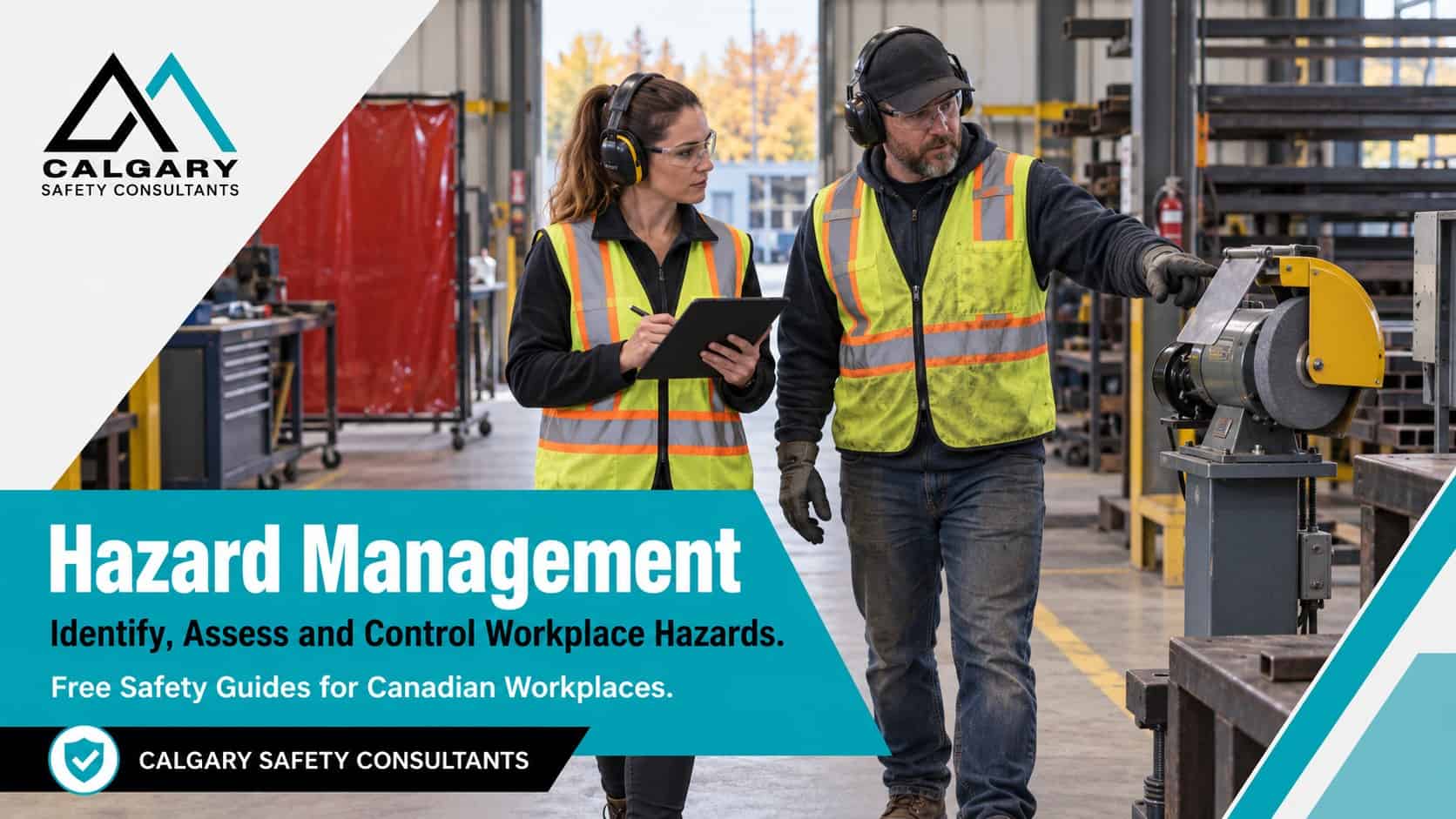
Hazard management guides
Every guide in this category explains how a hazard management task is done well, with the legal requirements linked at the point they matter and free downloads you can adapt. Guides marked coming soon open here as they're published.
How to build one formal, written JHA for each job or position, covering every task, with a free quick guide and template.
Read the guide →How workers check the day's conditions at the start of a shift or task, and feed what they find back into the JHA.
Coming soonHow to choose controls that work, from elimination and engineering controls down to procedures and PPE.
Coming soonHow to turn a higher-risk task into clear, step-by-step instructions that workers can follow on the job.
Coming soonHow to build and keep current the written hazard assessment at the centre of your safety program.
Coming soonHow to assess the hazards of working alone, set check-in procedures and meet the legal requirements.
Coming soonHow to manage hazardous products, labels, safety data sheets and worker education under WHMIS.
Coming soonHow to isolate, lock out and verify hazardous energy before maintenance and servicing work begins.
Coming soonHow to select, fit, maintain and train workers on personal protective equipment as part of your controls.
Coming soonHow to rate likelihood and severity consistently so the most serious risks are dealt with first.
Coming soonHow to tell when handling, offering or transporting dangerous goods means workers need TDG training.
Coming soonAbout hazard management
Hazard management is the ongoing work of finding what could hurt people at work, deciding how serious each hazard is, putting controls in place and checking that those controls keep working.
It's the foundation of every health and safety program. Training, procedures, inspections, PPE and emergency plans all exist to control hazards, so when hazard management is weak, everything built on it is weak too. Most of what an inspector or auditor looks at traces back to it.
Two words get mixed up a lot. A hazard is anything with the potential to cause harm, such as a moving forklift, a solvent, a heavy lift or a client who becomes aggressive. Risk is the chance that the hazard actually hurts someone, combined with how badly. Good hazard management deals with both: it lists the hazards honestly, then rates the risk so the most serious problems are fixed first.
It isn't a form you fill out once. Work changes, crews change, equipment wears out and new jobs come in. That's why hazard management works as a cycle, with each round of inspections, incident reviews and worker feedback flowing back into the hazard assessments and the controls.
Done well, it pays off well beyond compliance. Fewer injuries mean fewer claims and less lost time, controls built into the work make jobs run more smoothly, and a clear record of how you manage workplace hazards carries you through an inspection, a client's prequalification review or a COR or SECOR audit.
Research points the same way: workplaces that score higher on the Institute for Work & Health's organizational performance metric, which includes how involved employees are in health and safety decisions, tend to have lower injury claim rates.
How it works
Hazard management follows the same five steps in every workplace, whatever the industry or the size of the business.
Look at every job, task and area, including the work that only happens now and then, such as cleaning, clearing jams and minor maintenance. Use walk-throughs, conversations with workers, inspection and incident records, safety data sheets and manufacturers' manuals. WorkSafeNB's OHS guide lists injury reports, near-miss reports, monitoring data and experience with the task among the sources worth checking.
Rate each hazard for how likely it is to cause harm and how serious that harm could be, using one consistent method, such as a risk matrix. The rating tells you which hazards to deal with first and how strong the controls need to be.
Work down the hierarchy of controls: eliminate the hazard if you can, substitute something less hazardous, isolate people with engineering controls, then use administrative controls such as procedures and training, with PPE as the last line of defence. Most hazards need more than one control.
Make sure every worker knows the hazards of their job and the controls they rely on, and has the training and supervision to work safely. Record who was told and when, so you can show it later.
Check that controls are in place and working, through supervision, inspections and field-level hazard assessments. Review the assessment when the work changes, after an incident or near miss, and on a set schedule.
These steps aren't unique to Canada. The UK Health and Safety Executive sets out the same basic process in its guide to managing risk, Safe Work Australia's model code of practice describes a similar cycle, and WorkSafeBC walks employers through identifying, assessing and controlling risk in much the same order. What changes from one jurisdiction to the next is how the law frames the steps and what it expects you to record.
The order of controls matters, too. As the US National Institute for Occupational Safety and Health explains in its overview of the hierarchy of controls, the methods at the top are potentially more effective and protective than those at the bottom, which is why elimination and engineering controls come before procedures and PPE.
What the law expects
Every Canadian jurisdiction expects employers to find and control the hazards in their work, although each one frames it differently.
Some set out a specific hazard assessment rule. Others build hazard identification into a health and safety program that many workplaces must have, or into the employer's general duty to protect workers as far as it's reasonably practicable. Either way, the expectation is the same: know your hazards, control them and be able to show it.
Alberta's OHS Code is one of the most specific. It requires a hazard assessment before work begins at a work site, with the results and the controls recorded in a dated written report, and it requires employers to involve affected workers. Assessments must be repeated at reasonably practicable intervals and when work processes are introduced or change.
Yukon's Workplace Health and Safety Regulations require every employer to assess the hazards at each workplace and the likelihood of injury. Federally regulated employers, whatever their size, need a hazard prevention program, as the federal Labour Program's hazard prevention program guide explains.
Workers have rights in all of this, too, including the right to know about the hazards they face, to take part in health and safety and to refuse unsafe work. A hazard management process that involves workers and tells them what it finds supports all three.
Because the details differ, start by confirming which law applies to your workplace. Our OHS Legislation category links the Act, regulations and regulator for all 14 jurisdictions in Canada, and explains how to read them.
From our audits
Most of the gaps we find in audits aren't about missing paperwork. They're about paperwork that's drifted away from the work.
Each of these is easy to fix once you see it. The guides on this page show what good looks like, so you can compare it with how hazard management works at your workplace today.
Free downloads
Download these free templates, then adapt them to your work, your hazards and the law that applies to you.
From the blog
September 21, 2026
August 13, 2026

August 27, 2026
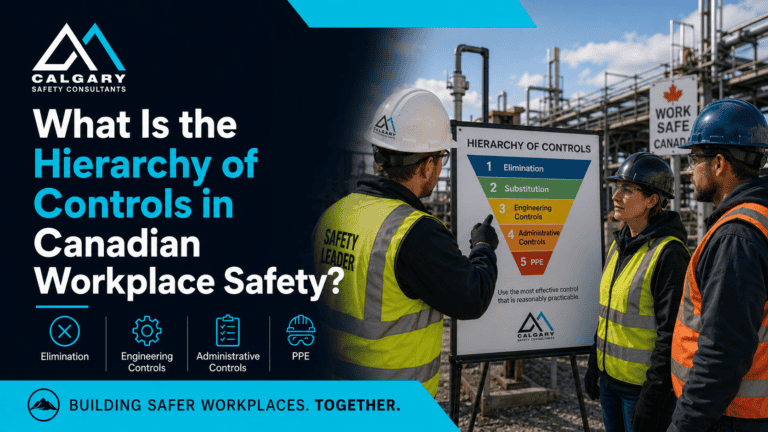
July 2, 2026
When to bring in help
The guides are written so you can act on them yourself. Sometimes it helps to have an experienced safety professional look at your situation, especially when an audit is coming up, an inspector has issued an order or your hazard assessments no longer match how the work is done.
Calgary Safety Consultants helps employers build hazard management programs that fit the real work. We facilitate JHA sessions with your workers, build job inventories and risk methods, write safe work procedures, train supervisors and review existing assessments before an audit. Our consulting focuses on Alberta, British Columbia and Saskatchewan, and our online training and free downloads are available anywhere in Canada.
We help employers prepare for COR and SECOR audits, but we don't issue certificates. CORs and SECORs are issued through the applicable certifying partner.
Common questions
Answers to the questions employers and supervisors ask most often about managing workplace hazards.
Hazard management is the ongoing process of identifying what could harm people at work, assessing how likely and how serious that harm could be, putting controls in place and checking that the controls keep working. It runs as a cycle, so inspections, incidents, worker concerns and changes to the work all feed back into the hazard assessments and the controls.
A hazard is anything with the potential to cause harm, such as a moving forklift, a chemical, a heavy load or an aggressive client. Risk combines how likely it is that the hazard will cause harm with how serious that harm could be. Two jobs can share the same hazard and carry very different levels of risk, depending on exposure and the controls in place.
Yes, although each jurisdiction frames it differently. Some set a specific hazard assessment rule, as Alberta and Yukon do, others build hazard identification into a required health and safety program, and every jurisdiction's general duties expect employers to control the hazards in their work. Federally regulated employers need a hazard prevention program. Check the legislation for your own province or territory.
The employer carries the main legal duty, but everyone has a part. Supervisors make sure controls are used on the job, workers identify and report hazards and follow the controls, and the joint health and safety committee or representative helps find problems and recommend fixes. A safety advisor or consultant can help design the process and keep it consistent.
A job hazard analysis (JHA) is a formal, written assessment of one job or position, covering every task it involves, prepared in advance and reviewed on a schedule. A field-level hazard assessment (FLHA) is a short check at the start of a shift or task that confirms the day's conditions against what the JHA assumed. Anything new an FLHA finds should go back into the JHA.
Review a hazard assessment whenever the work changes, such as new equipment, materials, methods or locations, after an incident or near miss, and whenever controls aren't working. Set a scheduled review date as well. Alberta's OHS Code, for example, requires hazard assessments to be repeated at reasonably practicable intervals and when a work process is introduced or changes.
It's the order for choosing controls, from most to least effective: eliminate the hazard, substitute something less hazardous, isolate people from it with engineering controls, use administrative controls such as procedures, training and scheduling, and finally use personal protective equipment. Most hazards need a combination of controls, and the higher ones depend less on people getting it right every time.
PPE only works when it's the right equipment, it fits, it's in good condition and it's worn correctly every time. It does nothing to remove the hazard itself, so a single lapse leaves the worker exposed. That's why PPE sits at the bottom of the hierarchy of controls and is used alongside controls that remove or reduce the hazard.
In most cases, yes. The duty to identify and control hazards applies from the first worker, even where some program requirements only start at a set number of workers. In Alberta, every employer must prepare a written hazard assessment, whatever its size. Even where the law doesn't spell it out, a written record is the simplest way to show due diligence.
Yes. Workplace violence and harassment, working alone, fatigue and work-related stress can cause serious harm and belong in your hazard assessments alongside physical hazards. Many jurisdictions require employers to address harassment and violence, and Quebec now requires prevention programs to identify and analyze psychosocial risks. Treat them with the same assess, control and review approach.
Involve them at every stage. Workers who do the job know the shortcuts, awkward reaches and non-routine tasks that never make it into a manual, so include them in hazard assessments, inspections and reviews. Record their names on the assessment, act on what they report and explain the controls. Alberta, for example, requires employers to involve affected workers in hazard assessment and control.
A template is a good starting point, but the content has to come from your own work. A downloaded form with someone else's hazards will miss what's specific to your equipment, sites and crews. Use a consistent template so assessments look the same across the business, then fill it in with the people who do each job.
Hazard assessment is one of the most closely examined elements in COR and SECOR audits, which look for an inventory of jobs and tasks, assessed risks, effective controls, worker involvement and regular review. A sound hazard management process produces those records. We help employers prepare, but we don't issue certificates. CORs and SECORs are issued through the applicable certifying partner.
Yes. We facilitate JHA sessions with your workers, build job inventories and risk methods, review existing hazard assessments, write safe work procedures and train supervisors to keep the process going. Our consulting focuses on Alberta, British Columbia and Saskatchewan, while our guides, free downloads and online training are available anywhere in Canada. Book a free consultation to talk it through.
Talk to a safety consultant
Whether you're starting from scratch, updating old assessments or preparing for an audit, we'll help you work out the next practical step. Complete the form below or book a 30-minute consultation.