On this page
Why Use Drones for Workplace Safety?
Traditionally, hazard assessments have required inspectors to physically enter high-risk areas—climbing scaffolding, navigating unstable structures, or entering confined spaces like tanks and tunnels. These methods, while effective, expose workers to significant hazards. Fortunately, technology is changing the game.
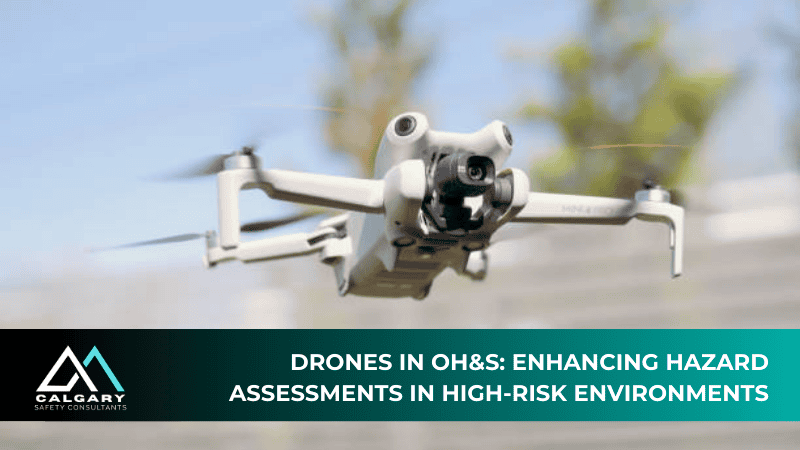
Drones, also known as unmanned aerial vehicles (UAVs), offer a safer, faster, and more efficient alternative for conducting workplace inspections and safety assessments. Here’s why more companies are adopting drones as part of their occupational health and safety strategy:
✅ Eliminate Unnecessary Risk
Sending workers into potentially hazardous areas increases the risk of injury or fatality. With drones, there’s no need to physically enter dangerous zones to perform inspections. Whether it’s a multi-storey scaffold, a high-voltage power line, or a structurally compromised building, drones allow workers to maintain a safe distance while still collecting critical safety data.
✅ Increase Efficiency
Drones can cover large and complex job sites in a fraction of the time it would take a team of workers on foot. A drone can complete a full aerial scan of a construction site, industrial facility, or oilfield in minutes, delivering real-time footage and data. This not only speeds up the inspection process but also allows for more frequent assessments without disrupting operations.
✅ Enhance Accuracy
Equipped with high-resolution cameras, LiDAR, and thermal imaging, modern drones can detect hazards invisible to the naked eye. Cracks in a structure, overheated equipment, or gas leaks can be identified early—before they lead to accidents or downtime. Advanced software can also process this data to highlight potential issues automatically, helping safety teams focus on the most critical concerns.
✅ Reduce Costs
Fewer man-hours spent on inspections, less need for heavy equipment (like scaffolding or lifts), and minimal downtime all translate into substantial cost savings. Drones offer a scalable solution—one operator can manage multiple assessments in a day, and the captured data can be reused for training, compliance, and incident investigation purposes.
Real Risk, Real Solutions
According to WorkSafe Alberta, falls from heights and struck-by-object incidents remain some of the leading causes of workplace injuries. These are precisely the types of risks drones help mitigate by reducing the need for workers to be physically present in danger zones. By integrating drone technology into your safety program, you’re not only protecting your team—you’re aligning with best practices for modern, proactive safety management.
More on Alberta’s workplace injury stats:
https://www.alberta.ca/occupational-health-and-safety.aspx
How Drones are Used in Safety Inspections
- Fall Hazard Assessments – Drones can inspect roofs, scaffolding, and elevated workspaces without requiring workers to climb.
- Fire & Explosion Risk Monitoring – Thermal imaging technology helps detect overheating equipment or gas leaks in industrial sites.
- Structural Integrity Checks – Bridges, towers, and pipelines can be monitored for cracks or weak points without shutting down operations.
- Confined Space Inspections – Drones equipped with sensors can enter tight spaces (tanks, ducts, silos) where human entry is risky.
- Real-Time Compliance Audits – Safety officers can get instant, high-quality footage for audits and documentation.
Want to see how drones are transforming workplace safety inspections? Check out Transport Canada’s guidelines for drone use in industrial settings:
https://tc.canada.ca/en/aviation/drone-safety
How we help
How Calgary Safety Consultants Can Help
At Calgary Safety Consultants, we help businesses integrate drones into their workplace safety programs while ensuring they meet OH&S regulations. Our team provides:
✔ Drone Safety Audits – We can conduct hazard assessments, fall protection evaluations, and compliance inspections. Learn more about our hazard assessment and inspection services.
✔ Workplace Hazard Assessments – Our experts assess fall hazards, confined space risks, and high-risk environments using advanced technology. Book an assessment.
✔ COR Auditing & Compliance Support – If your business is working toward COR certification, we help ensure your safety inspections align with industry best practices. Find out more about our COR and SECOR certification support.
Final Thoughts
Drones are not just a cool gadget—they are a powerful safety tool that can enhance workplace hazard assessments, improve compliance, and keep workers safe. Whether you’re in construction, oil & gas, transportation, or manufacturing, integrating drone technology could be a game-changer for your business.
Want to learn how Calgary Safety Consultants can help your company leverage drones for safety inspections?
Want to make your workplace safer? Book your complimentary consultation today.
Stay safe, stay compliant, and keep your business running smoothly!

About the author
John Duplessis, B.Sc., CRSP
John Duplessis is a Canadian Registered Safety Professional with more than 30 years of occupational health and safety experience in oil and gas, construction, green energy, midstream operations, and industrial project work.