On this page
- What a Risk Matrix Is
- Why a Risk Matrix Matters
- Initial Risk and Residual Risk
- Why Risk Assessment Is Always a Team Job
- What the Law Says Across Canada
- Comparison Across Canada
- Choose a 3 x 3, 4 x 4 or 5 x 5 Matrix
- Define Each Likelihood Level in Plain Words
- Define Each Severity Level
- Multiplying Scores or Looking Up the Cell
- Set Risk Bands, Actions and Approvals
- How to Run a Team Rating Session
- From Initial Risk to Residual Risk
- A Worked Example: Before and After
- When Residual Risk Is Still Too High
- Common Risk Matrix Pitfalls
- What a Risk Matrix Can't Do
- Where the Matrix Fits in Your Hazard Assessments
- A Practical Workplace Example
- Common Mistakes to Avoid
- What an Auditor Expects to See
- The Bottom Line
- Download the Worksheet and Calculator
- Frequently Asked Questions
- Related Guides and Articles
- How Calgary Safety Consultants Can Help
- Sources
What a Risk Matrix Is
A hazard is anything with the potential to cause harm: a moving conveyor, an icy ramp, a tank of caustic. Risk is the chance that the hazard actually hurts someone, combined with how badly. Two workplaces can share a hazard and carry very different risk, depending on exposure and the protection in place.
A risk matrix, sometimes called a risk assessment matrix, puts those two ideas on a grid. One side rates likelihood, the other rates severity, and the cell where they meet gives a risk level, usually colour coded from green to red.
It's one part of a bigger process. ISO 31000, the international risk management standard, describes identifying, analyzing, evaluating, treating, monitoring and communicating risks. The matrix helps with analyzing and evaluating. It can't find hazards you've missed, and it doesn't control anything by itself.
The WCB of PEI's hazard assessment guide puts it simply: risk is a combination of the likelihood of harm and its severity, and you determine the risk to rank the hazard by priority. That ranking answers the question every supervisor faces: what do we fix first?
Why a Risk Matrix Matters
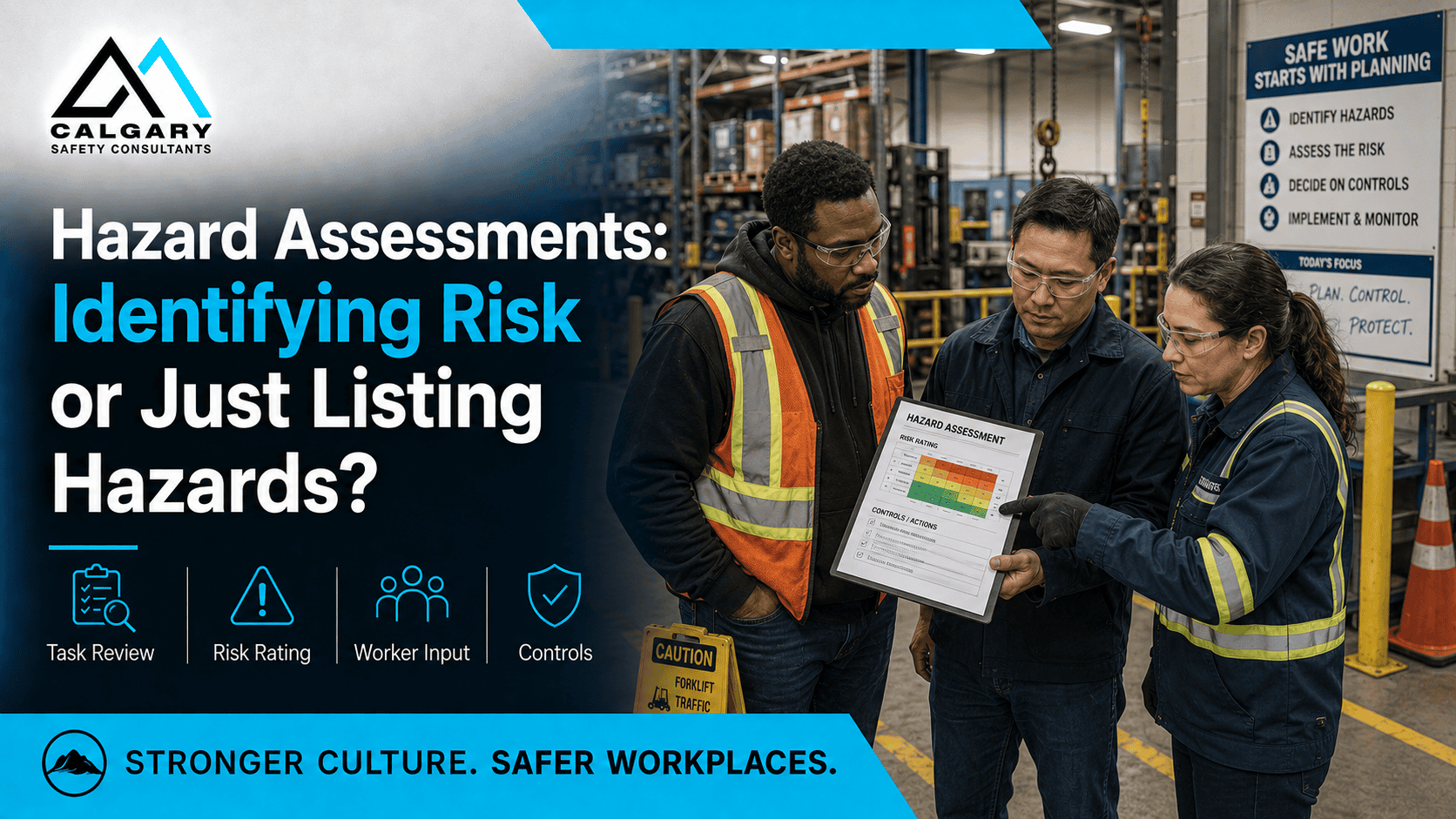
Many hazard assessments list the hazards but never decide which ones matter most, so a frayed cord and an unguarded nip point get the same one-line control. Our article on whether your hazard assessments are identifying risk or just listing hazards looks at that gap.
A matrix forces an honest conversation about likelihood and severity, gives everyone the same scale and links each rating to an action. WorkSafeBC's guidance on assessing risks says rating the risks helps you decide which are most serious and should be dealt with first, and it offers a simple matrix to help.
Initial Risk and Residual Risk
Every hazard in this method gets rated twice, and you need both ratings.
- Initial risk, also called inherent risk, is the risk before any controls are applied. Ask: if we did this job with no guard, no procedure and no PPE, how likely is harm and how bad could it be? It shows how much the controls have to achieve.
- Residual risk is the risk that remains after the controls you've selected are in place and working. It decides whether the work can go ahead.
The order matters. Rate the initial risk first, select controls using the hierarchy of controls, then rate the residual risk to confirm it's acceptable. If it's still too high, go back up the hierarchy for stronger controls rather than lowering the rating.
Some organizations also rate a current risk, with the controls that exist today, when reviewing an older assessment. Whatever you call it, never give a hazard credit for a control that isn't actually in place and used.
Why Risk Assessment Is Always a Team Job
One person with a clipboard can fill in a matrix, but rarely well. Risk assessment should always be done by a small team:
- Workers who do the job, who know the shortcuts, the jams and the steps the procedure leaves out
- The supervisor, who knows the schedule pressures and can commit to controls
- People with specialist knowledge, such as maintenance, an engineer or the equipment supplier
- The committee or representative. See our guides to setting up a JHSC and health and safety representatives
Alberta's hazard assessment and control handbook says it plainly: a team approach is necessary, because different people have different ways of seeing things. It also sets out the legal duty in section 8(1) of the OHS Code: an employer must involve affected workers in the hazard assessment.
Ratings also vary a lot between individuals. In a study published in Risk Analysis, Ball and Watt found that different assessors may assign vastly different ratings to the same hazard, and the scatter stayed high even after lengthy reflection. A process designer may underrate their own design, a supervisor under pressure may round down and a worker after a near miss may round up. Talking it through as a team, with written definitions, brings those differences into the open so they can be resolved.
Alberta's small business participation guide confirms the duty to involve affected workers in hazard assessment and control applies to small employers, with or without a committee or representative. Worker participation is also the law beyond Alberta. Saskatchewan's regulations require a worker participation strategy in the OHS program where one is required, and WorkSafe Saskatchewan's hazard assessment pillar stresses involving experienced workers.
Quebec's Act respecting occupational health and safety requires workers to participate in identifying and eliminating risks (s. 49(5)). The federal hazard prevention program guide says the policy committee shall be consulted and participate in hazard identification and assessment. ISO 45001 lists worker participation and risk assessment among the key elements of a safety management system.
What the Law Says Across Canada
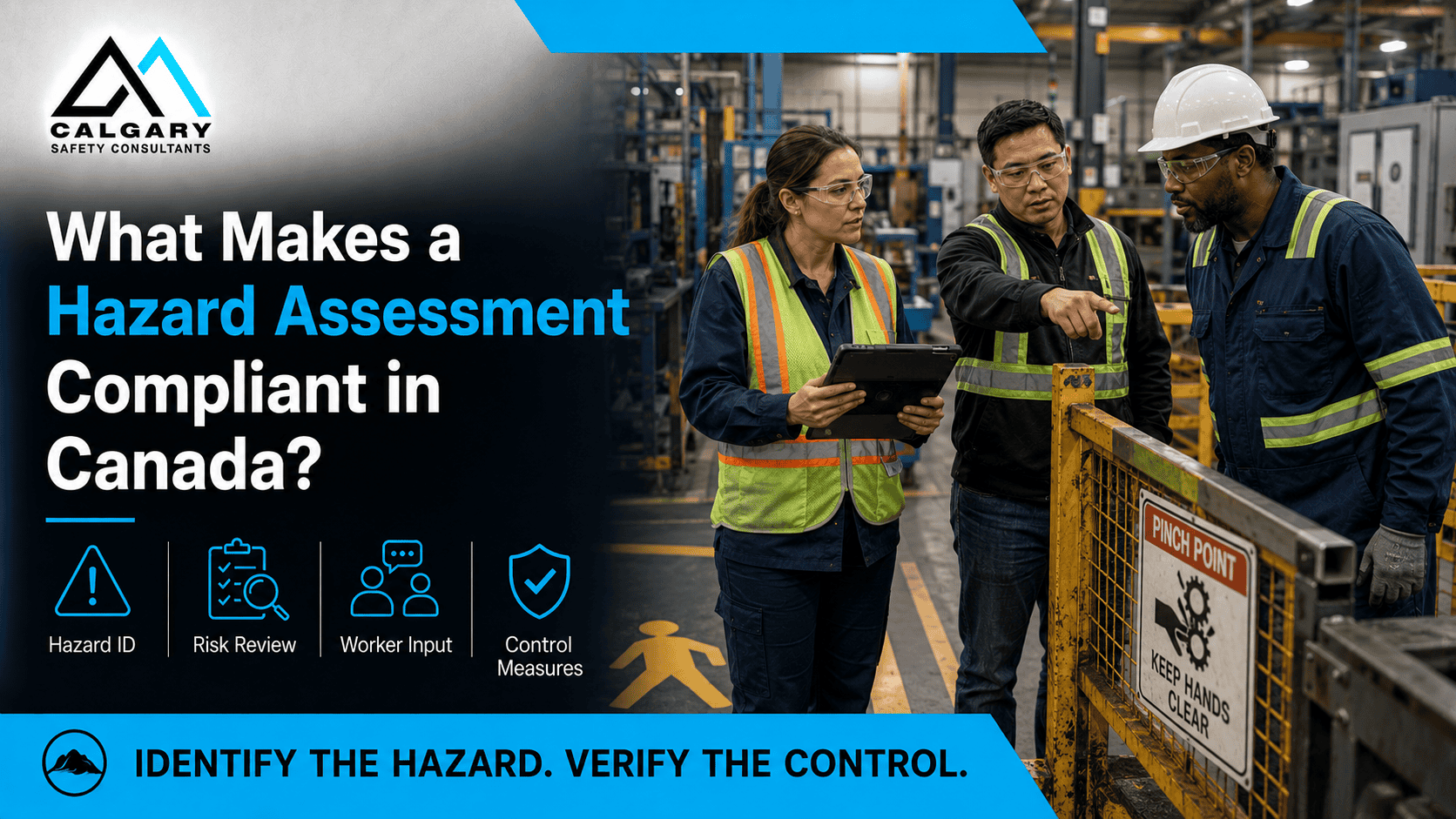
Every Canadian jurisdiction expects employers to identify and control hazards, directly or through a required health and safety program. None of the laws checked for this guide prescribes a risk matrix, a scale or a set of colours. The method is yours, and so is the job of using it consistently and showing it led to real controls. These summaries are current as of October 2026.
Western Provinces
Alberta. Section 7 of the OHS Code requires every employer to assess a work site and identify existing and potential hazards before work begins, with the assessment in writing and dated. The handbook tells employers to address the greatest risks right away and to customize the process to their operations. No matrix is required.
British Columbia. The OHS Regulation calls for hazard identification or risk assessment for specific hazards, such as working alone (s. 4.20.2), violence (s. 4.28) and musculoskeletal injury (ss. 4.47 and 4.48), in Part 4. WorkSafeBC suggests rating risks high, medium or low, but no method is mandatory.
Saskatchewan. Where an OHS program is required (workplaces listed in Table 7 of the OHS Regulations, 2020 with 10 or more workers), section 3-11 says it must include identifying existing and potential risks and a strategy for worker participation. Under The Saskatchewan Employment Act (ss. 3-27 and 3-28), committees and representatives must participate in identifying and controlling hazards.
Manitoba. Section 7.4 of The Workplace Safety and Health Act requires a written program for each workplace with 20 or more workers, identifying dangers and the measures to control them, designed with the committee or representative. SAFE Work Manitoba's small business guidance adds listening to workers' concerns as a way to find hazards.
Ontario and Quebec
Ontario. The Guide to the OHSA explains the duties to take every precaution reasonable in the circumstances (cl. 25(2)(h)) and to inform workers about any hazard in the work (cl. 25(2)(d)).
Quebec. Employers must use methods and techniques intended for the identification, control and elimination of risks (s. 51(5)), with a prevention program for each establishment of at least 20 workers (s. 58). No rating method is prescribed.
Atlantic Provinces
Nova Scotia. Employers with 20 or more regular employees need a written program that includes hazard identification, as the province's summary of rights and responsibilities explains. New Brunswick. WorkSafeNB's hazard identification guide explains the program required for 20 or more employees (s. 8.1) and tells employers to evaluate the risk of each task with the people who do the work.
Prince Edward Island. Workplaces with 20 or more workers need a program that evaluates the workplace for hazards (s. 23), and the WCB says a risk matrix can be used: a tool, not a rule. Newfoundland and Labrador. WorkplaceNL's OHS program guide explains that workplaces with 10 or more workers need a program (s. 36.1) with a system for the recognition, evaluation and control of hazards.
Territories and Federally Regulated Workplaces
Yukon. The Workers' Safety and Compensation Board's hazard assessment resources explain that the regulations require hazard assessments and, where possible, elimination of the hazards. Northwest Territories and Nunavut. The WSCC's Hazard Assessment Code of Practice includes a 3 x 3 matrix that multiplies likelihood by severity. Codes of practice don't carry the force of the regulations, and an alternative that achieves the same or better outcome is acceptable.
Federal. The Canada Occupational Health and Safety Regulations require a hazard identification and assessment methodology, developed with the policy committee, workplace committee or representative, and require the assessment to take into account factors such as the nature of the hazard, the frequency and duration of exposure and the preventive measures in place. The employer chooses the tool.
Comparison Across Canada
The pattern is the same everywhere: assess, prioritize, control and involve workers, using a method you choose. Our guide to OHS legislation in Canada links to each jurisdiction's laws. The UK Health and Safety Executive's risk assessment steps agree: decide how likely harm is and how serious it could be, involve your employees, and keep the focus on controlling the risks in practice.
| Jurisdiction | What the law requires | Matrix prescribed? |
|---|---|---|
| Alberta | Written, dated hazard assessment before work begins (OHS Code s. 7); involve affected workers (s. 8) | No |
| British Columbia | Hazard identification or risk assessment for specific hazards (OHS Regulation Part 4 and others) | No; WorkSafeBC offers a sample |
| Saskatchewan | Program identifies existing and potential risks and has a worker participation strategy, prescribed workplaces with 10 or more workers (Regulations s. 3-11); committee or representative participates in identifying and controlling hazards (SEA ss. 3-27, 3-28) | No; WorkSafe Saskatchewan offers a sample |
| Manitoba | Program identifies dangers and control measures, 20 or more workers (Act s. 7.4) | No |
| Ontario | Every precaution reasonable; inform workers of hazards (OHSA cl. 25(2)(h), (d)) | No |
| Quebec | Methods to identify, control and eliminate risks (s. 51(5)); prevention program, 20 or more workers (s. 58) | No |
| Nova Scotia | Program with hazard identification, 20 or more employees | No |
| New Brunswick | Program with hazard identification system, 20 or more employees (s. 8.1) | No |
| Prince Edward Island | Program with workplace evaluation for hazards, 20 or more workers (s. 23) | No; a matrix "can be used" |
| Newfoundland and Labrador | Program with recognition, evaluation and control of hazards, 10 or more workers (Act s. 36.1; Regulations s. 12) | No |
| Yukon | Hazard assessments, with elimination where possible (Regulations ss. 1.03.1, 1.04) | No |
| Northwest Territories and Nunavut | Hazard identification in the OHS program (Regulations s. 21(2)(b)); WSCC code of practice | No; code includes a sample 3 x 3 |
| Federal | Hazard identification and assessment methodology (COHSR ss. 19.1, 19.3, 19.4) | No; employer develops its own |
Summary only. Program thresholds and hazard-specific rules have details not shown here. Check the current legislation for your jurisdiction.
Choose a 3 x 3, 4 x 4 or 5 x 5 Matrix
The right size depends on who uses the matrix and what decisions it drives.
- 3 x 3 is quick and easy to teach, which suits field-level cards and introductory training. WorkSafe Saskatchewan's sample risk matrix is a 3 x 3 running from trivial to unacceptable risk. The drawback is coarse resolution: very different hazards share a cell.
- 4 x 4 removes the middle level that people drift toward.
- 5 x 5 gives 25 cells, enough to separate a serious but rare hazard from a minor but frequent one. It's the usual choice for formal assessments and job hazard analyses.
We recommend a 5 x 5 for formal work because it matches the template in our job hazard analysis guide: likelihood from 1 (rare) to 5 (almost certain), severity from 1 (insignificant) to 5 (catastrophic), and four bands from low to extreme. One matrix across your JHAs, formal assessments, worksheet and calculator keeps ratings comparable. If crews use a 3 x 3 on field cards, line up the bands so a red on the card is never a green on the JHA.
Define Each Likelihood Level in Plain Words
A matrix is only as good as its definitions. Bare words like "possible" or "likely" mean different things to different people, so write a sentence for each level, add an example from your own work and print it on the form.
Likelihood is about how often the harm could happen, not just how often the task is done. Consider how often and how long people are exposed, how many people, equipment condition and crew experience. WorkSafeBC notes that the longer the exposure, the higher the risk. Sample definitions for the 5 x 5:
| Level | What it means | Workplace examples |
|---|---|---|
| 5 Almost certain | Expected to happen. It happens here regularly, or near misses are frequent. | Back strain on a manual lifting job done hundreds of times a shift |
| 4 Likely | Will probably happen. It has happened here, or near misses are reported from time to time. | A pinch injury clearing jams by hand on a conveyor that jams daily |
| 3 Possible | Might happen. It has happened at similar workplaces and conditions here allow it. | A slip on an outdoor ramp in winter despite regular salting |
| 2 Unlikely | Could happen, but not expected. Rare in this industry. | A struck-by incident in a yard with separated, marked walkways |
| 1 Rare | Only in exceptional circumstances. Not known here or at similar workplaces. | Collapse of a recently inspected, correctly rated storage rack |
Define Each Severity Level
Severity is the realistic worst outcome, not the most common one and not the most dramatic thing you can imagine. A fall from a step stool usually means a bruise, but a credible bad day is a head strike. Ask what this hazard could realistically do to a person, given the energy involved.
Include health effects, not just injuries. Silica, noise and psychological harm develop slowly, so they're easy to underrate. If you add columns for property or environmental damage, rate safety on the people column. Sample definitions:
| Level | What it means | Workplace examples |
|---|---|---|
| 5 Catastrophic | Fatality, permanent total disability, or several people seriously hurt | Fall from a roof onto concrete; trench collapse; hydrogen sulphide exposure |
| 4 Major | Permanent injury or illness, or a long recovery | Hand amputation; crush injury; serious burn; noise-induced hearing loss |
| 3 Moderate | Lost-time injury or illness with full recovery expected | Simple fracture; concussion; back injury needing weeks off |
| 2 Minor | Medical aid or modified work, recovered within days | Cut needing stitches; mild sprain; splash treated at a clinic |
| 1 Insignificant | First aid only, no lost time | Small cut bandaged; brief eye irritation flushed at the eyewash |
Multiplying Scores or Looking Up the Cell
In a multiplied matrix, the risk score is likelihood times severity, from 1 to 25 on a 5 x 5. In a lookup matrix, you skip the arithmetic and read the level from the coloured cell. Saskatchewan's sample is a lookup matrix: each cell carries its own risk level.
Multiplying is easy to explain and sort in a spreadsheet, and our JHA template uses it. Its weakness is that very different hazards can share a score. A 1 x 5 (rare but fatal) and a 5 x 1 (constant but first aid) both score 5. A lookup matrix lets you push the catastrophic column into a higher band by judgement. Here's the 5 x 5 used in our JHA template, worksheet and calculator:
| Likelihood / Severity | 1 Insignificant | 2 Minor | 3 Moderate | 4 Major | 5 Catastrophic |
|---|---|---|---|---|---|
| 5 Almost certain | 5 MOD | 10 HIGH | 15 HIGH | 20 EXT | 25 EXT |
| 4 Likely | 4 LOW | 8 MOD | 12 HIGH | 16 HIGH | 20 EXT |
| 3 Possible | 3 LOW | 6 MOD | 9 MOD | 12 HIGH | 15 HIGH |
| 2 Unlikely | 2 LOW | 4 LOW | 6 MOD | 8 MOD | 10 HIGH |
| 1 Rare | 1 LOW | 2 LOW | 3 LOW | 4 LOW | 5 MOD |
Score = likelihood x severity. Low 1 to 4, Moderate 5 to 9, High 10 to 16, Extreme 17 to 25. A generic example: use your organization's approved method if it has one.
Whichever you use, add a severity rule: any hazard rated 5 for severity gets a documented review of its controls, whatever its score. That one rule fixes the biggest weakness of multiplied matrices.
Set Risk Bands, Actions and Approvals
A rating that doesn't trigger an action is decoration. Each band needs a plain statement of what must happen and who can approve the work. Put it in your hazard assessment procedure:
| Band | Score | Required action | Who decides |
|---|---|---|---|
| Low | 1 to 4 | Maintain controls and monitor. | Supervisor accepts |
| Moderate | 5 to 9 | Improve controls where practicable; supervisor review. Open actions get an owner and a date. | Supervisor accepts, reasons recorded |
| High | 10 to 16 | Additional controls required before work begins. | Manager approves controls and residual rating |
| Extreme | 17 to 25 | Do not proceed until the risk is reduced. Stop work under way. | Senior manager informed; work resumes only after re-rating |
Actions match the JHA template. Approval levels are a sample; set your own in your hazard assessment procedure.
Decide in advance which residual levels are acceptable. A common rule is that routine work may go ahead at low or moderate residual risk, never at high or extreme. Accepting a moderate residual should mean someone checked that a stronger control isn't reasonably practicable. Match approval to spending authority, because whoever accepts a risk should be able to fund the fix.
How to Run a Team Rating Session
A rating session takes an hour or two for a typical job. Here's how to keep ratings consistent:
- Prepare. Bring the task steps, incidents and near misses, inspection findings, SDSs and manuals. Meet at the work area if you can.
- Calibrate first. Rate two or three familiar hazards together, such as a ladder job and a forklift crossing. If answers are far apart, talk about why and agree what the levels mean.
- Use the written definitions. Keep the tables in front of everyone and point to the words when you choose a level.
- Rate privately, then discuss. Everyone writes their likelihood and severity before anyone speaks, so the most senior voice doesn't set the answer.
- Reach consensus. If you're split between two levels, take the higher one until facts justify the lower one.
- Record dissent. If someone still disagrees, write down their view and reason.
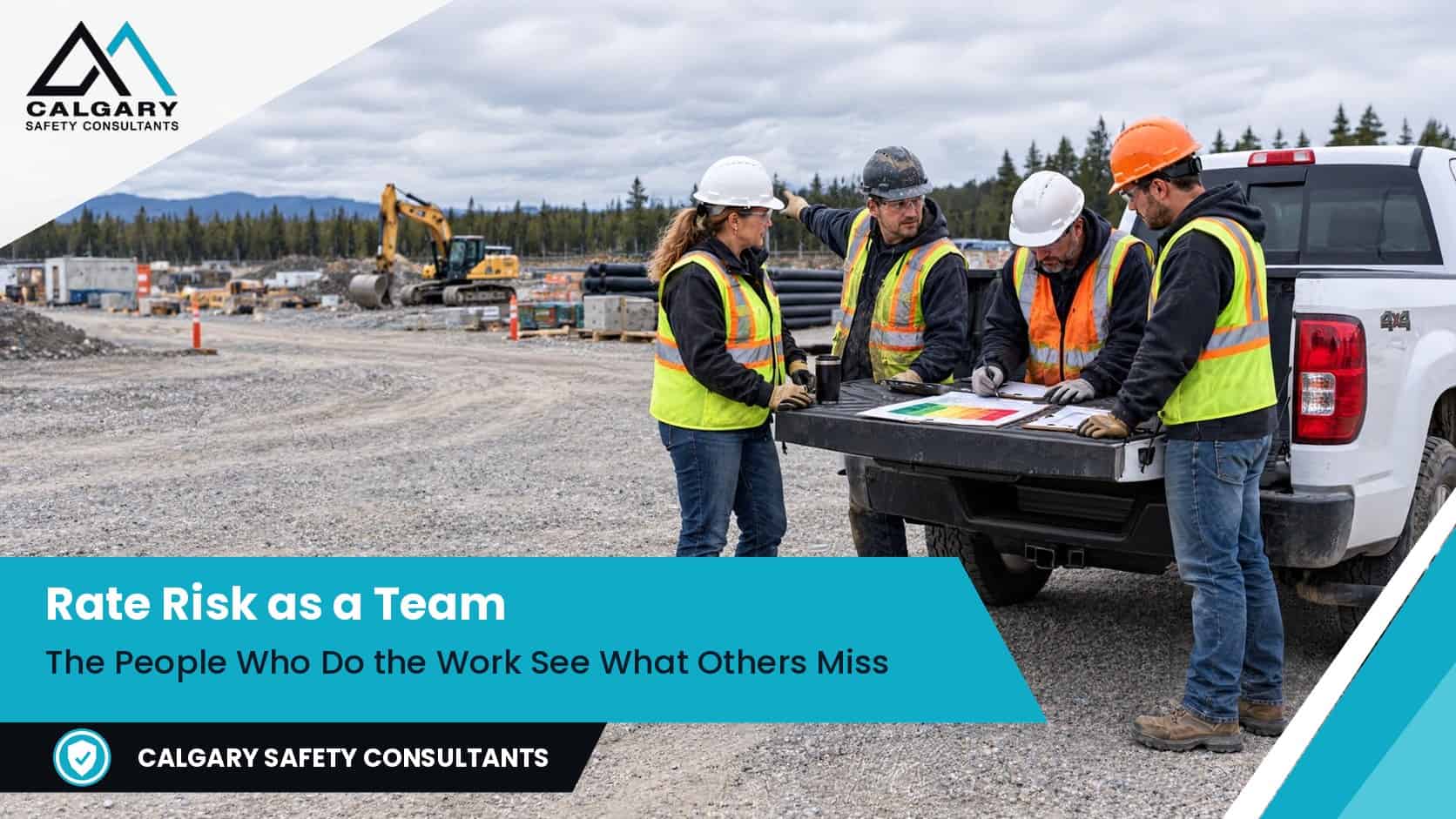
Rotate who leads, and let workers do most of the talking about how the job is really done. The supervisor listens and commits to the controls.
From Initial Risk to Residual Risk
The process runs in a loop: rate the initial risk, pick controls by the hierarchy, rate the residual risk, then accept it or go back for stronger controls.
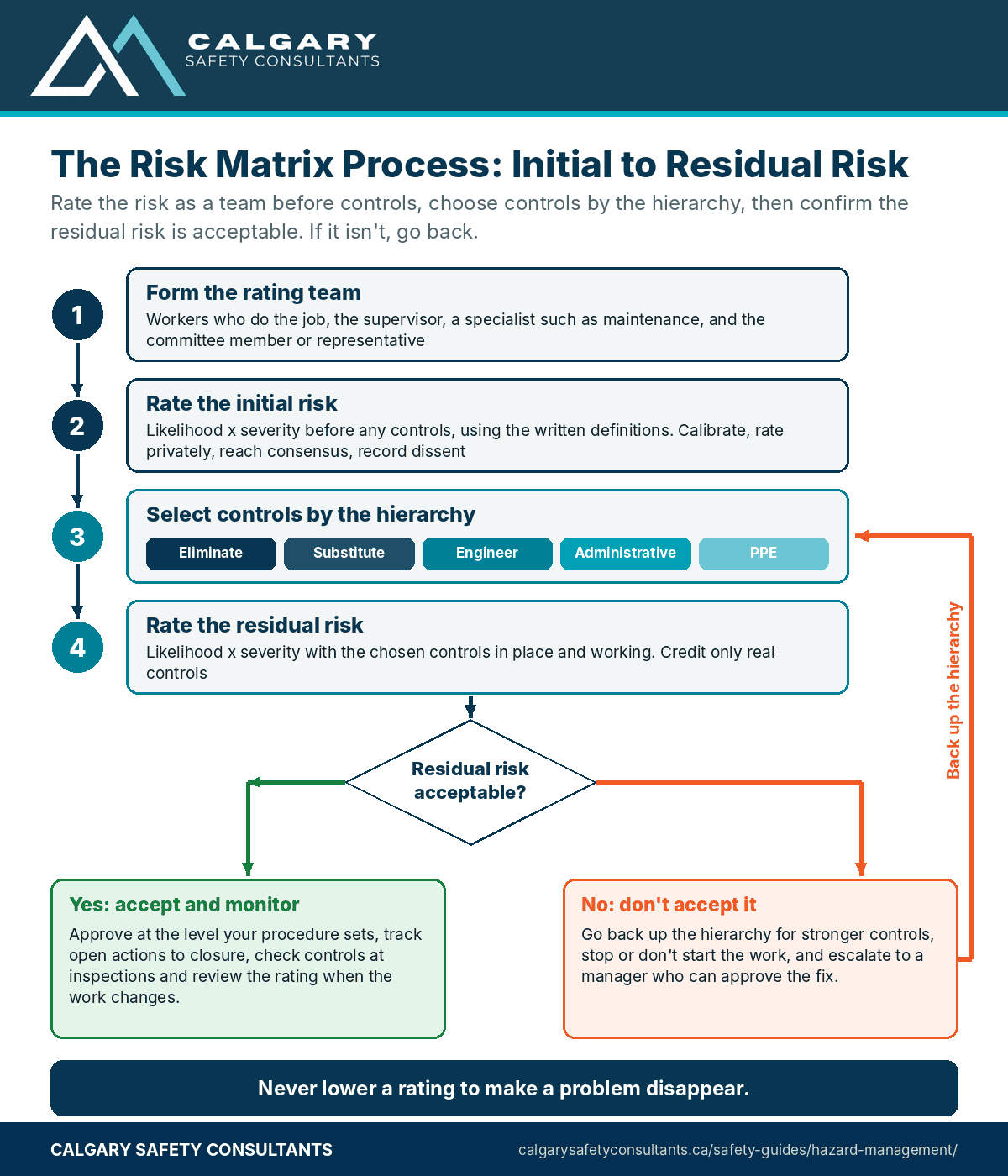
Start controls at the top: eliminate, substitute, engineer, then administrative controls, then PPE. The US National Institute for Occupational Safety and Health's guidance on the hierarchy explains why: elimination, substitution and engineering controls are more effective, while administrative controls and PPE need significant, ongoing effort by workers and supervisors.
Be honest when you re-rate. Most controls reduce likelihood: a guard makes contact less likely, but if someone reaches in anyway, the injury is just as bad. Severity drops only when a control reduces the energy involved, such as speed, pressure, weight or height. If residual severity is lower than initial severity, the team should be able to say exactly why.
A Worked Example: Before and After
The task is clearing jams on a packaging line's infeed conveyor, which jams several times a shift. Workers have been reaching past the end guard to pull out crushed cartons while the belt runs.
Initial risk. Hazard: hand drawn into the nip point between belt and roller. With no controls, the team rates likelihood 5 (almost certain, given how often it's done) and severity 4 (major: amputation is the realistic worst outcome). Score 20, extreme. Reaching in stops now.
First attempt. Retraining, a "do not reach in" sign and cut-resistant gloves. Re-rated: likelihood 4, severity 4, score 16, high. Gloves don't stop a nip point and signs don't stop a rushed worker, so it's not acceptable. Back up the hierarchy.
Second attempt. Maintenance adjusts the chute to cut jams at the source, and fits an interlocked guard that stops the belt when opened, with a jam-clearing tool. A short procedure requires lockout for jams that need the guard removed, and the interlock joins the pre-shift check.
Residual risk. Likelihood 2 (unlikely: contact now needs a defeated interlock), severity stays 4. Score 8, moderate. The supervisor accepts it, the manager is told and the interlock check is monitored. Initial 20, residual 8, every point explained by a real control.
When Residual Risk Is Still Too High
When the residual risk lands in a band your procedure doesn't accept, you have three options, in this order:
- Go back up the hierarchy. Look again for ways to eliminate, substitute or engineer the hazard out. Ask the supplier, other sites and your committee.
- Stop or don't start the work. If the controls can't be in place first, the job waits. Saskatchewan's sample matrix says it bluntly for its top band: don't start or continue work until the risk has been reduced, and if it can't be, the work stays prohibited.
- Escalate. Take it to the manager who can approve money, downtime or a new method, and record the decision and reasons.
Never lower the rating to make the problem disappear. Workers should know they can raise a concern, and in every Canadian jurisdiction they have the right to refuse unsafe work. Track every control not yet in place as a corrective action with an owner and a date.
Common Risk Matrix Pitfalls
Matrices are simple, which makes them easy to misuse. Watch for these:
- Rating everything medium. When every hazard lands in the middle, the matrix stops sorting. It usually means vague definitions or reluctance to call something high. Calibration and written examples fix it.
- Severity downgraded by controls that aren't in place. A rating that assumes a guard on order or training not yet delivered isn't residual risk. It's a hope. Rate controls as they actually exist.
- Ignoring low-probability, high-severity events. A rare but fatal hazard can score below a frequent paper cut. Treat severity 5 hazards as a priority whatever the score. WorkSafe Saskatchewan's serious incident and fatality prevention tools focus on these hazards and note that controls are most effective when they can't be defeated by worker actions.
- Using the matrix to justify skipping controls. A low score doesn't excuse you from reasonably practicable controls. The law expects you to control hazards, not just rate them.
- Changing the definitions to fit the answer. If a rating feels wrong, discuss the facts. Don't quietly edit the scale.
What a Risk Matrix Can't Do
A matrix is a sorting tool, not a measuring instrument. In a widely cited paper, Cox showed that typical risk matrices can correctly and unambiguously compare only a small fraction of pairs of hazards, can give identical ratings to very different risks, and should be used with caution and careful explanation of the judgements behind them. The WSCC code agrees that neither likelihood nor severity can be estimated without some inaccuracy.
- Health hazards such as noise, silica or chemicals need exposure measurements, not just a rating.
- Complex or major-hazard processes may need detailed techniques. IEC 31010 gives guidance on selecting and applying risk assessment techniques.
- Specific legal assessments, such as confined spaces or violence, have their own required contents.
Used that way, the matrix still puts the worst hazards at the top of the list.
Where the Matrix Fits in Your Hazard Assessments
Use the same matrix at every level of hazard assessment in your health and safety system:
- Formal hazard assessment. The matrix ranks each hazard for every job or position, so you know where to spend first. Our separate guide on how to complete a formal hazard assessment covers that process.
- Job hazard analysis. Each task step gets an initial rating, controls by the hierarchy and a residual rating, as on our JHA template.
- Field-level hazard assessment. Crews rate site conditions the formal assessment couldn't predict. See our FLHA guide.
- Inspections and investigations. Rating findings sets deadlines for fixes, and investigations should check whether the original rating was realistic.
Keep the levels linked. When a field-level assessment or incident shows a hazard was underrated, update the formal assessment and the JHA. Browse our other hazard management guides for the next steps.
Workplace example
A Practical Workplace Example
Situation: Consider an illustrative metal fabrication shop in Manitoba with about 40 workers. Its safety coordinator wrote the hazard assessments alone, using a 5 x 5 matrix with no written definitions. Almost every hazard was rated 3 x 3, moderate, including overhead crane lifts. After a near miss with a swinging load, the committee asked why a crane lift scored the same as a cardboard paper cut.
Action: The shop formed a rating team for each area: two workers who did the job, the supervisor, a maintenance lead and a committee member. They wrote definitions and examples for each level, calibrated on three familiar hazards and re-rated every job, initial risk first, then residual after controls, recording any disagreement.
Result: Crane lifts, confined bay grinding and forklift traffic at the shipping door moved to high initial risk, and the shop added an exclusion zone and tag lines, local exhaust and a separated walkway. Ratings became consistent across areas, and the committee now reviews the five highest-rated hazards at every meeting.
Common Mistakes to Avoid
- One person rating alone. It misses hazards, invites bias and leaves out the workers many laws require you to involve.
- No written definitions. Without them, ratings depend on who's holding the pen.
- Skipping the initial rating. Without it, you can't show how much the controls achieved or what happens if they fail.
- Residual risk never re-checked. Controls wear out, get bypassed or change. Confirm them at inspections and reviews.
- Ratings with no actions. Every high or extreme rating needs a decision, an owner and a date.
- Different matrices in different forms. If the JHA, FLHA card and inspection form use different scales, nobody can compare them.
- Not telling workers the results. The people exposed should know the highest risks and the controls that protect them.
Audit perspective
What an Auditor Expects to See
In a COR or SECOR audit, risk rating sits in the hazard assessment element. Energy Safety Canada's 2023 COR audit protocol asks whether each hazard for each task has been individually assessed using two or more factors, such as frequency, probability and severity, to determine its relative significance. Auditors confirm a consistent approach, and their notes describe the system in use with an example task, its hazards and the ratings assigned.
The protocol also asks whether affected employees take part in developing or reviewing formal hazard assessments, and whether senior managers know the highest-rated hazards. The hazard control element looks for high hazard items given priority and ongoing monitoring of controls.
Expect an auditor to look for a written risk method with defined levels, assessments showing initial and residual ratings, records of who took part, controls that match the ratings and exist on site, and managers who can name the top risks.
Calgary Safety Consultants helps employers build and review their programs and prepare for COR and SECOR audits; we don't issue certificates. CORs and SECORs are issued through the applicable certifying partner.
The Bottom Line
A risk matrix is a simple tool for a serious job: deciding which hazards get fixed first. Pick one matrix, a 5 x 5 for formal work, write plain definitions for every likelihood and severity level, and link each band to an action and an approval.
Then use it the right way, every time. Rate as a team, rate the initial risk before controls, choose controls from the top of the hierarchy, and rate the residual risk honestly. If it's still too high, go back up the hierarchy, stop the work or escalate. Done like that, a risk matrix turns your hazard assessments from lists into decisions.
Download the Risk Assessment Worksheet and Risk Matrix Calculator
Two free downloads go with this guide. Both use the same 5 x 5 risk matrix, bands and actions as our JHA template, so your ratings line up across every form.
- Risk Assessment Worksheet (PDF, 8 pages). A fillable worksheet with clickable checkboxes: how to use it, a team and participants record, likelihood and severity definitions you can edit, the 5 x 5 matrix with bands and required actions, a hazard rating table for initial risk, controls by the hierarchy of controls, residual risk and acceptance, a team sign-off and dissent record, and a completed worked example.
- Risk Matrix Calculator (Excel). A workbook with a How to Use tab, editable likelihood and severity definitions, and a risk register where you pick likelihood and severity from drop-down lists for initial and residual risk. The score, band and colour fill calculate automatically, with columns for the task, hazard, controls, hierarchy level, owner, due date, team members and acceptance. A summary tab counts hazards by initial and residual band.
Click either button to download the file. Adapt both to your own workplace and your organization's approved risk method, if it has one.

About the author
John Duplessis, B.Sc., CRSP
John Duplessis is a Canadian Registered Safety Professional with more than 30 years of occupational health and safety experience in oil and gas, construction, green energy, midstream operations and industrial project work. He is an external auditor with Energy Safety Canada.