On this page
- What a PPE Program Is
- Why a PPE Program Matters
- Apply the Hierarchy of Controls Before You Select PPE
- Who's Involved
- PPE Requirements Across Canada
- Comparison of PPE Requirements Across Canada
- Eight Steps to Build Your PPE Program
- Step 1: Do a PPE Hazard Assessment for Each Job
- Step 2: Complete the Hierarchy Check Before Choosing PPE
- Step 3: Select PPE Certified to the Right Standard
- Step 4: Get the Fit Right, Including Respirator Fit Testing
- Step 5: Train Workers on Use, Limits, Care and Inspection
- Step 6: Inspect, Maintain, Store and Replace PPE
- Step 7: Decide Who Pays, Issue PPE and Supervise
- Step 8: Keep Records and Review the Program
- A Practical Workplace Example
- Common Mistakes to Avoid
- What an Auditor Expects to See
- The Bottom Line
- Download the Worksheet and Register
- Frequently Asked Questions
- Related Guides and Articles
- How Calgary Safety Consultants Can Help
- Sources
What a PPE Program Is
Personal protective equipment (PPE) is anything a worker wears to protect themselves from a hazard: hard hats, safety glasses, face shields, hearing protection, respirators, gloves, safety footwear, high-visibility apparel, flame-resistant clothing and fall protection harnesses. A PPE program is the system around that equipment. It sets out who needs what, why, to which standard, and how it's fitted, taught, inspected, stored and replaced.
A personal protective equipment program usually covers:
- A hazard assessment for each job, showing which hazards remain after other controls
- Selection of PPE certified to the standard your law names
- Fit, including respirator fit testing and sizes that fit every worker
- Training on use, limits, care and inspection
- Inspection, maintenance, storage and replacement
- Issue and cost rules, supervision, records and review
Some jurisdictions require a written program for certain PPE. British Columbia requires one when PPE protects against a chemical exposure or an oxygen-deficient atmosphere. Even where it isn't required, a short written program is the easiest way to show you've done it properly.
Why a PPE Program Matters
PPE only works when everything goes right. The US National Institute for Occupational Safety and Health's guidance on the hierarchy of controls says PPE can be effective only when workers use it correctly and consistently, and employers shouldn't rely on it alone when other effective controls are available. A respirator that doesn't seal or a glove made of the wrong material gives a false sense of protection.
Fit is a bigger problem than many employers realize. In CSA Group's national survey of women who wear PPE at work, with 2,752 usable responses, 50 per cent said their PPE doesn't fit properly and 28 per cent said they don't wear all their required PPE because of fit. Nearly 40 per cent reported an injury or incident they believed was related to their PPE.
A program also protects the business. When an inspector asks why a worker wears a half-face respirator, the answer should be on paper: the hazard, the controls applied first, the standard and the training record. Our article on how to select the right PPE for your workplace covers the basics of matching PPE to hazards.
Apply the Hierarchy of Controls Before You Select PPE
This is the most important part of any PPE program, and it happens before anyone opens a catalogue. PPE is the last line of defence. It doesn't change the hazard; it puts a thin barrier between the hazard and one person, and the hazard is still there at full strength if that barrier fails. So the program starts with the hazard assessment and the hierarchy of controls, in this order:
- Elimination: remove the hazard, such as by doing the work at ground level or buying pre-cut material.
- Substitution: use something less hazardous, such as a water-based product or a quieter tool.
- Engineering controls: separate people from the hazard with guards, local exhaust ventilation, enclosures, guardrails or wet cutting.
- Administrative controls: change how the work is done, through procedures, permits, scheduling, restricted areas and training.
- PPE: protect the worker from the risk that's left.
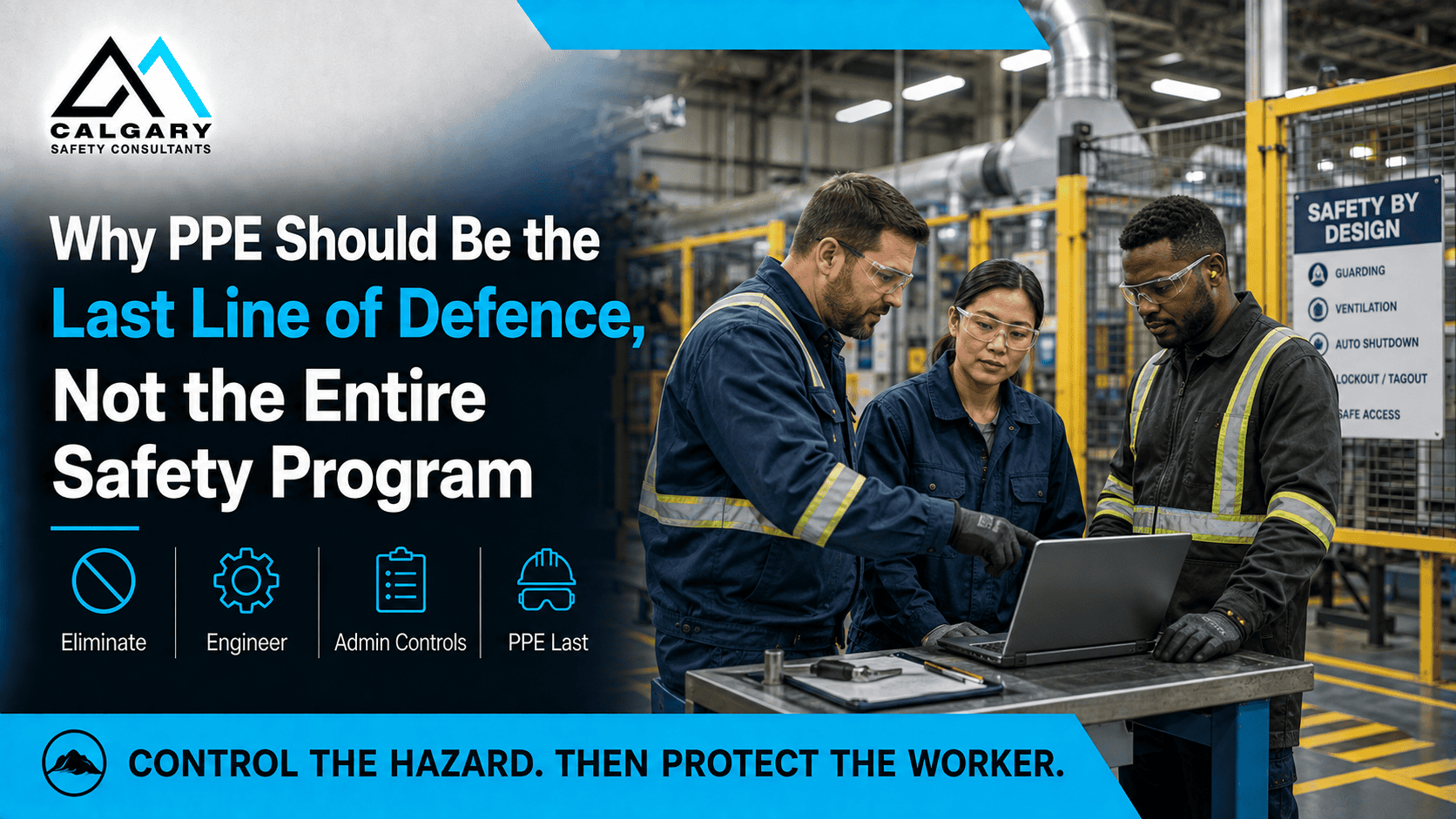
PPE belongs in two situations. It covers residual risk, the hazard that remains once the higher controls that are reasonably practicable are in place. Or it's an interim measure while a higher control is designed, bought or installed. Our article on why PPE should be the last line of defence, not the entire safety program explains why a site that relies on PPE alone usually hasn't finished its hazard assessment.
Auditors check this order. Energy Safety Canada's 2023 COR audit protocol asks whether the company's written procedure says hazard controls are identified in accordance with the hierarchy of controls.
What the Law Says About Controls Before PPE
Several Canadian jurisdictions write this order into law or into official guidance.
- Alberta. Section 9 of the OHS Code requires the employer to eliminate a hazard or, if that isn't reasonably practicable, control it: engineering controls first where reasonably practicable, then administrative controls that bring the hazard as low as reasonably achievable, then the appropriate PPE. A combination is allowed only if it gives workers a greater level of safety.
- British Columbia. Section 5.55 of the OHS Regulation permits PPE as the primary control for exposure to hazardous substances only when substitution, engineering and administrative controls aren't practicable, extra protection is needed, or the exposure is temporary or an emergency. Section 8.11 sets a similar order for head protection.
- Federal. Section 122.2 of the Canada Labour Code says preventive measures should eliminate hazards first, then reduce them, and finally provide PPE. Section 12.03 of the Canada Occupational Health and Safety Regulations requires protection equipment where it isn't feasible to eliminate a hazard or reduce it to within safe limits.
- Quebec. Section 3 of the Act respecting occupational health and safety says providing protective equipment must in no way reduce the effort to eliminate dangers at the source.
- Ontario. The Noise Regulation requires engineering controls first. Hearing protection is used when they don't exist, aren't practical, have broken down or don't work in an emergency.
- Yukon. Section 1.04 of the OHS Regulations puts elimination, engineering and administrative controls and safe work procedures ahead of PPE.
- Northwest Territories and Nunavut. The WSCC's PPE basics code of practice says elimination is always the first control to consider, and PPE isn't used until the employer has taken the necessary engineering measures.
Newfoundland and Labrador and Prince Edward Island apply the same test to respirators, as the comparison table shows.
Using PPE as an Interim Measure
Sometimes PPE is the only protection available today: a dust collector is on order or a guard is being built. Using PPE in the meantime is reasonable, but manage it as temporary:
- record the higher control, who owns it and the target date
- choose PPE that's adequate on its own for the full exposure
- add administrative controls, such as shorter tasks or restricted access
- track the higher control as a corrective action and close it out
- update the hazard assessment once it's installed and check whether the PPE is still needed
Our free worksheet includes a hierarchy check that has to be completed before any PPE is selected, so the reasoning is written down every time.
Who's Involved
- Employers and senior leaders set the program, fund the higher controls and the PPE, and make the rules apply to everyone, visitors included.
- Supervisors make sure the right PPE is worn and in good condition and correct problems on the spot. Our guide to supervisor due diligence explains why that's part of their legal role.
- Workers wear and care for their PPE, inspect it before use and report damage, poor fit or new hazards.
- The joint committee or representative is consulted on selection in B.C. and Yukon, and on some items in federally regulated workplaces.
- Purchasing staff need the approved standard, model and size range, not just the cheapest item.
- Fit testers and trainers must be competent or qualified for the work.
PPE Requirements Across Canada
Every province, territory and the federal jurisdiction has PPE rules. They differ on the standards named, who pays and how often respirators are fit tested. These summaries are current as of October 2026; check the official text before relying on a specific requirement.
Alberta
Part 18 of the OHS Code covers the duty to use PPE (s. 228), eye and face protectors (s. 229), footwear (s. 233), headwear (s. 234) and respiratory protective equipment (ss. 244 to 255), including selection (s. 247) and effective facial seal (s. 250). If the hazard assessment shows PPE is required, the employer must ensure workers wear and use it properly.
The Government of Alberta's explanation guide to Part 18 says employers must provide PPE in a limited number of situations, such as a breathing hazard or noise above the exposure limits, and aren't required to provide items like hard hats, safety boots or eye protection, although they must make sure workers use them. The guide dates from 2009 and names older standard editions, so check the current Code.
British Columbia
Part 8 of the OHS Regulation is one of the most detailed PPE regulations in the country. Under section 8.2, workers provide clothing for the natural elements, general purpose work gloves, appropriate footwear including safety footwear, and safety headgear, and the employer provides all other required PPE at no cost to the worker.
A written program is required when PPE protects against a chemical exposure or an oxygen-deficient atmosphere, covering selection, use, inspection, cleaning, maintenance, storage, training and review (s. 8.5), and it's reviewed annually (s. 8.6). Respirators are selected to CSA Z94.4-18 (s. 8.33) and fit tested before first use, at least once a year and after changes to the facepiece or the wearer (s. 8.40).
Saskatchewan and Manitoba
Saskatchewan. Part 7 of The Occupational Health and Safety Regulations, 2020 covers PPE, from general responsibilities (s. 7-2) to respiratory protective devices (s. 7-3), headwear (s. 7-6), eye and face protectors (s. 7-8) and footwear (s. 7-11). The province's approved standards for Part 7 include CSA Z94.4-18 for respirators, CSA Z94.1-15 (R2020) for headwear, CSA Z94.3:20 for eye and face protectors, CSA Z195-14 for footwear and CSA Z94.2-14 (R2019) for hearing protection.
Manitoba. Part 6 of the Workplace Safety and Health Regulation (ss. 6.1 to 6.18) sets out employer and worker obligations and specific types of PPE. SAFE Work Manitoba's PPE page says employers must supply PPE at no cost, except protective footwear and protective headwear required on a construction project site, and that PPE must be properly fitted.
Ontario and Quebec
Ontario. Under section 25 of the OHSA, explained in the province's guide to the Act, employers must ensure the prescribed protective devices are provided and maintained in good condition, and must instruct, inform and supervise workers, who must wear what the employer requires. Sector regulations set the specific PPE rules. The guide doesn't address who pays.
Quebec. Under section 51 of the Act respecting occupational health and safety, the employer provides, free of charge, the individual protective equipment selected by the health and safety committee or set by regulation, and makes sure it's used. The Regulation respecting occupational health and safety lists when a respirator must be provided (s. 45) and requires a respiratory protection program that complies with CSA Z94.4-11 (s. 45.1).
Atlantic Canada
Nova Scotia. The Occupational Safety General Regulations require employers to ensure adequate PPE is used (s. 9) and name CSA standards for eye, head and foot protection (ss. 10 to 12). The employer provides respirators and follows the latest CSA Z94.4 for selection, use, maintenance, testing and training (s. 13).
New Brunswick. WorkSafeNB's PPE guide covers General Regulation 91-191, including eye protection to CSA Z94.3-15 (s. 39), headwear the employer must provide (s. 40) and footwear to CSA Z195:14 (R2019) (s. 41). WorkSafeNB's interpretation of provide says it may or may not mean the employer pays, but the employer must still make the equipment available.
Prince Edward Island. The WCB's PPE guide says PPE should only be considered as a last means of protection. Part 45 of the OHS General Regulations requires pre-job instruction (s. 45.3) and approved respirators where eliminating the hazardous condition isn't reasonably practicable (s. 45.17), used and cared for to CSA Z94.4-18.
Newfoundland and Labrador. WorkplaceNL's PPE guide covers sections 71 to 86 of the OHS Regulations, 2012. PPE must meet recognized standards, not create a hazard, be compatible with other PPE and be kept in good order (s. 71). Respirators are used when engineering or other controls aren't practicable (s. 84), under a written program that follows CSA Z94.4 (s. 83).
Territories and Federally Regulated Workplaces
Yukon. Workers get PPE at no cost, except weather clothing, general-purpose work gloves and appropriate footwear, which they supply (ss. 1.08 and 1.09). PPE is inspected before each use (s. 1.11) and promptly replaced when it deteriorates (s. 1.09), and fit tests are done as required, with records (s. 1.33).
Northwest Territories and Nunavut. Under Part 7 of the OHS Regulations, PPE is required only where design, work practices or administrative controls can't reasonably protect the worker (s. 89), and PPE the regulations require the employer to provide must be approved and given at no cost (s. 90). The WSCC code of practice says respirators need annual fit testing.
Federal. Federally regulated employers follow Part XII of the Canada Occupational Health and Safety Regulations. Section 12.13 requires listed respiratory protection that meets CSA Z94.4, used and cared for to that standard. Section 12.06 sets an order for fall protection, passive systems first, then fall restraint, fall arrest and fall hazard zones, so the same order applies within fall protection.
Comparison of PPE Requirements Across Canada
If you operate in more than one province, build one PPE program to the strictest rule that applies, such as B.C.'s annual fit testing, with notes where the rules differ. Our guide to OHS legislation in Canada links to each jurisdiction's laws.
| Jurisdiction | Main PPE rules | Controls before PPE | Who pays | Respirator fit testing |
|---|---|---|---|---|
| Alberta | OHS Code Part 18 | Yes (s. 9) | Employer in limited cases, such as breathing hazards; not hard hats, boots or eye protection | s. 250; 2009 explanation guide: first issue, then at least every 2 years |
| British Columbia | OHS Regulation Part 8 | Hazardous substances (s. 5.55); head (s. 8.11) | Employer at no cost, except weather clothing, general gloves, footwear and headgear (s. 8.2) | First use, then yearly (s. 8.40) |
| Saskatchewan | OHS Regulations, 2020, Part 7 | Not stated in the sources cited | See s. 7-2 | s. 7-3; CSA Z94.4-18 |
| Manitoba | WSH Regulation Part 6 | Not stated in the sources cited | Employer at no cost, except footwear and construction headwear | SAFE Work Manitoba guidance: before first use, by a competent person (respirator rules in ss. 6.15, 6.16) |
| Ontario | OHSA s. 25; sector regulations | Noise (O. Reg. 381/15) | Employer provides; cost not addressed | Check your sector regulation |
| Quebec | OHS Act ss. 3, 51; Regulation s. 45.1 | Yes (s. 3) | Employer, free of charge (s. 51) | Program to CSA Z94.4-11 |
| Nova Scotia | Occupational Safety General Regulations ss. 9 to 13 | Not stated in the sections cited | Employer provides respirators; otherwise not stated | Latest CSA Z94.4 (s. 13) |
| New Brunswick | Regulation 91-191 ss. 38 to 47 | Not stated in the sources cited | Employer provides; may or may not mean paying | Code of practice covers fitting (s. 45) |
| Prince Edward Island | OHS General Regulations Part 45 | Respirators (s. 45.17) | Not addressed in the guide cited | CSA Z94.4-18 |
| Newfoundland and Labrador | OHS Regulations, 2012, ss. 71 to 86 | Respirators (s. 84) | Employer provides respirators; otherwise not stated | Program to CSA Z94.4 (s. 83) |
| Yukon | OHS Regulations Part 1 | Yes (s. 1.04) | Employer at no cost, except weather clothing, general gloves and footwear | As required, with records (s. 1.33) |
| NWT and Nunavut | OHS Regulations Part 7 | Yes (s. 89; code of practice) | No cost where the regulations require the employer to provide it (s. 90) | Annual (code of practice) |
| Federal | Canada Labour Code s. 122.2; COHS Regulations Part XII | Yes (Code s. 122.2; COHSR s. 12.03) | Employer provides listed items; cost not separately addressed | CSA Z94.4; fitted by a qualified person (s. 12.05) |
Summary only. Each set of rules has definitions, exemptions and sector rules not shown here, and collective agreements or company policy may go further on cost. Check the current legislation for your jurisdiction.
Eight Steps to Build Your PPE Program
A PPE program comes together in eight steps. The first two, the hazard assessment and the hierarchy check, happen before any PPE is chosen, and the last feeds back into the first, so every review starts with an updated hazard assessment.
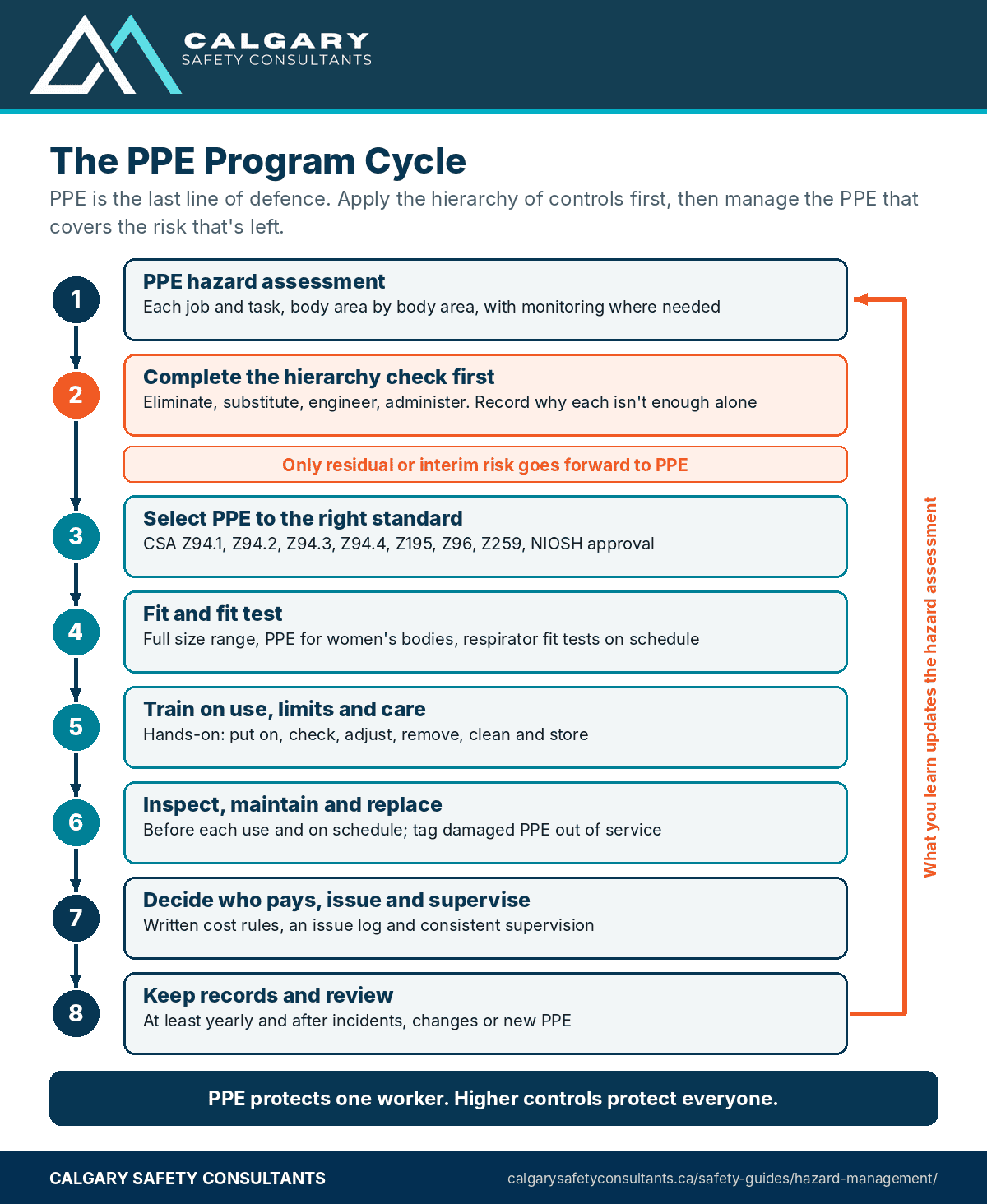
Work through the steps with your committee or representative, or with your workers. They know which gloves come off because nobody can grip a bolt in them.
Step 1: Do a PPE Hazard Assessment for Each Job
A PPE hazard assessment looks at each job, task and work area and asks what could hurt each part of the body. Build it from your job hazard analyses and your formal hazard assessment (our sister guide, How to Complete a Formal Hazard Assessment, covers that process). Walk the work, talk to the people doing it and read incident records and safety data sheets.
Go body area by body area: head, eyes and face, hearing, breathing, hands, feet, body and skin, falls from height, and visibility around traffic. Record the hazard, how long people are exposed and the conditions, such as heat, cold or wet work. Noise and airborne contaminants need monitoring results, not guesses, to choose the right hearing protector or respirator.
Step 2: Complete the Hierarchy Check Before Choosing PPE
Before writing down any PPE, complete the hierarchy check for each hazard: what you considered at each level, what you put in place and why it isn't enough on its own. If a higher control is coming, record it as interim PPE with a date. Only the residual risk goes forward to selection. Our sister guide, How to Assess Risk Using a Risk Matrix, can help you rate it.
Step 3: Select PPE Certified to the Right Standard
Canadian laws name standards for most PPE, and the certification mark matters:
- Head: CSA Z94.1, Industrial protective headwear
- Eyes and face: CSA Z94.3, Eye and face protectors
- Hearing: CSA Z94.2, Hearing protection devices
- Respiratory: CSA Z94.4, Selection, use, and care of respirators, with NIOSH-approved respirators
- Feet: CSA Z195, Protective footwear
- High visibility: CSA Z96, High-visibility safety apparel
- Fall protection: the CSA Z259 series of standards
Some laws also accept ANSI standards for head and eye protection. Editions matter: regulations reference different ones, and Nova Scotia's say the latest version. CSA Z94.4-18 is named in B.C., Saskatchewan and PEI, and the Standards Council of Canada lists a new edition of CSA Z94.4 in development.
Match the PPE to the actual hazard, not just the category. Chemical gloves must resist the specific chemical, respirator cartridges must suit the contaminant, and hearing protectors shouldn't over-protect a worker who needs to hear alarms. Check that items work together, such as glasses that don't break a respirator seal.
Step 4: Get the Fit Right, Including Respirator Fit Testing
PPE that doesn't fit doesn't protect. A fit test checks that a tight-fitting respirator seals to the wearer's face. It's done before first use, with the make, model and size the worker will wear, and repeated on your jurisdiction's schedule: yearly in B.C., annually under the WSCC code and at least every two years in Alberta's 2009 explanation guide.
SAFE Work Manitoba notes that all tight-fitting facepieces need fit testing by a competent person. Retest when the facepiece changes or the worker's face changes. A fit test isn't the same as the user seal check workers do each time they put a respirator on. Facial hair under the seal defeats both, so talk with workers who keep a beard for religious or medical reasons about alternatives, such as a loose-fitting powered air-purifying respirator where it suits the hazard.
Fit applies to everything else too. Ontario now requires employers to ensure the PPE provided is a proper fit and appropriate in the circumstances. Stock a full size range, including PPE designed for women's bodies, such as smaller gloves and boots, women's harnesses and coveralls cut for different shapes, and don't make workers buy their own to get something that fits.
Step 5: Train Workers on Use, Limits, Care and Inspection
Workers need to know why they wear the PPE, what it does and doesn't protect against, how to put it on, adjust it and take it off, and how to inspect, clean, store and replace it. Supervisors need the same, plus how to spot misuse.
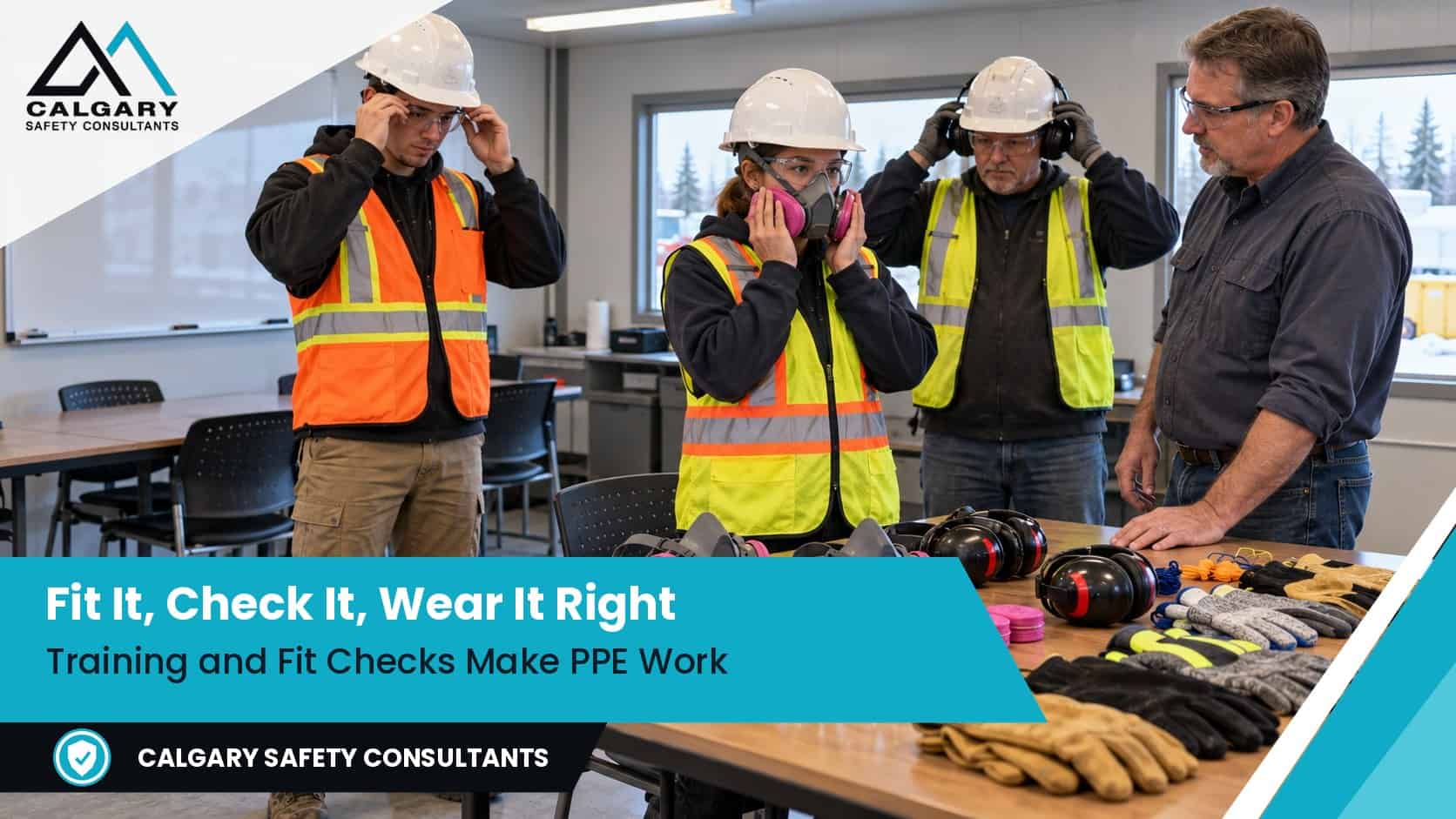
Make it practical: each worker dons and checks their own equipment and demonstrates a seal check. Train at hiring, during new worker orientation, when PPE or hazards change and when you see it worn wrong, and record it in your safety training matrix.
Under section 12.2 of the federal regulations, workers who use protection equipment get instruction and training from a qualified person, and the employer keeps a written summary. In New Brunswick, the respirator code of practice must cover selection, care, use, maintenance and fitting.
Step 6: Inspect, Maintain, Store and Replace PPE
- Before each use: the worker checks for cracks, cuts, worn straps, clogged filters and faded high-visibility material. Yukon requires this.
- Scheduled: a competent person inspects harnesses, lanyards and breathing apparatus on the manufacturer's schedule. Our guide to vehicle and equipment pre-use inspections shows how to build a simple checklist you can adapt.
- Maintenance and storage: clean shared items, change cartridges on a set schedule, and store PPE clean, dry and away from sunlight, heat and chemicals.
- Replacement: replace PPE that's damaged, past its service life or has done its job, such as a hard hat after an impact or a harness after a fall.
Tag damaged PPE out of service so the next person can't pick it up. Federally, section 12.05 requires employer-provided equipment to be maintained, inspected and tested by a qualified person and fitted to each user by a qualified person. Include PPE condition in your workplace safety inspections.
Step 7: Decide Who Pays, Issue PPE and Supervise
Cost rules differ more than any other part of PPE law. Quebec, Yukon, Manitoba and B.C. say the employer provides required PPE at no cost, some with exceptions for footwear, general gloves, headgear or weather clothing. In the Northwest Territories and Nunavut, PPE the regulations require the employer to provide is at no cost. Alberta's Code doesn't require employers to provide many common items, and in New Brunswick, "provide" may or may not mean the employer pays.
Whatever your law says, write your rule down: which items the company supplies, which workers supply, any boot or prescription eyewear allowance, and how lost or damaged PPE is replaced. Paying for specialized PPE is usually simpler and safer, because you control the standard and the fit. Issue PPE through a log that records the worker, item, size, date and condition.
Supervisors should check PPE at the start of the shift, during field level hazard assessments and while the work is under way, and correct problems on the spot. When someone isn't wearing PPE, ask why before reaching for discipline: poor fit, heat, fogging lenses or missing sizes each point to a fix. Our article on how to improve PPE compliance in your workplace looks at the behavioural side. Where a trained worker knowingly refuses, apply your discipline policy consistently, supervisors included.
Step 8: Keep Records and Review the Program
Keep the records that show the program works: hazard assessments with the hierarchy check, the job PPE matrix, issue logs, inspection and maintenance records, fit test results and training records. Federally, section 12.21 requires records of non-disposable equipment, including inspections, tests and maintenance, kept for two years after the equipment is permanently removed from service.
Review the program at least once a year (B.C. requires this for PPE programs covering chemical exposures or oxygen-deficient atmospheres), and after an incident, a new process, new PPE or a change in the law. Ask whether any hazard now controlled by PPE could be eliminated or engineered out, and whether fit tests and training are current. Record the review and fold the changes into your health and safety system.
Workplace example
A Practical Workplace Example
Situation: Consider an illustrative renovation and concrete cutting contractor in British Columbia with about 35 workers. Its PPE program was a box of disposable dust masks, some earmuffs and a safety glasses rule. Crews cut concrete dry, and nobody had been fit tested. When a client's prequalification asked for a written PPE program, the owner realized the company had PPE but no program.
Action: With the joint committee, the safety coordinator ran a PPE hazard assessment for each task and applied the hierarchy of controls before choosing any respirator: water-fed saws and vacuum shrouds, no dry sweeping, and scheduling so other trades weren't in the room during cutting. Air monitoring showed exposures dropped sharply, but some tasks still needed respirators.
The company chose half-facepiece respirators with the right filters, fit tested every user before first use with annual retests scheduled, set up a job PPE matrix and issue log, and trained crews on use, seal checks, cleaning and storage. It added women's sizes in gloves, boots and coveralls after two workers said their PPE didn't fit.
Result: Respirators were needed for fewer tasks than before, supervisors' inspections showed consistent use, and the company passed the client's review. The committee's first annual review added a dust extractor for interior grinding, which removed the respirator requirement for that task altogether.
Common Mistakes to Avoid
- Choosing PPE before the hazard assessment. Nobody then asks whether the hazard could be eliminated or engineered out.
- PPE as the control for every hazard. An assessment where every line says "wear gloves" isn't finished.
- Interim PPE that never ends. Temporary PPE needs an owner and a date for the higher control.
- Buying on price alone. A glove that meets no standard, or fails against your chemical, isn't a saving.
- One size for everyone. Ill-fitting PPE gets removed, altered or worn wrong.
- No fit testing. A tight-fitting respirator without a fit test gives unknown protection.
- Training on paper only. Workers should show how to put on, check and remove their PPE.
- Damaged PPE back in the bin. Tag it out and replace it.
Audit perspective
What an Auditor Expects to See
In a COR or SECOR audit, PPE comes up under hazard control. As noted above, Energy Safety Canada's 2023 COR audit protocol asks whether controls are identified in accordance with the hierarchy of controls. It then asks whether hazards are controlled with engineering controls whenever feasible, administrative controls where applicable and PPE where applicable or required by legislation, whether required PPE is made available and properly maintained, and whether training covers its care, use, maintenance and limitations. Supervisors are expected to enforce the use of hazard controls, PPE included.
An auditor will typically look for hazard assessments that show higher controls were considered first, a job PPE matrix, fit test and training records, inspection records and PPE in good condition on site. Workers should be able to explain why they wear their PPE and its limits. Calgary Safety Consultants helps employers build PPE programs and prepare for audits; we don't issue certificates. CORs and SECORs are issued through the applicable certifying partner.
The Bottom Line
A PPE program starts with the hazard, not the catalogue. Assess each job, apply the hierarchy of controls first and use PPE for the risk that's left, or as a short-term measure while a better control is installed.
Then do PPE properly: equipment certified to the right standard, a fit for every worker, fit-tested respirators, practical training, inspection and replacement, clear cost rules, consistent supervision and a yearly review. A PPE program built this way protects workers on the days the other controls fall short.
Download the PPE Hazard Assessment Worksheet and PPE Program Register
Two free downloads go with this guide. The worksheet is a fillable PDF with clickable checkboxes and fill-in fields, so you can complete it on screen or print it. The register is an Excel workbook with drop-down lists and automatic due dates.
- PPE Hazard Assessment and Selection Worksheet (PDF, 6 pages). A step-by-step worksheet with a hierarchy of controls check that must be completed before any PPE is selected, a body-area PPE assessment (head, eyes and face, hearing, respiratory, hands, feet, body, fall protection and high visibility) with the hazard, required standard and selected product, a fit and training record, jurisdiction notes, a worked example, common mistakes and sign-off.
- PPE Program Register (Excel). A workbook with a How to Use tab, a job PPE matrix with required and optional drop-downs, an issue log, an inspection and replacement tracker that calculates the next due date and flags overdue items, a fit test and training tracker with status, and a summary tab.
Click either button to download the file. Adapt both to your own workplace and the rules that apply in your province or territory, or under the Canada Labour Code.

About the author
John Duplessis, B.Sc., CRSP
John Duplessis is a Canadian Registered Safety Professional with more than 30 years of occupational health and safety experience in oil and gas, construction, green energy, midstream operations and industrial project work. He is an external auditor with Energy Safety Canada.