On this page
- What a Safety Training Matrix Is
- Why a Training Matrix Matters
- The Legal Duty to Train and Ensure Competency
- Training With Fixed Expiry Dates
- How to Build a Safety Training Matrix, Step by Step
- Step 1: List Roles and Tasks From Your Hazard Assessments
- Step 2: Map the Required Training to Each Role
- Step 3: Set Frequencies, Expiry Dates and Refresher Triggers
- Step 4: Track Training Records That Hold Up
- Competency Verification Versus Attendance
- Step 5: Find Gaps and Schedule Training
- Contractors, Temporary Workers and Transfers
- Supervisor Training: The Row People Forget
- Step 6: Review the Matrix and Keep It Current
- A Practical Workplace Example
- Common Training Matrix Mistakes to Avoid
- What an Auditor Expects to See
- The Bottom Line
- Download the Training Matrix and Worksheet
- Frequently Asked Questions
- Related Guides and Articles
- How Calgary Safety Consultants Can Help
- Sources
What a Safety Training Matrix Is
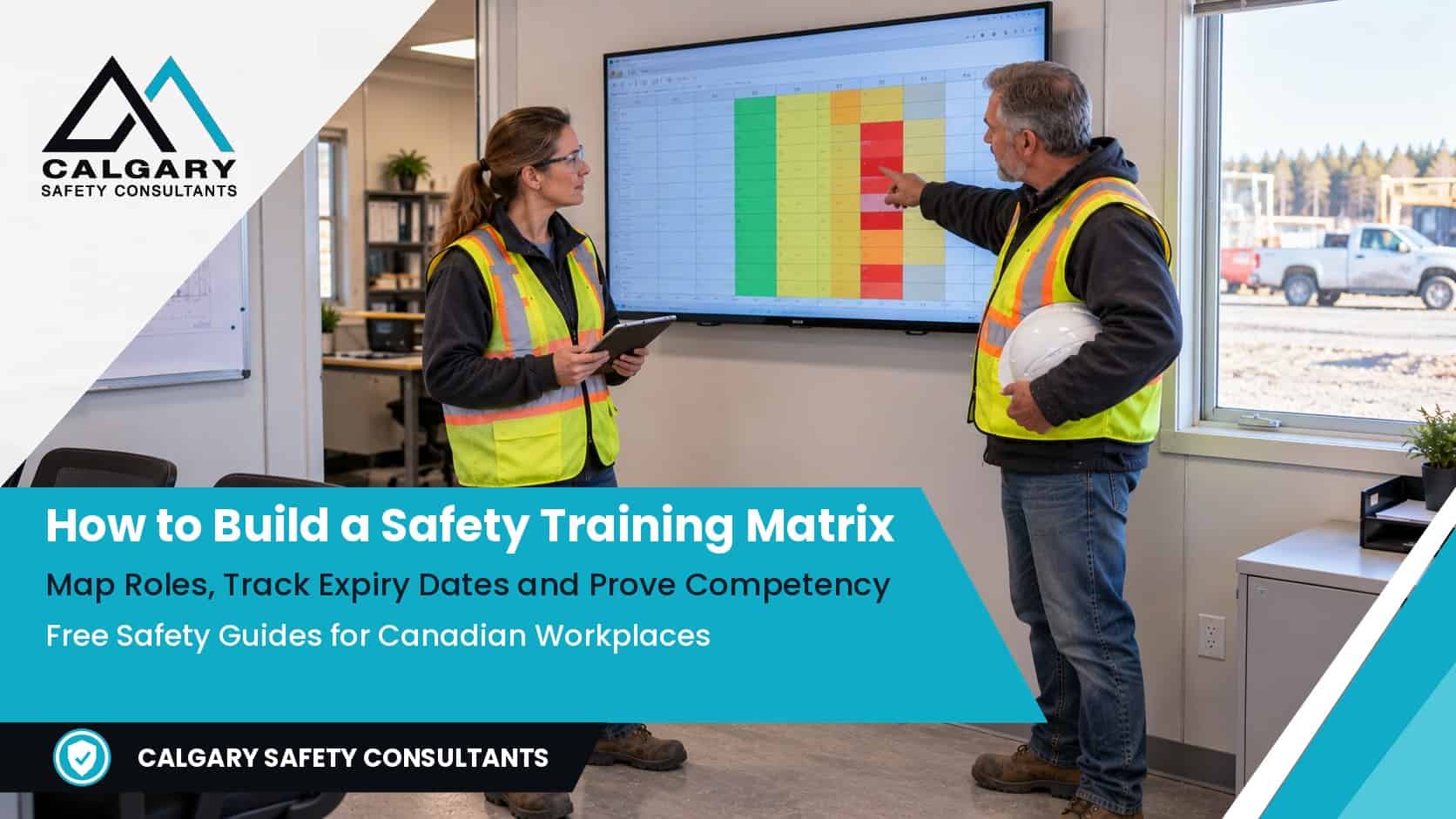
A safety training matrix is a planning and tracking tool. Down one side you list the roles in your company, such as labourer, equipment operator, supervisor or office staff. Across the top you list the training, tickets and certificates your workplace uses. Where a row and a column meet, you mark whether that training is required for that role.
A second layer adds the people. For each worker, the matrix shows the date they completed each required course, when it expires and a status: current, expiring soon, expired or missing. At a glance, a supervisor can see who is cleared to do what, and a manager can see what training to book next month.
People sometimes use "training matrix" and "training records" as if they mean the same thing. They don't. Training records are the evidence: certificates, sign-in sheets, competency assessments and course outlines. The matrix is the map that tells you what records should exist and whether they do. You need both, and they should point to each other.
A safety training matrix can live in a spreadsheet, a safety software platform or, for a very small crew, a printed chart. Accuracy matters far more than format.
Why a Training Matrix Matters
Training is one of the easiest controls to lose track of. Certificates expire quietly, workers move between jobs and new equipment arrives without anyone updating the list. Without a safety training matrix, gaps usually show up after something goes wrong.
New workers are where the gaps hurt most. Ontario research from the Institute for Work and Health, based on lost-time claims from 1999 to 2008, found that workers in their first month on the job had over three times the risk of a lost-time injury compared with workers who had more than a year of experience. A matrix makes sure a new hire's required training is identified and booked before they start the tasks that need it.
It also supports due diligence: after an incident, a current matrix backed by records shows the worker was trained and competent, with evidence instead of memory.
Finally, it keeps the focus on competence. The UK Health and Safety Executive describes competence as the combination of training, skills, experience and knowledge that a person has, and their ability to apply them to perform a task safely. Training is only one ingredient. A good matrix tracks the others too.
The Legal Duty to Train and Ensure Competency
No Canadian law uses the words "training matrix." Every jurisdiction does require that workers are trained, competent or supervised for the work they do, and a safety training matrix is the most practical way to show you're meeting that duty.
Alberta's law is a good example of how the pieces fit. The OHS Act defines competent as adequately qualified, suitably trained and with sufficient experience to safely perform work without supervision or with only a minimal degree of supervision. Part 1 of the Act requires employers to ensure workers are adequately trained, and says work that may endanger a worker must be done by a competent worker or under the direct supervision of one. Workers, in turn, must take part in the training the employer provides.
In British Columbia, section 21(2)(e) of the Workers Compensation Act requires employers to provide the information, instruction, training and supervision necessary to ensure workers' health and safety. Section 3.23 of the OHS Regulation requires orientation and training specific to the workplace before a young or new worker begins work, including instruction and demonstration of their work tasks. Section 3.24 requires more training when observation shows a worker can't do the work safely, and section 3.25 requires records.
Ontario's guide to the OHSA explains that clause 25(2)(a) requires employers to instruct, inform and supervise workers, and that O. Reg. 297/13 requires awareness training for workers and supervisors. It describes a competent person as one qualified because of knowledge, training and experience to organize the work.
In Saskatchewan, section 3-8 of the OHS Regulations, 2020 requires training when a worker starts work or moves to work with different hazards, and allows work only if the worker is trained and experienced enough, or under close and competent supervision.
Manitoba's Workplace Safety and Health Act requires information, instruction, training and supervision, and its regulation defines competent as possessing knowledge, experience and training to perform a specific duty. The new worker orientation guide published in 2026 by the WCB and the province says new workers must get a workplace-specific orientation before they begin work, and that records must be kept.
Quebec's Act respecting occupational health and safety requires employers to provide appropriate training, assistance or supervision so the worker has the skill and knowledge to safely do the work assigned. In Atlantic Canada, New Brunswick's OHS Act lists information, instruction and training as separate duties and requires competent supervision. Nova Scotia's summary of OHS Act duties tells employers to provide safety instruction and job training. The PEI OHS Act and the Newfoundland and Labrador OHS Act both require information, instruction, training and supervision.
In the North, Yukon's Code of Practice on young and new workers requires orientation and training before a young worker (under 19) or new worker starts, competent supervisors and records. The Northwest Territories and Nunavut WSCC's OHS programs code of practice calls training a legislated requirement and says the meeting of competency must be documented for each worker, for all tasks. Federally, section 125 of the Canada Labour Code requires information, instruction, training and supervision, and adequate health and safety training for supervisors and managers.
| Jurisdiction | Core training duty | Competency, orientation and supervision rules |
|---|---|---|
| Federal (Canada Labour Code, Part II) | s. 125(1)(q): provide each employee with the information, instruction, training and supervision necessary for their health and safety | s. 125(1)(z): employees with supervisory or managerial duties must be adequately trained in health and safety; s. 125(1)(s): employees made aware of every known or foreseeable hazard |
| Alberta | OHS Act s. 3(2): workers adequately trained in all matters necessary to work in a healthy and safe manner | s. 3(3): work that may endanger a worker is done by a competent worker or under the direct supervision of one; "competent" defined in s. 1(d); s. 5(1)(f): workers take part in training provided |
| British Columbia | Workers Compensation Act s. 21(2)(e): information, instruction, training and supervision | OHS Regulation s. 3.23: orientation and training before a young or new worker begins work; s. 3.24: more training if observation shows they can't work safely; s. 3.25: records |
| Saskatchewan | OHS Regulations, 2020, s. 3-8: trained in all matters necessary when starting work or moving to work with different hazards | s. 3-8(4): a worker may do the work only if trained and experienced enough to do it safely, or under close and competent supervision |
| Manitoba | Workplace Safety and Health Act s. 4(2)(b): information, instruction, training and supervision | Regulation s. 1.1 defines "competent"; s. 2.2.1 requires a workplace-specific orientation for new workers, with records |
| Ontario | OHSA cl. 25(2)(a): instruct, inform and supervise workers | "Competent person" defined in the Act; O. Reg. 297/13 awareness training for workers and supervisors |
| Quebec | Act respecting occupational health and safety s. 51(9): appropriate training, assistance or supervision | Training must ensure the worker has the skill and knowledge to safely do the work assigned |
| New Brunswick | OHS Act s. 9(2)(c) to (c.2): information, instruction and training | s. 9(2)(c.3) and (c.4): work competently and sufficiently supervised |
| Nova Scotia | Employers provide safety instruction and job training | Written OHS program (20 or more employees) covers training and supervision |
| Prince Edward Island | OHS Act s. 12(1)(c): information, instruction, training, supervision and facilities | s. 12(1)(d): workers and supervisors familiar with workplace hazards |
| Newfoundland and Labrador | OHS Act s. 5(b): information, instruction, training and supervision, where reasonably practicable | General duty; specific rules in the regulations |
| Yukon | Code of Practice 2022-04 (young and new workers) | Orientation before a young or new worker starts; supervisors must be competent to train them; records kept |
| Northwest Territories and Nunavut | OHS Regulations, Part 3, ss. 12(c) and 18 (as cited by the WSCC) | Supervisors must attend an approved familiarization course; WSCC guidance says competency must be documented for each worker and task |
Summary only. Every jurisdiction also has topic-specific training rules (for example WHMIS, fall protection, confined spaces and equipment) in its regulations. Check the full text that applies to your workplace.
For links to each jurisdiction's statutes, see our guide to OHS legislation in Canada.
Training With Fixed Expiry Dates
Some training comes with an expiry date set by law or by the certifying body, printed right on the card.
First aid is the classic example. Alberta's first aid training page says workplace first aid certifications are valid for up to 3 years, and workers may recertify before expiry or must take a full course afterward. In British Columbia, WorkSafeBC's page on workplace first aid certification says all certificates are valid for three years. First aid requirements also depend on your site's size, hazards and distance from medical help, which our upcoming first aid requirements guide covers in detail.
Dangerous goods training follows the federal TDG Regulations, which the provinces largely adopt, so the rules are much the same across Canada. Transport Canada's TDG training bulletin says anyone who handles, offers for transport or transports dangerous goods must be adequately trained and hold a training certificate, or work under the direct supervision of someone who is. Employers issue the certificate, and self-employed people may issue their own.
A TDG certificate expires 36 months after issue for road, rail and marine, and 24 months for air. Employers keep the training record and a copy of the certificate until two years after it expires.
Ontario's working at heights training is required for construction workers who use fall protection. It must be an approved program from an approved provider, is valid for three years, and needs a refresher to extend it. Alberta's 2026 bulletin on recognizing Ontario's working at heights program says that program meets Alberta's basic fall protection training requirements in section 141 of the OHS Code, apart from Alberta legislation and site-specific hazards, and notes Alberta's legislation doesn't require refresher training.
WHMIS works differently. In B.C., section 5.5 of the OHS Regulation requires the WHMIS program, including education and training, to be reviewed at least annually, or sooner when work conditions or hazard information change. It also requires periodic evaluation of workers' knowledge through means such as written tests and practical demonstrations. There's no card expiry, but the annual review is a natural trigger for a refresher.
Energy Safety Canada's certificates page notes that in-class certificates come with an expiration date, while online course certificates don't. Enter the date on the card.
| Training or certificate | Who sets the rule | Validity or refresher | Notes for your matrix |
|---|---|---|---|
| Workplace first aid (Alberta) | Government of Alberta | Valid for up to 3 years | Recertify before expiry, or take the full course after it lapses. Training must be with an approved agency. |
| Workplace first aid (B.C.) | WorkSafeBC | All certificates valid for 3 years | Basic, intermediate and transportation endorsement: retake the course. Advanced: refresher course while still valid. |
| Transportation of dangerous goods (all of Canada) | Transport Canada (TDG Regulations) | Expires 36 months after issue for road, rail and marine; 24 months for air | Employer issues the certificate (self-employed persons issue their own). Keep the record and a copy until two years after it expires. |
| Working at heights (Ontario construction) | Ontario (O. Reg. 297/13) | Valid for 3 years after completion | Approved program and provider; refresher from an approved provider; records kept for each worker. |
| Fall protection (Alberta) | OHS Code s. 141 | No refresher period set in Alberta legislation | Set a company refresher interval and retrain when equipment, tasks or performance change. |
| WHMIS (B.C.) | OHS Regulation s. 5.5 | No certificate expiry; the WHMIS program, including education, is reviewed at least annually | Many employers schedule an annual WHMIS refresher to match the review. Check your jurisdiction. |
| Energy Safety Canada courses (such as H2S Alive) | Energy Safety Canada | In-class certificates show an expiration date; online course certificates don't | Enter the expiry date printed on the worker's certificate. |
Only periods confirmed by an official source are shown. Other tickets (for example confined space, ground disturbance or equipment training) often carry provider or client expiry dates, so record the date on the certificate and your own company interval.
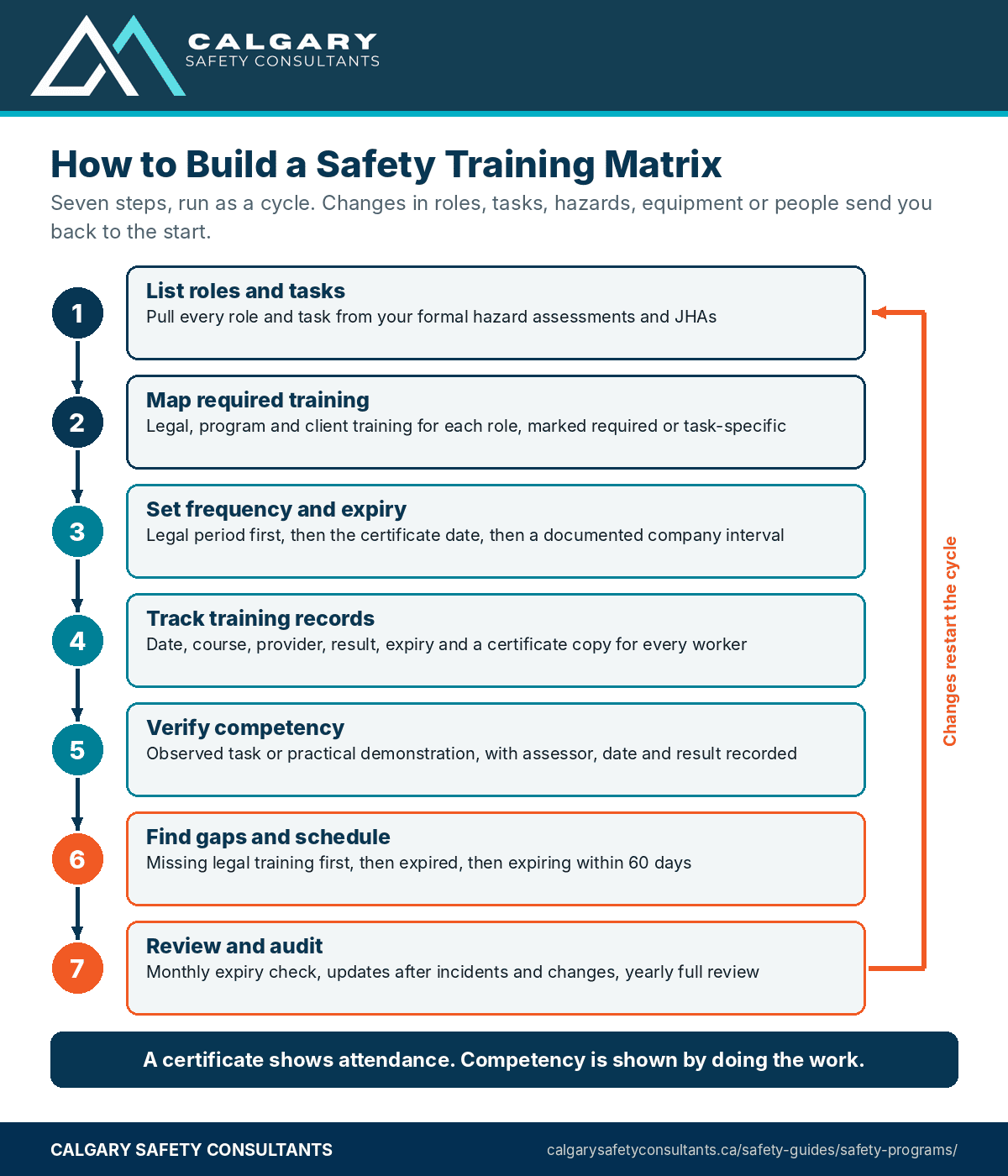
How to Build a Safety Training Matrix, Step by Step
Building a safety training matrix takes a few focused days for most small and mid-size employers, and far less time to maintain. Start from the work, decide what training it needs, then load the people.
Step 1: List Roles and Tasks From Your Hazard Assessments
Your hazard assessments already describe the work. Pull each job title or role from your formal hazard assessments, then list the tasks each role performs. A job hazard analysis gives you task-level detail, including the hazards and controls that training must support.
- Group by role, not by person. "Loader operator" is a row; "Dave" isn't. People change, roles last.
- Split roles that differ. A shop labourer and a field labourer face different hazards, so they may need different training.
- Include the roles people forget. Supervisors, office staff who visit sites, drivers, maintenance, summer students and anyone who works alone.
- Note task-specific triggers. If only some operators run the boom truck, list the boom truck as a separate task with its own requirement.
Each training requirement should trace back to a hazard or legal rule. If your hazard assessments are thin, fix them first, because a matrix built on a weak assessment inherits the gaps. Our guide to the hierarchy of controls explains why training sits low on the list: it supports engineering and other controls, it doesn't replace them.
Step 2: Map the Required Training to Each Role
Now decide what each role needs. Sort the training into three groups, because they're managed differently.
- Legal requirements. Training a statute, regulation or code requires for the work: WHMIS for workers exposed to hazardous products, first aid for designated attendants, TDG for workers who handle or ship dangerous goods, fall protection for work at height, and equipment training required by your regulations.
- Program requirements. Training your own health and safety program requires: company orientation, site orientation, hazard assessment training, safe work procedures, emergency response roles and incident investigation for those who investigate.
- Client and industry requirements. Tickets your clients or industry expect, such as H2S training in sour gas areas or ground disturbance for excavation near buried facilities. These may be contract conditions rather than law, so label them that way.
Mark each cell as required, required for a specific task, or recommended, and keep "recommended" rare. Then build a course catalogue: one line per course, with the provider, delivery method, the refresher interval and the source of that interval (law, provider or company decision).
Online training suits knowledge, like WHMIS principles, but doesn't prove someone can tie off or run a loader. Pair it with a practical assessment.
Step 3: Set Frequencies, Expiry Dates and Refresher Triggers
For every course, record how long it stays valid. Use three sources, in this order: the legal period if there is one, the provider's or certifying body's expiry if it's shorter, and a company interval for everything else. Write down which one you used, so the next person understands why.
Where the law sets no interval, you still need one. Many employers choose two to three years for rarely used practical skills and an annual WHMIS refresher. These are company decisions, so base them on how often the skill is used and how badly a mistake could go.
Dates aren't the only trigger. Our blog post on whether your safety training proves competency or only attendance lists the events that should prompt retraining or reassessment, whatever the date says:
- new equipment, materials or procedures
- new hazards or a change in the work site
- a worker returning after a long absence
- an incident, near miss or inspection finding that points to a skill gap
- a supervisor seeing uncertainty or shortcuts
- new legal or client requirements
Build a warning window into the matrix. The template with this guide flags anything expiring within 60 days, which leaves time to book a course before the card lapses. You can change the number to suit how quickly you can get seats.
Step 4: Track Training Records That Hold Up
The matrix shows status; the records prove it. Keep enough to show what was covered, who delivered it, when, and that the worker passed. A sign-in sheet alone rarely does that.
- Worker name and role, and the date of training.
- Course or topic, with an outline or reference to the procedure covered.
- Provider or trainer, and their qualifications for in-house training.
- Result: pass, test score, or the outcome of a practical assessment.
- Expiry date, where one applies.
- Certificate copy, filed where you can find it.
Some rules spell out the record. TDG certificates must show the employer's name and address, the employee's name, the expiry date preceded by "Expires on," the aspects of handling or transport the employee is trained for, and both signatures. Ontario lets employers keep either a copy of the worker's working at heights proof of completion or a record with the worker's name, provider, program and completion date.
Keep the matrix and the files in step: when a new certificate comes in, update the matrix the same day. Supervisors in the field should be able to see current status, because that's where decisions about who does what get made.
Competency Verification Versus Attendance
This is where most matrices fall short. A green cell that says "WHMIS: current" tells you a worker completed a course. It doesn't tell you they can read an SDS for the product they're using today. Attendance is a starting point. Competency is the goal.
Energy Safety Canada's 2023 COR audit protocol draws the line clearly. It describes competency as the combined knowledge, skills and sufficient experience required to successfully perform a work task with little or no supervision, and says competencies are not the same as qualifications or general training. It asks whether job-specific training includes a practical demonstration by the trainee to confirm they've acquired the knowledge or skill.
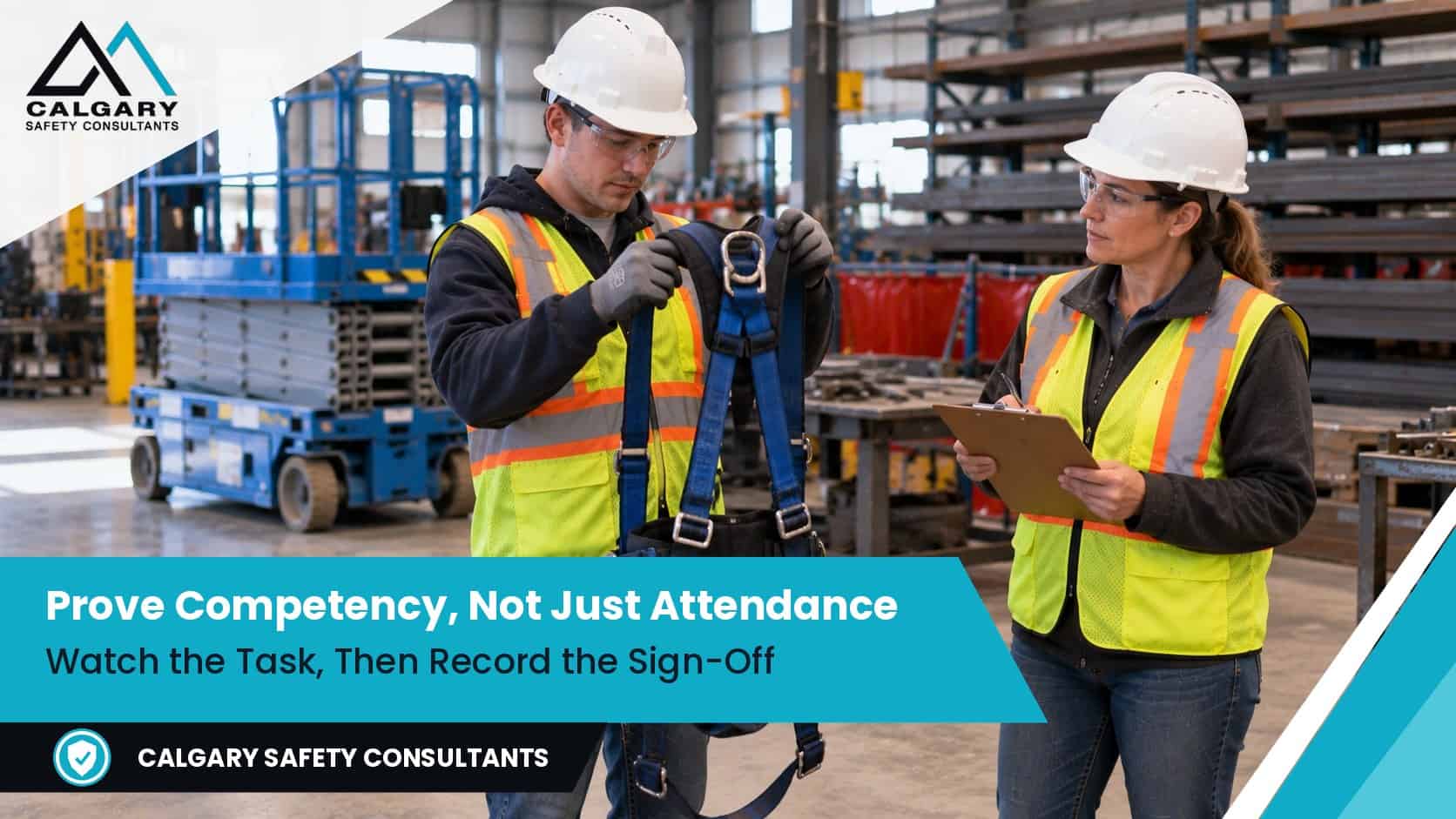
Add a competency column to your matrix for every task that needs one. Record who assessed the worker, the date, the method and the result. Practical methods work best:
- Observed task. The worker does the job while a competent assessor watches against set criteria.
- Demonstration. For example, a harness inspection and fit, a respirator seal check or a pre-use equipment inspection.
- "What would you do?" questions. Scenarios that test judgement when conditions change.
- Written or oral test. Useful for knowledge, weaker for skills.
Until a worker has been assessed, the matrix should show they need direct supervision for that task. That mirrors the law in several provinces: Alberta allows endangering work by a worker under the direct supervision of a competent worker, and Saskatchewan allows work under close and competent supervision. Use the field-level hazard assessment to confirm on the day that the right people are on the right tasks.
Step 5: Find Gaps and Schedule Training
With roles mapped and people loaded, the matrix shows you the gaps. Sort them by risk, not by convenience.
- Missing legal training for current work. Fix this first. If a worker doing a task lacks training the law requires, move them off the task until it's done. Only where the rule allows it, such as work under direct competent supervision in Alberta or Saskatchewan, can supervision bridge the gap.
- Expired certificates. Treat an expired card the same as a missing one for that task.
- Training expiring within your warning window. Book it now, while seats are available.
- Missing competency assessments. Schedule practical assessments with supervisors.
- Program and recommended training. Plan these into slower periods.
Turn the gap list into a dated training plan with an owner for each item, and track it like any other corrective action. For new hires, set the rule that their required training is identified on day one and the highest-risk items are completed before they start those tasks. Our upcoming guide to new worker safety orientation covers that first week in detail.
Contractors, Temporary Workers and Transfers
Your matrix is about your workers, but your duties don't stop there. When contractors work on your site, you need confidence that their people are trained for the work and know your site's hazards and rules.
- Ask for proof before arrival. Request a training list or matrix for the workers being sent, with certificate copies for the tickets your site requires.
- Verify where you can. Energy Safety Canada, for example, offers certificate status checks, and its page notes it gives employers status only when the cardholder authorizes it.
- Give a site orientation. Contractors' own training rarely covers your site-specific hazards, emergency procedures and rules.
Our guides to contractor safety management and contractor prequalification explain how training checks fit into selection and monitoring. For temporary agency workers, agree in writing who provides which training before the first shift.
Transfers count too. B.C.'s regulation treats a worker moved to a workplace with different hazards as a new worker, and Saskatchewan requires training when a worker moves to work with different hazards, facilities or procedures. When someone changes roles, run their name against the new row of the matrix before they start.
Supervisor Training: The Row People Forget
Supervisors make the daily calls about who does what, so their own training deserves its own row. Several jurisdictions say so directly. Alberta requires workers to be supervised by a person who is competent and familiar with the legislation that applies to the work. The Canada Labour Code requires adequate health and safety training for employees with supervisory or managerial duties. Ontario's awareness training rules apply to supervisors as well as workers.
In the Northwest Territories and Nunavut, the WSCC says supervisors must attend an approved familiarization course on OHS legislation. Yukon's code of practice requires supervisors of young and new workers to be competent to train and supervise them.
A practical supervisor row covers legislation and due diligence, hazard assessment, inspections, incident investigation and how to assess competency; our upcoming supervisor due diligence guide goes further. Supervisors usually sign competency assessments, so make sure they're competent to judge the task, or bring in someone who is.
Step 6: Review the Matrix and Keep It Current
A matrix that's six months out of date is worse than none, because people trust it. Build a simple routine:
- Weekly or as it happens: enter new certificates and assessments, add new hires and remove leavers.
- Monthly: review the expiring and expired list with supervisors and book training.
- When anything changes: new equipment, tasks, sites, clients or laws mean a new column or a changed requirement.
- After incidents: if an incident investigation finds a training or competency gap, update the matrix and check whether the same gap exists elsewhere.
- Yearly: review the whole matrix as part of your health and safety system review, including whether the training is working.
Name one owner, often the safety coordinator or office manager. Shared ownership usually means nobody updates it.
Check that training works, not just that it happened. If workers who are "current" keep making the same mistakes in inspections and near misses, fix the course, the assessment or the supervision; repeating the course rarely helps.
Workplace example
A Practical Workplace Example
Situation: Consider an illustrative mechanical and fabrication contractor in southern Saskatchewan with about 45 workers across a shop and field crews. Training was tracked in a folder of certificates and a spreadsheet one supervisor kept. Before a client prequalification review, the safety coordinator found three first aid certificates had expired, two workers were shipping propane cylinders without TDG certificates, and nobody could show who had been assessed on the new boom truck.
Action: The coordinator built a training matrix from the company's hazard assessments: nine roles, 22 courses and tickets, and a separate column for practical assessments on the boom truck, forklift and fall protection. Each course got a refresher interval and a source. Supervisors completed observed assessments using a simple checklist, and the matrix was set to flag anything expiring within 60 days. New hires were added on day one with a list of training to finish before starting each task.
Result: Within two months every legal gap was closed, and the monthly expiry list replaced last-minute scrambles for course seats. The client review went smoothly, and when an auditor later asked to see training and competency records for a sample of workers, the coordinator could pull each one from the matrix in minutes.
Common Training Matrix Mistakes to Avoid
- Building it from course lists instead of hazards. Start with the work, or you'll train for the wrong things.
- Treating a certificate as proof of competency. Attendance shows training happened. Only an assessment shows the worker can do the task.
- Guessing expiry dates. Use the date on the certificate or a documented company interval.
- Listing people instead of roles. The matrix breaks every time someone leaves.
- Forgetting supervisors, office staff and transfers. Everyone who does work needs a row.
- Letting workers start before training is done. Legal and high-risk training comes before the task; direct competent supervision bridges the gap only where the rule allows it.
- No owner and no review. An unmaintained matrix gives false confidence.
- Mixing contractors into the employee matrix. Track them separately and verify their tickets.
Audit perspective
What an Auditor Expects to See
Training gets close attention in a COR or SECOR audit. Element E of the Energy Safety Canada protocol (Qualifications, Orientation and Training) asks whether required qualifications are defined for health and safety sensitive positions and confirmed before work, refresher training is provided, competencies are defined for each position, new and reassigned workers are assessed, and all employees are deemed competent for their tasks. Elsewhere in the protocol, the WHMIS question under Element C (Hazard Control) names training records or a training matrix as evidence.
In construction, the IHSA COR 2020 audit tool asks under Element 8 whether competencies have been identified for each task or role, whether the organization has conducted a training needs analysis as per its procedure, and whether it evaluates learning.
Expect the auditor to sample records against the matrix, then test them in interviews: can a worker explain the training for their task, and can a supervisor explain how they knew the worker was competent? Our guides to the COR audit and COR audit interviews explain how sampling and interviews work.
In Alberta, the Certificate of Recognition program has 13 Certifying Partners, and a COR shows the employer's health and safety management system has been evaluated by a certified auditor. Calgary Safety Consultants helps employers build training matrices and prepare for audits; we don't issue certificates. CORs and SECORs are issued through the applicable certifying partner.
The Bottom Line
A safety training matrix turns a legal duty into something you can see. Every Canadian jurisdiction requires employers to train and supervise workers, and many require competent workers or competent supervision for hazardous work. The matrix shows, role by role and person by person, whether you're meeting that duty today.
Build it from your hazard assessments, use only confirmed expiry dates, keep records that prove the training, and add a competency check for the tasks that matter. Then keep it alive with a named owner and a monthly look at what's expiring. Done well, it saves time and money and, most importantly, helps keep people safe.
Download the Safety Training Matrix and Training Needs Worksheet
Two free downloads go with this guide: an Excel training matrix that calculates status for you, and a fillable PDF worksheet for working out what each role needs. Both are built to be adapted to your own roles, courses and jurisdiction.
- Safety Training Matrix (Excel). A How to Use tab, a roles and required training matrix, a workers roster with completion and expiry dates, automatic status (current, expiring within 60 days, expired or missing) with colour coding, competency verification columns, a course catalogue with refresher periods and their sources, and a summary dashboard. Drop-down lists and date checks keep entries clean.
- Training Needs Assessment Worksheet (PDF, 7 pages). A fillable, step-by-step worksheet for one role: tasks and hazards, legal, program and client training required, competency verification methods, gaps and a dated training plan, with clickable checkboxes, jurisdiction notes, worked examples, common mistakes, key terms and sign-off.
Click either button to download the file. Check every refresher period against the rules that apply in your province or territory and the date on each certificate.

About the author
John Duplessis, B.Sc., CRSP
John Duplessis is a Canadian Registered Safety Professional with more than 30 years of occupational health and safety experience in oil and gas, construction, green energy, midstream operations and industrial project work. He is an external auditor with Energy Safety Canada.