On this page
- What Roof Snow Removal Involves
- Why Roof Snow Removal Is High Risk
- Who's Involved
- Deciding Whether Snow Removal Is Needed
- Fall Protection Rules Across Canada
- Comparison of Fall Protection Rules Across Canada
- Seven Steps to Plan Safe Roof Snow Removal
- Step 1: Set the Snow Load Trigger
- Step 2: Map the Roof Hazards
- Step 3: Choose Controls, Starting with Design
- Step 4: Plan Safe Access to the Roof
- Step 5: Plan the Rescue and the Ground Exclusion Zone
- Step 6: Prepare the Crew, Equipment and Communication
- Step 7: Remove the Snow Safely and Close Out the Job
- Hiring a Roof Snow Removal Contractor
- Records to Keep
- A Practical Workplace Example
- Common Mistakes to Avoid
- What an Auditor Expects to See
- The Bottom Line
- Download the Plan Template and Checklist
- Frequently Asked Questions
- Related Guides and Articles
- How Calgary Safety Consultants Can Help
- Sources
What Roof Snow Removal Involves
Every winter, someone has to decide what happens to the snow on the roofs you own or manage. Sometimes the answer is nothing, because the roof was designed for it. Sometimes snow has to come off a flat roof before a storm adds more weight, ice has to be cleared from drains and scuppers, or a drift has to be removed from behind a parapet or rooftop unit.
That work is done by maintenance staff, property management crews, snow clearing contractors and roofers, often in the worst conditions of the year. Roof access is part of the job too, through a hatch, a fixed ladder, a portable ladder or a stairwell door. Roof snow removal safety means planning all of it: the decision, the access, fall protection, rescue and the people on the ground.
Why Roof Snow Removal Is High Risk
Roof snow removal combines several serious hazards in one short, rushed job. Alberta's working in winter bulletin warns that snow is heavy and adds to the load on roofs, and that snow on rooftops can hide hazards such as skylights or vents. The main hazards are:
- Falls through skylights and fragile roofs. A skylight buried under snow looks like the rest of the roof. Many skylights and fibreglass panels aren't built to hold a person's weight.
- Falls from edges. Snow hides the edge, drifts build out past it, and a shovel that suddenly breaks free can pull a worker forward.
- Slips on ice, especially on sloped roofs, around drains and where meltwater refreezes.
- Roof collapse under snow, ice and rain on snow, sometimes with workers on it.
- Falling snow and ice onto people, cars and entrances below.
- Overhead power lines and electrical equipment, including service drops to the building and rooftop units.
- Ladders on icy ground, and equipment hazards from snow blowers and fuel-powered machines.
- Cold stress and heavy physical work, and working alone where nobody would notice a fall.
The US Occupational Safety and Health Administration's winter weather guidance says to consider avoiding roof work and, when it's needed, to provide fall protection and training, use ladders safely and take extreme care near power lines. Manitoba's WCB lists gasoline- and propane-powered equipment among the sources of carbon monoxide, so keep small engines and heaters out of enclosed penthouses and stairwells. Its cold weather guidance warns that hypothermia can progress quickly and recommends layered, windproof clothing and warm-up breaks in heated shelters.
Who's Involved
Roof snow removal usually involves more than one party, and each has a part to play.
- Building owners, condo corporations and landlords are responsible for the condition of the building. Under Alberta's OHS Act, owners must keep the buildings they control from endangering people and must communicate the hazards they identify to everyone at the work site. B.C.'s Workers Compensation Act (section 25) requires owners to maintain their premises safely and give the employer or prime contractor the information needed to identify and control hazards.
- Property and facility managers usually decide when to clear a roof, hire the contractor and coordinate roof access.
- Employers and contractors whose workers go on the roof are responsible for fall protection, training, equipment, supervision and rescue.
- Prime contractors, where the law requires one, coordinate safety when more than one employer works at the site. Our guide to contractor safety management explains how this works in each province.
- Structural engineers assess snow load and advise on safe removal methods.
- Workers and supervisors follow the plan and stop the job when conditions change.
Deciding Whether Snow Removal Is Needed
The safest roof snow removal is the job you don't need to do. Most roofs are designed to carry the snow expected where they stand, so clearing every roof after every storm puts workers at risk for no real benefit.
Ontario's alert on snow loading and roof failures notes that snow can weigh from about 7 to 30 pounds per cubic foot, and rain on snow adds more. It advises employers to have a professional engineer assess roofs carrying significant snow. A civil or structural engineer can judge whether loads are excessive, plan a removal method that won't make a problem worse, or reinforce an overstressed structure.
The alert also points to the employer's duty under Ontario's OHS Act, section 25(1)(e), to ensure a roof can support the loads required by the building code in force when it was built. Design snow loads are set by the building code that was in force where and when the roof was built, which in most provinces and territories is based on the National Building Code of Canada. Don't guess at a number. Ask a structural engineer what your roof was designed for, and record it.
Between assessments, watch for signs of structural distress, such as twisting, bending, sagging or cracking in roof members, ceilings or walls. If you see them, keep people out of the area below and get an engineer's assessment right away. WorkSafeNB's snow removal advisory puts it simply: if you don't know the load limit, have a civil or structural engineer inspect the roof.
Fall Protection Rules Across Canada
Every jurisdiction in Canada requires fall protection for roof work above a set height, and most also require it lower where a fall could be especially harmful. Several require a written plan or procedures. The summaries below cover the rules most relevant to roof snow removal, and our guide to OHS legislation in Canada links to each jurisdiction's laws.
Alberta
Part 9 of the OHS Code requires protection where a worker may fall 3 metres or more, less where there's an unusual possibility of injury, or more than 1.2 metres at a permanent work area (section 139). Guardrails come first, then travel restraint, then fall arrest.
A fall protection plan is required where a worker may fall 3 metres or more without guardrails (section 140). It names the hazards, system, anchors, clearances and rescue procedures, and is reviewed with workers before work starts.
British Columbia
The OHS Regulation, Part 11 requires fall protection where a fall of 3 metres or more may occur, or a lower fall carries a greater risk of injury (section 11.2), with guardrails first where practicable. A written fall protection plan is required where a fall of 7.5 metres or more may occur without permanent guardrails, or where work procedures replace a system (section 11.3).
Saskatchewan
Part 9 of the OHS Regulations, 2020 covers protection against falling (section 9-2), fall protection plans (section 9-3) and control zones (section 9-4). Workers must use a fall protection system where they may fall 3 metres or more, or less where there's a possibility of injury. In 2024, a Saskatoon company was fined $50,000 plus a $20,000 surcharge under clause 9-2(2)(b), which covers falls of less than 3 metres, after a worker was seriously injured in a fall from a scaffold.
Manitoba
SAFE Work Manitoba's fall protection guide explains that Part 14 of the Workplace Safety and Health Regulation applies where a worker could fall 3 metres or more, or less where the surface below raises the risk. Employers need written safe work procedures naming the hazards and systems, including fall rescue procedures (section 14.2). Part 31, described on the WCB's roofing page, sets additional procedure and training rules for roof work, so check whether it applies to your snow removal job.
Ontario
For construction projects, Ontario Regulation 213/91 (section 26) requires fall protection where a worker could fall more than 3 metres, with guardrails first. For industrial establishments, Regulation 851 (section 85) applies where the surface a worker could fall to is more than 3 metres below. The Ontario government's working at heights guidance notes that under section 26.1(4), written rescue procedures must be in place before a fall arrest system or safety net is used on a construction project.
Quebec
Quebec's Safety Code for the construction industry (section 2.9.1) requires workers to be protected against falls where they could fall more than 3 metres, and in some situations from lower heights. Snow removal at workplaces outside construction falls under the Regulation respecting occupational health and safety, so check its fall protection division for the rule that applies to your building.
Atlantic Provinces
New Brunswick. Regulation 91-191 requires fall protection at 3 metres or more above water or the nearest permanent safe level (section 49), and a written code of practice where employees work from 7.5 metres or more (section 50.2). Nova Scotia. The Workplace Health and Safety Regulations require fall protection at 3 metres or more (section 21.2) and a written fall-protection safe-work plan where a fall of 7.5 metres or more is possible (section 21.4).
Prince Edward Island. The Fall Protection Regulations require protection at 3 metres or more (section 2(1)) and a written plan with rescue procedures wherever fall arrest or a safety net is used (section 3(11)). Newfoundland and Labrador. Part X of the OHS Regulations, 2012 (sections 138 to 146) sets the rules, and section 139 requires workers who use fall protection equipment to complete training prescribed by WorkplaceNL. WorkplaceNL's standard requires recertification every three years.
Territories
Yukon. The OHS Regulations require fall protection where a fall of 3 metres or more may occur, or a lower fall involves an unusual risk (section 1.37), and a written plan with rescue methods at 7.5 metres or more without permanent guardrails (section 1.38).
Northwest Territories and Nunavut. The WSCC's fall protection code of practice explains that section 119 requires fall protection where a worker could fall 3 metres or more, and section 120 requires a written plan with rescue procedures where workers aren't protected by a guardrail or similar barrier.
Federally Regulated Workplaces
Federally regulated employers, such as airports, ports and railways, follow the Canada Occupational Health and Safety Regulations. Section 12.07 requires a fall-protection system for work from a structure or vehicle at 3 metres or more, and lower where the landing surface is more dangerous than a flat one.
Under section 12.06, the employer must develop a fall-protection plan with the committee or representative before work begins, covering hazards, systems, anchors, clearance and rescue. Systems are chosen in order: passive systems, fall restraint, fall arrest, then fall hazard zones.
Comparison of Fall Protection Rules Across Canada
If your buildings are in more than one province, build one roof snow removal plan to the strictest rules that apply, with notes where they differ. Treat 3 metres as the outside limit, not the target: canopies and skylights can be dangerous well below it.
| Jurisdiction | Main rules | Fall protection required | Written plan or procedures |
|---|---|---|---|
| Alberta | OHS Code Part 9, ss. 139, 140 | 3 m or more; lower with unusual possibility of injury; over 1.2 m at a permanent work area | Fall protection plan at 3 m or more without guardrails |
| British Columbia | OHS Regulation Part 11, ss. 11.2, 11.3 | 3 m or more; lower with greater risk of injury | Plan at 7.5 m or more without permanent guardrails, or where procedures replace a system |
| Saskatchewan | OHS Regulations, 2020, ss. 9-2 to 9-4 | 3 m or more; lower with possibility of injury | Fall protection plan section 9-3 |
| Manitoba | WSH Regulation Part 14, s. 14.2; Part 31 (roof work, check whether it applies) | 3 m or more; lower where the surface below raises the risk | Written safe work procedures, including fall rescue |
| Ontario | O. Reg. 213/91 s. 26 (construction); Reg. 851 s. 85 (industrial establishments, including most commercial buildings) | More than 3 m; lower in listed situations (e.g. into water, machinery or a hazardous substance) | Written rescue procedures before fall arrest is used on construction projects |
| Quebec | Safety Code for the construction industry s. 2.9.1; Regulation respecting OHS | More than 3 m; lower in listed situations (construction) | Check the regulation that applies |
| New Brunswick | Regulation 91-191, ss. 49, 50.2 | 3 m or more | Code of practice at 7.5 m or more |
| Nova Scotia | Workplace Health and Safety Regulations, ss. 21.2, 21.4 | 3 m or more | Safe-work plan at 7.5 m or more |
| Prince Edward Island | Fall Protection Regulations, ss. 2, 3 | 3 m or more | Plan with rescue wherever fall arrest or nets are used |
| Newfoundland and Labrador | OHS Regulations, 2012, Part X, ss. 138 to 146 | See Part X | Certification training for equipment users (s. 139) |
| Yukon | OHS Regulations, ss. 1.37, 1.38 | 3 m or more; lower with unusual risk | Plan with rescue at 7.5 m or more without permanent guardrails |
| Northwest Territories and Nunavut | OHS Regulations, ss. 119, 120 | 3 m or more; lower with risk of injury | Plan with rescue at 3 m or more without guardrails |
| Federal | Canada OHS Regulations, ss. 12.06, 12.07 | 3 m or more; lower where the landing surface is more dangerous | Fall-protection plan before work begins, with rescue |
Summary only. Each set of rules has definitions, exceptions and details not shown here, and some apply only to certain work. Check the current legislation for your jurisdiction.
Seven Steps to Plan Safe Roof Snow Removal
Good roof snow removal safety comes from planning each roof once, in the fall, and then checking the plan before every job. Our free plan template follows the same seven steps.
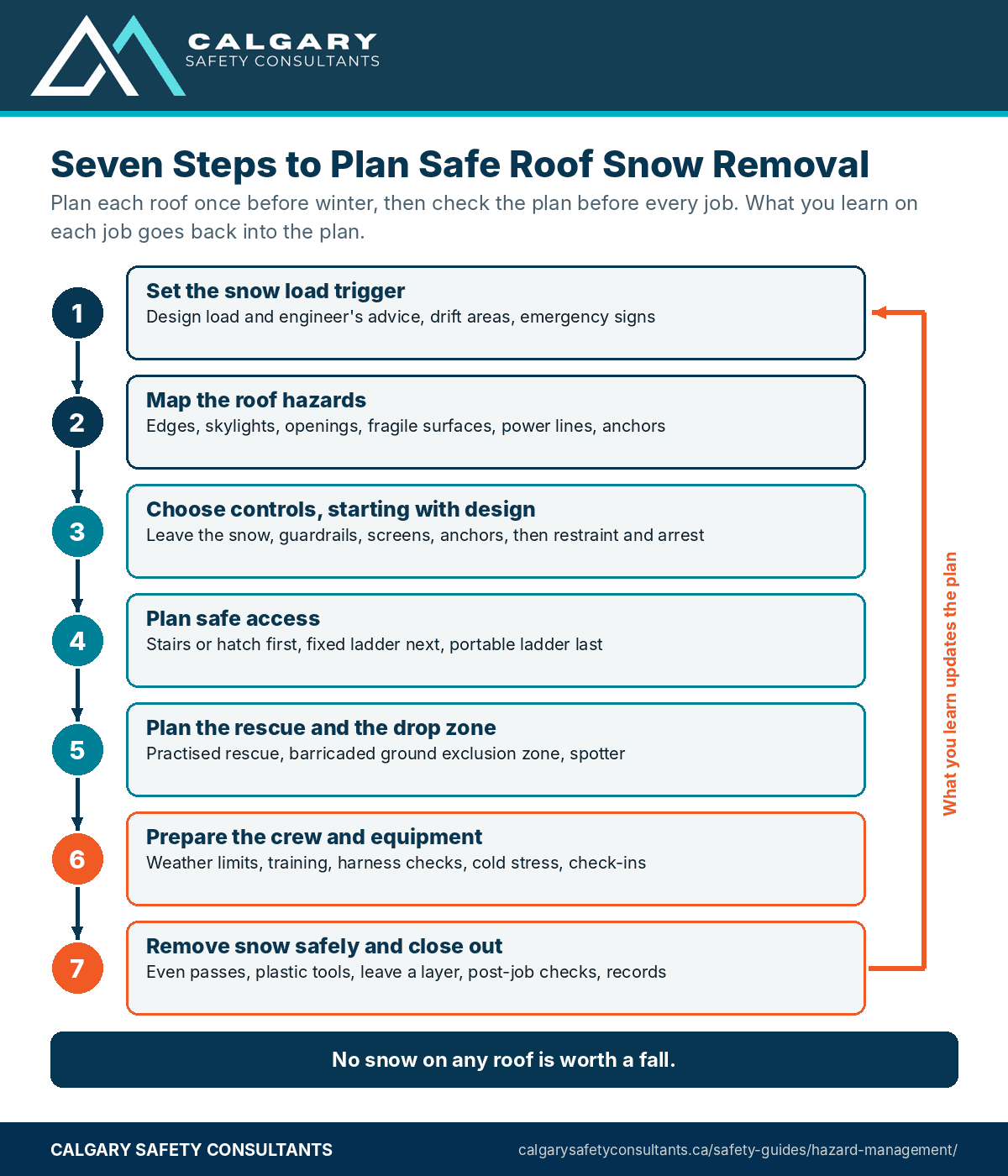
Build the plan with the people who know the roof: your maintenance lead, the contractor, the roofing company and, for load questions, your structural engineer. Involve your health and safety committee or representative too.
Step 1: Set the Snow Load Trigger
Before winter, decide what will trigger removal for each roof, so nobody has to make the call on a dark morning after a storm. Base it on the design snow load and your structural engineer's advice, such as a measured depth in the drift areas, not on a rule of thumb.
Record the engineer's contact details and the areas where snow collects: behind parapets, beside rooftop units and below higher roofs. Those drifts are often the real problem. Also decide what triggers an emergency response, such as visible sagging, and who will clear the area below.
Step 2: Map the Roof Hazards
Walk every roof in the fall and mark up a simple roof plan or aerial photo. Hazards that are hidden in January are easy to see in October. Show:
- unprotected edges, low parapets and changes in level
- skylights, roof hatches, smoke vents and other openings, and whether each has a screen, cover or guardrail
- fragile surfaces, such as fibreglass panels or older plastic domes
- drains and areas where water ponds and freezes
- overhead power lines, rooftop units, vents and gas lines
- permanent anchors and guardrails, with their inspection status
- access points and the areas below the edges where snow will land
Use the map to build a job hazard analysis for the task, add a field-level hazard assessment before each shift on the roof, and mark skylights with tall stakes or flags before snow falls.
Step 3: Choose Controls, Starting with Design
Work down the hierarchy of controls, starting with the options that remove the need to be near an edge at all.
- Eliminate. Confirm the roof can carry the snow and leave it, or use a roof rake from the ground on low roofs. When building or re-roofing, design for the snow, add heat trace cable where ice builds up, and install snow guards over entrances on sloped roofs.
- Engineering controls. Permanent guardrails, skylight screens and covers, and engineered anchors or horizontal lifelines set well back from the edge.
- Administrative controls. Control zones and warning lines where allowed, written procedures, training, supervision and weather limits.
- Personal protective equipment. Travel restraint, then personal fall arrest, plus traction footwear and cold weather clothing.
Travel restraint usually beats fall arrest for snow removal, because the lanyard stops the worker before the edge. Alberta allows a control zone at least 2 metres wide, marked by a raised warning line, only where the surface slopes no more than 4 degrees toward the edge (section 161). SAFE Work Manitoba says roof workers must not work within 2 metres of an edge without fall protection unless guardrails or warning barriers are in place.
Anchors matter. Alberta requires permanent anchors rated for at least 16 kilonewtons per worker, or twice the maximum arresting force, and B.C. requires 22 kilonewtons, certified by an engineer. Never tie off to vents, rooftop units or snow guards. Our blog post on fall protection plans in Alberta walks through choosing systems.
Step 4: Plan Safe Access to the Roof
Getting on and off the roof can be as dangerous as the shovelling itself. Safe roof access starts with an interior stair to a door, then a roof hatch with a guardrail around the opening and a grab bar, then a fixed ladder with a cage or ladder safety system. A portable ladder should be the last choice.
If you do use one, B.C.'s ladder rules are a good benchmark: a ladder to an upper landing should project about 1 metre above it, be secured, sit at about 75 degrees, and nobody should carry heavy or bulky objects up or down. In practice:
- clear and sand the ground at the base, and set the ladder where falling snow won't land
- tie off the top and secure the base, and keep three points of contact while climbing
- hoist shovels and tools up on a line instead of carrying them
- keep the ladder well away from power lines
- check the ladder before each use as part of your pre-use inspections
Keep hatches closed behind the crew, keep the access point out of the drop zone, and make sure workers can get down quickly if the weather turns.
Step 5: Plan the Rescue and the Ground Exclusion Zone
If anyone will use fall arrest, plan the rescue before the job starts. WorkSafeNB's hazard alert on working at heights is direct: a worker who has fallen must be rescued quickly, so a rescue plan must be developed in advance.
Name who will perform the rescue, the equipment, such as a rescue kit or a lift, how they'll reach the worker and how first aid and emergency services will be called. Our guide to first aid requirements covers the first aid side. Practise it in winter gloves. Travel restraint makes rescue much simpler.
On the ground, falling snow and ice can seriously injure people. Before work starts, barricade every area where snow will land, plus a wide margin, because ice bounces and slides. WorkSafeNB says drop areas must be marked to keep pedestrians out, and Ontario's alert says dumping areas should be secured.
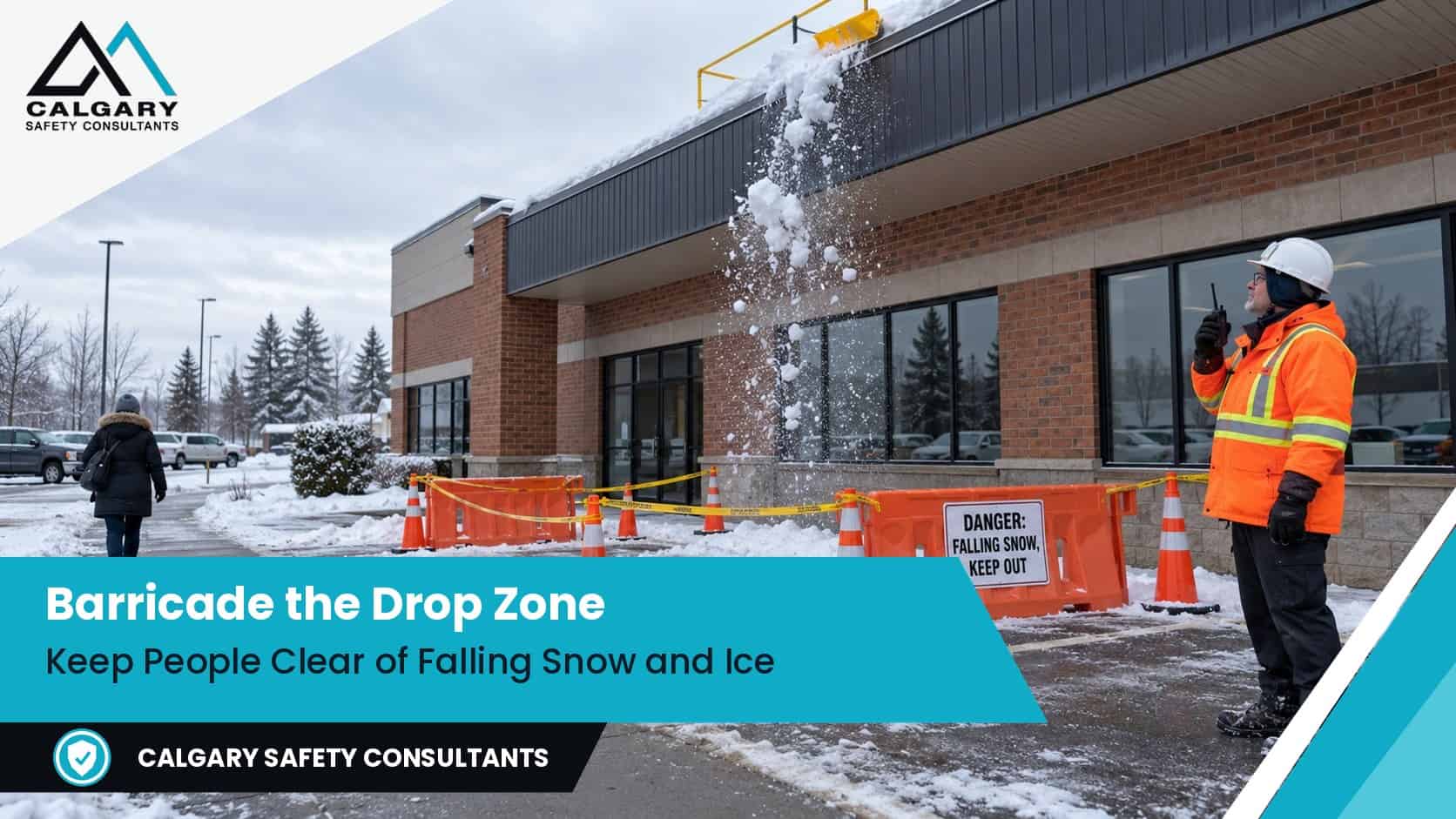
- close or redirect entrances, sidewalks and parking stalls with barricades and tape
- post a ground spotter with a radio, and agree on a stop signal
- move vehicles, and protect gas meters and windows below
- keep the zone closed until the roof work is finished
Our post on controlling falling objects explains how drop zones fit into planning for overhead hazards.
Step 6: Prepare the Crew, Equipment and Communication
Before each job, the supervisor should check the weather, the crew and the gear, and brief everyone on the roof plan.
- Weather limits. Set them in the plan for wind, wind chill, freezing rain, heavy snowfall and visibility, and stop when conditions get worse.
- Training. Alberta requires training in the safe use of the fall protection system and awareness of the hazards particular to the site. Include the rescue plan.
- Harness checks. Inspect every harness, lanyard and connector before use, and remove anything damaged or that has arrested a fall. Ice can jam connectors.
- Tools. Use plastic shovels or pushers, not metal.
- Cold stress. Plan warm-up breaks, a heated place, spare dry gloves and warm drinks. Our article on winter construction and outdoor projects covers cold stress.
Never send anyone onto a roof alone. Use at least two people, plus a ground spotter on larger jobs, and a check-in schedule with someone off the roof. Our guide on how to set up a working alone program explains check-in systems.
Step 7: Remove the Snow Safely and Close Out the Job
How the snow comes off matters. Ontario's alert says removal should avoid uneven or concentrated loads on the roof. WorkSafeNB's rooftop snow removal advice adds that drifted snow should be removed first and cleared in a cross direction to the roof trusses.
- work in balanced passes, following the pattern your engineer approved
- don't pile snow on the roof
- never clear down to the membrane: leave a thin layer, because tools damage roofing and a bare membrane is slippery
- keep clear of skylights, vents and gas lines, and open the drains
- keep mechanized equipment away from edges unless the plan allows it
Watch for overhead power lines. Alberta's overhead power line rules (section 225) require the employer to determine the voltage and set a safe limit of approach before work within 7 metres of an overhead power line. A roof rake or ladder that touches a line can kill.
Afterward, check that everyone is off the roof, hatches are closed and the drop zone is clear before barricades come down. Investigate any near miss using our incident investigation guide, and add what you learned to the plan.
Hiring a Roof Snow Removal Contractor
Hiring out the work is often the right call, but it doesn't hand off the owner's duties. Roof snow removal safety still depends on what you share and who you choose. Before you hire, ask for:
- proof of workers' compensation coverage and liability insurance
- their fall protection plan or procedures for your roof, including rescue
- fall protection training records for the crew
- their approach to weather, cold stress, working alone and the drop zone, and references
Give the contractor your hazard map, anchor records and snow load trigger, and agree in writing who controls the site and, where it applies, who is prime contractor. Our contractor safety guide covers prequalification and monitoring.
Records to Keep
For each roof, keep the plan, hazard map, engineer's advice and anchor certification. For each job, keep the pre-work checklist, hazard assessment, training records, harness inspections, check-in logs and any near miss reports.
Review the plan every fall and after any incident or change. Our workplace safety inspection guide helps you add anchors, guardrails and roof access points to your inspections, and our corrective actions guide covers tracking fixes. It all belongs in your health and safety system, alongside the safe work procedures and PPE program covered in our separate guides.
Workplace example
A Practical Workplace Example
Situation: Consider an illustrative property management company in Alberta that manages a mix of low-rise condo buildings and a small strip mall, with a maintenance team of six. Each winter, a maintenance worker would climb a portable ladder and shovel the mall's flat roof after big storms, usually alone and with no harness. Nobody could say what the roof was designed for, and two skylights near the back were invisible under the snow.
Action: The operations manager asked a structural engineer to review the roof drawings. The engineer set a snow depth trigger for the drift areas beside the rooftop units and confirmed the rest of the roof normally didn't need clearing. Before winter, the company installed skylight screens and two engineered anchors set well back from the edge, replaced the portable ladder with the existing interior hatch, and wrote a roof snow removal plan with a rescue procedure and a drop zone layout.
Workers were trained on travel restraint and the rescue kit, and the company set a two-person rule with a ground spotter and radio check-ins.
Result: The next winter, the crew cleared the roof twice instead of six times, always from the anchors and with the drop zone barricaded. One check-in caught a worker getting cold early, and the supervisor called a warm-up break. The plan now goes out with every contractor quote request.
Common Mistakes to Avoid
- Clearing every roof after every storm. Unneeded trips onto the roof add risk. Use an engineered trigger.
- Forgetting skylights. A buried skylight is a hole in the roof. Mark, screen or cover them before winter.
- Tying off to whatever is handy. Vent pipes and rooftop units aren't anchors.
- Fall arrest with no rescue plan. If nobody can get a suspended worker down quickly, the system is only half done.
- No drop zone. Snow and ice landing on a sidewalk can injure people.
- Uneven removal. Piling snow or clearing one side can overload part of the roof.
- Metal shovels and clearing to the membrane. Both damage the roof and create new slip hazards.
- Working alone. A fall that nobody sees can become a fatality.
- Assuming the contractor has it covered. Ask for their plan, check it and share your hazard map.
Audit perspective
What an Auditor Expects to See
In a COR or SECOR audit, roof snow removal comes up under hazard assessment, hazard control, training and emergency response. Energy Safety Canada's 2023 COR audit protocol asks whether hazards have been identified for each task, with working at heights as an example, whether controls such as engineering, administrative controls and PPE are in place, whether job-specific training and qualifications are confirmed, and whether the emergency response plan includes rescue plans for the scenarios identified.
An auditor will typically look for a current roof snow removal plan, a hazard assessment that names falls, skylights, load and cold stress, fall protection training records, harness and anchor inspection records, a rescue plan that has been practised, and completed checklists from recent jobs. Workers should be able to explain where they tie off, how they'd rescue a co-worker and when they'd stop the job.
Calgary Safety Consultants helps employers build and review their programs and prepare for COR and SECOR audits; we don't issue certificates. CORs and SECORs are issued through the applicable certifying partner.
The Bottom Line
Roof snow removal safety comes down to a few decisions made well before the first storm. Know what each roof can carry and what will trigger removal. Map the edges, skylights and power lines, and fix what you can with guardrails, screens and engineered anchors. Plan safe access, the fall protection method, the rescue and the drop zone.
Then run every job the same way: check the weather and the gear, never work alone, clear the snow evenly with plastic tools, and stop when conditions change. A roof you've planned once, properly, is a roof your crews can clear safely every winter.
Download the Roof Snow Removal Plan Template and Pre-Work Checklist
Two free, fillable PDF downloads go with this guide. Both have clickable checkboxes and fill-in fields, so you can complete them on screen or print them for the crew.
- Roof Snow Removal Plan Template (PDF, 8 pages). A plan for each roof: building and roof details, the snow load trigger and engineer contact, access points, a fall hazard map, fall protection method selection, anchors, the rescue plan, the ground exclusion zone, equipment, weather limits, contractor details, communication and working alone check-ins, review record and sign-off.
- Roof Snow Removal Pre-Work Checklist (PDF, 6 pages). A job-day checklist covering weather, access, anchors, harness inspection, the exclusion zone, rescue readiness, electrical lines and communication, plus an on-roof checklist, post-job checks, a crew sign-on, a fall protection height table for every jurisdiction, common mistakes and sign-off.
Click either button to download the file. Adapt both to your own buildings and the rules that apply in your province or territory, or under the Canada Labour Code.

About the author
John Duplessis, B.Sc., CRSP
John Duplessis is a Canadian Registered Safety Professional with more than 30 years of occupational health and safety experience in oil and gas, construction, green energy, midstream operations and industrial project work. He is an external auditor with Energy Safety Canada.