On this page
- What a Safe Work Procedure Is
- Safe Work Practice vs Safe Work Procedure
- How to Decide Which One a Task Needs
- Why Safe Work Procedures Matter
- Who's Involved
- When the Law Requires Written Procedures
- Comparison of Written Procedure Rules Across Canada
- Eight Steps to Write a Safe Work Procedure
- Step 1: Pick the Tasks From Your Hazard Assessment
- Step 2: Involve the Workers Who Do the Job
- Step 3: Break the Task Into Steps and Find the Hazards
- Step 4: Choose the Controls
- Step 5: Use a Consistent Structure
- Step 6: Write in Plain Language
- Step 7: Test It in the Field
- Step 8: Train, Sign Off and Keep It Current
- A Practical Workplace Example
- Common Mistakes to Avoid
- What an Auditor Expects to See
- The Bottom Line
- Download the Template and Guide
- Frequently Asked Questions
- Related Guides and Articles
- How Calgary Safety Consultants Can Help
- Sources
What a Safe Work Procedure Is
A safe work procedure, often shortened to SWP, tells a worker exactly how to do one task safely, in the order it has to be done. It names the hazards, the controls, the PPE and the training needed, then walks through numbered steps from setting up to cleaning up. Some companies call it a safe job procedure, a standard operating procedure or a work instruction. The name matters less than what's inside it.
Think about changing the blade on a particular saw, entering a specific tank or locking out a conveyor to clear a jam. Each task has a right sequence, and getting it wrong can hurt someone. A procedure captures that sequence so it's done the same safe way every time.
Procedures are an administrative control. They change the way people work, so they sit below elimination, substitution and engineering controls. A procedure doesn't replace a guard or an interlock. It tells people how to use them, and how to work safely around the hazards that are left.
Safe Work Practice vs Safe Work Procedure
This is the distinction that trips people up most, and it matters in a COR audit. In Canadian COR practice, a safe work practice is a general set of guidelines or rules for doing a type of work safely, written as positive and negative statements: do this, don't do that.
A ladder practice, for example, might say to inspect the ladder before use, face it while climbing, keep three points of contact and never stand on the top two rungs. It applies wherever ladders are used, and the order of the rules doesn't matter.
A safe work procedure is narrower. It's a written, step-by-step sequence for one specific task, usually a high-risk or critical task identified by the hazard assessment. The steps have to be done in order. Lockout of a specific machine, entry into a specific confined space and changing a specific blade are classic examples.
The certifying partners and regulators back this up. WorkSafe Saskatchewan defines a safe work practice as a set of guidelines to follow to carry out tasks safely, and a safe work procedure as a step-by-step guide for safely performing a task from beginning to end. It notes that procedures are also called standard operating procedures, safe job procedures or safe work instructions, and that a practice may support a procedure.
The Infrastructure Health and Safety Association in Ontario describes safe work practices as written methods for doing a task with minimum risk, and safe job procedures as a series of specific steps that guide a worker through a task from start to finish in chronological order. Its samples cover topics such as dust, hearing protection and welding fumes, and include a tagging and lockout procedure and traffic control procedures.
| Feature | Safe work practice | Safe work procedure (safe job procedure) |
|---|---|---|
| What it is | General guidelines or rules for doing a type of work safely | A step-by-step sequence for one specific task, from start to finish |
| Scope | Broad: applies to many tasks, jobs or locations | Narrow: one task, often on one machine, tool or location |
| How it's written | Positive and negative statements, the do's and don'ts | Numbered steps in order, each starting with an action verb |
| Order of steps | Doesn't matter; workers apply the rules as the work needs | Matters; steps are followed in the sequence written |
| When you need it | For common work with moderate hazards that workers do in different ways | For high-risk, complex, critical or infrequent tasks the hazard assessment flags |
| Examples | Ladder use, manual lifting, housekeeping, hand tool use, working in cold weather | Lockout of the No. 2 conveyor, entering a specific tank, changing a saw blade, pigging a pipeline |
| How workers learn it | Orientation, toolbox talks, posted rules | Task training, a practical demonstration and sign-off before working alone |
The two work together. A practice can support a procedure, and a procedure can point back to the practices that apply.
Terms Vary Between Regulators
Don't be thrown by the vocabulary. Regulators and certifying partners use different words for much the same thing. You'll see safe work procedure, safe job procedure, safe operating procedure, standard operating procedure, work procedure, written procedure, written instructions and code of practice.
Some terms have special meanings. In Alberta and New Brunswick, a code of practice is a required written document for certain hazards. When a law names a document, use that name in your manual so an officer or auditor can find it quickly.
How to Decide Which One a Task Needs
Not every task needs a written procedure. WorkSafeBC puts it plainly: at a minimum, you must have written procedures for high-risk or complex tasks such as lockout or confined space entry, but not all tasks need detailed written procedures, and some can be covered in crew talks or training. It suggests weighing the hazard level, the number and experience of workers, how often the work is done, how severe an injury could be and recommendations from inspections or investigations.
Ask these questions about each task on your hazard assessment:
- Could a mistake in the order of steps cause a serious injury? If yes, write a procedure.
- Does a law or your certifying partner require a written procedure or plan? If yes, write it to that standard.
- Is the task done rarely, so nobody remembers the steps? Infrequent tasks are often the riskiest.
- Do new or young workers do it? A procedure gives them something to train against.
- Has it gone wrong before, here or somewhere similar? An incident is a strong signal.
- Is it a general type of work done many ways? A safe work practice is probably enough.
Most employers end up with more practices than procedures.
Why Safe Work Procedures Matter
When a task is high risk, memory isn't a control. People get rushed, crews change and the experienced worker who knew every step retires. A good safe work procedure keeps the safe way of working in the company, not in one person's head, and gives supervisors a standard to coach against.
Procedures have limits, though. The UK Health and Safety Executive's guidance on procedures and human factors warns that too much reliance is often placed on procedures to control risk. It recommends a format, style and level of detail that fits the user, the task and the consequences of failure, and it stresses user involvement. That's the right mindset: engineer out what you can, then write procedures people will actually follow.
Written procedures also show due diligence. They show you identified the hazard, chose controls and told workers how to work safely. Our article on whether your safe work procedures are current enough to protect workers covers keeping them up to date.
Who's Involved
Writing a procedure is a team job. Alberta's hazard assessment and control handbook lists developing safe work practices and procedures as an administrative control, and it reminds employers that affected workers must be involved in the hazard assessment because they're in the best position to provide insight.
- Workers who do the job know the real steps, the shortcuts and where things go wrong.
- Supervisors check the procedure against how work is planned, then make sure it's followed.
- The committee or representative reviews procedures and is consulted where the law requires it.
- A qualified person, such as a maintenance lead, engineer or manufacturer's representative, confirms technical steps like energy isolation points.
- Managers approve the procedure and fund the controls.
Our article on how to show worker participation in workplace safety explains how to record that involvement.
When the Law Requires Written Procedures
No Canadian jurisdiction requires a written procedure for every task. The law works in two layers. Many jurisdictions require a health and safety program that includes written work procedures, or a way of deciding which work needs them. Then specific regulations require written procedures or plans for certain hazards, such as lockout, confined spaces, falls, working alone and violence. These summaries are current as of October 2026, so check the official text before relying on them.
Western Canada
Alberta. Section 16 of the OHS Act requires a health and safety program where an employer regularly employs 20 or more workers, or a Director directs it. The OHS Code requires written hazard assessments, a written fall protection plan where a worker may fall 3 metres or more and isn't protected by guardrails (section 140), and a confined space code of practice (section 44) that sets out the procedures workers follow. A workplace violence and harassment prevention plan is also required.
British Columbia. An OHS program is required for employers with 20 or more workers and a moderate or high hazard workplace, or 50 or more workers, and it must include appropriate written instructions available to all workers under section 3.3 of the OHS Regulation. Smaller employers run a less formal program based on monthly meetings.
B.C.'s hazard-specific rules are detailed. Lockout means isolating energy in accordance with a written procedure, and where shutting down equipment for maintenance isn't practicable, workers must follow written safe work procedures (section 10.12). Confined spaces need a written entry program with written safe work procedures.
A written fall protection plan is required where a fall of 7.5 m or more may occur without permanent guardrails. Section 4.21 requires a written check-in procedure for lone workers, and Part 5 requires written procedures to minimize exposure to hazardous substances, with WHMIS training that covers the workplace's safe work procedures.
Saskatchewan. Section 3-20 of the Saskatchewan Employment Act requires a written OHS program at prescribed workplaces with 10 or more workers, as WorkSafe Saskatchewan's guide to OHS program elements explains. Section 3-2 of the OHS Regulations, 2020 requires workers to follow the safe work practices and procedures required by or developed under the regulations.
WorkSafe Saskatchewan lists related sections, including worker training (3-8), and sections that require written plans or procedures: an exposure control plan (6-22), a fall protection plan (9-3), cleaning moving equipment (10-7), a confined space entry plan (18-7) and a fire safety plan (25-2).
Manitoba. Section 7.4 of the Workplace Safety and Health Act requires a written program where 20 or more workers are regularly employed, including a plan for training workers and supervisors in safe work practices and procedures. The Workplace Safety and Health Regulation has sections headed safe work procedures, including section 2.1.1 (general duties), 9.3 (working alone) and 14.2 (fall protection).
For working alone, the province's code of practice explains that procedures must be developed, implemented and posted in a conspicuous place.
Central Canada
Ontario. The guide to the OHSA explains that where more than five workers are regularly employed, the employer must prepare a written health and safety policy, review it at least once a year and maintain a program to implement it. Confined spaces need a written program that includes an entry permit system setting out the measures and procedures to follow, and entry plans. Workplace violence and harassment policies, written where more than five workers are regularly employed, and programs to implement them are also required.
Quebec. Section 58 of the Act respecting occupational health and safety requires a prevention program for each establishment with at least 20 workers, and for smaller establishments in the cases set by regulation. Section 51 requires employers to give workers adequate information about the risks of their work and appropriate training, assistance or supervision. Hazard-specific rules, such as those for lockout, are in the Regulation respecting occupational health and safety, so check its current text.
Atlantic Canada
Nova Scotia. Employers with 20 or more employees need an OHS program, and the province's guide to the OHS policy and program says it must include a method for writing safe work procedures, based on an evaluation of work practices.
New Brunswick. Employers with 20 or more employees need a written program that provides for written work procedures and codes of practice, and identifies the types of work that need them, as WorkSafeNB's guide to health and safety programs explains. Its lockout guide adds that every employer must establish a written lockout procedure for equipment and machines.
Prince Edward Island. Where 20 or more workers are regularly employed, the employer needs a written OHS program, reviewed at least annually, that provides for written work procedures and identifies which types of work need them.
Newfoundland and Labrador. The OHS Regulations, 2012 require the OHS program to include a plan for orienting and training workers and supervisors in workplace and job-specific safe work practices, and require a written procedure for checking on people who work alone.
Territories and Federally Regulated Workplaces
Yukon. The Workplace Health and Safety Regulations require lockout procedures to be explained verbally and given in writing to each worker, and a written confined space entry program with written entry procedures and written rescue procedures.
Northwest Territories and Nunavut. The Northwest Territories OHS Regulations require a written program where 20 or more workers work at a site, including a plan for training workers and supervisors in safe work practices and procedures, reviewed at least every three years. Nunavut employers should check the matching sections of Nunavut's OHS Regulations.
Federal. The Canada Labour Code requires a hazard prevention program, and ESDC's hazard prevention program guide notes that employees must acknowledge their hazard prevention education in writing. Confined spaces need dated procedures covering entry and exit, two-way communication, person checks and emergency response.
Comparison of Written Procedure Rules Across Canada
If you work in more than one province or territory, write each procedure to the strictest rule that applies and note any local differences. Our guide to OHS legislation in Canada links to each jurisdiction's laws.
| Jurisdiction | Program-level rule | Examples of written procedures or plans required for specific hazards |
|---|---|---|
| Alberta | Program for 20 or more workers (OHS Act s. 16); written hazard assessments | Fall protection plan at 3 m (Code s. 140); confined space code of practice (s. 44); violence and harassment prevention plan |
| British Columbia | Program with written instructions for all workers (OHS Regulation s. 3.3) for 20 or more workers in moderate or high hazard work, or 50 or more | Lockout to a written procedure (Part 10); confined space program and procedures (Part 9); fall protection plan at 7.5 m (s. 11.3); working alone check-in (s. 4.21); hazardous substances (s. 5.2) |
| Saskatchewan | Written OHS program at prescribed workplaces with 10 or more workers (Saskatchewan Employment Act s. 3-20); workers follow the practices and procedures required or developed (Regulations s. 3-2) | Exposure control plan (6-22); fall protection plan (9-3); cleaning moving equipment (10-7); confined space entry plan (18-7); fire safety plan (25-2) |
| Manitoba | Written program for 20 or more workers, with training in safe work practices and procedures (WSH Act s. 7.4); safe work procedures section in the general duties (Regulation s. 2.1.1) | Working alone procedures, posted (s. 9.3); fall protection (s. 14.2); rope access (s. 28.1.4); diving (s. 43.2) |
| Ontario | Written policy reviewed yearly and a program, where more than 5 workers (OHSA s. 25(2)(j)) | Confined space program with entry permit procedures and plans (O. Reg. 632/05); violence and harassment programs |
| Quebec | Prevention program for establishments with 20 or more workers (s. 58); training and supervision (s. 51) | Hazard-specific rules in the Regulation respecting occupational health and safety |
| Nova Scotia | Program for 20 or more employees, with a method for writing safe work procedures (OHS Act s. 28) | Violence and harassment rules (see the violence and harassment guide) |
| New Brunswick | Written program for 20 or more employees, with written work procedures and the work that needs them (OHS Act s. 8.1) | Written lockout procedure (Reg. 91-191 s. 239); codes of practice, including working alone |
| Prince Edward Island | Written program for 20 or more workers, reviewed yearly, with written work procedures (OHS Act s. 23) | Working alone written procedures |
| Newfoundland and Labrador | Program includes training in job-specific safe work practices (Regulations s. 12) | Working alone check procedure (s. 15) |
| Yukon | No general program rule listed here; check the Workplace Health and Safety Act and Regulations | Lockout procedures in writing to each worker (s. 3.04); written confined space program, entry and rescue procedures (Part 2) |
| Northwest Territories and Nunavut | Written program for 20 or more workers at a site, with training in safe work practices and procedures (NWT s. 21) | Written harassment policy (NWT s. 34) and, where violence is a risk, a written violence policy (s. 35); Nunavut: check matching sections |
| Federal | Hazard prevention program (Canada Labour Code; COHSR Part XIX); hazard prevention education acknowledged in writing | Dated confined space procedures (COHSR s. 11.04) |
Summary only. Each set of rules has definitions, thresholds and exemptions not shown here, and many other regulations also require procedures. Check the current legislation for your jurisdiction.
Eight Steps to Write a Safe Work Procedure
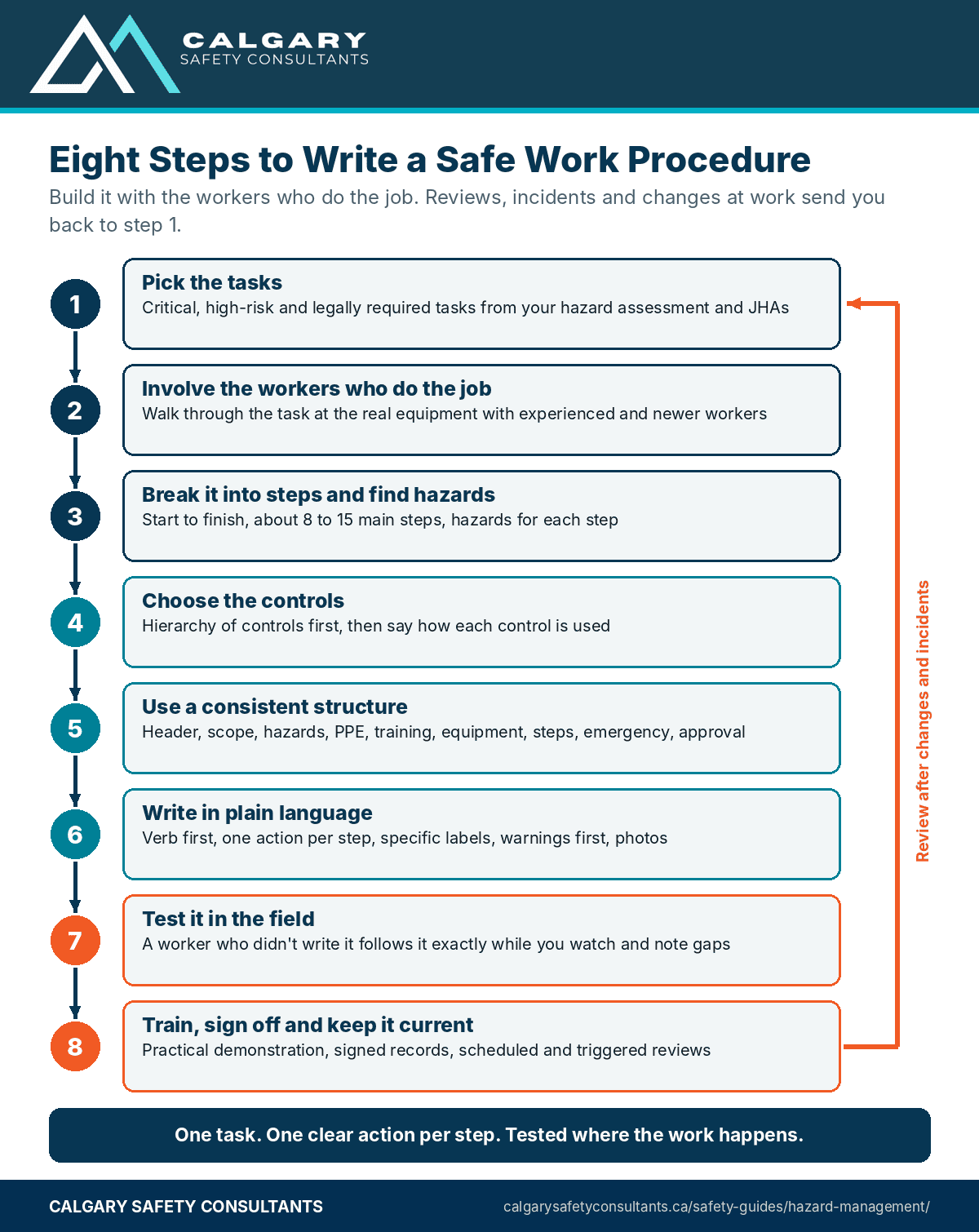
Whatever you call it, a good safe work procedure comes together in eight steps. The last step loops back to the first, because every review, incident or change at work is a reason to look at the procedure again.
Step 1: Pick the Tasks From Your Hazard Assessment
Start with what you already know. Your formal hazard assessment and each job hazard analysis show which tasks carry the highest risk. Rank them, and write procedures for the critical tasks first: the ones where a missed step could kill or seriously injure someone, the ones the law covers and the ones that have gone wrong before. Our companion guides on completing a formal hazard assessment and assessing risk with a risk matrix walk through the ranking.
Keep a simple inventory of every task, whether it needs a practice or a procedure, who owns it and when it's due for review. Auditors look for that link. The go2HR COR toolkit says procedures need to flow from the risk assessments, and its auditors compare a sample of safe work practices and job procedures against the hazard assessments.
Step 2: Involve the Workers Who Do the Job
Never write a procedure at a desk alone. Sit down with two or three workers who do the task regularly, ideally including one experienced worker and one newer worker. The experienced worker knows the real steps and the tricks. The newer worker will tell you which steps aren't obvious.
Ask them to walk you through the task at the actual machine, and ask what goes wrong and where they've seen near misses. Record who took part, because audit tools ask whether workers were involved.
Step 3: Break the Task Into Steps and Find the Hazards
List the basic steps from start to finish: preparing, setting up, doing the work, finishing and cleaning up. Aim for roughly eight to fifteen main steps. If you have forty, the task is probably two or three procedures. If you have three, you may have a practice, not a procedure.
For each step, ask what could hurt someone: stored energy, moving parts, pinch points, sharp edges, heavy loads, chemicals, heat, falls or nearby traffic. If you already have a JHA for the task, build on it.
Step 4: Choose the Controls
Before you write how to work around a hazard, ask whether you can remove it. Use the hierarchy of controls: eliminate, substitute, engineer, then administrative controls and PPE. A procedure that tells workers to keep their hands clear of an unguarded nip point is a weak substitute for a guard.
Once the controls are chosen, the procedure should say exactly how each one is used at the right step: where the isolation points are, how to verify zero energy, which permit is needed, where the PPE is kept and when it goes on. Keep the pre-use inspection of tools and equipment as an early step.
Step 5: Use a Consistent Structure
Use the same layout for every procedure so workers know where to look. A complete safe work procedure usually includes:
- Header: title, procedure number, version, department, location and the equipment it covers
- Purpose and scope: what the task is, and where it does and doesn't apply
- Hazards and controls: a short summary of the main hazards and how they're controlled
- PPE: what's required, when it must be worn and where to find it
- Training and competency: who's allowed to do the task and what they must have completed
- Tools, equipment and permits: everything needed before starting
- Steps in order: numbered, with the hazard and control beside each step
- Emergency steps: what to do if something goes wrong, and who to call
- References: legislation, manufacturer's manual, related practices and forms
- Approval and review: who wrote it, who approved it, the date and the next review date
For comparison, the US lockout standard, 29 CFR 1910.147, requires energy control procedures to be documented with a statement of intended use, specific steps for shutting down, isolating and securing equipment, steps for placing and removing locks, and steps for verifying isolation, with an inspection at least annually. That's a useful benchmark for any critical task.
Step 6: Write in Plain Language
Write for the person doing the job at 2 a.m., with gloves on, in a noisy shop. WorkSafeNB's guide recommends writing what to do in step-by-step instructions, avoiding what not to do, adding a brief explanation of why, and writing controls as actions. These habits help:
- Start each step with a verb. Isolate, verify, remove, install, torque, inspect.
- Put one action in each step. If a step has the word "and" twice, split it.
- Be specific. "Open breaker MCC-2, cell 4" beats "isolate the power."
- Put warnings before the step, not after it, so they're read in time.
- Use short sentences and common words, and the names on the equipment labels.
- Add photos or simple drawings of isolation points, adjustments and correct positions.
Compare "Ensure the machine is safe before blade change" with "Press the stop button. Open disconnect DS-14. Apply your personal lock and a completed tag. Press start to verify the saw won't run, then press stop." The second version can be followed and checked.
Step 7: Test It in the Field
A procedure isn't finished until someone has used it. Have a competent worker who didn't help write it follow the draft exactly at the real equipment while you watch. Don't coach. Every time they hesitate, ask a question or do something the procedure doesn't say, you've found a gap.
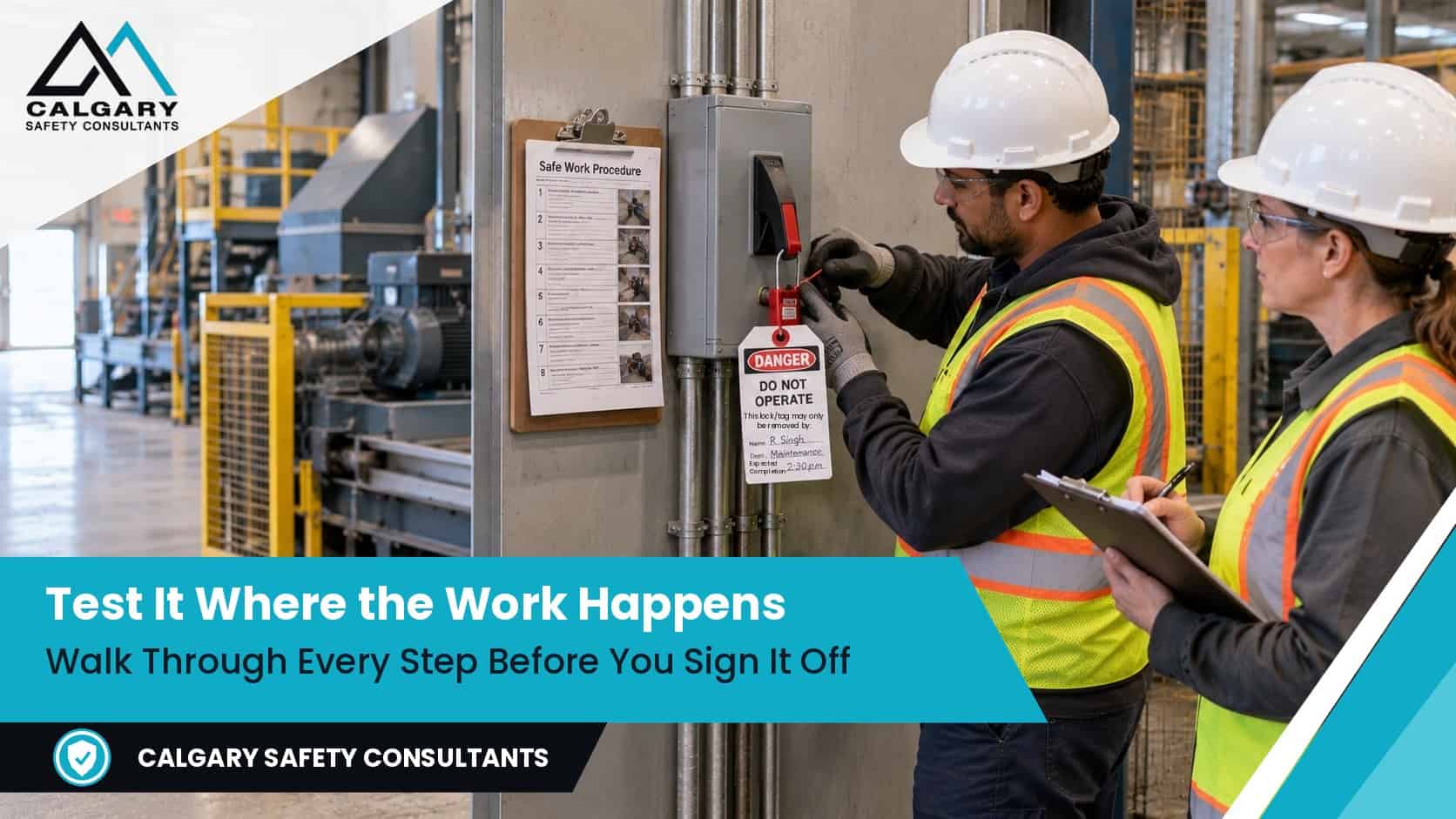
Record who tested it, the date, the problems found and the changes made, then fix the draft and, for critical tasks, test it again. Field testing also catches steps that don't fit the real layout, like a valve that can't be reached without a ladder.
Step 8: Train, Sign Off and Keep It Current
Once the procedure works, approve it, issue it with a version number and train everyone who does the task, including a practical demonstration. Energy Safety Canada's 2023 COR audit protocol asks for a formal job-specific training process that covers job-specific hazards and controls, any applicable work procedures or practices, and a practical demonstration by the trainee.
Have each worker sign that they've been trained and understand the procedure, and add it to your safety training matrix and new worker orientation where it applies. Make it easy to find at the work location, on paper, a tablet or a QR code at the machine.
Review the procedure on a set schedule, such as every one to three years depending on risk and your jurisdiction, and whenever:
- equipment, materials, the layout or the process changes
- an incident or near miss involves the task, as your incident investigation may show
- an inspection, audit or worker raises a concern, or workers are using a workaround
- the law, the manufacturer's instructions or your certifying partner's standard changes
Record each review, even if nothing changed, remove old copies and retrain workers on what's different. Track fixes like any other corrective action.
Workplace example
A Practical Workplace Example
Situation: Consider an illustrative millwork and cabinet shop in British Columbia with about 30 workers. Its manual had a document called "Saw Safety" that mixed general rules with a few blade-change steps. When a worker cut his hand while changing a blade on the panel saw, the investigation found he'd isolated the saw at the start button, not the disconnect, because that's how he'd been shown.
Action: The production manager and the joint committee split the old document in two. A safe work practice for all saws kept the general rules: guards in place, push sticks, no loose clothing, housekeeping. Then they wrote a separate safe work procedure for changing the blade on each saw, with two operators and a maintenance lead.
Each procedure named the disconnect by its label, showed photos of the isolation point and put one action in each step. A newer operator who hadn't helped write it tested each draft at the saw and found two steps out of order and a missing step, which they fixed before training everyone and recording sign-offs.
Result: The shop now has a short list of procedures for its critical tasks, each tied to its hazard assessment, with a review date and training records. In the following year, the committee's monthly spot checks found operators following the procedures as written, and workers could describe the steps in their own words during COR audit interviews.
Common Mistakes to Avoid
- Calling a list of rules a procedure. If the order doesn't matter, it's a practice. Critical tasks need real step-by-step procedures.
- Writing procedures for everything. Focus on the critical tasks.
- Writing at a desk. Procedures written without the workers who do the job miss the real steps.
- Vague steps. "Make sure it's safe" or "use caution" can't be followed or checked.
- Several actions in one step. Long steps hide the action that gets missed.
- Using a procedure instead of a better control. Fix the hazard first, then write the procedure.
- Skipping the field test. The first real use shouldn't be the first test.
- Training once, then forgetting it. Without a practical demonstration and sign-off, you can't show workers know it.
- Old copies everywhere. Remove outdated versions.
Audit perspective
What an Auditor Expects to See
In a COR or SECOR audit, safe work practices and procedures usually come up under hazard control, training and interviews. Energy Safety Canada's protocol expects a hazard control process that gives high hazard items priority, asks whether hazards are controlled with administrative controls where applicable or required by legislation, and expects job-specific training to cover applicable work procedures or practices with a practical demonstration.
Other certifying partners, like go2HR in B.C., compare a sample of procedures against the hazard assessments and interview workers who helped write them.
An auditor will typically look for procedures that match the hazards in your assessments, evidence that workers were involved, current versions at the work location, training records with sign-off, and supervisors who check the procedures are followed. In interviews, workers should be able to describe the steps for their critical tasks, and observations should show the work done the way the procedure says.
Calgary Safety Consultants helps employers write procedures and prepare for COR and SECOR audits; we don't issue certificates. CORs and SECORs are issued through the applicable certifying partner.
The Bottom Line
A safe work practice tells workers the rules for a type of work. A safe work procedure tells them the exact steps for one critical task. Most employers need both, and knowing the difference keeps your manual focused and makes your audit easier to prepare for.
Pick your critical tasks from the hazard assessment, write each safe work procedure with the people who do the work, put one clear action in each step, test it where the work happens, train and sign off everyone who uses it and review it whenever the work changes. A procedure earns its place the day a worker follows it exactly and goes home unhurt.
Download the Safe Work Procedure Template and Practice vs Procedure Guide
Two free, fillable PDF downloads go with this guide. Both have clickable checkboxes and fill-in fields, so you can complete them on screen or print them for the shop floor.
- Safe Work Procedure Template (PDF, 8 pages). A complete template with how-to-use notes, a header and approval block, a hazard and control summary, PPE and training requirements, a numbered step table with the hazards and controls for each step, emergency steps, a field test record, worker review and sign-off, a review log and a short worked example.
- Safe Work Practice vs Procedure Guide and Checklist (PDF, 8 pages). A side-by-side comparison, a decision tool for choosing a practice or a procedure, a writing quality checklist, common mistakes, a review checklist and a procedure inventory register.
Click either button to download the file. Adapt both to your own workplace and the rules that apply in your province or territory, or under the Canada Labour Code.

About the author
John Duplessis, B.Sc., CRSP
John Duplessis is a Canadian Registered Safety Professional with more than 30 years of occupational health and safety experience in oil and gas, construction, green energy, midstream operations and industrial project work. He is an external auditor with Energy Safety Canada.