Safety Guide
How to Plan Safe Roof Access and Snow Removal
Roof snow removal safety for owners and property managers: snow load triggers, safe roof access, fall protection rules by province, rescue and free templates.
Tell us what's happening and we'll recommend the next practical step.
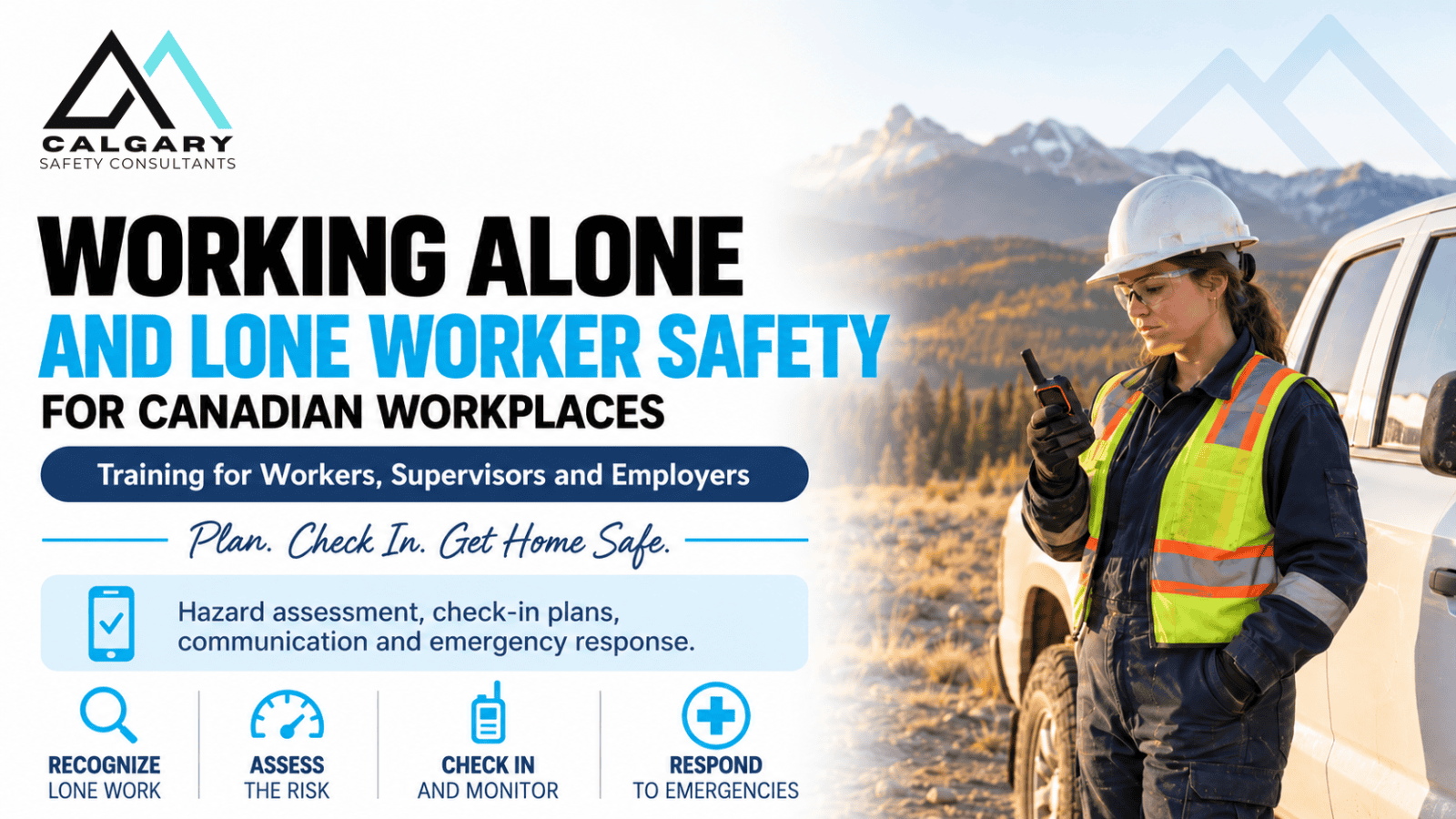
Table of Contents
Our online working alone training shows Canadian workers, supervisors and employers how to recognize lone work, assess the hazards, put practical controls in place, and make sure help arrives when something goes wrong. This self-paced online course covers what working alone means under Canadian law, lone-worker hazard and risk assessment, deciding whether work may be done alone, communication equipment, check-in plans, missed check-ins and emergency response, personal security on home visits, remote and vehicle-based work, after-hours facility work and stop-work decisions, using realistic examples from oil and gas, construction, utilities, health care, retail, agriculture and more.
Need training for your team? For online group training, buy your enrolments here, then complete our Group Training Student Information form so we can set up each worker’s account. For live virtual or onsite group sessions built around your own procedure, see our working alone training page. If you’d like help assessing lone work or building your working-alone procedure, see our hazard assessments, JHAs and workplace inspections consulting services.
Learn more about how our online safety training works.
A slip, fall, medical event, violence exposure or equipment incident can become more serious when help is delayed. A well-designed lone-worker process can reduce that delay and support more consistent planning, monitoring and response. Results depend on the actual hazard assessment, controls, equipment, supervision and emergency response; training and check-in records do not guarantee safety or establish compliance, due diligence or audit readiness.
This is foundation-level (awareness) training. It supports, but doesn’t replace, the employer’s workplace-specific hazard assessment, lone-worker procedure, emergency response plan, task-specific training, supervision and competency verification. It doesn’t qualify or authorize anyone for high-risk work such as confined space entry, fall rescue, energized electrical work or hot work.
The employer must determine whether the work meets the governing definition of working alone or in isolation, assess the specific task and location, and decide whether lone work is permitted. Eliminating lone work, assigning another person or changing the work should be considered before relying on check-ins or personal protective equipment.
Delivery: 100% online and self-paced
Course format: 16 narrated video lessons in four modules, with written lesson notes, workplace examples and knowledge checks
Course length (estimated): About 3.5 to 4 hours, including just over 3 hours of lesson video plus the knowledge checks
Assessment: A three-question knowledge check after every lesson (100% to continue)
Resources: Downloadable Student Reference Guide, available after purchase
Certificate: Certificate of Completion issued after you finish all required course steps
Price: $34.99 CAD plus GST
Level: Foundation (awareness)
Audience: Workers who work alone, supervisors, contact persons, dispatchers and employers across Canada
Workplace training: Your employer’s site-specific instruction is still required
This online working alone training follows the full lone-work cycle: recognize the lone work, assess the hazards, decide whether the work may be done alone, plan the controls and check-ins, respond when something goes wrong, and keep improving the plan. Each lesson connects the method to decisions you make on the job.
You’ll learn how to:
Every lesson includes written notes, a real-world example, a decision point and a knowledge check, so learners practise applying the plan rather than memorizing rules.
Canada has one federal, 10 provincial and 3 territorial occupational health and safety jurisdictions. Definitions, prohibited activities, hazard-assessment duties, check-in requirements, consultation, training, records and review requirements differ. Alberta OHS Code section 393 applies when assistance is not readily available and treats working alone as a hazard for Part 2; section 394 requires an effective communication system or, where electronic communication is not practicable, visits or worker contact at intervals appropriate to the hazard. British Columbia OHS Regulation sections 4.20.1 to 4.23 contain a separate framework for working alone or in isolation.
Jurisdiction depends on the employer and industry as well as location. Federally regulated workplaces use the Canada Labour Code, Part II and the applicable regulations; provincial or territorial rules generally govern other workplaces. Federal interpretation policy IPG-059 states that no general Code provision prohibits all lone work, but specific federal regulations prohibit certain work from being done alone and each case requires assessment. The linked Alberta, British Columbia and federal sources were reviewed on November 6, 2026. The course introduces broadly applicable principles, does not determine compliance and is not approved or recognized by a regulator.
This course is built for anyone who works alone, supervises lone workers or keeps track of them, whether that’s a technician heading to a remote site or a dispatcher watching the check-in board.
It’s suitable for:
Lessons are written for a mixed audience. Some sections speak directly to employers and supervisors, such as testing the plan or handling a shift handover, while every lesson explains what workers should do on the job. Employers often use the course for orientation, for supervisor and dispatcher training, or as a common starting point before rolling out a new working-alone procedure.
Our online working alone training is designed to be practical and easy to follow.
Course features include:
The course introduces practical considerations for assessing whether help is readily available, understanding risk-based check-in intervals, conducting a clear check-in and recognizing when work should stop for direction. Actual intervals, contacts and escalation steps must come from the employer’s authorized procedure.
The course is organized into four modules of four lessons each. Each lesson is one complete narrated video with written notes and a knowledge check.
The first module explains what working alone means, why it changes risk, who is responsible for what, and how the rules differ across Canada.
Lessons:
By the end of this module, learners can recognize possible lone work and identify the official and workplace sources needed to confirm the applicable duties.
The second module turns lone work into an assessment and a decision.
Lessons:
Learners use the 12 CSC Energy Sources as a prompt, consider delayed assistance and compare potential controls using the hierarchy of controls. Employer-specific criteria and authorization govern the actual decision.
The third module covers the systems that get help to a lone worker in time.
Lessons:
Learners examine check-in and missed-check scenarios and personal-security considerations for home and community visits. The employer must establish, resource, test and authorize the actual procedures.
The final module puts the plan to work in the settings where lone work happens most.
Lessons:
Learners finish with a pre-work prompt to compare with the employer’s authorized process before a shift alone. It does not replace a workplace assessment or approval.
Register online, then work through the lessons in order at your own pace. After each video, complete the lesson’s three-question knowledge check. You need all three answers correct (100%) to move on, and you can retry the knowledge check as many times as you need.
There’s no separate final exam. Once you’ve completed all 16 lessons and knowledge checks, and any other required course steps, you can download your Certificate of Completion.
The certificate records completion of awareness-level online training. It isn’t a qualification, competency record, regulatory approval or authorization for high-risk work. Employers should pair it with workplace-specific instruction, practical assessment and testing of the worker’s actual communication, monitoring and emergency arrangements. This course is available in English only. Employers in Quebec should check whether French-language training is required for their workers before enrolling them.
The course teaches broadly applicable lone-worker safety principles and selected jurisdictional examples. Definitions and legal duties differ across Canada. It isn’t approved by a regulator and doesn’t replace jurisdiction-specific or workplace-specific assessment, procedures and training.
Yes. You receive a Certificate of Completion after you complete all 16 lessons and their knowledge checks. It records completion of awareness-level online training; it doesn’t certify or qualify you for high-risk work.
We estimate about 3.5 to 4 hours. The 16 lesson videos run just over 3 hours in total, and the knowledge checks add time depending on your pace. You can stop and return at any time.
Workers who work alone or in isolation, supervisors who assign lone work, contact persons and dispatchers who monitor check-ins, and the managers, owners and joint health and safety committee members who build and review the lone-worker program.
Yes. Module Three explains factors used to select and test communication equipment, set risk-based check-in intervals, maintain monitoring and respond to a missed check-in. The employer’s authorized procedure sets the actual equipment, intervals, contacts, handovers and escalation steps and must be validated for the workplace.
No. Each lesson ends with a three-question knowledge check that you need to pass at 100% before moving on, with unlimited retries. There’s no separate final exam.
Yes. Employers can buy online training for two or more workers on this page. After placing your order, complete our Group Training Student Information form with your order number and each learner’s name and email address. We set up each learner’s account and email course-access instructions within 24 hours of receiving complete information. Buying 10 or more seats of this course in one order? A 10% group discount is applied automatically at checkout.
No. This course gives a common foundation. Workers still need instruction on their own workplace’s lone-work hazards, procedures, communication equipment and emergency response, plus any practical training and competency verification their tasks require.
The resources below support workplace application. Use them to check the governing requirements, compare a procedure with regulator guidance and identify when specialist support is needed. The official Alberta, British Columbia and federal links were reviewed on November 6, 2026. Requirements can change, and the Alberta online consolidation carries its own currency disclaimer, so confirm current official legislation before relying on it.
Issued by: Government of Alberta
Sections 393 and 394 define when Part 28 applies, treat working alone as a hazard for Part 2 and require an effective communication system or specified alternative contact where electronic communication is not practicable. Confirm the current official legislation for Alberta work.
Alberta OHS Code, Part 28: Working Alone
Issued by: WorkSafeBC
Sections 4.20.1 to 4.23 define working alone or in isolation and address hazard identification and control, written well-being checks, consultation, records, training, late-night retail requirements, fuel prepayment and annual review. Use the current regulation for British Columbia work.
OHS Regulation, Part 4: Working Alone or in Isolation
Issued by: Employment and Social Development Canada
This federal interpretation policy, effective May 2016 and marked for reference only, discusses Canada Labour Code, Part II, section 124, the federal hazard prevention framework and specific activities that cannot be performed alone under identified regulations. Use it only after confirming federal jurisdiction and checking the current Code and regulations.
Workers Working Alone at a Work Place Under the Control of the Employer (IPG-059)
Issued by: Calgary Safety Consultants
Our consulting support for assessing lone work and building or reviewing your working-alone procedure. Use it when your assessment, check-in plan or audit findings need hands-on help.
Hazard Assessments, JHAs and Workplace Inspections
Issued by: Calgary Safety Consultants
A companion online course on finding hazards, rating risk and choosing controls, including JHAs, FLHAs and toolbox talks. Take it next if you lead or take part in hazard assessments.
Hazard Assessment and Control for Canadian Workplaces
Related courses: Respectful Workplace Training – Worker Edition, Incident Reporting and Investigation Training and OH&S Online Leadership Training.
Take this next
Free Safety Guides
Roof snow removal safety for owners and property managers: snow load triggers, safe roof access, fall protection rules by province, rescue and free templates.
Build a PPE program the right way: hierarchy of controls first, PPE requirements across Canada, fit testing, training and a free worksheet and register.
Use a 5 x 5 risk matrix to rate initial and residual risk as a team, set risk bands and actions, and meet Canadian rules. Free worksheet and Excel calculator.