How to Prepare for a COR Audit
How to get your safety management system, records and people ready for a COR certification audit, element by element.
Coming soon
Practical guides to COR and SECOR certification and contractor prequalification: how the programs work, how to prepare for audits and interviews, and how to keep your status current. Written for employers and safety coordinators anywhere in Canada.
Prepared by Calgary Safety Consultants, led by John Duplessis, B.Sc., CRSP.
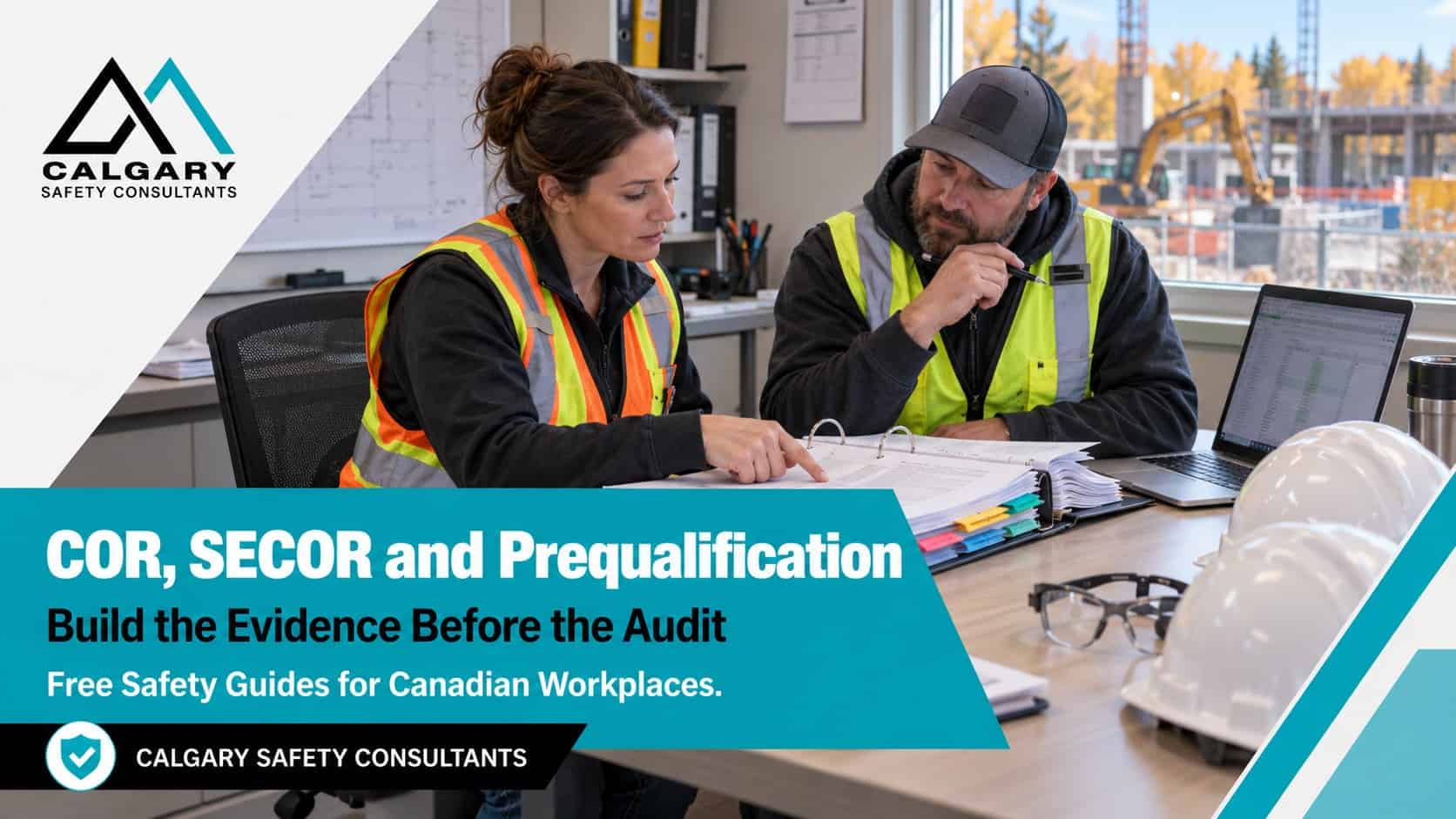
COR, SECOR and prequalification guides
Every guide in this category explains how a part of COR and SECOR preparation or prequalification is done well, with the program rules linked at the point they matter and free downloads you can adapt. Guides marked coming soon open here as they're published.
How to get your safety management system, records and people ready for a COR certification audit, element by element.
Coming soonHow small employers build the program and records a SECOR self-assessment needs, and what the certifying partner looks for.
Coming soonHow to gather the documents, statistics and program evidence clients ask for, and keep your prequalification current.
Coming soonHow to help workers and supervisors explain the safety program in their own words, without scripts or coaching.
Coming soonHow to plan and complete the maintenance audits that keep a COR valid between certification audits.
Coming soonHow to organize the records that prove each element of your program, so the evidence is easy to find on audit day.
Coming soonAbout COR and SECOR
A Certificate of Recognition, or COR, shows that an employer's health and safety management system has been audited against an established standard and met it. SECOR is the small employer version.
COR and SECOR programs are voluntary. They're run through partnerships between regulators, workers' compensation boards and industry safety associations, which act as certifying partners: they set the audit standard, train auditors and review audits. The details differ by province and industry, but the idea is the same everywhere. Build a safety system that works, then prove it through an audit that combines document review, interviews and observation.
Where SECOR exists, it's built for small employers. In Alberta, SECOR is for businesses with up to 10 employees and uses a self-assessment that the certifying partner reviews, while COR uses an external audit. Saskatchewan's construction SECOR is for employers with nine or fewer employees. British Columbia doesn't use the SECOR name, although some of its certifying partners offer a small-employer COR.
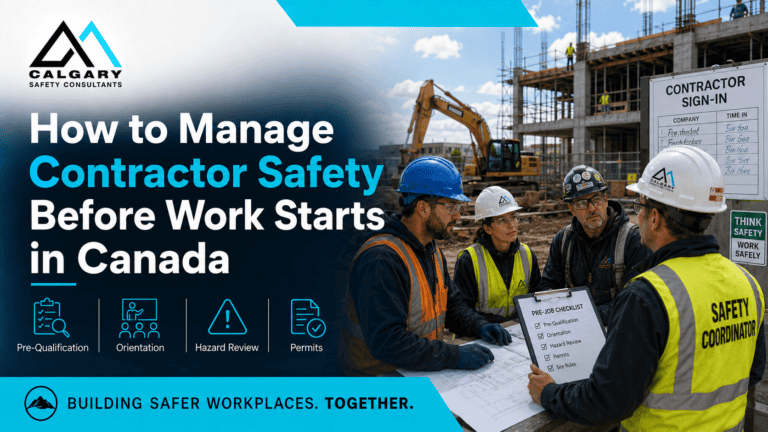
Prequalification is the other half of this category. Many owners and general contractors won't let a contractor bid or start work until it has shown its safety program, injury statistics and certifications, often through an online platform. Some government owners make COR mandatory: Alberta Infrastructure requires a valid COR or Temporary Letter of Certification for construction procurements of $100,000 or more.
For many contractors, COR and SECOR are the price of admission to bigger projects. They can lower premiums, too. In Alberta, WCB pays a refund to employers who earn and keep a COR, and WorkSafeBC pays eligible COR holders an incentive based on their premiums. Above all, the work of getting certified tends to leave a business with a clearer, more consistent safety program.
The evidence that COR makes a difference is growing. A 2026 study in the Journal of Safety Research by Macpherson and McLeod matched 346 certified Ontario firms with 310 non-certified firms and found 28% lower lost-time injury rates among certified firms, with weaker effects in small and non-construction firms. An Institute for Work & Health summary of research in British Columbia and Alberta found that COR firms saw a 12 to 14 per cent greater reduction in lost-time injury rates, but found no effect for Alberta's SECOR firms. Certification works best when it reflects a real system, not a binder built for the audit.
How it works
Whatever the province or industry, earning and keeping COR or SECOR follows the same five steps.
Find the certifying partner for your industry and province, register and complete the training it requires. Its audit standard tells you exactly what will be measured and how.
Compare your program with each audit element, from management commitment and hazard assessment to inspections, emergency response and investigations, and fix what's missing. If you're starting from scratch, Alberta notes that it may take 12 months or more.
Use the program day to day: hazard assessments, inspections, meetings, training and investigations. Auditors look for consistent records over time, so months of steady evidence beat a binder written the week before.
The certification audit reviews documents, interviews workers and supervisors at every level and observes workplace conditions and practices. In Alberta, you need at least 80% overall and 50% in each element to pass.
Act on the audit's recommendations, complete maintenance audits on schedule and recertify when the cycle ends. A missed maintenance audit can cost you the certificate.
Audit elements vary slightly from one certifying partner to the next, but they cover the same ground. Alberta's Partnerships in Injury Reduction program lists nine components: hazard identification and analysis, control measures, management commitment and policy, worker competency and training, the inspection program, emergency response planning, incident reporting and investigation, system administration, and the joint health and safety committee. Most of the categories in our Safety Guides map directly onto one of them.
Program rules
COR isn't required by OHS law, but it runs under clear program rules set by regulators, boards and certifying partners, and those rules differ by province and industry.
In Alberta, a certifying partner reviews the audit, then asks the Government of Alberta to issue the COR, which both sign. The province's guide to getting a Certificate of Recognition sets the pass mark at 80% overall and 50% per element, and explains that audits include interviews at all levels, a document review and observation. One rule matters for anyone using outside help: a consultant who helped develop your health and safety management system can't carry out your audit.
An Alberta COR stays valid for three years if maintenance audits are completed in each of the two calendar years after certification, with a pass mark of 60%. WCB-Alberta pays a refund of 10% of the industry rate in the first year and 5% in each year the COR is maintained, and performance measures can raise it to a maximum of 20%.
In British Columbia, WorkSafeBC issues COR, working with certifying partners that register employers, provide training and supply audit tools. Certificates are typically valid for three years, with annual maintenance audits and a recertification audit at the end. Eligible employers receive an incentive of 10% of base assessment premiums for each classification unit in their COR.
In Saskatchewan, the Saskatchewan Construction Safety Association administers COR and SECOR for construction, with an initial external audit, annual internal audits and an SCSA audit every three years. Energy Safety Canada runs COR and SECOR for oil and gas employers in Alberta, British Columbia and Saskatchewan. Construction COR is nationally registered and trademarked through the Canadian Federation of Construction Safety Associations, but it must be granted in each province or territory where you work.
| Program | Who issues or administers it | Certification cycle and incentives |
|---|---|---|
| Alberta | The Government of Alberta issues COR, co-signed by the certifying partner. SECOR is for businesses with up to 10 employees. | Valid for three years, with maintenance audits in years two and three (60% pass mark). WCB refund of 10% in the first year, then 5% a year, up to 20%. |
| British Columbia | WorkSafeBC issues COR. Certifying partners register employers and provide training and audit tools. | Typically valid for three years, with annual maintenance audits. Incentive of 10% of base assessment premiums for eligible employers. |
| Saskatchewan construction | The Saskatchewan Construction Safety Association administers COR and SECOR. SECOR is for nine or fewer employees. | An initial external audit, annual internal audits and an SCSA audit every three years. |
| Oil and gas (AB, BC, SK) | Energy Safety Canada acts as the certifying partner. SECOR is for 10 or fewer employees. | A three-year cycle, with maintenance audits in years two and three. |
Prequalification connects to real legal duties. Under Alberta's OHS Act, construction and oil and gas work sites with two or more employers must have a prime contractor, who must have a system or process to ensure compliance, and British Columbia's Workers Compensation Act sets similar prime contractor duties. That's why owners and general contractors look so closely at a contractor's safety program before work starts, and why the BC Construction Safety Alliance notes that many general contractors require a recognized safety program as a prequalification to bid.
The OHS law itself still applies whether or not you hold a COR. Our OHS Legislation category links the Act, regulations and regulator for all 14 jurisdictions in Canada, and explains how to read them.
From our audits
Most employers who struggle with COR and SECOR audits have a safety program. What they're missing is the evidence that it runs, every day, at every level.
Each of these is fixable once you see it. The guides on this page show how to prepare for COR and SECOR the right way, by building a program that produces its own evidence.
Free downloads
These free tools support several audit elements at once. Adapt them to your work and your certifying partner's standard.
From the blog
July 30, 2026
July 6, 2026
June 29, 2026
April 16, 2026
When to bring in help
The guides are written so you can act on them yourself. Sometimes it helps to have an experienced safety professional look at your program, especially when a client has asked for COR by a deadline, an audit is coming up or a maintenance audit didn't go well.
Calgary Safety Consultants helps employers prepare for COR and SECOR. We run gap reviews against your certifying partner's standard, build or update the program, hold mock audits and interview practice, support maintenance audits and help contractors set up and keep prequalification current. Our consulting focuses on Alberta, British Columbia and Saskatchewan, and our online training and free downloads are available anywhere in Canada.
We help employers prepare for COR and SECOR audits, but we don't issue certificates or guarantee certification. CORs and SECORs are issued through the applicable certifying partner.
Common questions
Answers to the questions employers and safety coordinators ask most often about COR and SECOR certification and contractor prequalification.
A Certificate of Recognition, or COR, shows that an employer's health and safety management system has been audited against an established standard and met it. COR programs are voluntary and run through partnerships between regulators, workers' compensation boards and industry safety associations. Many owners and general contractors treat COR as a sign that a contractor's safety program is real and working.
SECOR is a version of COR designed for small employers. In Alberta, SECOR is for businesses with up to 10 employees and uses a self-assessment reviewed by the certifying partner, while COR uses an external audit. Thresholds vary: Saskatchewan's construction SECOR is for nine or fewer employees, and Energy Safety Canada's is for 10 or fewer. Check your certifying partner's rules.
It depends on the province. In Alberta, the certifying partner reviews the audit and asks the Government of Alberta to issue the COR, which both of them sign. In British Columbia, WorkSafeBC issues COR, working with certifying partners. In Saskatchewan construction, the Saskatchewan Construction Safety Association administers COR and SECOR. Consultants can help you prepare, but they don't issue certificates.
Not by law. COR programs are voluntary, but many clients make COR a condition of work. Alberta Infrastructure requires a valid COR or Temporary Letter of Certification for construction procurements of $100,000 or more, and Alberta Transportation makes it mandatory for certain highway, bridge, water and high-hazard work. Many private owners and general contractors set the same requirement.
It depends on where you're starting. Alberta notes that it may take 12 months or more if you don't yet have a health and safety management system. Auditors look for records over time, and some programs expect around 12 months of documentation for a full-term certificate. If your system is already working well, the timeline is mostly training, the audit and the partner's review.
In Alberta and under most partner standards, you need at least 80% overall and at least 50% in each audit element. The per-element minimum matters, because one weak element can sink an otherwise strong audit. Maintenance audits in Alberta need 60% overall. Your certifying partner's audit instrument sets out exactly how each question is scored and verified.
Usually three years. In Alberta, a COR is valid for three years from the date of issue if maintenance audits are completed in each of the two calendar years after the certification audit. WorkSafeBC describes certificates as typically valid for three years, with annual maintenance audits and a recertification audit at the end. New employers may receive a one-year certificate.
You risk losing the certificate. Maintenance audits are a condition of keeping COR valid, and Energy Safety Canada, for example, declares a COR invalid if a maintenance audit is missed, which means starting again with a new external audit. Put maintenance audit dates in your calendar as soon as you're certified, and leave time for the partner's review.
Auditors interview people at every level, from senior managers and supervisors to workers, including part-time and casual staff. The number depends on the size of the workforce, and partners such as Energy Safety Canada set minimum sample sizes. Interviews check whether the program works in practice, so workers should be able to explain hazards, controls and procedures in their own words.
Not in Alberta. The province is clear that if a consultant helped you develop your health and safety management system, that consultant can't carry out your audit. Auditors must also be certified or recognized by your certifying partner. A consultant can still help you prepare, run a gap review or a mock audit, and support you through the process.
In Alberta, WCB pays a refund of 10% of the industry rate in the first year of COR and 5% in each year it's maintained, with performance measures able to raise it to a maximum of 20%. In British Columbia, eligible COR holders receive 10% of their base assessment premiums for each classification unit covered. Conditions apply, so check with your board.
Not automatically. For construction, COR is nationally registered through the Canadian Federation of Construction Safety Associations, but it must be granted in each province or territory where you work, through equivalency or reciprocity. Other industries have their own arrangements. Before bidding on out-of-province work, check with your certifying partner and the partner in the other province.
Prequalification is the process owners and general contractors use to check a contractor's safety performance before work starts. It usually involves submitting your safety program, injury statistics, certifications such as COR, insurance and workers' compensation clearance, often through an online platform such as ISNetworld, Avetta or ComplyWorks. Requirements vary by client, so keep your documents current.
Yes. We help employers prepare for COR and SECOR with gap reviews, program development, mock audits, interview practice and maintenance audit support, and we help contractors set up and maintain prequalification. We don't issue certificates or guarantee certification. CORs and SECORs are issued through the applicable certifying partner. Book a free consultation to talk through where you're starting from.
Talk to a safety consultant
Whether you're starting from scratch, closing gaps before an audit or setting up prequalification for a new client, we'll help you work out the next practical step. Complete the form below or book a 30-minute consultation.