Unsafe Contractor Work: OH&S Pre-Qualification Best Practices
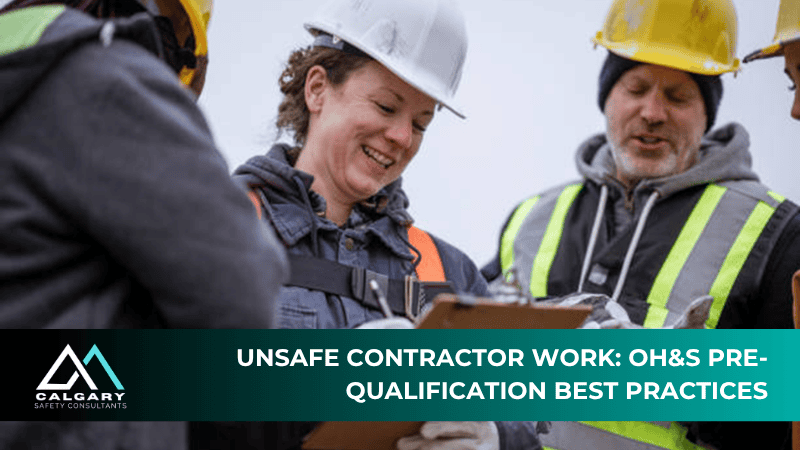
We’ve either experienced this or heard a similar account.
You bring in a contractor to do a quick repair, set up a new system, or knock out part of a wall. Next thing you know, they’re not wearing PPE, they’re walking through restricted zones, and your team’s looking at you like, “Who the heck let this guy in?”
Contractor safety isn’t a side project—it’s a legal and operational priority. Unsafe contractor work can damage your brand, trigger stop-work orders, lead to injury or death, and land your business in regulatory hot water. It only takes one slip-up to cost a company thousands (or worse).
So, how do you keep it tight?
In this blog, we’ll break down:
- Why contractor safety matters (especially in Canada)
- What “pre-qualification” should actually involve
- What real oversight looks like during a project
- And how Calgary Safety Consultants can help you avoid getting burned
Let’s jump in.
Why Contractor Safety Is a Bigger Deal Than You Think
Here’s the reality: contractors aren’t your employees—but when they’re on your site, you’re still responsible for what happens. Under Canadian OH&S legislation (including Alberta’s OHS Act), employers and prime contractors have a duty to ensure that all workers—including contractors and subcontractors—are protected from harm.
Section 3 of Alberta’s OHS Act is crystal clear on this: every employer must ensure the health and safety of workers under their control. That means if a contractor gets hurt while working at your facility, and due diligence wasn’t exercised, you’re on the hook.
Here’s the Alberta legislation:
https://www.alberta.ca/ohs-legislation.aspx
Now think about this in real-world terms:
- A contractor falls off a ladder while doing electrical work.
- A sub-subcontractor enters a confined space with no training.
- A temporary crew bypasses your lockout/tagout system.
If you didn’t vet them, train them, and supervise their work? The fines, liability, and reputational damage are all yours.
What Pre-Qualification Actually Means (Not Just a Checklist)
Let’s be honest—“pre-qualification” sounds like something out of a bureaucratic handbook. But in practice, it’s your first and best line of defense.
Too many businesses treat it like paperwork. You hand them a form, they tick boxes, you file it away. Done. Right?
Wrong.
Effective contractor pre-qualification is a real process, and it should answer questions like:
- Do they have valid insurance and WCB coverage?
- Are their workers trained to work safely in your environment?
- Have they had any safety violations or fines?
- Do they have a functioning safety program, or just a binder with dust on it?
This stuff matters. Especially when something goes wrong and an investigator starts asking why you allowed that contractor on-site.
At Calgary Safety Consultants, we can help you build or upgrade your contractor pre-qualification system. That means:
- Customizable safety pre-qualification templates
- Review support for certificates, safety manuals, and incident history
- Guidance on what to accept—and what’s a red flag
We’re not just looking at documentation. We’re assessing risk, capacity, and accountability.
Don’t Stop at Paper: Oversight Is Where It Counts
Here’s a scenario: you pre-qualify a contractor, they look great on paper, and then they show up with no harness, no training, and no clue where they’re going.
If you don’t follow up, you’re gambling with your business.
That’s why contractor oversight is just as important as pre-qualification. It’s how you verify they’re doing what they promised—and how you protect your own people and processes in real time.
Effective contractor oversight involves:
- Site-specific orientations: Not just “here’s where the washroom is,” but actual safety briefings relevant to the project
- Daily hazard assessments (like FLRAs or pre-job briefs)
- Regular spot-checks or walkthroughs
- Safety observation reports
- Escalation protocols for unsafe behaviour
And yes, you need to document it all. If a contractor violates safety protocols and no one recorded it, it’s like it didn’t happen. Until someone gets hurt. Then suddenly, everyone’s asking where the oversight logs are.
If this sounds like a lot to manage—it doesn’t have to be.
We help Alberta companies streamline contractor oversight with:
- Easy-to-use contractor safety forms
- Customized site orientation checklists
- Training for your supervisors on how to enforce site rules (without starting a war)
- Third-party contractor audits (if you want a neutral set of eyes)
Want help building a site-specific contractor management system? Here’s where to start:
https://calgarysafetyconsultants.ca/contact/
How Calgary Safety Consultants Can Help
If this all sounds like a lot, don’t stress—we do this every day.
Here’s how Calgary Safety Consultants can help Canadian businesses like yours build effective orientation and mentorship programs:
- Customized New Worker Orientation Programs
We don’t believe in off-the-shelf binders. We create role-specific orientation materials that:
- Highlight actual hazards for each job
- Include Canadian legal requirements
- Use checklists, quizzes, and visuals to keep it engaging
- Can be delivered in-person, online, or hybrid
https://calgarysafetyconsultants.ca/online-training/
- Mentorship Program Design
Need help setting up a mentorship system? We’ll help you:
- Choose the right mentors in your crew
- Create simple guidelines and schedules
- Train mentors on coaching and communication
- Build feedback loops so you know it’s working
https://calgarysafetyconsultants.ca/consulting/
- Compliance and Documentation
All our programs are built to meet OH&S legislation in Alberta and across Canada. We help you:
- Document training and mentoring activities
- Prepare for COR audits
- Align your onboarding with OH&S best practices
https://calgarysafetyconsultants.ca/cor-auditing/
- Onsite or Virtual Delivery
Whether you’re in Calgary, Red Deer, Edmonton, or operating remotely—we can deliver these programs virtually or in person. We tailor the delivery to your workforce, whether they’re field-based, shop-based, or in an office.
Let’s Not Forget the Human Side
All the legal boxes and safety plans in the world won’t matter if your workers feel lost or unsupported. For new and young workers, safety isn’t just about PPE and procedures—it’s about confidence, communication, and culture.
When you take the time to invest in proper onboarding and mentorship, you’re not just reducing injuries—you’re building trust. And that trust leads to better engagement, stronger performance, and a reputation as a safe place to work.
Want Backup? We’ve Got You Covered
Calgary Safety Consultants supports contractor safety programs across Alberta and beyond. Whether you’re a commercial property manager, a manufacturer, a construction company, or something totally niche—we help you build pre-qualification and oversight programs that actually work.
We offer:
- Pre-qualification systems
- Contractor safety audits
- Orientation packages
- Supervisor coaching
- Field-level training
- Support for small businesses trying to meet large-client standards
We’ve been in the trenches. We get it. And we’ll make sure your program doesn’t just meet the minimum—it actually protects your team and your business.
And if you need help getting there? We’ve got your back. Contact Calgary Safety Consultants for your complimentary consult to explore tailored OH&S solutions that drive real results.
Stay safe!
References
- Alberta OH&S Legislation: https://www.alberta.ca/ohs-legislation.aspx
- CCOHS Contractor Safety Guidelines: https://www.ccohs.ca/products/courses/contractor_safety
- Ontario Contractor Responsibilities Guide: https://www.ontario.ca/page/constructor-guideline
Frequently Asked Questions
Why is vendor and contractor safety compliance important?
Vendors and contractors work within your business operations, meaning their safety standards directly impact your workplace. Poor compliance can lead to accidents, fines, and legal issues.
How can I verify that a contractor is OH&S compliant?
You should request WCB clearance, COR or SECOR certificates, safety manuals, and training documentation. Calgary Safety Consultants can help build these screening tools.
Why do I need to pre-qualify contractors if they aren’t my employees?
Because under Canadian OH&S law, employers and prime contractors are responsible for ensuring the safety of all workers on their site—including contractors. If they’re unsafe, you could be liable.
What documents should I ask for in a pre-qualification process?
You should request proof of WCB coverage, liability insurance, a copy of their safety manual, training records, incident history, and COR/SECOR certifications (if applicable).
What does contractor oversight look like during a project?
Oversight includes orientations, daily hazard assessments, site inspections, and documentation of any unsafe behavior or near misses. You should also assign clear roles for who monitors contractors on-site.