On this page
- Reasonably Practicable and Hazard Controls
- What Employers Don’t Necessarily Know About Reasonably Practicable
- Reasonably Practicable and Due Diligence
- A Practical Reasonably Practicable Decision Process
- Common Weaknesses in Workplace Safety Programs
- Roles of Employers, Supervisors, and Workers
- In Western Canada – Alberta, British Columbia, and Saskatchewan Are Not Identical
- Reasonably Practicable, COR, and SECOR
- Business Impact and Risk Considerations
- How Calgary Safety Consultants Can Help
- Review Your Workplace Inspection Program
- Frequently asked questions
Quick answer
How Often Should Employers Conduct Workplace Inspections?
A practical answer is that workplace inspection frequency should be based on risk rather than an arbitrary calendar date.
An employer operating an active construction project may need supervisors reviewing changing conditions every day, equipment inspected before use, and formal documented inspections conducted on a regular schedule. A professional office may reasonably use a different inspection frequency because the hazards and rate of workplace change are significantly different.
An effective inspection system generally considers:
- The severity and likelihood of workplace hazards.
- How quickly workplace conditions change.
- The type and condition of equipment being used.
- Previous incidents, near misses, deficiencies, and worker concerns.
- Manufacturer inspection and maintenance requirements.
- Specific provincial legal requirements.
- Contractor, client, COR, SECOR, or other safety-management expectations.
This distinction matters. A monthly inspection may be an appropriate best practice for one workplace and inadequate for another.
Reasonably Practicable and Hazard Controls
The concept becomes especially important when employers select hazard controls.
As an example, Alberta’s OHS Code establishes requirements for hazard assessment, elimination, and control. Where reasonably practicable, employers are required to eliminate or control hazards through engineering controls before moving to lower levels of control in circumstances addressed by the Code.
This means the decision should start with the hazard, not with the control the employer would prefer to use.
Consider a noisy production area. Providing hearing protection may be easier than modifying equipment, installing barriers, isolating machinery, or addressing the source of the noise. However, Alberta’s requirements call for reasonably practicable measures to reduce worker noise exposure. The existence of PPE does not automatically answer whether other controls should have been considered.
The same principle can arise with fall protection, lifting and handling loads, mobile equipment, hazardous energy, chemical exposure, and many other workplace hazards.
What Employers Don’t Necessarily Know About Reasonably Practicable
What employers don’t necessarily know is that a reasonable decision made today may need to be reconsidered when circumstances change.
New equipment may become available. A work process may change. An incident may expose a weakness in an existing control. Workers may identify a hazard that management had not previously recognized. A manufacturer may change its instructions. Repeated inspection findings may show that an administrative control is not working.
Reasonably practicable should therefore not be treated as a one-time justification for continuing an existing practice.
There is another important issue. Saying “we decided it wasn’t practical” is considerably different from being able to demonstrate how that decision was reached.
A defensible safety-management process should show that the hazard was recognized, appropriate controls were considered, decisions were made by competent people, workers were informed where appropriate, controls were implemented, and their effectiveness was monitored.
Reasonably Practicable and Due Diligence
Reasonably practicable and due diligence are closely connected, but they should not be treated as interchangeable terms.
Reasonably practicable frequently describes the standard attached to a particular legislative responsibility. Due diligence generally concerns whether reasonable precautions were taken in the circumstances and whether the organization can demonstrate what it actually did to prevent harm.
Canadian guidance describes due diligence as taking reasonable precautions or steps based on the circumstances. WorkSafeBC similarly describes due diligence as taking all reasonable steps to protect workers and emphasizes awareness of obligations, risk assessment, proactive controls, monitoring, and maintaining evidence of implementation.
Documentation becomes important because an employer may eventually need to explain not only what its procedure said, but what happened in the workplace.
Useful evidence may include:
- Hazard assessments and risk assessments.
- Inspection records.
- Training and competency records.
- Safe work practices and procedures.
- Equipment specifications and maintenance records.
- Corrective-action records.
- Worker consultation and safety meeting records.
- Incident and near-miss investigations.
- Supervisor observations and follow-up.
- Records explaining significant hazard-control decisions.
The purpose is not paperwork for its own sake. The records should demonstrate that the safety system operated as intended.
A Practical Reasonably Practicable Decision Process
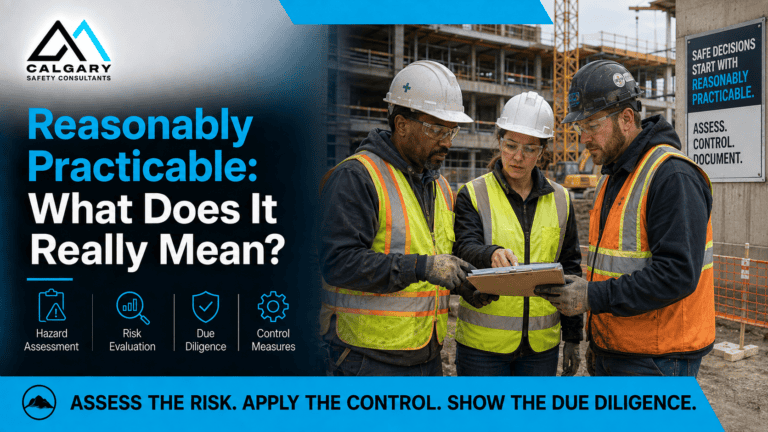
There is no single five-step statutory test that applies to every Canadian OHS situation. However, employers can use the following practical approach when evaluating their decisions.
- Identify the hazard and applicable legal requirements.
- Assess who may be exposed, how exposure could occur, and the potential consequences.
- Identify available methods of eliminating or controlling the hazard, including higher-level controls.
- Select and implement controls that are feasible and appropriate to the circumstances, and document significant decisions where stronger controls are not selected.
- Monitor the controls and reassess them when equipment, people, processes, hazards, legislation, incidents, or other workplace conditions change.
This approach supports better operational decisions because it connects legislation, hazard assessment, hazard controls, implementation, and verification rather than treating each as a separate safety activity.
Common Weaknesses in Workplace Safety Programs
One of the most common weaknesses is relying too heavily on written procedures.
A safety manual might require equipment inspections, hazard assessments, worker training, and supervisor monitoring. If inspections are incomplete, assessments have not been updated, workers cannot explain the procedure, or supervisors tolerate deviations, the written program provides limited evidence that the hazard was actually being controlled.
Another problem is starting with the easiest control.
Employers sometimes move directly from identifying a hazard to providing PPE, signage, training, or a safe work procedure without adequately considering whether the hazard could first be eliminated or controlled through stronger measures.
Cost can also become an oversimplified argument. Business cost is a real operational consideration, but “it costs too much” should not become the entire reasonably practicable analysis, particularly where workers face significant risk and effective controls are available.
Roles of Employers, Supervisors, and Workers
Reasonably practicable decisions cannot exist only at senior management level.
Employers establish resources, systems, responsibilities, equipment, training, and expectations. Supervisors translate those requirements into daily work by identifying changing conditions, enforcing procedures, correcting unsafe work, and escalating issues requiring additional resources.
Workers contribute through hazard reporting, following established controls, participating in assessments where applicable, using equipment properly, and communicating when conditions change.
Alberta’s OHS framework places responsibilities on multiple work site parties rather than placing workplace safety responsibility on one individual alone.
In Western Canada – Alberta, British Columbia, and Saskatchewan Are Not Identical
Although there are many similarities, there are differences that must be observed. Employers working across Western Canada should avoid copying an Alberta interpretation directly into another province without reviewing that jurisdiction’s legislation.
British Columbia’s Workers Compensation Act and OHS Regulation establish their own duties. WorkSafeBC describes due diligence as taking all reasonable steps to protect workers and expects employers to identify risks, develop controls, train workers, monitor implementation, and maintain evidence.
Saskatchewan also uses reasonably practicable concepts within its occupational health and safety framework. Saskatchewan employer duties include providing and maintaining plant, systems of work, and working environments that protect worker health, safety, and welfare as far as reasonably practicable. Saskatchewan also establishes responsibilities for employers, contractors, supervisors, workers, and, in applicable workplaces, prime contractors.
The underlying Canadian safety principle may be similar: identify hazards, understand risk, implement appropriate controls, and verify that they work. The actual legal wording, responsibilities, required documentation, and enforcement framework remain jurisdiction-specific.
Reasonably Practicable, COR, and SECOR
Legislative compliance and COR or SECOR performance are related but separate issues.
In Alberta, COR is a voluntary program that evaluates an employer’s health and safety management system against established standards. The program considers areas such as hazard identification, risk control, training, inspections, emergency response, incident investigation, and system administration.
A strong COR or SECOR system can help employers demonstrate that important safety processes exist and are being used. However, certification does not replace the employer’s responsibility to meet applicable legislation, nor does a successful audit establish that every hazard-control decision will automatically satisfy a reasonably practicable standard.
Business Impact and Risk Considerations
Reasonably practicable decisions affect considerably more than regulatory compliance.
Weak hazard-control decisions can contribute to incidents, WCB claims, operational interruptions, damaged equipment, retraining, investigations, corrective-action costs, and lost productivity. They can also affect contractor prequalification, client confidence, COR or SECOR performance, audit readiness, and the employer’s ability to demonstrate due diligence.
The opposite is also true. When decisions are documented and connected to actual workplace conditions, management has a clearer understanding of risk and supervisors have better direction about what is expected.
This can make safety controls easier to manage operationally because responsibilities, decisions, and follow-up are visible rather than buried in a safety manual.
Situation: A fabrication company had forklifts regularly travelling through an area also used by employees walking between production and shipping. Workers had been instructed to maintain eye contact with operators and wear high-visibility clothing, but several near misses were reported.
Action: The employer reassessed the traffic hazard, reviewed whether pedestrians and equipment could be separated, examined workflow and access points, involved supervisors and workers, and implemented additional physical and administrative controls. The hazard assessment, decisions, worker communication, and subsequent inspections were documented.
Result: The company had stronger evidence explaining how the hazard had been evaluated and controlled. Supervisors also had clearer expectations for managing pedestrian and mobile-equipment interaction, improving accountability, operational consistency, and audit readiness.
For a complete walkthrough, read our free guide on how to conduct a workplace safety inspection. It explains how to plan the inspection, walk the area, write findings someone can act on and follow up corrective actions, and it comes with a free 20-section inspection checklist and quick guide you can download.
How we help
How Calgary Safety Consultants Can Help
Calgary Safety Consultants supports employers across Canada, including Alberta, British Columbia, and Saskatchewan, with practical workplace inspection and safety-management systems.
Support may include workplace inspections, hazard assessment support, safety program assessments, OH&S program development, safety manual development and review, COR or SECOR consulting, internal audits, incident investigations, corrective-action planning, supervisor and leadership training, online OH&S training, and regulatory compliance support.
Employers reviewing their inspection processes may also find the following Calgary Safety Consultants resources useful:
- Customized Safety Manuals Built for Your Workplace
- COR Consulting and Safety Program Support
- Workplace Safety Training & Certification
- Hazard Assessments, JHAs and Workplace Inspections
- OH&S Regulatory Support
- Workplace Inspection and Compliance Training
- OHS Compliance Audit and Safety Program Gap Assessment
Review Your Workplace Inspection Program
If you’re determining how often employers in Canada should conduct workplace inspections, don’t start by automatically choosing “monthly.” Start with your jurisdiction, hazards, work activities, equipment, rate of workplace change, previous inspection findings, and applicable legal requirements.
Then compare your written inspection requirements with what actually happens in the workplace. Look for missed inspections, recurring deficiencies, incomplete corrective actions, and inspection frequencies that no longer reflect operational risk.
When professional support is required, Calgary Safety Consultants can help assess your current inspection process, identify weaknesses, and develop a practical system that better supports hazard control, due diligence, operations, and audit readiness.
Jurisdiction note: This article provides general occupational health and safety information. The legal requirements that apply depend on the workplace location, industry and federal, provincial or territorial jurisdiction. Verify current requirements with the applicable regulator before using the information operationally. Government of Canada overview of occupational health and safety jurisdiction.
References
- Government of Alberta. Obligations of work site parties.
https://www.alberta.ca/obligations-work-site-parties - Government of Alberta. Occupational Health and Safety Act – Part 1: General Obligations.
https://search-ohs-laws.alberta.ca/legislation/occupational-health-and-safety-act/part-1-general-obligations/ - Government of Alberta. Occupational Health and Safety Code.
https://www.alberta.ca/occupational-health-and-safety-code - Government of Alberta. Partnerships in Injury Reduction.
https://www.alberta.ca/partnerships-injury-reduction - WorkSafeBC. Occupational Health and Safety Regulation, Part 3 – Rights and Responsibilities.
https://www.worksafebc.com/en/law-policy/occupational-health-safety/searchable-ohs-regulation/ohs-regulation/part-03-rights-and-responsibilities - WorkSafeBC. Workplace Inspections.
https://www.worksafebc.com/en/health-safety/create-manage/workplace-inspections - Government of Saskatchewan. Occupational Health and Safety Regulations, 2020.
https://publications.saskatchewan.ca/api/v1/products/111283/formats/124952/download - Government of Saskatchewan. Duties and Rights of Workers.
https://www.saskatchewan.ca/business/safety-in-the-workplace/rights-and-responsibilities-in-the-workplace/duties-and-rights-of-workers - Government of Saskatchewan. Occupational Health Committees.
https://www.saskatchewan.ca/business/safety-in-the-workplace/ohc-and-ohs-representative/ohc

About the author
John Duplessis, B.Sc., CRSP
John Duplessis is a Canadian Registered Safety Professional with more than 30 years of occupational health and safety experience in oil and gas, construction, green energy, midstream operations, and industrial project work.