On this page
- What Internal Incident Reporting Means
- Why Fast Internal Reporting Matters
- Who's Involved
- What Counts as Reportable Internally
- The Internal Reporting Path at a Glance
- Setting Severity Tiers
- From the Worker to the Supervisor
- From the Supervisor to Management
- Telling the Committee or Representative
- Prime Contractors, Owners and Clients
- Night Shifts, Remote Crews and After Hours
- The First Call and the Written Report
- Removing Barriers to Reporting
- Reprisal Protections Across Canada
- Where Internal Reporting Meets the Regulator
- How the Report Feeds the Investigation
- A Practical Workplace Example
- Common Mistakes to Avoid
- What an Auditor Expects to See
- The Bottom Line
- Download the Template and Contact Sheet
- Frequently Asked Questions
- Related Guides and Articles
- How Calgary Safety Consultants Can Help
- Sources
What Internal Incident Reporting Means
Internal incident reporting is the part of your safety program that moves information about an incident from the person who saw it to the people who need to act on it. An incident, in this guide, is any unplanned event at work that hurt someone, made someone ill, damaged property or the environment, or could have done any of those things. That includes near misses, and it includes hazards spotted before anything went wrong.
It's different from reporting to the outside world. The regulator and the workers' compensation board have their own rules and deadlines, and internal reporting comes first and feeds them. If the supervisor hears about an injury two days late, the company can't meet an "immediately" duty to the regulator, start the investigation while memories are fresh or put interim controls in place before the next shift.
A good internal incident reporting procedure answers five plain questions: what do I report, who do I tell, how fast, how, and what happens next? When the answers are written down and practised, the news travels in minutes. When they aren't, it travels by rumour, or not at all.
This guide picks up where the first minutes end. Our guide on how to respond to a workplace incident covers making the scene safe, caring for the injured, calling 911 and holding the scene. Here, the focus is on the chain of internal notifications that runs alongside and after that response, and on building a reporting culture where people actually use it.
Why Fast Internal Reporting Matters
The obvious reason is people. A worker who reports a sore back on day one usually recovers faster than one who reports it a week later, and a hazard reported on Monday can be fixed before it hurts someone on Thursday.
The second reason is the law. Canadian jurisdictions expect workers to bring hazards and incidents to the employer, and employers to report serious events to the regulator quickly, which only works if the internal chain is fast. In Alberta, for example, section 33 of the Occupational Health and Safety Act requires serious injuries and incidents to be reported to a Director as soon as possible, and the employer can't report what it hasn't heard about.
The third reason is information. Under-reporting is common: in a Canadian survey, Shannon and Lowe (2002) found that 40 per cent of workers with a compensable injury hadn't filed a claim. Every unreported incident is a lesson you paid for and didn't get.
The last reason is money and reputation. Late claims cost more, and clients judge contractors on how quickly and honestly they hear about problems. A contractor that phones the client within the hour is trusted; one whose incident the client discovers on its own is not.
Who's Involved
Internal incident reporting touches almost everyone in the organization, and it works best when each role is named in advance.
- Workers report incidents, near misses and hazards to their supervisor right away, including their own injuries, however minor.
- Supervisors or the person in charge receive the report, confirm the response is under way, decide the severity tier, make the next calls and start the written report.
- Managers and the safety lead confirm the tier, decide whether the event is reportable outside the company and organize the investigation.
- Senior management hears about serious events quickly, approves external notifications and signs off on the investigation.
- The joint health and safety committee or representative is notified as the law and your procedure require, and usually takes part in the investigation. Our guides on setting up a JHSC and supporting a health and safety representative explain their wider role.
- The prime contractor, owner or client is told about incidents on their sites, often within a contract deadline.
- On-call contacts cover nights, weekends and remote work.
In a small business, one person may fill several roles; the procedure still tells workers who to call.
What Counts as Reportable Internally
The simplest rule is the best one: if in doubt, report it. The regulator wants to hear about deaths, serious injuries and dangerous occurrences. You want to hear about everything that could teach you something, which is a much longer list.
| Category | Examples | Why it belongs in the internal system |
|---|---|---|
| Injuries and illnesses | Cuts, strains, burns, fractures, exposures, delayed symptoms | Triggers care, claim timelines and the investigation |
| First aid cases | A bandage, eyewash or ice pack, even with no lost time | First aid records are required, and minor injuries point to bigger ones |
| Near misses | A dropped load that missed someone, a vehicle that nearly struck a worker, a slip with no injury | Same causes as an injury, without the harm |
| Property and equipment damage | Struck racking, a damaged guard, a toppled cylinder, a failed sling | Often a near miss for people, with a direct cost |
| Environmental releases | Fuel, hydraulic oil or chemical spills, gas releases, stormwater contamination | May trigger environmental reporting duties too |
| Vehicle incidents | Collisions, backing incidents, rollovers, vehicles sliding off icy roads | High-risk work, and insurers expect prompt notice |
| Dangerous occurrences | Fires, explosions, structural or crane failures, uncontrolled releases, whether or not anyone is hurt | Often reportable to the regulator even with no injury |
| Hazards and unsafe acts | Missing guards, damaged ladders, blocked exits, shortcuts, unsafe conditions | Fixing them is prevention at its simplest |
| Violence, harassment and work refusals | Threats, assaults, harassment complaints, refusals of unsafe work | Have their own legal processes, but still need recording |
The law sets a floor here. In Alberta, section 5(1)(e) of the OHS Act requires workers to report concerns about unsafe or harmful work site acts or conditions to the employer or supervisor, and section 4(c) requires supervisors to report those concerns to the employer.
In British Columbia, section 3.10 of the OHS Regulation requires anyone who sees what appears to be an unsafe or harmful condition or act to report it as soon as possible to a supervisor or the employer, and requires the person receiving the report to investigate and make sure any necessary corrective action is taken without delay. Section 3.19 of the same regulation requires a record of all injuries and exposures that are reported or treated.
Section 126 of the Canada Labour Code requires employees to report anything in the workplace likely to be hazardous, and every accident or other occurrence that has caused injury. Section 15.3 of the Canada Occupational Health and Safety Regulations goes further: an employee who becomes aware of an accident or other occurrence that has caused or is likely to cause injury must report it to the employer without delay. "Likely to cause injury" brings near misses squarely into the duty.
Minor injuries matter too. Section 5-8 of Saskatchewan's Occupational Health and Safety Regulations, 2020 requires every first aid treatment and every referral for medical attention to be recorded in a first aid register. If first aid cases never reach the register, you're out of compliance and blind to your own trends.
Near misses are the category most often left out. A separate guide, How to Set Up Near-Miss Reporting, is coming soon. Our article on why near-miss reporting matters explains how much they can teach you.
The Internal Reporting Path at a Glance
Every internal report starts the same way: whoever saw the event tells the supervisor or person in charge right away, once anyone injured is being cared for and help has been called. What happens next depends on how serious the event was or could have been. The diagram shows a three-tier path. The times are suggested company standards, not legal deadlines; set your own, fast enough to meet the regulator's timelines where you work.
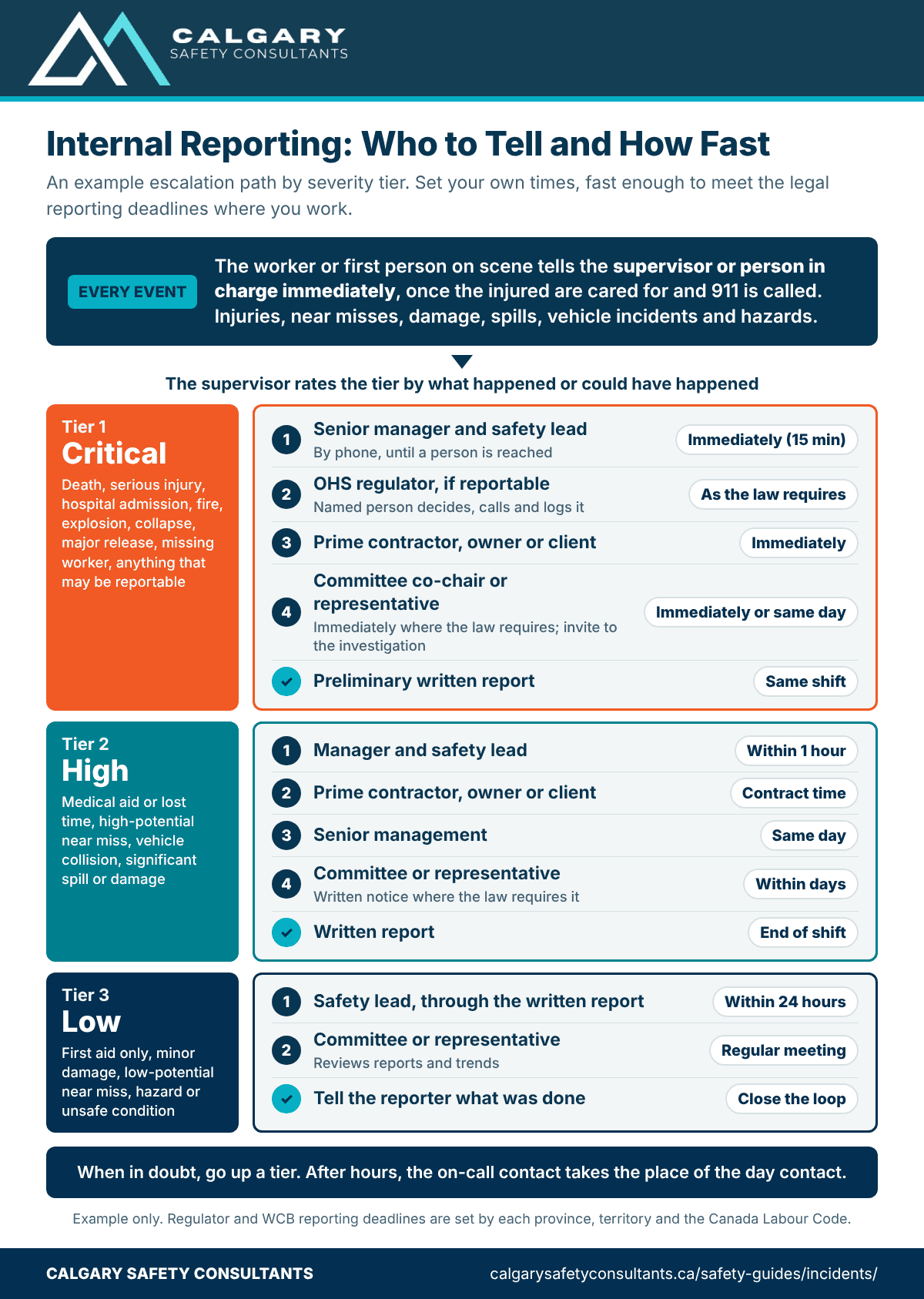
| Tier | Typical events | Supervisor notifies | Written report |
|---|---|---|---|
| Tier 1: Critical | Death, life-threatening or serious injury, hospital admission, fire, explosion, collapse, major release, missing worker, any event that may be reportable to the regulator | Senior manager and safety lead by phone immediately (target 15 minutes); they notify the regulator as the law requires, the committee or representative, and the prime contractor or client | Preliminary report the same shift; full report as the investigation requires |
| Tier 2: High | Medical aid or lost time injury, high-potential near miss, vehicle collision, significant spill or property damage | Manager and safety lead by phone within 1 hour; senior management the same day; prime contractor or client within the contract's time | Before the end of the shift |
| Tier 3: Low | First aid only, minor damage, low-potential near miss, hazard or unsafe condition | Safety lead through the written report; manager as needed | Within 24 hours |
Example tiers only. Adapt them to your hazards, contracts and jurisdiction, and escalate to a higher tier whenever you're unsure.
Setting Severity Tiers That Drive Escalation
Severity tiers turn a judgement call into a decision the supervisor can make in seconds. Without them, one supervisor calls the general manager about a paper cut while another sits on a crushed hand until morning.
The most important rule in any tiering system is to rate the event by its potential, not only by its outcome. A pallet that falls from the top rack and lands a metre from a worker caused no injury, but it could easily have killed someone. That's a Tier 1 or Tier 2 event, not a Tier 3, because the causes are exactly the same as a fatality's.
Alberta builds this idea into law: section 33 of the OHS Act requires the employer, or the prime contractor if there is one, to investigate incidents that had a likelihood of causing serious injury or illness, and the province requires those potentially serious incidents to be reported online once the investigation is done.
Keep the tiers few and plain. Three is enough for most employers, and each should use real examples from your own work, not language like "moderate consequence". A roofer's Tier 1 list mentions falls and electrical contact; a clinic's mentions needlestick exposures and violent incidents.
Two more rules prevent most tiering mistakes. When in doubt, go up a tier; it's easy to stand down an escalation and hard to explain why senior management heard about a hospital admission from the client. And the tier can change: a sprain that turns out to be a fracture, or a spill that reaches a storm drain, moves up, and the extra calls follow.
From the Worker to the Supervisor
The first link in the chain is the one most likely to break. Workers decide in a moment whether to say something, based on what happened the last time someone reported. Your procedure needs to make that first report easy, expected and safe.
Make it easy by keeping the method simple. A phone or radio call to the supervisor is best for anything beyond a scratch. For lower-tier events, a card, an app or a text followed by a form all work, as long as workers know which one to use and the supervisor checks it. Don't make anyone fill in a form before telling someone.
Make it expected by saying "immediately" and meaning it: report every incident, near miss and hazard to your supervisor immediately, or as soon as it's safe to do so, and before the end of the shift at the latest. Tell workers to report symptoms they believe are work-related, such as a strain that shows up the next morning, as soon as they notice them.
Make it safe by being clear about who to call when the usual person isn't there. Name an alternate for every supervisor, put the on-call number on hard hat stickers and in every vehicle, and tell workers they may go straight to the next level, or to the committee or representative, if they can't reach their supervisor or don't feel comfortable reporting to them.
From the Supervisor to Management and Safety
Once the supervisor knows, the clock for everything else starts. For a Tier 1 event, the first call is made while the scene is still being managed, and it goes to a named senior manager or the safety lead, whoever can be reached first.
Use phone or radio for Tier 1 and Tier 2 notifications, and keep trying until you speak to a person. A text or email isn't a notification until someone has acknowledged it. Every call should end with three things agreed: who makes the next call, who handles the external notifications, and when the next update will come.
Senior management needs to hear about serious events quickly for practical reasons. They decide whether to stop similar work elsewhere, fund interim controls and speak to the client and media. Energy Safety Canada's 2023 COR audit protocol, for example, expects senior management to review and sign off on incident investigations, which they can't do well if they first hear of the incident when the report lands on their desk.
Decide in advance who talks to an injured worker's family: a senior person with accurate information, coordinating with police after a death. Never let the news travel by word of mouth or social media.
None of this comes naturally the first time at 2 a.m. Practising the calls in a drill, or through our incident and emergency management training, makes the real day calmer.
Telling the Committee or Representative
Many employers forget the committee or representative until the investigation is under way. In several jurisdictions, that's a legal problem.
In Ontario, when a person is killed or critically injured, the employer must notify the joint committee or representative, and any trade union, immediately, along with an inspector. For an accident, explosion, fire or incident of workplace violence that leaves someone needing medical attention or unable to do their usual work, the employer must give written notice to the committee or representative and the union within four days, as the province's guide to Part VII of the OHS Act explains.
In Saskatchewan, sections 2-2 and 2-3 of the OHS Regulations, 2020 require the employer or contractor to give each co-chairperson or the representative a copy of every notice sent to the ministry about a serious accident or a dangerous occurrence. In Alberta, section 33 requires the investigation report for a serious or potentially serious incident to be given to the committee or representative, or made available to workers if there's neither.
The safest approach is to build the committee into the tiers: a phone call to the worker co-chair or representative for Tier 1 as soon as possible, and immediately where the law requires it, with an invitation to the investigation; written notice for Tier 2 within the time the law sets (four days in Ontario), or within a few days where it sets none; and a review of reports and trends at the regular meeting for Tier 3.
Prime Contractors, Owners, Clients and Contractors
On a multi-employer site, internal reporting runs in two directions at once. A contractor's worker reports to the contractor's supervisor, and the contractor's supervisor reports to the prime contractor or owner. The prime contractor needs to know because, in Alberta for example, it holds the legal duty to report serious incidents (the employer does if there's no prime contractor), and because it controls the site, the other contractors and often the scene itself.
Write both directions into your procedure. If you're the prime contractor or owner, require contractors to report every incident, near miss and hazard on your site to your site lead within set times, and say so in the contract and orientation. If you're the contractor, put the client's reporting requirements on your contact sheet before mobilizing, because some contracts set notification windows as short as an hour. Our guide on how to manage contractor safety covers how to build these terms into contractor selection and site orientation.
Agree in advance who reports what when a contractor's worker is hurt on someone else's site. Usually the contractor reports to its own management and the workers' compensation board, and the prime contractor or owner reports to the regulator, but it differs by jurisdiction and contract. When it's unclear, talk immediately and confirm in writing who's making which call.
Night Shifts, Remote Crews and After-Hours Contacts
Incidents don't keep office hours. The night shift, the field crew three hours from town and the worker alone at a pump station all need a reporting path that works at 2 a.m. in a snowstorm.
Start with an on-call roster: an on-call supervisor or manager, with a backup, for every hour people are working, published where workers can see it. One number that always reaches a person, such as a forwarded on-call line, beats a list. Test it now and then at an awkward hour.
For remote crews, confirm cell coverage at the actual work locations and provide satellite devices or radios where it's patchy. A missed check-in is itself a reportable event and starts the escalation. Our guides on setting up a working alone program and journey management for field crews explain how to build those check-ins.
Keep the after-hours path the same as the daytime one; only the names and numbers change.
What Goes in the First Call and What Waits for the Written Report
The first verbal notice and the written report do different jobs. The first call alerts people and gets decisions made; the written report records the facts for the investigation. Waiting to call until the report is finished is the most common mistake in incident reporting.
A good first call takes under two minutes and covers the essentials in a fixed order, so nothing is forgotten under stress:
- Who you are and where you're calling from.
- What happened, in one or two sentences, and the tier you think it is.
- Where and when: the site, the exact location and the time.
- Who's hurt, how badly as far as you know, and where they are now.
- What's been done: first aid, 911, ambulance, hazard controlled, work stopped, scene secured.
- What's still needed: help, equipment, decisions or calls you can't make yourself.
- Who else knows, so calls aren't missed or duplicated.
- When you'll call back with an update.
Stick to facts. "The forklift tipped while turning on the ramp" is a fact; "the operator was going too fast" is an opinion that may be wrong and can shape the investigation before it starts.
The written report follows, before the end of the shift for anything above Tier 3 and within 24 hours for the rest, with the full details: people and witnesses, the sequence of events, conditions, injuries and treatment, immediate actions and notifications. Our free downloads include an incident report form for that job, and a separate guide, How to Write a Workplace Incident Report, is coming soon. Keep a notification log from the first minute: who was called, by whom, when, and whether a person was reached. Regulators and auditors ask for it.
Removing Barriers to Reporting
Most organizations have a reporting procedure. Far fewer have workers who use it. The gap is almost always about what happens to the person who reports.
In a US study of health care workers, Galizzi and colleagues (2010) found that under-reporting was explained by time pressure and by workers' doubts about eligibility, reputation, income and career prospects, and that almost a third of the workers surveyed worried that a compensation claim could lead to discrimination, missed promotions or job loss. Probst and Estrada (2010), also in the US, found that under-reporting of accidents was influenced by the organization's safety climate and by whether supervisors enforced safe practices. The UK Health and Safety Executive's guide to investigating accidents and incidents notes that blame makes people defensive and uncooperative.
Here's what removes the barriers in practice:
- Respond to the report, not the reporter. "Thanks for telling me, is everyone okay?" gets the next near miss reported. "What did you do this time?" doesn't.
- Separate reporting from discipline. Discipline, where genuinely warranted, follows a fair investigation, never the report itself.
- Close the loop. Tell the reporter what was done. Reports that disappear kill reporting.
- Review incentive programs. Prizes for injury-free months and supervisor bonuses tied to injury rates can quietly discourage reporting. The US Occupational Safety and Health Administration's 2018 memorandum on incentive programs accepts rate-based programs only if they don't discourage reporting, and suggests rewarding hazard identification and measuring workers' willingness to report. Reward reported hazards, inspections and closed corrective actions instead.
- Watch for the signs. A sudden drop in first aid cases or near misses, or injuries that surface first as WCB claims, signal suppressed reporting.
Reporting culture is tied to psychological safety, the belief that it's safe to speak up. A separate guide, How to Address Psychological Health and Safety at Work, is coming soon. Our article on how to improve OH&S hazard reporting has practical ideas for getting more hazards reported.
Reprisal Protections Across Canada
Every Canadian jurisdiction protects workers from being punished for acting on health and safety. The wording differs, but an employer can't dismiss, discipline or otherwise penalize a worker for raising a concern, reporting a hazard or following the law. Your procedure should say so plainly.
- Alberta. Section 18 of the OHS Act prohibits disciplinary action against a worker for acting in compliance with the Act, the regulations, the OHS Code or an order, and section 19 gives the worker 180 days to complain to an officer.
- British Columbia. WorkSafeBC says plainly that it's illegal for an employer or union to penalize a worker for raising a health or safety issue.
- Saskatchewan. Section 3-35 of The Saskatchewan Employment Act prohibits discriminatory action, including against a worker who gives information to the committee, the representative or an occupational health officer.
- Ontario. Section 50 of the OHS Act prohibits reprisals, including intimidation and coercion, against workers who comply with the Act or seek its enforcement, with complaints going to the Ontario Labour Relations Board, as the province's guide to Part VI explains.
- Federal. Section 147 of the Canada Labour Code protects employees who provide information about health and safety conditions or act in accordance with Part II.
Manitoba, Nova Scotia, New Brunswick, the territories and the other provinces have their own reprisal or discriminatory action provisions. Our guide to OHS legislation in Canada links to each jurisdiction's laws. The same protections apply when a worker refuses unsafe work, which our guide on how to handle a work refusal covers.
Where Internal Reporting Meets the Regulator
For serious incidents, internal reporting starts a second chain: reports to the OHS regulator and the workers' compensation board. The handover point is the Tier 1 call. Your procedure should name who decides whether an event is reportable outside the company and who makes the call, with a backup for both, and give them the reporting numbers and rules for every jurisdiction you work in. If in doubt, call the regulator and ask. A full guide, How to Report Workplace Incidents Across Canada, covering regulator and WCB reporting in every province and territory, is coming soon, and the notification table in our incident response guide summarizes the serious incident rules now.
Remember that regulator deadlines start when the incident happens, that regulator and WCB reports are separate duties, and that internal reports replace neither.
How the Internal Report Feeds the Investigation and Corrective Actions
An internal report is the raw material for the investigation, the corrective actions and your trend data.
The tier decides the depth of the investigation: a full investigation with worker involvement and a root cause analysis for Tier 1 and high-potential Tier 2 events, and perhaps just a supervisor's review and a quick fix for Tier 3. British Columbia shows how tight the timelines can be: WorkSafeBC expects a preliminary investigation and report within 48 hours of an incident that requires an employer investigation, and a full investigation and report within 30 days, with an employer representative and a worker representative taking part where they're available. That can't happen if the internal report took two days to arrive.
Send the report, notification log, photos, first aid record and witness list to the investigator as one package. Our guides on how to investigate a workplace incident and how to conduct a root cause analysis explain what the investigator does with them. The fixes then belong in your corrective action tracking, with owners and due dates, and the result goes back to the person who reported. For a serious incident, or one where the company is too close to the facts, an independent incident investigation can help.
Look at the reports together, too. A monthly review by tier, location, task and time of day shows patterns no single investigation can, such as near misses clustering late in the night shift or vehicle incidents in the first week of winter driving.
Workplace example
A Practical Workplace Example
Situation: Consider an illustrative Saskatchewan mechanical contractor with about 40 workers on a shutdown at a client's facility. The contract requires injuries and serious near misses to be reported to the client within one hour. At 3:40 a.m. on a night shift in late November, a rigger guiding a heat exchanger bundle steps back as a sling slips, and the load drops about 30 centimetres onto its cribbing, a metre from his feet. Nobody is hurt.
Action: The crew stopped the lift and moved everyone clear. The rigger called his night supervisor on the radio straight away. Using the company's severity tiers, the supervisor rated it Tier 2, a high-potential near miss, because a dropped load could easily have been fatal. She phoned the on-call manager at 3:52 and gave a first notice in the order her contact sheet sets out: what happened, where, no injuries, lift stopped, area barricaded, rigging set aside. The on-call manager called the client's site representative at 4:15 and reached the company's safety lead by phone at 4:28, inside the one-hour target.
The safety lead moved the event up to Tier 1: a dropped load that could have killed someone may be a dangerous occurrence under section 2-3 of Saskatchewan's OHS Regulations, 2020, which the ministry must be told about as soon as is reasonably possible, so she called rather than guess. She woke the operations manager, called the ministry at 5:05, logged the call and arranged for the worker co-chair to get a copy of the notice. The supervisor logged every call with times and completed the written report before the end of the shift.
Result: The investigation started the same morning with the worker co-chair involved and found a worn sling that had passed a hurried pre-use check. Slings were pulled across the site, the check was retrained, and the rigger was thanked at the next toolbox talk. Two more near misses were reported that week.
Common Mistakes to Avoid
- Waiting for the written report before calling anyone. Call first, then write.
- Rating events by outcome alone. A near miss with fatal potential deserves a high tier.
- No one to call after hours. If the on-call number goes to voicemail, there's no procedure.
- Treating a text or email as a notification. It's not a notification until a person has acknowledged it.
- Forgetting the committee or representative. Several jurisdictions require them to be told.
- Forgetting the prime contractor or client. They may hold the legal duty to report.
- Opinions and blame in the first call. Stick to facts; let the investigation find the causes.
- Disciplining the reporter or rewarding silence. Both guarantee the next incident stays hidden.
- Reports that go nowhere. If workers never hear what happened, they stop reporting.
Audit perspective
What an Auditor Expects to See
In a COR or SECOR audit, internal incident reporting sits under the incident reporting and investigation element. Energy Safety Canada's 2023 COR audit protocol, for example, looks for written requirements that include reporting workplace incidents immediately, including injuries, illnesses, near misses and work refusals, and an outline of the incidents that must be reported to the governing authority. Interviewers then check whether employees understand the reporting requirements and whether incidents are actually reported the way the policy says.
In practice, auditors look for a written procedure, records of incidents of every tier reported within your own timelines, notification logs, committee involvement and near misses. A year with no near misses or first aid cases tells them reporting isn't working. Workers and supervisors should be able to say who they'd call and how fast.
Calgary Safety Consultants helps employers build and test their programs and prepare for COR and SECOR audits; we don't issue certificates. CORs and SECORs are issued through the applicable certifying partner.
The Bottom Line
Internal incident reporting is the nervous system of your safety program. When it's fast and trusted, the right people hear in minutes and the investigation starts with good facts. When it's slow or feared, problems stay hidden until they hurt someone.
Write down what gets reported, who tells whom and how fast, rate potential as well as outcome, put a real person on the after-hours line, and thank people who report. Then test it like any other emergency system.
Download the Procedure Template and Contact Sheet
Two free, fillable PDF downloads go with this guide. Both have clickable checkboxes and fill-in fields, so you can complete them on screen or print them for your site, vehicles and safety board.
- Internal Incident Reporting Procedure Template (PDF, 7 pages). A fill-in incident reporting procedure for your company: purpose and scope, definitions, what must be reported, three severity tiers with your own examples, notification order and timelines by role, after-hours, remote work and multi-employer sites, the first notice and written report, responsibilities, a non-reprisal commitment, legal reporting references for your jurisdictions, training and review, and sign-off.
- Incident Notification and Escalation Contact Sheet (PDF, 6 pages). A working call tree by severity tier with names, numbers, alternates and target times, an on-call roster, external and client contacts, a first-notice script to read from, a notification log, a written report tracker and a monthly test record.
Click either button to download the file. Fill in the procedure with your managers and your committee or representative, post the contact sheet where workers and supervisors can find it, and adapt both to the rules that apply in your province or territory, or under the Canada Labour Code.

About the author
John Duplessis, B.Sc., CRSP
John Duplessis is a Canadian Registered Safety Professional with more than 30 years of occupational health and safety experience in oil and gas, construction, green energy, midstream operations and industrial project work. He is an external auditor with Energy Safety Canada.