How To Quickly Improve Psychological Safety In Your OH&S Program
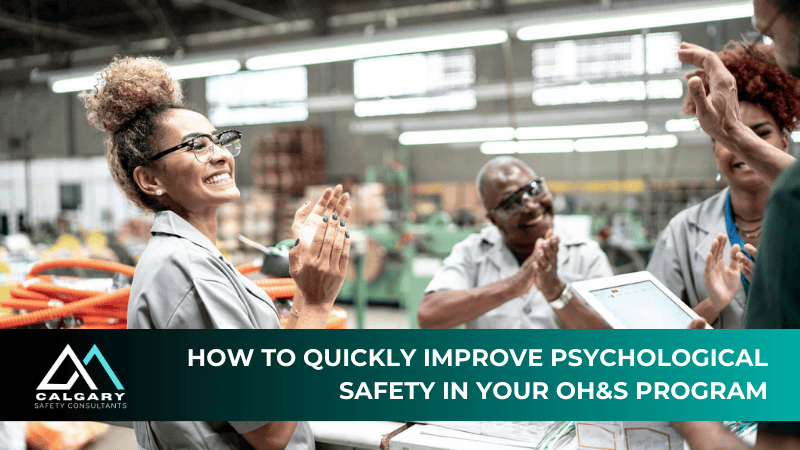
Psychological safety gets talked about a lot right now, but for many workplaces it still feels fuzzy and “soft.” In reality, it is a hard driver of OH&S performance. When people don’t feel safe to speak up, they also don’t feel safe to report hazards, near misses, or violence and harassment. That shows up in your incident stats, turnover, and workers’ compensation costs.
The good news: you don’t have to wait years to move the needle. There are practical things leaders and organizations can do in the next 30–90 days to improve psychological safety in a real, measurable way.
This blog walks through why psychological safety is important for OH&S, what it actually is (and isn’t), and some fast actions you can take to start changing the climate in your workplace.
Why you Need to Improve psychological safety and Why it matters for OH&S
Psychological safety is usually defined as a shared belief that people can speak up with ideas, questions, concerns, or mistakes without fear of humiliation or punishment.(CCL) It’s about the climate of the team: “If I say something, what’s likely to happen to me?”
On the OH&S side, that belief has direct consequences. Workers who feel safe to speak up are more likely to:
- Report hazards, near misses, and symptoms early
- Challenge unsafe behaviours, even if they come from senior people
- Admit mistakes so the team can fix root causes instead of hiding problems
- Participate honestly in incident investigations and safety meetings
Research and survey data are showing a direct relationship between psychological safety and reduced workplace injuries, as well as more proactive safety cultures.(AOGR) Health-care studies also link higher psychological safety to better patient safety and better staff well-being.(PMC)
From a Canadian perspective, this isn’t just “nice to have.” The CSA Z1003 Psychological health and safety in the workplace standard defines a psychologically healthy and safe workplace as one that promotes psychological well-being and actively works to prevent psychological harm.(ccohs.ca) That framing lines up with OH&S legislation that talks about protecting workers from both physical and psychological injury.
Bottom line: if your team doesn’t feel safe to speak up, you are flying blind as a safety leader. Hazards are still there; they’re just not being named.
What psychological safety is (and what it isn’t)
There are a few common misunderstandings that actually get in the way of improving psychological safety.
Psychological safety is:
- A climate of low interpersonal fear, where people can question, challenge, and admit uncertainty without being attacked or humiliated
- A shared expectation that speaking up about risk, error, or ideas will not lead to unfair punishment
- A condition that supports learning, innovation, and problem-solving, which are core to any OH&S program
Psychological safety is not:
- “Anything goes” or a free pass to ignore procedures or performance expectations
- A guarantee that people will always feel comfortable – tough conversations still happen
- An excuse to avoid accountability
In fact, the evidence suggests psychological safety and accountability work best together: clear expectations, high standards, and a climate where people can tell the truth about what is actually happening.(NeuroLeadership Institute) That is exactly the zone where strong safety cultures live.
The standards are catching up: ISO 45003 and CSA Z1003
If you already work with ISO 45001 or other OH&S management systems, you’ve probably seen more language about psychosocial hazards and mental health. ISO 45003 is the first global standard giving guidance on managing psychosocial risks within an OH&S management system based on ISO 45001.(iso.org)
ISO 45003 and CSA Z1003 both point in the same direction:
- Psychological health and safety needs structured management, not ad-hoc wellness campaigns
- Psychosocial hazards (like excessive workload, lack of role clarity, bullying, low support, or low autonomy) should be identified, assessed, and controlled like any other hazard(WSMH)
- Leadership, worker participation, and good communication are critical controls
In Canada, governments and agencies are increasingly referencing the National Standard on Psychological Health and Safety and related tools, such as the Mental Harm Prevention Roadmap.(Mental Health Roadmap) That means psychological safety is lining up with where regulators and courts expect organizations to be, especially after serious incidents or harassment/violence complaints.
Fast ways to improve psychological safety this month
You don’t need a full standard implementation to start improving psychological safety. You can start small, move fast, and build from there. Here are practical, OH&S-focused actions that can show results relatively quickly.
Make “asking questions” normal in safety conversations
Start with your toolbox talks, safety meetings, and pre-job discussions. Instead of leaders doing all the talking, build in space for workers to ask questions or flag concerns without being shut down.
Simple moves:
- End each meeting with: “What are we missing?” and wait long enough for someone to answer
- Thank people out loud when they raise a concern, even if you can’t fix it immediately
- Avoid public sarcasm, eye-rolling, or “we’ve already talked about that” responses
Those small behaviours show people that speaking up is not a career-limiting move. Over a few weeks, the tone of your meetings will start to shift.
Stop punishing honest reporting
If workers see someone disciplined every time they report a mistake, they will stop reporting. It’s that simple. This doesn’t mean you ignore reckless behaviour, but you separate human error and system problems from willful violations.
Quick checks:
- Look at your recent incident investigations – how many concluded with “worker failed to follow procedure” as the main cause?
- Review how often discipline follows self-reported issues or near misses
- Make a clear commitment: workers will not be punished for reporting hazards, near misses, or mistakes made in good faith
For higher-risk situations (violence, harassment, egregious violations), you still respond appropriately. The message you want is: “We will deal firmly with abusive or reckless behaviour, and we will support people who come forward early with concerns.”
Train supervisors in everyday psychological safety skills
Supervisors and front-line managers make or break psychological safety, because they control most day-to-day interactions. They need practical skills, not just a memo from HR.
Focus supervisor training on:
- How to respond in the first 10 seconds when a worker brings bad news
- How to run a short safety huddle that actually invites input
- How to challenge unsafe behaviour without shaming people in front of the crew
- How to recognize early signs of stress, burnout, or conflict and route them for support
If you already have OH&S leadership training, integrate psychological safety concepts so it’s not a separate “soft skills” course. Link it directly to hazard reporting, inspections, and investigations.
Build psychological safety into your hazard reporting system
If your safety app, paper forms, or reporting process is confusing, slow, or obviously used to assign blame, workers are going to bypass it. Linking psychological safety to the mechanics of reporting is a fast win.
You can:
- Allow anonymous or “no blame” near-miss reporting for early signals
- Make sure every report gets visible follow-up, even if the solution is “we’re still working on it”
- Share examples of issues that were raised, addressed, and closed – and recognize the people who spoke up
When people see reporting actually leads to change instead of trouble, reporting volume usually goes up. From an OH&S point of view, that’s success: more data, more chances to fix things before someone gets hurt.
Use incident investigations to learn, not to hunt for culprits
If your investigations feel like interrogations, people will give you the minimum information needed to protect themselves. Psychological safety turns investigations into learning exercises.
You can move in this direction by:
- Starting investigations with “help us understand how this made sense at the time” instead of “why did you do that?”
- Paying attention to conditions, workload, supervision, and design, not just the last person who touched the equipment
- Making sure investigators are trained to explore psychosocial factors: time pressure, conflicting priorities, fatigue, team conflict
Over time, this changes how people talk about incidents. Instead of “who messed up,” the question becomes “what in our system set this up, and how do we fix it?” That is directly aligned with modern OH&S approaches to root cause and organizational factors.
Supporting mental health and psychological safety
Psychological safety overlaps with, but isn’t identical to, broader mental health and wellness. You can’t have one without paying attention to the other.
Standards like CSA Z1003 and ISO 45003 emphasize:(ccohs.ca)
- Designing work so demands are reasonable and workers have some control over how they meet those demands
- Providing clear roles, expectations, and communication channels
- Managing exposure to traumatic events, harassment, bullying, and violence
- Offering access to support: employee assistance programs, benefits, peer support, or other resources
Again, you don’t have to fix everything at once. Often, the most powerful quick improvements are about clarity: clear expectations, simple processes for getting help, and leaders who model “it’s okay to talk about this.”
How Calgary Safety Consultants Can Help
Many companies know their documentation is not where it should be, but they do not have the time or internal expertise to fix it without dropping other priorities. This is where Calgary Safety Consultants can step in and help in a practical, no-nonsense way.
Here are a few ways we typically support clients:
- Documentation gap assessments: Reviewing your current policies, procedures, forms, and records against legislation, COR, or standards like ISO 45001, and giving you a clear, prioritized roadmap for improvement.
- Document development and cleanup: Drafting or revising policies, safe work practices, hazard assessment procedures, inspection programs, and incident investigation processes so they are compliant, realistic, and easy to use.
- Record-keeping system design: Helping you set up practical filing structures, naming conventions, and retention rules, whether you are using shared drives, safety software, or a mix of paper and digital systems.
- Training for supervisors and admins: Showing the people who actually complete and manage records how to do it efficiently, what matters to regulators and auditors, and how to catch errors before they become issues.
- Ongoing support: Acting as your on-call safety resource for questions, document updates, audit prep, and client prequalification documentation.
Our goal is always the same: create a documentation and record-keeping system that fits your business, meets legal and client expectations, and actually helps you manage risk instead of just creating more paperwork.
You can learn more or reach out through https://calgarysafetyconsultants.ca
Bringing It All Together
Psychological safety is not a buzzword. It is a critical condition that allows your OH&S system to actually work. When people feel safe to speak up, they give you information about hazards, near misses, and pressures that you will never see in a policy manual.
You don’t have to wait for a major incident, a lawsuit, or a mental health crisis in your workforce to start. You can:
- Change how leaders respond to questions and concerns
- Protect and value honest reporting
- Train supervisors in practical day-to-day behaviours
- Align your systems with standards like CSA Z1003 and ISO 45003
- Use investigations and safety meetings as learning tools, not blame sessions
Do those five things over the next 3–6 months, and you will feel the difference. Conversations will get more honest. Issues will surface earlier. And over time, that translates into fewer people getting hurt, better retention, and a stronger reputation as an employer who takes both physical and psychological safety seriously.
In my view, the most important point in this piece is that psychological safety is not a soft extra; it is a foundational control in your OH&S system. The “quick wins” here are realistic for most organizations, but they still require leadership courage: to hear bad news, to resist the urge to blame, and to change how power is used in day-to-day conversations. If a workplace commits to those shifts, the technical elements of CSA Z1003 and ISO 45003 become much easier to implement, and the benefits show up not only in lagging indicators, but in how it feels to come to work each day.
Connect with us here and let us help you improve your OH&S practices.
References
- https://www.ccl.org/articles/leading-effectively-articles/what-is-psychological-safety-at-work/
- https://hbr.org/2023/02/what-is-psychological-safety
- https://www.aft.org/news/psychological-safety-work
- https://www.ccohs.ca/oshanswers/psychosocial/phs/mentalhealth_checklist_phs.html
- https://www.csagroup.org/article/can-csa-z1003-13-bnq-9700-803-2013-r2022-psychological-health-and-safety-in-the-workplace/
- https://www.iso.org/standard/64283.html
- https://www.assp.org/docs/default-source/default-document-library/iso_45003_tech_report_final_210703.pdf
- https://psychsafety.com/benefits-of-psychological-safety/
- https://www.mckinsey.com/featured-insights/mckinsey-explainers/what-is-psychological-safety
- https://mentalhealthroadmap.wsps.ca/
- https://www.worksafebc.com/en/health-safety/create-manage/managing-psychological-health-safety
- https://pmc.ncbi.nlm.nih.gov/articles/PMC8344175/
- https://sbnsoftware.com/blog/how-can-psychological-safety-contribute-to-reduced-workplace-injuries/
- https://www.aogr.com/web-exclusives/exclusive-story/survey-highlights-benefits-of-promoting-psychological-safety
- https://www.naspweb.com/blog/psychosocial-hazards/
Because a safer workplace starts with smarter policy. Let’s build it together.
FAQs on How to Improve OH&S Documentation and Record-Keeping for Compliance
Why is safety documentation so important for OH&S compliance?
Safety documentation proves that your organization has a structured approach to managing risk and meeting legal requirements. It shows regulators, clients, and insurers how you identify hazards, control risks, train workers, investigate incidents, and follow through on corrective actions. Good documentation also helps you standardize work, support supervisors, and track trends over time.
What type of records should I keep for OH&S compliance?
Keep records of training, hazard assessments, incident reports, safety inspections, and emergency plans. These documents are essential to prove compliance during an inspection.
How can we make our safety forms and records easier for workers to use?
Focus on clear, short, and practical forms that fit naturally into the workday. Use plain language, avoid unnecessary fields, and align the form with the task it supports, such as pre-job hazard assessments, toolbox talks, inspections, or maintenance. Standardize versions, store them in one easy-to-find location, and train supervisors and workers on how and when to use them.