On this page
Spoiler Alert: a dusty binder in the foreman’s office with a form no one fills out? That’s not it.
Quick answer
Why Does Hazard Reporting Matter So Much?
Because early warnings save lives.
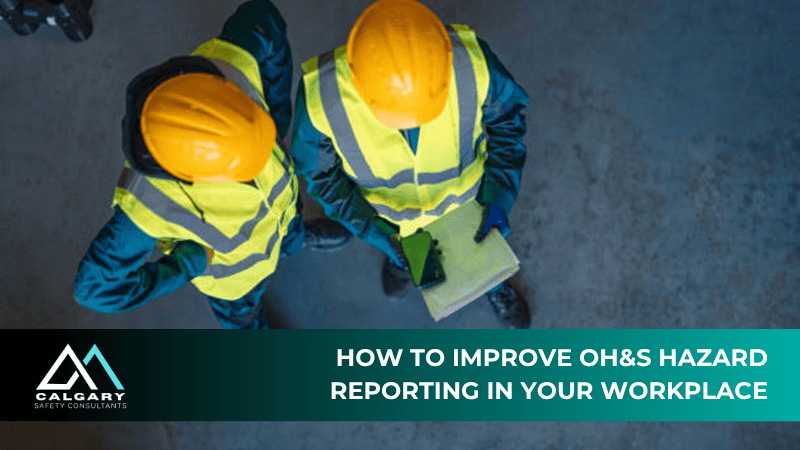
Hazards are the warning signs before the incident. If your team feels confident and empowered to report them, you’ve got a shot at fixing things before they escalate into injuries, lost time claims, or lawsuits.
According to the Canadian Centre for Occupational Health and Safety, workplace incidents are far more likely to be prevented when near-misses and unsafe conditions are consistently reported and acted upon.
https://www.ccohs.ca/oshanswers/hsprograms/report.html
Whether you’re operating in Alberta, Ontario, B.C., or federally, hazard identification and reporting is not optional—it’s required. Every OH&S act in Canada makes it the employer’s duty to provide a process that allows workers to report unsafe conditions without fear of reprisal.
But Here’s the Problem…
Too many Canadian businesses have systems that:
- Are buried under red tape,
- Require 12 steps and 4 signatures,
- Or are ignored altogether because… “nothing ever changes.”
And when that happens? Hazards pile up. Near-misses get swept under the rug. And the next time it’s not a near-miss—it’s an injury.
What Does a Good Reporting System Look Like?
It’s fast, easy, and leads to real action. It’s part of the culture, not just a checkbox. And it makes your workers feel heard—not punished.
Let’s break it down.
Tip 1: Make It Frictionless
Hazard reporting should be as simple as texting your friend.
If you’re still using paper forms that live in the supervisor’s office, it’s time to modernize. Consider:
- A digital form linked from your company intranet or emailed weekly,
- A QR code on breakroom walls or equipment lockers that links directly to a mobile-friendly form,
- Or an app-based tool where workers can submit reports anonymously if needed.
Tip 2: Teach it Right, Not Just Once
Training is the cornerstone of any safety system—but most employers teach hazard reporting the wrong way.
The usual mistake? Cramming it into orientation and never talking about it again.
Instead:
- Offer scenario-based examples (“What would you do if you saw this?”)
- Get your supervisors involved in training—they’re the front line
- Revisit hazard reporting at toolbox talks and safety meetings
And don’t just teach the how. Explain the why: Reporting protects you, your crew, and your job.
Tip 3: Make It Psychological-Safety-First
If your workers are scared they’ll get someone “in trouble,” they won’t report anything.
If they think their input doesn’t matter, they’ll stop trying.
You’ve got to build trust.
That means:
- Ensuring no-blame language in your policy
- Training supervisors to respond constructively
- Publicly recognizing people who report hazards
This kind of cultural shift isn’t easy—but it’s a game changer.
Tip 4: Always Close the Loop
One of the biggest killers of safety engagement?
Silence.
If a worker reports a hazard and never hears back, they’ll assume:
- No one cares
- The system doesn’t work
- Or worse, that reporting is just busywork
Create a process to:
- Acknowledge every report (even if it’s not urgent)
- Communicate next steps or fixes
- Thank the person who raised it
You don’t need to throw a parade. A simple, “Thanks for flagging that—we fixed it today,” goes a long way.
Tip 5: Track Trends, Don’t Just React
Hazard reports are a goldmine for your safety strategy. If you only ever treat them as “one-offs,” you’re missing the bigger picture.
You should be able to answer:
- Where are most hazards being reported?
- Are they related to a particular task, department, or time of day?
- Which types of hazards keep popping up?
We help clients build dashboards and action plans based on real-world reporting data. It’s how you move from reactive to proactive.
Real Talk: Reporting Systems Can’t Just Exist on Paper
They need to live in the day-to-day rhythm of your workplace. That means leadership buy-in, clear policies, trained staff, and consistent communication.
It’s not just about checking a box for compliance. It’s about protecting people—and running a business you can be proud of.
What Calgary Safety Consultants Brings to the Table
We work with businesses across Alberta and Canada to make hazard reporting real, not theoretical.
Here’s how we help:
- Customized hazard reporting forms (paper or digital)
- End-to-end training for frontline workers and supervisors
- Internal audit tools to assess your current system
- Communication templates and tracking tools
- Safety culture workshops
Whether you’re just starting out or trying to rebuild something that’s broken, we’re ready.
Check out our hazard assessment and inspection services, or book a free consult and let’s talk about where your current system is falling short—and how we can build something better together.
Final Thoughts: Make Reporting a Habit, Not a Hassle
Hazard reporting won’t win you any trophies—but it might save a life.
When workers feel safe to speak up, when reporting is simple and supported, and when leadership actually follows through, you create more than just compliance—you create a safety culture people trust.
And that’s the goal, right? Not just passing an audit, but building a workplace where people look out for each other, risks are handled before they escalate, and safety isn’t just a policy—it’s a shared priority.
If your current system is outdated, underused, or just plain broken, don’t wait for an incident to be your wake-up call.
And if you need help getting there? We’ve got your back. Contact Calgary Safety Consultants for your complimentary consult to explore tailored OH&S solutions that drive real results.
We don’t just talk safety—we build systems that work.

About the author
John Duplessis, B.Sc., CRSP
John Duplessis is a Canadian Registered Safety Professional with more than 30 years of occupational health and safety experience in oil and gas, construction, green energy, midstream operations, and industrial project work.