On this page
- What Workplace Incident Response Means
- Why the First Minutes and Hours Matter
- Who's Involved
- When to Use SCENE
- The SCENE Incident Response Steps at a Glance
- S: Stop the Work and Make It Safe
- C: Care for the Injured
- E: Emergency Help Called
- N: Notify
- Reporting and Scene Rules Across Canada at a Glance
- E: Evidence Preserved
- What Happens After the First Hour
- A Practical Workplace Example
- Common Mistakes to Avoid
- What an Auditor Expects to See
- The Bottom Line
- Download the SCENE Card and Response Record
- Frequently Asked Questions
- Related Guides and Articles
- How Calgary Safety Consultants Can Help
- Sources
What Workplace Incident Response Means
An incident is any unplanned event at work that hurts someone, makes someone ill, damages property or could have done any of those things. The UK Health and Safety Executive's guide to investigating accidents and incidents calls an event that causes injury or ill health an accident, and calls an event that, while not causing harm, has the potential to cause injury or ill health a near miss. In this guide, incident covers both.
Workplace incident response is everything that happens before the investigation starts: the first minutes, when people need protecting and caring for, and the first hours, when calls are made and the scene is held. Done well, it limits harm, meets your legal duties and keeps the facts intact, so the investigation can find out why it happened.
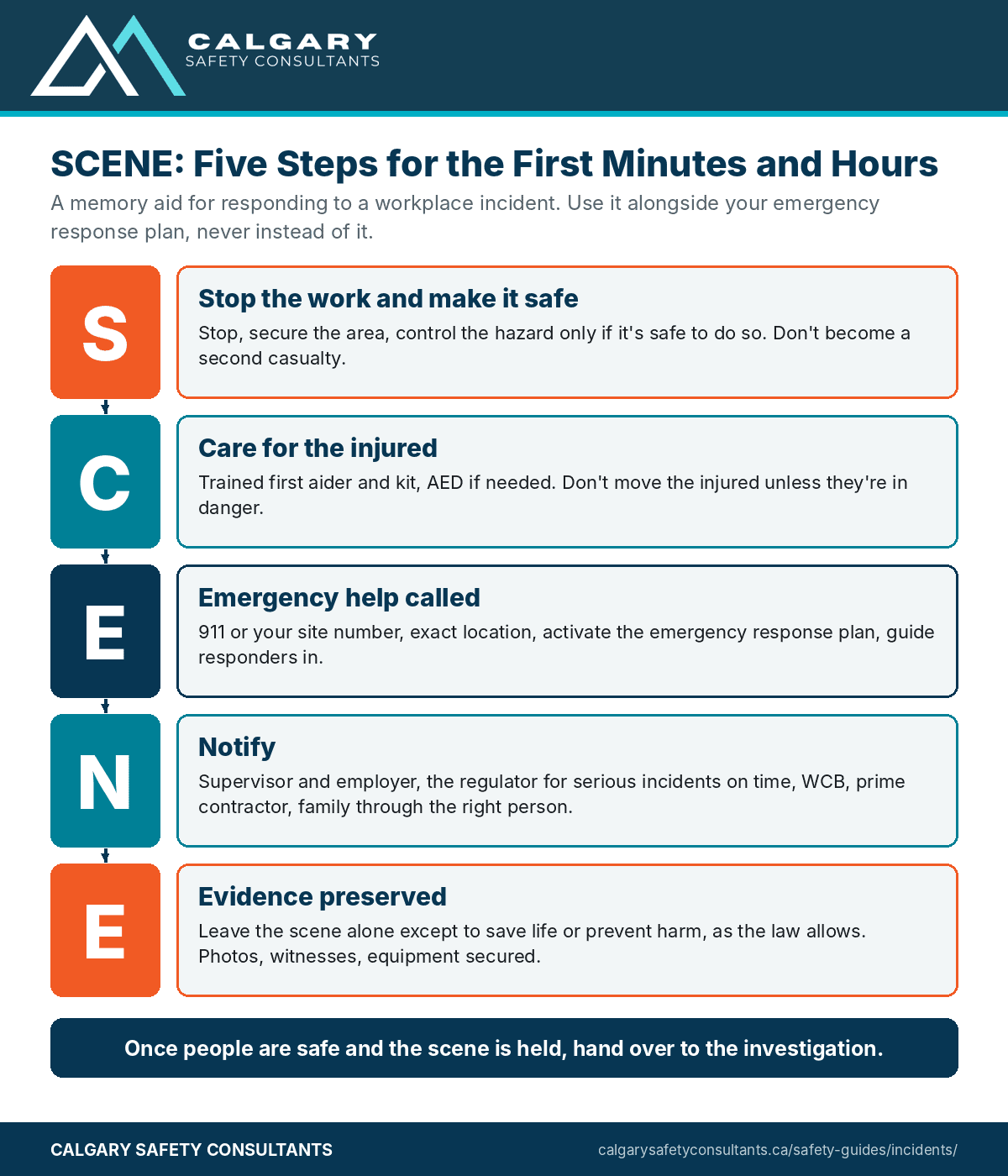
To make the incident response steps easy to remember, this guide uses one word: SCENE.
- S: Stop the work and make it safe. Stop, secure the area, control the hazard only if it's safe to do so, and don't become a second casualty.
- C: Care for the injured. First aid from the trained first aider, an AED if needed, and no moving the injured unless they're in danger.
- E: Emergency help called. 911 or your site emergency number, your emergency response plan, and someone to guide responders in.
- N: Notify. The supervisor and employer, then the regulator for serious incidents within the legal time, the WCB, the prime contractor or owner, and family through the right person.
- E: Evidence preserved. Leave the scene alone except to save life or prevent further harm, as the law allows, and record photos, witnesses and equipment.
SCENE is a memory aid for the first minutes and hours. It isn't a substitute for your emergency response plan, which sets out who does what at your site, your alarms, muster points and rescue plans. Our article on what to do when you have a serious workplace incident covers the same priorities from a manager's point of view.
Why the First Minutes and Hours Matter
Incidents aren't rare. Workers' compensation boards across Canada accepted 342,714 lost time claims in 2024, according to the Association of Workers' Compensation Boards of Canada, and behind every one is a workplace incident response that someone had to get right.
The first minutes decide how badly people are hurt. A hazard left running can injure the rescuer, and bleeding or cardiac arrest can't wait for a manager to arrive. A clear, practised response gives the injured person the best chance.
The first hours decide whether you meet your legal duties and keep the facts. Most jurisdictions require serious incidents to be reported immediately or as soon as possible and forbid disturbing the scene. A late call, a tidied work area or a restarted machine can lead to orders or charges, and destroys evidence.
People also remember how they were treated that day, and a calm, caring response builds the trust that gets the next near miss reported.
Who's Involved
Workplace incident response works best when everyone knows their part before anything happens.
- The first person on the scene raises the alarm, keeps clear of the hazard and gets help.
- The supervisor or person in charge takes charge: stops the work, assigns jobs, makes sure the calls are made and holds the scene. Supervisors' duties here are part of the due diligence covered in our supervisor due diligence guide.
- The first aider gives care within their training until paramedics take over.
- Emergency services or a site rescue team take control when they arrive.
- The employer, and the prime contractor where there is one, make the legal notifications and lead the follow-up.
- The joint health and safety committee or representative is notified in many jurisdictions and usually takes part in the investigation.
- The regulator and the workers' compensation board receive the reports the law requires.
In a small business, one person may fill several roles. That's fine, as long as names and numbers are written down in advance on the free SCENE card.
When to Use SCENE
Use SCENE for every incident, and scale it to the size of the event. For a minor cut, stopping, caring and noting what happened might take five minutes, and notifying means telling your supervisor. For a serious injury, every step runs at full strength. For a near miss, nobody needs first aid, but stopping, notifying and keeping the evidence still matter.
The same steps apply when the person hurt is a contractor, visitor or member of the public, and when the incident involves a vehicle, fire, chemical release or violence. Police or fire services may take charge of the scene; support them and keep everyone else safe.
The SCENE Incident Response Steps at a Glance
The five letters set the order of priorities for workplace incident response. On a crew, several steps usually happen at once: one person calls 911 while the first aider gives care and the supervisor secures the area. If you're alone, work through them in order.
| Letter | Step | Ask yourself |
|---|---|---|
| S | Stop the work and make it safe | Is the hazard still active, and is anyone else at risk, including me? |
| C | Care for the injured | Who needs help first, and where's the first aider, the kit and the AED? |
| E | Emergency help called | Has someone called 911, and does someone know to meet the responders? |
| N | Notify | Who must know now, and is this reportable to the regulator? |
| E | Evidence preserved | Is the scene protected, and have we recorded what we see? |
S: Stop the Work and Make It Safe
The first instinct is to run to the injured person. Pause for a few seconds first. If whatever hurt them is still moving, energized, leaking or unstable, it can hurt you too, and then there are two people needing help instead of one. The HSE guide notes that making the area safe may, in some cases, need to come before first aid.
- Stop the work. Call a stop, hit the emergency stop, shut down equipment and halt nearby work that could add to the danger.
- Secure the area. Keep people back with barricades, flagging, cones or a person posted as a guard, and control traffic.
- Control the hazard, but only if it's safe to do so and you're trained: close a valve, isolate power, ventilate or shut off fuel.
- Don't become a second casualty. Never enter a confined space, trench, unsafe atmosphere or area with live electrical hazards to rescue someone unless you're trained, equipped and part of the rescue plan. Wait for the rescue team.
- Account for everyone.
It's the hazard thinking of a field level hazard assessment, done in seconds. If the hazard can't be controlled, move people away and let emergency services handle it.
C: Care for the Injured
Once it's safe to approach, care for the injured person. Send for your trained first aider and the first aid kit straight away, and if someone may be in cardiac arrest, send for the AED and start CPR. The Heart and Stroke Foundation says anyone can use an AED, that all AEDs give voice prompts, and that CPR plus an AED can double a person's chance of survival from cardiac arrest.
- Treat life-threatening problems first: breathing, severe bleeding and shock.
- Don't move the injured unless they're in danger where they are. The Canadian Red Cross first aid pocket guide says to leave a person with a possible head, neck or spinal injury in the position they were found and call EMS/911, and to move them only if there are immediate dangers or their position stops you caring for life-threatening conditions.
- Stay with them until paramedics take over.
- Write down what you did and when, such as when bleeding was controlled or CPR began, and give it to the paramedics.
How many first aiders you need, and what's in your kits, depends on your jurisdiction, workforce and hazards, as our guide to workplace first aid requirements in Canada explains. A trained first aider still needs a system around them. Our article on why first aid responses fail even with a trained first aider suggests a short monthly drill.
Look after witnesses, too: move them away from the scene and have someone stay with them.
E: Emergency Help Called
Call 911, or your site's emergency number, early. If you're not sure whether an injury needs an ambulance, make the call and let the dispatcher help you decide. Give one person the job, and have them stay on the line.
- Give the exact location: the street address, or for rural and remote sites the legal land location, road name or GPS coordinates, plus the nearest gate or entrance.
- Say what happened: how many people are hurt, how badly, and any continuing hazards such as fire, gas or electricity.
- Activate your emergency response plan: alarms, evacuation and muster, your rescue plan and any on-site medical transport.
- Guide responders in. Send someone to the road or gate to meet the ambulance, open gates and keep the access route clear.
- Check workers who work alone or remotely. Your working alone procedure should say who raises the alarm if a check-in is missed.
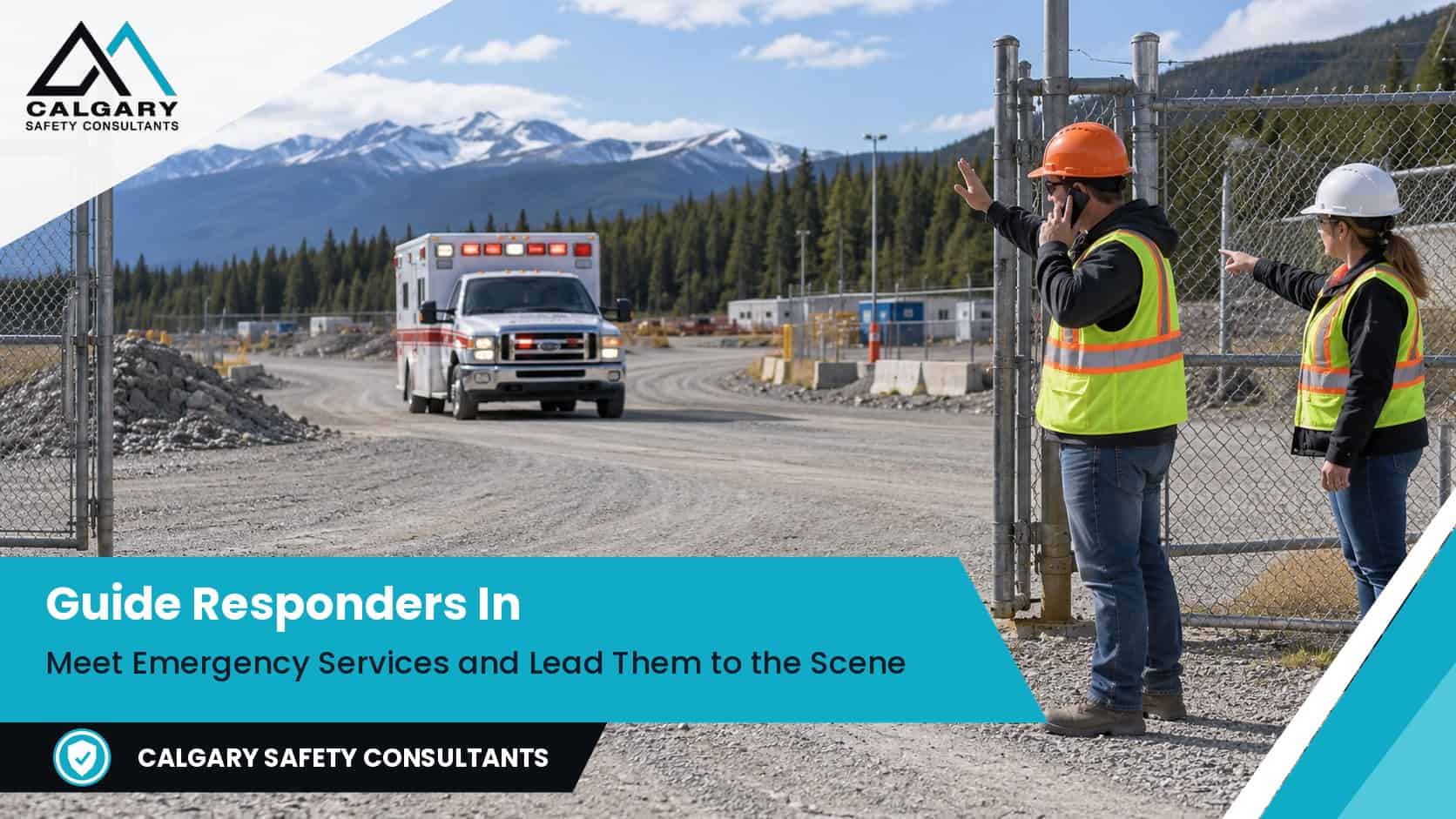
Write your site's details on the SCENE card now. Under pressure, people forget addresses they drive to every day.
N: Notify
Once people are cared for and help is on the way, tell the people who need to know, in the right order:
- The supervisor and the employer, right away, so someone with authority takes charge of the notifications.
- The OHS regulator, for serious incidents, within the time the law sets. That's usually a phone call by the prime contractor or employer.
- The prime contractor or owner of the site, if you're a contractor. They may have the legal duty to report.
- The joint health and safety committee or representative, which several jurisdictions require.
- The workers' compensation board, for injuries, within its own deadline.
- The injured worker's family, through the right person. That's usually a senior manager, or police after a death, and never word of mouth or social media.
If you aren't sure whether an incident is reportable, call the regulator and ask, and record who you called, when, who called and any reference number. Our article on incident reporting requirements in Canada explains how reporting fits into your wider program. The rules for each jurisdiction follow.
Alberta, British Columbia and Saskatchewan
Alberta. The prime contractor, or the employer if there's none, must report to Alberta OHS as soon as possible when a worker dies, or has been or will be admitted to hospital (not just emergency or urgent care), or after an unplanned or uncontrolled explosion, fire or flood that causes, or could cause, serious injury or illness, a crane, derrick or hoist collapse, or a structure failure. Potentially serious incidents are reported online after the investigation. Employers report injuries to WCB-Alberta within 72 hours of becoming aware.
British Columbia. Section 68 of the Workers Compensation Act requires immediate notice to WorkSafeBC when a worker is seriously injured or killed, of a major structural failure or collapse, a major release of a hazardous substance, a dangerous fire or explosion with potential for serious injury, or a blasting incident causing injury. The employer's injury report is due within 72 hours and doesn't replace the immediate notice.
Saskatchewan. Section 2-2 of the OHS Regulations, 2020 requires notice to the ministry as soon as is reasonably possible of an accident that causes or may cause a death, or will require a worker to be admitted to hospital as an in-patient for 72 hours or more. Section 2-3 adds dangerous occurrences, even when nobody's hurt, and the co-chairs or representative get a copy. Injuries needing medical attention go to the WCB within five days.
Manitoba, Ontario and Quebec
Manitoba. The employer must notify the Workplace Safety and Health Branch of a serious incident immediately, by the fastest means available. The regulation's list includes a death, electrical contact injuries, unconsciousness from a concussion, listed fractures and amputations, third degree burns, loss of sight, a cut needing hospital treatment, asphyxiation or poisoning, structural collapses, explosions, fires, floods, uncontrolled hazardous spills and respirator failure. Injuries go to WCB Manitoba within five business days.
Ontario. When a worker, or in some cases a non-worker, is killed or critically injured at a workplace, the employer, and the constructor on a construction project, must notify the ministry, the joint committee or representative and any union immediately, with a written report within 48 hours.
In Ontario, critical injuries include ones that endanger life, cause unconsciousness or substantial blood loss, fracture a leg or arm, amputate a leg, arm, hand or foot, burn a major part of the body or cost the sight of an eye. Employers report injuries to the WSIB within three business days.
Quebec. Section 62 of the Act respecting occupational health and safety requires notice to the CNESST by the most rapid means, with a written report within 24 hours, of a death, the loss or loss of use of a limb, significant physical trauma, serious injuries keeping two or more workers off for a working day, or material damage of $150,000 or more (indexed each year). For injury claims, the CNESST says the employer completes its employer's notice form online.
Atlantic Provinces
New Brunswick. Under section 43 of the OHS Act, the employer must notify WorkSafeNB immediately of listed injuries, such as unconsciousness, amputation, most fractures, hospital admission and death, and of accidental explosions or exposures and catastrophic events, injury or not, and tell the committee or representative. Form 67 is due within three days.
Nova Scotia. The Workers' Compensation Board says fatalities must be reported to the OHS Division immediately, and serious injuries and incidents as soon as possible, within 24 hours, and that it must receive the injury report within two business days. The 2016 amendment to section 63 of the OHS Act also covers explosions, major structural failures and hazardous releases, injury or not.
Prince Edward Island. Serious injuries, such as one that is or may be fatal, a fracture, unconsciousness or major burns, must be reported to the OHS Division immediately. The WCB's OHS guide gives 24 hours and the 24-hour line, 902-628-7513. The WCB injury report is due within three days.
Newfoundland and Labrador. Section 54 of the OHS Act requires the employer or principal contractor to notify the assistant deputy minister immediately of an accident causing serious injury or death, or with the reasonable potential to do so, and to tell the committee or representative. WorkplaceNL expects Form 7 within three days.
Territories and Federally Regulated Workplaces
Yukon. The prime contractor, or the employer if there's none, must report serious incidents and injuries to the Workers' Safety and Compensation Board immediately under sections 57 and 58 of the Workers' Safety and Compensation Act. That includes in-patient hospital admissions, major structural failures, major hazardous releases and dangerous fires or explosions. Other injuries go to the board within three days.
Northwest Territories and Nunavut. For the Workers' Safety and Compensation Commission, serious bodily injury accidents and dangerous occurrences go to the Chief Safety Officer as soon as is reasonably possible, through the incident line (NWT 1-800-661-0792, Nunavut 1-877-404-4407), and the employer's incident report is due within three business days. The Northwest Territories OHS Regulations define a serious bodily injury accident as one that could cause death or needs 24 hours or more in hospital. Nunavut employers should check Nunavut's matching regulations.
Federal. Federally regulated employers notify the Head of Compliance and Enforcement under section 15.5 of the Canada Occupational Health and Safety Regulations as soon as feasible, and no later than 24 hours, after a death, a disabling injury to two or more employees, the loss of a body part or its use, permanent impairment, an explosion, or listed boiler, pressure vessel or elevating device failures. Check with the board that covers your workers for injury claims.
Reporting and Scene Rules Across Canada at a Glance
If you work in more than one province, build your procedure around the strictest timeline that applies and keep the reporting numbers for each one on your SCENE card. Our guide to OHS legislation in Canada links to each jurisdiction's laws.
| Jurisdiction | Report to the OHS regulator | How fast | Leave the scene alone, except to | WCB injury report |
|---|---|---|---|---|
| Alberta | Death, hospital admission, unplanned explosion, fire or flood causing or able to cause serious injury, crane or structure collapse (OHS Act s. 33); potentially serious incidents online | As soon as possible | Attend to the injured or killed, prevent further harm, protect endangered property, or as a Director, OHS officer or police officer directs (s. 33(9)) | Within 72 hours |
| British Columbia | Serious injury or death, major structural failure, major hazardous release, dangerous fire or explosion, blasting injury (WCA s. 68) | Immediately | Attend to the injured or killed, prevent further injury, protect endangered property | Within 72 hours |
| Saskatchewan | Accident that causes or may cause death, or 72 hours or more in hospital (s. 2-2); dangerous occurrences (s. 2-3) | As soon as reasonably possible | Fatal accidents: save life or relieve suffering, until an officer completes the investigation (s. 3-19) | Within 5 days |
| Manitoba | Serious incidents listed in the WSH Regulation | Immediately, fastest means | Free a trapped person, avoid more hazards, give critical care; held until WSH releases it | Within 5 business days |
| Ontario | Death or critical injury of a worker, or in some cases a non-worker (OHSA s. 51) | Immediately; written report in 48 hours | Save life or relieve suffering, keep utilities or transit running, prevent unnecessary damage, or with an inspector's permission (s. 51(2)) | Within 3 business days |
| Quebec | Death, loss of a limb or its use, significant trauma, 2 or more workers seriously hurt, damage of $150,000 or more, indexed yearly (s. 62) | Most rapid means; written report in 24 hours | Prevent the consequences getting worse, or with the inspector's authorization | Employer's notice completed online |
| New Brunswick | Listed injuries, accidental explosion or exposure, catastrophic event or equipment failure (OHS Act s. 43) | Immediately | Attend to the injured or killed, prevent further injury, protect endangered property (s. 43(3)) | Within 3 days |
| Nova Scotia | Death or likely fatal injury; serious injuries; explosions, structural failures, hazardous releases, falls where fall protection is required (OHS Act s. 63) | Deaths and likely fatal injuries immediately; others within 24 hours | Any accident reportable under s. 63(1), not only deaths: attend to the injured or killed, prevent further injuries, protect endangered property, unless an officer directs otherwise (s. 64) | Within 2 business days |
| Prince Edward Island | Serious workplace injuries | Immediately (WCB guide: 24 hours) | Prevent further injury or damage, until the OHS officer arrives | Within 3 days |
| Newfoundland and Labrador | Serious injury or death, or reasonable potential for it (OHS Act s. 54) | Immediately | Attend to the injured or killed, prevent further injuries, protect endangered property (s. 55) | Within 3 days |
| Yukon | Serious injury or death, in-patient admission, major failures, releases, fires or explosions (WSCA s. 57) | Immediately | Attend to the injured or killed, prevent further injuries, protect endangered property, unless the board or RCMP direct otherwise | Within 3 days |
| Northwest Territories and Nunavut | Serious bodily injury accidents and dangerous occurrences (NWT OHS Regulations ss. 8, 9) | As soon as reasonably possible | Fatal accidents: save life or relieve suffering, until a safety officer investigates (NWT s. 29) | Within 3 business days |
| Federal | Death, disabling injury to 2 or more, loss of a body part, permanent impairment, explosion, listed failures (COHSR s. 15.5; other federal sector regulations have their own rules) | As soon as feasible, within 24 hours | Save life, prevent injury or relieve suffering, keep an essential public service running, prevent unnecessary damage (s. 127) | Check with your board |
Summary only, current as of October 2026. Each law has definitions, exceptions and extra rules for mines and some industries. Check the current legislation and your regulator's reporting page.
E: Evidence Preserved
Once people are safe, protect the facts. Most Canadian laws say the scene of a serious incident must be left alone, except to save life, prevent further harm or protect property, until the regulator releases it. Details differ: the rules in Saskatchewan and the Northwest Territories apply only to fatal accidents, Nova Scotia's applies to every accident it requires to be reported, including explosions, structural failures, hazardous releases and falls where fall protection is required, Manitoba may require a scene to be preserved for at least 24 hours, and the Canada Labour Code exempts transport incidents investigated under other federal laws.
- Guard the scene. Keep the barricade up, post someone to watch it and log who goes in and why.
- Don't move, clean, repair or restart anything unless it's needed to save life or prevent more harm. If you must move something, note where it was and photograph it first if you can.
- Take photos and video from all sides, wide shots and close-ups, before conditions change.
- Get witnesses' names and contact details, keep them apart if you can, and ask each one for a short written account while it's fresh.
- Secure equipment and records: tools, PPE, permits, hazard assessments, logbooks, camera footage and vehicle data.
- Keep a timeline of what happened and when, and record who released the scene and when.
Good records pay off. In Saskatchewan, an officer may only let wreckage be moved after a fatal accident once photographs or other evidence of the scene have been made and the committee co-chairs or representative have inspected it. Keeping evidence isn't about blame; it gives the investigation the facts it needs.
What Happens After the First Hour
Once the scene is held, the response turns into recovery and learning.
Hand Over to the Investigation
Give the investigator everything you gathered: the timeline, photos, witness list, notifications log and the first aid record. Our guides on how to investigate a workplace incident and how to conduct a root cause analysis explain what happens next. Some deadlines start right away. In B.C., for example, WorkSafeBC expects a preliminary investigation and report within 48 hours and a full investigation within 30 days.
Interim Controls and Corrective Actions
Don't restart the same work in the same way until you've made it safe. Put interim controls in place, such as isolating equipment, adding a spotter or changing the method, and record them. The investigation's fixes then go into your corrective action tracking with owners and due dates. Restock the first aid kit, replace AED pads and check that any emergency equipment you used is ready for next time.
Worker Support and Psychological First Aid
A serious incident affects more than the injured worker. The World Health Organization's guide to psychological first aid describes it as humane, supportive and practical help for people who've been through a serious crisis. In practice, that means checking on people, listening without pushing, meeting basic needs such as a ride home and connecting them with help.
Offer your employee assistance program, and check in again over the following days. In B.C., WorkSafeBC's Critical Incident Response program offers free, voluntary support from a qualified mental health professional to workers and employers directly exposed to an incident, such as witnessing a co-worker's serious injury, for up to three weeks, without a claim.
Communicating After an Incident
Brief the crew with facts, not guesses, and don't share the injured person's medical details without their consent. Name one person to deal with the media, clients and the public, ask workers not to post photos online, and update people as facts are confirmed.
Near Misses Are Incidents Too
A near miss gets a lighter version of SCENE: stop and make it safe, notify your supervisor and record what you saw. The HSE guide says investigating near misses is as useful as investigating accidents, and much easier. Treat every near miss as a free lesson, and thank the workers who report them. Our health and safety system guide shows where incident reporting fits in your program.
Workplace example
A Practical Workplace Example
Situation: Consider an illustrative industrial coatings contractor in central Alberta with about 50 workers, working on a maintenance project at a processing plant. The plant owner is the prime contractor. At 10:05 a.m., a scaffold plank shifts and a painter falls about two metres onto concrete. He's conscious, but his forearm is badly deformed. The supervisor had run a SCENE drill the month before.
Action: The supervisor called a stop, had the crew shut off the sprayer and put up barricade tape (S). The crew's first aider kept the painter still and supported his arm in the position he found most comfortable, as she'd been trained to do (C). A labourer called 911 at 10:07 using the site address on the SCENE card, while another went to the main gate to guide the ambulance in (E).
The supervisor called the project manager, who called the prime contractor's safety lead; because the painter was likely to be admitted to hospital, the prime contractor reported to Alberta OHS at 10:41 and logged the reference number (N). The crew photographed the scaffold before anyone touched it and wrote down three witnesses' names (E).
Result: Paramedics arrived at 10:21 and the painter was admitted to hospital for surgery. The scene stayed taped off until the OHS officer released it. With the timeline, photos and witness list in hand, the investigation quickly found an unsecured plank and a gap in scaffold inspections. The company added a daily scaffold tag check, and the painter returned to modified duties six weeks later.
Common Mistakes to Avoid
- Rushing in before the hazard is controlled. A second casualty helps nobody.
- Assuming someone else called 911. Give the job to one named person and confirm it's done.
- Moving an injured person who isn't in danger. Unless they're at risk where they are, wait for help.
- Not knowing the site address. Responders lose time at the wrong gate.
- Cleaning up or restarting work too soon. It can break the law and it destroys evidence.
- Waiting to report until all the facts are in. The legal clock starts at the incident. Call, then update.
- Treating the WCB report as the OHS report. They're separate duties with separate deadlines.
- Forgetting the prime contractor or owner. On many sites they hold the duty to report.
- Ignoring the witnesses. Shock and stress are real.
- Treating near misses as non-events. They're the cheapest lessons you'll get.
Audit perspective
What an Auditor Expects to See
In a COR or SECOR audit, incident response is tested under emergency response and incident reporting and investigation. Energy Safety Canada's 2023 COR audit protocol, for example, asks whether the emergency response plan sets out communication procedures, emergency contacts, evacuation and rescue plans for each scenario, whether there are plans for medical emergencies and first aid, whether the right number of workers are trained in first aid, and whether the plan is tested at least annually.
Under incident reporting, the same protocol looks for a written requirement to report incidents immediately, an outline of the incidents that must be reported to the governing authority, investigation of near misses and work refusals, and investigations started within a prompt, reasonably practicable timeline. Auditors also interview workers and supervisors, who should be able to explain what they'd do in the first minutes.
Calgary Safety Consultants helps employers build and test their programs and prepare for COR and SECOR audits; we don't issue certificates. CORs and SECORs are issued through the applicable certifying partner.
The Bottom Line
Good workplace incident response is simple to describe and hard to do under pressure, which is why it helps to have one word to remember. Stop the work and make it safe, care for the injured, get emergency help, notify the right people, including the regulator when the law requires it, and preserve the evidence.
Write your site's details on the SCENE card, practise it with your crews and make sure it matches your emergency response plan. The day something goes wrong, the first few minutes will go the way you've practised them.
Download the SCENE Card and First-Hour Response Record
Two free, fillable PDF downloads go with this guide. Both have clickable checkboxes and fill-in fields, so you can complete them on screen or print them for your site, vehicles and first aid stations.
- SCENE Incident Response Card (PDF, 4 pages). A printable SCENE poster, cut-out wallet and hard hat cards with space for your emergency numbers, a one-page SCENE checklist with clickable checkboxes and blank emergency contact fields for your site address, emergency number, first aiders, supervisor, regulator line and WCB, and a quick reference of reporting lines across Canada.
- Incident First-Hour Response Record (PDF, 8 pages). A record to fill in during and after the first hour: how to use it, incident details, a SCENE step log with times, injured persons and care given, emergency services, a notifications log with a jurisdiction table of regulator reporting rules, scene preservation and release, witnesses, photos and evidence, hand-off to the investigation and sign-off.
Click either button to download the file. Fill in the card before you need it, keep the record with your first aid kit or in your vehicle, and adapt both to your emergency response plan and the rules that apply in your province or territory, or under the Canada Labour Code.

About the author
John Duplessis, B.Sc., CRSP
John Duplessis is a Canadian Registered Safety Professional with more than 30 years of occupational health and safety experience in oil and gas, construction, green energy, midstream operations and industrial project work. He is an external auditor with Energy Safety Canada.