On this page
- Start with the correct jurisdiction
- Immediate response before regulatory reporting
- Provincial requirements at a glance
- Alberta: serious injury, incident and scene-preservation duties
- British Columbia: immediate notification and two-stage investigation
- Saskatchewan: serious injuries, fatalities and dangerous occurrences
- Internal reporting should be broader than regulator reporting
- What a practical incident-reporting procedure should contain
- Common mistakes to avoid
- Official sources
- Frequently asked questions
Quick answer
Know the jurisdiction before you report
When a serious workplace incident occurs, the first priorities are emergency response, preventing further harm and meeting the reporting rules that apply in the province where the work took place. Those rules are not identical across Canada. A trigger that requires immediate regulator notification in one province may be handled differently in another.
This guide summarizes the primary occupational health and safety reporting and investigation requirements for provincially regulated workplaces in Alberta, British Columbia and Saskatchewan. Federally regulated workplaces, mining operations and other special regimes may have different requirements and are outside the scope of this article.
Start with the correct jurisdiction
The governing jurisdiction is usually based on the nature of the employer’s operations and the location of the work. Most workplaces are provincially regulated. Banks, interprovincial transportation, telecommunications and certain other industries may be federally regulated under the Canada Labour Code. If authority is unclear, confirm it before relying on a reporting checklist.
Immediate response before regulatory reporting
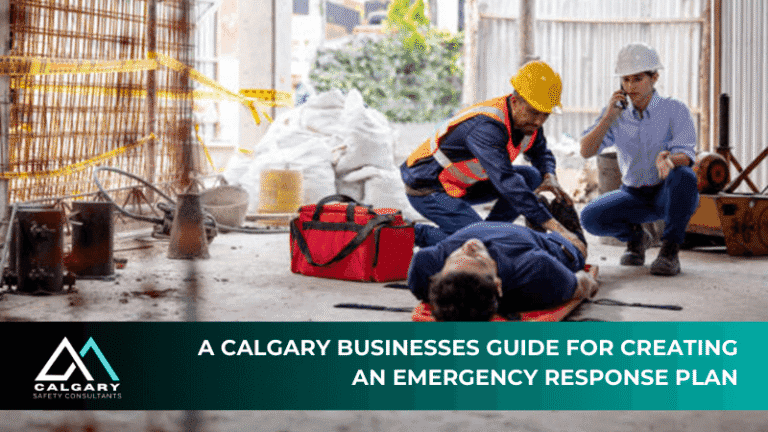
- Call emergency services where required and provide first aid within the responder’s training and authority.
- Stop the affected work and control immediate hazards without exposing others.
- Notify the employer’s designated incident contact and the site authority.
- Determine the governing jurisdiction and whether an immediate regulator report is required.
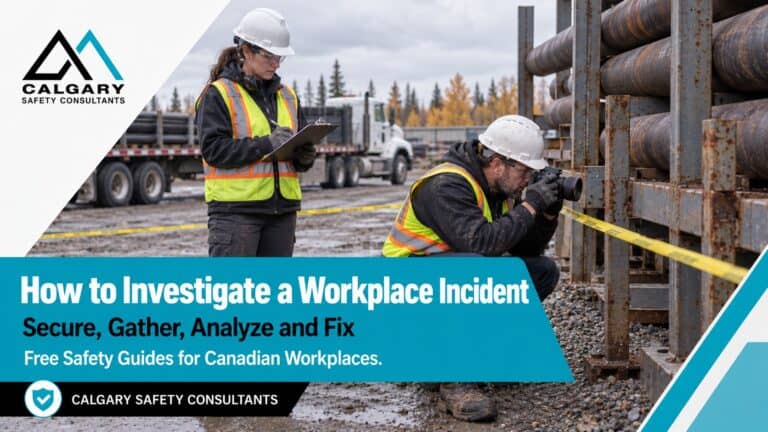
- Preserve the scene when required, subject to the legal exceptions for rescue, preventing further injury or protecting property.
- Begin the required investigation and consultation process after urgent conditions are controlled.
Do not delay an urgent regulator notification while waiting for a complete investigation. Initial reporting and the investigation are related but separate duties.
Provincial requirements at a glance
| Jurisdiction | Examples of external reporting triggers | Timing and key follow-up |
|---|---|---|
| Alberta | Death; hospital admission beyond emergency or urgent care; specified uncontrolled explosion, fire or flood; collapse or upset of a crane, derrick or hoist; or collapse or failure of a building or structure necessary for structural integrity. | Report as soon as possible under Occupational Health and Safety Act, s. 33(1)–(2). Preserve the scene for incidents reportable under s. 33(1), subject to the exceptions in s. 33(9). Investigate as required by s. 33(5)–(7). |
| British Columbia | Serious injury or death; major structural failure or collapse; major release of a hazardous substance; fire or explosion with potential for serious injury; or another prescribed incident. | Notify WorkSafeBC immediately under Workers Compensation Act, s. 68. Investigate the incidents described in s. 69. Complete the preliminary investigation requirements under s. 71 and the full investigation report under s. 72. |
| Saskatchewan | Fatalities and serious injuries meeting the provincial criteria, including an injury that causes or may cause admission to hospital for 72 hours or more, and listed dangerous occurrences. | Report as soon as reasonably possible under The Occupational Health and Safety Regulations, 2020, ss. 2-2 and 2-3. Investigation and reporting duties may also apply under ss. 3-18 and 3-20. |
This table is a practical summary, not a substitute for the legislation. Apply the complete wording of the applicable section and seek qualified advice when the facts are uncertain.
Alberta: serious injury, incident and scene-preservation duties
For provincially regulated Alberta workplaces, the main external reporting rule is in the Occupational Health and Safety Act, s. 33.
Section 33(2) identifies the incidents that must be reported as soon as possible under s. 33(1). They include:
- an injury, illness or incident that results in a worker’s death;
- an injury, illness or incident that results in a worker being admitted to a hospital beyond treatment in an emergency room or urgent care facility;
- an unplanned or uncontrolled explosion, fire or flood that causes, or had the potential to cause, a serious injury or illness;
- the collapse or upset of a crane, derrick or hoist; and
- the collapse or failure of any component of a building or structure necessary for its structural integrity.
Alberta’s scene-preservation requirement is in the Occupational Health and Safety Act, s. 33(9), not the OHS Code. For an incident reportable under s. 33(1), the scene must generally remain undisturbed unless the action is needed to attend to an injured or deceased person, prevent further injuries or protect property endangered by the incident.
Alberta also requires an investigation when an incident has a likelihood of causing a serious injury or illness and there is reasonable cause to believe corrective action may be needed. That investigation duty in s. 33(5) is broader than the list of incidents requiring immediate external reporting. Under s. 33(6), the investigation report must describe the circumstances, corrective action and other prescribed information, and it must be provided to the joint health and safety committee or health and safety representative, if applicable, or made available to workers when neither is required. Section 33(7) requires the report to be retained for at least two years.
Alberta OHS can be contacted at 1-866-415-8690. Follow the current instructions on Alberta’s official “Report serious injuries and incidents” page.
British Columbia: immediate notification and two-stage investigation
In British Columbia, the Workers Compensation Act, s. 68 requires the employer to notify WorkSafeBC immediately of specified incidents. Section 69 requires investigation of reportable incidents, incidents resulting in injury that required medical treatment and near misses with the potential to cause serious injury.
The Act also sets expectations for who participates. Under s. 70, the investigation must be carried out by persons knowledgeable about the work, and worker participation is required through a worker representative where the section applies.
British Columbia uses a two-stage investigation process:
- Section 71 requires a preliminary investigation and related report within 48 hours, subject to the section’s wording.
- Section 72 requires the full investigation report to be completed and submitted to the Board within 30 days, unless an extension applies.
Use WorkSafeBC’s current “Reporting incidents” page to confirm the reporting channel and any instructions that apply to the event.
Saskatchewan: serious injuries, fatalities and dangerous occurrences
Saskatchewan distinguishes between serious injuries or fatalities and listed dangerous occurrences. Under The Occupational Health and Safety Regulations, 2020, ss. 2-2 and 2-3, the employer, contractor or owner identified by the applicable section must report as soon as reasonably possible.
The serious-injury criteria include an injury that causes, or may cause, a worker to be admitted to hospital for 72 hours or more. Section 2-3 lists dangerous occurrences that require reporting even when no one was injured. Review the complete list against the facts rather than assuming that every near miss is externally reportable.
Saskatchewan Workplace Safety can be reached at 1-800-567-7233, option 1. Follow the province’s current “Reporting serious injuries, fatalities and dangerous occurrences” guidance.
Internal reporting should be broader than regulator reporting
A strong internal system should capture injuries, illnesses, equipment damage, environmental releases, unsafe conditions and near misses even when the event does not meet the threshold for external reporting. Internal reporting gives the employer the information needed to correct hazards before the next event is more serious.
That does not mean every internal report must be sent to the regulator. The incident lead should assess the facts against the exact legal trigger, document the decision and escalate uncertainty promptly.
What a practical incident-reporting procedure should contain
- Emergency contacts and first-response actions.
- A clear escalation path for workers, supervisors, contractors and management.
- Jurisdiction-specific regulator contacts and reporting triggers.
- Scene-control and evidence-preservation requirements.
- Roles for investigation, worker participation and report approval.
- Requirements for corrective-action ownership, due dates and effectiveness checks.
- Record-retention rules based on verified legal, contractual and organizational requirements.
- Communication steps for workers, committees, representatives, clients and prime contractors where applicable.
A completed form or signed attendance sheet is not proof that reporting arrangements work. Employers should test the process through supervisor scenarios, drills or tabletop exercises, then correct gaps in decision-making, contacts, after-hours coverage and documentation.
Common mistakes to avoid
- Using a single “Canada-wide” trigger list without checking the province and industry.
- Waiting for the investigation to finish before making an immediate regulator report.
- Disturbing a scene before confirming whether preservation is required.
- Assuming every near miss must be externally reported, or assuming that no-injury events never need investigation.
- Failing to involve the joint health and safety committee, representative or worker participant where required.
- Closing corrective actions without checking whether they were implemented and effective.
Official sources
- Alberta Occupational Health and Safety Act, Part 7, s. 33
- Government of Alberta: Report serious injuries and incidents
- British Columbia Workers Compensation Act, Part 2, ss. 68–72
- WorkSafeBC: Reporting incidents
- Government of Saskatchewan: Reporting serious injuries, fatalities and dangerous occurrences
Source verification date: November 6, 2026. This draft requires CRSP review and confirmation of any sector-specific or federally regulated requirements before publication.

John Duplessis, B.Sc., CRSP
This draft remains subject to the author’s professional review and approval before publication.