On this page
- What Journey Management Is
- Why Journey Management Matters
- The Legal Duties Behind Journey Management
- Working Alone Rules for Workers Who Drive Alone
- Hours of Service and Distracted Driving Laws
- Who Does What: Drivers, Journey Managers and Approvers
- When a Journey Management Plan Is Needed
- Start by Asking Whether the Trip Is Needed
- What Goes in a Journey Management Plan
- Setting Check-In Times That Work
- What to Do When a Driver Is Overdue
- Remote and Winter Travel
- Technology: GPS, In-Vehicle Monitoring and Satellite Devices
- Driver Fitness, Fatigue and Vehicles
- Rolling Out a Journey Management Program
- Reviewing and Improving the Program
- Journey Management in a COR Audit
- A Practical Workplace Example
- Common Journey Management Mistakes to Avoid
- What an Auditor Expects to See
- The Bottom Line
- Download the Plan and Quick Guide
- Frequently Asked Questions
- Related Guides and Articles
- How Calgary Safety Consultants Can Help
- Sources
What Journey Management Is
Every day, field crews drive to well sites, solar farms, pipelines, substations and remote camps. Most trips end without a problem. The ones that don't can be catastrophic, often on roads the crew has driven a hundred times. Journey management treats that drive as part of the work, with the same planning and supervision as any other hazardous task.
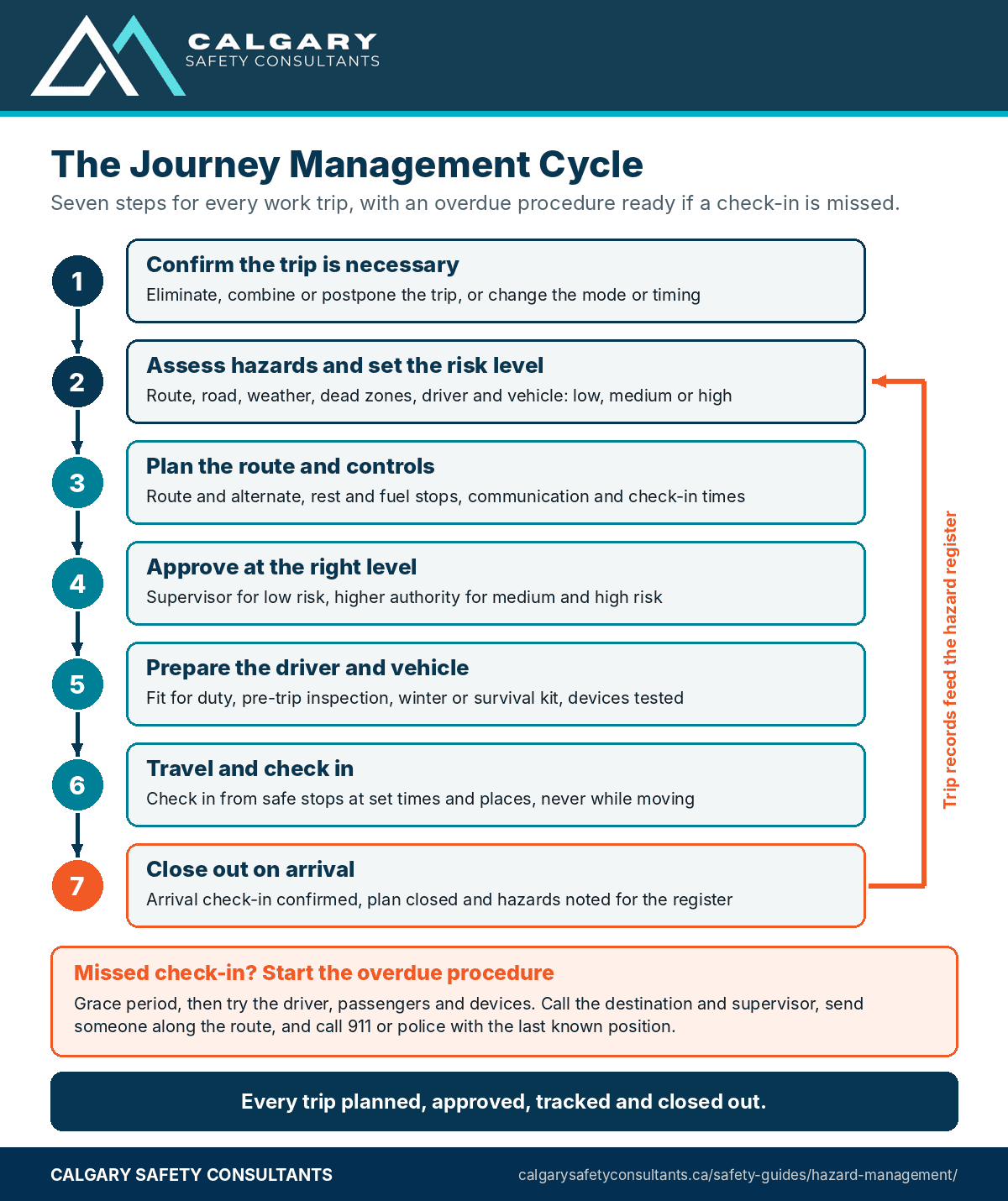
Energy Safety Canada's journey management guideline defines it as "a planned and systematic strategy to evaluate, reduce and control transportation-related hazards." The guideline isn't prescriptive. It sets out seven steps that most good programs follow in one form or another: decide whether the journey is necessary, assess the hazards, develop controls, approve the journey, prepare for it, undertake it and complete it.
Two terms get used a lot and they're worth separating. A journey management program is the system: the policy, roles, risk criteria, training, check-in rules and the overdue procedure. A journey management plan is the document for one trip: who's going, where, by what route, with what hazards and controls, and when they'll check in. The program makes sure every plan is done the same way and that someone acts when a plan goes wrong.
It isn't only for oil and gas. Renewable energy, utilities, forestry, survey crews and mobile service technicians all benefit whenever workers drive alone, drive long distances, drive in winter or head to remote sites.
Why Journey Management Matters
Driving is routine, which is exactly why it's underestimated. The numbers tell a different story.
- Energy industry. Energy Safety Canada's occupational fatalities report for the oil and gas industry in Alberta and Saskatchewan states that transportation accidents are the largest cause of death in the industry. They account for 46 per cent of fatalities from 2011 to 2025 and 60 per cent from 2021 to 2025, and most of those deaths were highway accidents.
- Alberta, all industries. Alberta's provincial injury, illness and fatality summary for 2022 categorizes 20 per cent of the 118 accepted work-related deaths that occurred in 2022 (excluding COVID-19) as motor vehicle incidents, almost the same share as workplace incidents at 21 per cent, and notes that fatal motor vehicle incidents increased from 2021 to 2022.
- British Columbia. According to Road Safety at Work, using WorkSafeBC statistics for 2021 to 2025, motor vehicle incidents are the leading cause of traumatic work-related death in BC, with 22 deaths a year on average.
- Distraction. Transport Canada estimates that distracted driving contributed to 22.5 per cent of fatal collisions and 25.5 per cent of serious injury collisions in Canada in 2021.
The picture is similar in the United States, where NIOSH says motor vehicle crashes are the leading cause of work-related deaths. A NIOSH-linked paper on journey management in oil and gas called it a promising prevention strategy because it questions whether trips are needed and steers the rest toward safer routes, conditions, drivers and vehicles.
A missed check-in nobody notices for six hours can turn a survivable slide into the ditch into something much worse. Journey management shortens that gap.
The Legal Duties Behind Journey Management
No Canadian jurisdiction has a regulation called "journey management." The legal duty comes from several places that overlap whenever work involves driving.
- The employer's general duty. Every jurisdiction requires employers to protect workers, and that includes work done behind the wheel. In Alberta, section 3 of the Occupational Health and Safety Act requires employers to ensure, as far as reasonably practicable, the health, safety and welfare of their workers. For federally regulated employers, section 124 of the Canada Labour Code says every employer shall ensure that the health and safety at work of every person it employs is protected.
- Hazard assessment. Rules requiring employers to identify and control hazards apply to driving like anything else. A journey management plan is, in effect, a hazard assessment for a trip.
- Working alone rules. A worker driving alone to a remote site is often working alone in the legal sense, which brings check-in requirements.
- Traffic and transport law. Hours-of-service and distracted driving laws set limits your program has to respect.
Workers have duties too: to follow the program, drive within the law and report hazards. They also keep the right to refuse dangerous work, including a trip they believe is unsafe, and Energy Safety Canada's guideline expects drivers to understand their duty to refuse unsafe driving-related work.
Working Alone Rules for Workers Who Drive Alone
Working alone rules are where journey management and the law connect most directly. If a worker travels alone and help wouldn't be readily available, most jurisdictions expect a way to communicate and a way to check on them.
Alberta's guide to working alone makes the link explicit: workers who travel alone with no routine interaction with the public, including truck drivers, can be considered to be working alone. Its checklist asks whether workers file a travel plan for remote locations and carry emergency supplies for cold or bad weather.
The details differ by jurisdiction. British Columbia's OHS Regulation is one of the most specific. Manitoba's working alone requirements, Prince Edward Island's Part 53, Newfoundland and Labrador's working alone rules and the working alone code of practice for the Northwest Territories and Nunavut each set their own versions.
| Jurisdiction | Where the rule is | What it means for workers who drive alone |
|---|---|---|
| Alberta | OHS Code, Part 28 | Hazard assessment, an effective means of communication (electronic, or visits or worker-initiated contact where electronic isn't practicable) and contact at regular intervals appropriate to the hazards |
| British Columbia | OHS Regulation, ss. 4.20.1 to 4.23 | Written check procedure, a designated checker who records results, an end-of-shift check, a rescue plan, training and annual review |
| Manitoba | Workplace Safety and Health Regulation, Part 9 | Safe work procedure developed with the worker or committee, a reliable communication device and check frequency based on risk |
| Prince Edward Island | OHS General Regulations, Part 53 | Written procedures with check intervals, a named checker, an emergency rescue process and an end-of-shift check |
| Newfoundland and Labrador | OHS Regulations (working alone provisions) | Risk assessment, written check-in procedures with intervals and steps if the worker can't be reached, and annual review |
| Northwest Territories and Nunavut | OHS Regulations, s. 33, and the WSCC Code of Practice | Hazard identification, controls and an effective communication system; the code ties check-in frequency to risk |
| Saskatchewan, other provinces, Yukon and federal workplaces | Specific working alone rules or the general duty | Check your own regulation. The general duty still applies, and a reliable way to know a lone driver is safe is the usual way to meet it. |
Summary only, based on the regulator pages linked in this section. Rules change, so confirm the current requirements for your jurisdiction. Our guide on how to set up a working alone program covers every jurisdiction in more detail, and our online course, Working Alone and Lone Worker Safety for Canadian Workplaces, trains workers and supervisors.
A good journey management program usually meets the working alone rules for drivers at the same time, provided check-ins are scheduled, recorded and followed up. Build it to the strictest rule that applies to your crews.
Hours of Service and Distracted Driving Laws
If your crews drive commercial vehicles, hours-of-service rules may apply. The federal Commercial Vehicle Drivers Hours of Service Regulations cover trucks over 4,500 kg registered gross vehicle weight, and buses designed for more than 10 people, run by extra-provincial carriers.
South of 60 degrees north, drivers can't drive after 13 hours of driving or 14 hours on duty in a day, or once 16 hours have passed since their last 8 consecutive hours off duty. They must take at least 10 hours off duty each day and stay within the cycle limits: 70 hours on duty in 7 days (cycle 1) or 120 hours in 14 days (cycle 2).
Carriers operating only within one province follow that province's rules. A 160 km radius exemption removes the daily log for drivers who stay within 160 km of their home terminal and return to it each day, if the carrier keeps the required records, but not the driving limits. And as Energy Safety Canada points out, being within hours of service doesn't automatically mean a driver is fit for duty.
Distracted driving laws matter just as much, because a program that expects drivers to answer the phone at every check-in pushes them toward hand-held use, which breaks the law, and toward distraction even when hands-free. Alberta's distracted driving rules, British Columbia's rules as summarized by ICBC and Ontario's distracted driving law show how much the details vary:
| Province | Key rule | Penalty (first offence) |
|---|---|---|
| Alberta | No hand-held phone use, even when stopped at a red light. Hands-free allowed if activated by voice or a single touch. Two-way radios allowed where a driver must stay in contact with an employer, for example escorting oversized loads. | $390 fine and 3 demerit points |
| British Columbia | No hand-held use, including at red lights and in stopped traffic. Hands-free means Bluetooth, a wired headset or speakerphone operated with one touch or voice. Learner and novice drivers can't use any device, even hands-free. | $368 fine and 4 penalty points |
| Ontario | Simply holding a phone or other device while driving is against the law. A securely mounted phone may only be touched to make, answer or end a call. | $615 out of court (up to $1,000), 3 demerit points and a 3-day suspension for fully licensed drivers |
Examples only. Every province and territory sets its own distracted driving rules, fines and exemptions, so check the law where your crews drive.
Design check-ins around these laws: drivers check in from a safe stop, and contacts never expect a moving driver to answer.
Who Does What: Drivers, Journey Managers and Approvers
Journey management works when everyone knows their part and nobody assumes someone else is watching the clock. In a small company, one person may hold several roles, as long as the journey contact isn't the driver.
| Role | Main responsibilities |
|---|---|
| Driver | Completes the plan, inspects the vehicle, checks in on time from a safe stop, reports changes, refuses an unsafe trip and closes out on arrival |
| Journey manager or contact | Receives check-ins, watches the clock, starts the overdue procedure, passes on weather or road changes and confirms close-out |
| Approver (supervisor or manager) | Reviews the plan, approves journeys within their authority, sends higher-risk trips up the line and can stop a journey |
| Program administrator | Owns the program and hazard register, reviews records for trends and runs training |
| Senior management | Sets the policy, provides resources and backs any decision not to travel |
The journey manager is the role that most often goes wrong. Energy Safety Canada notes that dispatch or call centres can take it on. In smaller companies it's usually a supervisor or office staff member, who needs a written procedure, a backup and the authority to call for help without asking permission.
Crews travelling together still need a plan, with one person responsible for it. Contractors driving to your sites should be covered by your program or theirs. Our guide on managing contractor safety explains how to set that expectation.
When a Journey Management Plan Is Needed
Not every trip needs a full plan. A five-minute drive across town to the supply store is different from four hours on gravel to a remote lease in January. Most programs sort journeys into risk levels so effort goes where it matters.
Energy Safety Canada's guideline asks each organization to define its own criteria and risk tolerance, and it uses snow as an example, asking when a condition like that should move a journey from low to medium risk. Common triggers for a written plan and a higher level of approval include:
- Driving alone to a remote or isolated location, or anywhere help wouldn't be readily available.
- Travel on resource roads, ice roads, radio-controlled roads or roads with no cell coverage.
- Long drives, early starts, night driving or driving after a long shift.
- Winter conditions, poor weather forecasts, wildfire smoke or spring breakup.
- Towing, heavy loads, dangerous goods or passengers.
- New or inexperienced drivers, or drivers unfamiliar with the route.
Approval should rise with the risk. Energy Safety Canada notes that a supervisor may only be able to approve low-risk journeys, while medium and high-risk journeys may need higher authority. Keep the criteria simple, with worked examples, so drivers can classify a trip in a minute.
Start by Asking Whether the Trip Is Needed
The most effective control for driving risk is the same as for any hazard: eliminate it. Energy Safety Canada's guideline says the first question should be whether the journey is necessary. That's the top of the hierarchy of controls, and it's the step most programs skip.
- Eliminate. Hold the meeting by video call, have the site send photos, or use remote monitoring instead of a site visit.
- Combine. Group several trips into one.
- Postpone. If a storm is forecast, wait. Very little field work is worth driving into a whiteout.
- Change the mode or timing. A crew bus or camp can beat daily long commutes, and avoiding dusk and post-shift drives cuts risk.
Make this a formal question on the plan, with a box to tick. It changes behaviour more than any reminder.
What Goes in a Journey Management Plan
A good journey management plan takes about ten minutes for a routine trip and answers one question for the person back at the office: if this driver stops checking in, do I know where to look and what to do?
| Plan section | What to record |
|---|---|
| Trip details | Driver, passengers, vehicle and unit number, departure point, destination, purpose, planned departure and arrival times |
| Route | Highways and roads, turn-offs, lease or site access, alternate route, distance and expected driving time |
| Hazards | Road type and condition, wildlife, construction, radio-controlled roads, river crossings, steep grades, dead zones, fatigue, night driving |
| Weather and road conditions | Forecast and warnings checked, road report checked, and the time you checked |
| Rest and fuel stops | Planned breaks, fuel points and places to stop safely to check in |
| Communication | Cell, radio channel, satellite device or in-vehicle monitoring, with known dead zones marked |
| Check-in schedule | Times or locations for each check-in, the journey contact and a backup contact |
| Overdue procedure | Grace period, who calls whom, and when to call emergency services |
| Vehicle and equipment | Pre-trip inspection done, winter or survival kit, first aid kit, spare tire, recovery gear |
| Approval and close-out | Risk level, approver's name and signature, and the confirmed arrival time |
Energy Safety Canada's guideline also suggests keeping a historical hazard register for routes your crews use often, recording each hazard's location, risk level, phone or radio coverage, suggested controls and driver comments. That register turns local knowledge into something a new driver can use. Our free journey management plan and trip log, which you can download below, follows this structure.
Keep it specific. "Hwy 43 to Fox Creek, then north 18 km to the lease, no cell past km 6" is useful. "Usual route" isn't, because nobody can search for one.
Setting Check-In Times That Work
Check-ins are the heart of the system. They tell the journey contact that the driver is still safe and, if they stop, give a starting point for a search.
- Base the interval on risk. There's no single legal interval for drivers. Energy Safety Canada's guideline gives "every two hours" as an example, the WSCC code's sample form uses two-hour call times, and BC's guidance says higher-risk work calls for shorter intervals. Remote, winter or solo trips justify more frequent contact.
- Tie check-ins to places as well as times. "At the Highway 2 junction, then at the lease gate" is easier to follow than a clock alone, and it tells you where to look first.
- Plan around dead zones. Mark where coverage ends and schedule a check-in just before the driver loses signal, with the expected time back in coverage.
- Always check in on departure and arrival. Arrival is the one people forget. BC and Prince Edward Island also require an end-of-shift check for lone workers.
- Check in from a safe stop. Never ask drivers to check in while moving.
- Record every check-in. A timed log is your evidence that the system works.
Timers, smartphone alerts and journey management software can remind both sides that a check-in is due, but someone must still be responsible for noticing when one doesn't come.
What to Do When a Driver Is Overdue
A missed check-in is where journey management proves its worth. Energy Safety Canada's guideline makes a sensible point: a late check-in isn't automatically an emergency. Often the driver simply forgot or couldn't stop safely. But the guideline is equally clear that if the driver can't be reached after the check-in window, the escalation protocol should begin.
Decide the steps and times in advance so nobody has to judge in the moment whether to "give it a bit longer." A typical escalation looks like this:
| Time after missed check-in | Example action (set your own times by risk level) |
|---|---|
| Check-in due | Journey contact notes the missed check-in and starts the clock. |
| Grace period (for example, 15 minutes) | Call and message the driver and passengers, try any satellite device and check the last known GPS position. |
| End of grace period | Call the destination site, the departure point and the next planned stop. Notify the supervisor. |
| Next stage (for example, 30 to 60 minutes) | Supervisor sends someone along the planned route from the last known location and notifies management. |
| Still no contact | Call 911 or police with the route, vehicle, driver details and last known position, and start the emergency response plan. |
Illustrative timeline only. The law doesn't set these times. Shorten them for high-risk journeys, extreme cold or routes with no coverage.
Give the journey contact everything in one place: the plan, vehicle description and plate, phone numbers, tracker details and emergency contacts. In winter, factor the cold into the timeline. A driver in a ditch at minus 30 doesn't have hours to wait.
Run an unannounced missed check-in drill a couple of times a year and track fixes as corrective actions.
Remote and Winter Travel
Remote and winter trips are where journey management matters most, because help is far away and conditions can turn quickly. Energy Safety Canada's guideline lists dead zones, near-freezing temperatures and known snow drifting locations among the hazards to plan for.
- Check conditions before leaving. Use official sources such as 511 Alberta, DriveBC and the equivalent service in your province, along with the forecasts and warnings from Environment and Climate Change Canada. Record the time you checked on the plan.
- Know the road. Resource roads may be radio-controlled or busy with industrial traffic. Get the channels first.
- Carry the right kit. Winter tires, warm clothing, blankets, food, water, a shovel, a tow strap, booster cables and a first aid kit.
- Set stricter limits. Shorter check-in intervals, no solo trips in extreme cold and clear "don't go" criteria anyone can call.
- Plan for being stranded. Stay with the vehicle, keep the exhaust clear if the engine runs and use the satellite device.
Technology: GPS, In-Vehicle Monitoring and Satellite Devices
Technology makes journey management easier, but it doesn't replace the plan or the person watching the clock.
- GPS tracking. A last known position is often the most useful fact in an overdue search.
- In-vehicle monitoring systems (IVMS). Energy Safety Canada's guideline describes IVMS as useful tools that give drivers immediate feedback on behaviour such as harsh braking, and says they may work as automatic check-in systems or backup communication devices. Training is specific to each provider.
- Satellite communicators and phones. Essential where cell coverage ends, with two-way messaging and SOS buttons.
- Journey management apps. Plans, one-tap check-ins and automatic alerts for missed check-ins.
Test devices before every trip and make sure alerts reach someone who's watching. Tell workers what monitoring data is collected and how it's used, and use it to coach, not to catch people out.
Driver Fitness, Fatigue and Vehicles
The UK Health and Safety Executive frames work-related road risk around three things: the journey, the driver and the vehicle. Journey management covers the journey. It also needs to touch the other two.
- Fit for duty. Before approval, confirm the driver is rested, well, not impaired and licensed for the vehicle. Energy Safety Canada lists fatigue as a driver hazard and expects programs to address fitness for duty.
- Fatigue. Long shifts followed by long drives are a major risk for field crews. Limit total work and driving hours, plan rest stops and let drivers stop or stay overnight. Our guide on how to manage driver fatigue covers this in detail.
- Competence. Check licences and driver abstracts, and train for the vehicles and roads involved.
- Vehicle condition. A documented pre-trip inspection belongs on every plan. Commercial vehicles may also need periodic inspections under provincial rules. Our guide on vehicle and equipment pre-use inspections explains what to check.
A crew's field-level hazard assessment is a good place to flag fatigue before the drive home.
Rolling Out a Journey Management Program
Journey management is a system, and like any part of a health and safety system it needs a policy, procedures, training and commitment from the top. Energy Safety Canada suggests that policies address hazard management, distracted driving, working alone and fitness for duty. A practical rollout looks like this:
- Inventory your driving. List who drives, where, how often, in what vehicles and on which roads. A job hazard analysis for driving tasks helps here.
- Write the policy and procedure. Define risk levels, approval authority, check-in rules, the overdue procedure and the right to refuse a trip.
- Choose the tools. Paper plan, spreadsheet, app or IVMS, plus the communication devices for remote routes.
- Train everyone. Drivers, journey contacts, approvers and backups. BC's regulation, for example, requires training in the check procedure for workers who work alone and for the people who check on them.
- Pilot it. Start with one crew, fix what doesn't work, then expand.
- Consult your committee or representative. Several working alone rules require it.
Larger fleets can look at ISO 39001, the international standard for road traffic safety management systems.
Reviewing and Improving the Program
A journey management program should get better every year. That only happens if someone looks at the records. Energy Safety Canada suggests metrics such as the number of journeys, distance travelled, the number of low, medium and high-risk journeys, incidents and their cost, driving infractions, missed check-ins and risk escalations, reviewed on set dates and by senior management.
- Missed check-ins. A rising number means unrealistic intervals, changed coverage or fading trust in the system.
- Incidents and near misses. Investigate them like any other. Our incident investigation guide explains how.
Review the procedure at least yearly and whenever routes, sites, technology or incidents change. BC and Newfoundland and Labrador both expect annual reviews of working alone procedures, a sensible minimum everywhere.
Journey Management in a COR Audit
COR audit instruments don't usually have a section called journey management, but driving shows up across several elements. Energy Safety Canada's 2023 COR audit protocol includes hazard assessment, hazard control and emergency response elements where driving hazards and overdue procedures belong. It also expects dispatched or remote workers to confirm there's regular contact with a dispatch or field supervisor, and it lists driver's licences among the qualifications employers track.
If driving is a significant hazard, expect an auditor to look for it in your hazard assessments, procedures, records and interviews. Our guide on how to prepare for a COR audit explains how the evidence comes together. CORs and SECORs are issued through the applicable certifying partner.
Workplace example
A Practical Workplace Example
Situation: Consider a well-servicing contractor in west-central Alberta with about 35 workers and a fleet of pickups. Crews drove two to three hours each way on gravel and lease roads, often alone and in the dark. "Check-in" meant texting the supervisor at some point. One January evening, an operator slid into a ditch on a lease road with no cell coverage. Nobody noticed until his partner called the shop four hours later.
Action: The operator was cold but unhurt, and the company built a proper journey management program. It defined low, medium and high-risk journeys, with solo winter travel to remote sites as high risk. Medium and high-risk trips now need a written plan approved by the field supervisor or operations manager. Each truck got a satellite communicator. Check-ins were set at departure, waypoints, dead zones and arrival, with a 15-minute grace period, a written escalation ladder and an on-call journey contact.
Result: Within six months, every high-risk trip had a plan and a close-out, and missed check-ins dropped once drivers saw someone really was watching. During a February storm, the system flagged an overdue driver after 15 minutes, and the journey contact reached him by satellite message soon after: he'd pulled over to wait out a whiteout. Journey records are now reviewed quarterly.
Common Journey Management Mistakes to Avoid
- Nobody watching the clock. Check-ins that go to a phone nobody monitors, or a supervisor who's busy, are worse than useless because they create false confidence.
- No written overdue procedure. Without set steps and times, people wait too long before raising the alarm.
- Forgetting the arrival check-in. The trip isn't over until it's closed out, including the drive home.
- Calling drivers while they're moving. It invites hand-held phone use, which breaks distracted driving laws, and even a hands-free call is a distraction.
- Ignoring fatigue. A 12-hour shift followed by a three-hour drive is a hazard that hours-of-service rules may not catch.
- Never testing the system. Without missed check-in drills, you won't know if escalation works until the day it has to.
Audit perspective
What an Auditor Expects to See
An auditor looking at journey management will start with your hazard assessments: is driving identified as a hazard for the people who drive, and are the controls realistic? Then they'll look for the written procedure, a sample of completed plans and check-in logs, records of missed check-ins and how they were handled, training records for drivers and journey contacts, and evidence that the program has been reviewed.
In interviews, drivers should explain how they plan a trip and when they check in, and journey contacts should describe the escalation steps without looking them up. Copied plans, logs with no times and not a single missed check-in in a year are warning signs that the system lives on paper.
Calgary Safety Consultants helps employers build and test their journey management and working alone procedures and prepare for COR and SECOR audits; we don't issue certificates. CORs and SECORs are issued through the applicable certifying partner.
The Bottom Line
For many field crews, the most dangerous part of the day is the drive. Journey management treats that drive as work: question whether the trip is needed, plan the route and hazards, approve it at the right level, track it with check-ins and act quickly when one is missed.
Keep it simple enough that crews will actually use it, make sure someone is always watching the clock, and test the overdue procedure before you need it. Do that, and a missed check-in becomes a short phone call instead of a four-hour wait in the cold.
Download the Journey Management Plan and Quick Guide
Two free, fillable PDF downloads go with this guide. Both have clickable checkboxes and fields you can type into, and both print cleanly if your crews prefer paper.
- Journey Management Plan and Trip Log (PDF, 8 pages). A complete, fillable plan for one trip, in 13 sections: trip and crew details, the "is this trip necessary?" check, a risk level screen with approval guidance, route and alternate route, a route hazard table, weather and road condition checks, communication devices and dead zones, the check-in schedule, a pre-trip vehicle and kit checklist, a driver fitness declaration, the overdue procedure with contacts, approval and sign-off, a trip log for every check-in, and close-out with lessons learned. It also includes how-to-use instructions, guidance notes on each stage, a worked example, key terms and common mistakes.
- Journey Management Quick Guide (PDF, 7 pages). A reference for drivers, journey contacts and supervisors: roles and key terms, sample risk levels, a check-in checklist, what drivers do when plans change, an overdue escalation ladder with your own times, a fill-in contact sheet, winter, survival kit and remote road checklists, a working alone, distracted driving and hours-of-service summary by jurisdiction, a program setup checklist, quarterly review metrics, an audit readiness checklist, and drill and training records.
Click either button to download the file. Adapt both to your own risk criteria, communication tools and jurisdiction.

About the author
John Duplessis, B.Sc., CRSP
John Duplessis is a Canadian Registered Safety Professional with more than 30 years of occupational health and safety experience in oil and gas, construction, green energy, midstream operations and industrial project work. He is an external auditor with Energy Safety Canada.