On this page
- What a New Worker Safety Orientation Is
- Why It Matters: The Risk in the First Months
- Who Counts as a New or Young Worker
- Orientation Requirements Across Canada
- What to Cover in a New Worker Safety Orientation
- Deliver It Before Work Starts, Then Spread It Out
- Site-Specific and Task-Specific Orientation
- Contractors, Temporary Workers and Visitors
- Supervision and Buddying in the First Weeks
- Check Understanding: Competency, Not Attendance
- Keep Records That Prove It Happened
- Review and Improve Your Orientation
- A Practical Workplace Example
- Common Orientation Mistakes to Avoid
- What an Auditor Expects to See
- The Bottom Line
- Download the Checklist and Competency Record
- Frequently Asked Questions
- Related Guides and Articles
- How Calgary Safety Consultants Can Help
- Sources
What a New Worker Safety Orientation Is
A new worker safety orientation is the structured introduction every worker gets before they start work at your workplace. It covers the basics they can't safely work without: who to go to, what the hazards are, what to do in an emergency, where first aid is, which rules apply and what their rights are.
It helps to separate three ideas that often get blurred together:
- Orientation is the information a worker needs about this workplace: people, rules, hazards, emergency procedures and rights. It's usually delivered on or before day one.
- Training teaches a worker how to do specific tasks safely, from operating a forklift to handling a chemical. It builds on the orientation and often takes days or weeks.
- Competency is the result you're after: proof that the worker can do the task safely, consistently, with the level of supervision you've set.
An orientation on its own doesn't make anyone competent. That's the point of our earlier article, What if your new worker thinks they're doing it right, but without guidance?: orientation explains the rules, but somebody still has to show, watch, coach and verify the work itself.
Why It Matters: The Risk in the First Months
New workers get hurt at a far higher rate than experienced ones, and the reason is mostly newness, not age. An Institute for Work & Health briefing summarizes Ontario research showing that the rate of lost-time claims for workers in their first month on the job stayed over three times as high as for workers with more than a year. The briefing's conclusion is blunt: the key risk factor is newness, not youth.
The pattern isn't unique to Canada. The UK Health and Safety Executive notes on its new to the job page that workers are as likely to have an accident in their first six months at work as during the whole of the rest of their working life.
Young workers face both risks at once. In a July 2026 news release, WorkSafeBC reported that it accepted more than 7,000 claims from injured young workers in 2025, and that 18 young workers died in workplace incidents between 2021 and 2025. It also found that many young workers hesitate to speak up about unsafe work, even when they recognize the hazard.
WorkSafeBC's page on young and new workers names the usual reasons: inexperience, a lack of training, orientation and supervision, exposure to more dangerous jobs, and hesitancy to ask questions. Alberta's young worker safety page makes the same point, noting that workers under 25 are more likely to be injured on the job than older workers. Almost every item on that list is something a good new worker safety orientation, followed by real supervision, can fix.
Orientation hasn't always happened. An older Institute for Work & Health study, using Statistics Canada survey data from 1999 to 2003, found that only about one in five Canadians reported receiving safety training in their first year of a new job. Rules have tightened since then, but the gap between what the law expects and what new workers actually get is still something inspectors and auditors check.
Who Counts as a New or Young Worker
"New" covers far more people than fresh hires. Most Canadian rules treat a worker as new when the workplace or the hazards are new to them, whatever their experience.
- British Columbia. Section 3.22 of the OHS Regulation defines a new worker as one who is new to the workplace, returning after the hazards changed while they were away, affected by a change in hazards, or relocated to a workplace with different hazards. A young worker is anyone under 25.
- New Brunswick. Under section 8.2 of the OHS Act, as explained in WorkSafeNB's guide to new employee orientation, a new employee includes someone new to a position or workplace, someone returning after hazards changed, and a worker under 25 returning after more than six months away.
- Yukon. The Young and New Workers Code of Practice defines a young worker as anyone under 19 and uses a new worker definition much like B.C.'s.
- Manitoba and the territories. Manitoba's new worker orientation guide includes workers moved to a different area with different hazards, and the WSCC in the Northwest Territories and Nunavut includes workers returning after a long absence or changing tasks.
In practice, plan to orient new hires, transfers, workers returning from long leave, workers moving to a new site or task, seasonal and temporary workers, and anyone affected when you change equipment or processes. Experienced tradespeople still need your site's orientation, even if they don't need basic training.
Orientation Requirements Across Canada
Every Canadian jurisdiction requires employers to inform, train and supervise workers. Some go further and spell out an orientation, with a list of topics, a deadline and a record. Here's how they compare.
British Columbia has the most detailed rules. Section 3.23 says the employer must ensure that, before a young or new worker begins work, they get health and safety orientation and training specific to that workplace. It lists 13 topics, from the supervisor's name to WHMIS and the joint committee contacts, and includes instruction and demonstration of the worker's task.
Alberta doesn't list orientation topics, but section 3 of the OHS Act requires employers to make sure workers are aware of their rights and duties and are adequately trained in all matters necessary to work safely. Work that may endanger a worker must be done by a competent worker or under the direct supervision of one. Alberta defines competent as adequately qualified, suitably trained and with sufficient experience to work safely with minimal or no supervision.
Saskatchewan's section 3-8 of the OHS Regulations, 2020, summarized in WorkSafe Saskatchewan's orientation and training guide, requires training in all matters necessary to protect the worker when they begin work or move to different hazards. It names fire and emergency procedures, first aid, restricted areas, hazard precautions and the employer's required programs, and says training time counts as work time with no loss of pay.
Manitoba requires an orientation before a new worker begins work under section 2.2.1 of the Workplace Safety and Health Regulation, with a set list of topics and a record of every orientation. Manitoba's guide also notes that youth aged 13 to 15 must complete the Young Worker Readiness Certificate Course before working.
Ontario's OHSA requires employers to instruct, inform and supervise workers, as the government's guide to the Act explains. O. Reg. 297/13 adds mandatory awareness training for workers, completed as soon as practicable, and awareness training for supervisors within one week of starting as a supervisor. That training is generic, so it doesn't replace your workplace-specific orientation.
Quebec's Act respecting occupational health and safety (s. 51(9)) requires employers to inform workers adequately about the risks of their work and give them appropriate training, assistance or supervision.
In Atlantic Canada, New Brunswick's section 8.2 requires position-specific orientation and training before work begins, with eight listed topics and records kept for at least three years. Nova Scotia lists employer duties that include safety instruction, job training and making workers familiar with hazards. PEI's OHS Act requires the information, instruction, training and supervision necessary for safety. Newfoundland and Labrador's OHS Regulations require the OHS program to include a plan for orienting and training workers and supervisors.
In the territories, Yukon's code of practice requires orientation and training before a young or new worker begins work, and the Northwest Territories' OHS Regulations (s. 18), with a parallel rule in Nunavut, require training on listed topics when a worker begins work or moves to different hazards.
Federally regulated workplaces fall under section 125 of the Canada Labour Code, which requires the information, instruction, training and supervision employees need. Section 19.6 of the Canada Occupational Health and Safety Regulations requires health and safety training for each employee, given shortly before they are assigned a new activity or exposed to a new hazard and whenever new hazard information becomes available, with written acknowledgement by both sides and a record kept for two years after the employee stops being exposed to the hazard.
| Jurisdiction | Where the rule is | When | Topics listed in law? | Records |
|---|---|---|---|---|
| Federal (Canada Labour Code) | CLC s. 125(1)(q); COHSR s. 19.6 | Training for each employee; shortly before a new activity or new hazard, and when new hazard information becomes available | General content: hazard prevention program, workplace hazards, duty to report, overview of the Act | Employee and employer acknowledge in writing; keep 2 years after exposure ends |
| British Columbia | OHS Regulation ss. 3.22 to 3.25 | Before a young (under 25) or new worker begins work | Yes, 13 topics, including task demonstration | Records of all orientation and training |
| Alberta | OHS Act ss. 3(1)(b), 3(2), 3(3) | No set timing; workers must be adequately trained, and work that may endanger a worker done by a competent worker or under direct supervision | No list in law | No orientation-specific record rule; COR audits expect records |
| Saskatchewan | OHS Regulations, 2020, s. 3-8 | When a worker begins work or moves to different hazards | Yes: emergencies, first aid, restricted areas, hazards, required programs | Not required by s. 3-8; recommended |
| Manitoba | WSH Regulation s. 2.2.1 | Before a new worker begins work | Yes, including rights, hazards, refusals and emergency procedures | Record of all orientations |
| Ontario | OHSA s. 25(2)(a); O. Reg. 297/13 | Awareness training as soon as practicable; supervisors within one week | Awareness topics set; workplace-specific content under the general duty | Record of awareness training for each worker and supervisor (O. Reg. 297/13 s. 4); written proof on request, up to 6 months after they leave |
| Quebec | Act respecting occupational health and safety s. 51(9) | General duty | No list in law | Not specified in s. 51(9) |
| New Brunswick | OHS Act s. 8.2 | Before a new employee begins work | Yes, 8 topics | Keep at least 3 years |
| Nova Scotia and PEI | General employer duties; PEI OHS Act s. 12(1)(c) | General duty | No list in law | Programs for 20 or more workers cover training and supervision |
| Newfoundland and Labrador | OHS Regulations, 2012, s. 12(1)(e) | Through the OHS program | Program must include a plan for orienting and training | Program records |
| Yukon | Young and New Workers Code of Practice (2022) | Before a young (under 19) or new worker begins work | Yes, including hands-on task training | Records of all orientation and training |
| Northwest Territories and Nunavut | NWT OHS Regulations s. 18 (Nunavut's regulations are parallel) | When a worker begins work at the work site or is moved to different hazards | Yes: emergencies, first aid, restricted areas, hazardous substances, site procedures and programs | No record rule in s. 18; WSCC expects training and competency records |
Summary only. Each jurisdiction has extra training rules for specific hazards, equipment and industries, and young worker employment standards that aren't shown here. Check the current legislation before relying on a row.
For the full statutes in each jurisdiction, use our guide to OHS legislation in Canada.
What to Cover in a New Worker Safety Orientation
A new worker safety orientation should start with the topics your jurisdiction lists, then add what your work demands. Put the lists side by side and the core topics are almost identical everywhere:
- People. The worker's supervisor and how to reach them, who the trainer or buddy is, and how to contact the joint health and safety committee or health and safety representative.
- Rights and responsibilities. The right to know, to participate and to refuse unsafe work, the duty to report hazards and protection from reprisal. Our guide to the right to refuse unsafe work explains the steps.
- Rules and policies. Your health and safety policy, site rules, fitness for duty, PPE requirements and the consequences of breaking critical rules.
- Hazards and controls. The specific hazards of this workplace and job, drawn from your job hazard analyses, and how they're controlled.
- Emergencies and first aid. Alarms, evacuation routes, muster points, first aid locations and attendants, and how to report injuries and illnesses.
- Reporting. How to report hazards, near misses and incidents, and what happens next.
- Specific programs. WHMIS, working alone, violence and harassment, PPE and any others your work requires.
- The task itself. A demonstration of the worker's job, as B.C. and Yukon require.
Don't forget hazards people rarely mention. B.C. includes risks from robbery, assault or confrontation, working alone and workplace violence. If your workers are ever on their own, our working alone guide covers the check-in systems they need to understand.
WorkSafeBC publishes an editable young and new worker orientation checklist for B.C. workplaces. The free orientation checklist with this guide sorts these topics into sections for any province or territory, with a jurisdiction table so you can tick off what your rules require.
Deliver It Before Work Starts, Then Spread It Out
When you deliver a new worker safety orientation matters as much as what's in it. B.C., Manitoba, New Brunswick and Yukon all require orientation before the worker begins work, Saskatchewan and the Northwest Territories require training when the worker begins work, and the logic applies everywhere: the first shift is when a new worker is most exposed and knows the least.
That doesn't mean cramming everything into a two-hour video on day one. People can only take in so much. WorkSafe Saskatchewan suggests giving the essential information immediately, then job-specific training and a safety buddy over the first week or so, and spreading the orientation over several days, or a week or two.
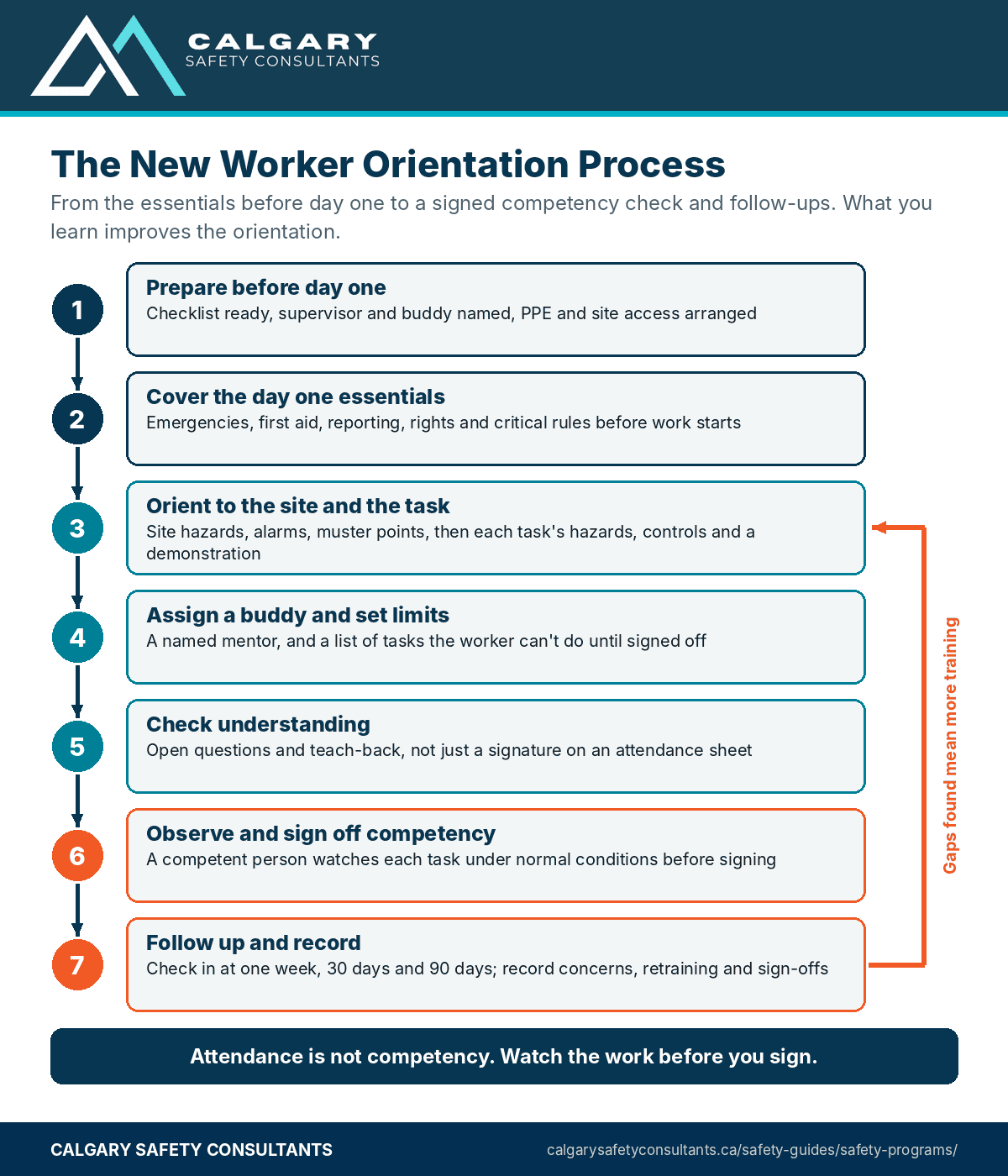
- Before or on arrival. Emergency procedures, alarms and muster points, first aid, how to report a hazard or injury, the supervisor's name, rights, and the critical rules that could kill or seriously hurt someone.
- Before each new task. The hazards, controls and procedure for that task, with a demonstration.
- Over the first weeks. The rest of your programs, policies and procedures, revisited as the worker takes on more.
A useful test: if a fire alarm sounded an hour into the worker's first shift, would they know where to go? If not, the orientation wasn't finished before work started.
Site-Specific and Task-Specific Orientation
A company orientation covers what's true everywhere you work. A site-specific orientation covers what's different about this site today: its alarms, muster points, traffic routes, restricted areas, other employers and current hazards. Workers who move between sites need one at each new site, even if they've worked for you for years.
Task-specific orientation goes one level down. Before a worker does a task for the first time, someone competent should walk them through the hazards and controls, show them the procedure and watch them try it. Your job hazard analysis is the natural script, and the daily field-level hazard assessment gives new workers a structured way to see how the crew thinks about hazards on that day's job.
Keep the hierarchy in mind. A good orientation explains controls in the order they matter, using the hierarchy of controls: why a guard is there, why the lockout steps can't be skipped, and why PPE is the last line of defence, not the first.
Contractors, Temporary Workers and Visitors
People who aren't your employees still need to know how to stay safe on your site. Orientation is one of the simplest controls you have over them.
- Contractors. Their employer is responsible for training them in their own work, but you should orient them to your site: emergency procedures, site rules, known hazards, permits and who to contact. Build it into your contractor safety process and confirm it before work starts.
- Temporary and agency workers. Treat them as new workers. The agency may provide general training, but your site, tasks and hazards are yours to explain.
- Visitors and delivery drivers. A short briefing or card: where they may go, PPE required, what to do if the alarm sounds, and who's escorting them.
- Students and volunteers. Some laws count unpaid people as workers, so check yours. Alberta's definition of worker, for example, includes people who supply services for no pay, such as volunteers, though it excludes unpaid students in learning activities run by their school. Orient them as you would any new worker.
Keep a simple log of who received which orientation and when. When an incident involves a contractor or visitor, it's usually one of the first records an investigator asks for.
Supervision and Buddying in the First Weeks
Orientation hands a new worker information. Supervision is what keeps them safe while they learn to use it. Yukon's code of practice puts it well: supervision of young and new workers has to take into account their inexperience, and supervisors must encourage questions, be readily available and regularly check that safe work practices and PPE use are followed.
Saskatchewan's rules point the same way. Under section 3-8, a worker may only do work they're trained and experienced in, or work under close and competent supervision. Alberta's direct supervision requirement for work that may endanger a worker does the same job.
- Assign a buddy or mentor by name. An experienced, competent worker the new worker can go to without feeling foolish. Give the buddy time to do it properly.
- Set limits. List the tasks the new worker must not do until they've been signed off, and make sure the whole crew knows the list.
- Check in often. A quick conversation at the end of day one, again at the end of week one, then at 30 and 90 days.
- Ask open questions. HSE warns that newcomers may hesitate to raise concerns. "What's been confusing?" works better than "Any questions?"

Check Understanding: Competency, Not Attendance
A signature on an attendance sheet proves the worker was in the room. It doesn't prove they understood, and it certainly doesn't prove they can do the job. Auditors look past the sign-in sheet, and so do investigators after an incident.
B.C.'s section 3.24 builds this into the law: if workplace observation shows a young or new worker can't perform tasks safely, the employer must give additional orientation and training. The worker can ask for more training too. That only works if somebody is watching.
- Ask, don't tell. Use a few open questions after each part: "Where's your muster point?" "What would you do if you found a damaged ladder?" "Who would you tell?"
- Use teach-back. Ask the worker to explain the task, its hazards and its controls in their own words.
- Watch the task. Have a competent person observe the worker doing the task under normal conditions, more than once, before signing them off.
- Sign off task by task. Competency is task-specific. A worker can be signed off on the pallet jack and still be in training on the forklift.
- Retrain when needed. If the observation shows gaps, coach, repeat and observe again. Record it.
The follow-up and competency record that comes with this guide gives you a place to record each check-in, each task sign-off and any concerns raised. A separate safety training matrix, which we cover in its own guide, helps you track what every role needs over time.
Keep Records That Prove It Happened
If it isn't written down, you'll struggle to prove it happened. Several jurisdictions require orientation records outright: B.C.'s section 3.25 requires records of all orientation and training, Manitoba requires a record of every orientation, New Brunswick requires records for at least three years, and Yukon's code requires records of all orientation and training. The WCB of Manitoba's employer page on new worker safety adds that employers must keep copies of the training delivered in individual personnel files.
In Ontario, employers must keep a record of the mandatory awareness training and give written proof on request, including up to six months after the person leaves.
Federally, each time training is given, both the employee and the employer must acknowledge it in writing, and the record must be kept for two years after the employee stops being exposed to the hazard. Even where the law is silent, a COR audit will expect records, and so will any investigator after an incident.
- Date and duration of each part of the orientation, and where it happened.
- Topics covered, ideally against a checklist rather than a single line saying "orientation done."
- Who delivered it, with their name and signature.
- The worker's signature confirming they received it and could ask questions.
- Understanding checks and their results.
- Task sign-offs and follow-ups, including the buddy assigned and any concerns the worker raised.
Store the records where supervisors can find them and where they'll survive staff turnover. Your wider health and safety system should say who keeps them and for how long. WorkSafeBC's employer guide on training and orientation is a useful planning tool if you're building a program from scratch.
Review and Improve Your Orientation
An orientation goes stale quickly. New equipment, new sites, new procedures and new people all change what a new worker needs to know.
- Review it at least once a year and whenever hazards, procedures or the law change.
- Ask recent hires. Workers who started in the last three months will tell you what was missing, confusing or too much.
- Learn from incidents. When a workplace incident investigation involves a worker in their first months, ask what their orientation covered and whether they were signed off for the task.
- Train the people who deliver it. Supervisors and buddies need to know what to cover, how to check understanding and how to record it.
Keep the orientation tied to your hazard assessments and procedures, so a change in one triggers a change in the other. Our topic page on safety programs and management systems links the other parts of the system.
Workplace example
A Practical Workplace Example
Situation: Consider an illustrative industrial supply distributor in Saskatoon with about 45 workers in a warehouse, a yard and two delivery trucks. Busy seasons brought in temporary workers through an agency. Orientation was a 40-minute video and a signature. Within one spring, two new workers were hurt in their first month: one struck by a reversing forklift, one cut while opening strapped bundles with a knife they'd been handed without instruction.
Action: The operations manager rebuilt the orientation in three stages. Day one covered emergency procedures, the yard traffic plan, reporting, rights and five critical rules, ending with a walk of the site and five questions. Each new worker got a named buddy and a list of tasks they couldn't do until signed off. Supervisors observed each task before signing, and held check-ins at one week, 30 days and 90 days. Agency workers went through the same process.
Result: Over the following year, the company had no lost-time injuries among workers in their first 90 days. The check-ins surfaced a confusing yard crossing and a missing knife policy, both fixed within weeks. When the company prepared for its COR audit, it had orientation and competency records for every new and transferred worker, and new workers could explain their rights and the emergency plan in interviews.
Common Orientation Mistakes to Avoid
- Treating a signature as proof. Attendance isn't understanding, and understanding isn't competency.
- Cramming it all into day one. Workers forget most of a long session. Cover the essentials first and spread the rest out.
- Starting work before the orientation. "We'll do the paperwork Friday" leaves a worker on the floor with no idea where the exits are.
- Skipping experienced hires and transfers. They need your site, hazards and procedures, even if they know the trade.
- Forgetting contractors, temps and visitors. They face the same site hazards with even less context.
- Generic content only. Online awareness training is useful, but it doesn't cover your hazards, people or emergency plan.
- No named buddy or limits. Without them, a new worker learns from whoever is nearby, shortcuts included.
- Never updating it. An orientation that describes last year's equipment and last year's supervisor teaches people to ignore it.
Audit perspective
What an Auditor Expects to See
Orientation is tested directly in a COR audit. Element E of Energy Safety Canada's 2023 COR audit protocol, Qualifications, Orientation and Training, asks whether the company has a comprehensive orientation for all new and transferred employees, whether supervisors make sure it happens before workers start their regular duties, and whether it happens within an appropriate timeframe, with emergency procedures and hazard reporting covered on the first day.
Auditors test this three ways. They sample orientation records from the past 12 months, check that site-specific orientations include emergency response, alarms and hazard reporting, and interview workers hired or transferred in that period. Those workers should be able to name their three rights: to know, to participate and to refuse dangerous work. Our guide to COR audit interviews explains how those conversations work.
The protocol then moves from orientation to competency. It asks whether competencies are defined for each position, whether there's a process to assess the competency of new and reassigned workers, and whether job-specific training includes a practical demonstration by the trainee. Records of observed sign-offs answer those questions far better than attendance sheets. Our guide to the COR audit covers the wider process.
Calgary Safety Consultants helps employers build and review their programs and prepare for COR and SECOR audits; we don't issue certificates. CORs and SECORs are issued through the applicable certifying partner.
The Bottom Line
New workers are most at risk in their first weeks and months, and a good new worker safety orientation is the first and cheapest control you have. Deliver the essentials before work starts, cover the topics your jurisdiction requires, and make the content specific to your site and tasks.
Then keep going. Assign a buddy, set limits, check in at one week, 30 days and 90 days, and sign workers off task by task only after you've watched them do the work safely. Record every step. That's what protects your workers, and it's what an inspector or auditor will want to see.
Download the New Worker Orientation Checklist and Competency Record
Two free, fillable PDF downloads go with this guide. Both have clickable checkboxes and fill-in fields, so you can complete them on screen or print them for the orientation.
- New Worker Safety Orientation Checklist (PDF, 7 pages). A full orientation checklist by topic, from people and rights to hazards, emergencies, PPE and task demonstration, with a jurisdiction-specific topics table for every province, territory and federal workplace, understanding check questions, contractor and visitor notes, key terms, common mistakes, and worker and supervisor sign-off with an orientation record.
- New Worker Follow-Up and Competency Record (PDF, 6 pages). First day, first week, 30-day and 90-day check-ins with prompts, buddy or mentor assignment, restricted tasks until sign-off, task-by-task competency sign-off with observation notes, a log of concerns raised and actions taken, additional training records and final sign-off.
Click either button to download the file. Adapt both to your own workplace, procedures and the rules that apply in your province or territory.

About the author
John Duplessis, B.Sc., CRSP
John Duplessis is a Canadian Registered Safety Professional with more than 30 years of occupational health and safety experience in oil and gas, construction, green energy, midstream operations and industrial project work. He is an external auditor with Energy Safety Canada.