On this page
- What an Emergency Response Plan Is
- When You Need an Emergency Response Plan
- Who's Involved
- How an ERP Comes Together at a Glance
- Identifying the Emergencies Your Site Could Face
- What Goes Into a Good Emergency Response Plan
- Writing Procedures People Can Follow Under Stress
- Coordinating With Responders and Other Employers
- Planning for Remote and Mobile Work
- Training and Communicating the Plan
- Testing the Plan With Drills and Exercises
- Reviewing and Updating the Plan
- A Practical Workplace Example
- Common Mistakes to Avoid
- What an Auditor Expects to See
- The Bottom Line
- Download the ERP Template and Checklist
- Frequently Asked Questions
- Related Guides and Articles
- How Calgary Safety Consultants Can Help
- Sources
What an Emergency Response Plan Is
An emergency response plan, often shortened to ERP, is a written plan that sets out how your workplace will respond to the emergencies it could realistically face: a fire, a serious injury, a chemical spill, a blizzard that cuts off the road, a violent customer, a worker stuck at height. It says who's in charge, how the alarm is raised, how people get out or stay safely inside, how everyone is accounted for, who rescues and who gives first aid, who calls whom, and where the equipment is.
A good plan answers three questions quickly for anyone who picks it up in a hurry: what's happening, who's in charge, and what do I do right now?
It isn't the same as a fire safety plan, which comes from the fire code, belongs to the building and deals mainly with fire alarms, fire protection systems and evacuation. Your emergency response plan comes from OHS law, belongs to your operation and covers every emergency your workers could face, including ones away from the building. The two should agree on alarms, exits and muster points; if you're a tenant, start from the landlord's fire safety plan. It also isn't your incident response procedure, which covers what happens after something has gone wrong: our guide on how to respond to a workplace incident covers those first minutes and hours.
Emergencies are rare, which is exactly why the plan matters: it carries knowledge the crew never gets to practise.
When You Need an Emergency Response Plan in Canada
In practice, almost every employer needs one. The wording differs across the country, but the common thread is clear: if an emergency could put your workers at risk, you're expected to have thought about it in advance and written down what happens. Our guide to OHS legislation in Canada links to each jurisdiction's laws if you need the full text.
Alberta is the most direct. Part 7 of the Occupational Health and Safety Code requires every employer to establish an emergency response plan for emergencies that may require rescue or evacuation, to involve affected workers in building it, and to keep it current (section 115). Section 116 lists what the plan must contain, section 117 requires designated rescue and evacuation workers to be trained with practice exercises that simulate your identified emergencies, repeated often enough to keep them competent, and section 118 requires their equipment. The Government of Alberta's emergency response planning tool kit makes a point worth borrowing anywhere: assign duties to positions, such as "shift supervisor", not named people, and cross-train so the plan still works when someone's away.
British Columbia starts with a risk assessment. Section 4.13 of the OHS Regulation requires an employer to assess any workplace where a need to rescue or evacuate workers may arise, and where it does, to develop written procedures and assign a worker to coordinate them. Written procedures are specifically required for high-angle work, confined spaces, hazardous substances, underground work, work on or over water, and workplaces with people who need help to move. Section 4.14 requires drills at least once a year, with a record. Workplaces with hazardous substances also have dedicated emergency planning sections in Part 5 of the regulation (sections 5.97 to 5.104).
Saskatchewan, Manitoba, the Northwest Territories and Nunavut build emergency planning into the health and safety program. The wording is almost identical: the program must set out procedures to respond to an emergency and identify the internal and external resources, including people and equipment, that may be needed. You'll find it in section 3-11 of Saskatchewan's Occupational Health and Safety Regulations, 2020 (which applies to prescribed workplaces with 10 or more workers), section 7.4(5) of Manitoba's Workplace Safety and Health Act (20 or more regular workers), and section 21 of the Northwest Territories Occupational Health and Safety Regulations (20 or more workers at the work site), with Nunavut's Occupational Health and Safety Regulations following the same pattern (section 21, 20 or more workers). Saskatchewan also requires a written rescue procedure wherever a worker could be trapped or incapacitated (section 5-3), and WorkSafe Saskatchewan's emergency response guidance recommends at least an annual fire drill.
Ontario has no single emergency plan rule for every workplace; the requirement comes through specific regulations. On construction projects, the Construction Projects regulation (O. Reg. 213/91) requires the constructor to establish written emergency procedures for the project, review them with the joint health and safety committee or health and safety representative, and post them in a conspicuous place (section 17). Many buildings also need a fire safety plan and fire drills under the Ontario Fire Code.
New Brunswick's rules, summarized in WorkSafeNB's OHS guide on emergency procedures, require an emergency communication procedure so workers can summon help and a written procedure for getting an injured or ill worker to medical care.
Federally regulated workplaces follow Part XVII of the Canada Occupational Health and Safety Regulations. Section 17.5 requires emergency procedures, prepared with the workplace committee or representative, for a person committing or threatening a dangerous act (harassment and violence have their own rules), hazardous substance spills or leaks, lighting failures and fire. Section 17.4 adds an evacuation plan where more than 50 employees work in a building, and section 17.10 requires drills at least once a year and after any change to that plan, with records kept for two years.
Two more layers often apply. Provinces and territories adopt the National Fire Code of Canada in their own editions, and its Section 2.8 covers fire safety plans and fire drills. Industry regulators add their own rules: in Alberta's energy sector, the Alberta Energy Regulator's Directive 071 (December 2025 edition) requires a corporate emergency response plan, operation-specific plans for certain higher-risk operations, and regular exercises, alongside your OHS plan.
Where the law is silent, the general duty in every Canadian OHS statute still applies. If you never planned for a foreseeable emergency, it will be very hard to show you took every reasonable precaution.
Who's Involved
The employer owns the plan, but nobody should write it alone at a desk. Workers know where the radio dead zones are and which exit door sticks in January. Alberta requires their involvement, the federal rules require consultation, Ontario's construction rules require the procedures to be reviewed with the committee or representative, and everywhere else it's simply how you get a plan that works.
- Senior management approves the plan, funds equipment and training, and makes the business continuity decisions.
- Supervisors usually lead the response on shift, take headcounts and make the first calls.
- The emergency coordinator takes charge until emergency services arrive, then supports them. Every shift needs one, plus a backup.
- Wardens, first aiders and designated rescue workers clear their areas, give care and carry out the rescues the plan assigns to your own people.
- The joint health and safety committee or representative helps develop and review the plan and takes part in drills and debriefs.
- Workers, contractors and visitors need to know the alarm, the exits, the muster point and how to report an emergency.
- Outside agencies such as the fire department, paramedics, the property manager and neighbours should know your plan, and you should know theirs.
In a small business, one person may wear several hats. That's fine, as long as someone covers when they're away and nobody has two jobs that must happen at the same moment in different places.
How an Emergency Response Plan Comes Together at a Glance
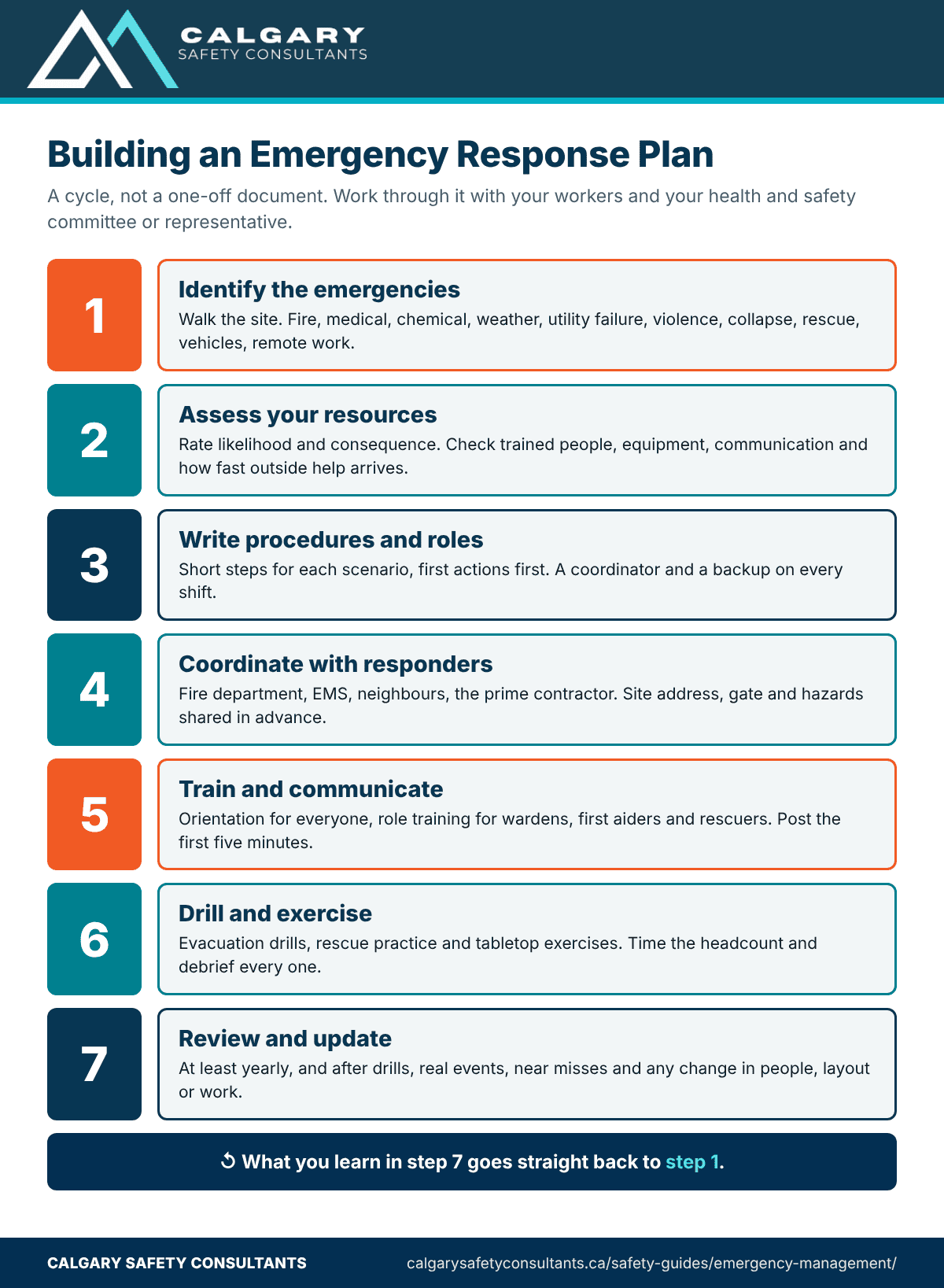
Creating an emergency response plan isn't a one-off writing exercise. It's a cycle: you identify what could happen, check what you'd have to respond with, write the procedures and roles, line up the outside responders, train people, test the plan with drills and exercises, then review and feed what you learned back into the start.
Identifying the Emergencies Your Site Could Face
Every useful emergency response plan starts with an honest list of what could actually happen at your workplace. Not a generic list copied from a template, and not every disaster imaginable, but the emergencies your work, your site, your location and your season could realistically produce.
Walk the site with a supervisor and a couple of experienced workers, looking at what you store, how people and vehicles move, where people work at height or in tight spaces, and what's next door. Then review your hazard assessments, incident and near-miss records and safety data sheets. Most emergencies grow out of hazards you've already identified; the plan simply asks what happens when the controls fail.
Most Canadian workplaces end up with some combination of these:
- Fire and explosion, including hot work, battery charging and flammable storage.
- Medical emergencies, from a serious injury to a cardiac arrest or an overdose.
- Chemical release, such as a spill, a leaking cylinder or a gas leak.
- Severe weather, including blizzards, extreme cold, tornadoes, floods, heat and wildfire smoke.
- Utility failure, such as a power outage, a loss of heat in winter or a communications outage.
- Violence, from threats and aggressive people to a robbery or an armed intruder.
- Structural collapse, such as racking failure, a roof under snow load or a trench wall.
- Rescue, for a worker suspended in a harness, trapped in a confined space or caught in machinery.
- Vehicle and mobile equipment incidents, on site or on the road.
- Remote-site scenarios, such as a serious injury hours from a hospital or a missed check-in.
Don't forget external emergencies that could reach you: a rail line, a pipeline, a chemical plant down the road or a flood-prone river. Environment and Climate Change Canada's weather alerts are a practical trigger to build in, because watches, advisories and warnings often give you hours of notice that a storm is coming, although a tornado or severe thunderstorm warning may give only minutes.
Taking a Risk-Based Approach
Once you have the list, rate each emergency for how likely it is and how bad it could be. A simple three- or five-point scale is plenty; the point is to decide how much planning each scenario deserves. A likely, serious emergency, such as a fall from height on a construction site, needs a full procedure, trained rescuers, equipment on site and regular practice. An unlikely but severe one, such as a tornado at a warehouse, might need a short shelter-in-place procedure. A likely but minor event, such as a small spill, might need a spill kit and a one-page procedure.
Alberta's tool kit makes a good point here: rank the emergencies, but address them all. A low-rated scenario still gets a line in the plan, even if that line simply says "evacuate and call 911".
The second half of the assessment is resources. For each scenario, ask whether you have trained people on every shift, the right equipment, communication that works where the work is done, and outside help that can reach you in time. If the fire department is eight minutes away, your role in a fire is to raise the alarm, get out and meet them. If the nearest ambulance is ninety minutes away, your plan has to cover far more on its own. The gap between what each scenario needs and what you have is where the work in your plan lies. The free scenario assessment checklist below walks through that gap analysis.
What Goes Into a Good Emergency Response Plan
Alberta's list in section 116 is a sensible backbone for any emergency response plan in Canada, and the elements below cover it and then some. Keep the plan as short as you can while still answering every question someone would have on the worst day.
| Plan element | What it needs to say |
|---|---|
| Site information | Address, legal land location or GPS, access routes, gates, hazards on site, utility shut-offs, site map |
| Emergency contacts | 911 or site number, regulator, utilities, management, client or prime contractor, nearest hospital |
| Roles | Coordinator, wardens, first aiders, rescuers, caller, gate guide, with backups by shift |
| Alarm and communication | How emergencies are reported, alarm signals, radio channels, who calls 911 |
| Evacuation and shelter-in-place | Routes, exits, when to shelter instead, people who need help |
| Muster and headcount | Primary and alternate muster points, sign-in source, missing-person procedure |
| Scenario procedures | Short, specific steps for each emergency identified |
| Rescue | Which rescues your people do, how, and with what equipment |
| First aid and medical transport | First aiders, kits, AED, nearest hospital, transport plan |
| Equipment | What, where, who inspects it and how often |
| Training, drills and review | Who's trained in what, drill schedule, review triggers, sign-off |
Roles and the Chain of Command
Name the emergency coordinator by position, give them authority to order an evacuation and shut down work without waiting for approval, and name a backup for every shift. The US Occupational Safety and Health Administration's guide, How to Plan for Workplace Emergencies and Evacuations, suggests about one evacuation warden for every 20 workers, which is a reasonable starting point to adjust for your layout. Give each role a short action card rather than expecting people to read the whole plan.
Alarm and Communication
Write down how anyone raises the alarm, what it sounds or looks like, and who makes the 911 call. Check the alarm can be heard or seen everywhere, including washrooms, noisy shops and outdoor yards, and by workers with hearing loss. Plan for the communication you'll lose, such as cell coverage on a remote site or the radio repeater in a storm. Decide who speaks for the company, too: Alberta's tool kit warns that social media posts during an emergency can spread confusion or even put workers at risk.
Evacuation and Shelter-in-Place
Set primary and secondary routes out of each area, with exits marked for quick, unimpeded exit, as British Columbia's section 4.14 requires, and work out with anyone who needs help to move how they'll get out, which the federal rules require. Then plan for times when leaving is wrong: a tornado warning, an outside chemical release or a person with a weapon outside can make sheltering in place safer. Say where people go, how doors and ventilation are handled and how the all-clear is given.
Muster Points and Headcount
A muster point is only useful if you can tell, within a few minutes, whether everyone is there. Choose a primary muster point upwind of likely releases, clear of the building and away from where fire trucks will park, plus an alternate. In a Canadian winter, think about where people will stand for 45 minutes at minus 25; a heated vehicle or a neighbouring building can be part of the plan.
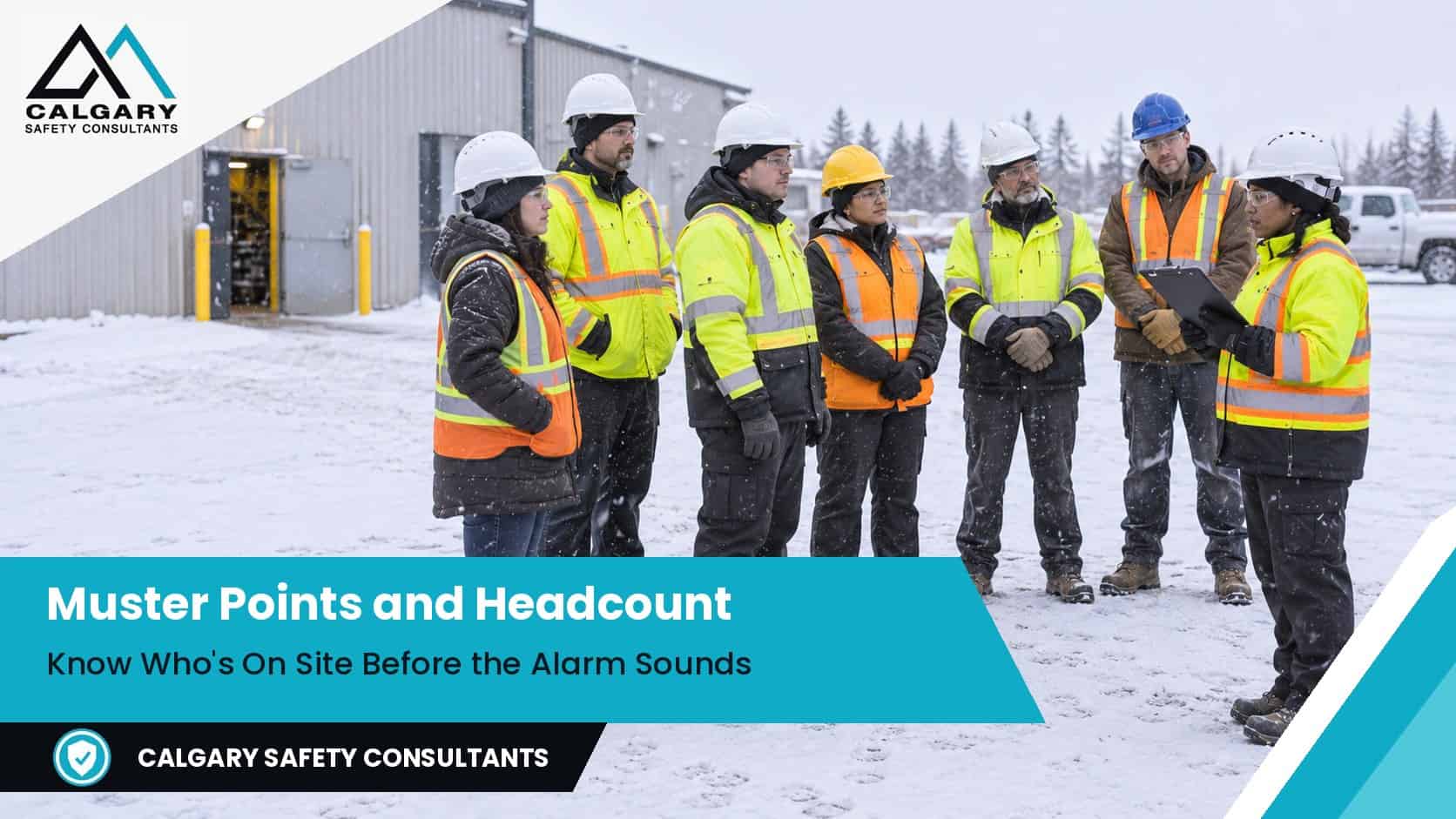
The headcount needs a source, such as a sign-in sheet, badge system, roster or visitor book. OSHA's guide warns that confusion at the assembly area can delay the rescue of anyone still trapped, so plan for missing people too: the warden reports the name and last known location to the coordinator, who tells the fire department, and nobody goes back in to look unless they're trained, equipped and directed to.
Rescue
Rescue is where many plans quietly fail. Calling 911 is not a rescue plan for a worker hanging in a harness or collapsed in a tank, because outside help may not have the equipment or arrive in time. For each rescue scenario, decide what your trained people will do, with what equipment, and what they must never do; untrained rescuers entering an unsafe atmosphere is how one casualty becomes several. British Columbia requires written rescue procedures for high-angle, confined space, underground and water work, Saskatchewan requires one wherever a worker could be trapped, and Alberta requires designated rescue workers to practise the specific emergencies you've identified.
First Aid and Medical Transport
Your plan should name your first aiders by shift, say where the kits and the AED, if you have one, are, and give the nearest hospital emergency department with directions, not just the nearest clinic, which may not be open or equipped for trauma. Most jurisdictions set first aid requirements based on the number of workers, the hazard level and the distance to medical care, as our guide on how to meet first aid requirements across Canada explains. Where an ambulance can't easily reach you, the plan must explain how an injured worker will be transported, which New Brunswick's rules require in writing.
Contacts, Directions and the Site Address
Under stress, people forget the address of the place they drive to every day. Put the civic address, the legal land location or GPS coordinates for remote sites and the best entrance for emergency vehicles at the top of the plan, and post them by every phone and in every vehicle. List emergency services (911, or the local fire, ambulance and police numbers where 911 isn't available, as in most of Nunavut), the regulator's reporting line, utilities, the client or prime contractor, management and any specialist responders, and check every number at least once a year.
Equipment
List the emergency equipment, where it is, who inspects it and how often: extinguishers, alarms, emergency lighting, first aid kits, AEDs, spill kits, rescue kits, radios and responder PPE. Record inspections, because an empty extinguisher on the wall is worse than none: people trust it.
Contractors and Visitors
Contractors, drivers and visitors are the people least likely to know your alarm and most likely to be missed in a headcount. Build a short emergency briefing into sign-in, include them in the headcount, and for higher-risk contract work, agree in writing whose plan applies. Our guide on how to manage contractor safety covers how that fits into prequalification and orientation.
Business Continuity Basics
A full business continuity plan is a separate project, but your emergency response plan should bridge the gap back to work: who decides when the site is safe to reoccupy, how critical processes are shut down and restarted, where key records are backed up, and who looks after workers afterward.
Writing Procedures People Can Follow Under Stress
An emergency procedure is read, or remembered, by someone whose heart is pounding. A review by Kinsey and colleagues in Fire Technology explains that when time and information are short, people in fires fall back on mental shortcuts and familiar patterns, and that cognitive biases shape their decisions without their being aware of it. People under stress do what they've practised, not what's in a binder they read once. The World Trade Center Evacuation Study by Gershon and colleagues in Prehospital and Disaster Medicine found that preparedness training, familiarity with the building, risk communication and leadership all affected how people got out.
- Write one short procedure per scenario. A fire and a gas leak have different first actions.
- Put the first three actions first. If people read nothing else, those should keep them alive.
- Use plain verbs and positions. "The shift supervisor calls 911 from the office phone" beats "notify emergency services".
- Say what not to do, such as "do not enter the tank".
- Use maps and pictures for exits, muster points and shut-offs.
- Test it with the people who'll use it. If a new worker can't follow it in a walk-through, rewrite it.
Then put the procedures where they'll be used: by the exit, on a card in the truck, in the first aid kit. Saskatchewan, for example, requires emergency procedures to be displayed prominently at first aid stations. The full plan can live in the office; the first five minutes have to be within arm's reach.
Coordinating With Responders, Neighbours and Other Employers
Your plan meets the real world when the fire truck or ambulance arrives, so it pays to talk to them first. Invite your local fire department to tour the site, show them your hazardous materials, shut-offs and access points, and ask what they'll need on arrival. British Columbia's section 4.17 makes telling the fire department about hazardous materials a duty for many workplaces. Ask EMS how long it takes to reach you and whether they can find your gate. On rural and industrial sites, ask whether the local fire service can do a high-angle or confined space rescue at all; that answer decides how much rescue capability you need yourself.
Talk to your neighbours too. Tenants in a shared building need one alarm and muster points that don't overlap, and industrial neighbours should know each other's hazards, because a release next door can be your emergency.
On a multi-employer site, someone has to own the overall plan. In Alberta, British Columbia, Saskatchewan and on many other sites that's the prime contractor; in Ontario construction, it's the constructor. Contractors should know whose plan applies, where they muster and who counts them. Our guide on how to create a site-specific safety plan shows how the emergency section fits into a project's overall safety plan.
Planning for Remote and Mobile Work
A plan written for a building doesn't work for a crew on a lease road two hours from town or a worker alone at a pump station. The Northwest Territories regulations capture the issue by defining an isolated work site as one more than an hour's travel from a hospital or medical facility, or where an aircraft is the normal way in. When help is that far away, your plan has to do more of the work.
For remote and mobile work, the plan should cover how the crew calls for help without cell signal, the location details responders will need, whether the crew can stabilize and transport an injured worker, the nearest emergency department and an ambulance meeting point, and seasonal survival gear in the vehicle. Our guides on setting up a working alone program and journey management for field crews cover the check-in and travel side; the emergency response plan says what happens when a check-in is missed. A separate guide on emergency response for remote wind and solar sites is coming soon.
Training and Communicating the Plan
A plan only works if people know their part, and Saskatchewan, British Columbia and the Northwest Territories, among others, require workers to be trained in their fire and emergency procedures.
Match the training to the role. Everyone on site needs the basics at orientation: how to report an emergency, the alarm, the exits, the muster point and where to shelter. Wardens, coordinators, first aiders and rescuers need role-specific training and hands-on practice with their equipment, and supervisors should be able to run the first ten minutes of any scenario on the list. Record who was trained, in what and when.
Then keep talking about it: post the key parts, discuss a scenario at a toolbox meeting every month or two, brief people when the plan changes, and make sure night shift and remote workers hear the same message as the day crew.
Testing the Plan With Drills and Exercises
The first test of your plan shouldn't be the real emergency. Drills show whether people hear the alarm, whether the headcount is accurate and whether the 911 caller knows the address. Tabletop exercises, where the team talks through a scenario, test the emergencies you can't safely act out, such as an armed intruder or a regional power failure.
The legal minimums vary, from annual drills in British Columbia and federal workplaces, to fire code drills for many buildings, to Alberta's exercises as often as needed to keep rescue and evacuation workers competent. Our article on the Canadian legal obligations for emergency drills compares them in more detail.
The evidence on exercises is encouraging but carries a warning. A scoping review by Skryabina and colleagues in the International Journal of Disaster Risk Reduction found that exercises improved participants' knowledge of plans and procedures and their confidence, and that the most common benefit for organizations was finding gaps in plans. But there was little evidence that those gaps were actually fixed afterward. That's the lesson for any workplace: a drill without a debrief, corrective actions and an updated plan is mostly a fire alarm test. A separate guide on how to conduct an emergency drill or tabletop exercise is coming soon.
Reviewing and Updating the Plan
Alberta requires the plan to be kept current, the federal rules require the evacuation plan to reflect any change to the building, and every audit standard expects a regular review. Set a fixed review at least once a year, and then build in triggers that send you back to the plan sooner:
- after any real emergency, serious near miss or drill that showed a gap;
- when the layout, processes, equipment or chemicals change;
- when you start work at a new site or for a new client;
- when key people, phone numbers, shifts or staffing change; and
- when legislation or your industry regulator's requirements change.
Real events should feed straight back into the plan. Our guides on how to report an incident internally, how to write a workplace incident report and how to report workplace incidents across Canada cover how emergencies and near misses get reported, inside your organization and to the regulator.
Record each review: the date, who took part, what changed and who approved it.
Workplace example
A Practical Workplace Example
Situation: Consider an illustrative steel fabrication shop in central Saskatchewan with 28 workers over two shifts, a paint booth, propane-fuelled forklifts and an overhead crane. Its emergency plan was a three-page template, last updated four years earlier. On a late-November evening shift, a forklift clipped a propane cylinder rack and a cylinder began venting in the loading bay.
Action: The night supervisor evacuated, but the plan's muster point was downwind of the loading bay, and the sign-in sheet didn't include two contract welders in the back bay. It took 20 minutes to confirm everyone was out, and the 911 caller gave the office address rather than the rear gate the fire department needed. Nobody was hurt. Afterward, the owner, the supervisor and the occupational health committee worked through a scenario assessment, rated propane release, fire, crane failure, serious injury and winter power loss as priorities, and rebuilt the plan: two muster points chosen by wind direction, a combined worker and contractor sign-in, the rear gate address on every phone, gas-specific action cards and a visit from the fire department.
Result: At the next unannounced drill, on night shift in January, the crew mustered at the alternate point in under four minutes, the headcount matched the sign-in board, and the caller gave the gate address first. The debrief found one more gap, a warden who didn't have a radio, and it was fixed within the week.
Common Mistakes to Avoid
- Using a generic template without site details. A plan that could belong to any business won't help at yours.
- Planning only for fire. Medical emergencies, weather, violence and rescues are often more likely.
- Relying on 911 for rescues it can't do in time. Suspended workers and confined space rescues need your own plan.
- Naming people instead of positions, with no backups for nights, weekends and holidays.
- Leaving contractors and visitors out of the headcount. They're the people most likely to be missed.
- Writing the plan without workers or the committee. It misses what they know, and in some places it breaks the law.
- Drilling without debriefing, or finding gaps and never fixing them.
- Not linking the plan to the building's fire safety plan or to the prime contractor's site plan.
Audit perspective
What an Auditor Expects to See
In a COR or SECOR audit, emergency preparedness is its own element, and auditors look at documents, observe the site and interview people. Energy Safety Canada's 2023 COR audit protocol, for example, asks whether the emergency response plan sufficiently identifies the potential emergency scenarios, including any required by legislation, and whether each scenario sets out communication steps, emergency contacts, evacuation plans and rescue plans. It asks whether the plan is evaluated, including testing at least annually, and whether the company meets its own testing schedule.
Interviews matter as much as paper. The same protocol has auditors ask managers and supervisors how scenarios were identified, ask workers about their responsibilities under the plan, and ask whether they've taken part in a drill or exercise in the past twelve months. Expect them to check that answers match the plan, listed equipment exists and is inspected, and drill findings led to corrective actions.
Calgary Safety Consultants helps employers build and test their emergency response plans and prepare for COR and SECOR audits; we don't issue certificates. CORs and SECORs are issued through the applicable certifying partner.
The Bottom Line
Creating an emergency response plan comes down to honest thinking done in advance. Work out what could realistically go wrong, check what you'd respond with, write short procedures with clear roles, line up the fire department and paramedics, then train, drill and review until the plan is something your people can actually do.
The best plan is short enough to use and specific enough to trust. Work through the scenario checklist with your crew, fill in the template, and put the first page where everyone can see it. You'll find more help on our emergency management guides page, and if you'd like a plan built for you, our Basic Site Emergency Response Plan package and ERP development services can help.
Download the Emergency Response Plan Template and Scenario Checklist
Two free, fillable PDF downloads go with this guide. Both have clickable checkboxes and fill-in fields, so you can complete them on screen or print them for your site.
- Emergency Response Plan Template (PDF, 8 pages). A complete site plan to fill in: how to use it, site information and directions for responders, emergency contacts, roles and backups by shift, alarm and communication, evacuation, shelter-in-place, muster points and headcount, scenario procedure blocks for each emergency you identify, rescue, first aid and medical transport, an emergency equipment list, a training and drill record, and review and sign-off.
- Emergency Scenario Assessment and ERP Review Checklist (PDF, 7 pages). A working tool for building and maintaining the plan: a scenario screening list, a likelihood and consequence rating, a resources and gap analysis, an action plan, an annual ERP review checklist, a drill and exercise findings log and sign-off.
Click either button to download the file. Use the checklist first to decide which emergencies need procedures, then fill in the template, and adapt both to the rules that apply in your province or territory, under the Canada Labour Code or from your industry regulator.

About the author
John Duplessis, B.Sc., CRSP
John Duplessis is a Canadian Registered Safety Professional with more than 30 years of occupational health and safety experience in oil and gas, construction, green energy, midstream operations and industrial project work. He is an external auditor with Energy Safety Canada.