On this page
- What a Workplace Incident Report Is
- Why the First Written Report Matters
- Who Writes It, and When
- The Anatomy of a Good Incident Report at a Glance
- The Facts to Capture
- Immediate Actions, First Aid and Notifications
- Writing in Plain, Factual Language
- Describing Injuries and Damage Accurately
- Timelines, Sketches and Photos
- Naming Witnesses Without Taking Their Statements
- What Not to Write
- Weak and Strong Wording, Side by Side
- Protecting Personal and Health Information
- Reviewing and Signing Off
- How the Report Connects to the WCB, Regulator and Investigation
- Keeping the Record
- A Practical Workplace Example
- Common Mistakes to Avoid
- What an Auditor Expects to See
- The Bottom Line
- Download the Quick Guide and Checklist
- Frequently Asked Questions
- Related Guides and Articles
- How Calgary Safety Consultants Can Help
- Sources
What a Workplace Incident Report Is
A workplace incident report is the first written account of an unplanned event at work that hurt someone, made someone ill, damaged property or could have done any of those things. It's usually written by the supervisor on the same shift, and it answers the basic questions: who, what, when, where and how, while the facts are still fresh.
It isn't the investigation. The incident report says what happened; the investigation works out why. The UK Health and Safety Executive's guide to investigating accidents and incidents makes the same split: its first-stage form asks only for brief details of what, where, when and who, and the emergency measures taken. Keeping the two apart is what lets a first report be quick, honest and useful.
It also isn't the heads-up a worker gives a supervisor the moment something happens, which our guide on how to report an incident internally covers. This guide picks up at the next step: turning what was reported into a clear written record that everyone downstream can rely on. If you need a form, the free Incident Report Form on our Free Downloads page gives you one. A form only gives you boxes, though; what goes in them decides whether the report helps.
Why the First Written Report Matters
The first report is read by more people than most supervisors realize: the injured worker, the workers' compensation board, the joint health and safety committee or representative, an OHS officer, the investigator and, a year later, perhaps a COR or SECOR auditor. All of them depend on the same few paragraphs being accurate.
Memory is the first reason to write it well and soon. A 2015 replication of Ebbinghaus's classic forgetting curve, published in PLOS ONE by Murre and Dros (using lists of nonsense syllables), confirmed the pattern psychologists have described for more than a century: what we take in fades fastest in the first hours and days. By the next morning, a witness remembers less and has heard three other versions.
Claims are the second. Ontario's Institute for Work & Health linked emergency department records with compensation data and found that over a third of work-related injuries and illnesses treated in Ontario emergency rooms didn't show up as compensation claims. There are many reasons for gaps like that, and one of them is an incident that was never written down, or was written too vaguely to connect the injury to the work.
Trust is the third. If the first report reads like an accusation, the next near miss won't be reported. If it reads like a fair account, people learn that reporting is safe. That makes report writing one of the plainest tests of a supervisor's due diligence.
Who Writes It, and When
In most workplaces, the supervisor or person in charge writes the first report, with help from the people involved. The supervisor knows the task and the crew and is responsible for making sure the facts are captured. The injured worker, if able, gives their own account, witnesses are identified, and the supervisor pulls it together into one record.
There are exceptions. If the supervisor was directly involved, or gave the instruction that led to the incident, another supervisor or the safety coordinator should write or co-write the report, so nobody is marking their own homework. A worker who works alone may be the only one who can write it, and your procedure should say so. On a multi-employer site, agree in advance whether the contractor or the prime contractor writes the first report, and make sure both get a copy.
Write it before the end of the shift whenever you can, once the urgent response is done. First aid, emergency calls, notifications and holding the scene come first, as our guide on how to respond to a workplace incident walks through. But don't let it drift to the next day, because deadlines start early: employers in Alberta must get their report of injury to WCB-Alberta within 72 hours of becoming aware of a reportable injury, and in British Columbia, WorkSafeBC explains that the employer's preliminary investigation and report must be completed within 48 hours of an incident that must be investigated.
If you can't finish on the shift, write rough notes right away: times, names, what you saw and did. HSE advises keeping informal notes at least until the investigation is complete.
Nobody should discourage or delay a report. In British Columbia, section 73 of the Workers Compensation Act says an employer or supervisor must not attempt to discourage, impede or dissuade a worker from reporting an injury, illness, death or hazardous condition to WorkSafeBC, or from making a compensation claim.
The Anatomy of a Good Incident Report at a Glance
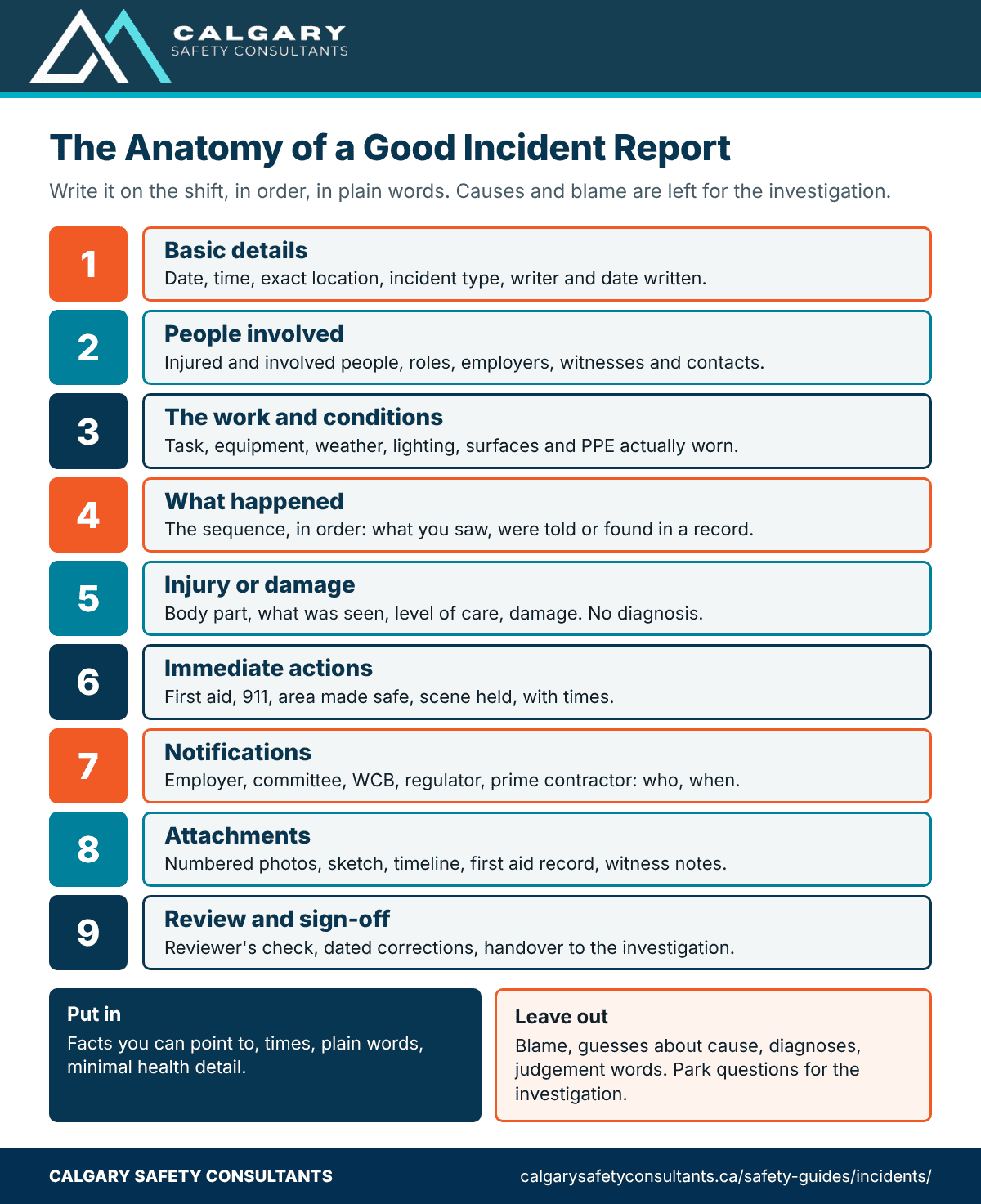
Forms vary, but good incident reports share the same bones: each part present, facts in the narrative, health details short and opinions out.
| Part of the report | What goes in it |
|---|---|
| Basic details | Date, time, exact location (Door 4 ramp, not "the yard"), type of incident, writer and date written |
| People involved | Injured or involved people, their roles and employers, and witnesses' names and contact details |
| The work and conditions | The task, equipment, materials, weather, lighting, surfaces and PPE in use |
| What happened | The sequence of events, in order, in plain words, saying how you know each fact |
| Injury or damage | Part of the body, what was seen and reported, level of care; what was damaged and how, with no diagnosis |
| Immediate actions | First aid, emergency calls, area made safe, scene held, equipment tagged out |
| Notifications | Who was told, when and by whom, with any reference numbers |
| Attachments | Photos, sketches, timeline, first aid record, witness list |
| Review and sign-off | Writer, reviewer, dates, corrections and handover to the investigation |
The Facts to Capture
A good report lets someone who wasn't there picture the event. That means covering the basics completely, then telling the story in the order it happened.
Who, What, When, Where and How
Who is everyone directly involved: the injured person, the equipment operator, responders and witnesses, with job titles and, on a shared site, employers. When is the date and best time you have, noting where it came from, such as a camera clock or the worker's estimate. Where is the exact spot: the bay, gridline, room, kilometre marker or GPS point. What is the event: a fall, a strike, a spill, a near miss with a suspended load. How is the mechanism in physical terms: his foot slid on the ramp and he fell onto his left side.
Notice what's missing: why. The report can record facts that will matter to the why, such as an expired inspection tag, but it doesn't draw the conclusion.
The Sequence of Events
Write the narrative in the order things happened, starting just before the incident: the task, who was doing it and what was going on. Then the event, then what happened immediately after. Short past-tense sentences work best. If the order isn't certain, say so.
Separate three kinds of information: what you saw, what someone told you (with their name), and what you found in a record, such as a pre-use inspection. "Priya told me she saw Sam step onto the ramp carrying a box" is far more useful than "Sam was carrying a box," because the reader knows how solid the fact is.
Conditions, Equipment and PPE
Record the conditions: weather and temperature, lighting, noise, surfaces, housekeeping, traffic, and anything unusual, such as a rushed schedule or a new crew member. In a Canadian winter, ice, snow, short daylight and cold hands come up again and again, so be specific: "thin clear ice on the ramp, no sand visible" says far more than "slippery."
Name the equipment, tools, vehicles and materials, with unit numbers, and note their condition as you found it, without adjusting or testing anything that should be held for the investigation. For PPE, record what the person was actually wearing, item by item. If something in your procedure wasn't in use, say so as a fact ("no ice cleats on his boots") and let the investigation decide what it means.
Immediate Actions, First Aid and Notifications
The report should show what was done in the first minutes and hours, with times: work stopped, area made safe, first aid given and by whom, 911 called, transport to a clinic or hospital, equipment tagged or locked out, and the scene secured or released. If anything was moved before photos were taken, for example to free an injured person, record what, by whom and why.
For first aid, the report needs the level of care, not clinical detail: first aid on site, clinic, hospital by ambulance, admitted or not. The first aid record holds the treatment details, as our guide on first aid requirements across Canada explains.
Log notifications too: who was told, by whom, when, and any reference number. That usually includes the employer, the prime contractor or owner, the joint health and safety committee or representative, the workers' compensation board, and for serious incidents the OHS regulator, whose rules differ across the country. A separate guide, How to Report Workplace Incidents Across Canada, is coming soon. In the meantime, our article on incident reporting requirements in Canada gives an overview, and our guide to OHS legislation in Canada links to the law in each jurisdiction.
Writing in Plain, Factual Language
The best incident reports read like a careful witness talking, not a police file. Use everyday words, short sentences and the active voice: "Sam slipped on the ramp," not "a slip event occurred involving the employee." Spell out abbreviations and give numbers: "about 1.5 metres," "6:40 a.m."
The hardest part is keeping opinion out. Careless, rushing, ignored, failed to and should have aren't facts; they're conclusions, usually written before anyone knows what happened. In a classic experiment published in the Journal of Verbal Learning and Verbal Behavior, Loftus and Palmer found that asking people how fast cars were going when they "smashed" rather than "hit" each other raised their speed estimates, and more of them later recalled broken glass that wasn't there. Your report's words shape the investigation's starting point the same way.
Hindsight is the other trap. Fischhoff showed in 1975 that knowing the outcome makes people judge it more predictable than it was, without noticing. HSE's guide is direct: investigations are about preventing accidents, not placing blame. Neutral language gives the investigation room to look at the whole system, which is where our guides on how to investigate a workplace incident and root cause analysis pick it up.
A simple test helps: could a camera have recorded this sentence, or could I point to a record that shows it? If it describes what someone was thinking, should have done or why it happened, it doesn't belong in the narrative.
Describing Injuries and Damage Accurately
Describe injuries as a careful first aider would: the part of the body, left or right, what you saw, what the person said they felt, and the care given. "Small cut, about 2 cm, on the back of the right hand, bleeding controlled with a dressing" is clear and checkable. "Hand laceration, probably needs stitches" mixes an observation with a medical guess.
Leave diagnoses to health professionals. A supervisor can't say a wrist is broken or a back is strained, and writing it down causes trouble if the diagnosis turns out different. The compensation board gets medical information from the health care provider, not from your incident report.
Damage gets the same treatment: the item, its unit number, what's damaged and how you can tell. "Rear bumper of forklift F-12 bent inward about 5 cm; rack upright at bay 7 dented at knee height." Don't write "minor" or "major" unless your form defines them, because everyone reads them differently.
Near misses need a description too. Record what could reasonably have happened, in factual terms: "the load passed about one metre from two workers." That potential is what makes some near misses worth investigating, and in Alberta, potentially serious incidents must be reported to the government once the investigation is complete. Our article on why near-miss reporting matters explains why these reports are worth the effort, and a separate guide, How to Set Up Near-Miss Reporting, is coming soon.
Timelines, Sketches and Photos
A short timeline is often the clearest part of a report: task started, incident, first aid began, 911 called, area barricaded, ambulance arrived, regulator notified, each with its time and the source of that time.
A sketch does what paragraphs can't. A plan view from above is enough, with a fixed landmark, the positions of people and equipment, measured distances and where photos were taken from, labelled with the date, time and your name.
Take photos before anything is moved, wherever that's safe: wide shots from each side, then close-ups, with something for scale. List each photo in the report with a number, who took it, when and what it shows, and keep the original files. Don't photograph injuries without the person's agreement and a clear reason, and never share incident photos on social media or group chats. Collecting and preserving physical evidence is a bigger subject; a separate guide, How to Collect Evidence for an Incident Investigation, is coming soon.

Naming Witnesses Without Taking Their Statements
The first report lists the witnesses: names, job titles, employers, contact details and where each one was. Full statements and interviews belong to the investigation, which can plan them, interview people separately and ask open questions.
What you can do on the day is ask each witness to jot down what they saw, in their own words, before comparing notes with anyone. In Law and Human Behavior, Gabbert, Hope and Fisher found that witnesses who used a structured self-administered interview recalled more correct details than those who simply wrote a free account, and in a second study, witnesses who completed one soon after the event recalled more correct details a week later than witnesses who hadn't. Keep those notes with the report, unedited.
Watch how witnesses appear in the narrative. "Dale saw the pallet tip" is fine; "Dale, who was supposed to be spotting, saw the pallet tip" assigns a failure that may be wrong.
What Not to Write
- Speculation on cause. "The plank probably wasn't secured" is a conclusion. Record what you saw ("the plank was on the deck below, no clips attached").
- Admissions and promises. "This was the company's fault" or promises about compensation or discipline, made before the facts are known.
- Diagnoses and medical history. No "broken wrist," no "bad back from before," no medications.
- Names used to blame. "The operator, Jim, ignored the spotter" belongs nowhere in the report.
- Character and attitude. Lazy, careless, complacent. None of these are observations.
- Hearsay presented as fact. If someone told you, say who.
- Jokes, sarcasm and venting. The report may be read aloud one day.
If you have a theory about the cause, don't bury it. A separate box, "Questions for the investigation," lets the writer note things worth checking, worded as questions: "Was the ramp on the de-icing schedule for the 6 a.m. receiving window?" The narrative stays factual and useful hunches still reach the investigator.
Weak and Strong Wording, Side by Side
These examples come from an incident many Canadian workplaces see every winter: a slip on an icy loading dock ramp. The strong versions record the same events as facts.
| Weak wording | Strong wording | Why it's better |
|---|---|---|
| "Worker was careless and fell." | "At about 6:40 a.m., Sam Ortiz, yard worker, slipped on the Door 4 ramp while carrying a box and fell onto his left side." | Who, when, where and what, with no judgement |
| "Ramp was icy because night shift didn't salt it." | "When I arrived at 6:45 a.m., the ramp had a thin layer of clear ice. I saw no sand or de-icer on it." | The condition seen; cause is for the investigation |
| "Broken wrist." | "Sam said his left wrist hurt and he couldn't grip. The wrist was swollen. He was driven to the walk-in clinic at 7:10 a.m." | What was seen and the level of care, no diagnosis |
| "Didn't have proper PPE on." | "Sam was wearing a hard hat, high-visibility vest, gloves and insulated safety boots. There were no ice cleats on his boots." | Lists what was actually worn, item by item |
| "He was rushing because the truck came early." | Narrative: leave it out. Questions for the investigation: "Did the early truck arrival affect the receiving routine?" | Turns a guess into a question the investigation can test |
| "A couple of guys saw it." | "Witnesses: Priya Nand, forklift operator, about 10 m away at Door 5; Dale Whitford, receiver, inside Door 4." | Gives the investigator names, roles and positions |
| "Cleaned up and got back to work." | "Photos 1 to 6 taken at 6:50 a.m. Ramp closed with cones at 6:52 a.m., sanded at 7:05 a.m. and reopened at 7:15 a.m. after I checked it." | Actions and times, with photos before the scene changed |
Names in these examples are invented. In your own reports, keep names in the "people involved" section and use them in the narrative only where they're needed to make the sequence clear.
Protecting Personal and Health Information
An incident report always holds personal information and often health information. According to the Office of the Privacy Commissioner of Canada, the federal private-sector privacy law, PIPEDA, applies to the employee information of federally regulated businesses; Alberta, British Columbia and Quebec have their own private-sector privacy laws that are considered substantially similar; and Ontario, New Brunswick, Nova Scotia and Newfoundland and Labrador have health information laws that apply mainly to health care providers and other health information custodians. Which law applies, if any, depends on your province and sector, but the same practical habits protect workers everywhere.
- Collect only what you need. Part of the body, what was seen, level of care. Not diagnoses, medications or history.
- Keep health details out of shared copies. The committee, the crew briefing or a client needs to know what happened, not the worker's medical details.
- Keep medical documents in a separate, restricted file, not in the incident binder in the site trailer.
- Control who sees the full report, and store electronic copies with access controls.
- Take extra care with sensitive incidents, such as violence, harassment, mental health or bloodborne exposure.
The United States offers a useful comparison. Under OSHA's recordkeeping rule (United States), for "privacy concern cases," such as sexual assault, mental illness or needlestick injuries, employers leave the worker's name off the injury log and keep a separate confidential list. That rule doesn't apply in Canada, but the idea transfers: for sensitive incidents, use a reference number in widely shared copies.
Reviewing and Signing Off
Every incident report should be read by someone other than the writer before it's final, usually the next level of supervision or the safety coordinator. The reviewer isn't rewriting the story; they're checking that it's complete, factual, private enough and signed.
Are the basics there? Does the narrative run in order, showing which facts were seen, told or taken from records? Is there any opinion, blame, diagnosis or speculation? Are attachments listed, notifications logged and an investigation opened if needed? The free Incident Report Review Checklist below turns those questions into a fillable form.
If the reviewer finds a problem, the correction is made as a dated, initialled addition or a new version, with the original kept. Never erase or quietly replace a first report; an edited report with no history looks like a cover-up, even when it isn't.
Ask the injured worker, if able, to read the narrative and confirm it or add their own account. In Ontario, the WSIB requires employers to give the worker a copy of the injury report they file, so the worker will see the employer's account anyway. Better that it's one they've already had the chance to check.
Finally, the report goes to the joint health and safety committee or representative where your law or program calls for it, and someone signs it off. That sign-off is the handover: the investigation now owns the questions, and the corrective actions go into your corrective action tracking.
How the Report Connects to the WCB, Regulator and Investigation
The WCB Employer Report
Each province and territory has its own employer's report of injury and deadline: 72 hours for WCB-Alberta and for WorkSafeBC, three business days for Ontario's Form 7, two business days for the Nova Scotia WCB, three days for WorkSafeNB's Form 67 under section 44 of New Brunswick's Workers' Compensation Act, as its OHS guide explains, and three business days for the Workers' Safety and Compensation Commission in the Northwest Territories and Nunavut.
Whatever the form, the employer's description should match the first report. Boards also receive the worker's and the health care provider's reports, and accounts that don't match invite questions and delay. Copy the facts from your first report, not from memory, and if new facts emerge, update both.
The Regulator Report
Serious incidents must also be reported to the OHS regulator, and some laws require a written report. In Ontario, a death or critical injury needs a written report to the ministry, the committee or representative and any union within 48 hours, and an accident, explosion, fire or incident of workplace violence that leaves a worker unable to do their usual work or needing medical attention needs written notice to the committee or representative and union within four days, as the Ontario government explains. What those reports must contain is set out in O. Reg. 420/21.
Federally regulated employers make a written report on the Schedule I form in Part XV of the Canada Occupational Health and Safety Regulations after a disabling injury, certain losses of consciousness, a rescue or revival, or a fire or explosion; under section 15.8, a copy goes to the workplace committee or representative without delay and to the Head of Compliance and Enforcement within 14 days.
The Investigation
The investigation starts from the first report and goes further: interviews, evidence, analysis of causes and corrective actions. In Alberta, section 33(6) of the Occupational Health and Safety Act requires the prime contractor, or the employer if there isn't one, to investigate serious injuries and incidents and prepare a report of the circumstances and the corrective action taken. In British Columbia, the 48-hour preliminary report names the injured workers and witnesses and describes the sequence of events, which a good first report already holds; the full report follows within 30 days.
Alberta's Act also says a report prepared under section 33 isn't admissible as evidence in a trial arising out of the incident, except in a prosecution for perjury or contradictory evidence. Don't take that as licence to write loosely. Write every first report as though a regulator, a compensation adjudicator, a lawyer and the injured worker will all read it, because they may.
Keeping the Record
Retention rules are scattered across different laws, so set one company rule that meets the longest period that applies to you. Alberta requires the investigation report under section 33 to be kept for at least two years. Ontario requires a copy of the written reports and notices to be kept for at least three years. Federally regulated employers must keep investigation reports and records under Part XV for ten years after the hazardous occurrence, under section 15.11 of the regulations.
Keep the first report, notes, photos and witness list with the investigation file and a cross-reference to any compensation claim, and keep health information separately under tighter access. Our article on digital reporting tools looks at keeping records organized and searchable.
Workplace example
A Practical Workplace Example
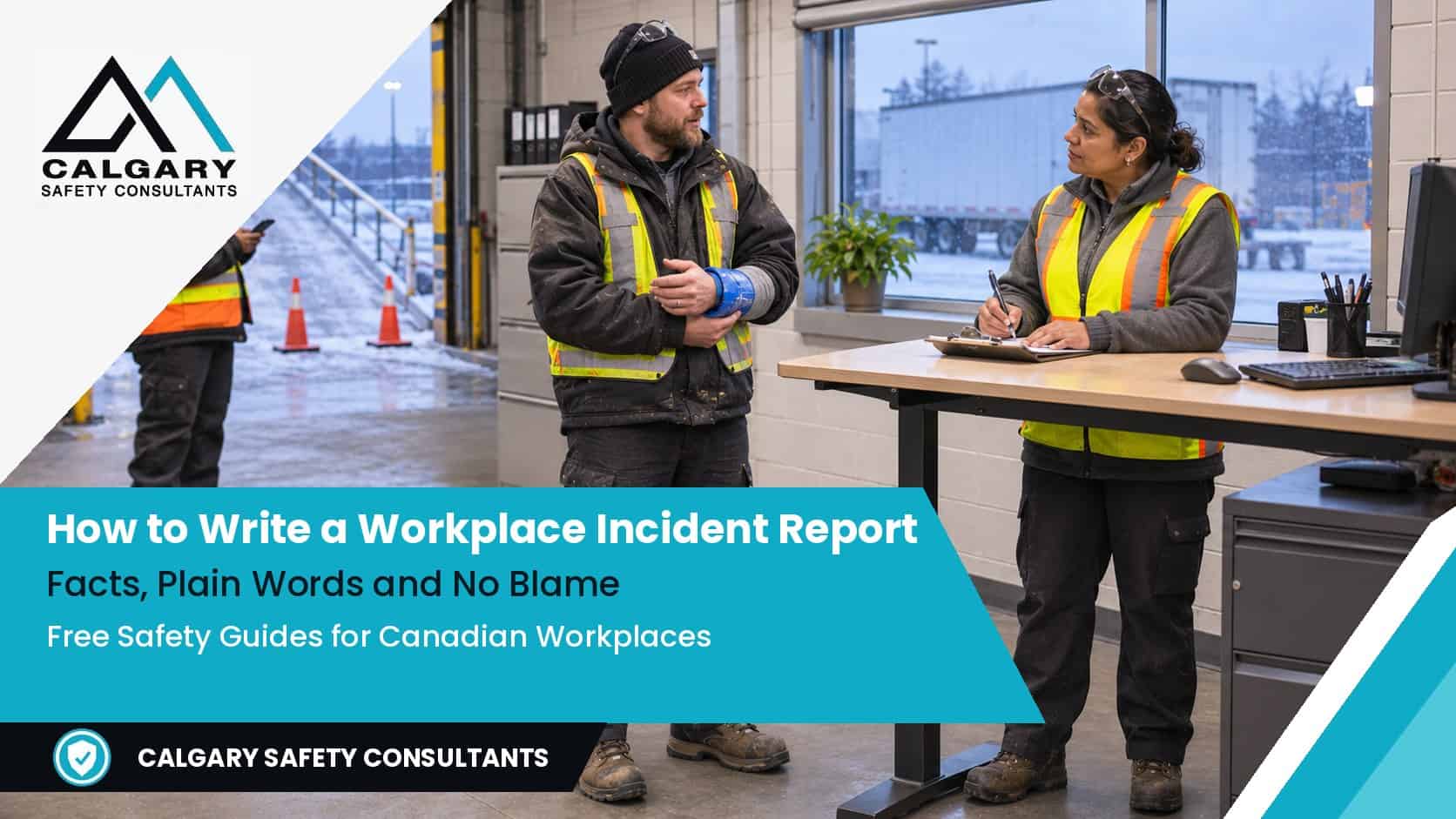
Situation: Consider an illustrative building supply distribution centre in central Alberta with about 40 workers. On a cold Tuesday in late November, at about 6:40 a.m., Sam, a yard worker, slips on the Door 4 ramp while carrying a box and falls onto his left side, then gets up holding his left wrist.
Action: The first aider supports the wrist with a cold pack, and a co-worker drives Sam to a walk-in clinic at 7:10 a.m. The supervisor photographs the ramp before anything changes, then closes it, has it sanded and reopens it. His first draft, typed on his phone at 8 a.m., reads: "Sam wasn't watching where he was going and slipped. Night crew didn't salt. Probably broke his wrist. Back to normal."
The safety coordinator sends it back: take out the judgements and the diagnosis; add times, conditions, PPE and witnesses. The revised report describes the thin clear ice and the absence of visible sand, lists Sam's PPE and notes there were no ice cleats on his boots, names two witnesses and where they stood, describes the swollen wrist and the clinic trip, lists six photos and logs the notifications. Under "Questions for the investigation," it asks whether the de-icing schedule covered the 6 a.m. receiving window. Sam reads it that afternoon and adds that he couldn't see the ice in the dark. The first draft is kept.
Result: Sam needed treatment beyond first aid and modified duties, so the employer's report went to WCB-Alberta the next morning, well inside 72 hours. The investigation found that the de-icing round started at 7 a.m., after receiving had begun, and that a dock light on that side had failed. The round was moved to 5:30 a.m., the light was fixed and ice cleats were issued for dock and yard work from November to March. Nobody was disciplined, and two more ice reports came in from the yard crew within the month.
Common Mistakes to Avoid
- Writing it days later. Write notes on the shift, even if the full report comes later.
- Deciding the cause in the narrative. Use a "questions for the investigation" box.
- Judgement words. Replace each with what was actually seen.
- Diagnosing injuries. Describe; don't diagnose.
- Vague locations and times. "In the shop this morning" can't be investigated.
- Missing witnesses. Once people go home and talk, independent accounts are gone.
- Unlisted photos. Unnumbered photos on someone's phone get lost.
- Editing the original. Add dated corrections; keep every version.
- Health details in shared copies. Share facts, not medical information.
- A WCB report that doesn't match. Build every external report from the first report.
Audit perspective
What an Auditor Expects to See
In a COR or SECOR audit, incident reports are tested under incident reporting and investigation. Energy Safety Canada's 2023 COR audit protocol, for example, looks for written requirements to report incidents immediately, checks that employees understand them and that incidents are actually reported, and samples the previous 12 months of investigation records for prompt starts, worker involvement, contributing and underlying factors, and senior manager review.
Auditors notice the quality of the first reports in that sample. Complete basics, a clear sequence, neutral language, witnesses, photos, a notification log and a signed review show the system works. Reports that start with blame, leave out times or contradict the compensation report raise questions about the whole process. In interviews, supervisors should be able to explain how they write a report, and workers should be able to say that reporting doesn't get them in trouble.
Calgary Safety Consultants helps employers build their incident reporting systems and prepare for COR and SECOR audits; we don't issue certificates. CORs and SECORs are issued through the applicable certifying partner.
The Bottom Line
A good workplace incident report is short on adjectives and long on facts. Write it soon, write it in order, say how you know each fact, describe injuries without diagnosing them, keep health details to a minimum and park your theories in a question for the investigation. Then have someone review it, keep every version and build every external report from it.
Supervisors learn this by practising: write up a past incident, swap it with a colleague and hunt for judgement words. The quick guide below is built for that, and our incident and emergency management training covers report writing and investigation for supervisors and workers.
Download the Quick Guide and Review Checklist
Two free, fillable PDFs go with this guide, with clickable checkboxes and fill-in fields. They work alongside your own incident report form or the Incident Report Form on our Free Downloads page; they don't replace it.
- Incident Report Writing Quick Guide (PDF, 8 pages). What to capture, words to avoid, weak and strong examples, a fillable draft worksheet, a writer's self-check and a practice exercise for supervisor training.
- Incident Report Review Checklist (PDF, 6 pages). A reviewer's checklist for completeness, facts versus opinion, privacy, notifications and WCB consistency, with corrections and follow-up logs, handover and sign-off.
Adapt both to your procedure and the rules in your province, territory or under the Canada Labour Code.

About the author
John Duplessis, B.Sc., CRSP
John Duplessis is a Canadian Registered Safety Professional with more than 30 years of occupational health and safety experience in oil and gas, construction, green energy, midstream operations and industrial project work. He is an external auditor with Energy Safety Canada.