On this page
- What a Health and Safety Policy Is (and Isn't)
- Why the Policy Matters
- Is a Health and Safety Policy Required? The Law by Jurisdiction
- Who Writes, Approves and Signs the Policy
- When to Write a New Policy or Update It
- What to Include in a Health and Safety Policy
- Aligning the Policy With ISO 45001
- Length, Tone and Plain Language
- Link the Policy to Roles and Responsibilities
- Signing, Posting and Communicating the Policy
- Reviewing the Policy Every Year
- Example Health and Safety Policy Wording
- A Practical Workplace Example
- Common Policy Mistakes to Avoid
- What an Auditor Expects to See
- The Bottom Line
- Download the Template and Review Checklist
- Frequently Asked Questions
- Related Guides and Articles
- How Calgary Safety Consultants Can Help
- Sources
What a Health and Safety Policy Is (and Isn't)
A health and safety policy, also called an OHS policy or a safety policy statement, is a short written statement of what your organization intends to do about health and safety at work. It says why safety matters to you, what you commit to, who is responsible, and that you'll meet the law. Most good ones fit on a single page.
People often lump three different things together. It helps to pull them apart:
- The policy is the commitment: what the organization stands for and who answers for it.
- The program is the system that delivers that commitment: hazard assessment, inspections, training, investigations, emergency response, worker participation and the rest.
- The manual is the set of documents that describes the program, plus the forms and records that prove it's working.
The UK Health and Safety Executive's guide on how to write your policy splits a full policy into three parts: a statement of intent, a list of responsibilities, and the practical arrangements. In Canadian practice, the signed statement of intent and the summary of responsibilities are what most people mean by "the policy." The arrangements live in the program and the manual.
A policy that tries to be a procedure gets long and stops being read. Keep the detail in your program, which our guide to building a health and safety system walks through, and let the policy do one job well: set direction.
Why the Policy Matters
It's tempting to treat the policy as a formality: print it, frame it, forget it. A good policy actually does three jobs.
- It meets the law. Several provinces require a written policy by name, and others require a program that starts with one. The next section sets out who needs what.
- It anchors your audit. In COR and SECOR audits, the policy is in the first element of the audit, and workers are asked about it in interviews.
- It sets the tone. A clear, signed promise gives workers something to hold leaders to.
The HSE's guidance for directors, Leading health and safety at work, puts it well. It says the board should set the direction for effective health and safety management, and that the policy should be an integral part of the organization's culture, values and performance standards, not just a document.
A current, signed policy is also one piece of your due diligence record, alongside training, inspections, supervision and enforcement. On its own it proves very little. Backed by a working program, it shows that commitment started at the top. Our guide to supervisor due diligence covers the rest of that record.
Is a Health and Safety Policy Required? The Law by Jurisdiction
Every Canadian OHS law puts a general duty on employers to protect workers. What differs is how directly it asks for a written policy. Some jurisdictions name the policy and set a worker threshold, others list it as a program element, and a few leave it to the employer. For comparison, the UK's HSE tells businesses with five or more employees that they must write their policy down and share it, and any changes, with employees. Here's how it breaks down in Canada.
Ontario and Federally Regulated Workplaces
Ontario is the clearest. Ontario's guide to the OHSA explains that clause 25(2)(j) requires employers to prepare a written occupational health and safety policy, review it at least once a year, and develop and maintain a program to implement it. Clause 25(2)(k) requires a copy of the policy to be posted in the workplace. These duties apply where more than five workers are regularly employed.
For federally regulated workplaces, such as banks and airlines, Part II of the Canada Labour Code applies. Paragraph 125(1)(d) requires employers to make readily available to employees, in printed and electronic form, a statement of the employer's general policy concerning the health and safety at work of employees. Paragraph 125(1)(z.09) adds that health and safety policies and programs must be developed in consultation with the policy committee or, if there isn't one, the workplace committee or the health and safety representative.
Western Canada
In British Columbia, section 3.1 of the OHS Regulation requires a formal program from employers with 20 or more workers and at least one workplace with a moderate or high hazard rating, and from any employer with 50 or more workers. Section 3.3(a) says the program must include "a statement of the employer's aims and the responsibilities of the employer, supervisors and workers." Smaller employers run a less formal program based on regular monthly meetings with workers. WorkSafeBC's Guideline G3.1 restates the same element.
Alberta changed its approach. Section 16 of the OHS Act requires an employer who regularly employs 20 or more workers, or who is directed to by a Director, to establish and implement a health and safety program. The government's health and safety program page says there are no mandatory elements, and its 2023 program guide lists "leadership and commitment" first among the standard elements employers usually include.
If your Alberta manual says a policy is one of ten required elements, it was probably written to the earlier rules. The government's 2019 version of that guide, now marked out of date, listed a health and safety policy as the first of ten mandatory elements and required the program to be reviewed every three years. A policy is still the expected starting point for COR, so keep it.
Saskatchewan's guide to the elements of an OHS program explains that section 3-20 of the Act and regulation 3-11 require a program at prescribed places of employment, such as hospitals, construction and trucking, with ten or more workers. Regulation 3-11(1)(a) requires "a statement of the employer's policy with respect to the protection and maintenance of the health and safety of the workers." The guidance says the most senior manager should sign it and it must be made known to all employees.
In Manitoba, section 7.4 of The Workplace Safety and Health Act requires a written program for each workplace where 20 or more workers are regularly employed. Clause 7.4(5)(a) requires a statement of the employer's policy on protecting the safety and health of workers at the workplace. The program is developed with the committee or representative, reviewed every three years or sooner if conditions change, and made available on request to the committee, any worker and any safety and health officer.
Quebec and Atlantic Canada
Quebec works through prevention programs rather than policy statements. The CNESST's page on prevention programs says the program applies to establishments with 20 or more workers. Its minimum content focuses on the main sources of risk and the measures to control them; a stand-alone policy statement isn't on the list. The CNESST's page on prevention and participation mechanisms adds that establishments with 19 or fewer workers prepare an action plan instead. Writing a policy anyway is good practice.
In New Brunswick, WorkSafeNB's guide to the safety policy quotes section 8 of the OHS Act: employers with 20 or more employees must establish a written safety policy with their employees, setting out everyone's responsibilities, and keep a copy at each place of employment. Under section 17(1), employers with 5 to 19 employees must also establish a safety policy for each place of employment. WorkSafeNB advises dating, reviewing and signing it every year.
Nova Scotia's guide to an OHS policy and program says employers with five or more employees need a written policy (section 27), and those with 20 or more also need a program (section 28). The bill that created the policy section requires the employer to prepare and review the policy at least annually, in consultation with the committee or representative if there is one. The guide adds that a senior manager signs it and it's posted in a prominent area.
On Prince Edward Island, the WCB says employers with 20 or more workers must have a written OHS program that includes a comprehensive OHS policy and is available to all employees.
In Newfoundland and Labrador, WorkplaceNL's guide to OHS policies and programs explains that workplaces with fewer than 10 workers need a written policy, developed with the worker representative or designate and posted in a prominent place, while workplaces with 10 or more need a program that is signed, dated and reviewed at least every three years.
The Territories and Other Required Policies
In Yukon, the Workers' Safety and Compensation Board's page on health and safety management systems says employers who regularly employ 20 or more workers have needed a system since July 1, 2022, and that it must include a health and safety policy showing the employer's commitment. It's developed in consultation with the joint committee. In the Northwest Territories and Nunavut, the WSCC's Safe Workplace program recognizes employers with an active OHS program; confirm any specific policy requirement with the WSCC.
| Jurisdiction | What the law requires | Who it applies to | Review, posting and signing |
|---|---|---|---|
| Federal (Canada Labour Code) | A statement of the employer's general policy on health and safety, made readily available; policies and programs developed with the policy committee, workplace committee or representative | Federally regulated employers | Readily available in printed and electronic form |
| British Columbia | Formal program that includes a statement of the employer's aims and the responsibilities of the employer, supervisors and workers (s. 3.3(a)) | 20 or more workers with a moderate or high hazard workplace, or 50 or more workers; smaller employers run a less formal program | No set interval; management meetings review activities and incident trends |
| Alberta | Health and safety program (OHS Act s. 16), with no mandatory elements | 20 or more regularly employed workers, or on a Director's direction | Not set; government lists leadership and commitment as a standard element |
| Saskatchewan | Program with a statement of the employer's health and safety policy (Reg. 3-11(1)(a)) | Prescribed places of employment with 10 or more workers | Program reviewed at least every 3 years; guidance says the most senior manager signs and all employees are made aware of the policy |
| Manitoba | Written program with a statement of the employer's policy (Act s. 7.4(5)(a)) | Workplaces with 20 or more workers regularly employed | Program reviewed every 3 years or sooner; developed with the committee or representative |
| Ontario | Written OHS policy and a program to implement it (OHSA 25(2)(j) and (k)) | More than five workers regularly employed | Reviewed at least once a year; posted in the workplace (or readily accessible electronic format) |
| Quebec | Prevention program; a stand-alone policy statement isn't in CNESST's content list | Establishments with 20 or more workers (action plan at 19 or fewer) | Keep the program up to date as the workplace changes; confirm update rules with the CNESST |
| New Brunswick | Written safety policy setting out responsibilities, developed with employees (s. 8) | 20 or more employees (s. 8); 5 to 19 for each place of employment (s. 17(1)) | Copy kept at each workplace; WorkSafeNB advises dating, reviewing and signing it annually |
| Nova Scotia | Written OHS policy (s. 27); program at 20 or more (s. 28) | 5 or more employees | Reviewed at least annually (Act); developed with the committee or representative; guide: posted prominently, senior manager signs |
| Prince Edward Island | Written OHS program that includes a comprehensive OHS policy | 20 or more workers | Available and accessible to all employees |
| Newfoundland and Labrador | Written policy under 10 workers (s. 36.2); program at 10 or more (s. 36.1) | All employers, by size | Policy posted and developed with the representative or designate; program signed, dated and reviewed at least every 3 years |
| Yukon | Health and safety management system that includes a health and safety policy | 20 or more workers regularly employed, since July 1, 2022 | Developed with the joint committee; employer sets review expectations |
| Northwest Territories and Nunavut | General employer duties under the Safety Acts and OHS Regulations | Confirm with the WSCC | Confirm with the WSCC |
Summary only. Thresholds count workers differently from one jurisdiction to the next, and most laws have exceptions and other required policies not shown here. Check the legislation and your regulator before relying on a row.
Other policies may be required too. In Ontario, every employer must prepare and review at least once a year separate workplace violence and harassment policies, written and posted where six or more workers are regularly employed. Federally, the Work Place Harassment and Violence Prevention Regulations require a policy developed jointly with the committee or representative and reviewed at least every three years. Our violence and harassment prevention plan service covers those in detail.
For the statutes behind all of this, see our guide to OHS legislation in Canada. Even where the law doesn't name a policy, write one anyway. It costs an afternoon, and it's one of the first documents an auditor, inspector or client's prequalification reviewer is likely to ask for.
Who Writes, Approves and Signs the Policy
The policy belongs to the person at the top. Someone else can draft it, but the commitment has to come from the owner, president or most senior leader of the business unit it covers.
- The senior leader approves and signs it, and is ready to explain it to a crew without notes.
- A safety coordinator or manager usually drafts it, checks it against the law and the audit standard, and keeps the review record.
- The joint committee or health and safety representative reviews the draft. Several laws require that consultation: Manitoba for the program, New Brunswick with employees, Nova Scotia with the committee or representative, Newfoundland and Labrador with the representative, and the Canada Labour Code with the policy or workplace committee.
- Supervisors and a few workers test it. If they can't explain a sentence back to you, rewrite it.
If you don't have a committee yet, our guides to setting up a joint health and safety committee and to the health and safety representative role explain who should be at the table. When the senior leader changes, the new leader should review and re-sign the policy.
When to Write a New Policy or Update It
Every employer should have a policy from day one, but some moments call for a fresh look:
- You cross a legal threshold in your jurisdiction, such as 5, 6, 10 or 20 workers.
- A new owner, president or general manager takes over.
- You start working toward COR or SECOR, or a client's prequalification asks for a signed policy.
- You expand into another province or territory, or take on federally regulated work.
- You merge, restructure or change the kind of work you do.
- A serious incident shows the policy and the reality have drifted apart.
- Your scheduled annual review comes up.
What to Include in a Health and Safety Policy
A strong policy covers the same core ground whatever your size. Use this as your checklist:
- Purpose and commitment. Why health and safety matters to you and what you're aiming for.
- Scope. Who and where it covers: employees, supervisors, contractors, visitors, every site.
- Whole health. Physical and psychological health, not just injuries.
- Legal compliance. A commitment to meet the OHS law in every jurisdiction where you work, as a minimum.
- Responsibilities. A sentence or two each for senior management, supervisors, workers and contractors.
- Hazard control. A commitment to identify hazards and eliminate or control them.
- Participation and rights. Consultation with workers and the committee, and the rights to know, to participate and to refuse unsafe work.
- Reporting without reprisal. A promise that raising a concern, a near miss or a refusal won't be punished.
- Resources and improvement. Time, training, equipment and money, plus objectives you'll set and review.
- Signature and date. The current senior leader, with the date signed and the next review date.
These line up closely with the audit tools. Energy Safety Canada's 2023 COR audit protocol scores the written policy against eight criteria: goals and commitment; employees' physical, psychological and social well-being; management, supervisor and worker responsibilities; compliance with legislation; the signature of the current most senior manager for the business units being audited; and the date it was signed.
The Infrastructure Health and Safety Association's COR 2020 audit tool, used in Ontario, asks whether the policy commits senior management to set and review objectives, commits to a safe and healthy work environment and legal compliance, expresses consultation and co-operation with workers, recognizes workers' right to a safe workplace, and refers to a program that sets out responsibilities. The worker rights and the refusal process are explained in our guide to the right to refuse unsafe work.
Aligning the Policy With ISO 45001
If you're working toward ISO 45001, the international standard for OH&S management systems, clause 5.2 covers the OH&S policy. A presentation from Ireland's national standards body, NSAI, summarizes the clause as a commitment to provide safe and healthy working conditions and prevent injury and ill health, a policy appropriate to the organization's size, context and risks, consultation with workers at all levels, and communication of the policy.
A policy written to the checklist above already covers most of that ground. If ISO 45001 matters to your clients, check your wording against the standard itself before a certification audit.
Length, Tone and Plain Language
One page is the target, under two minutes to read aloud. Extra pages are almost always procedure that belongs in the program.
- Write like a person. Use "we" for the company and "you" for workers. "We will give you the training, equipment and time to work safely" beats "The Organization shall endeavour to provide adequate resources."
- Make promises you can keep. Commitments such as "we will investigate every incident and near miss" are fine if you will. Avoid guarantees and slogans you can't back up.
- Be specific about your work. A trucking company, a dental clinic and a drilling contractor shouldn't have the same policy. Name the work you do.
- Use the right law. Name the jurisdictions you actually work in. A template that cites another province's Act tells an auditor nobody read it.
Link the Policy to Roles and Responsibilities
The policy names responsibilities in a sentence or two each. The detail belongs in a separate statement of responsibilities, job descriptions and supervisor expectations. What matters is that the two connect, so every promise in the policy has an owner and a way to check it.
| Policy commitment | Where it's delivered | Evidence an auditor can check |
|---|---|---|
| We will identify and control hazards | Hazard assessments, JHAs, field-level assessments | Current assessments for every position and task |
| We will inspect our workplaces | Inspection schedule and checklists | Completed inspections and closed corrective actions |
| We will train and supervise you | Orientation, training matrix, supervisor duties | Training records and supervisor sign-offs |
| We will investigate incidents | Incident reporting and investigation procedure | Investigation reports with root causes and actions |
| We will involve you | Committee or representative, toolbox talks | Minutes, meeting records, worker suggestions |
| We will review our performance | Annual program review | Review record, objectives and re-signed policy |
Saskatchewan's regulation lists a statement of responsibilities as a separate program element, and Energy Safety Canada's protocol has a separate section on safety responsibilities that checks, through interviews, whether people at every level understand theirs. Write the policy so it points to that document.
Build the links into everyday tools too: a job hazard analysis for each role, a regular workplace inspection, a clear incident investigation process and tracked corrective actions. If you hire contractors, our guide to contractor safety shows how to extend your policy expectations to them.
Signing, Posting and Communicating the Policy
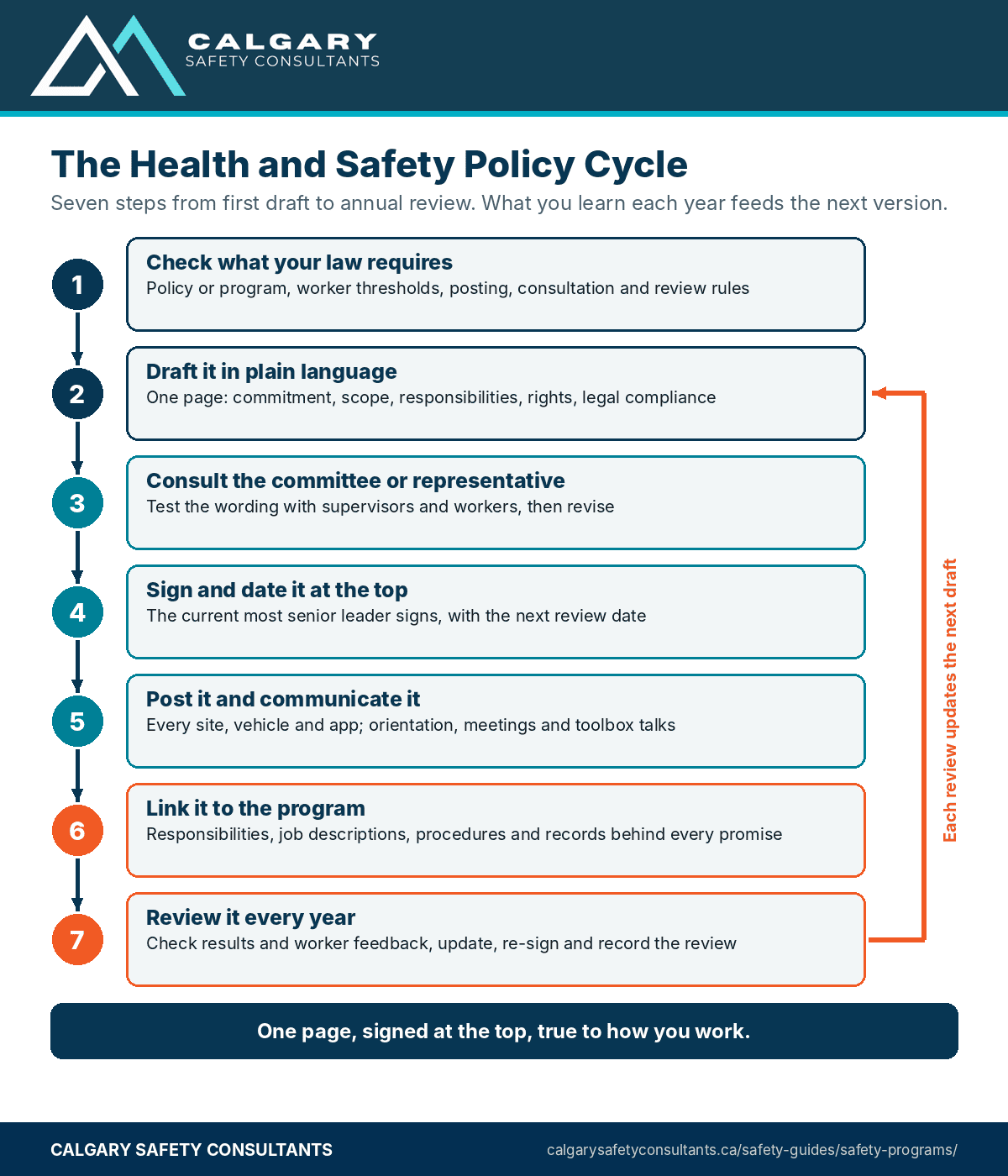
A policy nobody has seen doesn't count. Once it's approved, take three steps.
Sign and date it. The senior leader signs, preferably in front of the committee or at an all-hands meeting. Record the date signed and the next review date on the document.
Post it where people work. Ontario and Nova Scotia require posting, as does Newfoundland and Labrador for workplaces with fewer than 10 workers, and the Canada Labour Code requires the policy statement to be readily available in printed and electronic form. Put it on the safety board at each shop, office and site trailer, in vehicles if crews work from them, on your intranet or safety app, and in the front of the manual.
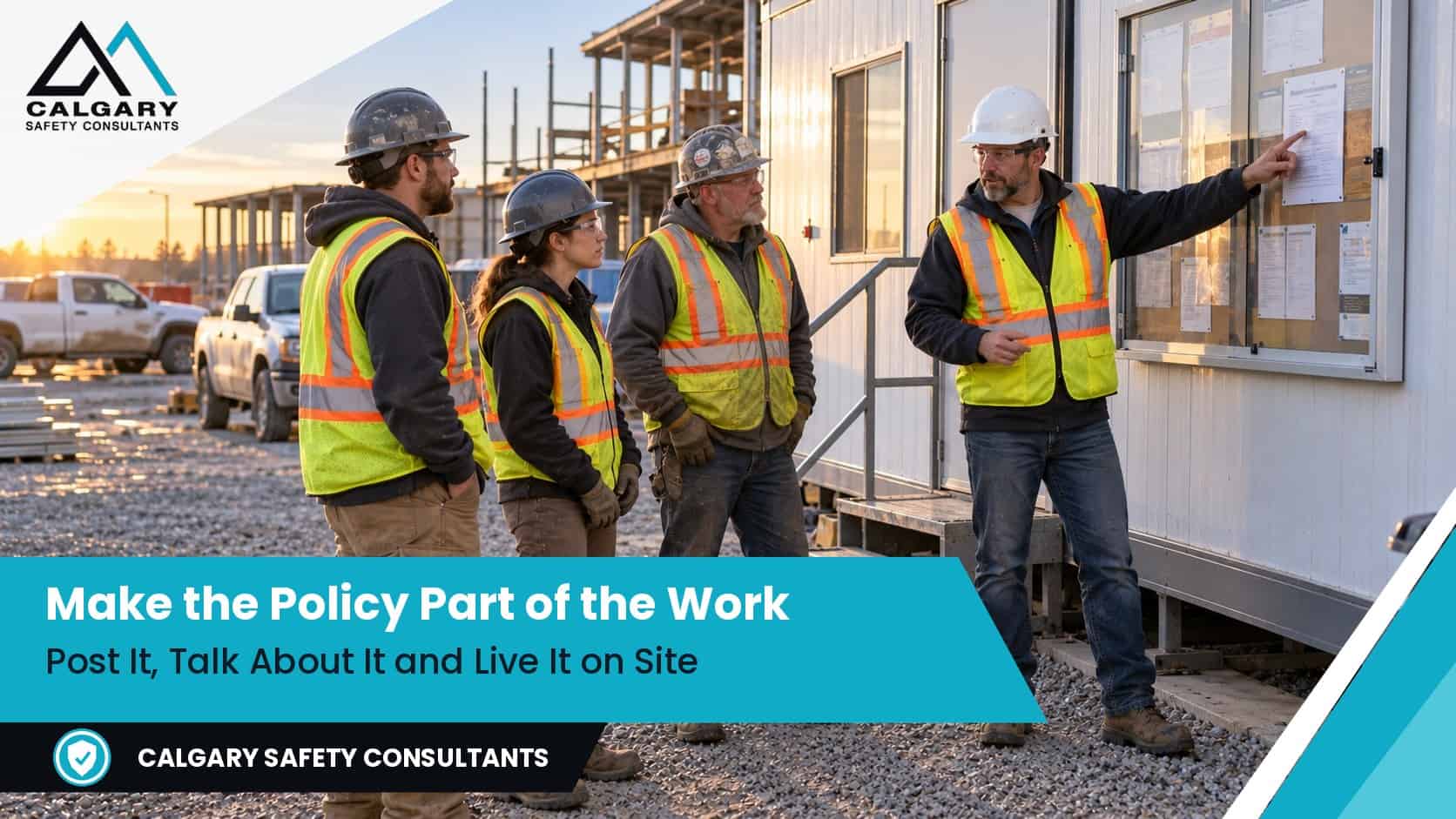
Communicate it, more than once. Cover it in every orientation, so new workers hear it in week one; our free New Worker Safety Essentials course shows what orientation covers. Read it at a safety meeting after each review, ask supervisors to explain one commitment at a toolbox talk, and include it in contractor orientation.
Auditors will test this. Energy Safety Canada's protocol asks employees in interviews whether they know how the policy is made available, then the auditor checks those locations to confirm it's posted or available there. Our guide to COR audit interviews explains how those conversations work.
Reviewing the Policy Every Year
Ontario and Nova Scotia require an annual policy review in law, the IHSA audit tool asks whether the policy is reviewed at least annually, and WorkSafeNB recommends the same. Program reviews in Saskatchewan, Manitoba and Newfoundland and Labrador run on cycles of up to three years. A yearly policy review is a sensible standard everywhere, and it takes less than an hour.
- Is it still true? Check each commitment against what actually happened this year.
- Is it still current? Confirm the signer, company name, scope and legal references.
- What do the results say? Look at incidents, inspections, audit findings and objectives.
- What do workers say? Ask the committee or representative for feedback.
- Re-sign and re-communicate. Even with no changes, a new date and signature show it was reviewed.
- Record it. Keep a simple review log: date, who took part, what changed and the next review date.
Tie the review to your annual program review if you can. The HSE's leadership guidance says the board should review health and safety performance at least once a year, and the policy review is the natural place to start.
Example Health and Safety Policy Wording
Here's an example for an illustrative mid-size employer. Use it as a starting point, then rewrite it in your own words for your work, your people and your jurisdictions.
Example policy
Health and Safety Policy: [Company Name]
At [Company Name], nothing we do is worth getting hurt for. We are committed to protecting the physical and psychological health and safety of everyone who works for us or with us, and our goal is that everyone goes home healthy at the end of every shift.
Our commitments. We will meet or exceed the occupational health and safety laws that apply wherever we work. We will identify hazards and eliminate or control them. We will give you the training, equipment, supervision and time you need to work safely. We will investigate incidents and near misses to learn from them, not to blame. We will consult with you and our health and safety committee, and we will set and review health and safety objectives every year.
Responsibilities. Management provides the resources and leadership for our health and safety program and holds everyone accountable for it. Supervisors make sure work is planned and done safely, and correct unsafe acts and conditions. Workers follow safe work procedures, use the required protective equipment, and report hazards, incidents and near misses. Contractors and visitors follow our rules and their own.
Your rights. You have the right to know about the hazards of your work, to take part in health and safety, and to refuse work you believe is dangerous. No one will be punished for raising a concern in good faith.
We will review this policy at least once a year.
Signed: ____________________ [Name], President Date: ________ Next review: ________
Notice what it leaves out: procedures, section numbers and promises of zero incidents. The free template below has optional clauses you can tick for psychological health, impairment, working alone, environment and more.
Workplace example
A Practical Workplace Example
Situation: Consider an illustrative mechanical contractor in Saskatchewan with about 45 workers, preparing for its first COR audit. Its "policy" was four pages copied from an online template. It cited another province's Act, named a founder who had retired three years earlier, and was posted only in the office lobby. In a practice interview, a pipefitter on a site 200 km away said he'd never seen it.
Action: The safety coordinator cut the policy to one plain-language page, moved the procedures into the program and corrected the legal references. The joint committee asked for a clearer line on reporting without reprisal. The new president signed it at a company-wide meeting, and it was posted at the shop, in every site trailer and in the safety app. Supervisors covered one commitment a week at toolbox talks, it went into orientation, and an annual review was booked for each January.
Result: In the next practice interviews, most workers could say where the policy was posted and explain at least one commitment in their own words. The policy section of the internal audit had no findings, and the committee used the January review to add a commitment on psychological health.
Common Health and Safety Policy Mistakes to Avoid
- Copying a template word for word. Generic wording, another company's name left in, or the wrong province's law.
- Writing a manual instead of a policy. Procedures in the policy make it long and quickly out of date.
- The wrong signature. Signed by the safety coordinator, or by a leader who has moved on.
- No date. Without a signed date and a review date, nobody can tell if it's current.
- Posting it in one place only. Field crews, remote sites and night shifts never see it.
- Never talking about it. A policy that isn't explained at orientation and meetings won't be understood in interviews.
- Promises nobody keeps. Commitments that don't match daily practice damage trust faster than having none.
- Leaving out psychological health. The COR protocol looks for physical, psychological and social well-being.
- Skipping the review. Ontario and Nova Scotia require it every year, and a stale policy is an easy audit finding anywhere.
Audit perspective
What an Auditor Expects to See
The policy sits in the first COR element, management leadership and commitment. In Energy Safety Canada's protocol, the auditor scores the document against eight criteria, interviews employees about how the policy is made available, and then checks those locations to confirm it's posted or available. The IHSA tool adds whether the policy is current, visibly posted, reviewed at least annually, and communicated and understood by employees.
Expect questions like "Where would you find the company's safety policy?" and "What does it mean to you?" Workers don't need to recite it. They should know where it is and be able to describe a commitment or two in their own words, and supervisors should be able to say how they put it into practice. The same applies in a SECOR evaluation, scaled to a small employer.
Calgary Safety Consultants helps employers write and review their policies and prepare for COR and SECOR audits; we don't issue certificates. CORs and SECORs are issued through the applicable certifying partner.
The Bottom Line
A health and safety policy is a short, honest promise from the top of your organization. Write it in plain language, cover the commitments the law and the audit tools expect, and keep procedures out of it. Have your most senior leader sign and date it, post it everywhere your people work, and talk about it often enough that workers can explain it.
Then keep it true. Review it every year, re-sign it when leaders change, and make sure every promise in it is backed by a real part of your program. A one-page policy that people believe in is worth more than a binder nobody opens.
Download the Health and Safety Policy Template and Review Checklist
Two free, fillable PDF downloads go with this guide. Both have clickable checkboxes and fill-in fields, so you can complete them on screen or print them for a committee meeting.
- Health and Safety Policy Template (PDF, 7 pages). A fill-in policy statement with guidance notes for each section, optional clauses you can tick, a worked sample policy, a jurisdiction quick reference, a signing, posting and communication record, an annual review log, key terms and common mistakes.
- Health and Safety Policy Review Checklist (PDF, 6 pages). A review against legal and COR expectations with clickable checkboxes, a jurisdiction requirements table, a worker understanding check with interview prompts, links to roles and responsibilities, common mistakes, an action plan and sign-off.
Click either button to download the file. Adapt both to your own organization and to the rules that apply in your province or territory.

About the author
John Duplessis, B.Sc., CRSP
John Duplessis is a Canadian Registered Safety Professional with more than 30 years of occupational health and safety experience in oil and gas, construction, green energy, midstream operations and industrial project work. He is an external auditor with Energy Safety Canada.