How to Build a Health and Safety Program
How to build a program that fits your work and your jurisdiction, from policy and hazard assessment to training, inspections and review.
Coming soon
Practical guides to building safety programs that work beyond the manual: what the law requires, how to train and supervise, how to measure what matters and how management systems fit in. Written for employers, managers and supervisors anywhere in Canada.
Prepared by Calgary Safety Consultants, led by John Duplessis, B.Sc., CRSP.
Safety program guides
Every guide in this category explains how a part of a health and safety program is done well, with the legal requirements linked at the point they matter and free downloads you can adapt. Guides marked coming soon open here as they're published.
How to build a program that fits your work and your jurisdiction, from policy and hazard assessment to training, inspections and review.
Coming soonWhat new and young workers need to know before they start, and how to deliver and record an orientation that sticks.
Coming soonHow to select, orient and oversee contractors so their work meets your safety standards, before and during the job.
Coming soonHow to write a short, signed policy statement that sets out your commitment, responsibilities and expectations.
Coming soonHow to map the training each role needs, track who has it and show that workers are competent, not just trained.
Coming soonWhat reasonable care looks like for supervisors day to day, and how to keep the records that prove it.
Coming soonHow to review your program each year, find the gaps and set clear priorities for the year ahead.
Coming soonHow to organize, control and keep the safety records the law and auditors expect, without drowning in paper.
Coming soonHow to choose measures that show whether your program is working before injuries tell you it isn't.
Coming soonHow the international management system standard works, how it compares with COR and what implementation involves.
Coming soonHow to plan safety for a single project or site, covering its hazards, contractors, emergency arrangements and communication.
Coming soonHow to orient, supervise and protect young and new workers while they're still learning the hazards of the job.
Coming soonHow OHS law applies to farming and ranching operations, and how to build a practical safety program for the farm.
Coming soonWhat condo boards and property managers are responsible for when workers and contractors are on the property.
Coming soonAbout safety programs
A health and safety program is the organized way a business identifies and controls hazards, assigns responsibilities and checks that it's all working. A safety management system is the same idea run as a continuous cycle of planning, doing, checking and improving.
Most safety programs share the same building blocks: a signed policy, hazard assessment and control, safe work procedures, training and orientation, inspections, incident investigation, emergency preparedness, worker participation, contractor management and records. The labels vary from one jurisdiction to the next, but the pieces look remarkably similar.
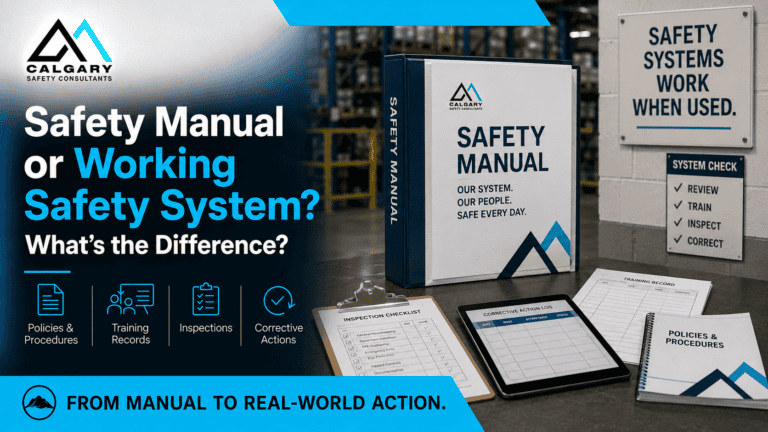
A safety manual isn't the same thing as a safety program. The manual is a description. The program is what happens at work: supervisors checking that controls are in place, workers trained before they start, hazards reported and fixed, and managers reviewing whether it all works. Inspectors and auditors look for the second.
A working program is also the foundation of due diligence. Since the Supreme Court of Canada's 1978 decision in R. v. Sault Ste. Marie, employers charged with most regulatory OHS offences can defend themselves by proving they took all reasonable care. The Criminal Code also places a legal duty on anyone who directs how another person works to take reasonable steps to prevent bodily harm. A documented program that's actually in use is how you show that reasonable care.
Strong safety programs pay off in day-to-day operations, too: fewer injuries and claims, less disruption, smoother audits and prequalification, and supervisors who know exactly what's expected of them.
The research supports a system approach, with a realistic caveat. A systematic review by Robson and colleagues in Safety Science found that results from management system interventions were generally positive, but the evidence was too limited and varied to recommend for or against them. In practice, what matters most is whether the system is actually used.
How it works
Effective safety programs follow the same five-part cycle, whatever the size of the business or the industry.
Write a short, signed policy, assign responsibilities from the owner to the front line, and identify the legal requirements that apply to your workplace and your work.
Identify the hazards in every job, assess the risks and put controls in place using the hierarchy of controls, with safe work procedures for higher-risk tasks.
Orient new workers before they start, train every worker for the hazards of their job, make sure supervisors are competent, and involve workers through the committee or representative.
Inspect, investigate incidents, track corrective actions and measure performance with leading indicators as well as injury rates, so you see problems before they become injuries.
Review the whole program on a set schedule, and sooner when the work changes or after a serious incident, then set priorities for the year ahead.
The US Occupational Safety and Health Administration's recommended practices for safety and health programs set out seven core elements, from management leadership and worker participation to program evaluation and coordination with contractors and staffing agencies. The UK Health and Safety Executive's HSG65 frames the same work as plan, do, check, act, and cautions that paperwork on its own isn't a good measure of performance.
OSHA's guidance on program evaluation explains the difference between lagging indicators, which track injuries that have already happened, and leading indicators, which track the steps taken to prevent them. Both belong in a well-run program.
What the law expects
Most Canadian jurisdictions require formal safety programs once a workplace reaches a certain size or hazard level, and every jurisdiction expects employers to manage health and safety systematically.
Alberta's OHS Act requires employers who regularly employ 20 or more workers to establish and implement a health and safety program. As the province's health and safety program page explains, there are no mandatory elements, but employers with fewer than 20 workers still need documentation that meets the legal requirements. British Columbia's OHS Regulation, Part 3 requires a formal program for employers with 20 or more workers in a moderate or high hazard workplace, or 50 or more workers, and a less formal program built on regular monthly meetings for smaller employers.
Saskatchewan's OHS Regulations, 2020 require a program at prescribed workplaces with 10 or more workers, reviewed at least every three years. Manitoba's Workplace Safety and Health Act requires a written program where 20 or more workers are regularly employed, reviewed every three years or sooner if circumstances change. Ontario requires a written policy, reviewed at least once a year, and a program to implement it where more than five workers are regularly employed, as its guide to employer duties explains. Federally regulated employers of every size must develop, implement and monitor a hazard prevention program.
| Jurisdiction | When a program is required | Review and key features |
|---|---|---|
| Alberta | Employers who regularly employ 20 or more workers, or when a Director requires one. | No mandatory elements or set review interval in the Act. Alberta's guidance suggests reviews at regular intervals and when circumstances change. |
| British Columbia | 20 or more workers in a moderate or high hazard workplace, or 50 or more workers. Smaller employers run a less formal program with monthly meetings. | Required elements include a statement of aims and responsibilities, inspections, written instructions, management meetings, investigations, records and worker supervision. |
| Saskatchewan | Prescribed workplaces with 10 or more workers. | Listed elements, with a review at least every three years. |
| Manitoba | A written program where 20 or more workers are regularly employed. | Listed elements, with a review every three years or sooner if circumstances change. |
| Ontario | A written policy and a program to implement it where more than five workers are regularly employed. | The policy is reviewed at least once a year and posted. |
| Federal | Every employer, with a hazard prevention program scaled to the size of the workplace. | Listed elements, with an evaluation at least every three years. |
Management system standards are voluntary. ISO 45001:2018 is the international standard for occupational health and safety management systems, and it's currently being revised. CSA Z45001:19 is Canada's adoption of it, with Canadian deviations. Neither is required by OHS law, but both give organizations a recognized framework, and certification is available for those who want it.
Because the details differ, start by confirming which law applies to your workplace. Our OHS Legislation category links the Act, regulations and regulator for all 14 jurisdictions in Canada, and explains how to read them.
From our audits
Most of the safety programs we review are well written. The gaps are almost always between what the manual says and what happens on the floor.
Each of these is fixable once you see it. The guides on this page show what effective safety programs look like, so you can compare them with your own.
Free downloads
Use these free tools as building blocks for safety programs of any size, then adapt them to your work and the law that applies to you.
From the blog

September 14, 2026
August 20, 2026
August 10, 2026
July 23, 2026
When to bring in help
The guides are written so you can act on them yourself. Sometimes it helps to have an experienced safety professional look at your program, especially when you're growing past a legal threshold, an audit is coming up or your manual no longer matches how the work is done.
Calgary Safety Consultants builds safety programs that fit the real work. We write programs and manuals for your jurisdiction and your hazards, review existing programs against the law and COR standards, train supervisors in their responsibilities, and support annual reviews, KPIs and ISO 45001. Our consulting focuses on Alberta, British Columbia and Saskatchewan, and our online training and free downloads are available anywhere in Canada.
We help employers prepare for COR and SECOR audits, but we don't issue certificates. CORs and SECORs are issued through the applicable certifying partner.
Common questions
Answers to the questions employers, managers and supervisors ask most often about health and safety programs and management systems.
A health and safety program is the organized system a business uses to identify and control hazards, assign responsibilities, train workers and check that everything is working. It usually includes a policy, hazard assessments, safe work procedures, training, inspections, incident investigation, emergency planning, worker participation and records. The program is what actually happens at work, not just what's written in a binder.
In most jurisdictions, written safety programs are required once you reach a set size. Alberta requires a program at 20 or more workers, British Columbia at 20 or more in moderate or high hazard workplaces or 50 or more overall, Saskatchewan at prescribed workplaces with 10 or more, and Manitoba at 20 or more. Ontario requires a written policy and program above five workers, and federally regulated employers need a program at any size.
Requirements vary, but most lists overlap: a policy statement, responsibilities, hazard identification and control, safe work procedures, training and orientation, inspections, incident investigation, emergency procedures, worker participation, contractor coordination and program review. British Columbia, Saskatchewan, Manitoba and federal law list required elements. Alberta has no mandatory elements, but its guidance suggests a similar set of components.
A policy is a short, signed statement of the employer's commitment and expectations. The program is the system that puts the policy into practice: the hazard assessments, procedures, training, inspections and everything else. A manual is simply where the program is written down. Inspectors and auditors care most about whether the program is happening, not how thick the manual is.
Yes, even if the law doesn't require a formal one. Small employers still have to identify and control hazards, train workers and keep certain records. British Columbia allows a less formal program based on regular monthly meetings with workers, and Alberta employers with fewer than 20 workers still need documentation that meets the legal requirements. Keep it simple, practical and in proportion to your risks.
At least every three years, and sooner when the work, the workforce or the hazards change, or after a serious incident. Saskatchewan and Manitoba set a maximum of three years, federally regulated employers must evaluate their program at least every three years, and Ontario requires the health and safety policy to be reviewed at least once a year. Many employers do a brief review every year.
Due diligence means taking every reasonable precaution to prevent injuries and illnesses. Since the Supreme Court of Canada's decision in R. v. Sault Ste. Marie, employers charged with most regulatory offences can avoid liability by proving they took all reasonable care. In practice, that means a working program, trained and supervised workers, hazards dealt with promptly and records that show it all happened.
Supervisors must make sure workers know the hazards, follow safe procedures and use the required equipment, and must take reasonable steps to protect them. Alberta requires employers to make sure their supervisors are competent, and the Criminal Code places a legal duty on anyone who directs how another person works to take reasonable steps to prevent bodily harm. Training and supporting supervisors is part of a sound program.
Lagging indicators, such as injury rates and lost-time claims, track harm that has already happened. Leading indicators track the actions that prevent harm, such as inspections completed, hazards and near misses reported, corrective actions closed on time and training completed. The UK Health and Safety Executive and OSHA both recommend using leading indicators alongside lagging ones to spot problems before they turn into injuries.
Not by law. ISO 45001 is a voluntary international standard for occupational health and safety management systems, and CSA Z45001 is Canada's adoption of it. Some organizations choose certification because clients ask for it or because they want a recognized, auditable framework. For many small and mid-sized employers, a solid program that meets the law, and COR or SECOR where relevant, comes first.
Contractors working at your site should be covered by your program through prequalification, orientation, coordination and oversight. On construction and oil and gas sites in Alberta with two or more employers, a prime contractor must have a system or process to ensure compliance, and British Columbia sets similar duties. Manitoba requires programs to include procedures for workplaces with more than one employer.
Keep records that show the program is working: hazard assessments, training and orientation, inspections, incident investigations, corrective actions, committee minutes, first aid records and program reviews. Some periods are set in law. British Columbia requires first aid records to be kept for at least three years, and federally regulated employers keep training records for two years after the employee stops being exposed to the hazard.
A COR or SECOR recognizes that your health and safety program has been audited against an established standard and met it. Building a working program is the main part of preparing for certification, and the audit tests whether it's really in use. We help employers prepare, but we don't issue certificates. CORs and SECORs are issued through the applicable certifying partner.
Yes. We build health and safety programs and manuals that fit your work and your jurisdiction, review existing programs against the law and COR standards, train supervisors in their responsibilities and help with annual reviews and ISO 45001. Our consulting focuses on Alberta, British Columbia and Saskatchewan, while our guides, free downloads and online training are available anywhere in Canada. Book a free consultation to talk it through.
Talk to a safety consultant
Whether you're starting from scratch, updating an old manual or preparing for an audit, we'll help you work out the next practical step. Complete the form below or book a 30-minute consultation.