On this page
- What Is Online Safety Training and Why Does It Work
- How Online Safety Training Supports Reducing Safety Violations
- How Online Safety Training Aligns With Canadian OH&S Requirements
- Best Practices for Implementing Online Safety Training
- The Business Impact of Online Safety Training in Alberta, BC, and Saskatchewan
- Why Online Safety Training Improves Compliance
- Example: Reducing Safety Violations Through Online Training
- How Calgary Safety Consultants can help
- Final thoughts
- Frequently asked questions
Across these provinces, employers are legally required to ensure workers understand workplace hazards, follow safe procedures, and demonstrate competency. However, most organizations do not struggle with having policies in place. The real issue is application, because workers often do not consistently understand or apply those policies in the field.
That gap between policy and real-world execution is where online safety training creates measurable impact.
When implemented correctly, it improves hazard awareness, standardizes procedures across multiple job sites, and provides verifiable training records that support compliance, due diligence, and COR audit performance.
For organizations looking to strengthen compliance systems, integrating online safety training with a broader workplace safety program is critical. This includes aligning training with hazard assessments, supervision, and enforcement, which ensures that training is not just completed, but applied.
You can explore how structured workplace safety training programs support this process through tailored online safety training solutions designed to match your actual operational risks.
Unlike traditional classroom-based instruction, which can vary depending on instructor and location, online safety training creates consistency. Every worker receives the same information, in the same format, with built-in tracking, assessment, and documentation.
As a result, organizations reduce knowledge gaps, improve accountability, and significantly reduce workplace safety violations tied to inconsistent training and communication.
What Is Online Safety Training and Why Does It Work
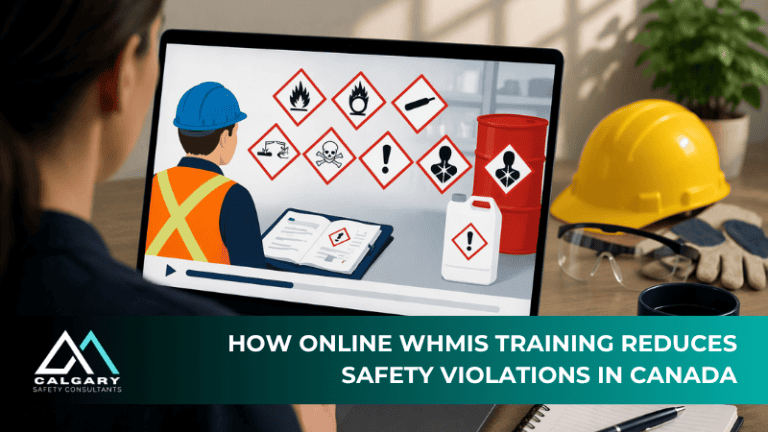
Online safety training in Canada refers to structured digital training programs that deliver workplace safety education through web-based platforms. These programs typically include topics such as hazard identification, WHMIS, PPE, incident reporting, and industry-specific risks.
Unlike traditional classroom training, which often varies by instructor and location, online safety training creates consistency. Every worker receives the same information, in the same format, with built-in tracking and verification.
This leads to three critical outcomes:
- Consistent delivery across all locations, including Alberta, BC, and Saskatchewan
- Verifiable completion records that support compliance and due diligence
- Faster updates to align with changing OH&S regulations
Because of this, organizations reduce knowledge gaps, which directly reduces workplace safety violations.
How Online Safety Training Supports Reducing Safety Violations
The connection between training and compliance is practical. When workers understand hazards, expectations, and procedures, they make better decisions in real time.
Online safety training strengthens this connection in several ways.
Training works best when it is built into a broader system of workplace safety program development and implementation, supported by supervision, documentation, and hazard control.
Improved Hazard Awareness
Workers who complete structured workplace safety training online in Canada are better equipped to recognize hazards early.
This matters because most violations occur when hazards are either misunderstood or overlooked. When awareness improves, intervention happens earlier, which reduces incidents and enforcement exposure.
Standardized Procedures Across Locations
For companies operating across Alberta, British Columbia, and Saskatchewan, inconsistent supervision often leads to inconsistent compliance.
Online safety training eliminates this issue by delivering standardized procedures across all job sites.
As a result, workers follow the same expectations regardless of province, which significantly reduces safety violations tied to inconsistent practices.
Reinforcement Through Accessibility
Retention is one of the biggest weaknesses of traditional safety training. Workers forget information when it is not reinforced.
Online safety training allows workers to revisit modules at any time, which improves long-term retention and supports correct decision-making in real-world situations.
Tracking and Accountability
Regulators in Alberta, BC, and Saskatchewan expect proof of training, not just verbal confirmation.
Online safety training platforms track completion, assessments, and competency, which provides defensible documentation during inspections, audits, and incident investigations.
This strengthens your position during COR audits and regulatory reviews.
How Online Safety Training Aligns With Canadian OH&S Requirements
Across Canada, employers are legally required to provide training that ensures workers are competent and aware of hazards.
Guidance from the Canadian Centre for Occupational Health and Safety reinforces that training must be effective, documented, and relevant to workplace risks.
Provincial expectations further reinforce this:
- Alberta Occupational Health and Safety requires employers to provide adequate training and supervision
- WorkSafeBC enforces competency and hazard awareness requirements
- Saskatchewan Labour Relations and Workplace Safety outlines employer responsibilities for worker education
For employers that also need audit readiness, see COR Audit Preparation Services & Certification Support | Alberta, BC & Saskatchewan – we can help ensure training records, competency, and documentation align with audit expectations.”
However, training must be integrated into a broader safety program that includes supervision, hazard assessments, and enforcement.
Best Practices for Implementing Online Safety Training
To maximize the impact of online safety training, organizations need to move beyond simply assigning courses and checking completion boxes.
Effective implementation follows a structured approach.
Align Training With Real Workplace Hazards
Training must reflect actual job risks.
Use hazard assessments and job hazard analysis services to determine training needs, rather than relying on generic courses.
This ensures training directly supports reducing workplace safety violations.
Use a Blended Training Approach
Online safety training should support, not replace, hands-on instruction.
For example, workers may complete hazard awareness training online, followed by site-specific practical training.
This improves competency and reduces improper application in the field.
Assign Responsibility and Oversight
Supervisors must be accountable for:
- Tracking completion
- Verifying understanding
- Reinforcing expectations
Without oversight, training becomes a checkbox exercise, which reduces its effectiveness.
Update and Refresh Training Regularly
Regulations and workplaces change.
Training should be reviewed annually and updated when hazards or processes change. Refresher training should also be scheduled to maintain competency.
The Business Impact of Online Safety Training in Alberta, BC, and Saskatchewan
When training gaps exist, the result is predictable.
Hazards go unrecognized, procedures are misunderstood, and unsafe behaviors become normalized.
To identify gaps before they lead to enforcement problems, many employers benefit from workplace safety audits and compliance reviews:
- Operational disruptions
- Increased WCB costs
- Potential fines and enforcement action
- Loss of COR eligibility and contract opportunities
Why Online Safety Training Improves Compliance
Organizations that implement structured online safety training programs typically see:
- Fewer minor safety violations
- Lower incident rates
- Improved COR audit scores
- Reduced administrative burden for tracking training
The improvement comes from consistency and accountability.
Workplace example
Example: Reducing Safety Violations Through Online Training
A construction company operating across Alberta and Saskatchewan experienced repeated violations related to PPE use and hazard reporting.
Their training was inconsistent and poorly documented.
After implementing online safety training programs focused on hazard awareness, PPE compliance, and reporting procedures, combined with supervisor follow-up, the results were clear.
Within six months:
- Violations decreased
- Audit readiness improved
- Workers became more proactive in identifying hazards
This shows how structured training can lead to measurable compliance improvements.
How we help
How Calgary Safety Consultants can help
Implementing online safety training effectively requires more than selecting a platform. It requires alignment with your safety program, regulatory requirements, and operational realities.
Calgary Safety Consultants provides support across:
- Online safety training development and delivery tailored to your workplace
•COR consulting and audit preparation to ensure training aligns with audit requirements
• Hazard assessments to identify training needs
• Compliance support across Alberta, British Columbia, and Saskatchewan
Their approach focuses on practical implementation, which means training is not just completed, but applied in the field.
Final thoughts
Online safety training is not just a convenience. It is a strategic tool that directly supports reducing safety violations, improving compliance, and strengthening overall safety culture.
When training is consistent, accessible, and reinforced through supervision and accountability, it changes behavior. And when behavior changes, results follow.
If your goal is to reduce incidents, improve audit performance, and protect your business, this is one area where investment delivers immediate and long-term returns.
Jurisdiction note: This article provides general occupational health and safety information. The legal requirements that apply depend on the workplace location, industry and federal, provincial or territorial jurisdiction. Verify current requirements with the applicable regulator before using the information operationally. Government of Canada overview of occupational health and safety jurisdiction.
References

About the author
John Duplessis, B.Sc., CRSP
John Duplessis is a Canadian Registered Safety Professional with more than 30 years of occupational health and safety experience in oil and gas, construction, green energy, midstream operations, and industrial project work.