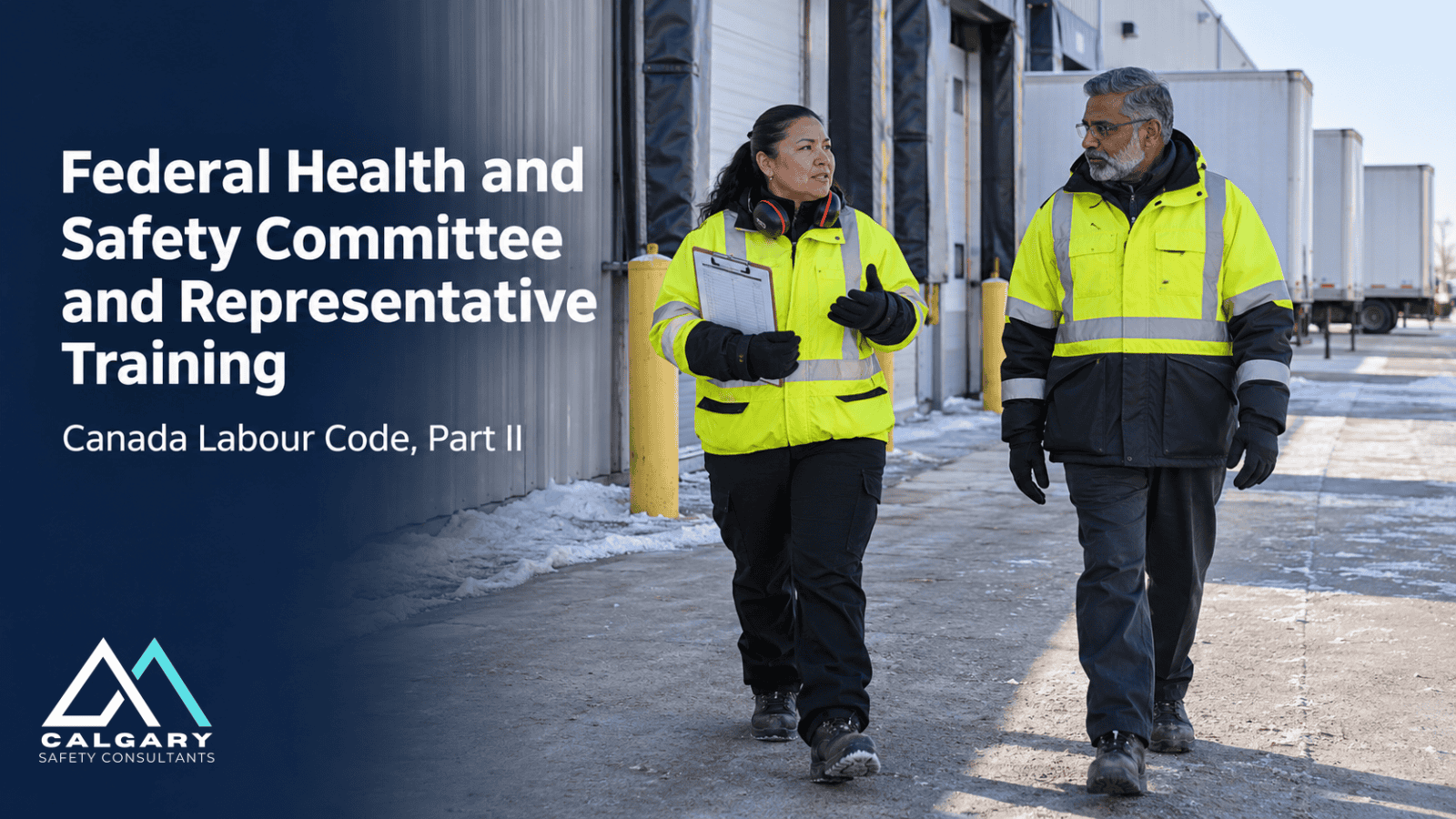
Federal Health and Safety Committee and Representative Training
Our online health and safety committee training for federally regulated workplaces gives work place committee members, health and safety representatives, policy committee members and co-chairs the knowledge to do the job well under the Canada Labour Code, Part II. In 24 narrated video lessons, you’ll learn what the Code and its regulations require, what committees and representatives do, how to run meetings, deal with complaints, take part in work refusals, inspections and investigations, and work with the Labour Program.
Training a team? For online group training, buy your enrolments here, then complete our Group Training Student Information form so we can set up each learner’s account.
Learn more about how our online safety training works.
A committee or representative that works helps find hazards early, gets them fixed and gives employees a real voice in their own safety. In a federally regulated work place, the employer must establish a work place committee where 20 or more employees are normally employed, and a health and safety representative is appointed where there are fewer than 20. Employers that normally employ 300 or more employees directly must also establish a policy committee. This course gives members and representatives a practical foundation in plain language, with tools they can use at their next meeting.
This course is designed to support your employer’s training program for committee members and representatives under section 14 of the Committees Regulations. Your employer still adds your own committee’s rules, programs, forms and people. The course isn’t approved by the Labour Program or any regulator, it isn’t legal advice, and it doesn’t replace the Canada Labour Code, its regulations or your employer’s duties. This course is available in English only. Employers in Quebec should check whether French-language training is required for their workers before enrolling them.
Federal Health and Safety Committee Training at a Glance
Price: $49.99 CAD plus GST per learner
Delivery: 100% online and self-paced
Course format: 24 narrated video lessons in six modules, with federal workplace examples and a knowledge check after every lesson
Course length (estimated): About 10.5 hours, including about 9.5 hours of lesson video plus the knowledge checks and final exam
Assessment: A three-question knowledge check after every lesson (100% to continue) and a 24-question final exam (80% to pass), with unlimited retries
Includes: A downloadable 231-page Student Reference Guide with a card for every teaching slide, lesson summaries, federal reference tables, official sources and 29 worksheets and checklists
Certificate: Certificate of Completion and Training Record
Covers: Policy committees, work place committees and health and safety representatives under the Canada Labour Code, Part II
Developed by: Calgary Safety Consultants, led by John Duplessis, a Canadian Registered Safety Professional (CRSP)
What Does This Health and Safety Committee Training Cover?
This health and safety committee training follows the work a member or representative actually does: understanding federal law, carrying out the duties, running the committee, handling complaints and refusals, inspecting and investigating, and keeping the committee effective year after year.
You’ll learn how to:
- Explain the purpose of committees and representatives and how they fit the internal responsibility system.
- Find what you need in the Canada Labour Code, Part II, the Committees Regulations and the COHSR.
- Describe the duties and rights of employers, supervisors and employees, and protection from reprisal.
- Tell when you need a policy committee, a work place committee or a health and safety representative.
- Carry out the committee’s and the representative’s duties, and work with the employer and a policy committee.
- Take part in the hazard prevention program and use the federal order of preventive measures.
- Support the two chairpersons, set rules of procedure, run effective meetings and keep minutes and records.
- Deal with complaints through the internal complaint resolution process and make recommendations that get a written response.
- Explain the right to refuse dangerous work and the committee’s role when a refusal continues.
- Plan and carry out monthly inspections, take part in hazardous occurrence investigations, and work with the Labour Program.
Lessons use workplace examples and decision points from federally regulated settings across Canada, such as a grain terminal, a cross-border trucking terminal, an airport ramp, a ferry terminal or a telecom service garage.
Committee and Representative Requirements Under the Canada Labour Code
Under section 135 of the Canada Labour Code, an employer must establish a work place committee for each work place it controls where 20 or more employees are normally employed. Under section 136, a health and safety representative is appointed for each work place with fewer than 20 employees, or where no work place committee is required. Under section 134.1, an employer that normally employs 300 or more employees directly must establish a policy committee. A committee has at least two members, and at least half must be employees who don’t exercise managerial functions, selected by the employees or their union. It has two chairpersons, one selected by each side.
Paragraph 125(1)(z.01) of the Code requires the employer to ensure that committee members and representatives receive the prescribed training and are informed of their responsibilities under Part II. Section 14 of the Committees Regulations says the employer develops that training after consulting the committees or representatives concerned. It must cover the Code and its regulations, the means to fulfil their responsibilities, the rules of each committee and the principles of consensus building. The training program is reviewed and updated at least every three years, and whenever circumstances change.
The Student Reference Guide’s federal reference tables summarize the sections the course relies on, checked against the Justice Laws Website and the Labour Program’s pages on November 13, 2026. Laws change, so read the current official text before you rely on a requirement.
Who Should Take This Health and Safety Committee Training?
This course is built for committee members, representatives and the people who support them in any federally regulated work place, such as interprovincial trucking and bus companies, airlines and airports, railways, ports and shipping, banks, telecommunications and broadcasting, grain handling and the federal public service.
It’s suitable for:
- New employee and employer members of work place committees
- Health and safety representatives in work places with fewer than 20 employees
- Policy committee members in organizations with 300 or more employees
- Chairpersons who lead meetings, rules of procedure and the annual report
- Current members who want a refresher or a stronger committee
- Managers, supervisors and safety coordinators who work with the committee
Employers often use this course as a common foundation for the whole committee. Our inspection, incident reporting and investigation and hazard assessment courses build on the same skills. Provincially regulated committees can see our Joint Health and Safety Committee Training Alberta and BC Joint Health and Safety Committee Training courses.
Federal Committee Training Course Features
Our federal health and safety committee training combines what the Canada Labour Code requires with the practical skills that make a committee work.
Course features include:
- 100% online and self-paced
- 24 narrated video lessons in six modules
- The four training topics in section 14 of the Committees Regulations, taught across the course
- Dedicated lessons on the two chairpersons, the internal complaint resolution process and the right to refuse dangerous work
- Hazard identification with the 12 CSC Energy Sources, such as Gravity, Motion and Psychosocial
- Federal workplace examples and decision points in every module
- A three-question knowledge check after each lesson, with feedback after each answer
- A 24-question final exam, with one question from every lesson
- A downloadable Student Reference Guide with federal reference tables
- A Certificate of Completion and Training Record
The Student Reference Guide includes 29 worksheets and checklists:
- Committee Documents Checklist
- “Is Our Workplace Federally Regulated?” Prompt List
- Duties and Rights Quick Reference
- Which Body Do We Need? Worksheet
- Committee Duties Sorter: Committee Task or Employer Task?
- Representative’s Monthly Plan and Log
- Employer Consultation and Response Tracker
- Hazard Identification Prompt and the Federal Order of Preventive Measures
- Chairpersons’ Duties Table: Law and Good Practice
- Chairpersons’ Annual Calendar
- Rules of Procedure Review Checklist
- Meeting Agenda Template
- Consensus Check Card
- Minutes Template
- Annual Report Monthly Tally Sheet
- Complaint Log
- Joint Complaint Investigation Record
- Written Recommendation Template and 30-Day Response Tracker
- Refusal Quick-Reference Flow
- Committee Refusal Investigation Report
- 12-Month Inspection Coverage Plan
- Inspection Finding Record
- Inspection Action Log
- Hazardous Occurrences: What Happened, What the Employer Must Do, What the Committee Receives
- Investigation Report Review Checklist
- Harassment and Violence: Applicable Partner Checklist
- Labour Program Visit Readiness Checklist
- Committee Self-Check
- First 90 Days Plan
They’re draft templates in our own words for your employer and committee to adapt. Where a worksheet names a section, read the section for its exact wording. For more depth, see our guides to job hazard analysis, incident investigation and corrective actions.
Federal Health and Safety Committee Training Modules
Six modules follow the work of a federal work place health and safety committee and representative, from the law that sets them up to your first year in the role. Each lesson is one narrated video with a knowledge check.
Module One: The Committee and Federal Health and Safety Law
Module One explains why committees matter, how federal health and safety law is organized, everyone’s duties and rights and protection from reprisal, and when you need a policy committee, a work place committee or a representative.
Lessons:
- Lesson One: Why Health and Safety Committees Matter
- Lesson Two: Federal Health and Safety Law: The Code, the Regulations and the Labour Program
- Lesson Three: Duties, Rights and Protection From Reprisal
- Lesson Four: Policy Committees, Work Place Committees and Representatives: Who Needs What
Module Two: Duties and Powers
Module Two covers duties and powers: the work place committee, the health and safety representative, the employer’s duties to you, working with a policy committee, and the hazard prevention program.
Lessons:
- Lesson Five: The Work Place Committee’s Duties and Powers
- Lesson Six: The Health and Safety Representative’s Role
- Lesson Seven: The Employer’s Duties to Your Committee and Working With a Policy Committee
- Lesson Eight: The Hazard Prevention Program and Your Committee
Module Three: Chairpersons, Rules and Meetings
Module Three covers the two chairpersons, rules of procedure, running effective meetings and building consensus, and minutes, records, posting and the annual report.
Lessons:
- Lesson Nine: The Chairpersons: Duties of the Two Co-Chairs
- Lesson Ten: Rules of Procedure: How Your Committee Operates
- Lesson Eleven: Running Effective Meetings and Building Consensus
- Lesson Twelve: Minutes, Records, Posting and the Annual Report
Module Four: Complaints, Recommendations and Refusals
Module Four covers the internal complaint resolution process, investigating complaints and making recommendations, the right to refuse dangerous work, and the committee’s role in a continued refusal.
Lessons:
- Lesson Thirteen: Dealing With Complaints: The Internal Complaint Resolution Process
- Lesson Fourteen: Investigating a Complaint and Making Recommendations That Get Results
- Lesson Fifteen: The Right to Refuse Dangerous Work
- Lesson Sixteen: The Committee’s Role in a Work Refusal
Module Five: Inspections and Hazardous Occurrences
Module Five covers inspection requirements and planning, carrying out an inspection, reports and follow-up, reporting hazardous occurrences, and taking part in investigations.
Lessons:
- Lesson Seventeen: Inspection Requirements and Planning
- Lesson Eighteen: Carrying Out an Inspection
- Lesson Nineteen: Inspection Reports, Preventive Measures and Follow-Up
- Lesson Twenty: Hazardous Occurrences: Reporting and the Committee’s Role
- Lesson Twenty-One: Participating in Investigations: Finding Causes and Preventing Recurrence
Module Six: Special Topics and Sustaining the Committee
Module Six covers harassment and violence prevention as the applicable partner, working with the Labour Program, and training, review and your first year on the committee.
Lessons:
- Lesson Twenty-Two: Harassment and Violence Prevention: Your Role as the Applicable Partner
- Lesson Twenty-Three: Working With the Labour Program: Inspections, Directions and Appeals
- Lesson Twenty-Four: Training, Review and Your First Year on the Committee
Complete Your Online Committee Training
Enrol on this page, then work through the lessons in order. After each video, complete the lesson’s three-question knowledge check. You need all three answers correct (100%) to move on, with feedback after each answer and unlimited retries.
After Lesson 24, complete the 24-question final exam, with one question from each lesson in random order. You need 20 correct answers (80%) to pass, and you can retake it as often as you need. Once you’ve completed all 24 lessons, their knowledge checks and the final exam, you can download your Certificate of Completion and Training Record. Give a copy to your employer for its training records.
Frequently Asked Questions About Health and Safety Committee Training
Does this course meet the federal training requirement?
The Code requires the employer to ensure that committee members and representatives receive the prescribed training, and section 14 of the Committees Regulations says the employer develops that training after consulting the committee or representative. This course is designed to support that program. Your employer still adds your own committee’s rules, programs and forms. The Labour Program doesn’t approve committee training courses.
Who needs this training?
Members of policy committees and work place committees, and health and safety representatives, in work places under the Canada Labour Code, Part II. It’s also useful for chairpersons, managers and supervisors who work with the committee.
Is my workplace federally regulated?
Federally regulated work includes interprovincial and international transportation such as trucking, bus, rail, air and marine, as well as banks, telecommunications and broadcasting, grain handling and the federal public service. Lesson 2 shows how to check, and the Government of Canada keeps a list of federally regulated industries.
How long does the online training take?
We estimate about 10.5 hours: about 9.5 hours of lesson video, plus the knowledge checks and final exam. You can stop and return at any time.
Do I receive a certificate?
Yes. You receive a Certificate of Completion and Training Record after you complete all 24 lessons, their knowledge checks and the 24-question final exam (20 of 24 correct, 80%, with unlimited retakes). Give a copy to your employer for its training records.
Can employers purchase training for a whole committee?
Yes. Employers can buy online training for two or more learners on this page. After placing your order, complete our Group Training Student Information form with your order number and each learner’s details so we can set up their accounts.
Does this course cover provincially regulated workplaces?
No. It covers committees and representatives under the Canada Labour Code, Part II. Most workplaces fall under provincial law instead. For those, see our Joint Health and Safety Committee Training Alberta and BC Joint Health and Safety Committee Training courses.
Additional Federal Committee Resources
These official sources sit behind this health and safety committee training. Always read the current versions on the Justice Laws Website and canada.ca.
Canada Labour Code, Part II
Issued by: Government of Canada, Justice Laws Website
Part II covers occupational health and safety, including committees and representatives in sections 134.1 to 137.
Canada Labour Code
Committees Regulations
Issued by: Government of Canada, Justice Laws Website
Chairpersons, meetings, minutes, the annual report and training (section 14).
Policy Committees, Work Place Committees and Health and Safety Representatives Regulations
Canada Occupational Health and Safety Regulations
Issued by: Government of Canada, Justice Laws Website
Hazardous occurrences (Part XV) and the hazard prevention program (Part XIX).
Canada Occupational Health and Safety Regulations
Health and safety committees and representatives
Issued by: Employment and Social Development Canada, Labour Program
The Labour Program’s overview of committees and representatives.
Health and safety committees and representatives
Federally regulated industries
Issued by: Government of Canada
Check whether your workplace falls under the Canada Labour Code.
List of federally regulated industries and workplaces
Related courses: Online Inspection Training, Incident Reporting and Investigation Training, Hazard Assessment and Control for Canadian Workplaces and Understanding Canadian OH&S Legislation.