On this page
- What Incident Reporting Requirements Cover
- Why Getting It Right Matters
- Who Reports, and Who Gets Told
- Two Separate Systems
- What Makes an Incident Reportable to the Regulator
- The Reporting Decision at a Glance
- Alberta, British Columbia and Saskatchewan
- Manitoba and Ontario
- Nova Scotia, New Brunswick and Atlantic Canada
- Yukon, the Northwest Territories and Nunavut
- Quebec and Federally Regulated Workplaces
- Reporting Deadlines Across Canada at a Glance
- Getting the Compensation Board Report Right
- Telling the Committee, Representative and Union
- Multi-Employer Sites and Prime Contractors
- Occupational Disease and Delayed-Onset Conditions
- Written Follow-Up and Investigation Reports
- What Happens When Reports Are Late or Missing
- Building a Reporting Decision Process
- A Practical Workplace Example
- Common Mistakes to Avoid
- What an Auditor Expects to See
- The Bottom Line
- Download the Quick Reference and Worksheet
- Frequently Asked Questions
- Related Guides and Articles
- How Calgary Safety Consultants Can Help
- Sources
What Incident Reporting Requirements Cover
Every province, every territory and the federal government has rules about telling someone outside your company when a worker is badly hurt or something dangerous happens at work. These incident reporting requirements are short on paper but easy to get wrong on the day, because they apply when people are stressed and nobody wants to make a call that might bring an inspection.
The most useful thing to understand is that there are two different reporting systems, and they run side by side. The OHS report goes to the regulator, usually by phone, for serious incidents and dangerous events; the workers' compensation report goes to the board, usually online, for injuries that need treatment or cost time or pay.
In British Columbia, Quebec, New Brunswick, Prince Edward Island and the territories one organization runs both systems, but even there the injury form doesn't count as the serious incident notice. WorkSafeBC says the employer's report of injury doesn't satisfy the duty to report certain incidents immediately.
A third layer sits underneath both: your own internal reporting, records and investigations, which apply to every incident whether or not anything goes outside the company. Our guides on how to report an incident internally and how to write a workplace incident report cover that layer.
Why Getting It Right Matters
Reporting is where many decent safety programs come unstuck. A contractor assumes the site owner made the call. An office manager files the compensation form and thinks the regulator now knows. Each is a missed legal duty, and each is common.
Workers' compensation boards across Canada accepted 342,714 lost time claims in 2024, according to the Association of Workers' Compensation Boards of Canada, and that only counts the ones that were reported and accepted. Research suggests many aren't. In a Canadian survey by Shannon and Lowe, 40% of workers with an injury eligible for compensation hadn't filed a claim, and a study of more than 21,000 young Canadian workers by Tucker and colleagues found that only about half of those with a lost-time injury reported it to both their employer and a doctor.
Late or missing reports weaken your due diligence defence. Reported properly, the same incident shows your system works.
Who Reports, and Who Gets Told
The person who picks up the phone is usually not the person the law names, so it helps to separate the two.
- The employer holds the duty in most jurisdictions, and always holds the compensation board duty for its own workers.
- The supervisor usually knows first and starts the chain. Making sure serious incidents reach the right person fast is part of the due diligence covered in our supervisor due diligence guide.
- The joint health and safety committee or representative must be told or given copies in most jurisdictions, and in Ontario the union must be notified as well.
- The injured worker has their own compensation claim to make, and in Ontario, for example, must be given a copy of the employer's report.
Two Separate Systems: OHS Reports and Compensation Reports
Think of them as two questions. The OHS question is, "Was this serious or dangerous enough that the regulator needs to know right now?" The compensation question is, "Did a worker need treatment or lose time or pay?" A fall that breaks a wrist answers yes to both. A crane overturning with nobody hurt answers yes to the first only. A sprained ankle needing physiotherapy and two days off usually answers yes to the second only.
| Question | OHS regulator report | Workers' compensation report |
|---|---|---|
| What triggers it? | Deaths, serious or critical injuries, hospital admissions and listed dangerous occurrences, even with no injury | Work injuries and illnesses needing treatment beyond first aid, lost time, modified work or lost pay |
| How fast? | Immediately or as soon as possible, with fixed limits in a few places, such as 24 hours | About two to five days, depending on the board |
| How? | Usually a phone call to a 24-hour line, sometimes followed by a written or online report | Usually an online employer report of injury |
| Why? | So the regulator can investigate, hold the scene and prevent a repeat | So the worker's claim for treatment and wages can start |
| Who else is told? | Usually the committee or representative, and in Ontario the union | The worker, who may make their own report |
What Makes an Incident Reportable to the Regulator
Every jurisdiction requires deaths to be reported. After that, the lists split into three broad groups, and the details are what trip people up.
Serious Injury Definitions
Some jurisdictions use a single test. Alberta's trigger is hospital admission, and Alberta OHS is clear that treatment in an emergency room or urgent care centre doesn't count. Saskatchewan's is an accident that will need the worker to be admitted as an in-patient for 72 hours or more. The Northwest Territories and Nunavut use an accident that needs in-patient admission for 24 hours or more, or that could reasonably be expected to cause death. British Columbia uses "serious injury," which WorkSafeBC describes as injuries that are life-threatening or could cause permanent injury, such as major fractures, amputations and serious burns.
Others use a list. Manitoba, Ontario, Nova Scotia and New Brunswick each name specific injuries, such as unconsciousness, amputations, certain fractures, burns, loss of sight and hospital admission, and the lists don't match. New Brunswick includes a deep laceration; Nova Scotia excuses injuries treatable with immediate first aid or medical treatment where the worker returns the next day; Manitoba includes any electrical contact injury.
Dangerous Occurrences With No Injury
Most jurisdictions also require some events to be reported even when nobody is hurt. Saskatchewan lists eight dangerous occurrences, from a scaffold or trench collapse to a bursting grinding wheel. British Columbia and Yukon list structural collapses, major hazardous releases and dangerous fires or explosions, Alberta lists crane and structural collapses and uncontrolled explosions, fires and floods, and Ontario's construction, mining, diving and X-ray regulations add their own events.
Potentially Serious Incidents
Alberta goes further than anyone else with potentially serious incidents: incidents that had a likelihood of causing serious injury or illness, where there's reasonable cause to believe corrective action may be needed to prevent a recurrence. They're submitted online after your investigation is complete, under section 33(6) of the OHS Act, rather than phoned in on the day. That's how a near miss can become a reportable event, and it's one reason a near miss you'd rather forget deserves a proper look. A separate guide on setting up near-miss reporting is coming soon.
The Reporting Decision at a Glance
The flow below works anywhere in Canada: it asks the two system questions in order and reminds you that internal records apply every time. The detail behind each box comes from your jurisdiction's rules, which follow.
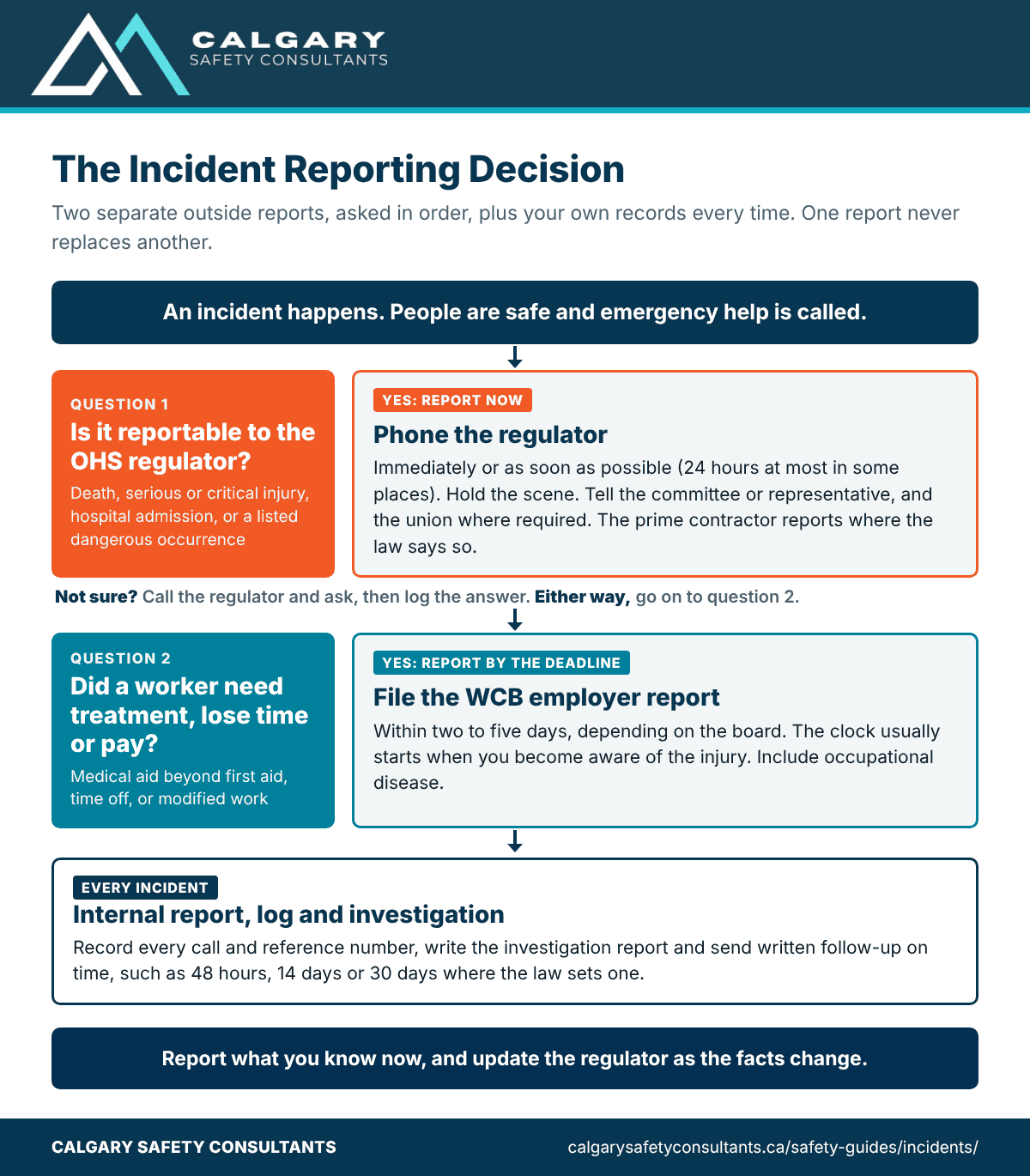
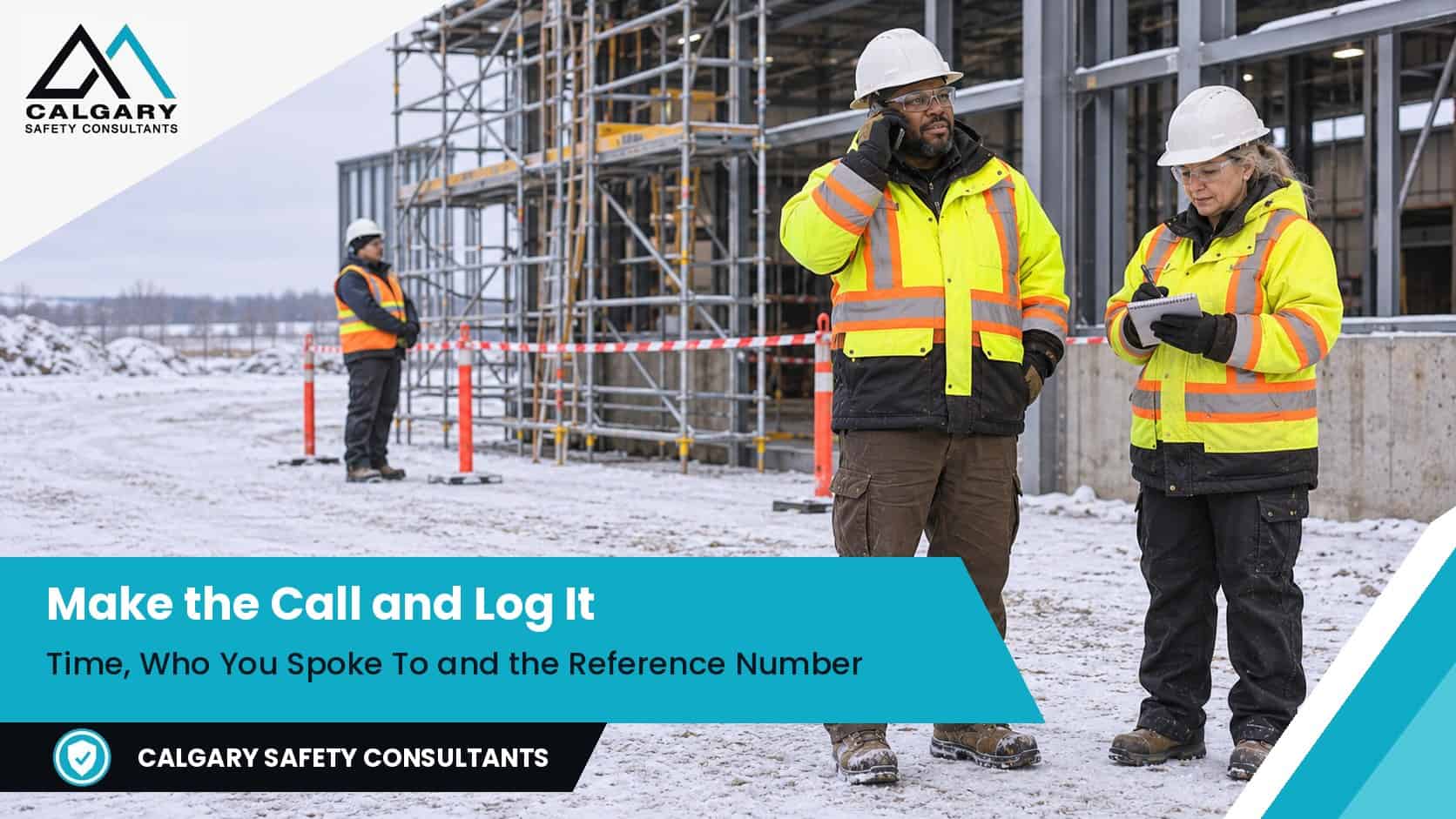
Two habits make the flow work: report what you know and update later, and log every call with the time, who you spoke to and any reference number. That log is your proof the duty was met.
Alberta, British Columbia and Saskatchewan
Alberta
Under section 33 of the Occupational Health and Safety Act, the prime contractor, or the employer if there isn't one, must report to Alberta OHS as soon as possible when a worker dies at work or from an illness connected to the work site, a worker is or will be admitted to hospital, an unplanned or uncontrolled explosion, fire or flood causes or could cause serious injury or illness, a crane, derrick or hoist collapses or upsets, or a component of a building or structure collapses or fails. The call goes to the OHS Contact Centre at 1-866-415-8690. Mine incidents listed in section 544 of the OHS Code are reported online, with a phone call as well for a death or serious injury.
The scene and related equipment and documents can't be disturbed except to help the injured or killed, prevent further incidents, protect endangered property, or with an OHS or police officer's permission. The prime contractor or employer then investigates with the committee or representative, prepares a written report on the circumstances and how to prevent a repeat, gives it to the committee or representative (or makes it available to workers), provides it to an OHS officer on request (or online where OHS requires it) and keeps it for at least two years.
For compensation, employers report to WCB-Alberta within 72 hours of becoming aware of an injury or illness that causes lost time or modified work beyond the day of the accident, needs treatment beyond first aid, or results in death or permanent disability.
British Columbia
Section 68 of the Workers Compensation Act requires the employer to notify WorkSafeBC immediately of an accident that seriously injures or kills a worker, a major structural failure or collapse, a major release of a hazardous substance, a fire or explosion with potential to cause serious injury, or anything else a regulation requires; WorkSafeBC's own list also names blasting incidents that cause injury. Call the Prevention Information Line, 604.276.3100 or 1.888.621.7233, which takes serious incident calls 24 hours a day. Section 68(2) says nobody may disturb the scene except as an officer or peace officer directs, or to attend to the injured or killed, prevent further injury or protect endangered property.
B.C. is also the clearest province on written follow-up. Section 69 requires an investigation of every reportable accident, every injury needing medical treatment and every incident with potential for serious injury. The preliminary report is due within 48 hours under section 71, given to the committee or representative or posted, and the full report within 30 days under section 72, sent to WorkSafeBC as well. Employers report injuries to WorkSafeBC within three days under section 150 of the Act.
Saskatchewan
Section 2-2 of The Occupational Health and Safety Regulations, 2020 requires the employer or contractor to notify the ministry as soon as is reasonably possible, on the 24-hour line at 1-800-567-7233 (option 1), of an accident that causes or may cause a worker's death, or will need the worker to be admitted as an in-patient for 72 hours or more. Section 2-3 adds dangerous occurrences, whether or not anyone is hurt. Both notices go to the committee co-chairpersons or the representative as well.
Watch the investigation threshold, because it's lower. Section 3-18 requires a written investigation report for accidents that cause or may cause death or need in-patient admission for 24 hours or more, covering causes and immediate and long-term corrective action; section 3-20 does the same for dangerous occurrences. The scene of a fatal accident is held under section 3-19 until an officer has finished. Injuries needing medical attention go to the Saskatchewan WCB on the E1 form within five days.
Manitoba and Ontario
Manitoba
The employer must notify the Workplace Safety and Health Branch of a serious incident immediately, by the fastest means available, at 1-855-957-7233 or 204-957-7233 in Winnipeg. Sections 2.6 to 2.9 of the Workplace Safety and Health Regulation deal with serious incidents. The list includes a death; injuries from electrical contact; unconsciousness from a concussion; fractures of the skull, spine, pelvis, arm, leg, hand or foot; amputation of an arm, leg, hand, foot, finger or toe; third degree burns; loss of sight; a cut needing hospital treatment; asphyxiation or poisoning; collapses or structural failures; explosions, fires, floods and uncontrolled hazardous spills; and the failure of an atmosphere-supplying respirator.
The scene stays undisturbed until the branch releases it, and the branch may require it to be held for at least 24 hours after notice. If any information you gave turns out to be wrong or incomplete, call back right away. The employer investigates with the committee co-chairs whether or not the incident was reportable. Injuries needing medical attention or time off go to WCB Manitoba within five business days, and the board fines late reports.
Ontario
Ontario has the most layered system, set out in sections 51 to 53.1 of the Occupational Health and Safety Act and in O. Reg. 420/21, which defines a critical injury and sets out what each report must contain. The Ministry of Labour summarizes it in four tiers.
- Death or critical injury (s. 51). The employer, and the constructor on a construction project, must immediately notify the ministry through the Health and Safety Contact Centre at 1-877-202-0008, plus the committee or representative and the union, then send a written report within 48 hours. It can apply to non-workers too. Critical injuries include those that place life in jeopardy, cause unconsciousness, substantial blood loss, certain fractures or amputations (including more than one finger or toe), burns to a major part of the body or loss of sight in an eye. The scene can't be disturbed except to save life or relieve suffering, keep essential utilities or transit running, prevent unnecessary damage, or with an inspector's permission.
- Disabling injury (s. 52). When an accident, explosion, fire or workplace violence leaves someone needing medical attention or unable to do their usual work, written notice goes to the committee or representative and union within four days.
- Occupational illness. Written notice to the ministry, committee or representative and union within four days of learning a worker has one or has claimed for one.
- Prescribed incidents with no injury. Construction, mining, diving and X-ray regulations list events, such as a fall of three metres or more on a construction project, that need written notice within two days.
Keep copies for at least three years. Separately, the WSIB needs the employer's report within three business days when a worker needs health care beyond first aid, misses work, loses pay or needs modified work for more than seven days, and the worker gets a copy.
Nova Scotia, New Brunswick and the Rest of Atlantic Canada
Nova Scotia
Section 63 of Nova Scotia's Occupational Health and Safety Act has three tiers. A death, or an injury likely to prove fatal, is reported to the Director immediately. Listed injuries, including unconsciousness, listed fractures, amputations, third degree burns, loss of sight, asphyxiation or poisoning, hospital admission and any life-endangering injury, are reported as soon as possible and no later than 24 hours, unless the injury can be treated with immediate first aid or medical treatment and the worker can return the next day. Accidental explosions, major structural failures, major hazardous releases and falls where fall protection is required are reported within the same 24 hours, injury or not. The employer must also notify the committee or representative.
Section 64 holds the scene of any accident covered by section 63(1), except to attend to the injured or killed, prevent further injuries or protect endangered property, unless an officer directs otherwise. The OHS line is 1-800-952-2687. The Workers' Compensation Board of Nova Scotia must receive the injury report within two business days of the injury being reported to you, the tightest board deadline in the country.
New Brunswick
Under section 43 of the Occupational Health and Safety Act, the employer must notify WorkSafeNB immediately when a worker suffers loss of consciousness, an amputation, a fracture other than to fingers or toes, a burn that needs medical attention, loss of vision, a deep laceration, in-patient hospital admission or death, and immediately notify the committee or representative. Accidental explosions, accidental exposures to biological, chemical or physical agents, and catastrophic events or equipment failures that caused or could have caused injury are reported too. The scene of an accident causing serious injury or death is held unless an officer orders otherwise. WorkSafeNB's OHS guide gives the reporting line as 1 800 999 9775 and says the Form 67 employer report is due within three days.
Prince Edward Island and Newfoundland and Labrador
In Prince Edward Island, the WCB's OHS guide says serious injuries, such as one that is or may be fatal, a fracture, unconsciousness or major burns, are reported to the Director of OHS within 24 hours on the 24-hour line, 902-628-7513, and the committee is told; the employer's report goes to the WCB within three days. In Newfoundland and Labrador, section 54 of the OHS Act requires the employer or principal contractor to notify the assistant deputy minister immediately of an accident that causes serious injury or death, or has a reasonable potential to, and section 55 holds the scene. WorkplaceNL expects the Form 7 employer report within three days.
Yukon, the Northwest Territories and Nunavut
Yukon
Yukon's board explains sections 57 and 58 of the Workers' Safety and Compensation Act this way: the prime contractor, or the employer if there isn't one, reports immediately on the 24-hour line, 867-667-5450 or 1-800-661-0443, when an incident seriously injures or kills a worker, puts a worker in hospital as an in-patient, involves a major structural failure or collapse, a major hazardous release, or an explosion or fire with potential to cause serious injury or death. The scene is held unless the board or the RCMP directs otherwise, the incident is investigated with the committee or representative, and the board's guidance is to keep the report for at least two years. The board's employer's report of injury is due within three days of learning of any work-related injury, and late reports can draw an administrative penalty.
Northwest Territories and Nunavut
Both territories work under the Workers' Safety and Compensation Commission and have near-identical Occupational Health and Safety Regulations. Under sections 8 and 9 of the Northwest Territories regulations and the matching sections of Nunavut's regulations, the employer notifies the Chief Safety Officer as soon as is reasonably possible of an accident causing serious bodily injury (one that causes or could reasonably be expected to cause death, or needs in-patient admission for 24 hours or more) and of any dangerous occurrence, and gives the committee or representative a copy with names removed. The commission's incident line is 1-800-661-0792. Section 28 requires an investigation and a written report with causes and corrective action, section 29 holds the scene of a fatal accident until a safety officer has investigated, and the employer's report of incident is due within three business days. Mines have their own, tighter rules under the Mine Health and Safety Act.
Quebec and Federally Regulated Workplaces
Quebec's rule is short and strict. Section 62 of the Act respecting occupational health and safety requires notice to the CNESST by the most rapid means, and a written report within 24 hours, of an incident causing a death, the loss of a limb or its use, significant physical trauma, serious injuries to two or more workers likely to keep them off for a working day, or material damage of $150,000 or more, an amount indexed every January under section 62.0.1. The scene stays unchanged until the inspector has investigated, except to prevent the consequences getting worse.
Federally regulated workplaces, such as banks, interprovincial trucking, airlines, railways and telecommunications, follow Part II of the Canada Labour Code and Part XV of the Canada Occupational Health and Safety Regulations. Under section 15.4, the employer must, without delay, appoint a qualified person to investigate, notify the committee or representative and act to prevent a recurrence. Section 15.5 requires a report to the Head of Compliance and Enforcement by telephone or fax within 24 hours of a death, a disabling injury to two or more employees, the loss of a body part or its use, the permanent loss of a body function, an explosion, or listed boiler, pressure vessel or elevating device failures.
Under section 15.8, a written investigation report on the prescribed form is prepared without delay for a disabling injury, a loss of consciousness from electric shock or a toxic or oxygen-deficient atmosphere, a rescue or revival, or a fire or explosion, and goes to the committee without delay and to the Head within 14 days. Section 15.10 adds an annual report by March 1, and section 127 of the Code holds the scene of a death or serious injury. Compensation claims for most federally regulated private employers go to the provincial or territorial board where the worker works.
Reporting Deadlines Across Canada at a Glance
This table goes a step past the quick summary in our incident response guide by adding the written follow-up each jurisdiction expects. If you work in more than one jurisdiction, build your procedure around the strictest timeline that applies, and use our guide to OHS legislation in Canada to find each jurisdiction's laws.
| Jurisdiction | OHS notice and written follow-up | WCB employer report |
|---|---|---|
| Alberta | As soon as possible by phone; investigation report to committee or representative, available to OHS, kept 2 years; PSIs online after investigation | 72 hours |
| British Columbia | Immediately by phone; preliminary report 48 hours, full report 30 days | 3 days |
| Saskatchewan | As soon as reasonably possible; copy to co-chairs or representative; written investigation report, no fixed deadline | 5 days |
| Manitoba | Immediately, fastest means; internal investigation with co-chairs | 5 business days |
| Ontario | Death or critical injury immediately, written report 48 hours; disabling injury and occupational illness 4 days; prescribed incidents 2 days | 3 business days |
| Nova Scotia | Death or likely fatal injury immediately; listed injuries and incidents within 24 hours | 2 business days |
| New Brunswick | Immediately, with immediate notice to committee or representative | 3 days |
| Yukon | Immediately; investigation report (board advises keeping 2 years) | 3 days |
| NWT and Nunavut | As soon as reasonably possible; copy to committee; written investigation report | 3 business days |
| Federal | Within 24 hours; written report to the Head within 14 days; annual report by March 1 | Provincial or territorial board |
Summary only, checked against the legislation and regulator pages in November 2026. Quebec, Prince Edward Island and Newfoundland and Labrador are covered above. Mines, diving and some industries have extra rules, so check your regulator's reporting page.
Getting the Compensation Board Report Right
The compensation report feels routine, so it's the one that slides. The clock usually starts when you become aware of the injury, not when the paperwork reaches the office, so a supervisor who sits on a report can make you late. The triggers are also broader than people think: treatment beyond first aid, lost time after the day of injury, modified work and lost pay all count in most provinces.
Boards say plainly that late reports carry consequences: the Saskatchewan WCB warns of fines or prosecution, WCB Manitoba of a fine or penalty, the WSIB of financial penalties and prosecution, and Yukon of an administrative penalty. Never pressure a worker not to report or claim; in B.C. that's spelled out in section 73 of the Act.
Telling the Committee, Representative and Union
Saskatchewan, the Northwest Territories and Nunavut want a copy of the regulator notice to go to the committee co-chairs or representative. New Brunswick, Nova Scotia, Prince Edward Island and Newfoundland and Labrador want the committee or representative told at the same time. Ontario adds the union for deaths, critical injuries, disabling injuries and occupational illnesses. Federal employers notify the committee or representative without delay and tell them who's investigating. Alberta, B.C. and Yukon build the committee into the investigation and give it copies of the reports.
Committee members usually take part in the investigation too. In Saskatchewan, an officer can only let items at a fatal accident scene be moved once the co-chairs or representative have inspected it and agreed. Our guides on setting up a joint health and safety committee and supporting a health and safety representative explain how to make sure they can respond quickly.
Multi-Employer Sites, Prime Contractors and Constructors
Shared sites cause the most missed reports, because everyone assumes someone else made the call. The law usually settles it. In Alberta and Yukon, the prime contractor reports. On Ontario construction projects, both the employer and the constructor have duties. Saskatchewan names the employer or contractor, and Newfoundland and Labrador names the employer or principal contractor. Elsewhere, the employer of the injured worker generally holds the duty.
The practical answer is the same everywhere: subcontractors tell the prime contractor or owner immediately, the prime contractor confirms who's calling the regulator, and both log it. The compensation report always stays with the injured worker's own employer. Write this into your contracts and your contractor safety program, and cover it at every site orientation.
Occupational Disease and Delayed-Onset Conditions
Hearing loss, dermatitis, asbestos-related disease and work-related mental health injuries often surface weeks or years later, sometimes after the worker has left. WCB-Alberta asks employers to report work-related diseases and mental health conditions as well as physical injuries, and B.C.'s Act requires an occupational disease to be reported within three days of the employer learning of it. Ontario requires notice within four days of learning of an occupational illness. Saskatchewan, the Northwest Territories and Nunavut make the treating physician or medical professional report listed conditions, and the federal 24-hour report covers occupational illnesses with one of the listed results. Treat a diagnosis like an injury: report it, record it and investigate the exposure.
Written Follow-Up and Investigation Reports
The phone call is the start, not the end. Most jurisdictions expect a written investigation report covering what happened, why, and what will stop it happening again, by the deadlines shown above. Our guides on how to investigate a workplace incident and how to conduct a root cause analysis explain how to find causes that hold up, and guides on collecting evidence and on following up after a workplace incident are coming soon.
What Happens When Reports Are Late or Missing
Failing to report is an offence under every OHS statute. Nova Scotia's Act allows fines up to $250,000 for a first offence and $500,000 for a repeat offence within five years or one involving a fatality, and New Brunswick's up to $250,000, six months in jail, or both. More often, a late report leads to an order, an administrative penalty or a board fine, and it damages your credibility in any later investigation.
Building a Reporting Decision Process
A good reporting process fits on one page and answers four questions for every jurisdiction you work in: what's reportable, who calls, which number, and what follows in writing. Start with the free quick reference below, add your own regulator numbers and account details, and decide who can report on nights and weekends so nobody waits for permission. Train supervisors on the triggers with real examples, because "will this worker be admitted to hospital?" is easier to answer than a list of section numbers.
Build in a default: when in doubt, call. Log every decision, including decisions not to report and why, then test the process with a tabletop exercise such as a forklift tipping with nobody hurt. If you'd like help writing or reviewing your procedure, our OH&S regulatory support and incident and emergency management training cover exactly this.
Workplace example
A Practical Workplace Example
Situation: Consider an illustrative mechanical contractor with crews in Alberta and Saskatchewan. On a cold late-November day, a pipefitter on a Saskatchewan plant shutdown slips on icy grating, falls about two metres and is kept in hospital for surgery on a fractured leg. That afternoon, at the company's Alberta shop, a forklift tips on a slope; the belted operator walks away unhurt.
Action: In Saskatchewan, the supervisor held the scene and called the safety manager. An in-patient stay of 72 hours or more was likely, so the employer notified the ministry that afternoon, sent a copy to the committee co-chairs, logged the call and filed the E1 with the WCB two days later. In Alberta, a forklift tip-over isn't on the phone-in list, but the shop manager treated it as a potentially serious incident, investigated and submitted it online afterwards.
Result: Both duties were met on time, and both incidents led to fixes: a winter walking-surface check in the pre-shift inspection and a slope rule for forklifts. At the next COR audit, the reporting log showed both decisions and the reasons for them.
Common Mistakes to Avoid
- Treating the WCB report as the OHS report. They're separate duties with separate triggers and deadlines.
- Using one national definition of serious injury. The lists differ, so check the one where the incident happened.
- Forgetting dangerous occurrences. A collapse, release or explosion can be reportable with nobody hurt.
- Assuming the prime contractor or owner made the call. Confirm it and log it.
- Leaving the committee and union out. Many jurisdictions require them to be told or given copies.
- Missing the written follow-up. Deadlines like 48 hours, 30 days or 14 days start with the incident.
Audit perspective
What an Auditor Expects to See
In a COR or SECOR audit, reporting is tested under incident reporting and investigation. Energy Safety Canada's 2023 COR audit protocol, for example, looks for a written requirement to report incidents immediately and an outline of the incidents that must be reported to the applicable governing authority, then asks whether employees understand the reporting requirements and whether incidents are actually reported as the policy requires.
Auditors usually compare your incident log with your regulator notices, compensation claims and investigation reports, and ask about any hospital admission with no matching regulator call. A reporting log with times, reference numbers and the reasons for each decision answers those questions in seconds.
Calgary Safety Consultants helps employers build and test their programs and prepare for COR and SECOR audits; we don't issue certificates. CORs and SECORs are issued through the applicable certifying partner.
The Bottom Line
Incident reporting requirements come down to two questions asked in order. Is this serious or dangerous enough that the regulator needs to know now? Did a worker need treatment, time off or modified work? Answer the first with a phone call, the second with the employer's report, and keep your own records either way.
Write the details down for each place you work and practise the decision before you need it. When you aren't sure, call.
Download the Quick Reference and Decision Worksheet
Two free, fillable PDF downloads go with this guide. Both have clickable checkboxes and fill-in fields, so you can complete them on screen or print them for your site office, vehicles and first aid stations.
- Incident Reporting Requirements Quick Reference for Canada (PDF, 8 pages). A jurisdiction-by-jurisdiction summary for every province, territory and federally regulated workplace: what's reportable to OHS, how fast, how to report, the scene rule, written follow-up and the WCB employer report deadline, with fillable fields for your own regulator numbers, WCB account numbers and the people authorized to report.
- Regulator and WCB Reporting Decision Worksheet and Log (PDF, 7 pages). A fillable decision checklist for each incident: is it reportable to OHS, to whom and by when, who made the call and the reference number, committee and union notice, the WCB report, written follow-up due dates and scene release, plus a running reporting log for audits.
Click either button to download the file. Fill in the quick reference before you need it, keep the worksheet with your incident reporting forms, and check both against the current rules in your province or territory, or under the Canada Labour Code.

About the author
John Duplessis, B.Sc., CRSP
John Duplessis is a Canadian Registered Safety Professional with more than 30 years of occupational health and safety experience in oil and gas, construction, green energy, midstream operations and industrial project work. He is an external auditor with Energy Safety Canada.