On this page
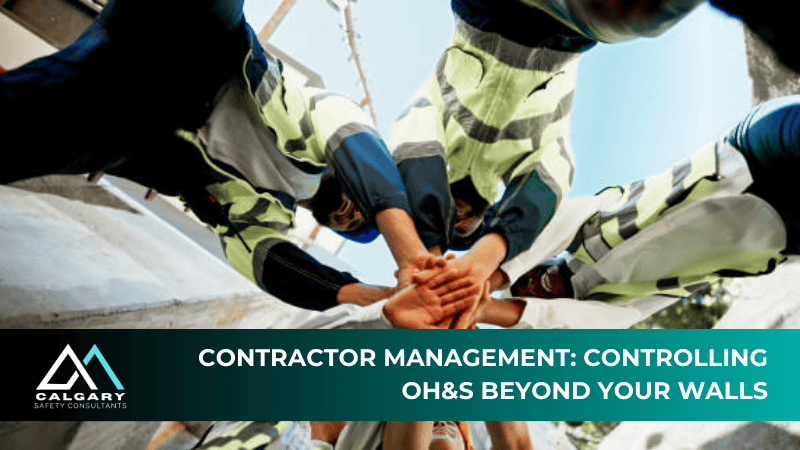
Think of it this way: contractors can either extend your safety culture—or undermine it completely. The difference comes down to how seriously you treat contractor management.
OH&S Management for Contractors
1. Get a Policy That Includes Contractors
A solid Occupational Health and Safety (OHS) policy is the foundation of contractor management. Without a clear policy, expectations get fuzzy, and that’s when accidents slip through the cracks. The Canadian Centre for Occupational Health and Safety (CCOHS) points out that a good policy should show leadership commitment, spell out responsibilities, and commit to legislation compliance. Their detailed guide is here: https://www.ccohs.ca/oshanswers/hsprograms/osh_policy.html
But don’t stop at employees. Your OHS policy should also include specific expectations for contractors:
- Pre-qualification requirements,
- Mandatory orientation processes,
- How incidents must be reported,
- What performance monitoring looks like.
By embedding contractors in your policy, you make it clear they are not just “guests” but an integral part of your workplace safety culture. Everyone who enters your site should know the rules of the game—and that the rules are enforced equally.
2. Pre-Qualify Before Hiring
Let’s face it: cost drives a lot of contracting decisions, but the cheapest bid isn’t always the safest. Pre-qualification means making sure a contractor takes safety as seriously as you do before they show up on site.
That includes asking for:
- Injury and incident rates,
- Proof of hazard assessments,
- Evidence of safety training programs,
- Documentation showing compliance with standards like ISO 45001. See more here: https://www.iso.org/standard/63787.html
Some organizations also use ISNetworld or similar platforms to standardize pre-qualification. The University of Calgary, for example, requires contractors to go through ISNetworld before awarding any work. You can read their contractor safety program here: https://www.ucalgary.ca/risk/sites/default/files/teams/13/contractor_safety_management_program.pdf
Pre-qualification weeds out risky contractors and sends a clear message: safety is non-negotiable.
3. Write Safety Right Into the Contract
A handshake deal doesn’t cut it anymore. Contracts must spell out safety expectations clearly, in writing. That way, there’s no grey area if something goes wrong.
Your contracts should include:
- Compliance with all relevant OHS laws,
- Mandatory participation in site-specific orientations,
- Timelines for reporting incidents or near misses,
- Requirements for regular safety updates,
- Penalties or termination clauses for failing to meet safety obligations.
The University of Calgary’s Contractor Safety Management Program highlights how important this step is, with contracts that specify orientation, posting safety plans, incident reporting, and evaluation: https://www.ucalgary.ca/risk/sites/default/files/teams/13/contractor_safety_management_program.pdf
By making safety contractual, you’re making it enforceable.
4. Orientations and Kick-Offs Matter
You wouldn’t hand over your car keys without explaining the brakes. Same goes for contractors on your site.
Every contractor—no matter how experienced—should go through an orientation that covers:
- Site-specific hazards (confined spaces, hazardous chemicals, moving equipment),
- Emergency response procedures,
- Communication protocols,
- Roles and responsibilities for both employees and contractors.
This isn’t busywork—it’s about ensuring everyone speaks the same “safety language.” Large institutions like the University of Calgary have written orientation requirements into their contractor management program: https://www.ucalgary.ca/risk/sites/default/files/teams/13/contractor_safety_management_program.pdf
If your contractors aren’t properly oriented, you’re increasing the odds of confusion, mistakes, and incidents.
5. Monitor, Monitor, Monitor
Contractor management doesn’t stop once the contract is signed. Safety isn’t “set it and forget it.”
That means ongoing monitoring:
- Conduct regular inspections and audits,
- Require monthly safety reports,
- Track leading indicators (like training hours, safety meetings held) and lagging indicators (like lost-time injuries),
- Document and follow up on hazards and near misses.
Continuous monitoring ensures that problems are caught before they escalate. Wolters Kluwer offers excellent guidance on best practices in contractor monitoring here: https://www.wolterskluwer.com/en/expert-insights/contractor-safety-management-best-practices
Think of monitoring as your insurance policy—it keeps small cracks from turning into disasters.
6. Do a Post-Job Review
Too many companies forget this step. Once the job’s done, they pay the invoice and move on. But without a post-job review, you’re missing valuable lessons.
Reviews should ask:
- Did the contractor meet safety expectations?
- Were there incidents or near misses?
- Did their safety culture align with yours?
- Would you hire them again?
Documenting contractor performance builds a knowledge base. Over time, you’ll develop a network of trusted contractors and avoid repeat mistakes.
The Campbell Institute provides a detailed whitepaper on contractor evaluation and lessons learned, which is worth reviewing: https://www.thecampbellinstitute.org/wp-content/uploads/2017/06/Campbell-Institute-Best-Practices-in-Contractor-Management-WP.pdf
7. Think Prevention Through Design
Contractor management isn’t just about reacting—it’s about designing hazards out before they show up. Prevention Through Design (PtD) is an approach that integrates safety into the design phase of projects.
Examples include:
- Designing out pinch points on equipment,
- Using safer materials in construction,
- Creating layouts that minimize exposure to hazards.
By embedding safety in design, you reduce risks for both employees and contractors. Learn more about PtD here: https://www.cdc.gov/niosh/research-programs/portfolio/ptd.html
This is forward-thinking safety management, and Canadian businesses that adopt it stay ahead of accidents and liability.
8. Use a Formal Safety Management System
All of these practices are easier when tied into a formal Safety Management System (SMS). An SMS (sometimes called an OHSMS) provides a structured approach:
- Policy,
- Planning,
- Implementation,
- Monitoring,
- Continuous improvement.
More here: https://www.ccohs.ca/oshanswers/hsprograms/occupational-health-and-safety-management-systems.html
For global credibility, you can align with ISO 45001, the international standard for OHS management systems: https://www.iso.org/standard/63787.html
Having a formal system isn’t just about compliance—it shows contractors, clients, and regulators that your safety management is mature and reliable.
How we help
How Calgary Safety Consultants Can Help
If you’re running a business in Alberta, you don’t have to figure this out alone. Calgary Safety Consultants specializes in contractor safety and risk management. We help Canadian businesses set up, maintain, and improve contractor OHS programs that actually work in the real world.
Here’s what we bring to the table:
- Policy Development: Build or update your OHS policy to cover contractors.
- Pre-Qualification Systems: Practical tools to vet contractors before they’re hired.
- Customized Training: Contractor orientations, supervisor training, leadership workshops.
- Site Monitoring & Audits: On-site inspections to verify compliance.
- Audit Readiness: Support for COR certification or regulatory inspections.
- Continuous Improvement: Post-job evaluations and feedback systems that get better with every project.
For more on managing contractor risk, read Vendor & Contractor OH&S: Managing Third-Party Risks.
With our help, you can move from reactive contractor management to a proactive, sustainable program that protects your people and your reputation.
Wrap-Up
Contractors can either be a safety asset or a liability—it all depends on how you manage them. In Canada, your responsibilities don’t stop at your payroll. By creating a contractor-inclusive OHS policy, doing thorough pre-qualification, locking in safety requirements, providing orientations, monitoring actively, and completing post-job reviews, you create a culture where safety extends beyond your walls.
And if you want support, Calgary Safety Consultants is here to make contractor safety straightforward, compliant, and effective. Because managing risk beyond your walls isn’t optional—it’s essential.
Connect with us here and let us help you improve your OH&S practices.
Jurisdiction note: This article provides general occupational health and safety information. The legal requirements that apply depend on the workplace location, industry and federal, provincial or territorial jurisdiction. Verify current requirements with the applicable regulator before using the information operationally. Government of Canada overview of occupational health and safety jurisdiction.
References
- Canada Labour Code, Part 2: https://laws-lois.justice.gc.ca/eng/acts/L-2/
- CCOHS on OHS Policies: https://www.ccohs.ca/oshanswers/hsprograms/osh_policy.html
- University of Calgary Contractor Safety Program: https://www.ucalgary.ca/risk/sites/default/files/teams/13/contractor_safety_management_program.pdf
- Wolters Kluwer – Contractor Safety Best Practices: https://www.wolterskluwer.com/en/expert-insights/contractor-safety-management-best-practices
- Campbell Institute – Best Practices in Contractor Management: https://www.thecampbellinstitute.org/wp-content/uploads/2017/06/Campbell-Institute-Best-Practices-in-Contractor-Management-WP.pdf
- ISO 45001 Overview: https://www.iso.org/standard/63787.html
- Prevention Through Design: https://www.cdc.gov/niosh/research-programs/portfolio/ptd.html
- Safety Management Systems: https://www.ccohs.ca/oshanswers/hsprograms/occupational-health-and-safety-management-systems.html
- Calgary Safety Consultants (main): https://calgarysafetyconsultants.ca/
- Calgary Safety Consultants – Vendor & Contractor OHS: https://calgarysafetyconsultants.ca/vendor-contractor-ohs-managing-third-party-risks/
Because a safer workplace starts with smarter policy. Let’s build it together.

About the author
John Duplessis, B.Sc., CRSP
John Duplessis is a Canadian Registered Safety Professional with more than 30 years of occupational health and safety experience in oil and gas, construction, green energy, midstream operations, and industrial project work.