
Incident Reporting and Investigation Training
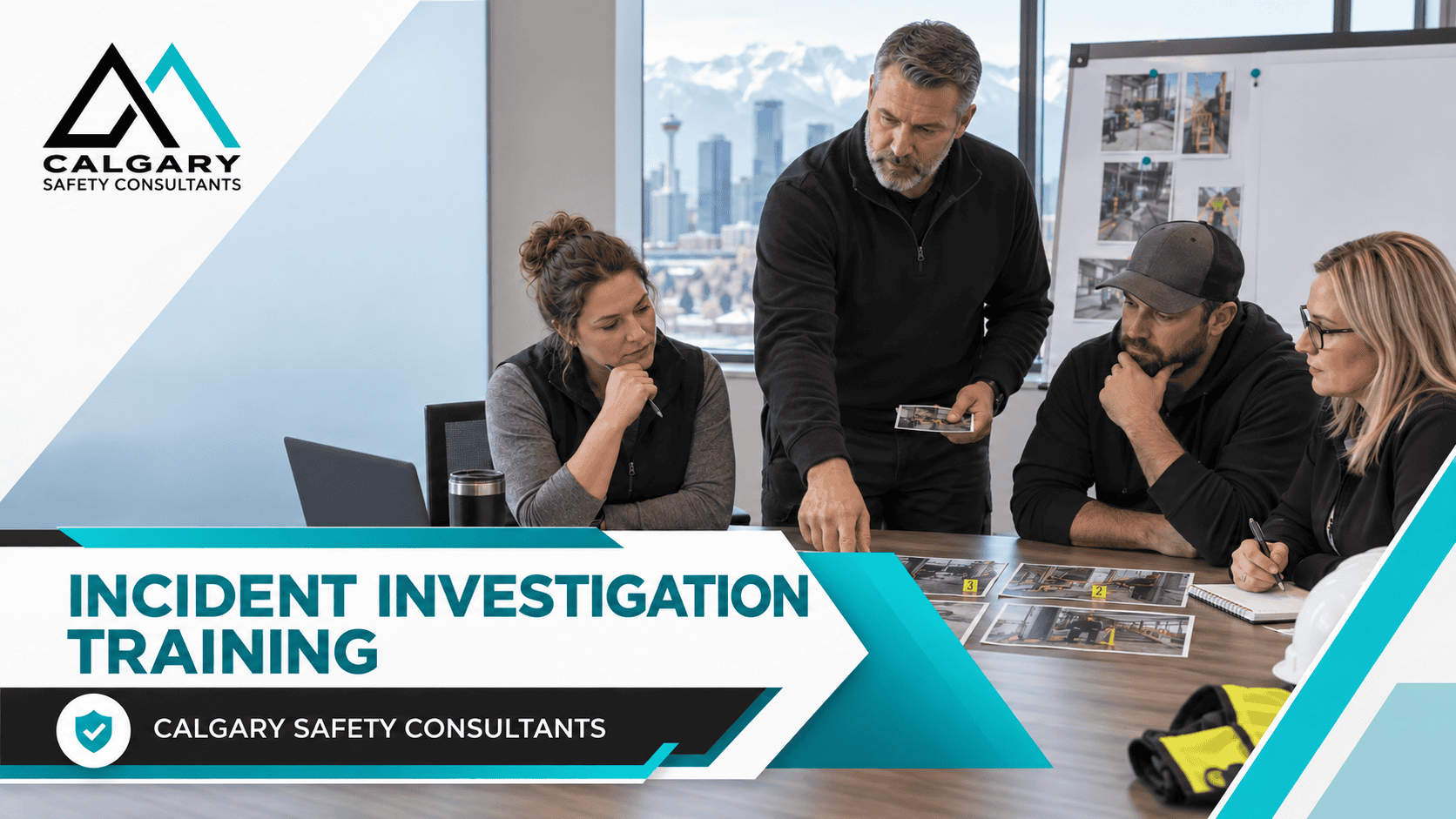
Incident Reporting and Investigation Training gives workers, supervisors, managers, committee members, and safety representatives a practical process for reporting events, preserving evidence, finding causes, and preventing recurrence.
Calgary Safety Consultants provides this training across Canada through self-paced online learning, live virtual instruction, and classroom delivery for workplace groups.
Participants learn how prompt reporting, scene control, interviews, causal analysis, corrective action, and follow-up work together to build safer and more defensible systems.
Training supports an employer’s incident-management program but does not replace workplace-specific procedures, competent investigation resources, or legal advice. Reporting and notification duties vary by jurisdiction and event.
Choose Your Incident Reporting and Investigation Training Option
Organizations need a reporting and investigation process that fits their people, risks, and operations. Workers need clear reporting expectations. Supervisors, managers, committee members, and investigation teams also need practical tools for initial response, evidence collection, causal analysis, documentation, and corrective-action follow-up.
Calgary Safety Consultants offers self-paced online, live virtual, and classroom training.
Online Incident Reporting and Investigation Training
Self-paced online training provides consistent instruction for individuals, new hires, supervisors, safety representatives, and multi-location teams. Participants can progress through the course on their own schedule and revisit the student guide when planning or reviewing an investigation.
Online learning includes:
- Four modules and sixteen focused lessons.
- Practical Canadian workplace examples and activities.
- Incident reporting, evidence preservation, interviews, root-cause analysis, and corrective-action planning.
- A knowledge check after every lesson and a final assessment.
- A downloadable student reference guide.
- A Certificate of Completion.
Start Online Incident Investigation Training
Virtual Incident Reporting and Investigation Training
Live virtual training combines remote access with instructor interaction. It works well for distributed teams, supervisors in several locations, safety committees, and organizations that want participants to discuss realistic reporting and investigation decisions.
Virtual sessions can be adapted to the organization’s incident classifications, reporting channels, investigation forms, escalation process, and provincial requirements. Activities can include interview planning, evidence review, causal analysis, and corrective-action development.
Request Virtual Incident Investigation Training
Classroom Incident Reporting and Investigation Training
Instructor-led classroom training is designed for teams that benefit from face-to-face discussion, case exercises, and workplace-specific examples. Content can be delivered to investigation teams, supervisors, managers, joint committee members, worker representatives, or mixed groups.
Classroom sessions can incorporate the employer’s forms and procedures and can be tailored to industry hazards, organizational roles, and investigation experience. Participants practise moving from the initial report to evidence-supported findings and practical corrective actions.
Why Incident Reporting and Investigation Training Matters
Incidents, near misses, hazardous occurrences, property damage, and occupational illnesses are opportunities to identify weak controls before the same pathway causes greater harm. When reporting is delayed or an investigation stops at the most obvious act or condition, important evidence and prevention opportunities can be lost.
Effective training creates a consistent process. Participants learn to care for people first, control continuing hazards, preserve facts, interview without blame, examine immediate and underlying causes, and recommend actions that address the system rather than symptoms alone.
Strong follow-up supports due diligence and continuous improvement. Corrective actions need accountable owners, realistic completion dates, and evidence that the control works in practice. Investigation findings should also inform procedures, training, maintenance, inspections, and management review.
For broader guidance, see the CCOHS resource on incident investigation, or explore our workplace safety training and certification services.
What Does Incident Reporting and Investigation Training Cover?
Incident Reporting and Investigation Training follows the complete process from the first report through verified corrective action and organizational learning. The goal is not simply to complete a form. A well-managed investigation protects people, preserves reliable information, explains what happened, identifies the conditions that allowed it to happen, and produces actions that reduce the chance of recurrence.
Incident Reporting and Investigation Training gives participants a repeatable process that can be scaled to near misses, injuries, occupational illnesses, property damage, equipment failures, environmental releases, and other hazardous occurrences. The course also explains why credible potential severity matters: an event with little actual harm may still deserve a detailed investigation when the possible outcome was serious.
Topics can include:
- Incidents, injuries, occupational illnesses, near misses, property damage, and hazardous occurrences.
- Prompt internal reporting and jurisdiction-specific external notification.
- Immediate response, scene control, and preservation of evidence.
- Investigation purpose, scope, team roles, competence, and impartiality.
- Photographs, documents, physical evidence, interviews, and data integrity.
- Event sequencing and the loss-causation chain.
- Immediate causes, contributing factors, root causes, and lack of control.
- Five Whys, barrier analysis, cause mapping, and other analytical tools.
- Corrective and preventive actions using the hierarchy of controls.
- Action ownership, deadlines, implementation, and effectiveness checks.
- Investigation reports, lessons learned, and need-to-know communication.
- Trend analysis, leading and lagging indicators, and recurring causal factors.
- Integration with hazard assessments, procedures, training, maintenance, audits, and management review.
- Leadership, fair accountability, and a proactive reporting culture.
Who Should Take Incident Reporting and Investigation Training?
Incident Reporting and Investigation Training is useful for anyone who receives incident information, takes part in the initial response, collects evidence, participates in interviews, approves corrective actions, or reviews organizational trends. The depth of training should reflect the person’s role and the complexity of the events they may be asked to investigate.
- Supervisors and managers who receive reports or lead the initial response.
- Health and safety coordinators, advisors, and professionals.
- Joint health and safety committee members and worker representatives.
- Incident investigation team members and technical specialists.
- Operations, maintenance, human resources, quality, and environmental personnel who may provide evidence or subject-matter expertise.
- Organizations improving reporting consistency, recurring-event prevention, or COR and audit readiness.
- Workers who need a stronger understanding of reporting, near misses, evidence, and follow-up.
Incident Reporting and Investigation Training does not assume that every participant will lead a complex investigation. Workers can focus on prompt reporting and cooperation. Supervisors can focus on the initial response, notifications, and evidence protection. Investigation team members can go deeper into interviewing, analysis, documentation, and corrective-action verification.
Seven Steps Taught in Incident Reporting and Investigation Training
A consistent sequence helps investigators avoid missed evidence, premature conclusions, and corrective actions that address only the most visible symptom. Incident Reporting and Investigation Training organizes the work into seven practical steps.
1. Report the Event Promptly
Early reporting starts the process while conditions, memories, documents, and physical evidence are still available. Workers need to know what must be reported, who receives the report, what information is immediately required, and when emergency or external notification procedures apply. Reporting expectations should include near misses and hazardous occurrences, not only events that result in injury.
A good initial report separates known facts from assumptions. It identifies the people involved, the location, the time, the task underway, the actual outcome, the potential outcome, and any immediate controls already taken. Investigators can add detail later; the first priority is a timely and accurate notification.
2. Care for People and Control Continuing Hazards
Medical attention, emergency response, and protection from further harm come before evidence collection. Supervisors should stop or restrict work when uncontrolled hazards remain, isolate energy or equipment when appropriate, and prevent other people from entering an unsafe area. These actions should be documented because emergency changes can alter the original scene.
Incident Reporting and Investigation Training helps participants distinguish necessary scene changes from avoidable disturbance. Nothing in an investigation should delay first aid, rescue, spill control, fire response, or another urgent protective action.
3. Establish the Investigation Scope and Team
The organization should determine the investigation level using actual and credible potential severity, legal requirements, organizational procedures, and the complexity of the event. A minor event may be reviewed by a supervisor, while a serious or technically complex event may require a multidisciplinary team, worker participation, specialized expertise, or legal guidance.
Team members need clear roles. One person may coordinate the process, another may manage photographs and documents, and a technical specialist may examine equipment or work methods. Conflicts of interest should be identified. The purpose is to establish facts and prevention opportunities through a fair process, not to create a conclusion before the evidence is reviewed.
4. Preserve and Collect Evidence
Evidence collection in Incident Reporting and Investigation Training can include the physical scene, equipment condition, tools, materials, photographs, measurements, permits, hazard assessments, procedures, training records, maintenance history, inspection findings, schedules, communications, and electronic data. Each item should be connected to the event and handled in a way that preserves its meaning and integrity.
Photographs should show both overall context and relevant detail. Notes should identify who collected the information, when it was collected, and where it came from. Documents should be the versions in effect at the time of the event. If equipment must be moved, repaired, or returned to service, the original condition and authorization should be recorded first whenever circumstances permit.
5. Conduct Fair and Effective Interviews
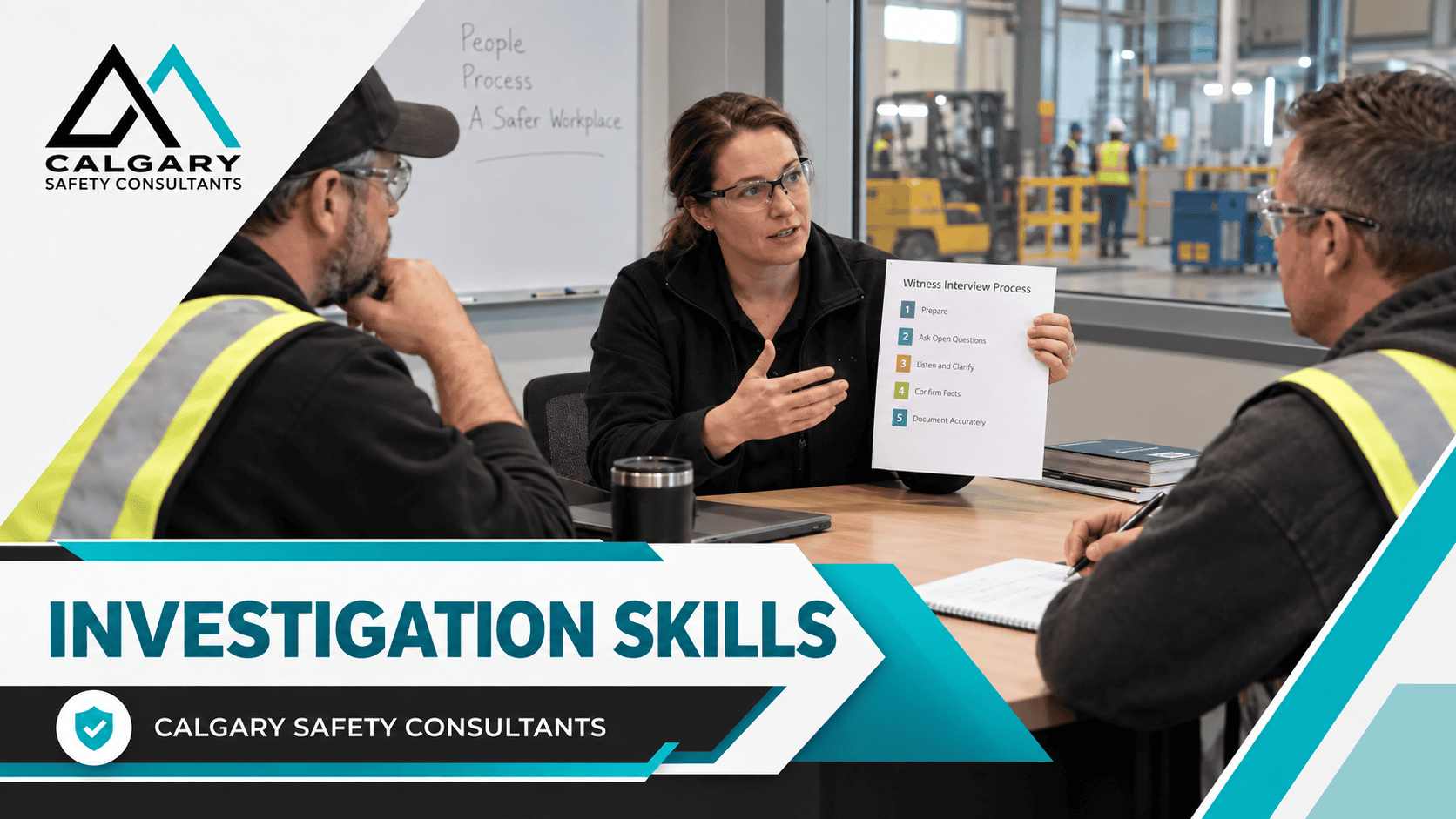
Interviews are most useful when they are timely, respectful, and focused on learning. The interviewer should explain the purpose, use open questions, listen without interruption, clarify the sequence, and distinguish what the person directly observed from what they later heard. Witnesses should be interviewed separately when practical so that one account does not unintentionally shape another.
Incident Reporting and Investigation Training emphasizes neutral language. Questions such as “What happened next?” and “What made that action seem reasonable at the time?” produce better information than blame-oriented questions. Interview notes should be reviewed for accuracy, confidentiality should be protected as required, and differences between accounts should be examined against other evidence.
6. Analyze the Event and Identify Causes
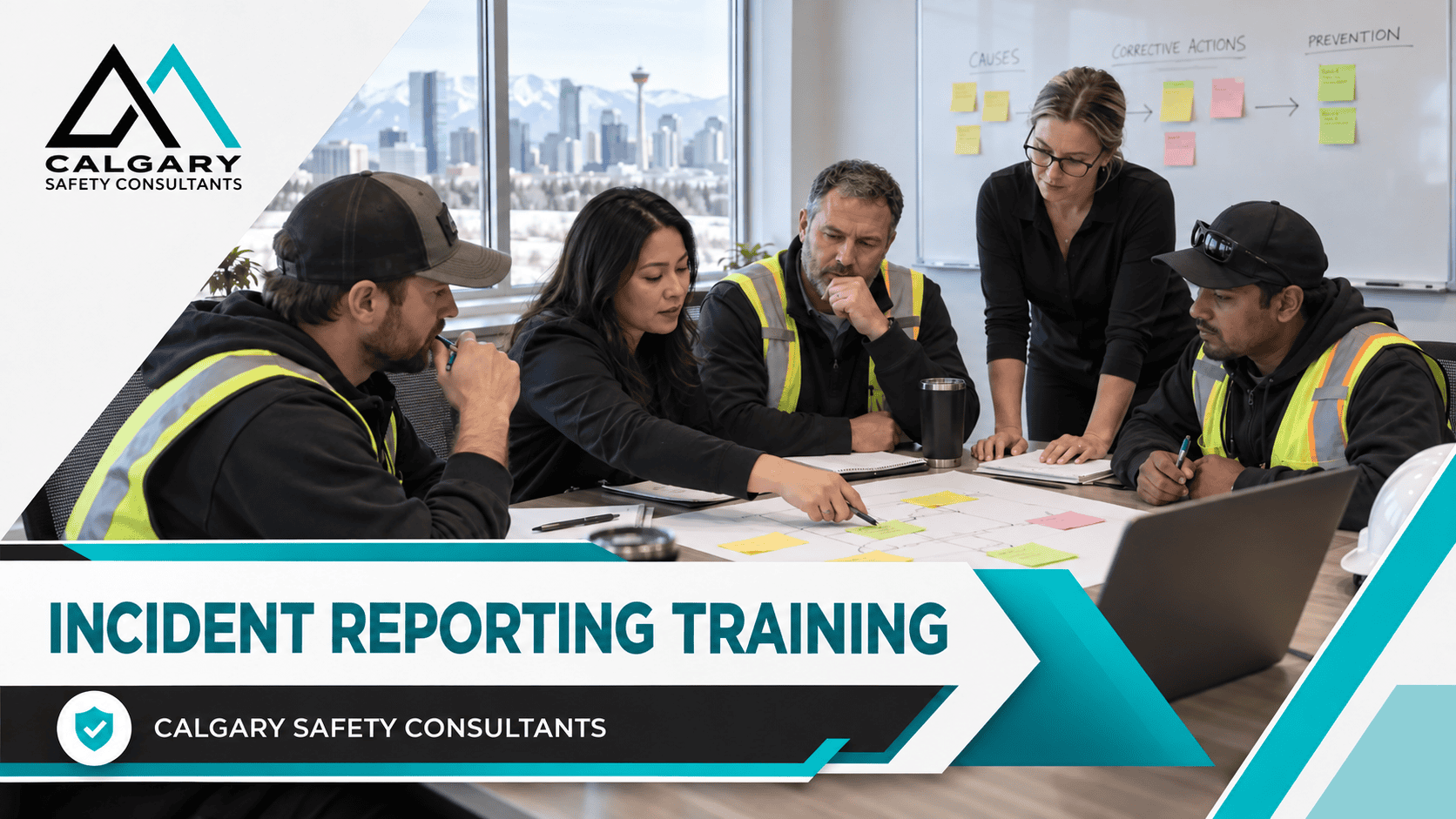
During Incident Reporting and Investigation Training, investigators learn to organize facts in an event timeline, identify changes from normal work, and compare the actual task with the planned task. The analysis should consider immediate conditions and actions as well as underlying influences such as design, planning, staffing, supervision, workload, communication, training, maintenance, purchasing, change management, and the effectiveness of existing controls.
Tools such as Five Whys, barrier analysis, cause mapping, and the loss-causation model can support the analysis, but the tool does not replace judgment. A useful causal statement is supported by evidence, explains how it contributed to the event, and points toward a preventable system weakness. “Worker error” by itself rarely explains why the error was possible, likely, or not detected.
7. Implement and Verify Corrective Actions
Corrective actions should address verified causal factors and follow the hierarchy of controls. Eliminating the hazard or redesigning the work is generally more reliable than relying only on reminders, retraining, or additional rules. Administrative controls and personal protective equipment may still be necessary, but their limitations should be understood.
Every action needs an accountable owner, a realistic completion date, required resources, and a way to confirm effectiveness. Closure means more than marking an item complete. The organization should verify that the change was implemented, that workers understand it, that it controls the intended risk, and that it did not introduce another hazard. Unresolved actions should be escalated through the organization’s management process.
Building a Strong Reporting and Investigation System
Incident Reporting and Investigation Training works best when it is supported by clear procedures, accessible reporting methods, leadership follow-through, and a fair culture. Training gives people a shared process, while the management system supplies the roles, resources, records, and accountability needed to use that process consistently.
Make Reporting Easy and Predictable
Incident Reporting and Investigation Training reinforces that workers should know how to report during normal operations, after hours, at remote locations, and when a supervisor is unavailable. Forms should capture essential information without becoming a barrier. Organizations may use paper forms, digital tools, telephone reporting, or a combination, but every method should lead to timely review and escalation.
Reporting performance improves when workers receive feedback. Even when a full investigation takes time, the organization can acknowledge the report, explain interim controls, and identify the next step. Silence discourages future reporting and makes the process appear inactive.
Use Consistent Investigation Criteria
A written decision guide can help determine who investigates, the required timeline, the level of documentation, worker or committee participation, and the approval authority. Criteria may include actual severity, credible potential severity, recurrence, regulatory notification, public impact, equipment damage, and uncertainty about the cause.
Incident Reporting and Investigation Training helps decision makers apply these criteria consistently. Similar events should receive similar attention, while high-potential events should not be dismissed simply because the actual outcome was minor.
Connect Findings to the Safety Management System
Investigation findings should inform more than a single action list. They may require changes to hazard assessments, safe work procedures, orientation, competency checks, inspection schedules, preventive maintenance, emergency plans, contractor management, procurement, design standards, or management review. Recurring causes across several events may reveal a program-level weakness that is not obvious when each event is reviewed separately.
Trend reviews can compare event types, locations, tasks, equipment, time periods, causal factors, action status, and credible potential. Organizations should use both lagging information, such as injuries and damage, and leading information, such as near-miss reports, overdue actions, verification results, and repeat deficiencies.
Support Fair Accountability
A learning-focused process does not mean that accountability disappears. It means the organization distinguishes human error, at-risk choices, reckless conduct, unclear expectations, inadequate systems, and management decisions using a fair and evidence-based approach. When workers believe every report will automatically lead to blame, important information may remain hidden.
Leaders strengthen trust by applying expectations consistently, protecting people from retaliation, correcting system weaknesses, and explaining how lessons learned will be used. Incident Reporting and Investigation Training gives supervisors and team members language and tools for discussing behaviour without ending the analysis at the individual level.
Measure Corrective-Action Effectiveness
Effectiveness measures should match the risk and the action. A physical safeguard might be verified through inspection and functional testing. A new procedure might require observation, worker feedback, and a review of related reports. A maintenance change might be checked through completion data and equipment performance. Verification should occur after enough time has passed to evaluate the control under normal conditions.
When an action does not work as expected, the investigation should be revisited. New evidence, implementation barriers, or changed operating conditions may require a different control. Continuous improvement depends on treating verification as part of the investigation rather than an optional final step.
Incident Investigation Documentation Checklist
Incident Reporting and Investigation Training emphasizes that a clear record helps the organization demonstrate what was reviewed, how conclusions were reached, and whether actions were completed. Documentation requirements vary, but an investigation file may include:
- The initial report and notification record.
- Emergency response and interim-control information.
- Investigation scope, team members, roles, and dates.
- Photographs, sketches, measurements, and physical-evidence records.
- Relevant procedures, permits, hazard assessments, training, inspection, and maintenance records.
- Interview plans, notes, and confirmed statements where appropriate.
- An event sequence and evidence-supported causal analysis.
- Corrective actions linked to specific findings and the hierarchy of controls.
- Assigned owners, due dates, approvals, and implementation evidence.
- Effectiveness checks, communication records, lessons learned, and final sign-off.
Incident Reporting and Investigation Training supports an employer’s incident-management program, but it does not replace workplace-specific procedures, competent investigation resources, collective-agreement requirements, regulator directions, or legal advice. Reporting and notification duties vary by jurisdiction and event, so organizations should confirm the requirements that apply to their operations.
Frequently Asked Questions About Incident Reporting and Investigation Training
What is Incident Reporting and Investigation Training?
Incident Reporting and Investigation Training teaches participants how to report workplace events, control the initial situation, preserve evidence, establish what happened, identify immediate and underlying causes, develop corrective actions, and verify that controls are working.
What will participants learn in this training?
Participants learn how prompt reporting, scene management, evidence collection, interviewing, event sequencing, root-cause analysis, corrective-action planning, communication, and follow-up work together to prevent recurrence.
Who should take incident investigation training?
The training is suitable for supervisors, managers, safety personnel, joint health and safety committee members or representatives, investigation-team members, technical specialists, and workers who report or help examine workplace incidents and near misses.
Is incident reporting and investigation required by law?
Canadian jurisdictions require specified injuries and categories of incidents to be reported and may require an investigation. Triggers, time limits, participation requirements, and records vary by jurisdiction and industry. Employers must verify the law and regulator requirements that apply to their workplace.
Does the training cover root-cause analysis?
Yes. Participants learn to look beyond the final unsafe act or condition and examine job factors, equipment, procedures, training, supervision, planning, communication, failed barriers, and management-system weaknesses.
Can the training use our forms and procedures?
Virtual and classroom sessions can be adapted to approved company forms, incident classifications, reporting contacts, escalation rules, investigation procedures, and realistic workplace examples.
Is the training available online, virtually, and in a classroom?
Yes. Training is available as self-paced online learning, live virtual instructor-led training, and in-person classroom training. Group sessions can be tailored to the organization’s roles, hazards, and procedures.
How long does the online course take?
Most learners should plan approximately 6.5 to 8.5 hours for the self-paced course, including lesson videos, reading, activities, knowledge checks, and the final assessment. Group-session timing depends on scope and customization.
Do online participants receive a certificate?
Yes. Participants who successfully complete the online course requirements receive a Certificate of Completion. Employers can retain it with their training records. A certificate does not, by itself, confirm every employer-specific or legal obligation has been met.