On this page
- What a Work Refusal Is
- Why Handling It Well Matters
- The Legal Test: When Can a Worker Refuse?
- Who's Involved in a Work Refusal
- How to Handle a Work Refusal, Step by Step
- Running the Investigation With the Worker and a Worker Representative
- Reassigning the Worker and Assigning Someone Else
- When the Regulator Gets Involved
- Pay During a Work Refusal
- Protection From Reprisal and How Complaints Work
- Exceptions and Limits on the Right to Refuse
- Work Refusal Rules by Jurisdiction
- Records to Keep
- A Practical Workplace Example
- Common Work Refusal Mistakes to Avoid
- What an Auditor Expects to See
- The Bottom Line
- Download the Investigation Record and Quick Guide
- Frequently Asked Questions
- Related Guides and Articles
- How Calgary Safety Consultants Can Help
- Sources
What a Work Refusal Is
A work refusal is a worker's legal right in action. When a worker has reasonable grounds to believe a job, a machine, a place or a condition is dangerous, the law lets them stop and say so, without being punished for it. Alberta's Guide to OHS: Workers lists it as one of three fundamental rights, alongside the right to know about hazards and the right to take part in health and safety.
For supervisors and employers, a work refusal is a process with legal steps. Those steps differ a little between provinces, territories and federally regulated workplaces, but they follow the same pattern: the worker reports, the employer investigates and fixes what's wrong, a worker representative gets involved, and a government officer decides if the two sides still disagree.
This guide is written for the people on the other side of the refusal: owners, managers, supervisors and safety coordinators. It covers the legal test in each jurisdiction, the process step by step, and the parts employers most often get wrong, such as reassigning the work, pay and reprisal. For a shorter read on the employer's side, see our article on the right to refuse unsafe work in Canada.
Why Handling It Well Matters
A worker who refuses a task is telling you something your hazard assessments, inspections and procedures may have missed. Sometimes the worker is right and a serious injury has just been prevented. Either way, how the supervisor reacts in the first few minutes decides whether the refusal ends as a safety win or a legal problem.
Handling it badly is expensive. Telling a worker to get back to it or go home, docking their pay, quietly giving the job to someone else or treating the worker differently afterwards can breach the law, lead to a reprisal complaint and an order to pay lost wages, and teach every other worker that raising a concern isn't worth the trouble. Handling it well builds trust, and workers who see a refusal investigated fairly are more likely to report the next problem early.
The Legal Test: When Can a Worker Refuse?
Every jurisdiction sets a test the worker's belief must meet, and the wording matters. In all of them, the worker doesn't have to be right. They need reasonable grounds, or reasonable cause, to believe the danger exists.
- Federal. Under section 128 of the Canada Labour Code, an employee may refuse to use or operate a machine or thing, work in a place or perform an activity if they have reasonable cause to believe it's a danger. The Labour Program's page on the right to refuse dangerous work describes danger as a hazard, condition or activity that could reasonably be expected to be an imminent or serious threat to life or health.
- Alberta. Section 17 of the OHS Act uses "undue hazard," which includes a hazard that poses a serious and immediate threat to health and safety.
- British Columbia. Section 3.12 of the OHS Regulation also uses "undue hazard": work the worker has reasonable cause to believe would create an undue hazard to the health and safety of any person.
- Saskatchewan. Section 3-31 of The Saskatchewan Employment Act, as WorkSafe Saskatchewan explains in what workers should do, covers work that's "unusually dangerous" to the worker or anyone else at the place of employment.
- Manitoba. Work the worker believes on reasonable grounds is a danger to their own or another person's safety or health. Manitoba's right to refuse FAQ adds that the hazard is generally unusual to normal working conditions, likely to cause serious injury or illness, and not already controlled.
- Ontario. Ontario's guide to the right to refuse explains that under section 43 a worker may refuse if equipment, a machine, a device or a workplace condition is "likely to endanger" them or another worker. Workplace violence can also be grounds.
- Quebec. Section 12 of the Act respecting occupational health and safety covers work that would expose the worker to danger to their health, safety, or physical or mental well-being, or expose another person to a similar danger.
- New Brunswick and Nova Scotia. New Brunswick's OHS Act (s. 19) and Nova Scotia's OHS Act (s. 43) both use "likely to endanger" the employee's or another person's health or safety.
- Prince Edward Island. Section 28 of the OHS Act lets a worker refuse an act they have reasonable grounds for believing is likely to endanger their health or safety or that of another worker.
- Newfoundland and Labrador. Section 45 of the OHS Act covers work that's dangerous to the health or safety of the worker, another worker or another person at the workplace.
- Northwest Territories and Nunavut. Section 13 of each Safety Act uses "unusual danger," which the WSCC's work refusal steps describe as a dangerous situation or task that isn't normal in a worker's regular day-to-day work.
- Yukon. The Workers' Safety and Compensation Act sets out the right to refuse unsafe work in sections 47 to 52 and reprisal protection in sections 53 to 56.
Two practical points follow. First, the threshold is higher than "I'd rather not." These tests are aimed at real danger, often serious, immediate or unusual danger, not discomfort or disagreement over how the work is organized. Second, a supervisor shouldn't argue the test on the spot. If a worker says they believe the work is dangerous, treat it as a refusal and follow the process. The investigation, and if needed an officer, decides whether the danger is real.
Who's Involved in a Work Refusal
- The refusing worker. Reports the refusal and the reason right away, stays available in a safe place and takes part in the investigation.
- The supervisor or employer. Receives the report, makes the area safe, investigates, fixes the hazard or explains why the work is safe, and keeps the records.
- A worker representative. Depending on the jurisdiction, a worker member of the joint health and safety committee, the health and safety representative, a worker chosen by the union or another worker. See our guides on how to appoint and support a health and safety representative and how to set up a JHSC.
- The committee. In some jurisdictions, such as Saskatchewan, the Atlantic provinces and the federal system, the committee or representative has its own investigation stage before the regulator is called.
- Other workers. In most jurisdictions, anyone asked to do the refused work while the refusal is unresolved must be told about it first.
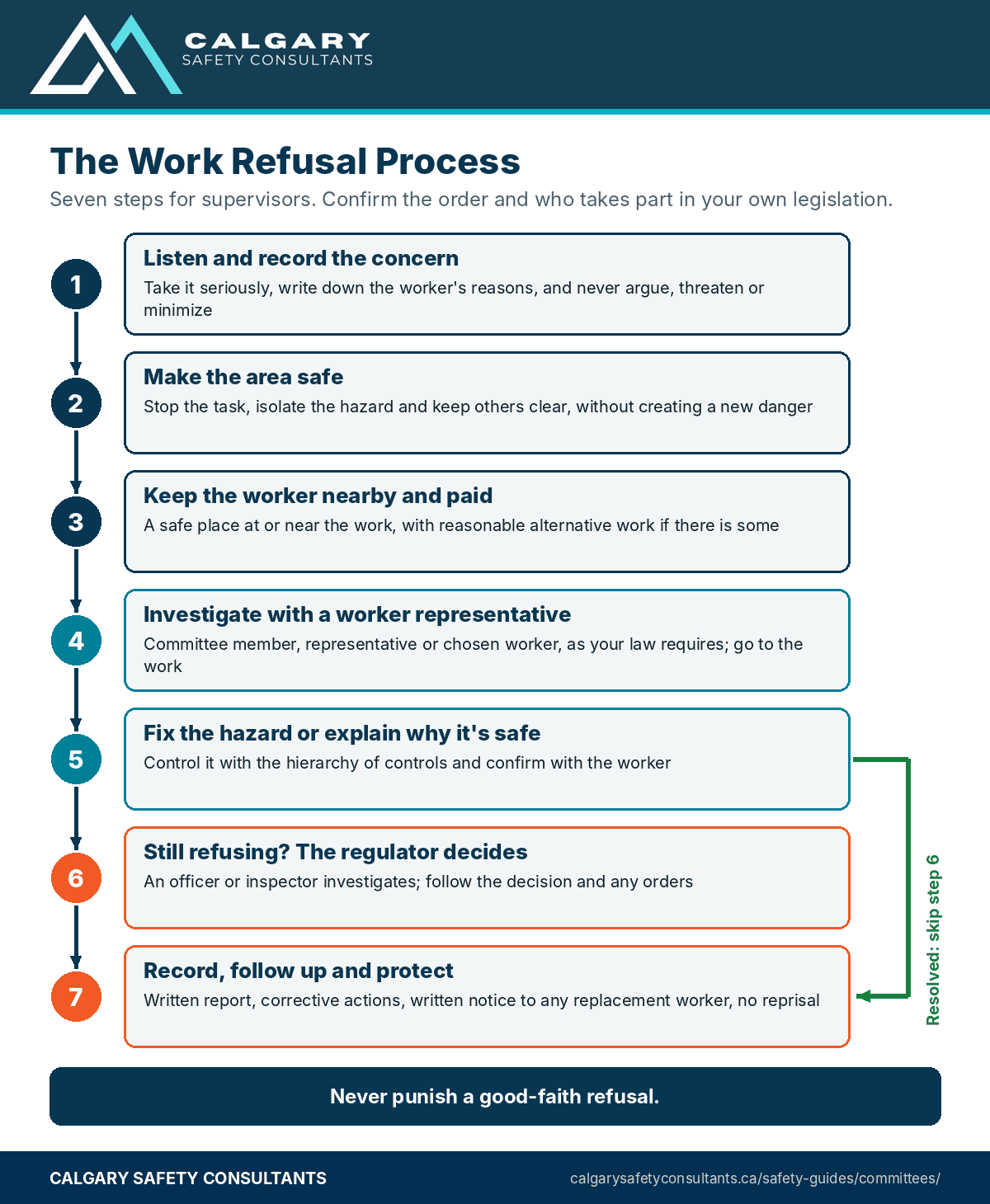
How to Handle a Work Refusal, Step by Step
These steps cover the core of the process in every Canadian jurisdiction; check your own law for who must take part and who calls the regulator.
- Listen and acknowledge. Ask what the concern is and write down what the worker tells you, when and where. Don't argue, threaten or minimize. Alberta's page on how to refuse dangerous work says workers must report the refusal and their reasons promptly to a supervisor, employer or employer's designate, so supervisors should be ready to receive it.
- Make the area safe. Stop the task, isolate the hazard and keep others away from it. Make sure the refusal itself doesn't leave anyone in danger, such as a half-finished lift or an unsecured load.
- Keep the worker nearby and paid. The worker usually stays at or near the workplace in a safe place and can be given other reasonable work. Don't send them home or clock them out.
- Tell the committee or representative. Alberta and the federal Code require it, and it's good practice everywhere.
- Investigate promptly with the right people. Look at the hazard with the worker and, where required, a worker representative. Start from your job hazard analysis and the crew's field-level hazard assessment.
- Fix it or explain it. If there's a hazard, control it using the hierarchy of controls and confirm with the worker that it's fixed. If you believe there's no danger, explain why, with the evidence.
- If the worker still refuses, call the regulator. A worker who still has reasonable grounds can continue the refusal, and an officer investigates.
- Record and follow up. Write the report, give copies to the people the law names, track the corrective actions and review what the refusal says about your controls.
WorkSafeBC's backgrounder on the right to refuse unsafe work describes the same flow from the regulator's side: the steps workers and employers take to resolve a refusal, and WorkSafeBC's role when they can't.
Running the Investigation With the Worker and a Worker Representative
The investigation is the heart of the process, and the law is specific about who must be there.
- Federal. The employer investigates immediately with the employee present and writes a report. If the refusal continues, one employee and one employer member of the committee, or the representative and an employer designate, investigate and report in writing.
- Alberta. The employer discusses the hazard with the worker, inspects it right away and writes a report, with copies to the worker and the committee or representative.
- British Columbia. If the first investigation doesn't resolve it, the employer investigates again with the worker and a worker member of the joint committee, a union-selected worker or another reasonably available worker.
- Manitoba. The government's right to refuse summary sets out section 43(3): the inspection includes the worker co-chair or a worker member of the committee, the representative, or another worker the refusing worker selects.
- Ontario. The employer or supervisor investigates with the worker and a worker member of the JHSC, the health and safety representative or a worker chosen for their knowledge, experience and training.
- Saskatchewan. If the employer can't resolve it, the occupational health committee investigates. The province's page on duties and rights of workers says the committee's decision must be a unanimous vote for or against the refusal.
Whatever the jurisdiction, a good investigation looks the same. Go to the work, not the office. Have the worker show you exactly what worries them. Check the equipment, the procedure, training records, recent changes and anything unusual about today's conditions, and write down both the facts and the opinions.

Reassigning the Worker and Assigning Someone Else
Giving the refusing worker other work. Most jurisdictions let the employer assign reasonable alternative work while the refusal is dealt with, usually at no loss of pay. In British Columbia, Alberta and the Atlantic provinces, the law says a temporary reassignment like this isn't a reprisal or disciplinary action. It has to be genuinely reasonable, though. Sending a worker to sweep the yard in the rain all week can look like punishment.
Giving the refused work to someone else. This is where employers get into the most trouble. Most of Canada restricts it, and nearly everywhere the replacement worker must be told about the refusal first, so they get the same chance to judge the work that the first worker had. Saskatchewan's heading for the rule, as printed in the bill that created the Act, says it plainly: other workers not to be assigned.
| Jurisdiction | Rule on giving the refused work to another worker |
|---|---|
| Federal | During the government investigation, only if the other employee is qualified, told of the refusal and the reasons, and the employer reasonably believes they won't be in danger (s. 129(5)) |
| Alberta | Not until the employer has determined there's no undue hazard (s. 17(10)). Once an officer is notified, the other worker must be told in writing of the refusal, the reasons and why the employer believes the work is safe (s. 17(14)) |
| British Columbia | Not unless resolved, or the other worker and their representative are told in writing of the refusal, the condition, why it isn't an undue hazard and their own right to refuse (s. 3.12.1) |
| Saskatchewan | Restricted by s. 3-34, "Other workers not to be assigned"; check the Act for the notice wording |
| Manitoba | Not unless the inspection is done and the other worker is told in writing of the refusal, the reasons, their right to refuse and why the employer believes the work is safe, and, where practicable, the first worker has told them (s. 43(6)) |
| Ontario | The other worker must first be told of the refusal and the reasons, in the presence of a worker representative (s. 43(11) and (12)) |
| Quebec | Generally not (s. 14); after the examination, if no danger is found and the refusal continues, another worker may do it once told of the refusal and why (s. 17) |
| NB, NS and PEI | Not unless the other worker is told of the refusal, the reasons and their own rights (NB s. 21(2), NS s. 44, PEI s. 29(2)) |
| Yukon | Set out in s. 51, "When employer may assign another worker to do work" |
The safest practice everywhere is to give the replacement worker the notice in writing, explain your reasons for believing the work is safe, remind them of their own right to refuse and have a worker representative present. If you can't explain to the second worker why the work is safe, you're not ready to assign it.
When the Regulator Gets Involved
If the workplace steps don't resolve the refusal and the worker still has reasonable grounds to believe there's a danger, the regulator is called. Who makes the call varies:
- Federal. The employer must immediately inform the Head of Compliance and Enforcement and the committee or representative (s. 128(16)). An employee can appeal the Head's "no danger" decision in writing to the Board within 10 days of receiving it (s. 129(7)).
- Alberta. The worker may notify an OHS officer, who investigates and gives a written record of findings to the worker, the employer and the committee or representative (s. 17(13) and (15)).
- British Columbia. Both the employer and the worker must immediately notify a WorkSafeBC officer (s. 3.12(5)).
- Manitoba. Anyone present at the inspection may notify a safety and health officer. If the officer finds no danger, the worker is told in writing they can no longer refuse (s. 43.1).
- Ontario and Quebec. An Ontario inspector investigates and gives a written decision (s. 43(7) to (9)). In Quebec, the worker, the safety representative or the employer can call a CNESST inspector, who decides immediately (ss. 18 and 19).
Cooperate fully. Have your notes, hazard assessments, procedures and training records ready. Follow the officer's decision and orders, and use the appeal process if you disagree.
Pay During a Work Refusal
A worker who refuses in good faith shouldn't lose money for it. Federally, affected employees are deemed to be at work for pay and benefits until work resumes or the shift ends, unless a collective or other agreement says otherwise (s. 128.1). Ontario treats the worker as at work and paid during the first stage of the refusal (s. 43(13) and the Ministry's guide), and Quebec deems the refusing worker to be at work (s. 14).
Manitoba (s. 43.2) and the Atlantic provinces require the same wages and benefits, although in Prince Edward Island a worker who isn't reassigned is paid only if the refusal is upheld, and not at all if it's found frivolous (s. 29(5) and (6)). In Alberta and BC, a temporary reassignment at no loss in pay isn't a reprisal, and docking pay for a good-faith refusal can be treated as one. The WSCC says workers in the Northwest Territories and Nunavut are paid during the investigation.
The practical rule: keep the worker on the clock, keep them nearby in a safe place and offer reasonable alternative work if there is some.
Protection From Reprisal and How Complaints Work
Every jurisdiction prohibits punishing a worker for a good-faith refusal. It's called reprisal, discriminatory action, disciplinary action or prohibited action, and it covers far more than firing.
- Federal. Section 147 of the Canada Labour Code bars dismissal, suspension, layoff, demotion, financial or other penalties, refusing pay for time the employee would otherwise have worked, and disciplinary action or threats. The Labour Program says complaints go to the Board within 90 days.
- Alberta. A worker may complain to an officer within 180 days (workers bound by a collective agreement use the grievance process instead, s. 19(7)), and the onus is on the employer to show the action was for another reason (s. 19).
- British Columbia. Under the Workers Compensation Act, prohibited action includes suspension, layoff, dismissal, coercion or intimidation. Complaints go to WorkSafeBC in writing within one year, and the burden is on the employer (ss. 47 to 49).
- Saskatchewan. The province's page on discriminatory action says it can be anything from a verbal warning to suspension, firing, demotion or loss of wages. A worker can contact the Ministry's Harassment and Discriminatory Action Prevention Unit, and under s. 3-36 the matter is referred to an occupational health officer, with the onus on the employer.
- Ontario. Ontario's guide on reprisals by the employer says a worker can file with the Ontario Labour Relations Board, or grieve under a collective agreement, and the employer must disprove the reprisal.
- Manitoba. The Workplace Safety and Health Act defines reprisal broadly, prohibits it (s. 42) and lets a worker refer a complaint to an officer (s. 42.1).
Quebec, the Atlantic provinces and Yukon have similar protections, summarized in the tables below. Notice the pattern: in most of Canada, the employer has to prove that any action taken after a refusal wasn't connected to it. That's why documentation matters. If a worker who refused is later disciplined for an unrelated reason, you'll need records showing that reason clearly.
The law does allow action for genuine abuse of the right. The federal Code allows discipline for wilful abuse, Quebec allows action within 10 days of a final decision where the right was abused, and Newfoundland and Labrador says a worker mustn't use the right without reasonable grounds. These are narrow exceptions, so get advice first.
Exceptions and Limits on the Right to Refuse
- When refusing would endanger someone else. Federally, an employee can't refuse if it would directly put another person's life, health or safety in danger (s. 128(2)(a)). Nova Scotia uses similar words (s. 43(9)), Quebec bars a refusal that puts another person in immediate danger (s. 13), and Alberta requires the worker, as far as reasonable, to make sure the refusal doesn't endanger anyone else (s. 17(3)).
- When the danger is a normal part of the job. Federally, there's no right to refuse where the danger is a normal condition of employment (s. 128(2)(b)). Quebec excludes ordinary conditions in that kind of work (s. 13) and Nova Scotia excludes danger inherent in the work (s. 43(9)).
- Workers with a limited right in Ontario. Section 43(1) and (2) of the OHSA limit the right for police, firefighters, correctional workers and certain hospital, long-term care and other health care workers. They can't refuse when the danger is inherent in the work or a normal condition of their employment, or when refusing would directly endanger another person's life, health or safety.
These exceptions are narrower than they sound. A normal condition of employment generally means the danger that remains with the usual controls in place, not a hazard that's out of control because a guard is missing. A firefighter can't refuse to enter a burning building because fire is dangerous, but one handed a breathing apparatus that's failed its check is in a different position.
Don't borrow rules from other countries. In the United States, OSHA's page on the right to refuse dangerous work says a refusal is protected only when several conditions are met, including that there wasn't time to fix the hazard through regular enforcement channels. Canadian law sets no such urgency condition.
Work Refusal Rules by Jurisdiction
Here's a side-by-side summary. The first table covers the test, the investigation and the regulator; the second covers pay and reprisal complaints. For the full text of your law, see our guide to OHS legislation in Canada.
| Jurisdiction | Legal test | Who joins the investigation | Regulator step |
|---|---|---|---|
| Federal | Danger (CLC s. 128) | Employer with employee; then committee members or representative | Employer informs Head of Compliance and Enforcement |
| Alberta | Undue hazard (s. 17) | Employer with worker; committee or representative informed | Worker may notify an OHS officer |
| British Columbia | Undue hazard (s. 3.12) | Worker committee member, union-selected or other worker | Both notify a WorkSafeBC officer |
| Saskatchewan | Unusually dangerous (s. 3-31) | Occupational health committee, unanimous decision | OHS Division officer |
| Manitoba | Danger (s. 43) | Worker co-chair or member, representative or chosen worker | Safety and health officer |
| Ontario | Likely to endanger (s. 43) | Worker JHSC member, representative or chosen worker | Ministry inspector |
| Quebec | Danger (s. 12) | Safety representative | CNESST inspector |
| New Brunswick | Likely to endanger (s. 19) | Supervisor, then committee | Officer |
| Nova Scotia | Likely to endanger (s. 43) | Supervisor, then committee or representative | OHS Division |
| PEI | Likely to endanger (s. 28) | Supervisor, then committee or representative | Officer |
| Newfoundland and Labrador | Dangerous (s. 45) | Employer, then committee or representative | OHS division or officer |
| NWT and Nunavut | Unusual danger (s. 13) | Supervisor with another worker, committee member or union representative | WSCC safety officer |
| Yukon | Right to refuse unsafe work (s. 47; check the test wording) | Set out in ss. 48 and 49 | Officer (s. 50) |
| Jurisdiction | Pay during the refusal | Reprisal complaint |
|---|---|---|
| Federal | Deemed at work (s. 128.1) | Board, within 90 days |
| Alberta | Reassignment at no loss in pay is not disciplinary action (s. 17(7)) | OHS officer, within 180 days (unionized workers grieve, s. 19(7)); employer onus |
| British Columbia | Reassignment at no loss in pay is not prohibited action (s. 3.13(2)) | WorkSafeBC, within one year; employer burden |
| Saskatchewan | Officer can order lost wages repaid (s. 3-36) | Occupational health officer; employer onus |
| Manitoba | Same wages and benefits (s. 43.2) | Officer (s. 42.1) |
| Ontario | Paid during the first stage (s. 43(13)) | OLRB or grievance; employer must disprove |
| Quebec | Deemed at work (s. 14) | Reprisals prohibited (s. 30) |
| New Brunswick | Same wages and benefits (ss. 22 and 23) | Arbitration or Commission, within one year |
| Nova Scotia | Same wages (s. 43(6) and (7)) | Officer, in writing within 30 days, or arbitration (s. 46); employer burden (s. 45(3)) |
| PEI | Same wages and benefits if reassigned (s. 29(3)); if not reassigned, only if the refusal is upheld (s. 29(5)); none if frivolous (s. 29(6)) | Arbitration or Board (s. 31) |
| Newfoundland and Labrador | Same wages and benefits (s. 45) | Grievance or Board (s. 51) |
| NWT and Nunavut | Paid during the investigation | Check the Safety Act |
| Yukon | Check ss. 51 and 52 | Complaint (s. 54); employer onus (s. 56) |
Summary only, from the official sources listed at the end of this guide. Rules change, and details such as deadlines and collective agreement routes matter, so check the current legislation for your workplace.
Records to Keep
Alberta requires a written report of the refusal, inspection and action taken, with copies to the worker and the committee or representative, and the federal Code requires written reports from the employer and the committee investigators. Even where it isn't spelled out, a complete record protects everyone. Record:
- The date, time, place and task, and the worker's reasons in their own words.
- Immediate actions: the area made safe and the worker's temporary assignment.
- Who was notified and when, and who took part in the investigation.
- What was examined, what was found, the decision and the corrective actions with owners and dates.
- Any notice given to a replacement worker, officer involvement and orders, and confirmation of pay.
Track the corrective actions like findings from an inspection or an incident investigation, using your corrective action process. Refusals belong on the agenda at the next JHSC meeting, and our guide on JHSC minutes and recommendations covers how committees record follow-up. Don't put a good-faith refusal on the worker's disciplinary file.
Workplace example
A Practical Workplace Example
This example is invented to show how the process works. It doesn't describe a real company.
Situation: A metal fabrication shop in British Columbia with about 35 workers had a large part to move with the overhead crane late on a Friday. The rigger assigned to the lift told his supervisor he wouldn't do it: one of the slings had a frayed section, and the only other sling rated for the load was out for inspection. The supervisor was under pressure to ship the part.
Action: The supervisor stopped, wrote down the rigger's concern and had the crane locked out. He gave the rigger other work in the shop at his regular rate and called the worker co-chair of the joint committee.
Together, the three of them inspected the sling, which had broken wires and should have been tagged out. The supervisor removed it from service and cancelled the lift until a rated sling arrived on Monday. Because the matter was resolved, no other rigger was asked to do the work and no officer was needed. The supervisor completed the refusal record that afternoon and gave copies to the rigger and the committee.
Result: The part shipped on Tuesday. At the next committee meeting, the refusal led to a recommendation for documented pre-use sling checks and a sling inventory. Over the next quarter, workers reported three more rigging defects before anyone had to refuse a lift.
Common Work Refusal Mistakes to Avoid
- Arguing the test on the spot. A supervisor doesn't decide whether the worker's belief is reasonable. Follow the process and let the investigation, and if needed the officer, answer that.
- Quietly giving the job to someone else. Most jurisdictions restrict this and require the replacement worker to be told about the refusal first, often in writing.
- Sending the worker home without pay. The worker generally stays at or near work and keeps being paid. Docking pay can be a reprisal.
- Leaving out the worker representative. Many jurisdictions require a committee member, representative or other worker at the investigation.
- Treating the worker differently afterwards. Less overtime, worse jobs or a cold shoulder can all look like reprisal.
Audit perspective
What an Auditor Expects to See
Work refusals show up in a COR audit in two places. In interviews, auditors expect workers to know their rights, and Energy Safety Canada's 2023 COR audit protocol, for example, expects new workers to know all three health and safety rights, including the right to refuse. Supervisors are often asked what they'd do if a worker refused a task, and a clear, confident answer that matches your procedure scores far better than a guess.
In documents, an auditor looks for a written refusal procedure that matches your jurisdiction, evidence that workers and supervisors were trained on it, and completed investigation records for any refusals during the audit period, with corrective actions closed. Our guide on how to prepare for a COR audit explains how these elements fit together.
Calgary Safety Consultants helps employers build refusal procedures, train supervisors and prepare for COR and SECOR audits; we don't issue certificates. CORs and SECORs are issued through the applicable certifying partner.
The Bottom Line
A work refusal is a worker telling you they believe something could hurt them or someone else. The law in every Canadian jurisdiction expects the same response: take it seriously, make the area safe, investigate promptly with the worker and, where your law requires it, a worker representative, fix the hazard or explain why the work is safe, and call the regulator if the worker still disagrees.
Keep the worker paid and nearby, tell anyone else assigned to the work about the refusal before they start, never punish a good-faith refusal, and write it all down. Handle refusals this way and they become one of the most valuable sources of hazard information you have.
Download the Work Refusal Investigation Record and Supervisor Quick Guide
Two free downloads go with this guide. Both are fillable PDFs with clickable checkboxes, so you can complete them on a computer or tablet or print them for the truck.
- Work Refusal Investigation Record (PDF, 6 pages). A ten-part fillable record that follows the process in this guide: how to use the form, the jurisdiction that applies, the refusal report in the worker's own words, immediate actions, notifications, the investigation with the worker representative, findings and controls, the worker's response, notice to any replacement worker, regulator involvement and orders, pay confirmation, corrective actions, a record review checklist, distribution, lessons learned and sign-off, with guidance notes, prompts and examples throughout.
- Supervisor Quick Guide to Work Refusals (PDF, 6 pages). A practical reference for supervisors: a first-five-minutes checklist, what to say and what never to say, key definitions, a step-by-step checklist, investigation questions, two tables with the legal test and key rules for every province, territory and federal workplace, reassignment and pay rules, what to put in a written notice to a replacement worker, reprisal protections, exceptions, common mistakes, what to record, and a fillable page for your site contacts, procedure notes and supervisor briefings.
Click either button to download the file. Adapt both to your workplace, your procedures and the law where you work.

About the author
John Duplessis, B.Sc., CRSP
John Duplessis is a Canadian Registered Safety Professional with more than 30 years of occupational health and safety experience in oil and gas, construction, green energy, midstream operations and industrial project work. He is an external auditor with Energy Safety Canada.