On this page
- What a Joint Health and Safety Committee Is and Why It Matters
- Who's Involved: Members, Co-Chairs and Representatives
- When a Committee or Representative Is Required
- Membership, Selection and Training Rules Across Canada
- How to Set Up a JHSC in Eight Steps
- Choosing the Right People
- Write Clear Terms of Reference
- Training, Resources and Paid Time
- Multi-Site, Multi-Shift and Remote Workplaces
- Unionized Workplaces
- Small Employers and Health and Safety Representatives
- Make the Committee Useful, Not a Formality
- Review the Committee's Effectiveness
- A Practical Workplace Example
- Common JHSC Setup Mistakes to Avoid
- What an Auditor Expects to See
- The Bottom Line
- Download the Checklist and Terms of Reference
- Frequently Asked Questions
- Related Guides and Articles
- How Calgary Safety Consultants Can Help
- Sources
What a Joint Health and Safety Committee Is and Why It Matters
A joint health and safety committee, or JHSC, is a group of worker and employer representatives who meet regularly to deal with health and safety at the workplace. It's "joint" because both sides sit at the table, and in most jurisdictions at least half the members must be workers who don't do management work. The committee receives worker concerns, takes part in inspections and investigations, and makes recommendations to the employer.
The committee advises; it doesn't manage. The employer keeps its legal duty and decides how to respond to recommendations. What the committee adds is a structured way for the people who do the work to raise problems and help solve them. As U.S. OSHA's guidance on worker participation puts it, workers "often know the most about potential hazards associated with their jobs."
A committee on paper isn't one that works. A 1984 study of 127 Massachusetts manufacturers found that simply having a committee had virtually no effect on complaints or serious citations, while firms whose committees were perceived as effective, in interviews at 13 of the firms, had fewer of both. A later systematic review funded by WorkSafeBC found that effective committees share adequate information, education and training, the right membership and senior management commitment.
That's why this guide covers how to set up a JHSC well, not just legally.
A committee also fits the way modern safety management works. ISO 45001, the international standard for occupational health and safety management systems, lists worker participation among its key elements, alongside leadership commitment and hazard identification.
Who's Involved: Members, Co-Chairs and Representatives
Every committee has the same basic cast, though titles vary.
- Worker members. Workers who don't exercise management functions, chosen by the workers or by their union. They bring the shop floor's view of hazards and concerns.
- Employer members. People the employer appoints, usually managers or supervisors with enough authority to get things done. In most jurisdictions, employer members can't outnumber worker members.
- Co-chairs. Most jurisdictions require two co-chairs, one chosen by the worker members and one by the employer members. In some jurisdictions the employer appoints its co-chair. They plan agendas, run meetings in turn and make sure minutes and recommendations move forward.
- Health and safety representative. In smaller workplaces, one worker takes on the committee's role, working with the employer. Quebec calls this person a liaison officer in establishments with 19 or fewer workers.
- Senior management. Not usually members, but they decide what gets resourced, and their support decides whether the committee is taken seriously.
A safety coordinator or HR lead often supports the committee with records and scheduling. That helps, as long as they don't end up running it alone.
When a Committee or Representative Is Required
Before you set up a JHSC, confirm that you need one, and what kind. Most Canadian jurisdictions require a committee once an employer regularly employs 20 or more workers and a single representative in smaller workplaces. Saskatchewan sets the bar lower, and some jurisdictions add rules for projects and multi-employer sites. Our blog post on when your workplace legally requires a health and safety committee or representative walks through the Western Canadian rules in more detail.
| Jurisdiction | Committee required | Representative instead | Where to look |
|---|---|---|---|
| Alberta | Health and safety committee at 20 or more regularly employed workers | Health and safety representative at 5 to 19 workers | OHS Act ss. 13 and 14; OHS Code Part 13 |
| British Columbia | Joint health and safety committee at 20 or more regularly employed workers | Worker health and safety representative at 10 to 19 workers | Workers Compensation Act ss. 31 to 45; OHS Regulation ss. 3.26 and 3.27 |
| Saskatchewan | Occupational health committee at 10 or more workers | OHS representative at prescribed places with 5 to 9 workers | The Saskatchewan Employment Act, Part III; OHS Regulations, 2020, Part 4 |
| Manitoba | Workplace safety and health committee at 20 or more workers | Workplace safety and health representative at 5 to 19 workers | Workplace Safety and Health Act ss. 40, 41 and 44 |
| Ontario | JHSC at 20 or more regularly employed workers, on construction projects with 20 or more workers lasting three months or more, and where a designated substance regulation applies | Health and safety representative at more than 5 workers | OHS Act ss. 8 and 9 |
| Quebec | Comité de santé et de sécurité and a représentant en santé et en sécurité at 20 or more workers | Agent de liaison (liaison officer) at 19 or fewer workers | Act respecting occupational health and safety; Regulation respecting prevention and participation mechanisms in an establishment |
| Nova Scotia | Joint occupational health and safety committee at 20 or more workers | Representative at 5 or more workers where no committee is required | OHS Act ss. 29, 30 and 33 |
| New Brunswick | Joint health and safety committee at 20 or more employees | At 5 to 19, a written safety policy, which may provide for an elected representative | OHS Act ss. 14 and 17 |
| Prince Edward Island | Joint occupational health and safety committee at 20 or more workers, and on projects with 20 or more workers lasting three months or more | Representative at 5 or more workers where no committee is required | OHS Act ss. 25 and 26 |
| Newfoundland and Labrador | Occupational health and safety committee at 20 or more workers | Worker health and safety representative under 20; a designate may be used where fewer than 6 | OHS Act ss. 37 to 42.1 |
| Yukon | Health and safety committee at 20 or more regularly employed workers | Worker health and safety representative at 5 to 19 workers | Workers' Safety and Compensation Act |
| Northwest Territories and Nunavut | Joint occupational health and safety committee where 20 or more workers work, or are likely to work, for more than 90 days | Representative where fewer than 20 workers | OHS Regulations ss. 37 to 51, in each territory |
| Federally regulated | Work place committee at 20 or more employees; policy committee at 300 or more directly employed | Health and safety representative at fewer than 20 employees | Canada Labour Code ss. 125(1)(z.01) and (z.17), 134.1 to 136; SOR/2015-164 |
A regulator can also order a committee or representative in many jurisdictions, even below these numbers. Our OHS legislation guide links each jurisdiction's Act and regulations.
A few details matter when you count.
- Alberta. The OHS Act requires a committee where an employer regularly employs 20 or more workers and a representative at 5 to 19, both after consulting any certified bargaining agent. On a site with 20 or more workers from two or more employers, the employers coordinate one committee, unless a prime contractor has been designated. Members must meet and do committee work during normal working hours.
- British Columbia. The Workers Compensation Act requires a joint committee at 20 or more regularly employed workers and a worker representative where there are more than 9 but fewer than 20. WorkSafeBC can approve one committee for more than one workplace.
- Saskatchewan. Employers must set up an occupational health committee at workplaces with 10 or more workers. A representative is required at prescribed places of employment with more than 4 but fewer than 10 workers.
- Ontario. Ontario's guide for health and safety committees and representatives confirms a JHSC at 20 or more regularly employed workers, on construction projects with 20 or more workers expected to last three months or more, and at workplaces covered by a designated substance regulation. Workplaces with more than five workers that don't need a committee have workers select a representative.
- Quebec. CNESST's page on prevention and participation mechanisms lists a committee and a health and safety representative for establishments with 20 or more workers, and a liaison officer for 19 or fewer. The 2021 modernization law phased these rules in: interim rules applied first, and the Regulation respecting prevention and participation mechanisms in an establishment came into force on October 1, 2025. Unless an agreement says otherwise, it sets 2 to 8 worker representatives by size and 4, 6 or 9 meetings a year, at least once every three months.
- Newfoundland and Labrador. The committee threshold rose from 10 or more to 20 or more workers on March 1, 2024. Where fewer than six workers are at a workplace and a representative isn't practicable, the employer can appoint a health and safety designate instead.
- The North. In the Northwest Territories and Nunavut, the WSCC's joint OHS committee code of practice explains that a committee is required where 20 or more workers work, or are likely to work, for more than 90 days. The code also includes a sample terms of reference, though a code of practice doesn't have the same legal force as the regulations.
- Federally regulated workplaces. The Canada Labour Code requires a work place committee at each work place with 20 or more employees and a policy committee for employers with 300 or more employees. Smaller work places need a health and safety representative, selected by the non-managerial employees or their union.
Membership, Selection and Training Rules Across Canada
Next come size, selection and training, which differ more than the thresholds do.
| Jurisdiction | Size and selection | Meetings | Training |
|---|---|---|---|
| Alberta | Employer members can't outnumber worker members; worker members are not associated with management; selection and co-chair rules in Code ss. 196.1 and 196.2 | Terms of reference required (Code s. 197) | Required under Code s. 201; employer may deliver it |
| British Columbia | At least 4, at least half workers; secret ballot where no union; two co-chairs | At least monthly; own rules of procedure | 8 hours within 6 months (representatives 4 hours); 8 hours paid education leave a year |
| Saskatchewan | 2 to 12, at least half non-management workers; elected by workers or appointed by the union; two co-chairs; terms up to 3 years | First within 2 weeks, then three monthly meetings, then at least every 3 months | Co-chairs and representatives must be trained; up to 5 working days of paid education leave a year |
| Manitoba | 4 to 12, at least half workers; elected by workers or appointed by the union; co-chairs chosen by members | At least every 3 months; first within one month | Entitled to the greater of 16 hours or two shifts a year of paid training leave |
| Ontario | At least 2 (under 50 workers) or 4 (50 or more), at least half non-managerial workers chosen by workers or the union; two co-chairs | At least every 3 months; monthly inspections | At least one worker and one employer member certified; refresher every 3 years |
| Quebec | Worker representatives set by agreement, or by regulation (2 to 8 by size) | 4, 6 or 9 a year by level, at least every 3 months | Members: certificate for at least one day of training within 120 days; health and safety representative: refresher of at least 7 hours every 2 years |
| Nova Scotia | Size by agreement, at least half employees chosen by employees or the union; co-chairs | Monthly unless the rules of procedure say otherwise | Prescribed training on paid time |
| New Brunswick | Size by agreement, equal employer and employee representation; each side elects a co-chair | At least monthly | Prescribed program within 12 months of designation |
| Prince Edward Island | Size by agreement or order; half chosen by the union or workers | Monthly unless the rules of procedure say otherwise | Prescribed training on paid time |
| Newfoundland and Labrador | 2 to 12, at least half workers, elected or appointed under the union constitution; co-chairs | At least every 3 months | All members at 50 or more workers; co-chairs at 20 to 49 |
| Yukon | At least 4, half chosen by workers or their union; co-chairs | Monthly | Orientation for all members within 30 days; co-chairs and representatives trained within 6 months |
| Northwest Territories and Nunavut | Equal worker and employer members, worker members chosen by workers; co-chairs | First within 14 days, three monthly, then at least every 3 months | Co-chairs and representatives trained |
| Federally regulated | At least 2, at least half non-managerial employees chosen by employees or the union; two chairpersons | At least 9 a year; policy committee quarterly | Prescribed training required (Code s. 125(1)(z.01)); employer develops it after consulting the committees and reviews it at least every 3 years |
Some points are worth reading in the source.
- Alberta. The OHS Code, Part 13 covers worker membership selection, co-chairs, terms of reference, quorum, posting names, paid time away and training. Alberta's small business bulletin, Participation in health and safety, says training covers the roles of co-chairs, members and representatives, work site party obligations and workers' rights, and that employers can deliver it themselves or use an outside provider. Supervisors and managers can't be the representative.
- British Columbia. New members need at least 8 hours of instruction and training within six months, and representatives need 4 hours, under the OHS Regulation. The same Part requires a written evaluation of each joint committee every year.
- Saskatchewan. The province's OHC page says a committee has 2 to 12 members, at least half of them workers not involved in management, and members serve three-year terms. The OHS Regulations, 2020 set the meeting schedule, quorum and co-chair training.
- Manitoba. Manitoba's committee FAQ notes that an employer "cannot direct any particular worker to sit as a worker member." SAFE Work Manitoba's guide to creating a committee sets 4 to 12 members, signed and posted minutes, kept for 10 years as recommended, and written rules of procedure.
- Atlantic Canada. Nova Scotia's OHS Act and Prince Edward Island's OHS Act both require the committee to set its own rules of procedure. New Brunswick's OHS Act requires equal representation, monthly meetings and minutes kept for three years. Newfoundland and Labrador's OHS Act sets 2 to 12 members and ties training to workplace size.
- Yukon. The Yukon WSCB's page on health and safety committees requires orientation for all members within 30 days and training for co-chairs and representatives within six months, at the employer's cost.
- Federal. The federal committee regulations require minutes approved by both chairpersons and kept for two years, and a training program the employer develops after consulting the committees. The Code also requires employers to post the names, work place phone numbers and work locations of committee members or the representative.
How to Set Up a JHSC in Eight Steps
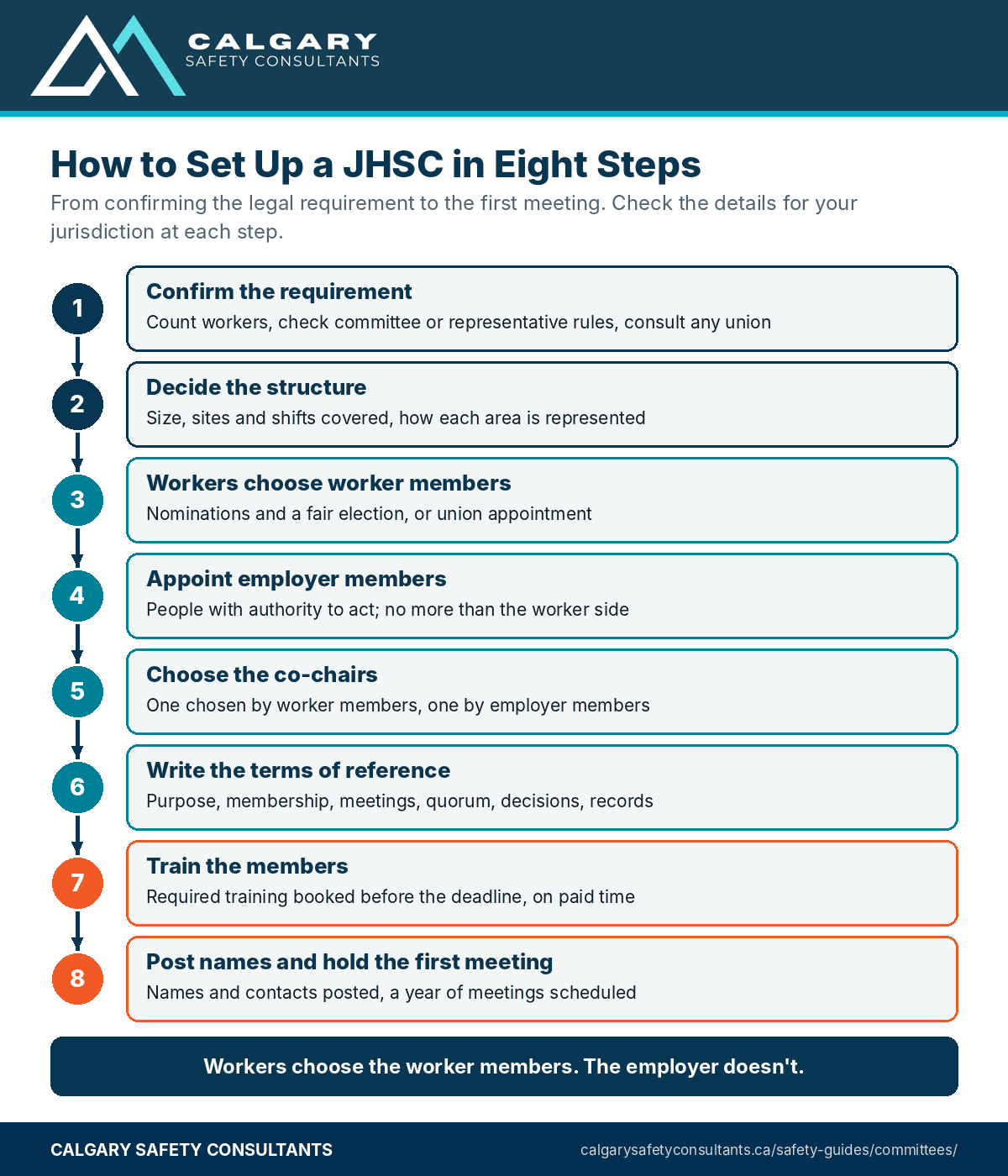
Whatever your jurisdiction, the work follows the same order, from the first question to the first meeting.
1. Confirm the requirement
Count your regularly employed workers using your jurisdiction's rules, check whether you need a committee, a representative or both, and note any project, multi-employer or designated substance rules. If you have a union, consult it before you start, as Alberta requires and good practice calls for everywhere.
2. Decide the structure
Decide how many members you need, whether one committee can cover several sites or shifts, and how each work area and shift will be represented. Some jurisdictions set the size, and others leave it to agreement between the employer and workers.
3. Have workers choose the worker members
Workers or their union choose the worker members, not the employer. Announce the vacancies, explain the role, and run a fair nomination and election, by secret ballot where the law requires it.
4. Appoint the employer members
Choose managers or supervisors who can act on recommendations, and keep their number at or below the worker side.
5. Choose the co-chairs
Worker members choose the worker co-chair and employer members choose the employer co-chair, usually at the first meeting.
6. Write the terms of reference
Draft terms of reference, or rules of procedure, covering how the committee will work. Have the members review and approve them early.
7. Train the members
Book the training your jurisdiction requires and set dates before the deadline.
8. Post names and hold the first meeting
Post the members' names and how to reach them, schedule a year of meetings, and hold the first meeting within the time your jurisdiction allows, such as two weeks in Saskatchewan.
Choosing the Right People
When you set up a JHSC, the law tells you who picks the members. It doesn't tell you who makes a good one. Worker members are chosen by workers or their union, not hand-picked by management, although some jurisdictions, such as Alberta, set out what happens if workers don't choose within the time allowed. The employer can still make the role attractive and explain what it involves, so the right people put their names forward.
- Credibility with co-workers. Good worker members are people others already go to with problems. They listen, follow up and don't mind speaking up.
- Coverage. Aim for members from different work areas, trades and shifts, so the committee hears from every part of the operation. Saskatchewan's regulations, for example, call for enough worker members to represent groups with substantially different concerns.
- Authority on the employer side. Employer members should be able to approve small fixes on the spot and take bigger ones to the people who control budgets. A committee of junior staff with no authority quickly becomes a complaint box.
- Time and interest. Members need time for meetings, inspections and training. Overloaded or volunteered-by-others members rarely stay engaged.
- Continuity. Stagger terms so the whole committee doesn't turn over at once, and name alternates.
Keep selection transparent: post the call for nominations, the results and the term lengths. If workers don't trust how members were chosen, they won't trust the committee.
Write Clear Terms of Reference
Terms of reference are the committee's operating rules. Some jurisdictions call them rules of procedure. Alberta requires terms of reference, British Columbia, Nova Scotia and Prince Edward Island require committees to set their own rules of procedure, and Manitoba expects written rules. Ontario doesn't require them, but its guide recommends reviewing them at least once a year. Even where optional, they prevent most later arguments.
They should cover:
- The committee's purpose, scope and the workplaces, sites and shifts it covers
- Membership: numbers, how worker and employer members are chosen, terms of office, alternates and how vacancies are filled
- Co-chairs: how they're chosen and what each does
- Meetings: how often, agenda deadlines, quorum and what happens if a meeting can't go ahead
- Decision-making: consensus as the default, and what happens when the committee can't agree
- Recommendations: how they're written, who receives them and how responses are tracked
- Inspections, investigations and concerns: the committee's role in each
- Records: who takes minutes, how they're approved, posted and kept
- Training, paid time and resources
- Confidentiality of personal information
- How often the terms of reference themselves are reviewed
Our free terms of reference template, below, covers each of these with fill-in fields. Check it against your jurisdiction's rules, then have the committee review and sign it at its first or second meeting.
Training, Resources and Paid Time
Training is where many new committees fall behind. When you set up a JHSC, book training as part of the setup, because untrained members tend to drift toward complaints rather than solutions. Check your deadline: British Columbia allows six months, Yukon expects orientation within 30 days, New Brunswick allows 12 months and Quebec allows 120 days (with later transition dates, up to October 1, 2027, for members already in place, depending on the establishment's level).
Useful committee training covers the members' legal role, workers' rights, hazard identification and the hierarchy of controls, inspections, incident investigations, work refusals and how to write recommendations. Our joint health and safety committee and representative training covers those topics.

Committees also need resources. In British Columbia, the employer must provide the equipment, premises and clerical help the committee needs, respond in writing to recommendations within 21 days and give each member 8 hours of paid education leave a year. Across Canada, committee work is generally paid work time, so build it into schedules. OSHA's guidance says it plainly: "Give workers the necessary time and resources to participate in the program."
Multi-Site, Multi-Shift and Remote Workplaces
A committee works best when every worker can reach a member, which takes planning across shifts, sites and field work.
- Check whether one committee can cover several sites. Some jurisdictions allow it, often with regulator approval. British Columbia's Board can approve one committee for more than one workplace, and Ontario needs a ministry order for a multi-workplace committee.
- Represent every shift. Choose worker members from nights and weekends as well as days, and rotate meeting times or allow virtual attendance where your rules permit.
- Use local contacts. At sites without a member, name a contact who passes concerns on and shares minutes back.
- Spread inspections. Where the committee covers several locations, schedule inspections so each site gets looked at over the year.
- Coordinate on shared sites. Where several employers share a site, agree in writing how committees or representatives coordinate.
Unionized Workplaces
In a unionized workplace, the union usually appoints or selects the worker members under its constitution or bylaws, and where several unions are present, they agree on how seats are shared. Alberta requires employers to consult the certified bargaining agent before setting up a committee or designating a representative.
Talk with the union about structure, seats and meeting times, and check the collective agreement. Keep the committee's work separate from bargaining and grievances, or it stops being useful for safety. Where some workers are unionized and others aren't, make sure the non-union workers have their own way to choose members.
Small Employers and Health and Safety Representatives
Below the committee threshold, most jurisdictions need a single worker health and safety representative instead. The representative does the committee's work with the employer, scaled to one person: receiving concerns, taking part in hazard assessments and inspections, and making recommendations. Supervisors and managers generally can't fill the role.
The steps are the same as when you set up a JHSC, just smaller. Have the workers choose the representative, write a short description of the role and how you'll meet, provide the required training, post the representative's name and schedule regular meetings. British Columbia requires 4 hours of training within six months, for example. A small employer can also choose to set up a committee instead, which Alberta specifically allows.
A good representative strengthens your job hazard analysis and inspection work.
Make the Committee Useful, Not a Formality
The biggest risk after you set up a JHSC isn't breaking the rules. It's a committee that meets, reads the minutes and changes nothing. A few habits keep it useful.
- Bring real problems to the table. Put incident trends, near misses and open hazards on every agenda. Our guide to investigating a workplace incident explains how the committee can take part.
- Inspect, don't just discuss. Good inspections find hazards before they hurt someone. Our guide on workplace safety inspections shows how.
- Write recommendations that can be acted on. Say what the hazard is, what you recommend, why and by when. Then track the response.
- Close the loop. Track every action to completion and report back to workers. Our corrective actions guide covers the tracking.
- Run meetings well. Short, focused meetings with an agenda, a quorum and clear minutes get more done. Our guide on how to run a JHSC meeting covers agendas, minutes and follow-up.
- Show management support. When leaders attend now and then and answer recommendations on time, workers notice.
Review the Committee's Effectiveness
Once a year, step back and ask whether the committee is working. British Columbia makes this a legal requirement: each joint committee needs a written annual evaluation covering compliance with membership, meeting and training rules, the effectiveness of its rules of procedure and its overall effectiveness. WorkSafeBC offers an evaluation tool and committee handbook that any employer can adapt.
A practical review asks a few questions. Are meetings held on schedule with a quorum? Are members trained and terms current? Are recommendations answered and actions closed? Do workers know who their members are, and do they bring concerns forward? Then update the terms of reference, training and membership to match. The review also feeds your wider health and safety system and management review, and it gives you the evidence an auditor looks for when you prepare for a COR audit.
Workplace example
A Practical Workplace Example
Situation: Consider a food distribution warehouse in British Columbia that grew from 14 to 26 regularly employed workers over two years, across a day shift and an evening shift. It had a worker representative, but no one had noticed that crossing 20 workers meant it now needed a joint health and safety committee. The issue came to light when a forklift near miss on the evening shift went unreported for a week.
Action: The operations manager and the HR and safety coordinator used the eight steps to set up a JHSC. Workers elected two worker members by secret ballot, one from each shift, and the company appointed its warehouse supervisor and maintenance lead. The coordinator drafted terms of reference from a template, the members approved them, and all four completed 8 hours of training within three months. Names went up in the break room, and monthly meetings were booked, alternating between shifts.
Result: Within six months, the committee's inspections led to new pedestrian walkways and a rule change for evening forklift traffic, and reported near misses rose as workers got used to raising them. The first annual evaluation found two gaps, late minutes and no alternates, and both were fixed in the revised terms of reference.
Common JHSC Setup Mistakes to Avoid
- Missing the threshold. Growing workplaces often pass 20 workers, or 10 in Saskatchewan, without anyone noticing.
- Picking the worker members. The employer doesn't choose worker members. Hand-picked members undermine trust and break the rules.
- Too many managers. Employer members can't outnumber worker members in most jurisdictions.
- No terms of reference. Without written rules, every disagreement about quorum, vacancies or recommendations turns into an argument.
- Late training. Members who start without training make weaker recommendations, and the deadline is easy to miss.
- Names not posted. If workers don't know who their members are, they can't bring concerns forward.
- Meetings on unpaid time. Committee work is work time. Asking members to meet on breaks or after hours sends the wrong message.
- Recommendations that disappear. Unanswered recommendations are the fastest way to kill a committee.
Audit perspective
What an Auditor Expects to See
Energy Safety Canada's 2023 COR audit protocol has a full element, Element J, on the joint health and safety committee and representative. It asks whether the committee has terms of reference that meet legislated requirements, whether the company has the representation the law requires, whether members' names and contact information are readily available, whether members are trained, whether minutes are kept and shared with employees, whether corrective actions are tracked and whether there's a process for recommendations to reach management.
In Ontario, IHSA's COR 2020 audit tool doesn't have a separate committee element, but its management review element lists the results of consultation with the representative or JHSC as an input.
An auditor will check the records: selection or election results, the terms of reference, training certificates, posted names, minutes and the recommendation log. Interviews matter just as much. Members should be able to explain their duties, and workers should know who their members are and how to raise a concern.
Calgary Safety Consultants helps employers set up committees and prepare for COR and SECOR audits; we don't issue certificates. CORs and SECORs are issued through the applicable certifying partner.
The Bottom Line
To set up a JHSC well, confirm the rules for your jurisdiction, let workers choose their own members, appoint employer members with real authority, write clear terms of reference, train everyone on time, post the names and start meeting. Then keep it useful by bringing real problems to the table, answering recommendations and reviewing the committee every year.
A joint health and safety committee costs some time. In return, it gives workers a voice, finds hazards earlier and shows that safety is shared work.
Download the JHSC Setup Checklist and Terms of Reference Template
Two free downloads go with this guide.
- JHSC Setup Checklist (PDF). A two-page checklist with clickable checkboxes that follows the eight steps, from confirming the legal requirement to holding the first meeting.
- JHSC Terms of Reference Template (PDF). A fillable template covering purpose, scope, membership, selection, co-chairs, meetings, quorum, decision-making, recommendations, records, training, review and signatures.
Click either button to download the file. Check both against the rules for your jurisdiction and adapt them to your workplace.

About the author
John Duplessis, B.Sc., CRSP
John Duplessis is a Canadian Registered Safety Professional with more than 30 years of occupational health and safety experience in oil and gas, construction, green energy, midstream operations and industrial project work. He is an external auditor with Energy Safety Canada.