On this page
- What a Violence and Harassment Prevention Plan Is
- Why a Prevention Plan Matters
- Who's Involved
- Legal Requirements by Jurisdiction
- Comparison of Requirements Across Canada
- Domestic Violence That Reaches the Workplace
- Seven Steps to Build Your Plan
- Step 1: Assess the Risk
- Step 2: Write the Policy and Plan
- Step 3: Set Up Reporting Procedures
- Step 4: Investigate Fairly, Confidentially and Promptly
- Step 5: Support Affected Workers
- Step 6: Train Everyone and Communicate the Plan
- Step 7: Review and Improve
- A Practical Workplace Example
- Common Mistakes to Avoid
- What an Auditor Expects to See
- The Bottom Line
- Download the Worksheet and Checklist
- Frequently Asked Questions
- Related Guides and Articles
- How Calgary Safety Consultants Can Help
- Sources
What a Violence and Harassment Prevention Plan Is
Before you can prevent something, you need to name it. Alberta's OHS Act defines violence as the threatened, attempted or actual conduct of a person that causes or is likely to cause physical or psychological injury or harm, including domestic and sexual violence. Harassment is any single or repeated objectionable or unwelcome conduct, comment, bullying or action that the person knows, or ought reasonably to know, will cause offence or humiliation to a worker or adversely affects their health and safety.
That definition covers conduct based on protected grounds such as race, gender identity and sexual orientation, and sexual solicitation or advances. It excludes reasonable conduct by an employer or supervisor in managing workers. Assigning work, giving honest feedback and applying discipline fairly aren't harassment.
The federal Canada Labour Code treats the two as one concept: any action, conduct or comment, including of a sexual nature, that can reasonably be expected to cause offence, humiliation or other physical or psychological injury or illness to an employee. The UK Health and Safety Executive's guidance on violence at work uses a simple test: any incident in which a person is abused, threatened or assaulted in circumstances relating to their work.
The prevention plan is how an employer manages these hazards. It's called a prevention plan in Alberta, policies and procedures in British Columbia, policies and programs in Ontario, codes of practice in New Brunswick and a prevention policy federally. The building blocks are much the same everywhere: a risk assessment, a written policy with a clear commitment from the top, controls, procedures for reporting and investigating, confidentiality, supports for affected workers, training and a regular review.
Some laws are narrower than Alberta's. In B.C.'s OHS Regulation, violence means force or threats by a person other than a worker, and conduct between workers falls under bullying and harassment rules instead. Use the definitions in your own law, and feel free to go further.
Why a Prevention Plan Matters
Harassment and violence at work are common. In Statistics Canada's 2020 Survey on Sexual Misconduct at Work, 47 per cent of women and 31 per cent of men said they had ever experienced some form of harassment or sexual assault in the workplace. Young workers were among the most affected: in the year before the survey, 43 per cent of women and 25 per cent of men aged 15 to 24 had experienced it.
People who are harassed or threatened can lose sleep, confidence and health, and some leave jobs they were good at. Teams lose trust, and employers face complaints, claims and orders. A plan doesn't make every problem disappear, but it gives people a safe way to speak up and gives managers a fair way to respond.
Expectations are rising. Canada ratified the International Labour Organization's Violence and Harassment Convention, C190, on January 30, 2023. According to Employment and Social Development Canada, it covers incidents linked to work, including work trips, work communications, employer-provided accommodation and commutes, so workplace violence prevention shouldn't stop at the office door. Our article on why harassment and violence prevention training matters in Canada looks at the training side.
Who's Involved
Prevention works when everyone knows their part. Part 1 of Alberta's OHS Act shows how duties are shared: employers must ensure, as far as reasonably practicable, that none of their workers are subjected to or participate in harassment or violence at the work site, supervisors have the same duty for their workers, and workers must refrain from causing or participating in it.
- Owners and senior leaders sign the policy, fund the controls and make it clear the rules apply to everyone, including managers and top performers.
- Supervisors usually hear about problems first and need to know how to respond, escalate and keep things confidential.
- Workers follow the policy, treat each other with respect and report what they experience or see.
- The committee or representative is consulted on the assessment and plan in most jurisdictions. See our guides on how to set up a JHSC and how to appoint and support a health and safety representative.
- Investigators and support providers, such as an employee assistance program, help resolve problems and help people recover.
In a small business, one person may wear several hats. That's fine, as long as there's a second route for reporting when the owner or supervisor is the person involved.
Legal Requirements by Jurisdiction
Every Canadian jurisdiction now addresses workplace harassment, and most address violence directly. These summaries are current as of October 2026, but rules change, so check the official text before relying on a specific requirement.
Alberta
The Government of Alberta's page on workplace harassment and violence explains the OHS Code Part 27 rules. Every employer must develop and implement one workplace violence and harassment prevention plan, in consultation with the committee or representative, or with affected workers if there's neither, and address both hazards in the hazard assessment. The plan must include measures to eliminate or control the hazards, procedures to inform workers of specific or general threats, procedures for reporting and investigating, and how confidentiality will be protected, with limited exceptions.
The plan must be reviewed when an incident shows it's needed, when a change at work could affect the risk, when the committee asks, and at least every three years. Workers must be trained to recognize violence and harassment and on the plan, appropriate responses and how to report.
Every incident must be investigated, with a report kept at least two years. A worker who reports an injury or adverse symptom must be advised to see a health professional of their choice for treatment or referral. Where an employer knows or expects a worker to be exposed to domestic violence at work, it must take reasonable precautions.
British Columbia
Sections 4.27 to 4.31 of the OHS Regulation cover violence from people other than workers, such as clients and the public. A risk assessment is required wherever there's a risk of injury from violence, considering past experience, similar workplaces and the location and circumstances of the work.
Where there's a risk, employers must set up procedures, policies and work environment arrangements to eliminate or minimize it, inform workers of the risk (including people with a history of violent behaviour), and instruct them in recognizing, responding to and reporting violence.
Bullying and harassment, including between workers, falls under WorkSafeBC's Policy Item P2-21-2. Its reasonable steps include a policy statement, steps to prevent or minimize it, reporting procedures (including when the employer or supervisor is the alleged bully), procedures for dealing with complaints, training and an annual review. WorkSafeBC's page on bullying and harassment adds that investigation procedures must cover roles, follow-up, corrective action and records.
Saskatchewan
Section 3-25 of the OHS Regulations, 2020 requires a written harassment policy, developed with the committee and posted, that includes the Act's definition, every worker's right to employment free of harassment, commitments to prevention and corrective action, how to complain, limits on disclosure, the right to an officer's help and to the Human Rights Commission, and how both parties learn the results.
Section 3-26 sets out the violence policy statement and prevention plan: the worksites and positions at risk, how workers are informed, controls, how incidents are reported and investigated, a recommendation to see a physician or counsellor, and training. Counselling and training time counts as work, and the plan is reviewed at least every three years.
The province's page on preventing violence confirms that, since May 17, 2024, all provincially regulated workplaces need it, not only the high-risk sectors listed in the regulation, and its harassment page says employers must protect workers from harassment, including by third parties, and investigate all incidents.
Manitoba
Part 10 of the Workplace Safety and Health Regulation covers harassment. SAFE Work Manitoba's Bulletin 275 explains the written, posted harassment prevention policy, developed with the committee or workers, including how complaints are made and investigated and how results are shared.
Part 11 covers violence. The WCB's harassment and violence page says employers must assess the risk, give workers the policy and risk information, investigate incidents and report violent incidents each year to the committee, representative or workers. WCB Manitoba's guide to preventing violence in the workplace explains that listed workplaces, such as health care, education, financial services, security, taxi and transit, late-night retail and licensed premises, must have a violence prevention policy, and any other workplace needs one once its risk assessment identifies a risk.
Ontario
Part III.0.1 of the OHSA, explained in the province's guide to the Act, requires violence and harassment policies reviewed at least annually, in writing and posted where six or more workers are regularly employed. Employers must assess and reassess violence risks and share the results with the committee or representative. The violence program must include ways to control risks, summon immediate assistance and report incidents.
The written harassment program, developed with the committee or representative, must cover reporting (including to someone other than the employer or supervisor if they're involved), investigation, confidentiality and how results are shared. Under section 32.0.7, incidents and complaints must be investigated, and the worker who complained and the alleged harasser, if a worker, must be told the results and any corrective action in writing.
Quebec
Section 81.18 of the Act respecting labour standards defines psychological harassment as vexatious behaviour, in the form of repeated and hostile or unwanted conduct, comments, actions or gestures, that affects an employee's dignity or integrity and results in a harmful work environment. Under section 81.19, employers must prevent it, stop it when they become aware of it, and adopt and make available a psychological harassment prevention and complaint processing policy.
Since the 2024 amendments, section 81.19 lists what the policy must cover: methods used to identify, control and eliminate harassment risks, including conduct of a sexual nature; information and training for employees and for the people who handle complaints; recommendations on conduct at work-related social activities; how to make a complaint or report and how the employer will follow up; measures to protect the people involved; how a situation is handled, including any investigation; and confidentiality measures, with related documents kept for at least two years.
The policy forms part of the employer's prevention program or action plan under occupational health and safety law. Section 51 of the Act respecting occupational health and safety requires measures to protect workers exposed to physical or psychological violence, including spousal, family or sexual violence.
Atlantic Provinces
Nova Scotia. The Violence in the Workplace Regulations apply to listed sectors such as health services, education, retail, financial services and transit. Those employers need a written violence risk assessment and, where there's a significant risk, a prevention plan, reviewed at least every five years.
The harassment rules, added as Part 27 of the Workplace Health and Safety Regulations and in force September 1, 2025, require every provincially regulated workplace to have a written harassment prevention policy that covers reporting and investigation, commits to confidentiality and non-retaliation, and is reviewed at least every three years.
New Brunswick. WorkSafeNB's guide on violence explains that every employer must assess the risk of violence, including intimate partner and domestic violence, and needs a written violence code of practice if it has 20 or more employees, does listed types of work or has identified a risk. Its harassment guide confirms every employer needs a written harassment code. Both need training and an annual review.
Prince Edward Island. The WCB's harassment guide sets out the Workplace Harassment Regulations: a written policy with an alternative complaint route, confidentiality, no reprisal for good-faith complaints and investigation by an impartial person. Its violence guide describes a required risk assessment and procedures where a risk exists.
Newfoundland and Labrador. Amendments to the OHS Regulations, 2012, in force January 1, 2020, require a violence risk assessment, precautions where family violence is likely to expose a worker to injury, and a written harassment prevention plan reviewed at least annually. Employers and workers must take harassment prevention training.
Territories
Yukon. The Violence and Harassment Prevention Regulation came into force September 4, 2021. The Workers' Safety and Compensation Board's prevention page says all employers need a written policy and procedures. Northwest Territories and Nunavut. The Northwest Territories OHS Regulations require a written violence policy where violence has occurred or could reasonably be expected (section 35) and a written harassment policy (section 34). The WSCC's harassment code of practice applies in both territories; Nunavut employers should check the matching sections of Nunavut's own OHS Regulations.
Federally Regulated Workplaces
Banks, interprovincial transportation, telecommunications and other federally regulated employers follow the Work Place Harassment and Violence Prevention Regulations, the most detailed rules in the country:
- a joint workplace assessment with the policy committee, workplace committee or representative, considering risk factors including family violence, reviewed every three years
- a prevention policy with set contents, including the resolution process, emergency procedures, privacy and support measures
- training within three months of starting and at least every three years after that
- contact with the principal party within seven days of a notice, and the resolution process completed within one year
- qualified, conflict-free investigators, records kept for 10 years and an annual report by March 1
Comparison of Requirements Across Canada
If you operate in more than one province, the simplest approach is usually one plan built to the strictest rules that apply, with short notes where the rules differ. Our guide to OHS legislation in Canada links to each jurisdiction's laws.
| Jurisdiction | Main rules | Written policy, plan or program | Review |
|---|---|---|---|
| Alberta | OHS Act; OHS Code Part 27 | One combined prevention plan for every employer | At least every 3 years and after set triggers |
| British Columbia | OHS Regulation ss. 4.27 to 4.31; Policy P2-21-2 | Violence procedures where there's a risk; bullying and harassment policy statement and procedures | Bullying and harassment pieces annually |
| Saskatchewan | OHS Regulations, 2020 ss. 3-25, 3-26 | Harassment policy; violence policy statement and prevention plan | Violence plan every 3 years |
| Manitoba | WSH Regulation Parts 10, 11 | Harassment policy; violence policy in listed workplaces or where a risk exists | Not set in the sources cited |
| Ontario | OHSA ss. 32.0.1 to 32.0.8 | Violence and harassment policies and programs | At least annually |
| Quebec | Act respecting labour standards ss. 81.18, 81.19; Act respecting occupational health and safety s. 51 | Psychological harassment prevention and complaint processing policy | Not set in the sections cited |
| Nova Scotia | Violence in the Workplace Regulations; Workplace Health and Safety Regulations, Part 27 (harassment) | Violence plan in listed sectors with significant risk; harassment policy for all | Violence 5 years; harassment 3 years |
| New Brunswick | Regulation 91-191 | Violence code where required; harassment code for all | At least annually |
| Prince Edward Island | Workplace Harassment Regulations; General Regulations Part 52 | Harassment policy; violence procedures where a risk exists | Not set in the guides cited |
| Newfoundland and Labrador | OHS Regulations, 2012 | Violence procedures; harassment prevention plan | Harassment plan at least annually |
| Yukon | Violence and Harassment Prevention Regulation | Written policy and procedures for all employers | See the regulation |
| Northwest Territories and Nunavut | NWT OHS Regulations ss. 34, 35; Nunavut OHS Regulations (matching rules) | Harassment policy; violence policy where violence is a risk | See the regulations |
| Federal | Canada Labour Code Part II; SOR/2020-130 | Prevention policy with set contents | Assessment every 3 years |
Summary only. Each set of rules has definitions, exemptions and details not shown here. Check the current legislation for your jurisdiction.
Domestic Violence That Reaches the Workplace
Domestic violence doesn't always stay at home. An abusive partner may call a worker repeatedly at work or show up in the parking lot. Alberta, Ontario, Quebec and Newfoundland and Labrador require employers to take precautions when they know, or ought reasonably to know, that a worker is or may be exposed to domestic or family violence at work. New Brunswick's risk assessment must consider it, and the federal rules list family violence as a risk factor.
The employer's job isn't to fix the relationship. It's to keep the worker and everyone around them safe at work, respectfully and privately. That might mean screening calls and visitors, sharing a description with reception with the worker's agreement, offering an escort to the parking lot or a different work location, keeping a copy of any protection order and pointing the worker to an employee assistance program. Share information only with people who need it to keep someone safe.
Seven Steps to Build Your Plan
Whatever your jurisdiction calls it, a workplace violence and harassment prevention plan comes together in seven steps. The last step feeds back into the first, so each review starts with an updated risk assessment.
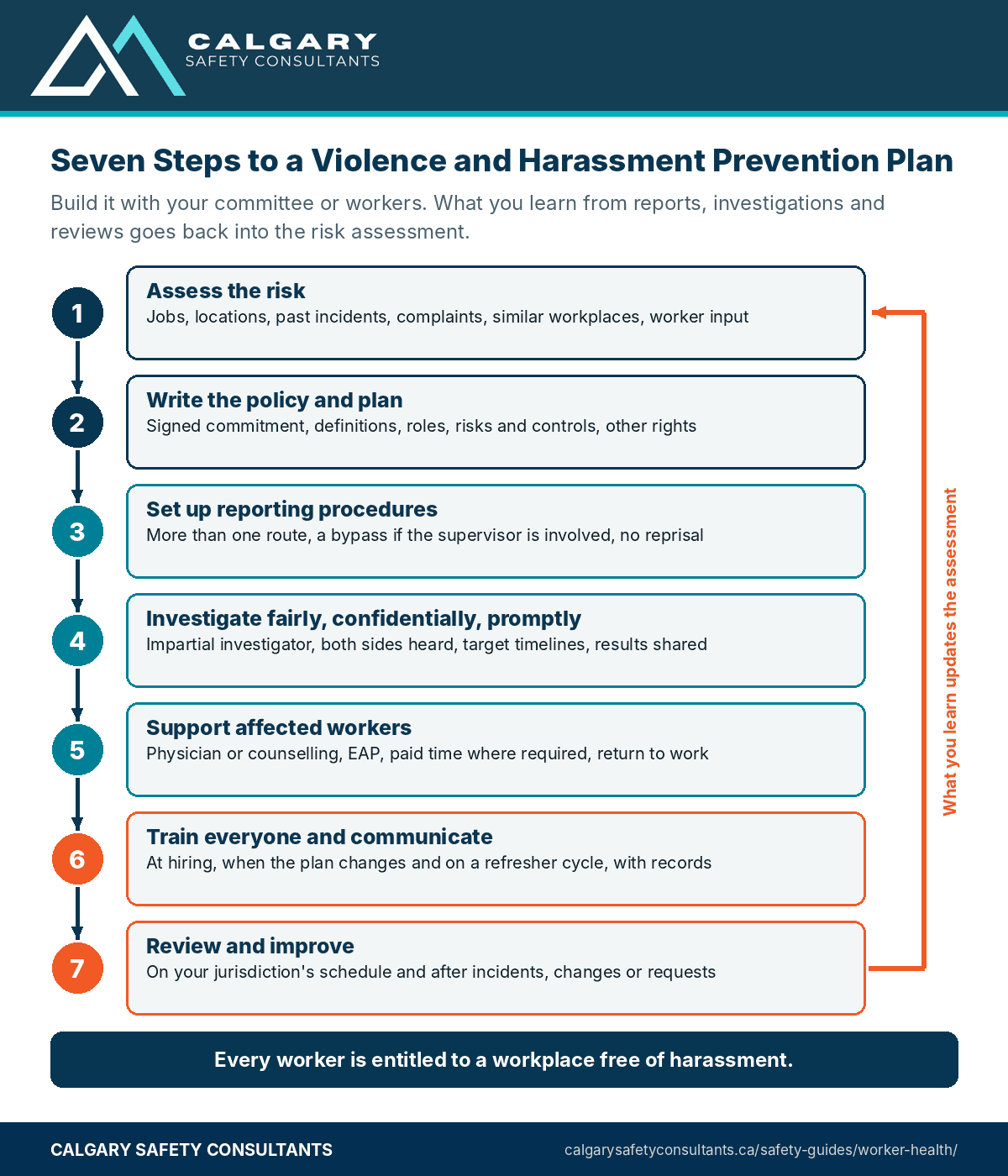
Work through the steps with your committee or representative, or with your workers if you have neither. Most jurisdictions require that consultation, and workers know where the real risks are.
Step 1: Assess the Risk
The risk assessment tells you where to focus, and our article on how to conduct a workplace violence and harassment risk assessment covers it in detail. Look at each job and location, ask what could happen, and rate how likely and serious it would be. Review past incidents, complaints and claims, talk with workers or run a short anonymous survey, and consider similar workplaces. Common risk factors include:
- working with the public, clients or patients, especially people in distress or impaired
- handling cash, medication or valuables
- working alone, at night or at remote sites and camps
- enforcing rules or refusing service
- large power differences, poor supervision or a culture that tolerates crude jokes
- contact through texts and social media (Ontario's definition of harassment now expressly covers harassment done virtually), and a worker known to be at risk of domestic violence
Choose controls with the hierarchy of controls: secure entrances, lighting and panic buttons, then staffing, cash limits and check-ins from our working alone guide. For harassment, leadership behaviour and clear procedures do most of the work. Add the hazards to each role's job hazard analysis.
Auditors will look for this. Energy Safety Canada's 2023 COR audit protocol asks whether hazards have been identified for each task, and its examples of psychological hazards include harassment and bullying.
Step 2: Write the Policy and Plan
The policy is the short, signed statement of what your organization stands for. The plan is the detail behind it. Many employers combine them in one document, as Alberta now requires. Write it in plain language, because the people who need it most may be reading it on a bad day. A complete harassment prevention plan usually covers:
- Commitment and scope: signed by the most senior leader, covering workers, contractors, clients and visitors
- Definitions that match your law, with examples, including what reasonable management action looks like
- Roles for leaders, supervisors, workers, the committee and investigators
- Risks and controls for each job or location
- Reporting, investigation and confidentiality procedures, with protection from reprisal
- Supports, domestic violence provisions, training and the review schedule
- Other rights, such as human rights complaints, which the policy doesn't replace
Fit it into your health and safety system. Your health and safety policy, new worker orientation and training matrix, covered in separate guides, should all point to it.
Step 3: Set Up Reporting Procedures
Reporting only works if people trust it. People often hesitate to report harassment because they fear being disbelieved or punished, so make reporting easy and safe.
- Offer more than one route: a supervisor, a named manager and a written or online form. Ontario, B.C., P.E.I. and Newfoundland and Labrador require a route that bypasses the employer or supervisor if they're involved.
- Accept reports in any form, from the person affected or a witness.
- Explain what happens next: who will make contact, how quickly and what choices the person has.
- Protect people from reprisal, and treat retaliation as serious misconduct.
- Plan for emergencies. For violence in progress, get help first: call 911, use the alarm, move to safety. Ontario's violence program must include a way to summon immediate assistance.
Record every report, even ones resolved informally. Three minor complaints about the same person tell you something one report can't.
Step 4: Investigate Fairly, Confidentially and Promptly
A good investigation is fair to everyone, keeps information as private as it can and doesn't drag on. Those qualities give the whole plan its credibility.
- Fair. The investigator should be impartial: not involved, not supervised by the person accused and without a conflict of interest. P.E.I. and the federal rules spell this out. Both sides tell their story and respond to what's said about them.
- Confidential. Share names and details only as needed to investigate, take corrective action or meet the law. Federal investigation reports must not reveal identities.
- Timely. Start quickly, set target timelines and keep the parties updated.
Most investigations follow the same path: protect people in the meantime, interview the person who reported, the person accused and witnesses separately, gather texts, emails and schedules, decide what most likely happened and write a report. Our guides on how to investigate a workplace incident and root cause analysis explain the techniques. Tell the parties the outcome, and track fixes such as discipline, coaching or new controls like any other corrective action. For serious cases, or when a senior leader is involved, consider an external investigator.
Step 5: Support Affected Workers
Someone who has been threatened, assaulted or harassed may need medical care, time and practical help to feel safe at work again. B.C., P.E.I. and Alberta require employers to advise an injured worker to see a physician or health professional of their choice, Saskatchewan's plan must recommend a physician or counselling, and federal employers must share information about support services.
- Check in right away about safety, first aid, a ride home or someone to talk to.
- Offer professional support through an employee assistance program, counselling or victim services.
- Use interim measures carefully. Don't move or penalize the person who reported unless they ask.
- Protect pay where the law treats treatment or counselling time as work.
- Plan the return to work, and remember witnesses and co-workers.
An injury from workplace violence, including a psychological injury, may also need to be reported to your workers' compensation board.
Step 6: Train Everyone and Communicate the Plan
A plan that sits in a binder protects nobody. Training should cover what violence and harassment look like, the risks and controls for each job, how to respond and get help, how to report and what happens next. Supervisors also need to know how to receive a report, keep it confidential and support people.
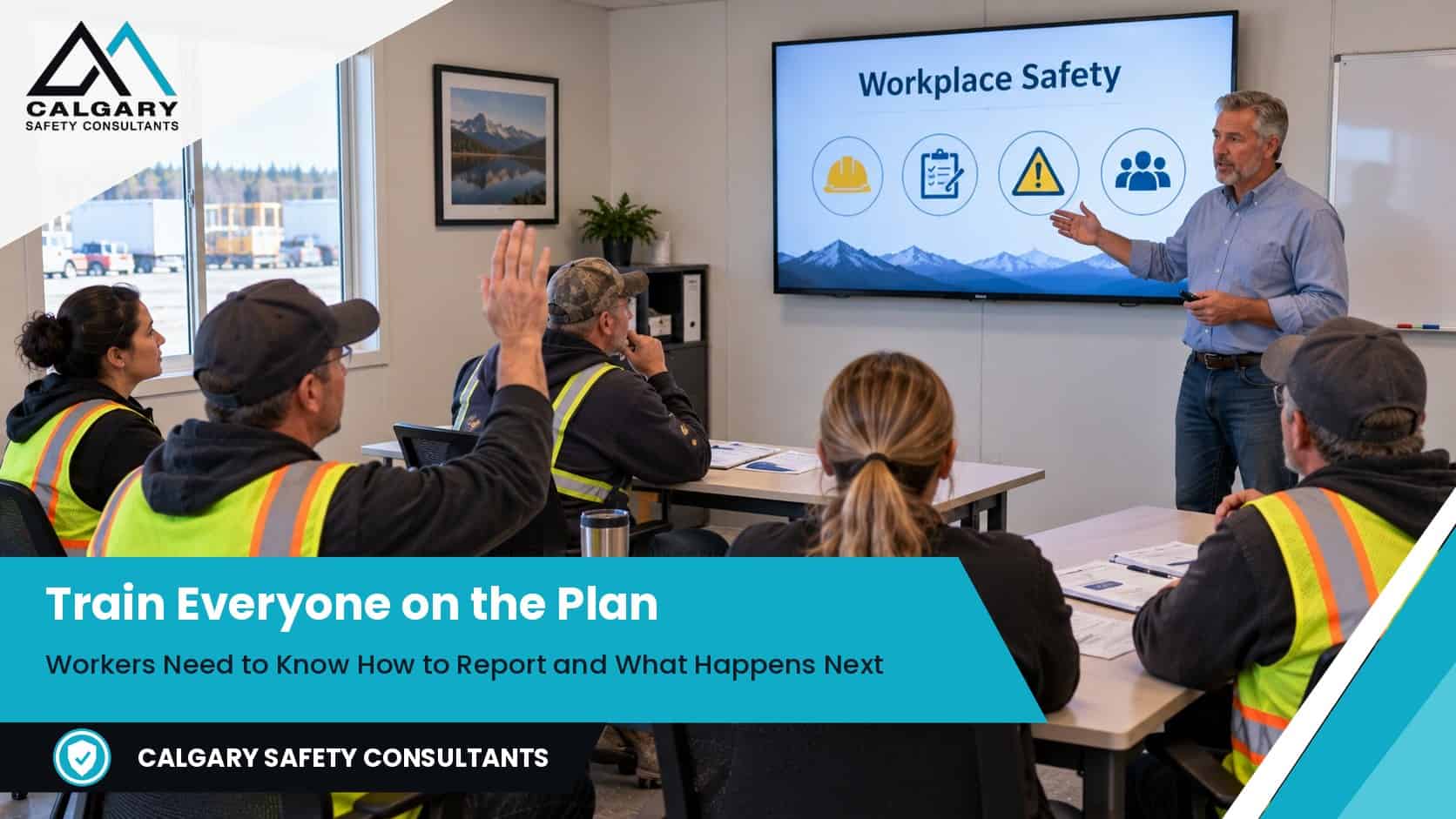
Train at hiring, when the plan changes and on a regular refresher cycle. The federal rules set a clear benchmark: within three months of starting and at least every three years. Keep records of who was trained, when and on what, and repeat the message in orientation, toolbox talks and committee meetings.
Step 7: Review and Improve
Review deadlines vary, from at least annually in Ontario, New Brunswick, Newfoundland and Labrador and for B.C.'s bullying and harassment procedures, to every three years in Alberta, Saskatchewan and for Nova Scotia's harassment policy, and every five years for Nova Scotia's violence plans. A yearly review works well for most employers, plus an extra review after a serious incident, a pattern of complaints, a change in work or a request from your committee.
Look at evidence, not just wording. How many reports came in, and is silence a good sign or a warning? Were investigations finished on time? Did corrective actions work? Is training up to date? Has the law changed? Record the review and the changes, share a summary with your committee or workers, and update the risk assessment so the cycle starts again.
Workplace example
A Practical Workplace Example
Situation: Consider an illustrative property management company in Saskatchewan with about 45 workers: office staff, a rental counter and maintenance crews who enter tenants' suites. Its harassment policy dated from years earlier and nobody could remember seeing it. After a tenant threatened a maintenance worker, and an office worker quietly told a manager about repeated comments from a supervisor, the owner realized there was no clear process for either situation.
Action: With the occupational health committee, the safety coordinator ran a risk assessment for each role, using incident records and a short anonymous survey. The company combined its harassment policy and a new violence policy statement and prevention plan into one document, added a reporting route to the general manager for complaints about supervisors, and set target timelines for investigations.
Maintenance workers got a check-in procedure and a rule that two people attend suites flagged for threats. Everyone took a short training session, and supervisors had an extra session on receiving reports.
Result: In the first year, the company received six reports, compared with none the year before. Two led to investigations by an external investigator, with written outcomes and corrective action. The survey repeated a year later showed more workers saying they knew how to report and believed they'd be taken seriously, and the committee's review added better lighting at the rental counter.
Common Mistakes to Avoid
- Copying a template without a risk assessment. A generic policy won't name your real risks or controls.
- Only one way to report. If the only route runs through the supervisor, people won't report the supervisor.
- Treating a drop in reports as success. Few reports often means low trust, not low risk.
- Investigations by someone involved. A manager investigating their own team member, or a friend, undermines the result.
- Promising total confidentiality. You can't keep everything secret and still investigate. Explain the limits honestly.
- Moving the person who complained. Unless they ask for it, it looks like punishment and discourages others.
- Forgetting third parties. Clients, contractors and visitors can be the source of violence and harassment, and the plan should cover them.
- Training once and never again. Turnover, new supervisors and changes to the law all call for refreshers.
- Missing review dates. An out-of-date plan is one of the first things a regulator or auditor will notice.
Audit perspective
What an Auditor Expects to See
In a COR or SECOR audit, violence and harassment usually come up under hazard assessment and hazard control, and again in interviews. As noted above, Energy Safety Canada's audit protocol expects hazards to be identified for each task, and it names harassment and bullying among psychological hazards.
An auditor will typically look for a current, signed policy and plan that matches your jurisdiction's requirements, a documented risk assessment with controls, training records, and investigation files showing reports were handled and corrective actions were closed. Workers should be able to explain how they'd report a problem, and supervisors how they'd respond. The plan's review dates will be checked too.
Calgary Safety Consultants helps employers build and review their programs and prepare for COR and SECOR audits; we don't issue certificates. CORs and SECORs are issued through the applicable certifying partner.
The Bottom Line
Every Canadian employer needs a way to prevent and respond to workplace violence and harassment, whatever the law calls it. Start with an honest risk assessment, write a plain-language policy and plan that meets your jurisdiction's rules, and give people safe ways to report.
Then do what you said you'd do. Investigate fairly, confidentially and promptly, support the people affected, train everyone and review the plan on schedule. A workplace violence and harassment prevention plan earns its value on the day someone needs it, and the trust you build before that day is what makes them use it.
Download the Risk Assessment Worksheet and Prevention Plan Checklist
Two free, fillable PDF downloads go with this guide. Both have clickable checkboxes and fill-in fields, so you can complete them on screen or print them for your committee meeting.
- Violence and Harassment Risk Assessment Worksheet (PDF, 6 pages). A step-by-step worksheet for work activities and locations, risk factors with checkboxes, past incidents and complaints, likelihood and severity ratings, controls chosen by the hierarchy of controls, an action plan, a record of worker consultation, key terms, worked prompts, common mistakes and sign-off.
- Violence and Harassment Prevention Plan Checklist (PDF, 6 pages). A checklist of plan and policy contents, a jurisdiction-by-jurisdiction requirements table, reporting and investigation procedure checklists, a supports checklist, a training and communication record, an annual review record and sign-off.
Click either button to download the file. Adapt both to your own workplace and the rules that apply in your province or territory, or under the Canada Labour Code.

About the author
John Duplessis, B.Sc., CRSP
John Duplessis is a Canadian Registered Safety Professional with more than 30 years of occupational health and safety experience in oil and gas, construction, green energy, midstream operations and industrial project work. He is an external auditor with Energy Safety Canada.