
On this page
- What a JHSC Meeting Is and Why It Matters
- JHSC Meeting Requirements by Jurisdiction
- Who Does What: Co-Chairs, Recorder and Members
- Before the Meeting: Plan the Agenda and Prepare Members
- A Standard JHSC Meeting Agenda
- Running the Discussion and Reaching Consensus
- Turning Concerns Into Recommendations
- Handling Disagreement and When to Call the Regulator
- After the Meeting: Minutes, Posting and Follow-Up
- Keeping the Meeting Short and Useful
- Virtual and Multi-Site Meetings
- Measuring Whether Your Committee Is Working
- How JHSC Meetings Show Up in a COR Audit
- A Practical Workplace Example
- Common JHSC Meeting Mistakes to Avoid
- What an Auditor Expects to See
- The Bottom Line
- Download the Agenda and Action Item Tracker
- Frequently Asked Questions
- Related Guides and Articles
- How Calgary Safety Consultants Can Help
- Sources
What a JHSC Meeting Is and Why It Matters
A joint health and safety committee, or JHSC, is a group of worker and management representatives who meet regularly to find and fix health and safety problems at their workplace. The meeting is where most of that work comes together. It's where inspection findings, incident reports and worker concerns are reviewed, where the committee decides what to recommend to the employer, and where last month's promises get checked.
A JHSC meeting is not a toolbox talk. It's a working session with a legal purpose: across Canada, committees receive worker concerns, take part in inspections and investigations and make recommendations to the employer. A meeting that only reads out statistics isn't doing that job, however tidy the paperwork looks.
When the JHSC meeting works, it's one of the cheapest safety tools an employer has. Workers raise problems before someone gets hurt, and small fixes happen quickly because the people who can approve them are in the room. When it doesn't, the same items roll from one agenda to the next.
If you're not sure whether your workplace needs a committee or a representative at all, start with our article on when a health and safety committee is legally required. Our upcoming guide, How to Set Up a JHSC, will cover forming the committee, choosing members and writing terms of reference.
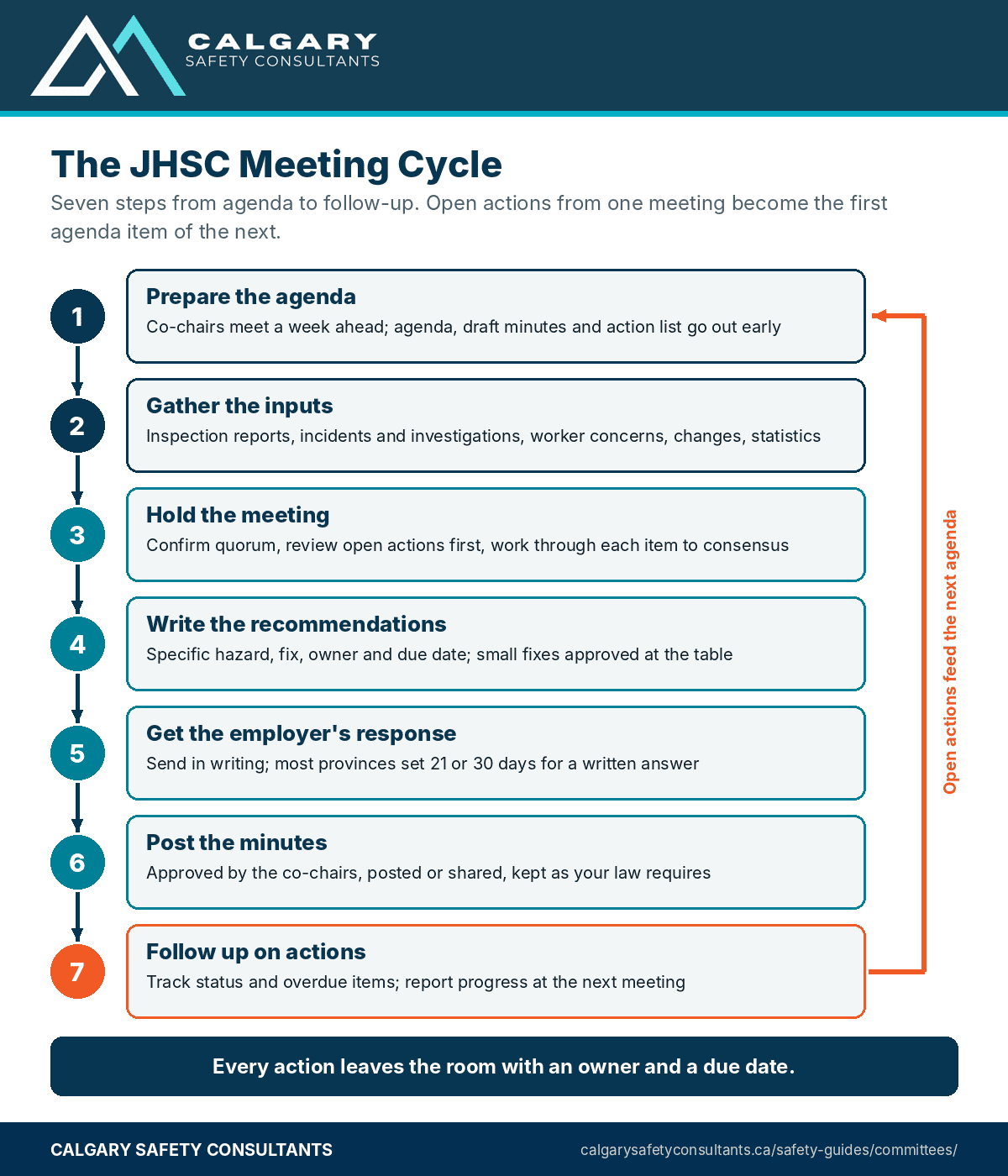
JHSC Meeting Requirements by Jurisdiction
Every province, territory and the federal jurisdiction sets its own meeting rules, and even the name changes: Saskatchewan has an occupational health committee, Manitoba a workplace safety and health committee and Quebec a comité de santé et de sécurité. The tables summarize the rules with section references.
Meeting frequency, co-chairs and quorum
| Jurisdiction | Committee name and when required | Minimum meetings | Co-chairs and quorum |
|---|---|---|---|
| Alberta | Joint health and safety committee (HSC); 20 or more regularly employed workers (OHS Act s. 13) | Alberta's OHS Code doesn't set a fixed minimum; the committee's terms of reference must say how often it meets (Code s. 197). Meetings are held during normal working hours (Act s. 13(7)), and a special meeting must be held if an OHS officer asks (Code s. 198) | Two co-chairs, one chosen by worker members and one by employer members (Code s. 196.2); quorum is half the members, with both sides present and at least half of those present workers (s. 199) |
| British Columbia | Joint health and safety committee; 20 or more workers (WCA s. 31) | At least once each month (s. 37(2)) | Two co-chairs, one chosen by each side (s. 33(d)) |
| Saskatchewan | Occupational health committee (OHC); 10 or more workers | At intervals not over 3 months, after a monthly start-up period (Regulations s. 4-4) | Two co-chairs (s. 4-6); quorum is half the members, at least half of those present workers (s. 4-3) |
| Manitoba | Workplace safety and health committee; 20 or more workers | At regular intervals not exceeding three months (WSH Regulation s. 3.3) | Two co-chairs chosen by committee members (Act s. 40(8)(b)), who alternate; quorum is half the worker members and half the employer members (Regulation s. 3.5) |
| Ontario | Joint health and safety committee (JHSC); 20 or more regularly employed workers (OHSA s. 9(2)) | At least once every three months (s. 9(33)) | Two co-chairs (s. 9(11)); no quorum set in the Act |
| Quebec | Comité de santé et de sécurité (health and safety committee); 20 or more workers | 4, 6 or 9 a year by level, at least every 3 months (r. 8.3, s. 19; in force October 1, 2025; rules apply unless the committee has an agreement, s. 17) | Two alternating co-chairs (ss. 21, 22); quorum is half the worker representatives plus one employer representative (s. 26) |
| Federal | Workplace health and safety committee, 20 or more employees (CLC s. 135); policy committee, 300 or more (s. 134.1) | Workplace committee nine times a year (s. 135(10)); policy committee quarterly (s. 134.1(7)) | Two chairpersons (s. 135.1(7)); quorum is a majority, at least half employee members (SOR/2015-164 s. 7) |
| Nova Scotia | Joint occupational health and safety committee; 20 or more employees | At least once each month unless the rules of procedure say otherwise (s. 30(4)) | Two co-chairs unless the rules provide otherwise (s. 30(8)) |
| New Brunswick | Joint health and safety committee; 20 or more employees | At least once a month (s. 14(6)), unless reduced for low risk (s. 16(1)) | A co-chair elected by each side (s. 14(5)) |
| Prince Edward Island | Joint occupational health and safety committee; 20 or more workers | At least once each month unless the rules of procedure say otherwise (s. 25(8)) | Not set in the Act's committee sections; cover it in your rules of procedure |
| Newfoundland and Labrador | Occupational health and safety committee; 20 or more workers | At least once every 3 months, during regular working hours (s. 40) | A co-chair elected by each side (Act s. 38(6)); quorum is half the members, with employer and worker members equally represented (Regulations s. 25(5)) |
| Northwest Territories and Nunavut | Joint occupational health and safety committee; 20 or more workers | At intervals not over three months, after a monthly start-up period (Regulations s. 42) | Two co-chairs (s. 44); quorum is half the members, at least half of those present workers (s. 41) |
| Yukon | Joint health and safety committee; 20 or more workers (WSCA s. 36) | Once each month or more often when required, during regular working hours (s. 37) | Worker and employer co-chairs who alternate as chair (s. 37) |
Paid time, minutes and the employer's response
| Jurisdiction | Paid time | Minutes or meeting reports | Employer response to recommendations |
|---|---|---|---|
| Alberta | Time away for committee work and entitlement to pay (Code s. 199.3) | Terms of reference must say how records are kept (Code s. 197); special meeting minutes kept 2 years (Part 13) | No fixed period; the terms of reference must cover forwarding concerns to the employer and resolving disputes (Code s. 197) |
| British Columbia | Meetings and reasonably necessary preparation, paid as time worked (s. 40) | Report of each meeting, kept 2 years (s. 43); latest 3 posted (s. 44) | Written, within 21 days of a request (s. 39(2)) |
| Saskatchewan | No loss of pay for regular or special meetings (s. 4-11(2)) | Ministry format, posted until concerns are resolved (s. 4-5) | Written, after notice of an unsafe condition (s. 3-17(2)) |
| Manitoba | Meetings plus at least one hour to prepare (Act s. 40(11)) | Signed by both co-chairs and posted (Regulation s. 3.7); keep 10 years (SAFE Work Manitoba advice) | Written, within 30 days (Act s. 41.1(2)) |
| Ontario | Meetings plus one hour of preparation (s. 9(34), (35)) | Recorded for every meeting (s. 9(22)) | Written, within 21 days (s. 9(20), (21)) |
| Quebec | Worker representatives deemed at work during meetings (Act s. 76) | Approved at the next meeting, kept 5 years (r. 8.3, s. 29) | Written reply on points of disagreement (Act s. 79) |
| Federal | Meetings and preparation (CLC s. 135.1(10), (11)) | Approved by both chairpersons, available to employees, kept 2 years (SOR/2015-164 s. 8) | Written, within 30 days (CLC s. 125(1)(z.10)) |
| Nova Scotia | Deemed work time, paid (s. 30(6)) | Approved form (s. 31(g)); latest posted (s. 37) | Written, within 21 days of a request (s. 34(1)) |
| New Brunswick | Paid at the member's rate for meetings (s. 14.1(6)) | Approved form, latest posted, kept 3 years (s. 14(8) to (10)) | No fixed period; if the committee can't agree on a matter, it must call an officer (s. 14(13)) |
| Prince Edward Island | Deemed work time with usual pay (s. 25(10) and (11)) | Approved form (s. 25(7)(g)); latest posted by the employer (s. 27(7)(b)) | Written, within 30 days of a request (s. 27(1)) |
| Newfoundland and Labrador | No loss of pay for meetings (s. 40) | Recorded on the Commission's form, one copy on file and one posted (OHS Regulations s. 25(2)) | Written, within 30 days (s. 5(f.1)) |
| Northwest Territories and Nunavut | No loss of pay or benefits (s. 47) | Recorded, kept on file and posted (s. 43) | Written, as soon as reasonably possible (s. 52) |
| Yukon | Committee work is paid work time (s. 42) | Committee keeps records of its duties (s. 38) | No fixed period stated by the regulator |
Thresholds, exceptions and project-site rules vary, and many provinces let the committee or regulator set a different schedule. Check the current law for your jurisdiction; our OHS legislation guide links them all.
The official sources behind the tables, and a few details worth knowing:
- Ontario. The committee guide confirms meetings can be in person or virtual, and either co-chair can send written recommendations when the committee can't reach consensus.
- British Columbia. The Workers Compensation Act calls the meeting record a report, which the employer keeps for two years.
- Alberta. The OHS Act sets the committee's duties, and OHS Code Part 13 covers co-chairs, quorum and pay. Alberta's committee information sheet explains them.
- Saskatchewan. Under the OHS Regulations, 2020, business done without quorum isn't valid. The ministry's OHC page adds five days of education leave a year.
- Manitoba. See SAFE Work Manitoba on creating a committee and the province's committee FAQ, which says the 30-day response must include interim controls and reasons for disagreeing.
- Quebec. The CNESST notes a workplace agreement can adapt operating rules. Otherwise the regulation on participation mechanisms and the Act respecting occupational health and safety apply.
- Federal. See the Canada Labour Code, its section 125 duty to respond within 30 days, and the committee regulations.
- Atlantic Canada. See the OHS Acts of Nova Scotia, New Brunswick, Prince Edward Island and Newfoundland and Labrador. In Newfoundland and Labrador, the employer must keep sending written updates until an accepted recommendation is in place, and the OHS Regulations, 2012 set the quorum and require minutes to be recorded and posted.
- The North. The WSCC's joint committee code of practice for the Northwest Territories and Nunavut suggests answering within 21 calendar days. See also Yukon's committee guidance.
Who Does What: Co-Chairs, Recorder and Members
Most JHSC meetings run on three roles, best written into the terms of reference.
- The co-chairs. One represents workers and one represents the employer. Together they build the agenda, chair the meeting, keep discussion on track and sign or approve the minutes. Many committees alternate who chairs each meeting, and Manitoba, Quebec, Yukon and the federal regulations expect it. Between meetings, the co-chairs are the committee's link to the employer and to the workers they represent.
- The recorder. Someone captures decisions, owners and dates as the discussion happens. It can be a member or an administrative support person, but not whoever is chairing. A good recorder reads back each action before moving on.
- The members. Members bring the concerns of the people they represent, report on inspections and investigations they took part in, and help decide what to recommend. Worker members shouldn't be outnumbered by management members, and in Alberta, British Columbia and Saskatchewan, for example, the law says so.
Managers who can approve spending and subject experts can be invited for a single item, but they shouldn't take over the meeting. Comcare, the Australian federal regulator, makes a useful point in its guide to effective health and safety committees: having someone in the room who can approve actions on the spot encourages members, because they see their recommendations put into practice.
Training makes every role easier, and several jurisdictions require it for co-chairs or members. Our joint health and safety committee and representative training covers committee roles, meetings and action items, inspections, investigations and recommendations.
Before the Meeting: Plan the Agenda and Prepare Members
The quality of a JHSC meeting is mostly decided before anyone sits down. About a week ahead, the co-chairs should meet for 15 minutes to build the agenda together. That short meeting is where they check which actions are due, which inspection and incident reports are ready, and which worker concerns came in since last time.
- Send the agenda early. Get the agenda, last meeting's draft minutes and the action list to members at least three working days before the meeting. Comcare's guide says the agenda should go to all members before the meeting and should stay focused on health and safety issues.
- Attach the inputs. Include inspection reports, incident summaries and statistics, so members read them beforehand.
- Ask members to collect concerns. Worker members should bring specific concerns: where, what and who is exposed.
- Book the time. Tell supervisors in advance so members aren't pulled back to production.
- Use the terms of reference. Alberta's sample terms of reference is a practical starting point for writing down how your committee schedules meetings, sets the agenda and handles recommendations, and the government says to customize it to your work site.
U.S. OSHA's recommended practices on worker participation put it simply: give workers the time and resources to take part, and make sure people at every level can participate regardless of skill level, education or language.
A Standard JHSC Meeting Agenda
Using the same agenda structure every time makes the JHSC meeting faster, because members know what's coming and what to bring. Here is a standard order that works for most committees.
- Opening. Confirm quorum, note who is present and absent, and agree on the agenda.
- Review of the last minutes. Correct and approve the previous minutes. Keep this to a few minutes.
- Outstanding action items. Go through every open item: done, on track, overdue or blocked. This is the most important item, so keep it near the top.
- Employer responses. Review written responses to the committee's recommendations and decide whether each needs follow-up.
- Inspection reports. Review findings from the month's workplace inspections and whether the hazards found have been controlled.
- Incidents and investigations. Review incidents, near misses, investigation findings and their corrective actions.
- Worker concerns. Hear new concerns raised by workers, and agree on how each will be handled.
- New hazards and changes. Discuss new equipment, processes, chemicals or layouts, ideally before they happen.
- Training and communication. Note committee training, worker training needs and what the committee wants to tell the workforce.
- Statistics and trends. Look briefly at injury and incident numbers, first aid cases and inspection trends.
- New recommendations. Confirm the recommendations the committee is sending to the employer at this meeting.
- Close. Read back the actions, confirm the date of the next meeting and any special topics for it.
Our free JHSC meeting agenda, below, follows this order and includes a pre-meeting and post-meeting checklist.
Running the Discussion and Reaching Consensus
The chair's job during the JHSC meeting is to make sure every item gets a fair hearing and a clear outcome. The best chairs say very little themselves. They ask questions, keep time and make sure quieter members, often front-line workers, get heard before managers weigh in.
- Start every item with the facts. What was found, where and who is exposed?
- Separate the problem from the fix. Agree on the hazard first, then talk about controls. The hierarchy of controls helps the committee look past "retrain the worker" toward fixes that remove or reduce the hazard.
- Aim for consensus, not votes. Committees work best when worker and employer members agree on a recommendation. Consensus doesn't mean everyone loves the answer; it means everyone can live with it and will support it.
- Park items that need information. If the committee needs a quote or test result, assign someone to bring it back.
- Close each item out loud. State the decision, owner and due date, and have the recorder confirm it.
ISO 45001, the international standard for occupational health and safety management systems, treats consultation and participation of workers as a core requirement. A JHSC meeting where workers speak, are listened to and see results is the most visible place an employer can show it.
Turning Concerns Into Recommendations
A worker concern becomes useful when the committee turns it into something the employer can act on. Many committees lose credibility here: everyone agrees something should be done, and nothing specific is written down.
A strong recommendation is specific. It names the hazard and where it is, says what the committee recommends and why, proposes an owner, and suggests a reasonable date. Compare "look at the loading dock" with "install a dock lock or wheel chocks at doors 3 and 4, where trailers have crept during loading twice this month, by March 31." The second one can be answered with a yes, a no or a date.
- Fix it now if you can. Many concerns can be resolved by the manager at the table without a formal recommendation. Record them as actions with an owner and date.
- Write formal recommendations for the rest. Anything that needs a decision above the committee, or that the employer hasn't fixed, should go to the employer in writing. In most provinces, a written recommendation starts the clock on the employer's 21-day or 30-day answer (in British Columbia, Nova Scotia and Prince Edward Island, the committee must also ask for a response in writing).
- Track every item. Use one action list for both, with the source, the date raised, the owner, the due date, the status and the date the employer responded. Our free JHSC action item tracker does this automatically and flags anything overdue.
Our guide to managing corrective actions covers how to follow actions through to completion and check that they worked. A separate guide, How to Write JHSC Minutes and Recommendations, coming on October 26, will go deeper into wording recommendations and minutes.

Handling Disagreement and When to Call the Regulator
Worker and employer members won't always agree, and that's normal. What matters is how disagreement is handled.
- Get the facts straight first. Most disagreements are about facts: how often something happens, who is exposed, what a control costs. Assign someone to bring back the missing information.
- Record both views. If the committee can't agree, record each side's position fairly.
- Use the co-chair route. In Ontario, either co-chair can send written recommendations when the committee can't reach consensus. In Quebec, worker representatives can present written recommendations and employer representatives must reply in writing.
- Know when to escalate. If the employer doesn't respond within the legal time, or a serious hazard isn't being controlled, the committee or any member can contact the regulator. Nova Scotia and Prince Edward Island require an unacceptable delay to be reported to an officer, Manitoba lets any party refer an unresolved response to a safety and health officer, and New Brunswick tells committees to call an officer when a problem can't be resolved.
Calling the regulator should be the exception, not a threat. But everyone should know the committee isn't the last stop if recommendations are ignored.
After the Meeting: Minutes, Posting and Follow-Up
The JHSC meeting isn't finished when people leave the room. Within a few days, the recorder should circulate draft minutes to the co-chairs, the co-chairs should approve or sign them, and the minutes should be posted or shared where workers can see them. Saskatchewan's guidance on OHC meeting minutes is a good model: post them where workers can easily get to them and leave them up until every concern in them is resolved.
Send formal recommendations to the employer in writing right away, with the date, so the response clock starts. Update the action list the same day, while it's fresh. Keep minutes and reports for at least as long as your jurisdiction requires, which ranges from two years federally and in British Columbia to five years in Quebec.
Minutes don't need to be long. They need to show who attended, what was decided and who is doing what by when.
Keeping the Meeting Short and Useful
Most committees can run a solid JHSC meeting in 60 to 90 minutes. If yours regularly runs over two hours, or finishes in 20 minutes with nothing decided, something is off.
- Read before, discuss during. Reports go out with the agenda; the meeting is for decisions.
- Time-box the agenda. Give each item a rough number of minutes.
- Handle small fixes outside the meeting. Fix a missing sign when it's found, then report it as done.
- Keep the committee a workable size. Comcare suggests about six to 12 members. Larger committees tend to talk more and decide less.
- Use special meetings for urgent items. A serious incident or a work refusal shouldn't wait for the next regular meeting, and several jurisdictions, including Saskatchewan and the Northwest Territories and Nunavut, let either co-chair call a special meeting.
Build the meeting schedule around inspections, the committee's main source of fresh information. Our guide on how to conduct a workplace safety inspection explains how to make each one count.
Virtual and Multi-Site Meetings
Video calls make it easier for committees with shift workers, remote sites or several locations to meet. Ontario's guide confirms a committee can meet in person or virtually. A few practices keep a virtual JHSC meeting as useful as an in-person one.
- Check that your rules allow it. Write the option into your terms of reference or rules of procedure, and confirm quorum counts people who join remotely.
- Make sure everyone can connect. Book a room with a screen at each site.
- Share the screen. Update the action list live so everyone sees the same decisions.
- Bring every site in. Give each site a standing agenda slot.
- Don't replace the walk-around. Virtual meetings can't replace physical inspections. Members still need to see the workplace.
SafeWork NSW's guidance on health and safety committees in Australia makes a point that applies here too: employers must give members the time that's reasonably necessary to attend meetings and pay them at their normal rate. Connection problems and production pressure shouldn't quietly take that away.
Measuring Whether Your Committee Is Working
Meeting on schedule isn't the same as working. A few simple measures show whether your JHSC meetings lead to safer work.
- Actions closed on time. The share of actions completed by their due date, and the number overdue.
- Response time. How many days the employer takes to answer recommendations, compared with the legal limit.
- Worker concerns raised. A committee that hears no concerns for months is usually one workers don't trust or don't know about.
- Attendance and quorum. Meetings held on schedule, with quorum.
- Repeat findings. A hazard that keeps coming back means the fix didn't work.
In British Columbia, employers must evaluate the joint committee every year, and WorkSafeBC's JHSC evaluation tool is a ready-made template that works well in any province. Research supports doing this honestly: in a study that developed a tool to assess committee functioning and effectiveness, hospital committee members lowered their self-assessment scores after their meetings, and the authors found the tool helped members discuss and agree on where the committee stood. Our action item tracker calculates several of these measures for you.
How JHSC Meetings Show Up in a COR Audit
The committee is part of the major COR audit standards. Energy Safety Canada's 2023 COR audit protocol has a full element, Element J, on the joint health and safety committee and representative, covering how the committee is designed, implemented and involved in the program.
In Ontario, IHSA's COR 2020 audit tool doesn't have a separate committee element, but its management review requires the results of participation and consultation with the committee, and its inspection element looks for worker participation.
Auditors look for evidence that the committee meets as required and that its work leads to action. Our guide on how to prepare for a COR audit explains the wider audit, and the auditor's view is below.
Workplace example
A Practical Workplace Example
Situation: Consider a metal fabrication shop in Manitoba with about 60 workers on two shifts. Its workplace safety and health committee met every quarter, but meetings ran nearly two hours and mostly involved reading the previous minutes and the injury statistics aloud. Night shift members rarely came. The action list had 23 open items, some more than a year old, and workers on the floor said they didn't bother raising concerns because nothing happened.
Action: The co-chairs started meeting a week ahead to build the agenda, with outstanding actions at the top. Reports went out three days early, so the meeting was used for decisions. The plant manager joined for the action review so small fixes could be approved at the table. Each recommendation had a location, an owner and a date, went to the employer the next day and was logged in a tracker. A room with a video link let night shift members join.
Result: Within two quarters, meetings were down to about 75 minutes, the open action list had dropped to seven items, and the employer was answering written recommendations well inside Manitoba's 30-day limit. Night shift attendance went up, and the number of worker concerns brought to the committee doubled, which the co-chairs saw as a sign of trust rather than a problem.
Common JHSC Meeting Mistakes to Avoid
- No agenda, or one that never changes. If the agenda is the same list of headings with nothing behind them, members stop preparing.
- Burying the action list at the end. Open actions should be reviewed early, while there's time and energy to deal with them.
- Reading reports aloud. It wastes the meeting. Send them ahead and use the time for decisions.
- Vague recommendations. "Look into it" can't be accepted, rejected or tracked. Name the hazard, the fix, the owner and the date.
- Managers outnumbering or out-talking workers. The committee is joint for a reason. If worker members stop speaking, the committee stops working.
- Missing the employer's response deadline. In most provinces, a written recommendation starts a 21-day or 30-day clock.
- Minutes that never leave the binder. Workers should be able to see what the committee is doing about their concerns.
- Cancelling meetings when it's busy. Missing the minimum schedule is a compliance gap, and it tells workers safety comes second.
Audit perspective
What an Auditor Expects to See
An auditor reviewing the committee wants to see that it exists as the law requires, meets as often as required and makes a difference. That usually means terms of reference, a current membership list with worker members chosen by workers, meeting minutes for the audit period that show quorum and the required frequency, inspection and investigation involvement, written recommendations and the employer's responses, and an action list that shows items being closed.
Interviews complete the picture. Workers should know who their committee members are and how to raise a concern, and committee members should be able to describe a recent recommendation and what happened to it. Minutes that show the same items open for months, or meetings missed without explanation, are where audit marks are lost.
Calgary Safety Consultants helps employers set up committees, train members and prepare for COR and SECOR audits; we don't issue certificates. CORs and SECORs are issued through the applicable certifying partner.
The Bottom Line
A good JHSC meeting comes down to a simple routine: plan the agenda with both co-chairs, send it out early with the reports attached, review open actions first, turn every concern into a specific action or recommendation with an owner and a date, and follow up in writing. The law sets the minimum schedule, paid time and response deadlines for your jurisdiction, but it's the routine that makes the committee worth the time.
Start with your next JHSC meeting. Move the action list to the top of the agenda, write down owners and dates for everything, and see how much changes in one quarter.
Download the JHSC Meeting Agenda and Action Item Tracker
Two free downloads go with this guide.
- JHSC Meeting Agenda and Checklist (PDF). A two-page fillable form with the standard agenda in this guide, space for attendance, quorum and decisions, and a pre-meeting and post-meeting checklist with clickable checkboxes.
- JHSC Action Item Tracker (Excel). One row for each concern, action or recommendation, with its source, date raised, owner, due date, status and employer response date, plus automatic days-open counts, overdue flags and a summary tab for your next JHSC meeting.
Click either button to download the file. Adapt both to your committee, your terms of reference and the law where you work.

About the author
John Duplessis, B.Sc., CRSP
John Duplessis is a Canadian Registered Safety Professional with more than 30 years of occupational health and safety experience in oil and gas, construction, green energy, midstream operations and industrial project work. He is an external auditor with Energy Safety Canada.