On this page
- What SECOR Is and Why Small Employers Get One
- How SECOR Differs From COR
- Small-Employer Certification Across Canada
- SECOR in Western Canada and Yukon
- Ontario, Quebec, Atlantic Canada and the North
- Are You Eligible, and Is SECOR the Right Fit?
- The Training You'll Need
- Building a Safety Program That Fits a Small Business
- The Records to Have Ready for the Previous 12 Months
- How the SECOR Evaluation Works
- If You Already Hold a SECOR
- Workers' Compensation Rebates and Incentives
- What the Evaluation Looks For
- A Practical Workplace Example
- Common SECOR Mistakes to Avoid
- What an Auditor Expects to See
- The Bottom Line
- Download the Checklist and Records Tracker
- Frequently Asked Questions
- Related Guides and Articles
- How Calgary Safety Consultants Can Help
- Sources
What SECOR Is and Why Small Employers Get One
SECOR stands for Small Employer Certificate of Recognition. It's the small-business version of the Certificate of Recognition, or COR, and it shows that a company has a health and safety management system that has been evaluated against an approved standard and met it. The idea is the same as COR, but the training, the audit tool and the evaluation process are sized for a business with a handful of people.
In Alberta, for example, the provincial government describes SECOR as being for businesses with up to 10 employees, with a self-assessment of the health and safety management system reviewed by the certifying partner instead of the external audit a standard COR needs. Other provinces set their limits and processes differently, which is why the first step in any SECOR plan is to find out exactly which program applies to you.
Small employers usually go after a SECOR for three reasons:
- Getting work. Prime contractors, owners and municipalities often ask subcontractors for a COR or SECOR before they'll prequalify them. For a small company, a SECOR can be the difference between bidding on a project and being left off the list.
- Lower premiums. In several provinces and territories, a valid certificate qualifies you for a workers' compensation rebate or incentive. The amounts and rules differ, and we cover them below.
- A safer business. Building the program forces the questions every small employer should answer anyway: what can hurt someone on our jobs, what are we doing about it, and how would we prove it?
Who issues it matters too. SECORs are issued through certifying partners, which are usually industry safety associations, working with the provincial government or workers' compensation board. Consultants, including Calgary Safety Consultants, can help you build the program and prepare for the SECOR evaluation, but CORs and SECORs are issued through the applicable certifying partner.
How SECOR Differs From COR
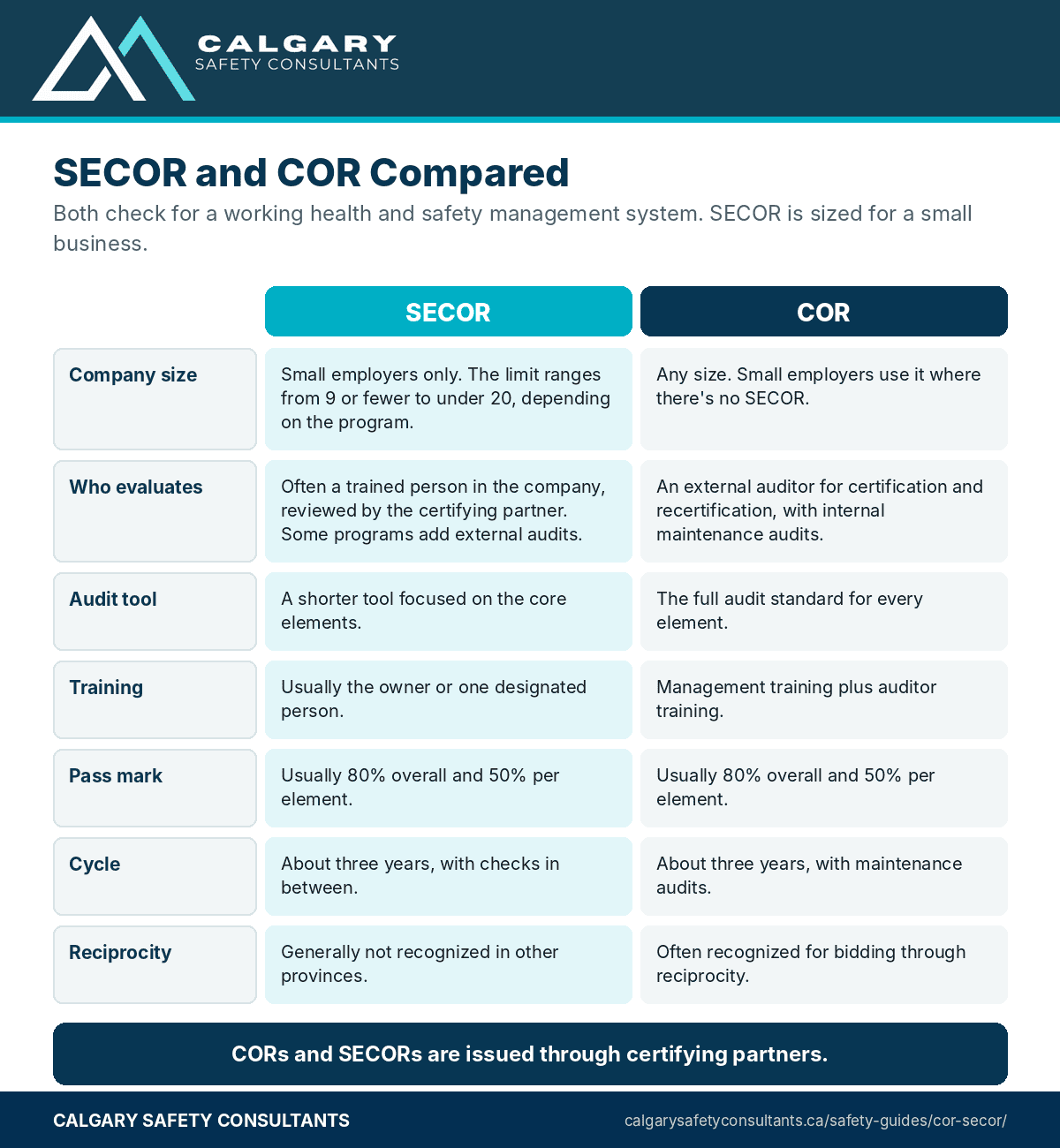
SECOR and COR share the same foundation. Both look at whether you have a written health and safety program, whether it's actually used and whether the people doing the work understand it. The differences are in how the program is evaluated and how much paperwork a small business is expected to carry.
- Company size. SECOR is limited to small employers. The limit is usually around 10 workers, such as 10 or fewer in Alberta and with Energy Safety Canada and fewer than 10 in several other programs, but it ranges up to fewer than 20, depending on the province and certifying partner.
- Who does the evaluation. Many SECOR programs use a self-assessment completed by a trained person inside the company and then reviewed by the certifying partner. Others add an external audit in the first year or every few years.
- The audit tool. SECOR audit tools are generally scaled down from COR tools and focus on the core elements a small business needs, such as hazard assessment, controls, inspections, training, emergency response and incident investigation.
- Training. SECOR training is usually aimed at the owner or one or two designated people, with a lighter course load than full COR, although many programs still include an auditor or evaluation course.
- The pass mark and the cycle. Most programs that publish a SECOR standard use the same pass mark as COR, generally 80% overall with at least 50% in each element, on a cycle of about three years with checks in between.
If your business grows past your program's limit, you'll usually need to move to a full COR. Alberta, for example, offers a transition program for SECOR holders who grow beyond 10 employees. If you expect to grow, it's worth building your program with that move in mind. Our guide on how to prepare for a COR audit explains what the full COR asks for.
Small-Employer Certification Across Canada
There's no single national SECOR. Certification is run province by province and territory by territory, usually through industry safety associations, and only some have a separate program for small employers. Where there isn't one, small businesses either follow a size-based pathway within COR or go through the regular COR, scaled to their size. The Canadian Federation of Construction Safety Associations lists the construction safety associations that run COR in each province and territory that has one, which is a good place to start if you're in construction and not sure who covers your area.
The table below summarizes what we found for each province and territory. Use it as a starting point, then confirm the details with the certifying partner for your industry.
| Province or territory | Small-employer program | Size limit | How it's evaluated |
|---|---|---|---|
| Alberta | SECOR, issued through industry certifying partners such as the Alberta Construction Safety Association and Energy Safety Canada | Up to 10 employees | Self-assessment (SECOR evaluation) reviewed by the certifying partner; a qualified external assessor or auditor is also allowed |
| British Columbia | Small-employer tracks run by certifying partners: SECOR (go2HR, Energy Safety Canada), Small COR (BC Construction Safety Alliance) and small-employer audits in forestry and manufacturing | Fewer than 20 employees for most tracks; 10 or fewer for Energy Safety Canada's SECOR | Audit by a trained internal auditor in most tracks; self-assessment or external auditor with Energy Safety Canada |
| Saskatchewan | SECOR through the Saskatchewan Construction Safety Association, the Heavy Construction Safety Association of Saskatchewan and Energy Safety Canada | Nine or fewer to 10 or fewer, depending on the partner | Internal audits with external audits by the association at set points in the cycle |
| Manitoba | SECOR through the Construction Safety Association of Manitoba and MHCA WORKSAFELY, plus Energy Safety Canada | Fewer than 10 (10 or fewer with Energy Safety Canada) | Self-audit, association audit and independent audit in the first year, then self-audits with verification |
| Ontario | No separate SECOR. COR 2020 is scaled to the size of the business | Any size | Internal audit, IHSA review and external audit |
| Quebec | No SECOR. ASP Construction administers COR in Quebec | Any size | Documentation review, site visit and interviews |
| New Brunswick | No separate SECOR. COR through the New Brunswick Construction Safety Association | Any size | Internal and external evaluation, renewed each year |
| Nova Scotia | Size-based pathways within COR: Owner Operator, Small Business, Intermediate and Standard | Owners count in every category; Small Business is 2 to 4 people | Depends on the size category |
| Prince Edward Island | No COR or SECOR program found | Not applicable | Check with your prime contractor or owner about what they accept |
| Newfoundland and Labrador | No separate SECOR. COR through the Newfoundland and Labrador Construction Safety Association | Any size | Harmonized COR audit |
| Yukon | SECOR through Northern Safety Network Yukon | Fewer than 10 at peak times | External audit in year one, documentation reviews in years two and three |
| Northwest Territories and Nunavut | No separate SECOR. COR through the Northern Safety Association | Any size | Internal and external audits over a three-year cycle |
Programs and limits change, and each certifying partner sets its own details. Confirm the current rules with the partner for your industry before you start.
SECOR in Western Canada and Yukon
SECOR is most established in the West, and the details vary between certifying partners even within a province.
Alberta. In construction, the Alberta Construction Safety Association's SECOR is for companies with no more than 10 employees at any time in the past 12 months, and everyone on the company's WCB-Alberta account counts, including owners, managers, office staff, part-time and temporary workers, family members and volunteers. Full-time staff take the required health and safety management course for small employers plus an industry course, which can be split between employees, and the company completes the SECOR evaluation once it has at least three months of documentation. ACSA's auditing requirements call for 80% overall and at least 50% in each element for certification, 60% overall in maintenance years, and 12 months of documentation for a three-year certificate.
Energy Safety Canada. For energy-sector employers in Alberta, British Columbia, Saskatchewan and Manitoba, Energy Safety Canada's SECOR is designed for companies with 10 or fewer employees. You can complete a self-assessment or hire an external auditor from Energy Safety Canada's approved list, and you need 12 months of documentation, although a company with at least three months may qualify for a one-year SECOR. In years two and three you complete a maintenance audit, or, once you've completed a full three-year cycle, an approved action plan instead, which isn't currently available to employers certified through WorkSafeBC. Energy Safety Canada's SECOR Safety Program Requirements define an employee as anyone covered by the company's WCB account, including managers and supervisors.
British Columbia. WorkSafeBC issues the certificates, and the small-employer tracks are run by its certifying partners. In tourism and hospitality, go2HR's SECOR is for businesses with fewer than 20 full-time equivalent employees, and its SECOR policies and procedures call for a trained internal auditor, a pass mark of 80% overall and 50% per element, and maintenance audits in years two and three. In construction, the BC Construction Safety Alliance calls its version Small COR, for companies with 19 or fewer employees, and the BC Forest Safety Council runs ISEBASE and SEBASE audits for small forestry employers.
Saskatchewan. WorkSafe Saskatchewan's list of safety associations shows which association covers your industry. The Saskatchewan Construction Safety Association's SECOR is for nine or fewer employees (confirm the exact threshold with the association, as its eligibility wording varies), counting owners, office staff and subcontractors, with required courses, a baseline external audit and then annual audits. The Heavy Construction Safety Association of Saskatchewan's SECOR is for companies with fewer than 10 employees, with internal audits in the first two years and an external audit in the third.
Manitoba. The Construction Safety Association of Manitoba's SECOR is for employers with fewer than 10 people. A full-time employee completes three courses, and the first year includes a company self-audit, an association audit and an independent audit. The certificate lasts up to three years, with self-audits and a verification review in years two and three.
Yukon. The Government of Yukon describes its SECOR as being for businesses with fewer than 10 employees during peak times. Northern Safety Network Yukon, which administers it, lists three required courses and an external audit in year one, followed by documentation reviews in years two and three and a recertifying audit in year four.
Ontario, Quebec, Atlantic Canada and the North
Outside the West and Yukon, small employers generally don't have a separate SECOR, but that doesn't put certification out of reach.
Ontario. The Infrastructure Health and Safety Association says COR can be achieved by companies of any size, and the scope of the management system is expected to match the type and complexity of the business. A small Ontario company follows the same COR 2020 process as a large one, with a program that fits its size. Small Ontario businesses can also earn rebates through the WSIB's Health and Safety Excellence program, which is separate from COR.
Quebec. ASP Construction administers COR in Quebec, with an audit of 14 sections and no separate small-employer program. Many small and medium employers in Quebec instead join a prevention mutual group through the CNESST, which links their premiums to the group's prevention work. That's not a certification, but the CNESST promotes it as a route for small and medium employers.
Nova Scotia. Construction Safety Nova Scotia handles company size inside COR. Its COR terms and conditions set four categories, and owners count in every one: Owner Operator for a one-person business, Small Business for two to four people, Intermediate for five to 19, and Standard for 20 or more. The training and the audits depend on the category and where the company is in its audit cycle.
New Brunswick and Newfoundland and Labrador. The New Brunswick Construction Safety Association runs COR with required courses and an annual renewal, and the Newfoundland and Labrador Construction Safety Association runs COR using the harmonized audit, with no separate small-employer program in either province. In Newfoundland and Labrador, WorkplaceNL's PRIME program offers small employers, with every worksite under 20 workers, a path to a 5% practice refund through health and safety education, although construction employers must hold COR with a letter of good standing to qualify.
The territories and PEI. In the Northwest Territories and Nunavut, the Northern Safety Association runs COR on a three-year cycle, with no separate small-employer track. We found no COR or SECOR program based in Prince Edward Island, so PEI employers should ask the owner or prime contractor what they'll accept.
Are You Eligible, and Is SECOR the Right Fit?
Start with the head count. Each program defines who counts, and the definitions are stricter than many owners expect. Depending on the program, the count can include owners, office staff, part-time and seasonal workers, family members, volunteers and even subcontractors working under you. Some programs count the peak number in the past year, not the number on today's payroll.
Then ask whether SECOR will actually get you what you need:
- Will your clients accept it? Some owners and prime contractors ask specifically for a full COR. Check the prequalification requirements for the work you want before you choose.
- Do you work in more than one province? A SECOR is a provincial credential. Northern Safety Network Yukon states plainly that SECOR companies aren't eligible for COR reciprocity, and other associations' reciprocity rules refer to full COR only. If you regularly work across borders, plan for that early.
- Are you about to grow? If you'll pass your program's limit soon, it may make more sense to build toward a full COR from the start.
- Which industry are you in? Certifying partners are organized by industry. Construction, energy, transportation, manufacturing and hospitality employers usually certify through different associations.
If SECOR fits, choose the certifying partner that covers your industry in the province where you're based, register with it, and ask for its current SECOR requirements, audit tool and fees. Everything else in your preparation depends on those documents.
The Training You'll Need
Every SECOR program requires training, and it's usually the first step after registering. The courses differ by partner, but they generally cover how to build and run a health and safety management system and how to evaluate it.
- A management course for the owner or senior manager, covering how a health and safety system works and what the owner's responsibilities are.
- An auditing or evaluation course for the person who will complete the SECOR evaluation or internal audit.
- Industry or hazard courses, such as hazard identification and control, leadership for supervisors or an industry safety orientation.
- Refresher training every few years to keep the certificate.
Most programs require the training to be held by a permanent, full-time employee, not a consultant or a temporary hire. If that person leaves, you'll usually need someone else trained before your next evaluation, so it's wise to train a second person when you can.
Building a Safety Program That Fits a Small Business
The SECOR evaluation checks your health and safety program against the elements in your partner's audit tool. For a small business, the goal is a program that's short enough to use and complete enough to pass. A thick manual nobody opens will lose marks in the interviews and observations. A short program people actually follow will earn them.
Most SECOR audit tools look for these core elements:
- A health and safety policy, signed by the owner, that sets out the company's commitment and everyone's responsibilities.
- Hazard assessment and control. A formal hazard assessment for each job or task, field-level hazard assessments before work starts, and controls chosen using the hierarchy of controls.
- Safe work practices and procedures for the hazardous tasks your crew actually does.
- Inspections of worksites, tools and equipment on a regular schedule, with follow-up on what's found.
- Training and orientation, including new-worker orientation and the tickets each job needs.
- Emergency response plans that fit your sites, with first aid arrangements and a drill each year.
- Incident reporting and investigation, including near misses.
- Worker participation, such as safety meetings, toolbox talks and a way for workers to raise concerns.
- Program review, at least once a year, to check what's working and fix what isn't.
Our guide on how to build a health and safety system explains how these pieces fit together, and our guides on job hazard analysis, field-level hazard assessments, the hierarchy of controls and workplace safety inspections cover the key elements in more detail.
The Records to Have Ready for the Previous 12 Months
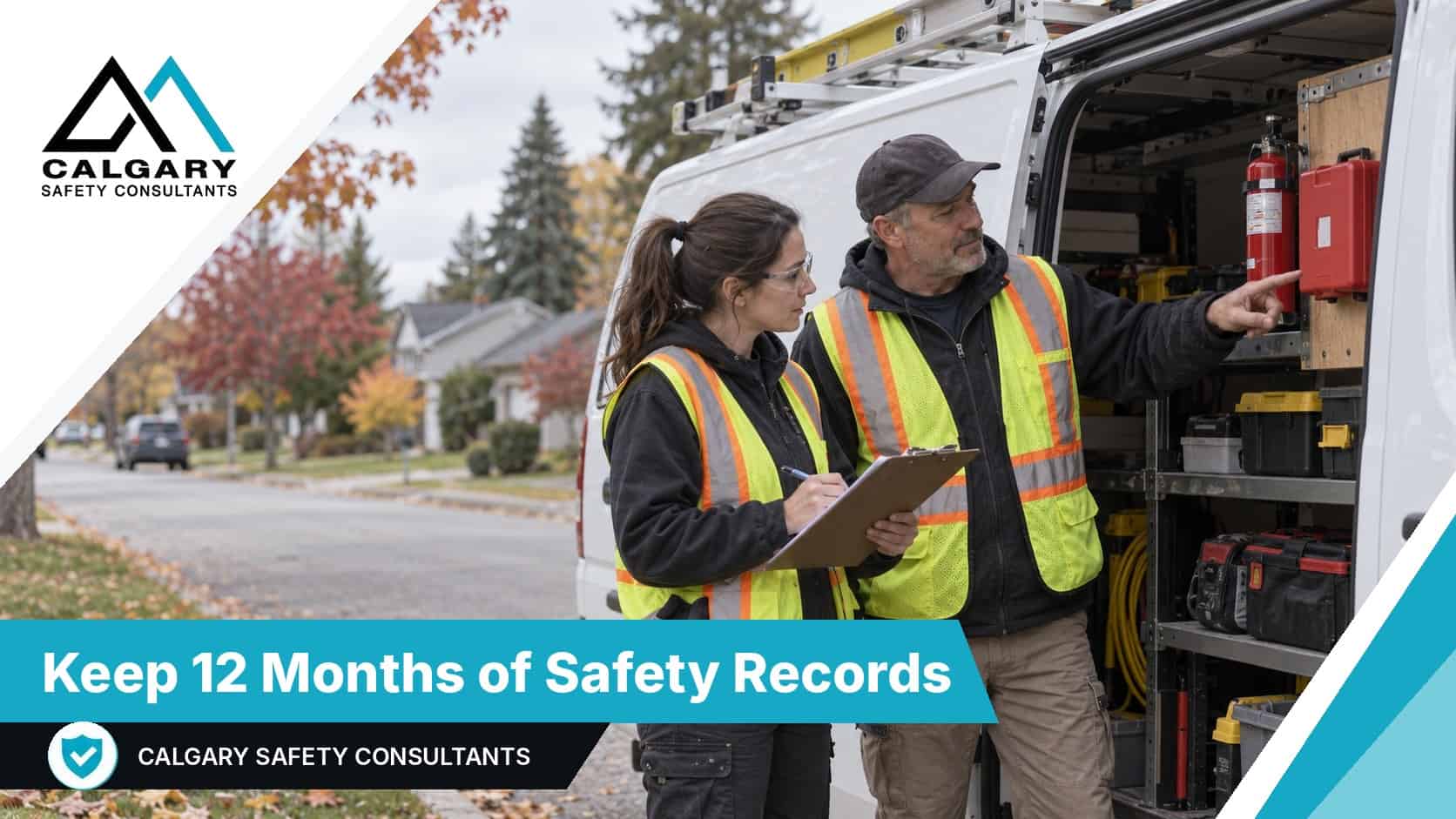
A SECOR evaluation isn't just a check of your written program. It's a check that the program has been working, and records are how you prove it. Most programs expect about 12 months of records for a three-year certificate, and some allow a one-year certificate with as little as three months. Records should be spread across the year, not created in a rush at the end.
Here are the records most SECOR evaluations sample, with how often they're typically kept. Your own program sets the actual frequencies, and the evaluation will check that you met them.
| Record | What to have ready | How often, typically |
|---|---|---|
| Health and safety policy | Signed and dated by the owner, posted and reviewed | Reviewed once a year |
| Formal hazard assessments | One for each job or task, with controls, reviewed when work changes | When work changes, and at least once a year |
| Field-level hazard assessments | Completed and signed by the crew before work starts | Each shift or task |
| Safe work practices and procedures | Written for hazardous tasks, with signatures showing workers reviewed them | Reviewed once a year |
| Workplace inspections | Completed checklists with findings, actions and sign-off | As your program sets, often monthly |
| Equipment and vehicle checks | Pre-use checks and maintenance records | Daily or before use; maintenance as scheduled |
| Orientation and training | Orientation checklists, tickets and training records for each worker | On hire and as training is completed |
| Safety meetings and toolbox talks | Topics, attendance and actions | As your program sets, often weekly or monthly |
| Incident and near-miss reports | Reports, investigations and corrective actions, with close-out | Whenever an incident or near miss occurs |
| Emergency response | Site emergency plans, first aid records and drill records | Plans per site; at least one drill a year |
| Corrective action tracking | Actions from inspections, incidents and audits, with owners and dates | Ongoing |
| Program review and evaluation records | Annual review notes, last SECOR evaluation and action plan | Once a year |
If you already hold a SECOR, keep your last evaluation report, your action plan and your maintenance submissions with these records. Our free 12-month records tracker, below, lets you tick off each record month by month, so gaps show up while there's still time to fix them. Our corrective actions guide explains how to track fixes through to close-out.
How the SECOR Evaluation Works
The evaluation itself follows the same pattern in most programs: gather evidence, score each element against the audit tool, and submit the results to the certifying partner for review. What changes is who gathers the evidence.
- Self-assessment. In Alberta and with Energy Safety Canada, the SECOR evaluation is usually a self-assessment completed by a trained person inside the company and submitted with supporting documents, although both allow a qualified external assessor or auditor instead. The certifying partner reviews it for quality and may ask for corrections.
- Internal auditor. In BC tracks such as go2HR's SECOR and BCCSA's Small COR, a trained internal auditor completes the audit and writes the report.
- External or association audits. Some programs bring in an outside auditor, for example in Manitoba's first year, Saskatchewan's baseline audits and Yukon's certifying audit.
Whoever does it, a SECOR evaluation usually draws on three kinds of evidence. Documents and records show what the program says and what's been done. Interviews show whether the owner, supervisors and workers understand the program and follow it. Observation shows whether the work matches what the documents say. Even in a self-assessment, you're expected to interview your people and look at the work, not just score the binder.
Plan for the timelines, too. Energy Safety Canada, for example, publishes set periods for gathering data, writing the report and making corrections after a revision request. Missing a deadline can delay your certificate, so put the dates in your calendar as soon as you register the evaluation.
If You Already Hold a SECOR
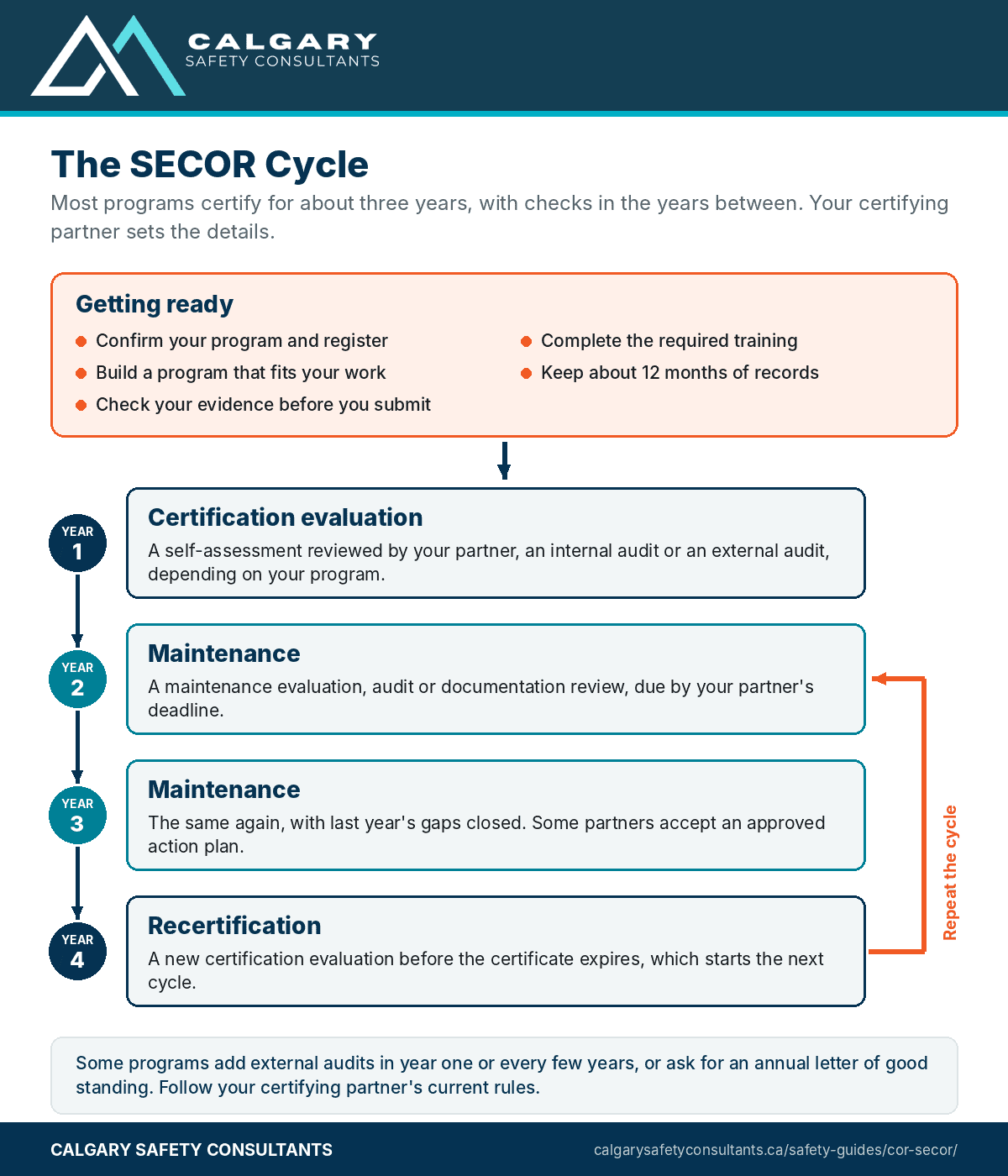
Earning a SECOR is the start of a cycle, not the end of the work. Most programs run on a cycle of about three years. After certification, you complete a maintenance evaluation or audit in each of the years between, and before the certificate expires you complete a recertification. Some programs also ask for an annual letter of good standing.
- Know your dates. Your annual date usually follows the month on your certificate. Missing a maintenance deadline can cost you your SECOR, and some programs decertify employers that miss one.
- Keep the training current. Refresher courses are often due every three years, and the trained person must still work for you.
- Use the findings. Each evaluation will identify gaps. Close them during the year, so the next evaluation shows improvement.
- Watch your head count. If you grow past your program's limit, talk to your certifying partner about moving to a full COR before your next evaluation.
- Look for alternatives. Some partners, such as Energy Safety Canada, allow an approved action plan in place of a maintenance audit in certain years, once a full cycle is complete.
Workers' Compensation Rebates and Incentives
A valid certificate can lower your workers' compensation costs, but the incentives differ widely across Canada and come with conditions, such as filing payroll on time and having no recent penalties.
- Alberta. WCB-Alberta's Partnerships in Injury Reduction program offers refunds of up to 20%. Under the certificate measure, a company earns a 10% industry-rate refund in its first year and 5% in each year it keeps the certificate, and larger refunds are possible through the program's other measures. The Alberta Construction Safety Association states that SECOR holders are eligible. Confirm your own eligibility with WCB-Alberta.
- British Columbia. WorkSafeBC pays an incentive of 10% of base premiums for each certified classification unit, with a minimum incentive of $1,000 or 75% of the premiums paid, whichever is less, which matters for small employers with small premiums.
- Manitoba. Under WCB Manitoba's Prevention Rebate Program policy, eligible SAFE Work Certified employers receive 15% of their premium or $3,000, whichever is greater, capped at 50% of the premium from January 1, 2026.
- Yukon. COR and SECOR holders automatically qualify for a 10% rebate under the Yukon Workers' Safety and Compensation Board's CHOICES program, up to $25,000 a year.
- Elsewhere. Saskatchewan has no rebate tied to COR or SECOR that we could find, although its experience rating rewards a good claims record. In Ontario, Newfoundland and Labrador and Nova Scotia, the incentives are tied to COR or to separate programs, not to a SECOR.
What the Evaluation Looks For
Small employers usually pass or fail on the same few things. The evaluation is checking whether your program is real, and the clearest sign of that is consistency between what you've written, what you've recorded and what your people say.
- Hazard assessments that match the work. If your crew does work that isn't in your hazard assessments, the gap will show up in interviews and observation.
- Records spread across the year. Inspections, meetings and field-level hazard assessments should appear steadily, month after month.
- Workers who know the basics. Every worker should be able to explain the main hazards of their job, how they're controlled, how to report a hazard or incident and what to do in an emergency.
- Follow-through. Problems found in inspections and incidents should have actions, owners, dates and a record of being closed.
- An honest self-assessment. Certifying partners review self-assessments for quality. Scores that aren't backed by evidence are likely to be challenged.
Workplace example
A Practical Workplace Example
Situation: Consider a seven-person electrical contractor in Manitoba, made up of the owner, an office manager and five electricians. A general contractor it had worked with for years told the owner that every subcontractor on its next commercial project would need a COR or SECOR. The company had a safety manual bought online and filled out hazard assessments when a client asked, but nothing was kept up month to month.
Action: The owner registered with the construction safety association, confirmed the company qualified for SECOR at fewer than 10 people, and had herself and her lead electrician take the required courses. They replaced the generic manual with a short program written around their own work: residential service calls, commercial tenant improvements and lift work. They set a simple routine for field-level hazard assessments on every job, a monthly inspection of the shop and vans, and a toolbox talk every second Monday, and they tracked it all on a 12-month calendar. After a year of steady records, they completed the first-year self-audit and prepared for the association and independent audits, including interviews with every electrician.
Result: The audits found minor gaps, such as two vans missing first aid kit checks, which the company fixed within the week. It earned its SECOR in time to prequalify for the project, is on track for WCB Manitoba's prevention rebate once it has kept its certification for the required 12 months, and now runs the same routine all year, so maintenance audits take a few hours instead of a scramble.
Common SECOR Mistakes to Avoid
- Buying a generic manual and stopping there. A manual that doesn't describe your actual work won't survive the interviews.
- Building a year of records in the last month. Evaluations sample across the year, and rushed paperwork is easy to spot.
- Counting heads wrong. Owners, office staff, family members and sometimes subcontractors count, depending on your program.
- Scoring your own evaluation generously. Every point needs evidence, and the certifying partner will check.
- Training someone who then leaves. If the only trained person goes, you may not be able to complete the next evaluation.
- Missing maintenance deadlines. It's an easily avoided way to lose a SECOR.
- Assuming SECOR works everywhere. SECOR is provincial and generally isn't covered by COR reciprocity.
- Treating SECOR as the whole of compliance. Passing the evaluation doesn't cover legal requirements the audit tool doesn't ask about.
Audit perspective
What an Auditor Expects to See
In a small business, an experienced auditor or reviewer can often tell quickly whether the program is real. The documents are short and specific to the work, the records are steady through the year, and the owner and workers describe the same process the documents describe. Hazard assessments mention the tasks the crew actually does, and the last evaluation's action items are closed.
The companies that struggle often have the right paperwork but no rhythm: inspections that stopped in the busy season, field-level hazard assessments signed after the fact, or a self-assessment scored without interviews. Those gaps are much easier to fix a few months before the SECOR evaluation than after it.
Each certifying partner uses its own audit tool, so work from the current version for yours. Calgary Safety Consultants helps small employers build their programs and prepare for SECOR evaluations; we don't issue certificates. CORs and SECORs are issued through the applicable certifying partner.
The Bottom Line
Preparing for a SECOR evaluation comes down to three things: find out exactly which program applies to you, build a short program that fits your real work, and keep a steady year of records that prove it's in use. Because small-employer certification differs so much across Canada, the first conversation with your certifying partner is the most important step you'll take.
Done well, a SECOR opens doors to work, can lower your premiums and makes your business safer. Done at the last minute, it's stressful and fragile. Start early, keep it simple and keep it real.
Download the SECOR Readiness Checklist and Records Tracker
Two free downloads go with this guide.
- SECOR Readiness Checklist (PDF). A checklist with clickable checkboxes that walks you through choosing your program, the training, building your program, the 12 months of records and the evaluation itself.
- 12-Month SECOR Records Tracker (Excel). A month-by-month tracker for the records evaluations sample, with a summary that shows how complete each one is and flags missing months.
- 12-Month SECOR Records Tracker (fillable PDF). The same records on printable pages, with a clickable box for each month, space for your own record types and a monthly review log.
Click a button to download the file. Adapt each one to your certifying partner's audit tool and your own work.

About the author
John Duplessis, B.Sc., CRSP
John Duplessis is a Canadian Registered Safety Professional with more than 30 years of occupational health and safety experience in oil and gas, construction, green energy, midstream operations and industrial project work. He is an external auditor with Energy Safety Canada.