
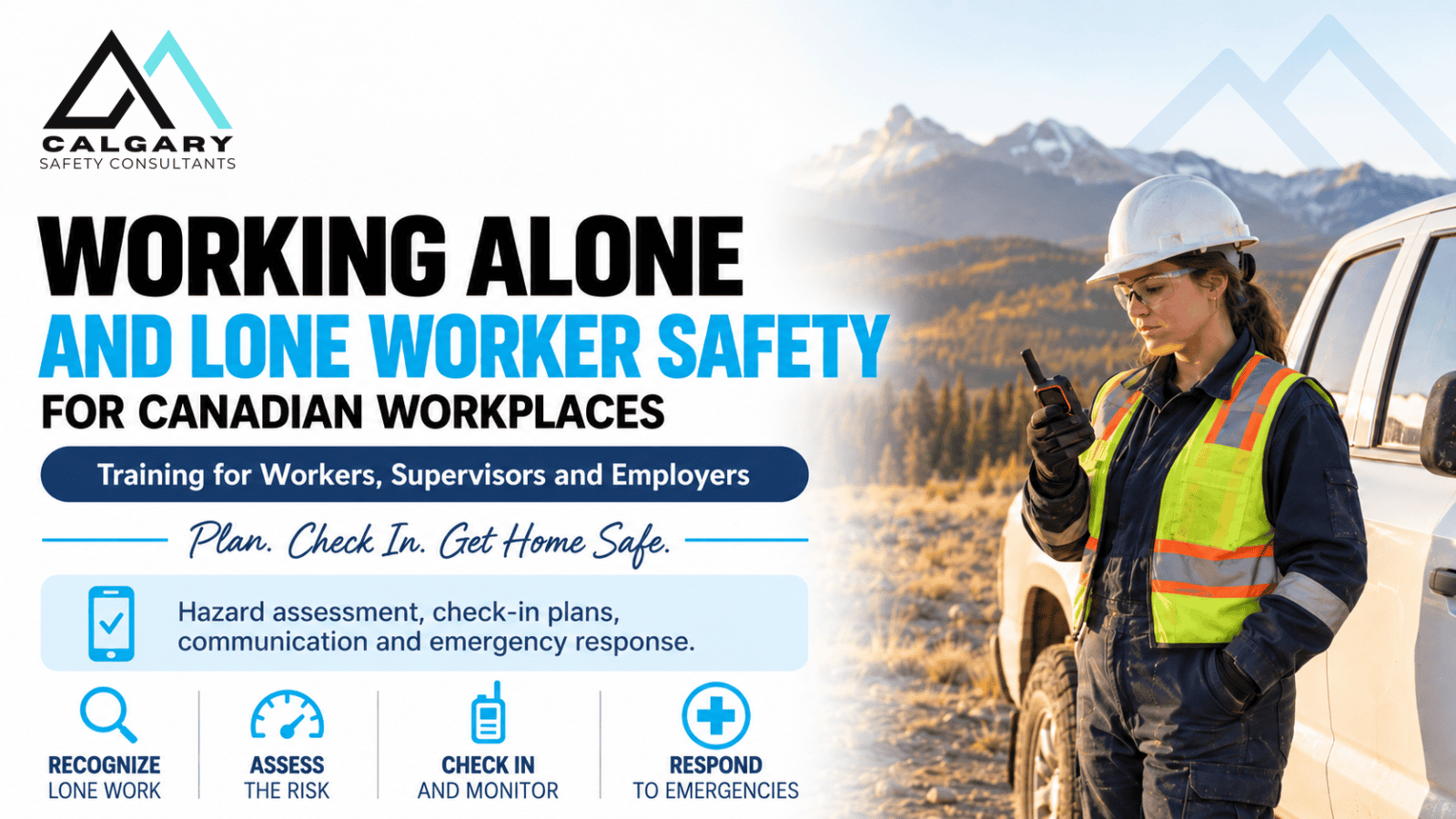
Working Alone and Lone Worker Safety for Canadian Workplaces
Once you have registered and enrolled, scroll to the Course Content section at the end of this page to begin your lessons.
Our online working alone training shows Canadian workers, supervisors and employers how to recognize lone work, assess the hazards, put practical controls in place, and make sure help arrives when something goes wrong. This self-paced online course covers what working alone means under Canadian law, lone-worker hazard and risk assessment, deciding whether work may be done alone, communication equipment, check-in plans, missed check-ins and emergency response, personal security on home visits, remote and vehicle-based work, after-hours facility work and stop-work decisions, using realistic examples from oil and gas, construction, utilities, health care, retail, agriculture and more.
Need training for your team? For online group training, buy your enrolments here, then complete our Group Training Student Information form so we can set up each worker’s account. For live virtual or onsite group sessions built around your own procedure, see our working alone training page. If you’d like help assessing lone work or building your working-alone procedure, see our hazard assessments, JHAs and workplace inspections consulting services.
Learn more about how our online safety training works.
Most lone-work emergencies start with something ordinary, like a slip, a fall or a medical event. What turns them serious is the wait for help. A good lone-worker plan closes that gap, and it also helps your organization with claims, audits and the confidence that every worker who heads out alone gets home safe. This course gives workers and supervisors a shared, practical way to plan, check in and respond.
This is foundation-level (awareness) training. It supports, but doesn’t replace, your employer’s workplace-specific hazard assessment, lone-worker procedure, emergency response plan and task-specific training. It doesn’t qualify or authorize anyone for high-risk work such as confined space entry, fall rescue, energized electrical work or hot work.
Online Working Alone Training Course at a Glance
Delivery: 100% online and self-paced
Course format: 16 narrated video lessons in four modules, with written lesson notes, workplace examples and knowledge checks
Course length (estimated): About 3.5 to 4 hours, including just over 3 hours of lesson video plus the knowledge checks
Assessment: A three-question knowledge check after every lesson (100% to continue)
Resources: Downloadable Student Reference Guide, available after purchase
Certificate: Certificate of Completion issued after you finish all required course steps
Price: $34.99 CAD plus GST
Level: Foundation (awareness)
Audience: Workers who work alone, supervisors, contact persons, dispatchers and employers across Canada
Workplace training: Your employer’s site-specific instruction is still required
What Does Online Working Alone Training Cover?
This online working alone training follows the full lone-work cycle: recognize the lone work, assess the hazards, decide whether the work may be done alone, plan the controls and check-ins, respond when something goes wrong, and keep improving the plan. Each lesson connects the method to decisions you make on the job.
You’ll learn how to:
- Recognize when a worker is working alone or in isolation, including lone work that’s easy to miss inside busy buildings.
- Explain why delayed help makes ordinary incidents more serious, and what multiplies that risk.
- Describe what employers, supervisors, contact persons and workers each need to do.
- Find the working-alone requirements that apply in any of Canada’s 14 jurisdictions.
- Use the 12 CSC Energy Sources and working-alone factors to identify lone-work hazards, then assess and record the risk.
- Decide whether lone work is acceptable, needs stronger controls or shouldn’t go ahead, and set stop-work limits in advance.
- Choose communication equipment that works where you are, and build risk-based check-in plans with a backup.
- Follow a defined response when a check-in is missed, and apply personal security controls on home and community visits.
- Plan remote, vehicle-based and after-hours facility work, and use a pre-work check before every shift alone.
Every lesson includes written notes, a real-world example, a decision point and a knowledge check, so learners practise applying the plan rather than memorizing rules.
Working Alone Training for Canadian Workplaces
Working-alone rules aren’t the same everywhere in Canada. There are 14 OHS jurisdictions: the federal government, 10 provinces and 3 territories. Nine have dedicated working-alone rules: British Columbia, Alberta, Saskatchewan, Manitoba, New Brunswick, Prince Edward Island, Newfoundland and Labrador, the Northwest Territories and Nunavut. Quebec has a narrower surveillance rule, while the federal government, Ontario, Nova Scotia and Yukon rely on the employer’s general duty and related requirements such as workplace violence programs. In Yukon, that general duty includes making efforts to check on workers who might not be able to get help. Alberta’s OHS Code goes furthest in its wording, stating that working alone is considered a hazard.
Provincially regulated work generally follows the law where the work is done, while federally regulated employers, such as interprovincial trucking, airlines, banks and telecommunications, follow the Canada Labour Code, Part II, wherever they operate. This course teaches the common expectations that apply everywhere, and it uses legal examples checked against official sources in October 2026 to show how the rules differ. The course doesn’t determine whether a particular employer complies with the law, and it isn’t approved or recognized by any regulator.
Who Should Take This Working Alone Course?
This course is built for anyone who works alone, supervises lone workers or keeps track of them, whether that’s a technician heading to a remote site or a dispatcher watching the check-in board.
It’s suitable for:
- Workers who work alone or in isolation, including new, young, contract and temporary workers
- Supervisors, forepersons and crew leads who assign or approve lone work
- Contact persons, dispatchers and monitoring staff who receive check-ins
- Safety coordinators, managers and business owners who run the lone-worker program
- Joint health and safety committee members and health and safety representatives
Lessons are written for a mixed audience. Some sections speak directly to employers and supervisors, such as testing the plan or handling a shift handover, while every lesson explains what workers should do on the job. Employers often use the course for orientation, for supervisor and dispatcher training, or as a common starting point before rolling out a new working-alone procedure.
Online Working Alone Training Course Features
Our online working alone training is designed to be practical and easy to follow.
Course features include:
- 100% online and self-paced learning
- 16 narrated video lessons, each about 11 to 14 minutes long
- Written lesson notes with learning objectives, examples, decision points and key takeaways
- Downloadable Student Reference Guide with lesson summaries, key points, reflection questions and space for notes
- Realistic examples from many Canadian industries and regions
- A three-question knowledge check after every lesson, with feedback after each answer
- Certificate of Completion after you finish all required course steps
- Progress tracking through your training account
The course focuses on what to do, not just what the law says: how to tell whether help is readily available, how to set a check-in interval, what a good check-in sounds like, and when to stop the work and get direction.
Online Working Alone Training Course Modules
The course is organized into four modules of four lessons each. Each lesson is one complete narrated video with written notes and a knowledge check.
Module One: Understanding Working Alone
The first module explains what working alone means, why it changes risk, who is responsible for what, and how the rules differ across Canada.
Lessons:
- Lesson One: What Working Alone Means
- Lesson Two: Why Working Alone Changes Risk
- Lesson Three: Responsibilities of Employers, Supervisors and Workers
- Lesson Four: Canadian Legal Context and Workplace Rules
By the end of this module, learners can recognize lone work and explain the duties that apply to it.
Module Two: Identifying and Assessing Lone-Work Hazards
The second module turns lone work into an assessment and a decision.
Lessons:
- Lesson Five: Recognizing Lone Worker Hazards
- Lesson Six: Assessing Lone Worker Risk
- Lesson Seven: Deciding Whether Work May Be Done Alone
- Lesson Eight: Selecting and Planning Controls
Learners use the 12 CSC Energy Sources, rate the risk with delayed help in mind, and choose controls with the hierarchy of controls.
Module Three: Communication, Monitoring and Response Systems
The third module covers the systems that get help to a lone worker in time.
Lessons:
- Lesson Nine: Communication Methods and Equipment
- Lesson Ten: Check-In Plans and Monitoring
- Lesson Eleven: Emergency Response and Missed Check-Ins
- Lesson Twelve: Violence, Personal Security and Home Visits
Learners build a check-in plan, practise the missed check-in response, and plan safe home and community visits.
Module Four: Applying Lone Worker Safety
The final module puts the plan to work in the settings where lone work happens most.
Lessons:
- Lesson Thirteen: Remote, Mobile and Vehicle-Based Work
- Lesson Fourteen: After-Hours and Facility-Based Work
- Lesson Fifteen: High-Risk Tasks and Stop-Work Decisions
- Lesson Sixteen: Applying the Plan and Workplace Action
Learners finish with a pre-work check they can run before every shift alone.
Complete Your Online Working Alone Training
Register online, then work through the lessons in order at your own pace. After each video, complete the lesson’s three-question knowledge check. You need all three answers correct (100%) to move on, and you can retry the knowledge check as many times as you need, with feedback after each answer to help you learn.
There’s no separate final exam. Once you’ve completed all 16 lessons and knowledge checks, and any other required course steps, you can download your Certificate of Completion.
The certificate shows that you completed awareness-level online training. It isn’t a qualification or authorization for high-risk work, and employers should pair it with instruction on their own lone-work hazards, procedures, communication equipment and emergency response plans.
Frequently Asked Questions About Online Working Alone Training
Is this working alone training valid across Canada?
The course teaches lone-worker safety principles that apply in every Canadian jurisdiction, and it shows how working-alone requirements differ across federal, provincial and territorial workplaces. It isn’t approved by any regulator, and it doesn’t replace the workplace-specific training your employer must provide under the law that applies to your work.
Do I receive a working alone training certificate?
Yes. You receive a Certificate of Completion after you complete all 16 lessons and their knowledge checks. It records completion of awareness-level online training; it doesn’t certify or qualify you for high-risk work.
How long does the online working alone course take?
We estimate about 3.5 to 4 hours. The 16 lesson videos run just over 3 hours in total, and the knowledge checks add time depending on your pace. You can stop and return at any time.
Who should take working alone training?
Workers who work alone or in isolation, supervisors who assign lone work, contact persons and dispatchers who monitor check-ins, and the managers, owners and joint health and safety committee members who build and review the lone-worker program.
Does the course cover check-in procedures and missed check-ins?
Yes. Module Three teaches how to choose communication equipment, set risk-based check-in intervals, keep monitoring active, and follow a defined escalation when a check-in is missed. Your employer’s own procedure sets the actual intervals and contacts, and the same method applies.
Is there a final exam?
No. Each lesson ends with a three-question knowledge check that you need to pass at 100% before moving on, with feedback after each answer and unlimited retries. There’s no separate final exam.
Can employers purchase training for multiple workers?
Yes. Employers can buy online training for two or more workers on this page. After placing your order, complete our Group Training Student Information form with your order number and each learner’s name and email address. We set up each learner’s account and email course-access instructions within 24 hours of receiving complete information. Buying 10 or more seats of this course in one order? A 10% group discount is applied automatically at checkout.
Does online working alone training replace workplace-specific training?
No. This course gives a common foundation. Workers still need instruction on their own workplace’s lone-work hazards, procedures, communication equipment and emergency response, plus any practical training and competency verification their tasks require.
Additional Working Alone and Lone Worker Safety Resources
The resources below help you apply what you learn to your own workplace. Use them to check the working-alone requirements where you work, to compare your procedure with regulator guidance, and to get help when your lone-worker program needs more than a refresher. Always check the law for your own jurisdiction, since requirements differ across Canada.
Alberta OHS Code, Part 28: Working Alone
Issued by: Government of Alberta
Sets out Alberta’s working-alone requirements, including that working alone is considered a hazard for hazard assessment and that workers need effective communication or regular contact. Use it when you work in Alberta or want a detailed example of working-alone law.
Alberta OHS Code, Part 28: Working Alone
OHS Regulation, Part 4: Working Alone or in Isolation
Issued by: WorkSafeBC
Sections 4.20.1 to 4.23 define working alone and cover hazard identification and control, procedures for checking a worker’s well-being, training, late-night retail safety, mandatory fuel prepayment and annual reviews. Use it for work in British Columbia.
OHS Regulation, Part 4: Working Alone or in Isolation
Workers Working Alone at a Work Place Under the Control of the Employer (IPG-059)
Issued by: Employment and Social Development Canada
Explains how the Canada Labour Code, Part II, applies to employees who work alone. Use it if your employer is federally regulated, such as interprovincial trucking, airlines, banks or telecommunications.
Workers Working Alone at a Work Place Under the Control of the Employer (IPG-059)
Hazard Assessments, JHAs and Workplace Inspections
Issued by: Calgary Safety Consultants
Our consulting support for assessing lone work and building or reviewing your working-alone procedure. Use it when your assessment, check-in plan or audit findings need hands-on help.
Hazard Assessments, JHAs and Workplace Inspections
Hazard Assessment and Control for Canadian Workplaces
Issued by: Calgary Safety Consultants
A companion online course on finding hazards, rating risk and choosing controls, including JHAs, FLHAs and toolbox talks. Take it next if you lead or take part in hazard assessments.
Hazard Assessment and Control for Canadian Workplaces
Related courses: Respectful Workplace Training – Worker Edition, Incident Reporting and Investigation Training and OH&S Online Leadership Training.