How to Create an Emergency Response Plan
How to identify the emergencies your workplace could face and write a plan people can follow, with clear roles, procedures and contacts.
Coming soon
Practical guides to workplace emergency management: how to plan for the emergencies you could face, practise your response and meet first aid requirements. Written for employers, supervisors and safety committees anywhere in Canada.
Prepared by Calgary Safety Consultants, led by John Duplessis, B.Sc., CRSP.
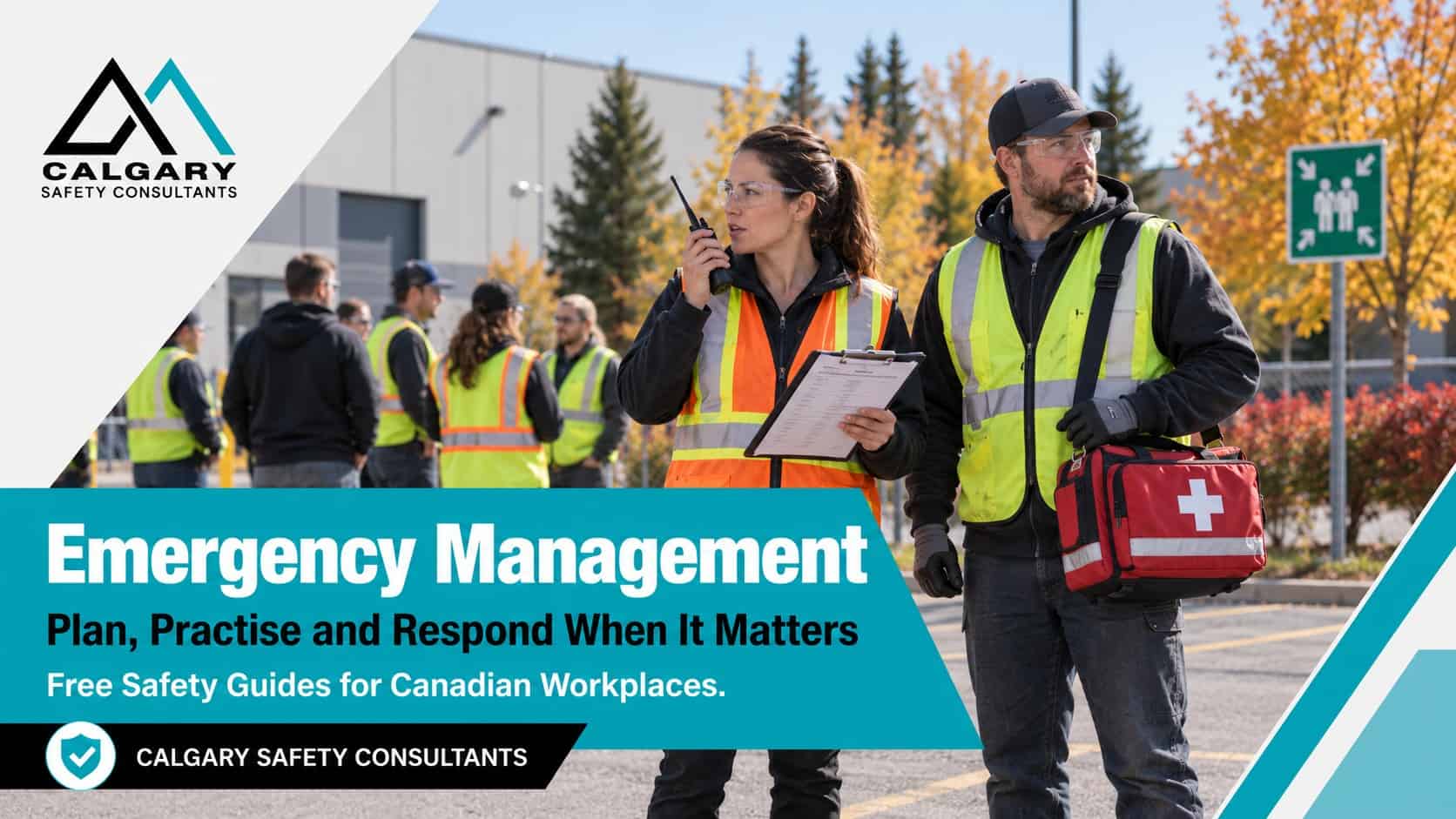
Emergency management guides
Every guide in this category explains how a part of emergency management is done well, with the legal requirements linked at the point they matter and free downloads you can adapt. Guides marked coming soon open here as they're published.
How to identify the emergencies your workplace could face and write a plan people can follow, with clear roles, procedures and contacts.
Coming soonHow to plan, run and debrief drills and tabletop exercises that test your plan and show you exactly what to fix.
Coming soonHow to work out the first aiders, kits and transport your workplace needs, based on its hazards, size and distance from care.
Coming soonHow to plan rescue, first aid and evacuation where help is far away, from rescue at height to long transport times.
Coming soonAbout emergency management
Emergency management is how a workplace prepares for, responds to and recovers from events that put people at immediate risk, such as fires, serious injuries, chemical releases, severe weather and violent incidents.
It covers far more than an evacuation map on the wall. Good emergency management starts with knowing which emergencies are realistic for your work and your sites, then sets out who does what, with what equipment, and how everyone will be accounted for. First aid is part of it, because what happens in the first minutes after a serious injury matters.
Emergency planners often describe four phases: prevention and mitigation, preparedness, response and recovery. CSA Z1600, the Canadian standard for emergency and continuity management programs, is built around the same idea. For most workplaces, the focus is practical: a written emergency response plan, trained people, the right first aid coverage and drills that show whether it all works.
Preparedness is often thinner than people think. In a 2024 Statistics Canada survey, 14.1% of businesses said they'd been affected by a natural disaster or weather emergency, and only 22.5% of those described themselves as fully prepared. Rural businesses were less likely to be fully prepared than urban ones.
Strong emergency management protects people first, but it also limits damage, downtime and the cost of getting back to work. It's also something clients, insurers, auditors and OHS officers all expect to see, and a plan that has clearly been practised tells them a lot about how seriously a business takes safety.
Practice is what makes plans work. A scoping review of 86 studies on health emergency preparedness exercises, published in the International Journal of Disaster Risk Reduction, found that exercises improved knowledge, competence and confidence and exposed gaps in plans, although long-term evidence was limited. Research on the World Trade Center evacuation found that preparedness training and worksite planning affected how well people got out.
How it works
Emergency management at work follows the same five steps, whatever the size of the business or the risks it faces.
List the emergencies that could realistically happen at each site: fire, serious injury, chemical release, severe weather, power failure, violence, and work-specific events such as a fall from height, a confined space rescue or a vehicle rollover. Factor in how far you are from emergency services.
Set out the procedure for each emergency, alarms and communication, evacuation routes and muster points, who's in charge, rescue arrangements, first aid and how you'll account for everyone, including visitors and contractors. Involve the workers affected as you write it.
Put the right first aid kits and attendants, fire protection and rescue equipment in place. Train every worker on the plan, with extra training for wardens, first aiders and anyone with a rescue role.
Run drills and tabletop exercises on a schedule and after changes. Vary the scenarios, include every shift and record what happened, how long it took and what didn't go to plan.
Debrief after every drill and every real event, fix the gaps you find, and update the plan when people, equipment, sites or the work change. Keep contact lists and role assignments current.
The same principles show up internationally. The US Occupational Safety and Health Administration's guide to emergency action plans recommends practice drills as often as necessary, an evaluation after each one, and a way to account for non-employees such as suppliers and customers. Public Safety Canada's emergency management planning guide makes the same point about exercises: they reveal planning weaknesses and gaps in resources, and they should end with an after-action report.
WorkSafeBC's emergency planning guidance puts it simply for employers: consult your workers, and conduct drills at least once a year or whenever workplace circumstances change.
What the law expects
Every Canadian jurisdiction expects employers to plan for emergencies and provide first aid, but the details, from plan contents to drill frequency and first aid coverage, vary.
Alberta's OHS Code, Part 7 requires an emergency response plan wherever an emergency may need rescue or evacuation, developed with the affected workers and kept current. The plan must cover potential emergencies and their procedures, emergency equipment, training, alarms and communication, first aid, rescue and evacuation, and designated rescue and evacuation workers, who must be trained through exercises that simulate the site's emergencies. The province's emergency response planning tool kit explains how to build a plan and describes four kinds of drills, including tabletop exercises.
British Columbia's OHS Regulation, Part 4 requires a risk assessment wherever rescue or evacuation may be needed, written procedures where a need is found, and emergency drills at least once a year, with a record kept. BC's first aid rules changed on November 1, 2024: employers now complete a written first aid assessment, review it within 12 months and hold first aid drills at least yearly.
Saskatchewan's OHS Regulations, 2020 require health and safety programs to include emergency response procedures and resources, and set first aid requirements based on hazards, workers and distance. WorkSafe Saskatchewan recommends annual fire drills and a plan review at least every three years. Federally regulated employers must prepare emergency procedures, have an evacuation plan where more than 50 employees are in a building and hold an evacuation drill at least once a year.
| Jurisdiction | Emergency plan | Drills and first aid |
|---|---|---|
| Alberta | An emergency response plan wherever an emergency may need rescue or evacuation, developed with affected workers and kept current. | Rescue and evacuation workers train through simulated exercises as often as needed. First aid is based on hazard level, workers per shift and distance to a health care facility. |
| British Columbia | A risk assessment, with written procedures where rescue or evacuation may be needed and always for work such as confined spaces and high-angle work. | Emergency drills at least yearly, with a record. A written first aid assessment, reviewed within 12 months, and yearly first aid drills. |
| Saskatchewan | Emergency procedures and resources form part of the health and safety program, which is reviewed at least every three years. | A first aid risk assessment by a competent person. The first aid register is kept for five years. |
| Federal | Emergency procedures for every employer, plus an evacuation plan where more than 50 employees are in a building. | An evacuation drill at least yearly and after changes, with records kept for two years. A first aid attendant wherever six or more employees work. |
Fire codes, municipal bylaws and industry rules can add requirements of their own, such as annual fire drills in many buildings. Because the details differ, start by confirming which law applies to your workplace. Our OHS Legislation category links the Act, regulations and regulator for all 14 jurisdictions in Canada, and explains how to read them.
From our audits
Most of the emergency plans we review look complete on paper. The problems show up when someone asks how the plan would actually work on a bad day.
Each of these is fixable once you see it. The guides on this page show what good emergency management looks like, so you can compare it with your own plan today.
Free downloads
Use these free tools to start or tidy up your emergency planning, then adapt them to your sites, your emergencies and the law that applies to you.
From the blog
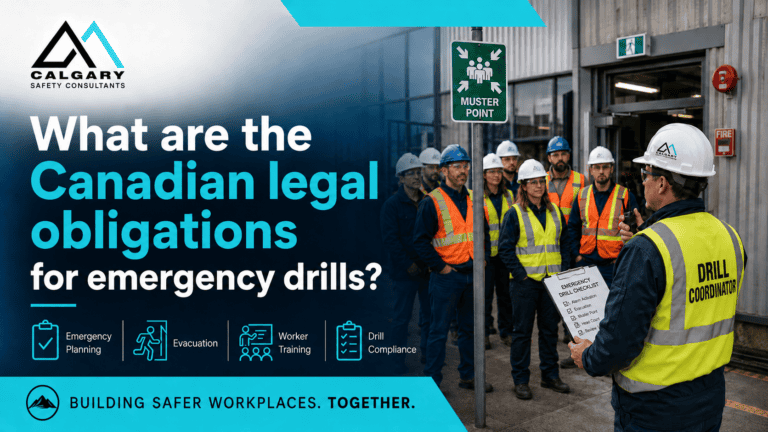
June 18, 2026
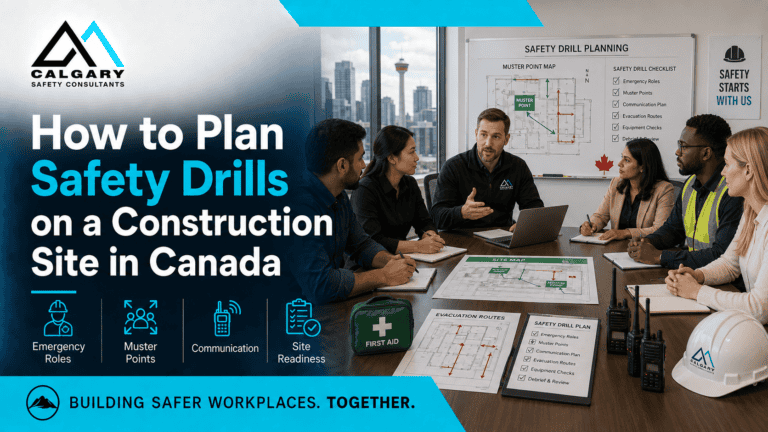
June 8, 2026
January 22, 2026
October 14, 2025
When to bring in help
The guides are written so you can act on them yourself. Sometimes it helps to have an experienced safety professional look at your situation, especially when you're opening a new site, an audit is coming up or a drill has shown that the plan doesn't hold together.
Calgary Safety Consultants helps employers build emergency management that works on a bad day. We write emergency response plans around your real sites and emergencies, complete first aid assessments, plan and facilitate drills and tabletop exercises, and review existing plans before an audit. Our consulting focuses on Alberta, British Columbia and Saskatchewan, and our online training and free downloads are available anywhere in Canada.
We help employers prepare for COR and SECOR audits, but we don't issue certificates. CORs and SECORs are issued through the applicable certifying partner.
Common questions
Answers to the questions employers, supervisors and committee members ask most often about emergency planning, drills and first aid.
Emergency management is how a workplace prepares for, responds to and recovers from events that put people at immediate risk, such as fires, serious injuries, chemical releases and severe weather. In practice, it means knowing your realistic emergencies, having a written plan, trained people and the right equipment, and practising regularly so the plan works when it's needed.
In most cases, yes. Alberta requires an emergency response plan wherever an emergency may need rescue or evacuation, British Columbia requires written procedures where a risk assessment shows a need, Saskatchewan builds emergency procedures into the health and safety program, and every federally regulated employer must prepare emergency procedures. Check the legislation for your own province or territory.
At minimum: the emergencies you could realistically face and the procedure for each, alarms and communication, evacuation routes and muster points, roles and who's in charge, rescue arrangements, first aid, emergency equipment and how to use it, and how you'll account for everyone. Alberta's OHS Code lists the required contents, and it makes a useful checklist even outside Alberta.
At least once a year, and more often for higher-risk sites or after changes. British Columbia requires emergency drills at least yearly with a record kept, and federally regulated employers must hold an evacuation drill at least once a year. Alberta requires rescue and evacuation workers to practise as often as needed to stay competent. Vary the scenarios and include every shift.
A drill puts the plan into action, with people moving, alarms sounding and equipment being used. A tabletop exercise is a discussion-based session where the team talks through a scenario step by step to test decisions and procedures. Tabletops suit scenarios that would be unsafe or disruptive to drill live, and they cost little to run. Most workplaces benefit from both.
It depends on your jurisdiction, your hazards, how many workers are on each shift and how far you are from medical care. Alberta's OHS Code and British Columbia's first aid schedule set requirements based on those factors, and federally regulated workplaces need a first aid attendant wherever six or more employees work. A written first aid assessment is the best way to work out what you need.
Most jurisdictions now point to a standard. Alberta and Saskatchewan require kits that meet CSA Z1220-17, which sets out personal, basic and intermediate kits, while British Columbia uses the CSA standard plus some BC-specific items. Federally regulated workplaces use the kit types set out in their regulations. Choose kits based on your first aid assessment, and check them regularly.
Plan for the extra time it takes help to reach you. Distance thresholds matter: Alberta classes a work site as isolated when it's 40 minutes or more from a health care facility, and British Columbia treats a workplace as remote when an ambulance is more than 30 minutes away. Remote sites often need more first aid capability, reliable communication and a planned way to transport injured workers.
Working alone needs its own plan. Alberta requires an effective communication system with regular contact, and British Columbia requires a written check-in procedure with set intervals, an end-of-shift check and steps to follow if the worker can't be reached. Build these procedures into your emergency plan, so a missed check-in triggers a response rather than a shrug.
An emergency response plan focuses on protecting people during an emergency: alarms, evacuation, rescue and first aid. A business continuity plan focuses on keeping or restoring critical operations afterward. CSA Z1600 brings emergency and continuity management together in one program. Most small and mid-sized employers start with a solid emergency response plan, then add continuity planning as they grow.
Your plan should account for everyone on site, not just your own workers. Visitors and contractors need to know the alarms, routes and muster points, and someone needs to account for them in a headcount. In British Columbia, a prime contractor's first aid assessment covers all workers at the site, and federal evacuation plans are prepared in consultation with other employers in the building.
Review it at least once a year, after every drill or real emergency, and whenever people, equipment, sites or the work change. Some laws set the pace: British Columbia requires first aid assessments to be reviewed within 12 months, Saskatchewan requires the health and safety program to be reviewed at least every three years, and Alberta requires the plan to be kept current.
Emergency preparedness is one of the areas a COR audit examines. Auditors look for identified emergencies, written plans, trained workers, drills with records and evidence that the results were used to improve the plan, along with first aid that meets the requirements. We help employers prepare, but we don't issue certificates. CORs and SECORs are issued through the applicable certifying partner.
Yes. We write emergency response plans around your real sites and emergencies, complete first aid assessments, plan and facilitate drills and tabletop exercises, and review existing plans before an audit. Our consulting focuses on Alberta, British Columbia and Saskatchewan, while our guides, free downloads and online training are available anywhere in Canada. Book a free consultation to talk it through.
Talk to a safety consultant
Whether you're starting a plan from scratch, updating an old one or planning your next drill, we'll help you work out the next practical step. Complete the form below or book a 30-minute consultation.